| (19) |
 |
|
(11) |
EP 0 059 558 B2 |
| (12) |
NEW EUROPEAN PATENT SPECIFICATION |
| (45) |
Date of publication and mentionof the opposition decision: |
|
15.09.1993 Bulletin 1993/37 |
| (45) |
Mention of the grant of the patent: |
|
29.07.1987 Bulletin 1987/31 |
| (22) |
Date of filing: 17.02.1982 |
|
|
| (54) |
Improvements in or relating to relief valves for sanitation systems or the like
Unterdruckventil für sanitäre Anlagen
Vanne de sous pression pour systèmes sanitaires
|
| (84) |
Designated Contracting States: |
|
AT BE CH DE FR GB IT LI LU NL SE |
| (30) |
Priority: |
21.02.1981 GB 8105546
22.04.1981 GB 8112503
|
| (43) |
Date of publication of application: |
|
08.09.1982 Bulletin 1982/36 |
| (73) |
Proprietor: McALPINE & COMPANY LIMITED |
|
Hillington
Glasgow G52 4LF Scotland (GB) |
|
| (72) |
Inventor: |
|
- McAlpine, James Edward
Hillington
Glasgow G52 4LF
Scotland (GB)
|
| (74) |
Representative: McCallum, William Potter et al |
|
MARKS & CLERK
19 Royal Exchange Square
Glasgow G1 3AE
Scotland
Glasgow G1 3AE
Scotland (GB) |
| (56) |
References cited: :
DE-B- 1 021 218
FR-A- 2 247 656
GB-A- 2 029 937
US-A- 3 403 696
US-A- 3 973 588
|
DE-C- 149 665
FR-A- 2 299 016
US-A- 2 216 808
US-A- 3 605 132
|
|
| |
|
|
|
|
| |
|
[0001] This invention relates to relief valves for sanitation systems or the like.
[0002] Such valves have previously been proposed for the purpose of admitting air into a
pipe in response to a reduction in pressure in the pipe. Examples of such valves are
described, for example, in British Patent No. 1433446 as well as in British Patent
No. 2,029,937. Both British Patent No. 1433446 and British Patent No. 2,029,937 disclose
arrangements in which a valve chamber communicates with a pipe through an annular
inlet defined by inner and outer concentric valve seats. The annular inlet opening
is closeable by an elastomeric valve element having holes therethrough and extending
across the inlet to engage both valve seats. The valve element is normally biased
into engagement with the inner and outer concentric valve seats to assist in preventing
inflow of air from the inlet opening into the valve chamber. If there is a pressure
reduction within the pipe, then the valve element is displaced from the concentric
valve seats to permit air to pass from the exterior of the reliefvalve into the valve
chamber to eliminate the partial vacuum.
[0003] Such relief valves have particular application in sanitation waste pipe systems or
in pipe systems associated with siphonic waste traps.
[0004] Such previously proposed valves, however, are of relatively complex construction
and it is frequently difficult with inner and outer concentric seats, to achieve an
adequate seal over an extended period of time. This is because, during use, the elastomeric
valve element tends to become distorted and a satisfactory seal is not achieved.
[0005] An object of the present invention is to provide an improved construction of relief
valve which only requires a single seat for an elastomeric valve element and which
will consequently retain its sealing efficiency over an extended period.
[0006] According to the present invention there is provided a negative pressure relief valve
for admitting air into a system in response to a pressure reduction therein so as
to relieve said pressure reduction comprising a valve body (3,21) defining a valve
chamber (5,22) therein; an air inlet (9,10 and 26) interconnecting the valve chamber
(5,22) and the exterior of the valve body (3,21) and defining a continuous valve seat
(11,25) within the valve chamber (5,22); at least one aperture (8,24) connected to
the valve chamber (5,22); a flexible, substantially air impermeable valve element
(12) normally disposed in engagement with the continuous valve seat (11,25) to prevent
inflow of air to the valve chamber (5,22) through the air inlet (9,10 and 26); a valve
element support member (15) carrying the valve element (12); guide means (16,17) for
assisting the valve element (12) into effective sealing engagement with the valve
seat (11,25) when the pressure drop in the system has been relieved, the aperture
(8,24) being adapted to interconnect the valve chamber (5,22) with the system into
which the valve is to be fitted and the valve being adapted to admit air into the
system via sequentially the air inlet (9,10 and 26), the valve chamber (5,22) and
then the aperture (8,24) so as to relieve a pressure drop in the system;
characterised in that the valve element (12) is freely flexible at its area of engagement
with the valve seat (11,25) and the valve element support member (15), during sealing
engagement of the valve element (12) with the valve seat (11,25), extends over the
area of engagement of the valve element (12) with the valve seat (11,25) but is spaced
therefrom to permit free flexibility of the valve element (12).
[0007] Embodiments of the present invention will now be described, by way of example, with
reference to the accompanying drawings, in which:-
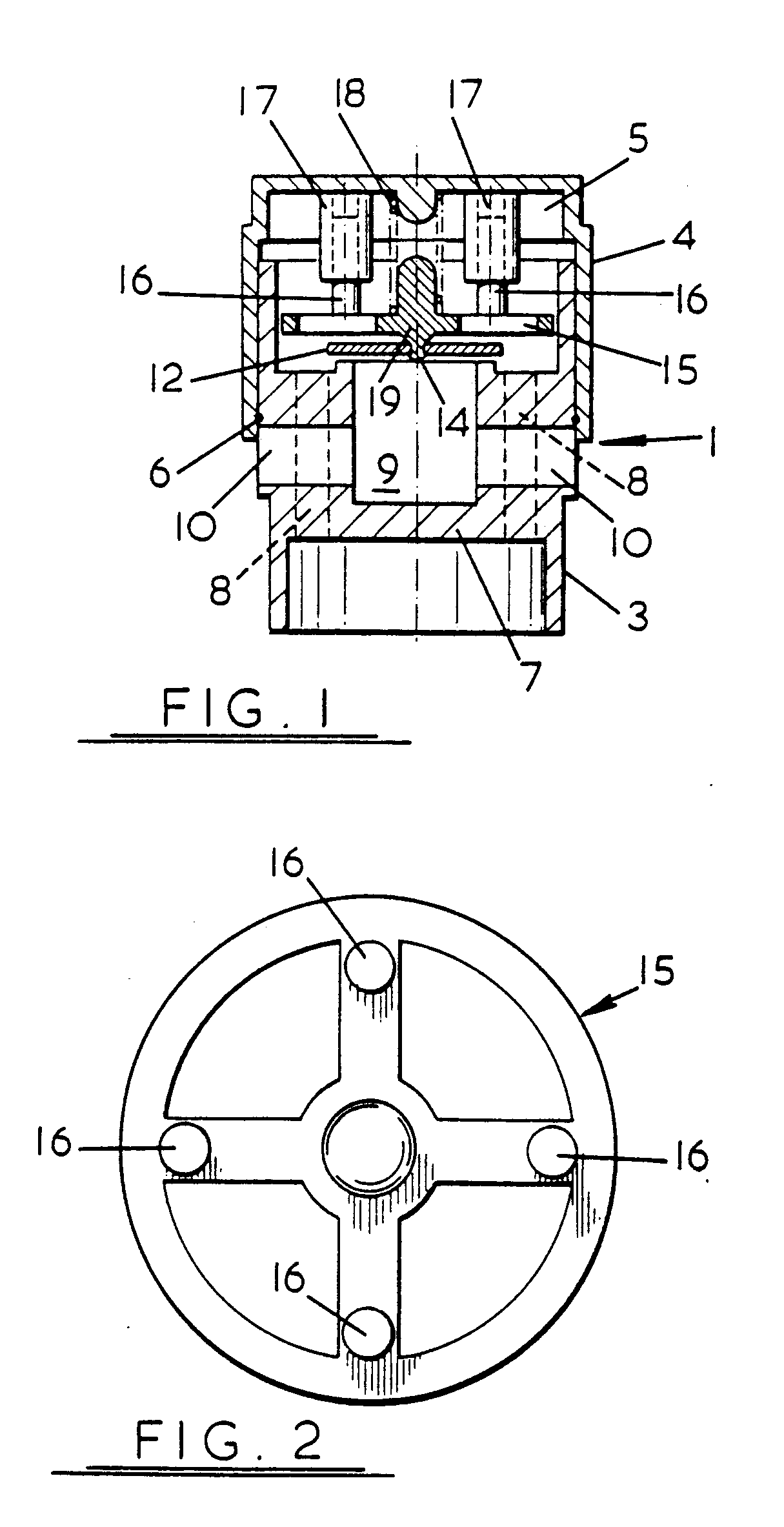
Fig. 1 is a vertical sectional view of a first embodiment of relief valve according
to the invention;
Fig. 2 is a plan view from above of a valve element support for the valve element
in Fig. 1.
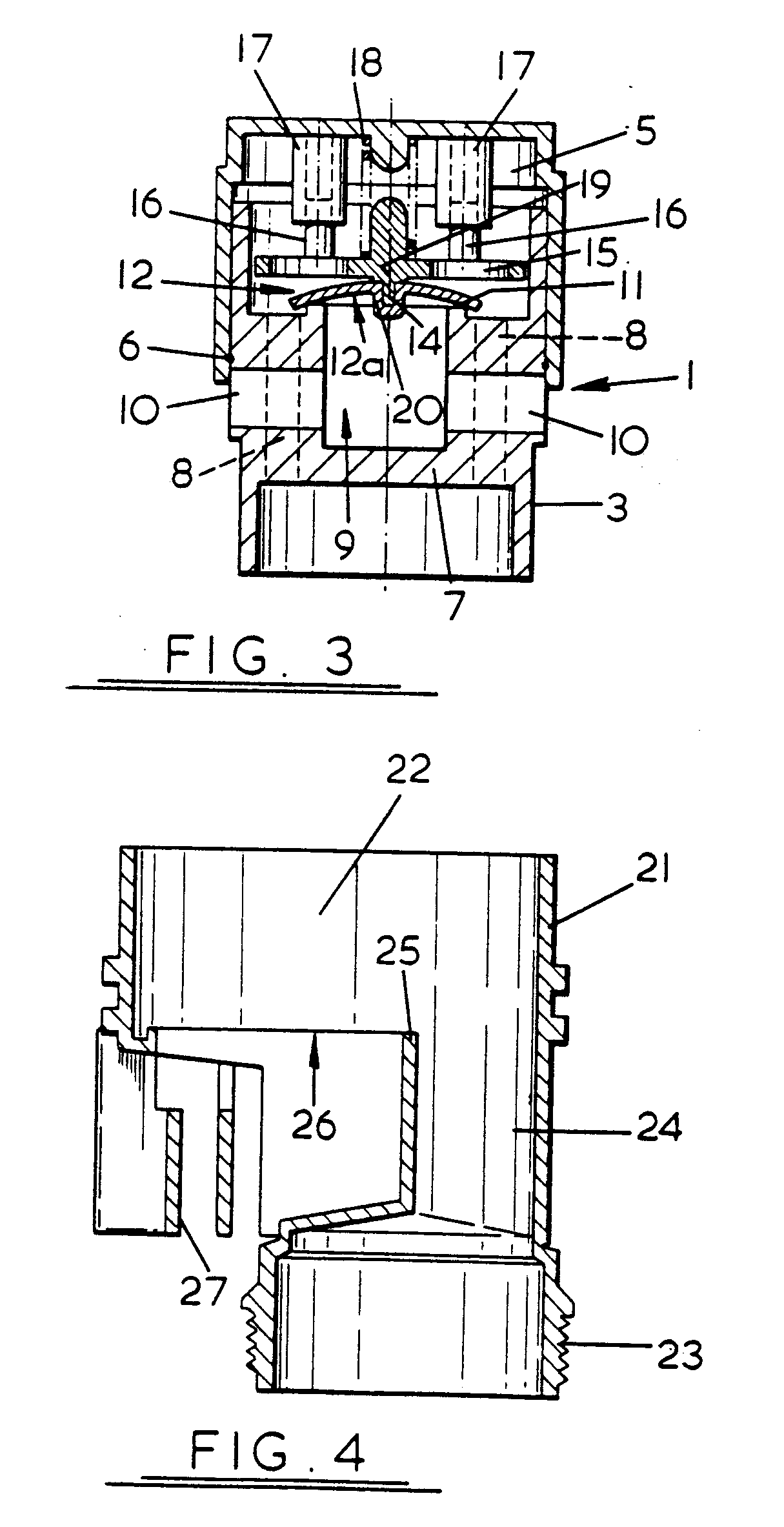
Fig. 3 is a vertical sectional view of a second embodiment of relief valve according
to the invention; and
Fig. 4 is a vertical section of the body portion of a third embodiment of relief valve
according to the invention in which the valve seat is offset relative to the vertical
axis of the body portion.
[0008] Referring to Fig. 1 of the drawings, a first embodiment of relief valve comprises
a cylindrical valve indicated generally by the reference numeral 1. The valve is made
in two parts namely a body 3 over which a lid 4 can be releasably fitted to define
a valve chamber 5 therewithin. The lid 4 is retained and sealed by an O-ring 6. Within
the body 3 there is provided a deep partition 7 extending across the bore of the body
3. A plurality of vertical apertures 8 extend through the partition 7 to interconnect
the valve chamber 5 with the underside of the partition 7 so that when the body 3
is fitted into a pipe, the pressure in the pipe will be transmitted to the valve chamber.
[0009] An axial well 9 opens at its upper end into the valve chamber 5, the well 9 being
closed at its lower end. A pair of radial bores 10 communicate with the interior of
the well 9 and extend through the body 3 to the exterior of the valve at a location
just below the lower end of the lid 4 when the latter is fitted.
[0010] Surrounding the upper end of the axial well 9 is an upstanding annular valve seat
11. An annular flexible valve element or seal 12 made of rubber or soft polyvinyl
chloride or similar material is located within the valve chamber 5 to seat on the
valve seat 11.
[0011] The valve element 12 has a single central hole which frictionally receives a central
projection or pin 14 which is integral with a rigid spider-like support member 15
for the valve element 12. The support 15 which is in the form of an annular grid,
tends to prevent excessive distortion of the flexible valve element. Extending upwardly
from the support member 15 are integral guide rods 16 which are received within cooperating
sleeves 17 formed integral with the lid 4. The guide sleeves 17 ensure that on movement
of the valve element 12, it returns accurately on to its valve seat. A spring 18 is
disposed between the support 15 and the underside of the lid 4 in order to tend to
urge the valve element on to its seat. It will be understood, however, that this spring
loading is not essential. The underside of the valve support 15 is formed with a spacer
19 to space the valve element 12 from the support 15. In this way, the valve element
12 is freely flexible so that it can conform more easily to the shape of the valve
seat in a self-aligning manner.
[0012] In operation of the relief valve, the valve element 12 normally is in engagement
with its valve seat 11 under the combined effect of gravity and the spring.
[0013] If the pressure within the pipe into which the valve is fitted drops, then this drop
in pressure is transmitted into the valve chamber 5 through the apertures 8 which
are located radially outwardly of the outer extremity of the valve element 12. The
reduction of pressure within the valve chamber 5 causes the valve element 12 to be
lifted from its seat. This action allows air to be drawn into the valve chamber thrugh
the radial bores 10 and axial well 9 in order to balance the pressure.
[0014] The apertures 8 in the partition 7 also function as a means whereby condensation
can flow out of the valve chamber should this eventuality arise.
[0015] The second embodiment of the invention illustrated in Fig. 3 is identical in construction
and operation to the valve shown in Figs. 1 and 2 save for variations in the form
of the valve element 12 and the manner in which it is fitted to its support 15. In
the embodiment shown in Fig. 3, the downwardly projecting central pin 14 of the support
15 is sufficiently long to project through the central aperture of the valve element
12 where it is surrounded and closed at its lower end by a shroud 20 which is integrally
formed on the lower surface 12a of the valve element 12. Alternatively, the upper
surface of the valve element 12 could be provided with an integral projection which
frictionally engages in a recess formed in the lower face of the support 15. The lower
surface 12a of the valve element is concave in profile. As a result, the natural elasticity
in the valve element and the fact that the effective area of the valve element is
freely flexible ensures that a good sealing contact is made with the valve seat 11.
The shroud 20 renders the valve element 12 air-impermeable and thus prevents the passage
of air through the central hole of the valve element 12 so as to improve the efficiency
of the valve.
[0016] Fig. 4 illustrates the body portion 21 only of a relief valve in accordance with
the invention and in which the lid, valve element and valve support are omitted for
clarity. It will be understood, however, that these components can take the form described
above in relation to the embodiments shown in Figs. 1 to 3. The relief valve body
21 is of cylindrical form and in use is closed by a lid to define a valve chamber
22. The valve body 21 is adapted to be fitted into a pipe system by means of an integral
externally screw- threaded skirt 23. A passage 24 connects the pipe system into which
the valve is fitted to the valve chamber so that pressure variations in the pipe system
will be transmitted to the valve chamber 22.
[0017] Within the valve chamber 22, there is provided an annular valve seat 25, the vertical
axis of which is offset in relation to the vertical axis of the valve body 21. The
valve seat 25 defines an air inlet 26 to permit the passage of air from the exterior
of the valve to the valve chamber 22 through a grid 27 which restricts access to the
interior of the valve through the annular opening defined by the valve seat. The offset
nature of the valve allows it to be fitted close to walls or the like obstructions
which would cause difficulties in the fitting of valves as illustrated in Figs. 1
and 3.
[0018] Although the above described embodiments incorporate a single spring centrally located
relative to the valve element, it will be readily apparent to those skilled in the
art that a plurality of springs can be provided around the perimeter of the valve
element support if desired. The use of springs enables the valve to be used at an
angle to the vertical.
[0019] If desired the valve element 12 and/or valve seat 11 can be lubricated with a non-drying
lubricant such as castor oil or silicone. Such lubrication assists in a satisfactory
seal being achieved.
[0020] The above-described embodiments show an arrangement in which the valve element is
provided with a support which is slidable in guides provided on the inside of the
lid. It will be readily apparent that the valve element can be guided on to its seat
in other ways. For example, the central portion of the valve element could be provided
with a depending projection which is slidable relative to an upwardly directed guide
carried by the valve body.
[0021] The designs of the relief valve as described above are such that it is difficult
for unauthorised persons, particularly children, to tamper with its internal components.
[0022] If desired the relief valve of the present invention can be provided with an insulating
jacket e.g. of polystyrene in order to protect it against extreme temperature conditions.
1. A negative pressure relief valve for admitting air into a system in response to
a pressure reduction therein so as to relieve said pressure reduction comprising a
valve body (3,21) defining a valve chamber (5,22) therein; an air inlet (9,10 and
26) interconnecting the valve chamber (5,22) and the exterior of the valve body (3,21)
and defining a continuous valve seat (11,25) within the valve chamber (5,22); at least
one aperture (8,24) connected to the valve chamber (5,22); a flexible, substantially
air impermeable valve element (12) normally disposed in engagement with the continuous
valve seat (11,25) to prevent inflow of air to the valve chamber (5,22) through the
air inlet (9,10 and 26); a valve element support member (15) carrying the valve element
(12); guide means (16,17) for assisting the valve element (12) into effective sealing
engagement with the valve seat (11,25) when the pressure drop in the system has been
relieved, the aperture (8,24) being adapted to interconnect the valve chamber (5,22)
with the system into which the valve is to be fitted and the valve being adapted to
admit air into the system via sequentially the air inlet (9,10 and 26), the valve
chamber (5,22) and then the aperture (8,24) so as to relieve a pressure drop in the
system; characterised in that the valve element (12) is freely flexible at its area
of engagement with the valve seat (11,25) and the valve element support member (15),
during sealing engagement of the valve element (12) with the valve seat (11,25), extends
over the area of engagement of the valve element (12) with the valve seat (11,25)
but is spaced therefrom to permit free flexibility of the valve element (12).
2. A relief valve as claimed in claim 1, in which the valve element (12) is spring-loaded
to tend to urge it into sealing engagement with the valve seat (11, 25).
3. A relief valve as claimed in claim 1 or 2, in which the valve element support member
(15) has a projection or projections (16) engageable with guide elements (17) to ensure
proper location of the valve element (12) on the valve seat (11,25).
4. A relief valve as claimed in any preceding claim, in which spacer means (19) is
provided between the central area of the valve element (12) and the support member
(15) to ensure free flexibility of the valve element (12).
5. A relief valve as claimed in any preceding claim, in which the surface (12a) of
the valve element (12) which is adapted to engage the valve seat has a concave profile.
6. A relief valve as claimed in any preceding claim in which the valve element (12)
is carried by the support member (15) by means of a pin (14) on the support member
(15) which frictionally engages a centrally-located hole in the valve element (12).
7. A relief valve as claimed in claim 6, in which a shroud (20) is provided to prevent
passage of air through said centrally-located hole.
8. A relief valve as claimed in any preceding claim, in which the air inlet (9) defining
the valve seat (11) is co-axial with the valve body (3).
9. A relief valve as claimed in any of claims 1 to 7, in which the axis of the air
inlet (26) defining the valve seat (25) is offset relative to the valve body (21).
10. A relief valve as claimed in any preceding claim, in which the valve element (12)
and/or valve seat (11, 25) is lubricated.
1. Unterdruckausgleichventil zum Einlaß von Luft in ein System infolge eines Druckabfalls
darin, um den Druckabfall auszugleichen, mit einem Ventilkörper (3, 21), der innen
eine Ventilkammer (5, 22) bildet; mit einem Lufteinlaß (9, 10 und 26), der die Ventilkammer
(5, 22) und das Äußere des Ventilkörpers (3, 21) verbindet und einen durchgehenden
Ventilsitz (11, 25) innerhalb der Ventilkammer (5, 22) bildet; mit zumindest einer
Öffnung (8, 24), welche mit der Ventilkammer (5, 22) verbunden ist; mit einem flexiblen,
im wesentlichen luftundurchlässigen Ventilelement (12), das normalerweise mit dem
durchgehenden Ventilsitz (11, 25) im Eingriff steht, um ein Einströmen von Luft durch
den Lufteinlaß (9, 10 und 26) in die Ventilkammer (5, 22) zu verhindern; mit einem
Ventilelementträger (15), der das Ventilelement (12) trägt; sowie mit einer Führungseinrichtung
(16,17), um das Ventilelement (12) bei einem wirkungsvoll abgedichteten Eingriff mit
dem Ventilsitz (11,25) zu unterstützen, sobald der Druckabfall in dem System ausgeglichen
ist, wobei die Öffnung (8, 24) dazu ausgelegt ist, die Ventilkammer mit dem System
zu verbinden, in welches das Ventil eingesetzt werden soll, und das Ventil dazu ausgelegt
ist, Luft aufeinanderfolgend über den Lufteinlaß (9, 10 und 26), die Ventilkammer
(5, 22) und dann die Öffnung (8, 24) in das System einzulassen, um dadurch einen Druckabfall
in dem System auszugleichen; dadurch gekennzeichnet, daß das Ventilelement (12) an
seiner Eingriffsfläche mit dem Ventilsitz (11, 25) frei flexibel ist und sich der
Ventilelementträger (15) während eines dichtenden Eingriffs des Ventilelements (12)
mit dem Ventilsitz (11, 25) über die Eingriffsfläche des Ventilelements (12) mit dem
Ventilsitz (11, 25) erstreckt, jedoch davon beabstandet ist, um die freie Flexibilität
des Ventilelements (12) zu ermöglichen.
2. Unterdruckventil gemäß Anspruch 1, wobei das Ventilelement (12) federnd vorgespannt
ist, um es in einem abdichtenden Eingriff mit dem Ventilsitz (11, 25) drücken zu wollen.
3. Unterdruckventil gemäß Anspruch 1 oder 2, wobei der Ventilelementträger (15) einen
Vorsprung oder Vorsprünge (16) besitzt, die in Führungselemente (17) eingreifen können,
um die richtige Anordnung des Ventilelements (12) auf dem Ventilsitz (11, 25) sicherzustellen.
4. UnterdruckventilgemäßallenbisherigenAnsprüchen, wobei zwischen dem Mittelbereich
des Ventilelements (12) und dem Träger (15) ein Abstandshalter (19) vorgesehen ist,
um die freie Flexibilität des Ventilelements (12) sicherzustellen.
5. UnterdruckventilgemäßallenbisherigenAnsprüchen, wobei die Fläche (12a) des Ventilelements
(12), die dazu dient, um in den Ventilsitz einzugreifen, konkav ausgebildet ist.
6. UnterdruckventilgemäßallenbisherigenAnsprüchen, wobei das Ventilelement (12) vom
Träger (15) mit Hilfe eines Zapfens (14) auf dem Träger (15) gehalten wird, der in
eine mittig angeordnete Öffnung im Ventilelement (12) reibungsmäßig eingreift.
7. Unterdruckventil gemäß Anspruch 6, wobei ein Verstärkungsflansch (20) vorgesehen
ist, um das Durchströmen von Luft durch die mittig angeordnete Öffnung zu verhindern.
8. Unterdruckventil gemäß allen bisherigen Ansprüchen, wobei der Lufteinlaß (9), der
den Ventilsitz (11) bildet, koaxial zum Ventilkörper (3) liegt.
9. Unterdruckventil gemäß jedem der Ansprüche 1 bis 7, wobei die Achse des Lufteinlasses
(26), der den Ventilsitz (25) bildet, relativ zum Ventilkörper (21) versetzt ist.
10. UnterdruckventilgemäßallenbisherigenAnsprüchen, wobei das Ventilelement (12) und/oder
der Ventilsitz (11, 25) geschmiert werden.
1. Vanne de sous-pression ou soupape de sûreté de pression négative destinée à l'admission
de l'air dans un système en réponse à une réduction de pression dans celui-ci de façon
à soulager cette réduction de pression, cette vanne réductrice de pression comprenant
un corps de vanne (3,21) définissant une chambre de vanne (5,22) dans celui-ci; une
entrée d'air (9,10 et 26) reliant la chambre de vanne (5,22) et l'extérieur de la
chambre de vanne (3,21) et définissant un siège de vanne continu (11,25) à l'intérieur
de la chambre de vanne (5,22); au moins une ouverture (8,24) raccordée à la chambre
de vanne (5,22); un élément de vanne flexible, sensiblement imperméable à l'air (12)
normalement disposé en engagement avec le siège de vanne continu (11,25) pour empêcher
l'arrivée d'air à la chambre de vanne (5,22) par l'entrée d'air (9,10 et 26); un organe
de support d'élément de vanne (15) supportant l'ensemble de vanne (12); des moyens
de guidage (16,17) destinés à faciliter l'engagement ou coopération hermétique efficace
de l'élément de vanne (12) avec le siège de vanne (11,25) lorsque la chute de pression
dans le système a été soulagée, l'ouverture (8,24) étant apte à relier la chambre
de vanne (5,22) avec le système dans lequel la vanne doit être encastrée et la vanne
étant apte à admettre l'air dans le système par l'intermédiaire séquentielle- ment
de l'entrée d'air (9,10 et 26), de la chambre de vanne (5,22) et ensuite de l'ouverture
(8,24) de façon à libérer une chute de pression dans le système; caractérisé en ce
que l'élément de vanne (12) est librement flexible sur sa zone d'engagement avec le
siège de vanne (11,25) et l'organe de support d'élément de vanne (15), pendant l'engagement
ou coopération hermétique de l'élément de vanne (12) avec le siège de vanne (11,25),
s'étend sur la zone d'engagement de l'élément de vanne (12) avec le siège de vanne
(11,25) mais espacé pour permettre la libre flexibilité de l'élément de vanne (12).
2. Vanne de sous-pression selon la revendication 1, dans laquelle l'élément de vanne
(12) est chargée par un ressort qui a tendance à la solliciter en contact avec le
siège de vanne (11, 25).
3. Vanne de sous-pression selon la revendication 1 ou 2, dans lequel l'organe de support
d'élément de vanne (15) comprend une ou plusieurs saillies (16) pouvant coopérer avec
des éléments de gui- i-dage (17) pour assurer un positionnement correct de l'élément
de vanne (12) sur le siège de vanne (11, 25).
4. Vanne de sous-pression selon l'une quelconque des revendications précédentes, dans
laquelle des moyens d'écartement (19) sont prévus entre la région centrale de l'élément
de vanne (12) et l'organe de support (15) pour assurer une flexibilité libre de l'élément
de vanne (12).
5. Vanne de sous-pression selon l'une quelconque des revendications précédentes, dans
laquelle la surface (12a) de l'élément de vanne (12) qui est adaptée à venir en contact
avec le siège de vanne a un profil concave.
6. Vanne de sous-pression selon l'une quelconque des revendications précédentes, dans
laquelle l'élément de vanne (12) est supporté par l'organe de support (15) au moyen
d'un téton (14) de l'organe de support (15) qui vient en contact par friction avec
un trou disposé centralement dans l'élément de vanne (12).
7. Vanne de sous-pression selon la revendication 6, dans laquelle est prévue une enveloppe
(20) pour éviter le passage de l'air par ledit trou situé centralement.
8. Vanne de sous-pression selon l'une quelconque des revendications précédentes, dans
laquelle l'entrée d'air (9) définissant le siège de vanne (11) est coaxiale au corps
de vanne (3).
9. Vanne de sous-pression selon l'une quelconque des revendications 1 à 7, dans laquelle
l'axe de l'entrée d'air (26) définissant le siège de vanne (25) est décalé par rapport
au corps de vanne (21).
10. Vanne de sous-pression selon l'une quelconque des revendications précédentes,
dans laquelle l'élément de vanne (12) et/ou le siège de vanne (25) sont lubrifiés.