| (19) |
 |
|
(11) |
EP 0 061 282 B1 |
| (12) |
EUROPEAN PATENT SPECIFICATION |
| (45) |
Mention of the grant of the patent: |
|
14.09.1988 Bulletin 1988/37 |
| (22) |
Date of filing: 16.03.1982 |
|
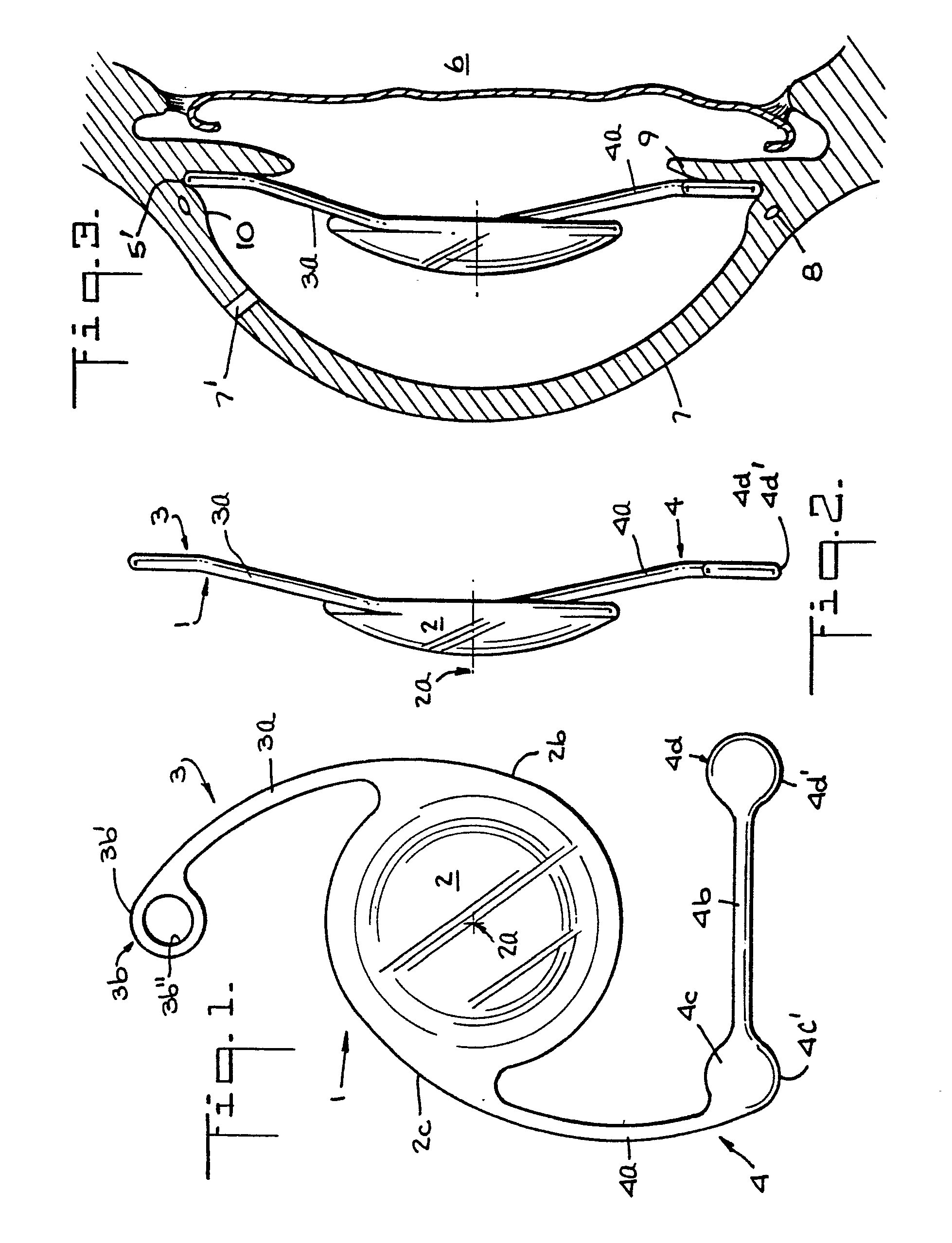
| (51) |
International Patent Classification (IPC)4: A61F 2/16 |
|
| (54) |
Anterior chamber intraocular lens
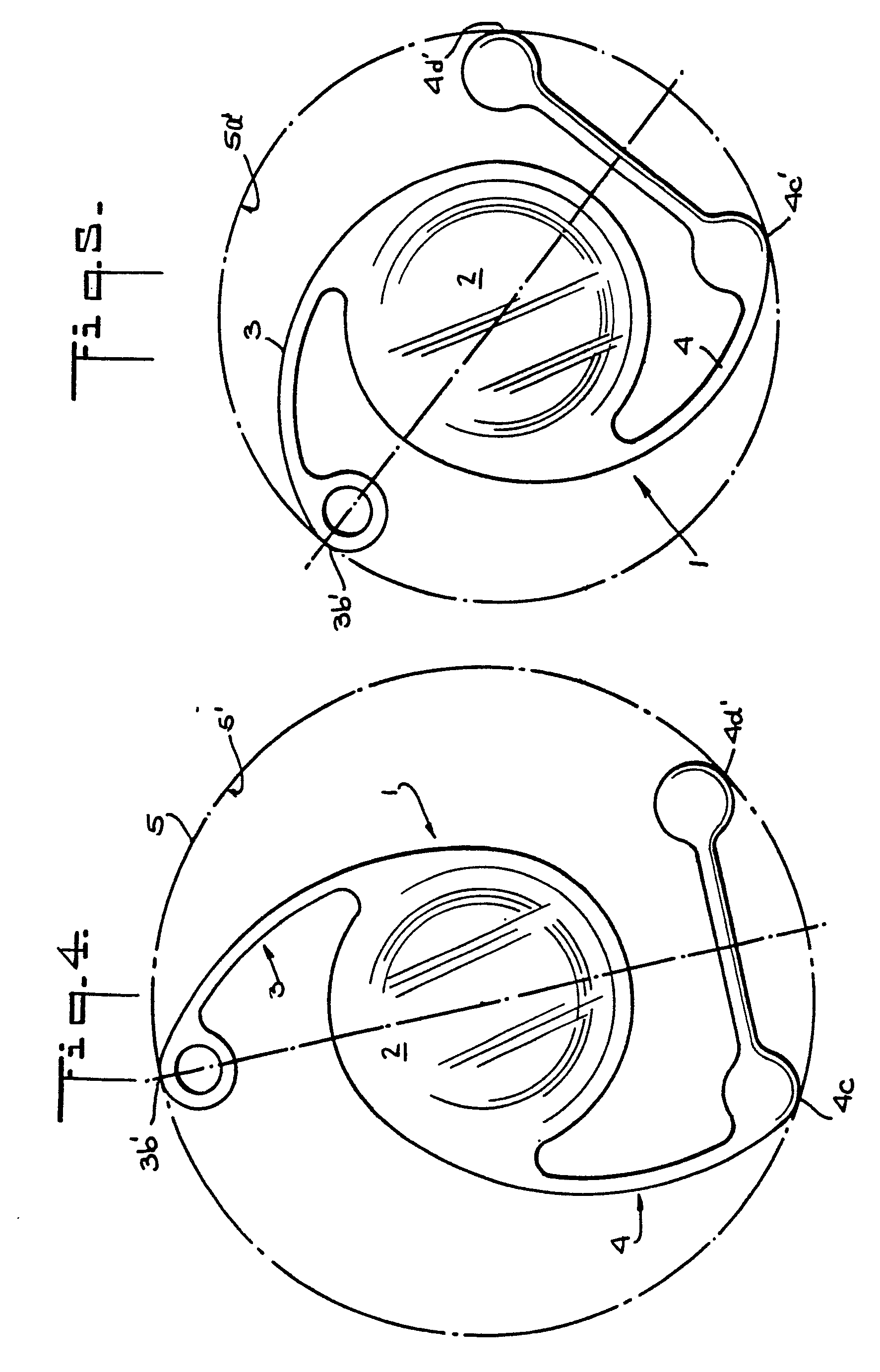
Vorderaugenkammer-Intraokularlinse
Lentille intraoculaire pour la chambre antérieure
|
| (84) |
Designated Contracting States: |
|
BE DE FR GB IT NL SE |
| (30) |
Priority: |
25.03.1981 US 247570
|
| (43) |
Date of publication of application: |
|
29.09.1982 Bulletin 1982/39 |
| (73) |
Proprietor: Kelman, Charles D. |
|
Nassau
New York 11005 (US) |
|
| (72) |
Inventor: |
|
- Kelman, Charles D.
Nassau
New York 11005 (US)
|
| (74) |
Representative: Geldard, David Guthrie et al |
|
Urquhart-Dykes & Lord
Tower House
Merrion Way
GB-Leeds LS2 8PB
GB-Leeds LS2 8PB (GB) |
| (56) |
References cited: :
EP-A- 0 073 755
GB-A- 2 021 955
US-A- 4 159 546
US-A- 4 296 501
US-A- 4 316 293
|
FR-A- 2 464 063
US-A- 4 092 743
US-A- 4 254 509
US-A- 4 298 995
|
|
| |
|
|
|
|
| |
|
| Note: Within nine months from the publication of the mention of the grant of the European
patent, any person may give notice to the European Patent Office of opposition to
the European patent
granted. Notice of opposition shall be filed in a written reasoned statement. It shall
not be deemed to
have been filed until the opposition fee has been paid. (Art. 99(1) European Patent
Convention).
|
[0001] This invention relates to intraocular lenses for implantation in the anterior chamber
of a human eye and more particularly to an intraocular lens having postion fixation
elements whose effective size is variable so as to permit use of a lens of one size
in human eyes of vaying size.
[0002] The implantation of an intraocular lens is a well known and widely used technique
for restoring vision after cataract surgery. The natural structure of the eye furnishes
a variety of locations for fixing the position of an intraocular lens in the eye.
For example, an intraocular lens can be supported anteriorly of the iris, between
the scleral spur and the iris, as disclosed in my U.S. Patents No. 4,174,543 and 4,092,743.
Alternatively, an intraocular lens can be supported posteriorly of the iris as disclosed,
for example, in U.S Patent No. 4,159,546 to Shearing. In practice, anterior chamber
lenses are the easiest to implant because the anterior chamber angle can be viewed
by the surgeon while he seats the position fixation members therein. This, of course,
is not the case with posterior chamber lenses, since they seat behind the iris.
[0003] Lens implatations are not only extremely difficult and delicate operations but the
use of the currently available anterior chamber lenses, even by highly skilled surgeons,
entails a number of disadvantages. One of these is that due to the different sizes
of the eyes of different patients a sizable inventory of lenses is currently required
by the surgeon to be immediately available in the operating room during the operation.
Since the internal diameter of the anterior chamber angle, that is the diameter of
the groove formed between the iris and the scleral spur, varies from patient to patient,
generally within a range of 11.5 to 14.0 millimeters, the lenses currently available
are manufactured in half-millimeter increments within that range which is the normal
size range for human eyes. Thus lenses are currently available with diameters of 11.5,
12.0, 12.5, 13.0, 13.5 and 14.0 millimeters. Many of these lenses are furthermore
available in powers varying from 14.50 to 22.00 diopters in one diopter increments
at the low and high end of the scale and in half diopter increments in the mid-range
of that scale. It is very difficult with existing instrumentation to precisely measure
the diameter of the anterior chamber angle in which the anterior chamber lens will
be seated, prior to the time when the patient is actually in the operating room and
an incision has been made. Thus, for each half- diopter increment in the aforesaid
mid-range, the surgeon must have available in the operating room seven lenses of different
size. It is only after the incision has been made that the most accurate known method
for measuring the anterior chamber angle diameter, namely the dip-stick method, can
be used.
[0004] Once the internal diameter of the anterior chamber has been measured accurately,
the surgeon chooses from his inventory of differently dimensioned lenses that lens
which most nearly approximates the measured dimension.
[0005] Anterior chamber intraocular lenses are known which exhibit some degree of flexibility.
Usually the flexibility is for the purpose of compensating for tolerance error in
the dimension of the lens, for measurement error on the part of the surgeon, for permitting
some flexure in response to normal deformation of the eyeball, or, since lenses commonly
are manufactured in half millimeter sizes, for allowing for differences between actual
lens size and anterior chamber angle diameter should the angle or groove diameter
fall somewhere between two discrete lens sizes. For example, my U.S. Patent 4,092,743
describes an anterior chamber intraocular lens in which the three-point position fixation
element is sufficiently flexible to compensate for small differences, up to about
one-half millimeter, between the diameter of the groove in the eye in which the lens
is to be implanted and the size of the lens in its undeformed condition. Also, my
U.S. Patent 4,174,543 discloses a four-point anterior chamber lens comprising an optic,
first and second lateral position fixation means the first position fixation means
including a first portion connected with the optic and having a free end at which
there is a first contact portion for seating in a first portion of the groove formed
between the iris and the scleral spur and said second position fixation means (4)
including a first portion connected with said optic and having a free end at which
there is a second contact portion (4c) for seating in a second portion of the groove.
The first and second contact portions can deflect between fully extended and fully
compressed positions along lines drawn diagonally through its four contact points
and are urged to the fully extended position. Such deflection is stated to be in response
to the "normal distortions of the eyeball".
[0006] Since the latter lenses are intended to deflect only to the extent required to compensate
for normal distortions of the eyeball so as to minimize the distortion-related trauma
sometimes attributable to an intraocular lens implant, a lens of proper size i.e.
one which has a dimension approximating as closely as possible the measured groove
dimension must be used to achieve good results. Since the lenses come in discrete
sizes and since it is extremely unlikely that the diameter of the anterior chamber
angle in the eye will match exactly one of those discrete sizes, the optimum lens
fit is hardly ever achieved with known anterior chamber lenses.
[0007] According to the present invention I provide an anterior chamber intraocular lens
having contact portions which in a first, fully extended position, are spaced apart
by a distance, substantially approximating the largest diameter of the range of anterior
chamber diameters most commonly exhibited by human eyes; in a second fully compressed
position are spaced apart by a distance substantially approximating the smallest diameter
of said range; the lens being such that said first and second lateral position fixation
means are sufficiently flexible and configured so that during the range of movement
from said first to said second position, movement of said optic along the optical
axis (in use in the anterior direction toward the cornea), will not substantially
excced 1.0 mm so that after seating of the lens in the groove of an anterior chamber
having a diameter within the given range the lens will be sufficiently spaced from
the cornea to avoid risk of contact between the optic and the cornea during normal
deformations of the eyeball thereafter; said urging means being designed, in use,
to maintain said contact portions seated in the respective portions of said groove
while not exerting an excessively injurious force on the tissues of such groove portions
even where such groove is that of an anterior chamber having the smallest diameter
within said range; and said first and second contact portions being designed such
that in any position of use the surface portions of the anterior chamber groove with
which they are in contact when seated therein will have an aggregate peripheral length
sufficiently small so as not to interfere with the functioning of Schlemm's canal
to any undesirable extent.
[0008] Thus the invention provides a single lens which may be properly positioned in the
anterior chamber of any eye exhibiting any anterior chamber diameter within the normal
range.
[0009] The known anterior chamber lenses which have flexure capability, have such capability
for an entirely different purpose and to a substantially different degree than is
the case with the lens according to the instant invention. None of the known anterior
chamber lenses, are capable of minimizing the lens inventory in the operating room
to the extent of the instant invention which provides for a single anterior chamber
lens adapted to fit all eyes within the normal size range, without danger of contact
with cornea during normal defomations of the eyeball thereafter.
[0010] It is known that posterior intraocular lenses have for some time now been made flexible
enough to fit all normal posterior chambers. Since, however, posterior chamber lenses,
particularly when implanted after extra capsular cataract removal, can be seated in
the capsule, i.e. in a membrane which is relatively inert in that it has no nerve
endings and no blood vessels, and which can therefore readily withstand punishment
imposed by seating therein of springy position fixation elements, the forces exerted
by, and the length of the contact areas of, the latter, are not nearly as critical
in the posterior chamber capsule as in the anterior chamber. In this connection it
should also be remembered that surrounding the anterior chamber angle in the vicinity
of the scleral spur is the trabecular me.shwork which normally pumps fluid out of
the eye into Schlemms' canal, which canal, in turn, peripherally surrounds the trabecular
meshwork. Any undue pressure on the anterior chamber angle in the vicinity of the
scleral spur, such as may be caused by a lens implant, may interfere with the proper
functioning of Schlemms' canal and may cause pain and inflammation.
[0011] While some slight interference with the functioning of the canal does not appear
to be detrimental, more substantial interference as would be occasioned by anterior
chamber lenses having seating portions extending over substantial peripheral regions
of the anterior chamber angle and thus sealing substantial portions of the trabecular
meshwork and possibly even transmitting pressure against substantial regions of Schlemms'
canal, would be detrimental. By limiting such contact to regions aggregating preferably
less than 10% of the periphery of the anterior chamber angle such detrimental interference
with the functioning of Schlemms' canal may be minimized.
[0012] From the foregoing it will be seen why known posterior chamber lenses have not been
used and are not useful in the anterior chamber. Thus, known posterior chamber lenses,
such as the Simcoe posterior chamber lens having two or three very long and very flexible
haptic loops which are curved to match their respective arcs of contact with the ciliary
sulcus, so as to distribute pressure evenly over as large a surface area as possible,
so as to avoid focused single-point pressure, would have a deleterious effect on the
functioning of Schlemms' canal and therefore should not be used in the anterior chamber.
Most other known posterior chamber lenses which exhibit flex capability sufficient
to operate within the size ranges specified herein, are not of three-point contact
construction and therefore do not exhibit the stability which known anterior chamber
lenses are able to provide. Many posterior chamber lenses including the 2- and the
3- leg Shearing-type posterior lenses have a construction which results in their optic
portion being displaced axially when the legs of the lens are squeezed from their
undeformed condition into their deformed condition, i.e. their condition after the
lens has been seated in the posterior chamber. Since the anterior chamber lenses however
are positioned between the iris and the cornea, substantial axial movement of this
type cannot be tolerated since the distances to the iris on the one hand and to the
cornea on the other hand are relatively small. Therefore, if the optic, after implant
surgery, is too close to the cornea, normal distortions of the eyeball can result
in contact by the optic with the endothelial layer of the cornea risking severe injury
to the cornea. The invention allows avoidance of this problem. Furthermore, many of
the known posterior as well as anterior chamber lenses such as shown in US-A-4147543
require a deflection force substantially in excess of one gram, which force will,
in the implanted lens, determine the amount of pressure exerted against the tissues
of the eye in which the lens is seated. The amount of pressure, will depend not only
on the force but also on the area of contact between the position fixation elements
of the lens and the tissue in which they are seated. Substantially greater pressures
are acceptable for seating in the capsular sulcus in the posterior chamber than are
acceptable for seating in the anterior chamber angle, and it is prefered in the lens
of this invention that in any position of the fixation means between the first and
second portions, the contact portions are forced against the respective groove portions
with a force not substantially exceeding one gram.
[0013] In such a lens the contact areas may be limited and are preferably substantially
point-contact. Thus, the force exerted by the position fixation elements may be transmitted
at preferably three or four discrete points only and is not distributed over large
surface areas at any of these points. If we assume a force of one gram and a contact
area of one square millimeter then the pressure will of course be less than one gram
per square millimeter. Contact areas in the order of 2 or 3 square millimeters will
of course even further substantially reduce the pressure on the tissue that is contacted.
For a better understanding of the present invention reference is made to the following
description of a specific embodiment thereof, given by way of example only and taken
in connection with the accompanying drawings, in which:-
Fig. 1 is a plan view of an embodiment of the present invention intended for fixation
in the anterior chamber of the eye.
Fig. 2 is a side view of the intraocular lens structure of Fig. 1.
Fig. 3 is a sectional view of an eye with the intraocular lens structure of Fig. 1
fixed therein and shown in side elevation in reduced size.
Fig. 4 is a plan view of the intraocular lens structure of Fig. 1 seated in the anterior
chamber angle of a relatively large eye.
Fig. 5 is a plan view of the intraocular lens structure of Fig. 1 seated in the anterior
chamber angle of a relatively small eye.
[0014] According to the preferred embodiment of this invention there is provided an anterior
chamber intraocular lens having a central optic portion 2 with an optical axis 2a,
as seen in Figs. 1, 2 and 3 of the drawings. Extending from a first peripheral portion
2b of the optic 2 is a first position fixation element 3. The optic has a second peripheral
portion 2c spaced from said first mentioned peripheral portion and generally at opposite
sides of the optical axis 2a with respect to said first mentioned peripheral portion.
Extending from said second peripheral portion 2c of optic 2 is a second position fixation
element 4. The position fixation elements 3, 4 extend from the optic 2 generally tangentially
and in generally opposite directions with respect to each other. Position fixation
element 3 has a curved leg portion 3a with a free end 3b forming a contact surface
3b', while position fixation element 4 has a curved leg portion 4a and an arm portion
4b extending transversely from the distal end of leg portion 4a so as to extend partly
peripherally of said optic. The leg portions are so configured that the concave side
of the curved leg 4a faces generally toward the concave side of leg 3a. Position fixation
element 4 has a pair of contact surfaces for contacting and seating in the anterior
chamber angle 5' of an eye in the vicinity of the scleral spur 10. One contact surface
4c' is in the region where the leg 4a connects with arm 4b, and the other contact
surface 4d' is located at the free end 4d of transverse arm 4b.
[0015] Leg portions 3a and 4a are also oblique and respectively connect the corresponding
end portions 3b and 4c with the lens body 2. End portions 3b, 4c and 4d are located
substantially in coplanar relationship in a plane which is perpendicular to the optical
axis 2a and is spaced posteriorly of the optic 2. The oblique leg portions 3a and
4a thus extend between the optic 2 and the said plane containing end portions 3b,
4c and 4d.
[0016] According to the aforesaid construction, there is formed an anterior chamber lens
1 which exhibits three-point fixation capability. One or both of the position fixation
elements, or legs, 3 and 4 is resilient i.e. springy, such that is will return to
its original undeformed condition shown in Fig. 1 after compression or extension away
from the illustrated configuration. The anterior chamber lens according to the instant
invention has the important capability of being able to be deformed in such manner
and to such an extent as to be safely and easily accommodated in anterior chamber
angles having a wide range of diameters. Thus, according to the preferred embodiment
of the instant invention the anterior chamber lens 1 is manufactured in its entirety
as a unit of a single piece of polymethylmethacrylate, or similar biologically inert
plastic material. Alternatively, the elements 3, 4 may be connected by adhesive or
ultrasonic welding or any other connection method known in the art. The cross- sectional
shape, diameter and length of the position fixation elements 3 and 4 as well as the
angles at which they project from optic 2 and the amount of curvature of the legs
3a and 4a are all such as to facilitate a combined flexure of those elements sufficient
to permit substantial relative movement between contact surfaces 4c' and 4d', on the
one hand, and contact surface 3b' on the other hand. Because of the greater stability
of lenses having three-point-contact over those having two-point-contact, the former
are much preferred to the latter in those regions of the eye in which they are capable
of being used. Lenses with three or more contact points are more difficult to use
in the posterior chamber because of the inaccessibility of the seating region in the
posterior chamber and the necessity to dilate the pupil substantially in order to
insert the larger lens into the posterior chamber.
[0017] Preferably, the legs 3 and 4 have their end portions 3b and 4b located in a plane
which is parallel to and approximately 1 mm behind the plane of the posterior face
of optic 2. By way of example, I will refer to a lens which in its undeformed condition,
as seen in Fig. 1 fits within an imaginary 14 mm diameter circle (not shown), with
its three contact surfaces 3b', 4c' and 4d' each touching that circle and each making
substantially a point contact therewith. The lens, in the example, has a 6 mm diameter
optic. The legs 3 and 4 are of generally round cross-section approximately .320 mm
in diameter. Arm 4b is straight and is located approximately 5.46 mm from the optical
axis 2a and is approximately 6.14 mm long as measured center to center of the radii
of curvature of the contact surfaces 4c' and 4d' respectively. The legs 3a and 4a
are both curved in generally the same direction about the periphery of the optic 2,
and the radius of curvature of each of the legs 3a and 4a is approximately 6.80 mm
while the radius of curvature of each of the contact surfaces 3b', 4c' and 4d' is
approximately 0.75 mm. The lens is dimensioned such that a line drawn through the
center of curvature of contact surface 3b' and through the optical axis 2a bisects
the arm 4b. It will be seen that each of the contact surfaces is located on an element
which is cantilevered from the optic. Leg 3a is cantilevered and extends generally
tangentially from the periphery of optic 2. Leg 4a is cantilevered and also extends
generally tangentially from optic 2, and arm 4b is cantilevered from and extends generally
transversely from end portion 4c and generally circumferetially of, and spaced from
the optic 2.
[0018] A lens constructed in the manner just described and having the dimensions described
above has been found to exhibit the following characteristics when a force was applied
between surface 3b', on the one hand, and surfaces 4c' and 4d', on the other hand,
so as to deform the lens from the undeformed condition thereof illustrated in Fig.
1, to a first deformed condition such as the one illustrated in Fig. 4 of the drawings,
and then to a second even further deformed condition, such as the one illustrated
in Fig. 5: A force of approximately one tenth of one gram resulted in a reduction
of 3.54 millimeters in the distance between the surface 3b' and the surface 4c' and
4d'. A 3.8 millimeter reduction in the distance between those surfaces from the said
first undeformed condition to one of said second deformed conditions was accomplished
with the application of a force between said surface of approximately two tenths of
one gram.
[0019] Figure 4 illustrates the lens according to the preferred embodiment of this invention
seated in the anterior chamber angle 5' of an eye having an anterior chamber angle
diameter of approximately 13.5 mm, i.e. near the large end of the normal size range
for human eyes. Thus, the lens 1, which is preferably 14.0 mm in size i.e. would fit
into a circle having a diameter of 14.0 mm, is seen in only sightly deformed condition
in Fig. 4 with the contact surface 3b' on the one hand and contact surfaces 4c' and
4d', on the other hand, having been moved somewhat relatively to each other from their
undeformed condition illustrated in Fig. 1 to their slightly deformed condition illustrated
in Fig. 4. It will be seen that because of the position, shape and size of the contact
surfaces 3b', 4c' and 4d', the three-point-contact lens according to the preferred
embodiment of this invention contacts the anterior chamber angle at three distinct,
relatively widely spaced, locations and that the extent of such contact at each of
those locations is substantially limited.
[0020] Fig. 5 of the drawings shows the deformation of the same lens 1 accommodated in an
anterior chamber angle 5a' having a diameter of approximately 11.5 mm, i.e. a diameter
at the small end of the range of normal sizes for human eyes. It will be seen that
the configuration, according to the preferred embodiment of the invention, is such
that lens 1 remains relatively stable even when implanted in anterior chamber angles
of substantially different diameters such as illustrated in Figs. 4 and 5, respectively.
Thus, the contact surface 3b', even in substantially fully deformed condition of the
lens shown in Fig. 5, has its center of curvature located on a line which passes through
the optical axis 2 and bisects the arm 4b. This results at least partly from rotation
of the optic 2 about its optical axis 2a during movement of the contact portions 3b,
on the one hand, and 4c and 4d, on the other hand, toward one another. Such rotational
movement of the optic takes place in the clockwise direction, as viewed in Fig. 4
of the drawings, when the lens is deformed from its condition illustrated in Fig.
1 to any of the second positions thereof as exemplified by the conditions illustrated
in Figs. 4 and 5.
[0021] As is well known, because of the proximity of the cornea 7 to the optic of any anterior
chamber lens, it is essential that such optic is maintained spaced from and not be
permitted to come in contact with the cornea. This is true both during insertion and
seating of the lens in the anterior chamber angle and thereafter. It has been found
that the risk of contact with the cornea can be minimized by a lens design which limits
to a distance of approximately one millimeter the distance which the optic moves toward
the cornea as a result of deflection of the position fixation elements during as well
as after implantation. Thus, deformation of the legs 3a and 4a of the lens in order
for it to be seated in the anterior chamber angle must not result in movement of the
optic toward the cornea a distance substantially in excess of 1 mm otherwise there
is increased substantially the risk of contact between the optic and cornea during
deformations normally occurring in the eyeball after lens implatation. The lens according
to the preferred embodiment of the present invention has it legs 3 and 4 sufficiently
flexible and configurated such that axial movement of the optic does not substantially
exceed one millimeter in response to deformation of the contact portions 3b, 4c and
4d toward each other from the undeformed condition of the lens illustrated in Fig.
1 to the deformed condition illustrated in Fig. 5.
[0022] Also, the lens according to the preferred embodiment of the present invention is
con- stucted and arranged such that during deformation of the springy legs 3 and 4
thereof from the condition illustrated in Fig. 1 to the condition illustrated in Fig.
5, the force exerted by each of the respective contact portions 3b, 4c and 4d preferably
does not substantially exceed one gram. Since the amount of contact which the surfaces
3b', 4c' and 4d' each make with the tissue at the interior of the anterior chamber
angle, is on the order of but centainly not less than approximately one square millimeter,
the pressure exerted on the tissue will be less than and will certainly not exceed
one gram per square millimeter. Furthermore, the legs 3 and 4 are constructed and
arranged such that when positioned in all but the very largest diameter anterior chamber
angle, i.e. the maximum size within the aforesaid normal range of sizes, the force
exerted by each of the legs 3 and 4 will help to assure that the lens will remain
seated within the anterior chamber angle of the eye, yet will not exert excessive
pressure, even when used in eyes having an anterior chamber angle diameter of only
approximately 11.5 mm.
[0023] According to the preferred surgical procedure for seating such a lens, the surgeon
would first position contact surfaces 4c' and 4d' in the anterior chamber angle 5a'
in the vicinity of the scleral spur of the eye as illustrated for example in Fig.
5 and thereafter with a forceps or similar instrument grasping the leg 3, preferably
at opening 3b' thereof, urge the latter in a direction toward the optical axis 2a
until the lens is deformed to a somewhat smaller size than the diameter of the anterior
chamber angle in question. Then, after tilting the leg 3 toward and into position
adjacent the iris 9, release the end portion 3b so as to permit the latter to expand
toward and to seat in the corresponding part of the anterior chamber angle 5a' between
the iris and the scleral spur, resulting in the lens assuming its fully seated position
illustrated in Figs. 3, 4 and 5 respectively. It will be noted that even in the substantially
deformed condition of the lens 1 illustrated in Fig. 5, each of the three spaced contact
surfaces 3b', 4c' and 5d', have only very limited areas thereof in contact with the
interior peripheral surface of the groove 5a', and that these limited areas of contact
aggregate substa- nially less then 10% of the periphery of the groove 5a'.
[0024] In this procedure the contact surface 361 contacts the upper portion of the groove
and the surfaces 4c' and 5d' contact the lower portion of the groove. The orientation
of the lens relative to the groove could, of course, differ, for example it could
be inserted from the position shown in the drawings.
[0025] While in the foregoing specification an embodiment of the present invention has been
set forth in considerable detail for the purpose of making a complete disclosure of
the invention, it will be apparent to those skilled in the art that various changes
may be made in such details. For example, the leg 3 illustrated above could be replaced
with an L-shaped leg such as the leg 4 also illustrated above, so that the lens would
then have four contact points instead of three. Also, four contact points could be
achieved with four legs similar to the leg 3 above. Many other such changes would
of course be apparent to those of ordinary skill in the art.
1. An intraocular lens (1) designed to be implanted in the groove (5') formed between
the iris (9) and the scleral spur (10) in the anterior chamber of a human eye having
an anterior chamber diameter lying within the range of diameters most commonly exhibited
by human eyes, said lens comprising: an optic (2); first and second lateral position
fixation means (3, 4); said first position fixation means (3) including a first portion
connected with said optic and having a free end at which there is a first contact
portion (3b) for seating in a first portion of the groove; said second position fixation
means (4) including a first portion connected with said optic and having a free end
at which there is a second contact portion (4c) for seating in a second portion of
the groove; said first and second contact portions (3b, 4c) each being capable of
movement with the first portion of the respective postion fixation means to move towards
and away from the optic and towards and away from the other said contact portion so
that the contact portions may assume any position between a first, fully extended,
position and a second, fully compressed, position; and means for urging said contact
portions in a direction to assume said first position so as to maintain said contact
portions seated in respective portions of said groove (5') characterised in that in
said first position said contact portions are spaced apart by a distance substantially
approximating the largest diameter of said range, in said second position said contact
portions are spaced apart by a distance substantially approximating the smallest diameter
of said range; said first and second lateral position fixation means are sufficiently
flexible and configured so that during said range of relative movement from said first
to said second position, movement of said optic along the optical axis (in use in
the anterior direction towards the cornea) will not substantially exceed 1.0 mm so
that after seating of the lens in the groove of an anterior chamber having a diameter
within the given range the lens will be sufficiently spaced from the cornea to avoid
risk of contact between the optic and the cornea during normal deformations of the
eyeball thereafter; said urging means is designed, in use, to maintain said contact
portions (3b, 4c) seated in the respective portions of said groove (5') while not
exerting an excessively injurious force on the tissues of such groove portions even
where such groove is that of an anterior chamber having the smallest diameter within
said range; and that the said first and second contact portions (3b, 4c) are designed
such that in any position of use the surface portions of the anterior chamber groove
(5') with which they are in contact when seated therein will have an aggregate peripheral
length sufficiently small so as not to interfere with the functioning of Schlemm's
canal to any undesirable extent.
2. An intraocular lens as claimed in claim 1 characterised in that over said range
of relative movement of said contact portions (3b, 4c), said position fixation means
(3,4) simultaneously limit movement of said optic also in the posterior direction
toward the iris so that after seating of the lens in the groove (5') of an anterior
chamber having a diameter within the given range the lens will be sufficiently spaced
from the iris to avoid risk of contact between the optic and the iris during normal
deformations of the eyeball thereafter. r.
3. An intraocular lens as claimed in claim 1 or claim 2 characterised in that said
second contact portion comprises a pair of spaced contact portions (4c, 4d) so that
the lens will have three-point fixation.
4. An intraocular lens as claimed in any one of the preceding claims characterised
in that the distance between said first and second contact portions (3b, 4c) in their
first position is at least 14.0 mm.
5. An intraocular lens as claimed in claim 4 characterised in that the distance between
said first and second contact portions (3b, 4c) in their' second position is 11.5
mm.
6. An intraocular lens as claimed in any one of the preceding claims characterised
in that at least one of said position fixation means (3, 4) includes said means for
urging the respective contact portion in a direction to assume said first position.
7. An intraocular lens as claimed in any one of the preceding claims characterised
in that said means for urging said contact portions exerts a force not substantially
in excess of one gram against the respective groove portions upon said lens being
implanted in the eye.
8. An intraocular lens as claimed in any one of the preceding claims characterised
in that said contact portions together contact less than 10% of the periphery of the
anterior chamber groove in which, in use, they are seated.
9. An intraocular lens as claimed in any one of the preceding claims characterised
in that said second position fixation means (4) includes a leg portion (4a) contiguous
to and extending generally laterally outwardly from the periphery of said optic (2)
and having a first end portion spaced from said optic, said first end portion including
said second contact portion (4c), and an arm portion (4b) extending from said first
end portion generally transversely to said leg portion and at least partly peripherally
of said optic, said arm portion having a free second end portion spaced from said
optic and including a third contact portion (4d), and said arm portion having a medial
region between said first and second end portions disposed closer to the optic than
is either of said first and third contact portions.
10. An intraocular lens as claimed in claim 9 characterised in that each position
fixation means (3, 4) extends generally tangentially from the peripheral portion of
the optic (2) to which is is connected.
11. An intraocular lens as claimed in claim 9 or claim 10 characterised in that said
first position fixation means (3) extends generally tangentially from said optic (2)
and said first contact portion (3b) is substantially bisected by an imaginary extension
of a diameter of the optic which substantially bisects said transverse arm portion
(4b) of said second position fixation means (4).
12. An intraocular lens as claimed in any one of claims 9 to 11 characterised in that
said first position fixation means (3) and said leg portion (4a) of said second position
fixation means (4) are each arcuate and are each curving in the same general direction
around the periphery of the optic (2).
13. An intraocular lens as claimed in any one of claims 9 to 12 characterised in that
said second and third contact portions (4c, 4d) at opposite ends of said arm portion
(4b) have rounded contact surfaces (4c', 4d') for limiting their engagement with the
groove (5') in the eye when seated therein.
14. An intraocular lens as claimed in any one of claims 9 to 13 characterised in that
said arm portion (4b) is cantilevered from said leg portion (4a) and said leg portion
(4a) is cantilevered from said optic (2) so as to facilitate flexing of said second
position fixation means.
15. An intraocular lens as claimed in any one of claims 9 to 14 characterised in that
each of said position fixation means (3, 4) is springy for permitting movement of
said first contact portion (3b) as well as of said second and third contact portions
(4c, 4d) toward and away from the optical axis of said optic (2).
16. An intraocular lens as claimed in any one of claims 9 to 15 characterised in that,
in undeformed condition of said position fixation means (3, 4), there is a diametral
distance of approximately 14 mm from each of said second and third contact portions
(4c, 4d) of said second position fixation means (4) to said first contact portion
(3b) of said first position fixation means (3) and that a force applied between said
first contact portion (3b) of said first position fixation means (3), on the one hand
and said second and third contact portions (4c, 4d) of said second position fixation
means (4) on the other hand, sufficient to move said contact portions toward each
other a distance of approximately 2.5 mm will not result in movement of said optic
(2) along said optical axis thereof, in posterior to anterior direction, a distance
substantially in excess of 1.0 mm.
17. An intraocular lens as claimed in claim 16 characterised in that said position
fixation means (3, 4) are arranged and constructed such that said optic (2) will undergo
some rotational movement about its optical axis in response to said force being applied
between the said pair of contact portions (4c, 4d) of said second position fixation
means (4) on the one hand and the contact portion (3b) of said second position fixation
means (3) on the other hand.
18. An intraocular lens as claimed in any one of claims 9 to 17 characterised in that
said first position fixation means (3) includes a leg portion (3a) intermediate said
optic (2) and said first contact portion (3b), and said leg and arm portions (3a,
4a, 4b) of both said position fixation means (3, 4) are each approximately 0.320 mm
in diameter, said leg portions (3a, 4a) each have a radius of curvature approximately
6.80 mm and all said contact portions (3b, 4c, 4d) have a radius of curvature of approximately
0.75 mm.
19. An intraocular lens as claimed in any one of claims 9 to 18 characterised in that
all said contact portions (3b, 4c, 4d) are spaced from and out of contact with said
optic (2) when said position fixation means (3, 4) are in any position between said
first and second position.
20. An intraocular lens as claimed in any one of the preceding claims characterised
in that each of said position fixation means (3, 4) is connected at one of its ends
to said optic (2), is bowed in a direction generally conforming to the curvature of
the periphery of said optic and otherwise is spaced therefrom along its entire length
so as to permit said contact portions (3b, 4c, 4d) to flex towards the optic in response
to the application of a force applied thereto in a direction generally toward said
optic.
21. An intraocular lens as claimed in any one of the preceding claims characterised
in that said optic (2) has a convex anterior surface, and a substantially flat posterior
surface defining a first plane and said pair of lateral position fixation means (3,
4) have their contact portions (3b, 4c, 4d) located in a second plane spaced posteriorly
to said first plane.
22. An intraocular lens as claimed in any one of the preceding claims characterised
in that said optic (2) and the pair of position fixation means (3, 4) are formed out
of one piece of plastic material, preferably polymethylmethacrylate.
1. Intraokularlinse (1), die dazu bestimmt ist, in den Kammerwinkel (5') implantiert
zu werden, de zwischen der Iris (9) und dem Lederhautvorsprung (10) in der Vorderkammer
eines menschlichen Auges ausgebildet ist, das einen Vorderkammerdurchmesser hat, der
in dem bei menschlichen Augen zumeist vorzufindenden Durchmesserbereicht liegt, enthaltend:
ein optisches Element (2); erste une zweite seitliche Lagefixierungseinrichtungen
(3, 4), von denen die erste Lagefixierungseinrichtung (3) einen ersten Abschnitt aufweist,
der mit dem optischen Element verbunden ist und ein freies Ende hat, an welchem sich
eine erster Kontaktabschnitt (3b) zum Sitz in einem ersten Abschnitt des Kammerwinkels
befindet, umd die zweite Lagefixierungseinrichtung (4) einen ersten Abschnitt aufweist,
der mit dem genannten optischen Element verbunden ist und ein freies Ende hat, an
welchem sich ein zweiter Kontaktabschnitt (4c) zum Sitz in einem zweiten Abschnitt
des Kammerwinkels befindet, wobei die ersten und zweiten Kontaktabschnitte (3b, 4c)
jeweils in der Lage sind, sich mit dem ersten Abschnitt der entsprechenden Lagefixierungseinrichtung
gegen das und von dem optischen Element und gegen den und von dem anderen Kontaktabschnitt
zu bewegen, so daß die Kontaktabschnitte eine beliebige Position zwischen einer ersten,
völlig gestreckten Position un einer zweiten, völlig zusammengedrückten Position einnehmen
können; und eine Einrichtung zum Vorspannen der genannten Kontaktabschnitte in eine
Richtung, daß sie die genannte erste Position einnehmen, um die genannten Kontaktabschnitte
in ihrem Sitz in entsprechenden Abschnitten des Kammerwinkels (5') zu halten, dadurch
gekennzeichnet, daß in der genannten ersten Position die Kontaktabschnitte um eine
Distanz voneinander beabstandet sind, die sich im wesentlichen dem größten Durchmesser
des genannten Bereiches annähert, in der zweiten Position die Kontaktabschnitte um
eine Distanz beabstandet sind, die sich im wesentlichen dem kleinsten Durchmesser
des genannten Bereichs annähert; die ersten und zweiten seitlichen Lagefixierungseinrichtungen
ausreichend flexibel und derart gestaltet sind, daß während des genannten Bereiches
der Relativbewegung aus der ersten in die zweite Position die Bewegung des genannten
optischen Elements längs der optischen Achse (im Gebrauch in der Vorwärtsrichtung
gegen die Hornhaut) 1,0 mm nicht wesentlich übersteigt, so daß nach dem Einsetzen
der Linse in den Kammerwinkel einer Vorderkammer, die einen Durchmesser innerhalb
des gegebenen Bereiches hat, die Linse von der Hornhaut einen ausreichenden Abstand
hat, um das Risiko einer Berührung zwischen dem optischen Element und der Hornhaut
bei normalen späteren Verformungen des Augapfels zu vermeiden; die Vorspanneinrichtung
so gestaltet ist, daß sie im Gebrauch die genannten Kontaktabschnitte (3b, 4c) in
ihrem Sitz in den entsprechenden Abschnitten des genannten Kammerwinkels (5') hält,
ohne übermäßige verletzende Kräfte auf das Gewebe dieser Kammmerwinkelabschnitte auszuüben,
selbst wenn der Kammerwinkel ein solcher einer Vorderkammer ist, die den kleinsten
Durchmesser innerhalb des genannten Bereiches hat; und daß die genannten ersten und
zweiten Kontaktabschnitte (3b, 4c) derart gestaltet sind, daß in einer beliebigen
Gebrauchsposition die Oberflächenabschnitte des Vorderkammerwinkels (5') mit denen
sie in Berührung sind, wenn sie darin eingesetzt sind, eine Gesamtumfangslänge haben,
die ausreichend klein ist, um nicht die Funktion des Schlemm'schen Kanals in einem
unterwünschten Ausmaß zu stören.
2. Intraokularlinse nach Anspruch 1, dadurch gekennzeichnet, daß über den genannten
Bereich der Relativbewegung der genannten Kontaktabschnitte (3b, 4c) die Lagefixierungseinrichtungen
(3, 4) gleichzeitig die Bewegung des optischen Elements auch in der Richtung nach
hinten gegen die Iris derart begrenzen, daß nach dem Einsetzen der Linse in den Kammerwinkel
(5') einer Vorderkammer, die einen Durchmesser innerhalb des gegebenen Bereichs hat,
die Linse von der Iris einen ausreichenden Abstand hat, um eine Berührung zwischen
dem optischen Element und der Iris während normaler spätererer Verformungen des Augapfels
zu vermeiden.
3. Intraokularlinse nach Anspruch 1 oder 2, dadurch gekennzeichnet, daß der zweite
Kontaktabschnitt ein Paar beabstandeter Kontaktabschnitte (4c, 4d) aufweist, so daß
die Linse eine Dreipunkt-Fixierung aufweist.
4. Intraokularlinse nach einem der vorhergehenden Ansprüche, dadurch gekennzeichnet,
daß die Distanz zwischen den ersten und zweiten Kontaktabschnitten (3b, 4c) in ihrer
ersten Position wenigstens 14,0 mm beträgt.
5. Intraokularlinse nach Anspruch 4, dadurch gekennzeichnet, daß die Distanz zwischen
den ersten und zweiten Kontaktabschnitten (3b, 4c) in ihrer zweiten Position 11,5
mm beträgt.
6. Intraokularlinse nach einem der vorhergehenden Ansprüche, dadurch gekennzeichnet,
daß wenigstens eine der Lagefixierungseinrichtungen (3, 4) die Einrichtung zum Vorspannen
des entsprechenden Kontaktabschnitts in eine Richtung zur Einnahme der genannten ersten
Position aufweist.
7. Intraokularlinse nach einem der vorhergehenden Ansprüche, dadurch gekennzeichnet,
daß die Einrichtung zum Vorspannen der Kontaktabschnitte eine Kraft gegen die entsprechenden
Kammerwinkelabschnitte, an denen die Linse im Auge implantiert ist, entwickelt, die
1 g nicht wesentlich übersteigt.
8. Intraokularlinse nach einem der vorhergehenden Ansprüche, dadurch gekennzeichnet,
daß die genannten Kontaktabschnitte zusammen weniger als 10% des Umfangs des Vorderkammerwinkels
berühren, in dem sie im Gebrauch sitzen.
9. Intraokularlinse nach einem der vorhergehenden Ansprüche, dadurch gekennzeichnet,
daß die zweite Lagefixierungseinrichtung (4) einen Schenkelabschnitt (4a) aufweist,
der sich angrenzend an und im westentlichen seitlich auswärts vom Umfang des genannten
optischen Elements (2) erstreckt und einen ersten Endabschnitt aufweist, der von dem
optischen Element Abstand hat und den zweiten Kontaktabschnitt (4c) und einem Armabschnitt
(4b) enthält, der sich von dem ersten Endabschnitt im wesentlichen quer zu dem genannten
Schenkelabschnitt und wenigstens teilweise peripher von dem optischen Element erstreckt,
welcher Armabschnitt einen freien zweiten Endabschnitt aufweist, der von dem optischen
Element Abstand hat und einen dritten Kontaktabschnitt (4d) enthält, wobei der genannte
Armabschnitt einen mittleren Bereich zwischen den genannten ersten und zweiten Endabschnitten
aufweist, der näher an dem optischen Element liegt, als die genannten ersten und dritten
Kontaktabschnitte.
10. Intraokularlinse nach Anspruch 9, dadurch gekennzeichnet, daß jede Lagefixierungseinrichtung
(3, 4) sich im wesentlichen tangential vom Umfangsabschnitt des optischen Elements
(2), mit dem sie verbunden ist, erstreckt.
11. Intraokularlinse nach Anspruch 9 oder 10, dadurch gekennzeichnet, daß die erste
Lagefixierungseinrichtung (3) sich im wesentlichen tangential von dem optischen Element
(2) erstreckt und der erste Kontaktabschnitt (3b) im wesentlichen durch eine imaginäre
Verlängerung eines Durchmessers des optischen Elements geschnitten wird, der den genannten
quer verlaufenden Armabschnitt (4b) der zweiten Lagefixierungseinrichtung (4) in der
Mitte schneidet.
12. Intraokularlinse nach einem der Ansprüche 9 bis 11, dadurch gekennzeichnet, daß
die erste Lagefixierungseinrichtung (3) und der genannte Schenkelabschnitt (4a) der
zweiten Lagefixierungseinrichtung (4) jeweils bogenförmig sind und jeweils in der
gleichen Hauptrichtung um den Umfang des optischen Elements (2) bogenförmig verlaufen.
13. Intraokularlinse nach einem der Ansprüche 9 bis 12, dadurch gekennzeichnet, daß
die zweiten und dritten Kontaktabschnitte (4c, 4d) an entgegengesetzten Enden des
genannten Armabschnitts (4b) verrundete Kontaktflächen (4c', 4d') aufweisen, um ihren
Eingriff in den Kammerwinkel (5') im Auge zu begrenzen, wenn sie darin sitzen.
14. Intraokularlinse nach einem der Ansprüche 9 bis 13, dadurch gekennzeichnet, daß
der Armabschnitt (4b) von dem Schenkelabschnitt (4a) frei vorsteht und der Schenkelabschnitt
(4a) von dem optischen Element (2) frei vorsteht, um das Biegen der zweiten Lagefixierungseinrichtung
zu erleichtern.
15. Intraokularlinse nach einem der Ansprüche 9 bis 14, dadurch gekennzeichnet, daß
jede der Lagefixierungseinrichtungen (3,4) federnd ist, um die Bewegung des ersten
Kontaktabschnitts (3b) als auch des zweiten und des dritten Kontaktabschnitts (4c,
4d) gegen die und von der optischen Achse des optischen Elements (2) weg zu ermöglichen.
16. Intraokularlinse nach einem der Ansprüche 9 bis 15, dadurch gekennzeichnet, daß
im unverformten Zustand der Lagefixierungseinrichtungen (3, 4) eine Durchmesserdistanz
von etwa 14 mm von jedem der zweiten und dritten Kontaktabschnitte (4c, 4d) der zweiten
Lagefixierungseinrichtung (4) zum dem ersten Kontaktabschnitt (3b) der ersten Lagefixierungseinrichtung
(3) gegeben ist, und daß eine Kraft, die zwischen dem ersten Kontaktabschnitt (3b)
der ersten Lagefixierungseinrichtung (3) einerseits und den zweiten und dritten Kontaktabschnitten
(4c, 4d) der zweiten Lagefixierungseinrichtung (4) andererseits aufgebracht wird,
die ausreichend ist, um die genannten Kontaktabschnitte gegeneinander um eine Distanz
von etwa 2,5 mm zu bewegen, nicht zu einer Bewegung des genannten optischen Elements
(2) längs der optischen Achse desselben von vorn nach hinten führt, die eine Distanz
von 1,0 mm wesentlich übersteigt.
17. Intraokularlinse nach Anspruch 16, dadurch gekennzeichnet, daß die Lagefixierungseinrichtungen
(3, 4) derart angeordnet und aufgebaut sind, daß das optische Element (2) eine gewisse
Drehbewegung um seine optische Achse infolge der genannten Kraft erfährt, die zwischen
das genannte Paar Kontaktabschnitte (4c, 4d) der zweiten Lagefixierungseinrichtung
(4) einerseits und des Kontaktabschnitts (3b) der zweiten Lagefixierungseinrichtung
(3) andererseits angelegt wird.
18. Intraokularlinse nach einem der Ansprüche 9 bis 17, dadurch gekennzeichnet, daß
die erste Lagefixierungseinrichtung (3) einen Schenkelabschnitt (3a) zwischen dem
optischen Element (2) und dem ersten Kontaktabschnitt (3b) aufweist, und daß die Schenkel-
und Armabschnitte (3a, 4a, 4b) der beiden Lagefixierungseinrichtungen (3, 4) jeweils
etwa 0,320 mm Durchmesser aufweisen, wobei die Schenkelabschnitte (3a, 4a) jeweils
einen Krümmungsradius von etwa 6,80 mm aufweisen und alle Kontaktabschnitte (3b, 4c,
4d) einen Krümmungsradius von etwa 0,75 mm aufweisen.
19. Intraokularlinse nach einem der Ansprüche 9 bis 18, dadurch gekennzeichnet, daß
alle Kontaktabschnitte (3b, 4c, 4d) von dem optischen Element (2) Abstand haben und
außer Berührung mit ihm sind, wenn die Lagefixierungseinrichtungen (3, 4) in einer
beliebigen Position zwischen den genannten ersten und zweiten Positionen sind.
20. Intraokularlinse nach einem der vorhergehenden Ansprüche, dadurch gekennzeichnet,
daß jede der Lagefixierungseinrichtungen an einem ihrer Enden mit dem optischen Element
(2) verbunden ist, in einer Richtung gebogen ist, die im wesentlichen mit der Krümmung
des Umfangs des optischen Elements übereinstimmt und ansonsten davon längs ihrer gesamten
Länge Abstand hat, um es den genannten Kontaktabschnitten (3b, 4c, 4d) zu erlauben,
sich infolge der Aufbringung einer Kraft, die in einer Richtung im wesentlichen gegen
das optische Element aufgebracht wird, sich in Richtung auf das optische Element zu
biegen.
21. Intraokularlinse nach einem der vorhergehenden Ansprüche, dadurch gekennzeichnet,
daß das optische Element (2) eine konvexe Vorderfläche und eine im wesentlichen flache
Hinterseite aufweist, die eine erste Ebene definiert, und daß die Kontaktabschnitte
(3b, 4c, 4d) des genannten Paares Lagefixierungseinrichtungen (3, 4) in einer zweiten
Ebene liegen, die gegenüber der ersten Ebene nach hinten versetzt ist.
22. Intraokularlinse nach einem der vorhergehenden Ansprüche, dadurch gekennzeichnet,
daß das optische Element (2) und das Paar Lagefixierungseinrichtungen (3, 4) einstückig
aus Plastikmaterial, vorzugsweise Polymethylmethacrylat, hergestellt sind.
1. Une lentille intra-oculaire (1) destinée à être implantée dans la gorge (5') formée
entre l'iris (9) et le rebord scléral (10) dans la chambre antérieure d'un oeil humain
ayant un diamètre de chambre antérieure se trouvant dans la plage de diamètres se
présentant la plus communément pour les yeux humains, ladite lentille comprenant:
un optique (2); des premier et second moyens latéraux de fixation en positon (3, 4);
lesdits premiers moyens de fixation en position (3) comprenant une première portion
connectée à ladite optique et présentant une extrémité libre sur laquelle il existe
une première portion de contact (3b) pour se placer dans une première portion de la
gorge; lesdits deuxième moyens de fixation en position (4) comprenant une première
portion raccordée à ladite optique et présentant une extrémité libre sur laquelle
il existe une seconde portion de contact (4c) pour se placer dans une seconde portion
de la gorge; lesdites première et seconde portions de contact (3b, 4c) étant chacune
capable de déplacement avec la première portion des moyens de fixation en position
respectifs pour se déplacer vers et l'écart de l'optique et vers et à l'écart de ladite
autre portion de contact de façon que les portions de contact puissent prendre n'importe
quelle position entre une première position, complètement détendue, et une seconde
position, complètement comprimée; et des moyens pour solliciter lesdites portions
de contact dans une direction où elles prennent ladite première position de façon
à maintenir lesdites portions de contact placées dans des portions respectives de
ladite gorge (5'), caractérisée en ce que, dans ladite première position lesdites
portions de contact sont espacées d'une distance sensiblement proche du plus grand
diamètre de ladite plage, dans ladite seconde position lesdites portions de contact
sont espacées d'une distance sensiblement proche du plus petit diamètre de ladite
plage; lesdits premier et second moyens latéraux de fixation en position sont suffisamment
flexibles et conformés de façon que, durant ladite plage de mouvement relatif depuis
ladite première position jusqu'à ladite seconde position, un déplacement de ladite
optique suivant l'axe optique (en service, dans la direction antérieure vers la cornée)
n'excédera pas sensiblement 1,0 mm de façon que, après placement de la lentille dans
la gorge d'une chambre antérieure ayant un diamètre à l'intérieur de la plage donnée
la lentille sera suffisamment écartée de la cornée pour éviter un risque de contact
entre l'optique et la cornée au cours des déformations normales ultérieures du globe
oculaire; lésdits moyens de sollicitation sont adaptés, en service, à maintenir lesdites
portions de contact (3b, 4c) placées dans les portions respectives de ladite gorge
(5') tout en n'exerçant pas une force excessivement préjudiciable sur les tissus de
telles portions de la gorge lorsque cette gorge est celle d'une chambre antérieure
ayant le plus petit diamètre dans ladite plage; et en ce que les première et seconde
portions de contact (3b, 4c) sont conçues de façon telle que dans n'importe quelle
position de service les portions de surface de la gorge (5') de la chambre antérieure
avec lesquelles elles sonta en contact lorsqu'elles y sont placées auront une longueur
périphérique globale suffisamment petite de façon à ne pas interférer, dans toute
mesure indésirable, avec le fonctionnement du cannal de Schlemm.
2. Une lentille intra-oculaire suivant la revendication 1 caractérisée en ce que,
sur ladite plage de mouvement relatif desdites portions de contact (3b, 4c), lesdits
moyens de fixation en position (3, 4) limitent simultanément aussi le mouvement de
ladite optique dans la direction postérieure vers l'iris de façon que, après placement
de la lentille dans une gorge (5') d'une chambre antérieure ayant un diamètre à l'intérieur
de la plage donnée, la lentille sera suffisamment écartée de l'iris pour éviter le
risque de contact entre l'optique et l'iris pendant les déformations normales ultérieures
du globe oculaire.
3. Une lentille intra-oculaire suivant la revendication 1 ou la revendication 2 caractérisée
en ce que ladite seconde portion de contact comprend une paire de portions espacées
de contact (4c, 4d) si bien que la lentille aura une fixation en trois points.
4. Une lentille intra-oculaire suivant l'une quelconque des revendications précédentes
caractérisée en ce que la distance entre lesdites première et seconde portions de
contact (4b, 4c) dans leur première position est au moins 14,0 mm.
5. Une lentille intra-oculaire suivant la revendication 4 caractérisée en ce que la
distance entre lesdites première et seconde portions de contact (3b, 4c) dans leur
seconde position est 11,5 mm.
6. Une lentille intra-oculaire suivant l'une quelconque des revendications précédentes
caractérisée en ce qu'au moins l'un desdits moyens de fixation en position (3, 4)
inclut lesdits moyens pour solliciter les portions de contact respectives dans une
direction où elles prennent ladite première position.
7. Une lentille intra-oculaire suivant l'une quelconque des revendications précédentes
caractérisée en ce que lesdits moyens pour solliciter lesdites portions de contact
exercent une force qui n'est pas sensiblement supérieure à un gramme contre les portions
respectives de la gorge lorsque ladite lentille est implantée dans l'oeil.
8. Une lentille intra-oculaire suivant l'une quelconque des revendications précédentes
caractérisée en ce que lesdites portions de contact entrent en contact, ensemble,
sur moins de 10% de la périphérie de la gorge de la chambre antérieure dans laquelle,
en service, elles sont placées.
9. Une lentille intra-oculaire suivant l'une quelconque des revendications précédentes
caractérisée en ce que lesdits seconds moyens de fixation en position (4) comportent
une portion de branche (4a) contigue à s'étendant généralement latéralement vers l'extérieur
à partir de la périphérie de ladite optique (2) et ayant une première portion terminale
espacée de ladite optique, ladite première portion terminale comportant ladite seconde
portion de contact (4c), et une portion de bras (4b) s'étendant à partir de ladite
première portion terminale généralement transversalement par rapport à ladite portion
de branche et au moins partiellement périphérique- ment par rapport à ladite optique,
ladite portion de bras ayant une seconde portion terminale libre espacée de ladite
optique et comportant une troisième portion de contact (4d) et ladite portion de bras
ayant une région intermédiaire entre lesdites première et seconde portions terminales
située plus près de l'optique que ne le sont l'une ou l'autre desdites première et
troisième portions de contact.
10. Une lentille intra-oculaire suivant la revendication 9 caractérisée en ce que
chaque moyen de fixation en position (3, 4) s'étend généralement tangentiellement
à partir de la portion périphérique de l'optique (2) à laquelle il est raccordé.
11. Une lentille intra-oculaire suivant la revendication 9 ou la revendication 10
caractérisée en ce que ledit premier moyen de fixation en position (3) s'étend généralement
tangentiellement à partir de ladite optique (2) et en ce que ladite première portion
de contact (3b) est sensiblement bissectée par un prolongement imaginaire d'un diamètre
de l'optique qui bissecte sensiblement ladite portion transversale de bras (4b) dudit
second moyen de fixation en position (4).
12. Une lentille intra-oculaire suivant l'une quelconque des revendications 9 à 11
caractérisée en ce que ledit premier moyen de fixation en position (3) et ladite portion
de branche (4a) dudit second moyen de fixation en position (4) sont chacun arqués
et sont chacun recourbés dans la même direction générale autour de l'optique (2).
13. Une lentille intra-oculaire suivant l'une quelconque des revendications 9 à 12
caractérisée en ce que lesdites seconde et troisième portions de contact (4c, 4d)
aux extrémités opposées de ladite portion de bras (4b) ont des surfaces de contact
arrondies (4c', 4d') pour limiter leur engagement avec la gorge (5') dans l'oeil lorsqu'elles
y sont placées.
14. Une lentille intra-oculaire suivant l'une quelconque des revendications 9 à 13
caractérisée en ce que ladite portion de bras (4b) est en porte-à-faux à partir de
ladite portion de branche (4a) et en ce que ladite portion de branche (4a) est en
porte-à-faux à partir de ladite optique (2) de façon à faciliter la flexion dudit
second moyen de fixation en position.
15. Une lentille intra-oculaire suivant l'une quelconque des revendications 9 à 14
caractérisée en ce que chacun desdits moyens de fixation en position (3, 4) est élastique
pour permettre le déplacement de ladite première portion de contact (3b) aussi bien
que desdites seconde et troisième portions de contact (4c, 4d) vers et à l'écart de
l'axe optique de ladite optique (2).
16. Une lentille intra-oculaire suivant l'une quelconque des revendications 9 à 15
caractérisée en ce que, dans la condition non-déformée desdits moyens de fixation
en position (3, 4), il existe une distance diamétrale d'approximativement 14 mm depuis
chacune desdites seconde et troisième portions de contact (4c, 4d) dudit second moyen
de fixation en position (4) jusqu'à ladite première portion de contact (3b) dudit
premier moyen de fixation en position (3) et en ce qu'une force appliquée entre ladite
première portion de contact (3b) dudit premier moyen de fixation en position (3),
d'une part, et lesdites seconde et troisième portions de contact (4c, 4d) dudit second
moyen de fixation en position (4), d'autre part, suffisante pour déplacer lesdites
portions de contact l'une vers l'autre sur une distance d'approximativement 2,5 mm
ne résultera pas en un déplacement de ladite optique (2) suivant son axe optique,
en direction postérieure ou antérieure, sur une distance sensiblement supérieure à
1,0 mm.
17. Une lentille intra-oculaire suivant la revendication 16 caractérisée en ce que
lesdits moyens de fixation en position (3, 4) sont agencés et réalisés de façon telle
que ladite optique (2) exécutera un petit mouvement de rotation autour de son axe
optique sous l'effet de ladite force appliquée entre ladite paire de portions de contact
(4c, 4d) dudit second moyen de fixation en postion (4), d'une part, et la portion
de contact (3b) dudit second moyen de fixation en position (3), d'autre part.
18. Une lentille intra-oculaire suivant l'une quelconque des revendications 9 à 17
caractérisée en ce que ledit premier moyen de fixation en position (3) comprend une
portion de branche (3a) entre ladite optique (2) et ladite première portion de contact
(3b) et en ce que lesdites portions de branche et de bras (3a, 4a, 4b) des deux moyens
de fixation en position (3, 4) ont chacune approximativement 0,320 mm de diamètre,
lesdites portions de branche (3a, 4a) ayant chacune un rayon de courbure d'approximativement
6,80 mm et en ce que toutes lesdites portions de contact (3b, 4c, 4d) ont un rayon
de courbure d'approximativement 0,75 mm.
19. Une lentille intra-oculaire suivant l'une quelconque des revendications 9 à 18
caractérisée en ce que toutes lesdites portions de contact (3b, 4c, 4d) sont espacées
de et hors de contact avec ladite optique (2) lorsque lesdits moyens de fixation en
position (3, 4) sont dans n'importe quelle postion entre la première et la seconde
position.
20. Une lentille intra-oculaire suivant l'une quelconque des revendiations précédentes
caractérisée en ce que chacun desdites moyens de fixation en position (3, 4) est raccordé
par une de ses extrémités à ladite optique (2), est arqué suivant une direction se
conformant généralement à la courbure de la périphérie de ladite optique et, autrement,
est espacé de celle-ci sur toute sa longueur, de façon à permettre auxdites portions
de contact (3b, 4c, 4d) de fléchir vers l'optique sous l'effet de l'application d'une
force qui leur est appliquée dans une direction générale vers ladite optique.
21. Une lentille intra-oculaire suivant l'une quelconque des revendications précédentes
caractérisée en ce que ladite optique (2) a une surface antérieure convexe et une
surface postérieure sensiblement plane définissant un premier plan et en ce que ladite
paire de moyens latéraux de fixation en position (3, 4) a ses portions de contact
(3b, 4c, 4d) situées dans un second plan écarté postérieurement par rapport audit
premier plan.
22. Une lentille intra-oculaire suivant l'une quelconque des revendications précédentes
caractérisée en ce que ladite optique (2) et la paire de moyens de fixation en position
(3,4) sont faites en une seule pièce de matière plastique, de préférence du poly(méthacrylate
de méthyle).