|
(11) | EP 0 061 880 B1 |

| (12) | EUROPEAN PATENT SPECIFICATION |
|
|
| (54) |
Process for preparing racemized cyclopropanecarboxylic acids Verfahren zur Herstellung von razemisierten Cyclopropancarbonsäuren Procédé pour la préparation d'acides cyclopropanecarboxyliques racémisés |
|
|
|||||||||||||||||||||||||||||||
| Note: Within nine months from the publication of the mention of the grant of the European patent, any person may give notice to the European Patent Office of opposition to the European patent granted. Notice of opposition shall be filed in a written reasoned statement. It shall not be deemed to have been filed until the opposition fee has been paid. (Art. 99(1) European Patent Convention). |
[0001] The present invention relates to a process for preparing recemized cyclopropanecarboxylic acids. More particularly, it relates to a process for preparing racemized cyclopropanecarboxylic acids by treating optically active cyclopropanecarboxylic acid anhydrides as represented by the following formula (I),
(wherein R1 and R2 mean hydrogen atom, or an alkyl group having 1 to 4 carbons, or, when taken together with the carbon atom to which they are attached, represent a cycloalkylidene group having of from 4 to 6 carbon atoms) with a Lewis acid to be subjected to the racemization, and obtaining the resulting racemized acid anhydrides as they are, or, alternatively, obtaining the racemized cyclopropanecarboxylic acids after the hydrolysis of the acid anhydrides.
[0002] The present invention also provides for a process for preparing racemized cyclopropanecarboxylic acids by converting optically active cyclopropanecarboxylic acids as represented by the following formula (II),
(wherein R1 and R2 have the same meanings as described above) to the corresponding optically active cyclopropanecarboxylic acid anhydrides as represented by the above formula (I), and then treating the resulting acid anhydrides in the similar way as mentioned above.
[0003] Among the cyclopropanecarboxylic acids as represented by the formula (II) described above, 2,2-dimethyl-3-(2-methyl-1-propenyl)cyclopropane-1-carboxylic acid is called chrysanthemic acid, and constitutes the acid component of the esters well-known as the so-called pyrethroidal insecticides, such as pyrethrin, allethrin, phthalthrin, etc., which are utilized as low toxic, quickly effective insecticides.
[0004] Besides, the cyclopropanecarboxylic acids such as 2,2-dimethyl-3-vinylcyclopropane-1-carboxylic acid, 2,2-dimethyl-3-cyclopentylidenemethylcyclopropane-1-carboxylic acid and 2,2-dimethyl-3-cyclohexylidenemethylcyclopropane-1-carboxylic acid, are also known as the acid components of pyrethroidal insecticides.
[0005] The cyclopropanecarboxylic acids represented by the above formula (II) have four kinds of isomers, that is, two geometrical isomers, i.e. cis and trans forms, which respectively have two kinds of optical isomers, i.e. (+) and (-) forms. It has been known that, in general, among the isomers the esters composed of a trans-form acid exhibits stronger insecticidal activity than those composed of a corresponding cis-form acid, furthermore, the esters composed of a (+)-form acid exhibits exceedingly higher activity than those composed of the corresponding (-)-isomer.
[0006] In general, the cyclopropanecarboxylic acids of the above formula (II) are industrially produced as a mixture of cis and trans forms, each of which is in the form of racemic modification, namely, as (±)-form. The optical resolution of the thus-synthesized" acids by means of an optically active organic base is conducted to obtain the (+)-form acids which are utilized for the preparation of insecticidal compounds with a high activity. Wherein, the remaining (-)-isomers after the optical resolution are least useful, since the esters composed of them are almost inactive. Accordingly, it is a problem to be solved in the production of the (+)-form acids, particularly in a commercial scale, that the (-)-form acids be racemized with a high efficiency, so as to be utilized again as the material for the optical resolution mentioned above.
[0007] The racemization of the optically active cyclopropanecarboxylic acids represented by the formula (II) is highly difficult, since they possess two asymmetric carbon atoms, as shown above, at the 1- and 3- positions (exhibited by * marks). The transformation of the configuration solely at the C1 asymmetric carbon atom, namely, the Ci-epimerization, is comparatively easier than the racemization. For such epimerization, there are known several methods as that a lower alkyl cis-chrysanthemate is heated in the presence of a specific basic catalyst to yield trans-chrysanthemic acid (Japanese Published Examined Patent Applications No. 18495/1978 and No. 18496/1978), and that cis-pyrethric acid chloride is heated at a high temperature (Japanese Published Examined Patent Application No. 24694/1971).
[0008] These methods are for the epimerization with respect to the C1 asymmetric carbon, and by no means for the racemization to transform the configurations of both of the C1 and C3 asymmetric carbons.
[0009] On the other hand, some racemization methods have so far been studied. Thus, a method in which (-)-trans-chrysanthemic acid is oxydized at its C3-substituted iso-butenyl group to convert into a keto-alcohol group, and the acid group at the C1-position is converted into a lower alkyl ester, which is then subjected to a reaction with an alkali metal alcoholate in a solvent (Japanese Published Examined Patent Application No. 15977/1964); and a method in which (-)-trans-chrysanthemic acid is irradiated with ultraviolet rays in the presence of a photosensitizer (Japanese Published Examined Patent Application No. 30697/1972), have been known. In practising these methods commercially, however, there remain various problems. The former method necessitates a lot of reaction steps. In the latter method, the conversion is insufficient, with a large amount of electric power consumption of the illuminant, besides of a comparatively short life of the illuminant.
[0010] Under such circumstances, the present inventors have studied on efficient racemization processes for the said cyclopropanecarboxylic acids, and have previously found a process for racemization wherein an optically active cyclopropanecarboxylic acid halide is treated with a Lewis acid catalyst (U.S. Pat. No. 3,989,750 and 4,182,906).
[0011] After further studies on the highly efficient racemization process, the present inventors have now found that the optically active cyclopropanecarboxylic acid anhydrides of the formula (I) can be racemized conveniently by the treatment with a Lewis acid. Thus, the present invention has been accomplished based upon these findings with the various additional investigations.
[0012] The process of the present invention will more fully be described hereinafter. The carboxylic acid anhydrides represented by the formula (I) may easily be derived from the corresponding carboxylic acids represented by the general formula (II), according to such methods as (i) direct dehydration of the acid with acetic acid anhydride or acetyl chloride, (ii) reaction of a salt of the acid with a halide of the acid, and (iii) dehydrogen chloride reaction between the acid and a halide of the acid in the presence of a base. The racemization of the resuming acid anhydrides readily proceeds by the treatment with a Lewis acid, such as iodine, or metal halide type Lewis acid, for example, tin tetrachloride, iron chloride, aluminum chloride, aluminum bromide, titanium chloride, zinc chloride or like, and the complex compounds thereof, irrespective of the external pressure. Among these Lewis acids, iodine gives more favorable results.
[0013] The starting optically active carboxylic acid may be any of four optical isomers solely, or may be a mixture of them in an arbitrary proportion. The acid material of any degree of the optical purity may be employed. Needless to say, however, employment of the carboxylic acids of (-)-form, or rich in (-)-form, i.e. levo-rotatory acids, makes the object of the present invention significant.
[0014] In carrying out the present racemization reaction, a solvent may preferably be used, which is inert to the racemization reaction substantially. For such solvents, there may be illustrated ethers, aromatic hydrocarbons and their halide compounds, other hydrocarbons and their halide compounds, etc.
[0015] The Lewis acid may be used in an amount of about 1/1000 to 1/2 mol, preferably about 1/200 to 1/5 mol, based upon a mol of the acid anhydride to be treated.
[0016] The reaction temperature may generally be chosen arbitrarily within the range form about -50°C to the boiling point of the acid anhydride used (or the boiling point of the solvent if used), preferably from about -20° to 150°C.
[0017] The reaction time is more or less associated with the amount of Lewis acid and the reaction temperature. Usually the object would be well achieved within a period of time ranging from about 10 minutes to 20 hours.
[0018] The racemized carboxylic acid anhydride thus-prepared may be reacted with a pyrethroidal alcohol, for example, pyrethrolone and allethrolone, to produce an insecticidal ester. Alternatively, it may be once converted to the corresponding acid halide with a halogenating agent such as thionyl chloride, and the resulting acid halide is then reacted with the said alcohol, to obtain the same insecticidal ester.
[0019] Upon hydrolysis of the racemized acid anhydride by addition of an aqueous alkali solution according to the conventional procedure, the corresponding racemized carboxylic acid is readily obtained, which may be employed as the starting material to prepare its (+)-isomer through the optical resolution as mentioned above, or to produce an insecticidal ester.
[0020] As described, the process of the present invention enables the transformation of the cyclopropanecarboxylic acids represented by the general formula (II), which are of, or rich in, (-)-form, namely levo-rotatory, into the useful racemized cyclopropanecarboxylic acid in a commercial scale with a high efficiency. Moreover, the combination of the process of the invention with the process of the optical resolution enables the conversion of the (-)-form carboxylic acids into the useful (+)-form carboxylic acids. Thus, it can be said that the present invention is very useful in-the field of pyrethroidal insecticides.
[0021] Also, the racemic cyclopropanecarboxylic acids or acid anhydrides obtained according to the process of the present invention is rich in the trans-form which is more useful for the preparation of insecticidal esters. This fact derives an additional advantage of the process of the invention.
[0022] The method of the present invention will be further illustrated in the following examples, which, however, should not be construed to be limitative.
Example 1
[0023] In a 500 ml flask were placed 200 g of toluene, 27.8 g of (-)-trans-2,2-dimethyl-3-isobutenylcyclopropane-1-carboxylic acid chloride and 25.0 g of (-)-trans-2,2-dimethyl-3-isobutenylcyclopropane-1-carboxylic acid. Into the mixture was added drop-wise 11.9 g pyridine, while stirring under nitrogen at a temperature of 20° to 25°C. After 5 hours, the reaction mixture was washed sequentially with an aqueous 10% hydrogen chloride solution, an aqueous 5% sodium hydroxide solution, and water, and then concentrated in vacuo. The residue was distilled in vacuo at boiling point 130° to 135°Cl 0.2 mmHg, to obtain 46.1 g of (-)-trans-2,2-dimethyl-3-isobutenylcyclopropane-1-carboxylic acid anhydride, with [a]D-17.3° (C=1, CH2CI2).
Example 2
[0024] Using 55.5 g of a levo-rotatory 2,2-dimethyl-3-isobutenylcyclopropane-1-carboxylic acid chloride and 50.0 g of a levo-rotatory 2,2-dimethyl-3-isobutenylcyclopropane-1-carboxylic acid [the both having the constitution of 3.3% of (+)-cis, 19.8% of (-)-cis, 11.7% of (+)-trans, and 65.2% of (-)-trans isomers], with otherwise the similar procedure as in Example 1, 90.6 g of levo-rotatory 2,2-dimethyl-3-isobutenylcyclopropane-1-carboxylic acid anhydride was prepared, with the boiling point 158 to 168°C/0.3 mmHg.
Example 3
[0025] Into a 500 ml flask equipped with a distillation apparatus, were placed 113 g of a levo-rotatory 2,2-dimethyl-3-isobutenylcyclopropane-1-carboxylic acid [having the constitution of 2.2% of (+)-cis, 20.6% of (-)-cis, 10.2% of (+)-trans and 67.0% of (-)-trans isomers] and 275 g of acetic anhydride. The mixture was heated to distill the resulting acetic acid off until the distilling temperature reached 133°C. Then the residue was distilled in vacuo (0.3 to 0.4 mmHg) to obtain 104.8 g of the corresponding levo-rotatory acid anhydride.
Example 4
[0026] Into a 100 ml reaction vessel replaced with nitrogen atmosphere, were placed 15.0 g of (-)-2,2-dimethyl-3-isobutenylcyclopropane-1-carboxylic acid anhydride (prepared in Example 1) and 35 g of toluene. To the mixture was added 1.02 g of iodine, followed by stirring at a temperature of 70°C for 60 minutes. The reaction mixture was analyzed for the ratio of the optical isomers by means of gas chromatography. The results showed the progress of racemization, as follows: 5.4% of (+)-cis, 4.3% of (-)-cis, 43.4% of (+)-trans and 46.9% of (-)-trans isomer.
[0027] Then the reaction mixture was concentrated to remove the toluene off to give the remainder racemized acid anhydride. To this was added 25 g of an aqueous 20% sodium hydroxide solution, and the mixture was stirred at a temperature of 80°C for 3 hours. The reaction mixture was extracted with toluene to remove the impurities, and the aqueous layer was acidified with an aqueous 20% sulfuric acid and then extracted with toluene. The toluene layer was washed with water, and then evaporated to remove the toluene. The residue was distilled at boiling point 95° to 104°C/0.2 mmHg to give 12.75 g of the corresponding racemized carboxylic acid, which readily crystallized (melting point 48° to 52°C). Its infrared spectrum was identified with that of (±)-2,2-dimethyl-3-isobutenylcyclopropane-l-carboxylic acid.
Example 5
[0028] In a 100 ml reaction vessel replaced with nitrogen atmosphere, were charged 15.0 g of the levo-rotatory acid anhydride (prepared in Example 2) and 35 g of toluene. To the mixture was added 1.0 g of iodine. The mixture was stirred at a temperature of 70°C for 60 minutes. During the course of the reaction, a part of the reaction mixture was sampled at intervals, chlorinated with thionyl chloride and analysed by gas chromatography. The results are as follows.
[0029] The reaction mixture was concentrated to obtain the acid anhydride, which was then hydrolyzed in the similar way as in Example 4. The resulting racemized carboxylic acid had melting point of 48° to 52° C.
Example 6
[0030] In a 200 ml reaction vessel were placed 10.3 g of the levo-rotatory carboxylic acid anhydride (prepared in Example 2) and 90 g of dioxane. To the mixture was added 1.02 g of ferric chloride. The mixture was stirred at a temperature of 70°C for 60 minutes. The ratio of the optical isomers in the reaction mixture was as follows, showing the progress of racemization.
[0031] A small amount of water was added to the reaction mixture to decompose the ferric chloride. After removal of the decomposed iron compound, the reaction mixture was hydrolysed in the same way as in Example 4, to obtain 6.71 g of the corresponding racemized carboxylic acid having boiling point 95° to 104°C/0.2 mmHg.
Example 7
[0032] In a 200 ml reaction vessel were charged 10.0 g of the levo-rotatory acid anhydride (prepared in Example 3) and 90 g of toluene. While cooling, 1.67 g of tin tetrachloride was added to the mixture. The mixture was stirred at a temperature of 50°C for 3 hours. A part of the reaction mixture was sampled and analyzed, with the optical isomer ratio of 1.3% of (+)-cis, 1.5% of (-)-cis, 43.1% of (+)-trans and 54.1 % of (-)-trans forms.
Example 8
[0033] In a 500 ml reaction vessel replaced with nitrogen atmosphere, were charged 20.0 g of the levo-rotatory acid anhydride prepared in Example 3, and 180 g of toluene. Into the mixture was added 3.35 g of aluminum chloride. The mixture was stirred at a temperature of 100°C for 7 hours. A part of the reaction mixture was sampled and analyzed, with the results of 4.0% of (+)-cis, 6.7% of (-)-cis, 40.5% of (+)-trans and 48.7% of (-)-trans forms.
1. A process for racemizing an optically active cyclopropanecarboxylic acid compound
by treatment with a Lewis acid, characterised in that racemized cyclopropanecarboxylic
acid anhydrides are prepared by treating an optically active cyclopropanecarboxylic
acid anhydride of the formula,
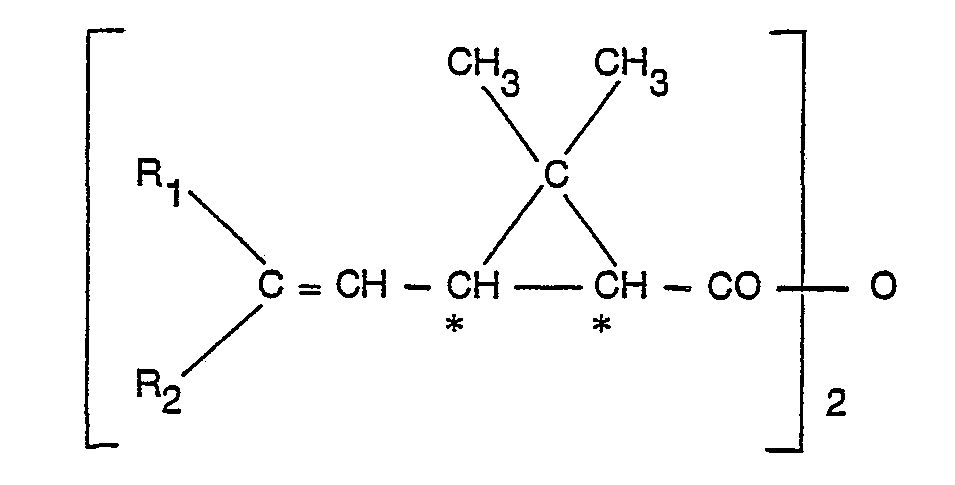
(wherein R1 and R2 separately represent hydrogen or alkyl of 1 to 4 carbons, or together with the carbon atom to which they are attached represent a cycloalkylidene group of 4 to 6 carbon atoms) with a Lewis acid.
(wherein R1 and R2 separately represent hydrogen or alkyl of 1 to 4 carbons, or together with the carbon atom to which they are attached represent a cycloalkylidene group of 4 to 6 carbon atoms) with a Lewis acid.
2. A process according to claim 1 wherein the optically active cyclopropane carboxylic
acid anhydride has been obtained by conversion in manner known per se from the corresponding
optically active cyclopropanecarboxylic acid of the formula,
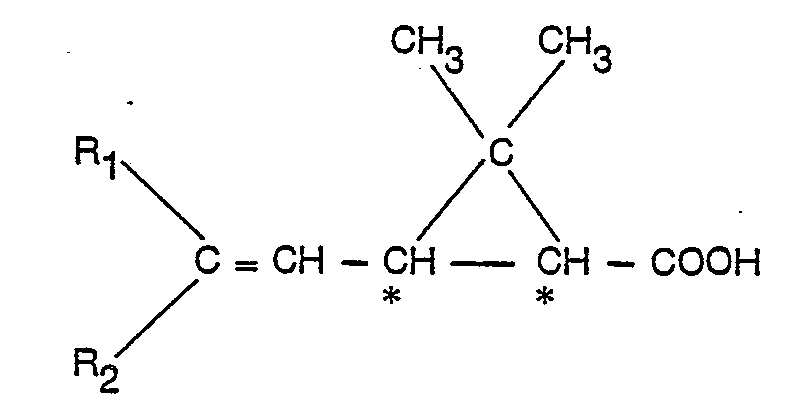
wherein R1 and R2 are as defined in claim 1.
wherein R1 and R2 are as defined in claim 1.
3. A process according to claims 1 or 2, wherein the Lewis acid is iodine or a metal
halide type Lewis acid.
4. A process according to claim 3, wherein the Lewis acid is ferric chloride, tin
tetrachloride, aluminum chloride, aluminum bromide, titanium chloride or zinc chloride.
5. A process according to any one of claims 1 to 4, wherein the treatment with a Lewis
acid is effected in an inert solvent.
6. A process according to claim 5, wherein the inert solvent is an ether, aromatic
hydrocarbon, halogen substituted aromatic hydrocarbon, aliphatic hydrocarbon or halogen
substituted aliphatic hydrocarbon.
7. A process according to any one of claims 1 to 6, wherein the amount of Lewis acid
is 1/1000 to 1/2 mol based on the acid anhydride.
8. A process according to any one of claims 1 to 7, wherein the reaction temperature
is from -50°C to the boiling temperature of the reaction system.
9. A process for preparing racemized cyclopropanecarboxylic acids, which comprises
hydrolyzing racemized cyclopropanecarboxylic acid anhydrides prepared by the process
of any one claims 1 to 8.
10. Use in an optical resolution process of racemized cyclopropanecarboxylic acids
or anhydrides prepared by a process as claimed in any one of the preceding claims
for the preparation of optically active (+)- form acids and esters thereof.
1. Procédé de racémisation d'un acide cyclopropanecarboxylique optiquement actif par
traitement par un acide de Lewis, caractérisé en ce qu'il consiste à préparer des
anhydrides. d'acide cyclopropanecarboxylique racémisés en traitant un anhydride d'acide
cyclopropanecarboxylique optiquement actif de formule:
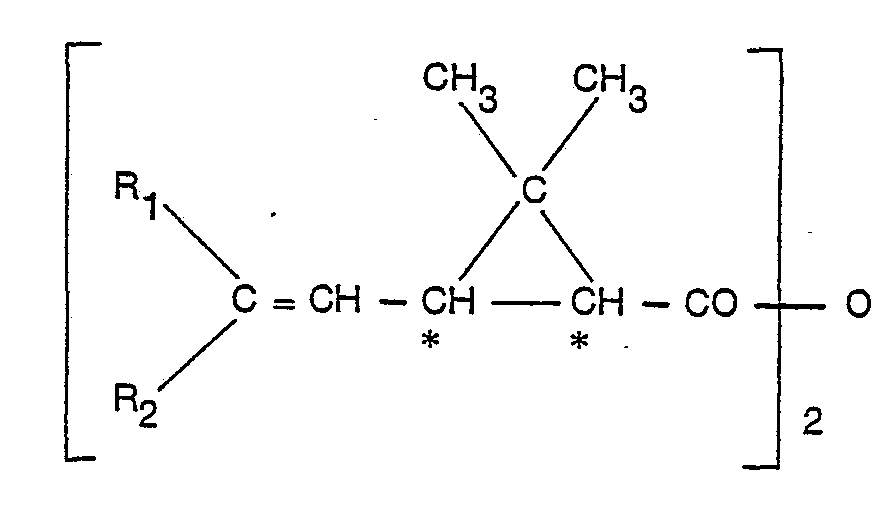
(dans laquelle R1 et R2 représentent, indépendamment, de l'hydrogène ou un alcoyle ayant de 1 à 4 atomes de carbone ou, ensemble avec l'atome de carbone auquel ils sont reliés, représentent un groupe cycloalcoylidène de 4 à 6 atomes de carbone) par un acide de Lewis.
(dans laquelle R1 et R2 représentent, indépendamment, de l'hydrogène ou un alcoyle ayant de 1 à 4 atomes de carbone ou, ensemble avec l'atome de carbone auquel ils sont reliés, représentent un groupe cycloalcoylidène de 4 à 6 atomes de carbone) par un acide de Lewis.
2. Procédé suivant la revendication 1, dans lequel l'anhydride d'acide cyclopropanecarboxylique
optiquement actif a été obtenu par conversion, d'une manière soi connue, de l'acide
cyclopropanecarboxylique, optiquement actif, correspondant de formule:
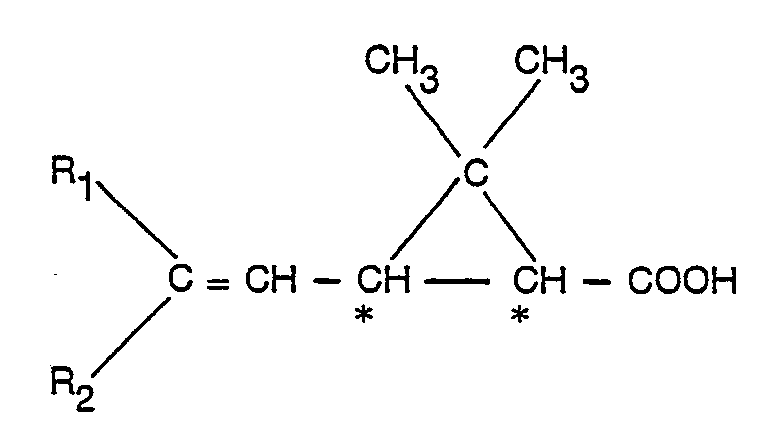
de laquelle R1 et R2 sont tels que définis à la revendication 1.
de laquelle R1 et R2 sont tels que définis à la revendication 1.
3. Procédé suivant les revendications 1 ou 2, caractérisé en ce que l'acide de Lewis
est de l'iode ou un acide de Lewis de type halogénure métallique.
4. Procédé suivant la revendication 3, dans lequel l'acide de Lewis est le chlorure
ferrique, le tétrachlorure d'étain, le chlorure d'aluminium, le bromure d'aluminium,
le chlorure de titane ou le chlorure de zinc.
5. Procédé suivant l'une des revendications 1 à 4, qui consiste à effectuer le traitement
par l'acide de Lewis dans un solvant inerte.
6. Procédé suivant la revendication 5, dans lequel le solvant inerte est un éther,
un hydrocarbure aromatique, un hydrocarbure aromatique halogéné, un hydrocarbure aliphatique
ou un hydrocarbure aliphatique halogéné.
7. Procédé suivant l'une de revendications 1 à 6, dans lequel la quantité d'acide
de Lewis est de 1/1000 à 1/2 mole par rapport à l'anhydride d'acide.
8. Procédé suivant l'une des revendications 1 à 7, dans lequel la température de la
réaction est comprise entre -50°C et le point d'ébullition du système réactionnel.
9. Procédé de préparation d'acides cyclopropanecarboxyliques racémisés, qui consiste
à hydrolyser des anhydrides d'acide cyclopropanecarboxylique racémisés préparés par
le procédé suivant l'une des revendications 1 à 8.
10. Utilisation dans un procédé de résolution optique d'acides ou d'anhydrides cyclopropanecarboxyliques
racémisés préparés par un procédé tel -que revendiqué dans l'une des revendications
précédentes, pour la préparation de leurs acides et de leurs esters, sous forme optiquement
active (+).
1. Verfahren zur Razemisierung einer optisch aktiven Cyclopropancarbonsäureverbindung
durch Behandlung mit einer Lewissäure, dadurch gekennzeichnet, daß man razemisierte
Cyclopropancarbonsäureanhydride dadurch herstellt, daß man ein optisch aktives Cyclopropancarbonsäureanhydrid
der Formel
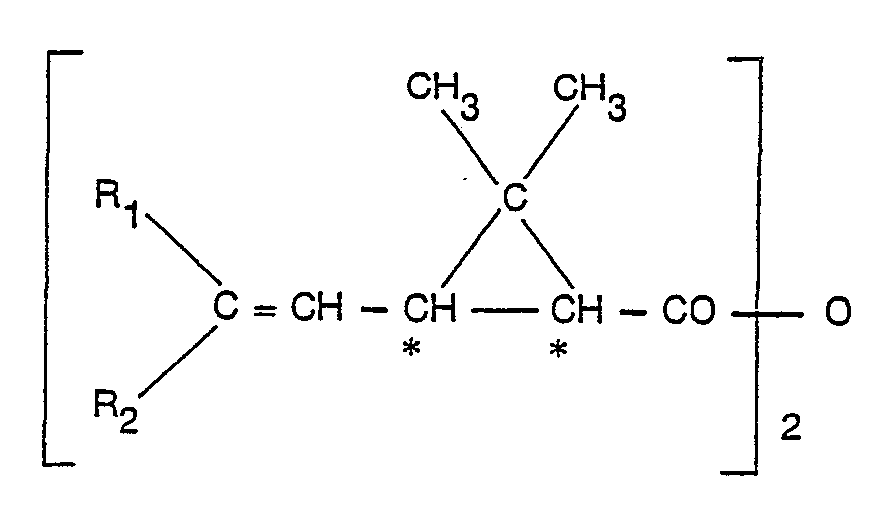
(worin R1 und R2 unabhängig voneinander für Wasserstoff oder Alkyl mit 1 bis 4 Kohlenstoffatomen stehen oder zusammen mit dem Kohlenstoffatom, an das sie angefügt sind, eine Cycloalkylidengruppe mit 4 bis 6 Kohlenstoffatomen bilden) mit einer Lewissäure behandelt.
(worin R1 und R2 unabhängig voneinander für Wasserstoff oder Alkyl mit 1 bis 4 Kohlenstoffatomen stehen oder zusammen mit dem Kohlenstoffatom, an das sie angefügt sind, eine Cycloalkylidengruppe mit 4 bis 6 Kohlenstoffatomen bilden) mit einer Lewissäure behandelt.
2. Verfahren nach Anspruch 1, dadurch gekennzeichnet, daß man ein optisch aktives
Cyclopropancarbonsäureanhydrid verwendet, das durch Umwandlung in an sich bekannter
Weise aus der entsprechenden optisch aktiven Cyclopropancarbonsäure der Formel
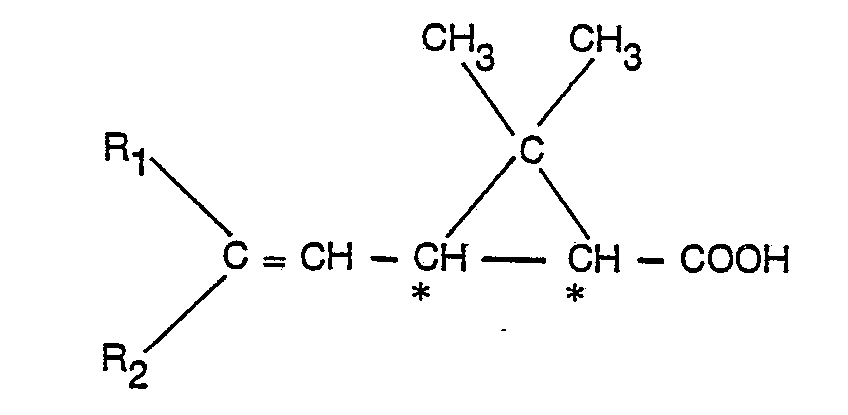
worin R1 und R2 wie in Anspruch 1 definiert sind, erhalten worden ist.
worin R1 und R2 wie in Anspruch 1 definiert sind, erhalten worden ist.
3. Verfahren nach Anspruch 1 oder 2, dadurch gekennzeichnet, daß die Lewissäure Jod
oder iene Lewissäure vom Metallhalogenidtyp ist.
4. Verfahren nach Anspruch 3, dadurch gekennzeichnet, daß die Lewissäure Eisen(lll)-Chlorid,
Zinntetrachlorid, Aluminiumchlorid, Aluminiumbromid, Titanchlorid oder Zinkchlorid
ist.
5. Verfahren nach einem der Ansprüche 1 bis 4, dadurch gekennzeichnet, daß man die
Behandlung mit einer Lewissäure in einem inerten Lösungsmittel durchführt.
6. Verfahren nach Anspruch 5, dadurch gekennzeichnet, daß das inerte Lösungsmittel
ein Ether, aromatischer Kohlenwasserstoff, ein mit Halogen substituierter aromatischer
Kohlenwasserstoff, aliphatischer Kohlenwasserstoff oder mit Halogen substituierter
aliphatischer Kohlenwasserstoff ist.
7. Verfahren nach einem der Ansprüche 1 bis 6, dadurch gekennzeichnet, daß die Menge
der Lewissäure 1/1000 bis 1/2 mol, bezogen auf das Säureanhydrid, beträgt.
8. Verfahren nach einem der Ansprüche 1 bis 7, dadurch gekennzeichnet, daß die Reaktionstemperatur
-50°C bis Siedetemperatur des Reaktionssystems ist.
9. Verfahren zur Herstellung von razemisierten Cyclopropancarbonsäuren, dadurch gekennzeichnet,
daß man nach dem Verfahren nach einem der Ansprüche 1 bis 8 hergestellte razemisierte
Cyclopropancarbonsäureanhydride hydrolysiert.
10.Verwendung der razemisierten Cyclopropancarbonsäuren oder-anhydride, hergestellt
nach einem Verfahren nach einem der vorstehenden Ansprüche, bei einem optischen Auflösungsverfahren
zur Herstellung von Säuren und Estern davon in optisch aktiver (+)-Form.