|
(11) | EP 0 062 016 B1 |

| (12) | EUROPEAN PATENT SPECIFICATION |
|
|
| (54) |
An aluminium chloride composition and a method for its manufacture Aluminiumchloridzusammensetzung und Verfahren zu ihrer Herstellung Composition de chlorure d'aluminium et procédé pour la produire |
|
|
|||||||||||||||||||||||||||||||
| Note: Within nine months from the publication of the mention of the grant of the European patent, any person may give notice to the European Patent Office of opposition to the European patent granted. Notice of opposition shall be filed in a written reasoned statement. It shall not be deemed to have been filed until the opposition fee has been paid. (Art. 99(1) European Patent Convention). |
Technical field
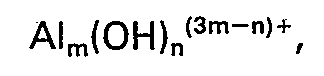
[0001] The present invention relates to an aluminium chloride composition for water-purifying, sludge-dewatering and plant-dewatering purposes, comprising a dear, stable aqueous solution of aluminium chloride containing polynuclear complexes of the kind
where m and n are positive integers.
Background of the invention
[0002] Two principally different kinds of aluminium chloride solutions containing such polynuclear complexes are known to the art. One kind is the so-called PAC-solutions which include polynuclear complexes, having a general empirical formula which can be written as:
where x is smaller than 3, normally 1-2.
[0003] Such compounds are described, for example, in SE-B-7201333-7, SE-B-7405237-4, SE-B-7412965-1, SE-B-7503641-8 and DE-A-2630768. A feature common to all PAC-type compositions containing aluminium chloride and based on polynuclear complexes is that extremely complicated methods are required to produce an effective solution, e.g. a solution which will effectively purify water, and hence the price demanded by the solutions is relatively high when seen against the effect they produce.
[0004] The other type of aluminium chloride-solutions, PALC, which are also based on the same polynuclear complex content as the PAC solutions, have the general, empirical formulae:
where A is an alkali metal, and
where B is an alkaline earth metal, and n is a positive integer, and x is a number in the range 1-2.7. PALC-type polynuclear aluminium chloride solutions are found described in FR-A-2 308 594 (=DE-A-2 617 282), according to which the solution are produced by alkalizing aluminium chloride solutions with solutions of alkali hydroxide. However, according to this published reference clear, stable solutions can not be produced, other than in highly diluted state. By "stable solution" is meant here and in the following a solution which remains unchanged with respect to its composition and properties, even when stored for long periods of time. Thus it is given in the aforementioned reference that a solution containing up to 0.40 mole AI per litre can be obtained under certain conditions. However, this solution has a greatly limited stability, and must be injected directly into the water to be purified. It is apparent from the publication, and in particular from the working examples therein, that solutions having a higher concentration of aluminium than approximately 0.1 mole/I can not be expected to be effective and stable in the known PALC-soiutions according to the publication.
[0005] However, an important advantage with this second type of polynuclear aluminium chloride composition, i.e. PALC-solutions, is that it ought to be possible to produce said solutions much more cheaply than the earlier discussed PAC-solutions, owing to the far less complicated production methods required, and thereby to compete with said PAC-solutions, provided that the PALC-solutions can be made sufficiently effective. The effectiveness of the solutions can only be increased by increasing either the total aluminium content of the solutions or the percentage of aluminium present in the form of polynuclear complexes, or by increasing both contents. Those PALC-solutions known hitherto have been unable to compete with the more expensive PAC-solutions because it has not been possible to produce PALC-solutions which will retain their stability at sufficiently high concentrations.
Disclosure of the present invention
[0006] It has now surprisingly been found possible to produce substantially improved PALC-solutions, which are not encumbered with the disadvantages and limitations normally credited to the above mentioned solutions. The invention is based on the surprising stabilizing effect obtained when using carbonates or hydrogen carbonates of alkali metals, or alkaline earth metals, or ammonium as an alkalizing agent in the preparation of the solutions. The stabilizing effect of the carbonate or hydrogen carbonate on the solutions has not been fully established. It has not been possible to show residues of carbonate in the solutions when applying conventional analyzing methods. Nevertheless, it would seem probable that extremely small trace quantities of residual carbonate are present and that these trace quantities co-act synergistically with the polynuclear complexes formed during the alkalization process, such that the resultant solutions remain stable over much wider concentration ranges and for much longer period of time than was previously possible.
[0007] The novel PALC-type aluminium chloride compositions including polynuclear complexes according to the present invention consist of a clear, stable aqueous solution of aluminium chloride containing polynuclear complexes of the kind
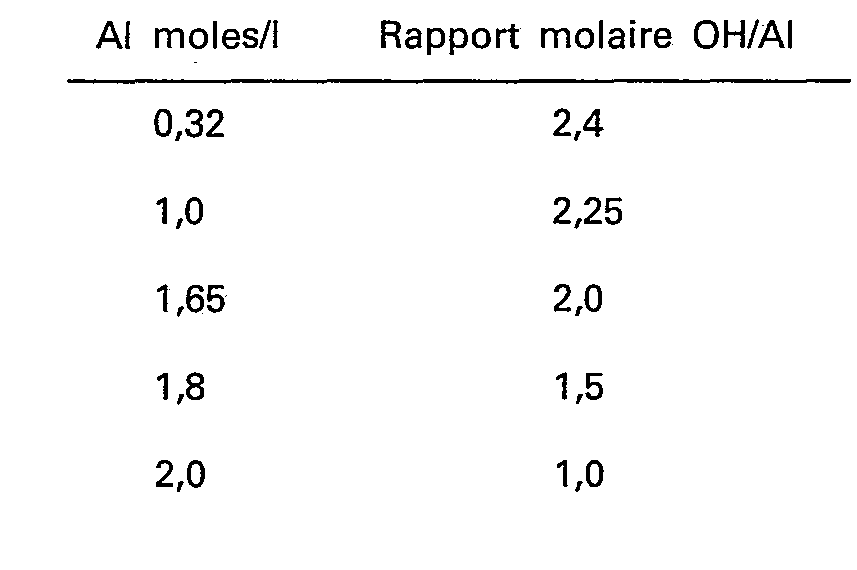
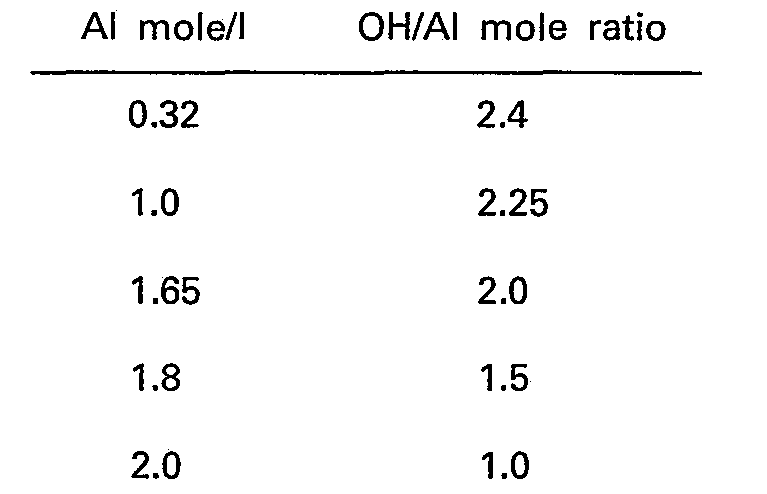
where m and n are positive integers, whereby the invention is characterized in that said composition is obtained by reacting a carbonate or hydrogen carbonate of alkali metal, alkaline earth metal, or ammonium with an aluminium chloride in an aqueous solution, whereby the composition contains one of alkali metal, alkaline earth metal, and/or ammonium in an amount which stoichiometrically corresponds to the OH-content of the solution; and that the total aluminium content is between 0.32 and 2 mole per litre, whereby at least 40% of the total aluminium content is present in the form of said polynuclear complexes and whereby in relation to the amount of aluminium present the ratio between the number of moles of OH and the total number of moles of aluminium present in the resultant solution does not exceed the value determined by the following associated values:
If so desired, compositions according to the invention can be obtained in which more than 80% of the aluminium content is present in the form of said polynuclear complex at a total aluminium content which does not exceed about 1.6 moles per litre.
[0008] The novel PALC-solutions according to the invention may thus contain from about 1.5 up to 8.3% by weight AI203, corresponding to an aluminium content of about 0.32-2.0 mole/I, depending on the desired polynuclear content, which in turn depends on the maximum extent to which the solutions can be alkalized without hydroxides precipitating out.
[0009] According to another aspect of the invention, there is provided a method for producing the novel aluminium chloride composition, said method being characterized by selecting the amount of aluminium chloride so that a given total aluminium content of between 0.32 and 2 mole per litre is obtained in the solution; and selecting the amount of carbonate or hydrogen carbonate so that in relation to the amount of aluminium chloride the ratio between the number of moles of OH and the total number of moles of aluminium in the resultant solution does not exceed the value determined by the associated values given above.
[0010] PALC-solutions according to the invention are suitably prepared by alkalizing concentrated AICI3- solutions with carbonate or hydrogen carbonate of an alkali metal, alkaline earth metal or ammonium. A suitable alkalizing agent is sodium carbonate, i.e., soda, since this is a particularly cheap raw material. The alkalizing process is relatively rapid at room temperature, and is normally finished in. less than 1 hour. Carbon dioxide is driven off during the alkalizing process, and hence the solution must be vigorously agitated during said process, so as to accelerate the expulsion of carbon dioxide. In concentrated solutions the extent to which the solutions can be alkalized is restricted by the solubility of the carbonate, and in more dilute solutions by the risk of aluminium hydroxide precipitating. Consequently, the degree of alkalization can never exceed 1.25 mole carbonate or. 2.5 mole hydrocarbonate per mole AICI3, i.e. an OH/AI- ratio=2.5: 1. Alternatively, alkalization may be carried out substantially simultaneously with the solution of solid aluminium chloride, without affecting the properties of the resultant solution.
[0011] In the following Table I there is given the maximum degree of alkalization, expressed as the mole ratio OH/Al at different total aluminium contents, Altot, in the solution, and the calculated degree of polynucleation. Polynucleation is expressed as the percentage of the total aluminium content present in the form of polynuclear complexes.
[0012] The prepared solutions remain stable for several months at room temperature, and can be diluted at least 10 times without risk of precipitation. The invention will now be described in more detail with reference to the following non-limitative examples, which illustrate the properties of the compositions as flocculating agents.
Example 1
[0013] 77.2 g of AICI3 6H20 (0.32 moles) were dissolved in 900 ml of water, whereupon 40.7 g of Na2C03 were added successively during violent stirring. C02 is allowed to leave the solution, whereafter the solution becomes clear. Water is added to a total volume of 1000 ml.
Example 2
[0014] PALC-solutions having different polynuclear contents (40, 80 and 90% respectively) were tested as flocculating agents on a laboratory scale and compared with three other flocculating agents, namely ALG, i.e. commercial granulated aluminium sulphate, FALS, i.e. alkalized aluminium sulphate solution, and a commercial PAC-quality (Sachtoklar). Clear solutions containing 0.32 moles AI per litre (corresponding to 100 g of ALG per litre) were prepared from these flocculating agents. The flocculating tests were carried out according to the following procedure. The chemicals were added to the water to be purified while rapidly agitating the water for 10 seconds, whereafter the formation of flocs was allowed to take place for twenty minutes while slowly stirring the water at a peripheral speed of 0.1 m per second. A period of 10 minutes was allowed for sedimentation, whereafter a 200 ml sample was sucked from the surface of the water for analysis. In a first series of tests, flocculating experiments were made on water taken from Lussebacken. The results of these tests are set forth in Table II. This Table shows the flocculating results firstly as the resultant residual turbidity expressed in FTU, i.e. Formazin Turbidity Units, whereat a high value corresponds to a high degree of turbidity, and secondly as a visual assessment of the formation of flocs, called "Flock". The results show that the PALC-solutions with the highest polynuclear content possessed better flocculating properties than both ALG and FALS and are fully comparable with the substantially more expensive PAC-products (Sachtoklar). Flocculation has been carried out with two different metered quantities of aluminium, namely 3.5 mg/l and 2.6 mg/I respectively. In a first series of tests, the flocculating chemicals were metered to the contaminated water without previously adjusting the pH, while in two experiments the pH was lowered somewhat prior to introducing the chemicals into the water.
Example 3
[0015] A second series of tests was carried out analogously with the procedure taken in Example 2, whereat flocculation was carried out on biologically purified sewage water taken from Helsingborg's sewage purification plant. The test results are set forth in Table III, which shows that the PALC-solutions containing the most polynucleates possessed better flocculating properties than ALG and FALS. The precipitation of phosphorous was approximately the same with all flocculating chemicals, but at the time of making the tests the sewage water contained very little phosphorous, less than 1 mg/I and hence these results are not generally applicable.
[0016] It has previously been known that products having a high content of polynuclear aluminium-hydroxide complexes, e.g. PAC, precipitate less phosphorous than aluminium sulphate in corresponding amounts, a fact which is partly compensated by the good floc separation, however. Tests have been carried out in which two different quantities were metered to the water, namely quantites corresponding to 8.6mg/1 AI and 4.3mg/I Al, as will be seen from Table III below.
1. An aluminium chloride composition for water-purifying, sludge-dewatering, retention
of fiber and filler in papermaking systems, and plant dewatering purposes, consisting
of a clear, stable aqueous solution of aluminium chloride containing polynuclear complexes
of the kind
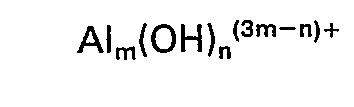
where m and n are positive integers, characterized in that said composition is obtained by reacting a carbonate or hydrogen carbonate of alkali metal, alkaline earth metal, or ammonium with an aluminium chloride in an aqueous solution, whereby the composition contains ions of alkali metal, alkaline earth metal, and/or ammonium in an amount which stoichiometrically corresponds to the OH-content of the solution; and that the total aluminium content is between 0.32 and 2 mole per litre, whereby at least 40% of the total aluminium content is present in the form of said polynuclear complexes and whereby the relation to the amount of aluminium present the ratio between the number of moles of OH and the total number of moles of aluminium present in the resultant solution does not exceed the value determined by the following associated values:
where m and n are positive integers, characterized in that said composition is obtained by reacting a carbonate or hydrogen carbonate of alkali metal, alkaline earth metal, or ammonium with an aluminium chloride in an aqueous solution, whereby the composition contains ions of alkali metal, alkaline earth metal, and/or ammonium in an amount which stoichiometrically corresponds to the OH-content of the solution; and that the total aluminium content is between 0.32 and 2 mole per litre, whereby at least 40% of the total aluminium content is present in the form of said polynuclear complexes and whereby the relation to the amount of aluminium present the ratio between the number of moles of OH and the total number of moles of aluminium present in the resultant solution does not exceed the value determined by the following associated values:
2. A composition according to claim 1, characterized in that more than 80% of the
aluminium content is present in the form of said polynuclear complexes at a total
aluminium content not exceeding 1.6 mole per litre.
3. A method for producing the composition according to any one of the preceeding claims,
by bringing a carbonate or hydrogen carbonate of alkali metal, alkaline earth metal,
or ammonium, and an aluminium chloride into aqueous solution, characterized by selecting
the amount of aluminium chloride so that a given total aluminium content of between
0.32 and 2 mole per litre is obtained in the solution; and selecting the amount of
carbonate or hydrogen carbonate so that in relation to the amount of aluminium chloride
the ratio between the number of moles of OH and the total number of moles of aluminium
in the resultant solution does not exceed the value determined by the following associated
values:
1. Aluminiumchloridzusammensetzung für die Wasserreinigung, Schlammentwässerung, Rückhaltung
von Fasern und Füllstoffen in Papierherstellungssystem und Anlagenentwässerung, bestehend
aus einer klaren beständigen wäßrigen Lösung von Aluminiumchlorid, die mehrkernige
Komplexe der Art
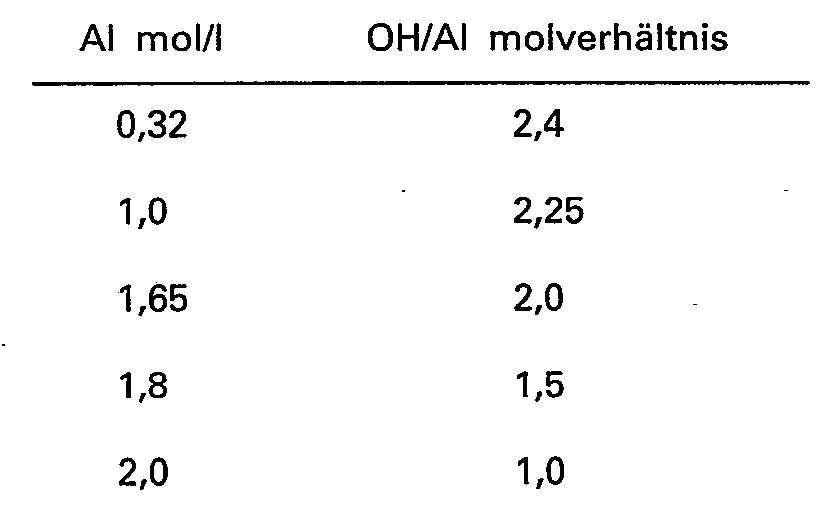
worin m und n positive ganze Zahlen sind, enthält, dadurch gekennzeichnet, daß die Zusammensetzung durch Umsetzung eines Alkali-, Erdalkali- oder Ammoniumcarbonats oder -hydrogencarbonats mit einem Aluminiumchlorid in einer wäßrigen Lösung erhalten wurde, wobei die Zusammensetzung Alkali-, Erdalkali- und/oder Ammoniumionen in einer Menge enthält, die stöchiometrisch dem OH-Gehalt der Lösung entspricht, und daß der Gesamtaluminiumgehalt zwischen 0,32 und 2 Mol je Liter liegt, wobei wenigstens 40% des Gesamtaluminiumgehaltes in der Form dieser mehrkernigen Komplexe vorliegen und wobei in Bezug auf die vorhandene Aluminiummenge das Verhältnis zwischen der OH-Molzahl und der Gesamtmolzahl an Aluminium in der resultierenden Lösung den Wert nicht übersteigt, der durch die folgenden miteinander verbundenen Werte bestimmt wird:
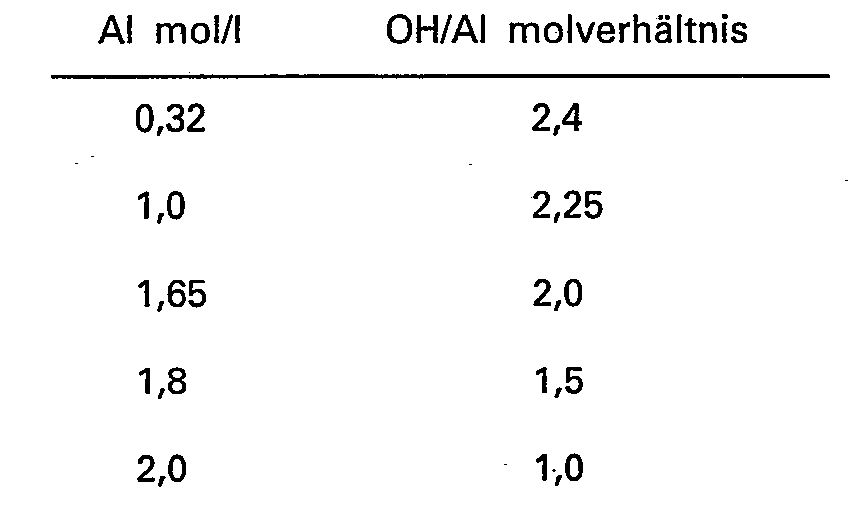
worin m und n positive ganze Zahlen sind, enthält, dadurch gekennzeichnet, daß die Zusammensetzung durch Umsetzung eines Alkali-, Erdalkali- oder Ammoniumcarbonats oder -hydrogencarbonats mit einem Aluminiumchlorid in einer wäßrigen Lösung erhalten wurde, wobei die Zusammensetzung Alkali-, Erdalkali- und/oder Ammoniumionen in einer Menge enthält, die stöchiometrisch dem OH-Gehalt der Lösung entspricht, und daß der Gesamtaluminiumgehalt zwischen 0,32 und 2 Mol je Liter liegt, wobei wenigstens 40% des Gesamtaluminiumgehaltes in der Form dieser mehrkernigen Komplexe vorliegen und wobei in Bezug auf die vorhandene Aluminiummenge das Verhältnis zwischen der OH-Molzahl und der Gesamtmolzahl an Aluminium in der resultierenden Lösung den Wert nicht übersteigt, der durch die folgenden miteinander verbundenen Werte bestimmt wird:
2. Zusammensetzung nach Anspruch 1, dadurch gekennzeichnet, daß mehr als 80% des Aluminiumgehaltes
in der Form der mehrkernigen Komplexe bei einem Gesamtaluminiumgehalt, der 1,6 Mol
je Liter nicht übersteigt, vorliegen.
3. Verfahren zur Herstellung der Zusammensetzung nach einem der vorausgehenden Ansprüche,
bei dem man ein Alkali-, Erdalkali- oder Ammoniumcarbonat oder -hydrogencarbonat und
ein Aluminiumchlorid in wäßrige Lösung bringt, dadurch gekennzeichnet, daß man die
Aluminiumchloridmenge derart auswählt, daß ein bestimmter Gesamtaluminiumgehalt zwischen
0,32 und 2 Mol je Liter in der Lösung erhalten wird, und die Carbonat- oder Hydrogencarbonatmenge
derart auswählt, daß in Bezug auf die Menge des Aluminiumchlorids das Verhältnis zwischen
der OH-Molzahl und der Gesamtmolzahl an Aluminium in der resultierenden Lösung den
Wert nicht übersteigt, der durch die folgenden miteinander verbundenen Werte bestimmt
wird:
1. Composition de chlorure d'aluminium pour des besoins de purification d'eaux, de
déshydratation de boues, de rétention de fibres et de charges dans des systèmes de
papeterie, et d'assèchement d'installations, consistant en une solution aqueuse, stable,
claire, de chlorure d'aluminium contenant des complexes polynucléaires du type:
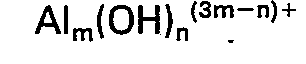
dans lequel m et n sont des nombres entiers positifs, caractérisée en ce qu'elle est obtenue par réaction d'un carbonate ou bicarbonate de métal alcalin, de métal alcalino-terreux ou d'ammonium, avec un chlorure d'aluminium en solution aqueuse, de manière que la composition contienne des ions de métal alcalin, de métal alcalinoterreux et/ou d'ammonium en une quantité qui corresponde, du point de vue stoechiométrique, à la teneur en OH de la solution, et que la teneur totale en aluminium soit comprise entre 0,32 et 2 moles par litre, de sorte qu'au moins 40% de la teneur totale en aluminium sont présents sous la forme des complexes polynucléaires susdits et de sorte que, en rapport avec la quantité d'aluminium présent, le rapport entre la nombre de moles de OH et le nombre total de moles d'aluminium présent dans la solution résultante ne dépasse pas la valeur déterminée par les valeurs associées suivantes:
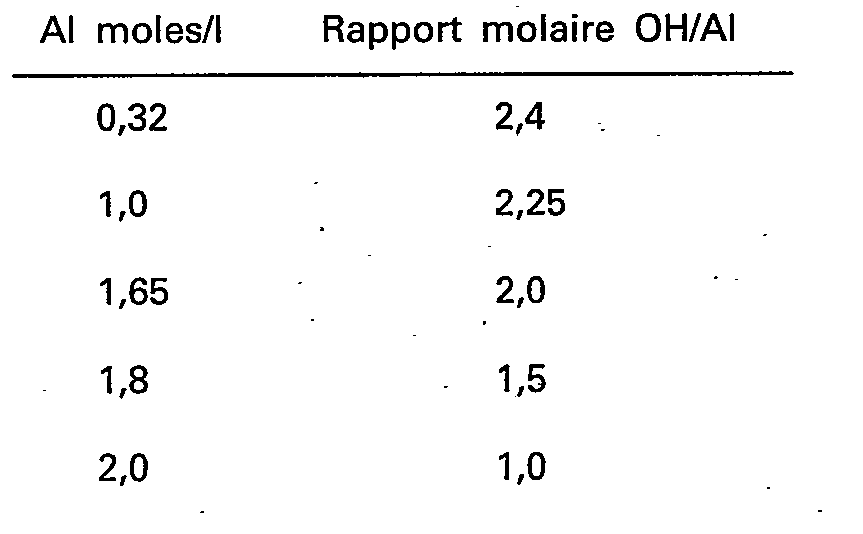
dans lequel m et n sont des nombres entiers positifs, caractérisée en ce qu'elle est obtenue par réaction d'un carbonate ou bicarbonate de métal alcalin, de métal alcalino-terreux ou d'ammonium, avec un chlorure d'aluminium en solution aqueuse, de manière que la composition contienne des ions de métal alcalin, de métal alcalinoterreux et/ou d'ammonium en une quantité qui corresponde, du point de vue stoechiométrique, à la teneur en OH de la solution, et que la teneur totale en aluminium soit comprise entre 0,32 et 2 moles par litre, de sorte qu'au moins 40% de la teneur totale en aluminium sont présents sous la forme des complexes polynucléaires susdits et de sorte que, en rapport avec la quantité d'aluminium présent, le rapport entre la nombre de moles de OH et le nombre total de moles d'aluminium présent dans la solution résultante ne dépasse pas la valeur déterminée par les valeurs associées suivantes:
2. Composition suivant la revendication 1, caractérisée en ce qu'il y a plus de 80%
de la teneur en aluminium, sous la forme des complexes polynucléaires susdits à une
teneur totale en aluminium ne dépassant 1,6 mole par litre.
3. Procédé de production de la composition suivant l'une ou l'autre des revendications
précédentes, par mise en solution aqueuse d'un carbonate ou bicarbonate de métal alcalin,
de métal alcalino-terreux ou d'ammonium, et d'un chlorure d'aluminium, caractérisé
par la sélection de la quantité de chlorure d'aluminium pour que l'on obtienne, dans
la solution, une teneur totale donnée en aluminium, comprise entre 0,32 et 2 moles
par litre, et la sélection de la quantité de carbonate ou de bicarbonate pour que,
en relation avec la quantité de chlorure d'aluminium, le rapport entre le nombre de
moles de OH et le nombre total de moles d'aluminium dans la solution résultante n'excède
pas la valeur déterminée par les valeurs associées suivantes: