| (19) |
 |
|
(11) |
EP 0 063 553 B1 |
| (12) |
EUROPEAN PATENT SPECIFICATION |
| (45) |
Mention of the grant of the patent: |
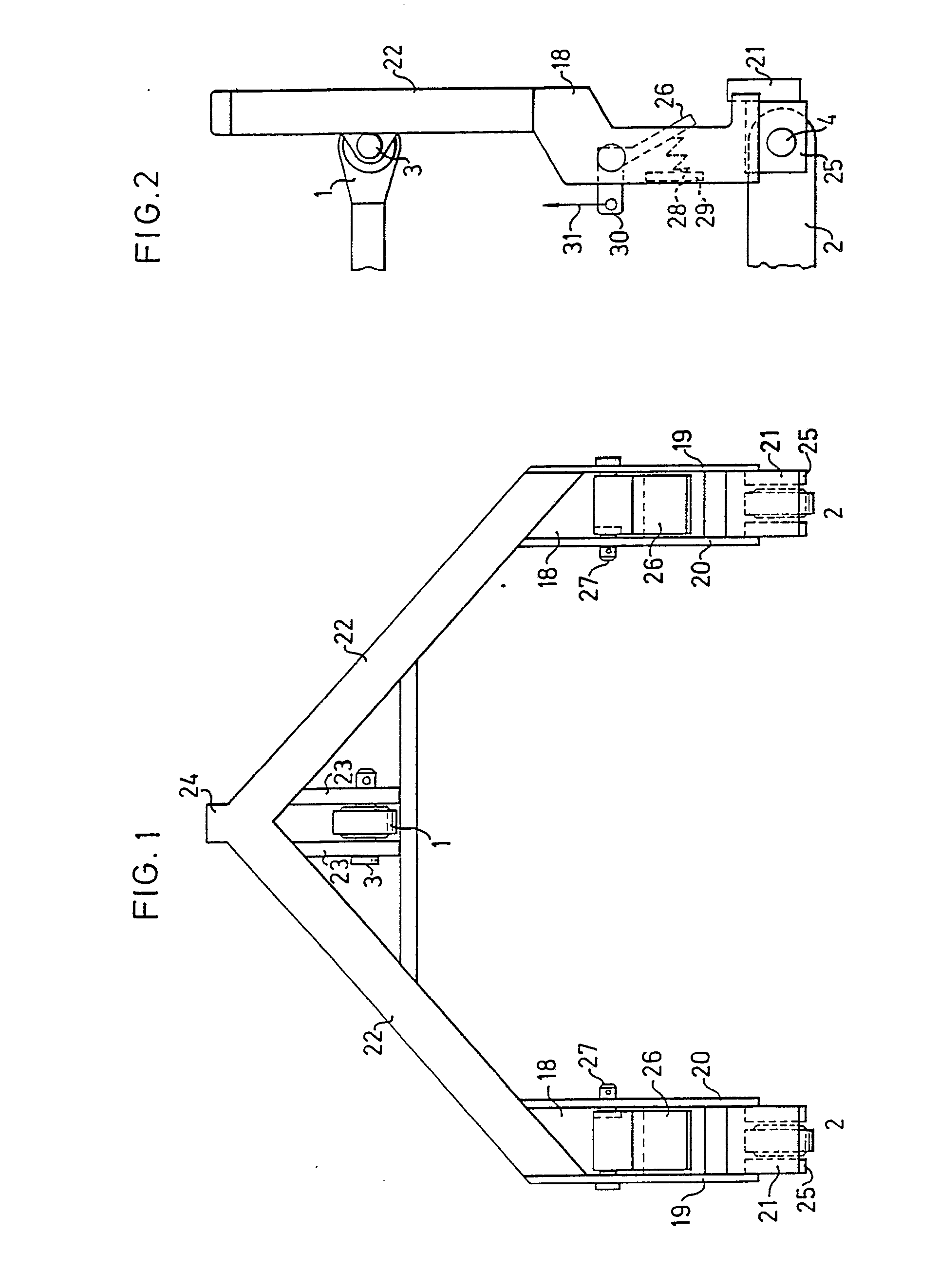
|
07.08.1985 Bulletin 1985/32 |
| (22) |
Date of filing: 07.04.1982 |
|
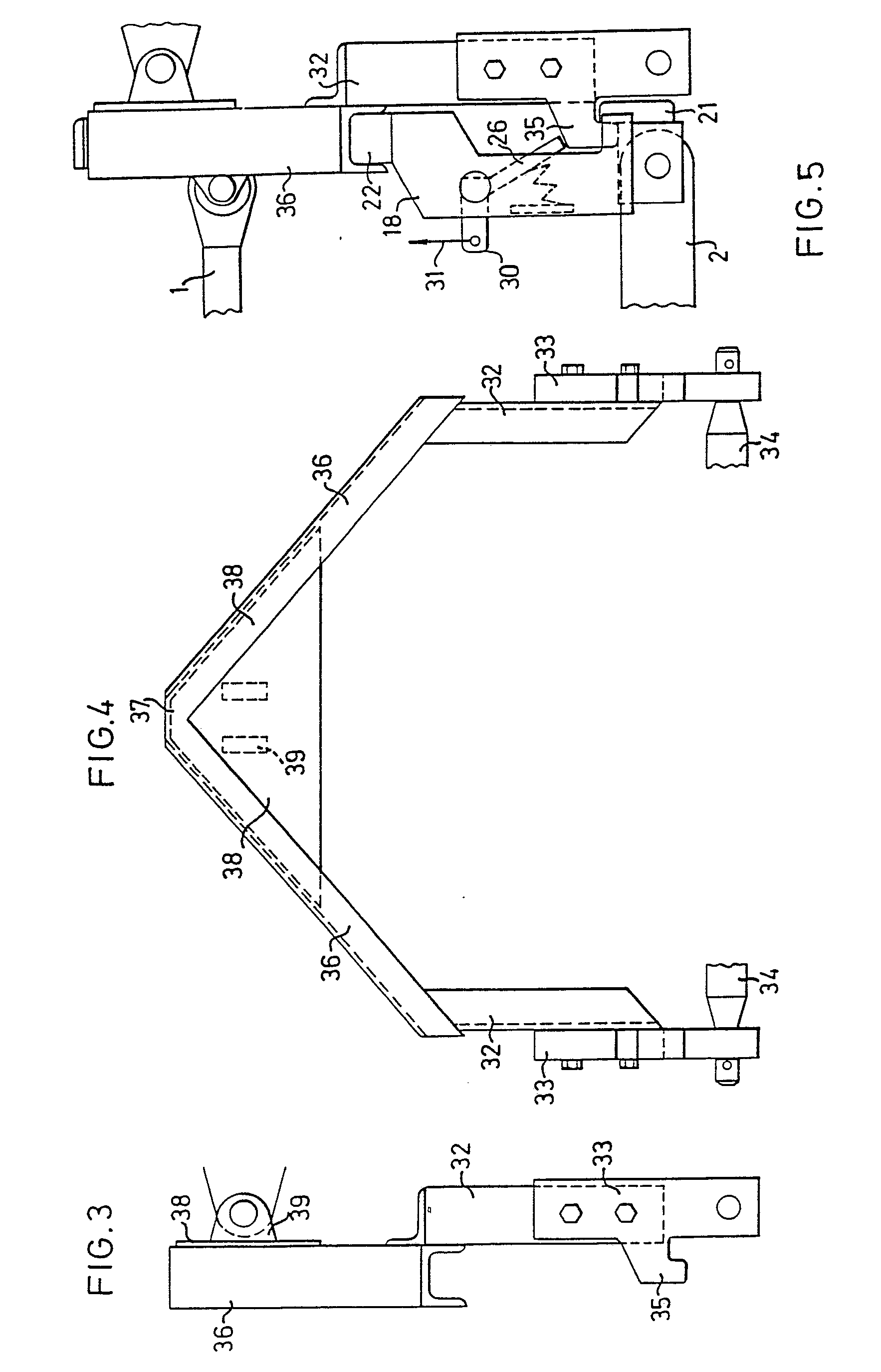
| (51) |
International Patent Classification (IPC)4: A01B 59/06 |
|
| (54) |
Arrangement for coupling an implement to a tractor
Vorrichtung zum Kuppeln eines Arbeitsgerätes an einen Traktor
Dispositif d'accouplement d'un instrument agricole à un tracteur
|
| (84) |
Designated Contracting States: |
|
CH DE FR GB IT LI NL SE |
| (30) |
Priority: |
15.04.1981 SE 8102431
|
| (43) |
Date of publication of application: |
|
27.10.1982 Bulletin 1982/43 |
| (71) |
Applicant: Tunamatic Handelsbolag |
|
S-633 52 Eskilstuna (SE) |
|
| (72) |
Inventors: |
|
- Nilsson, Rolf
S-633 52 Eskilstuna (SE)
- Lindström, Nils-Georg
S-64040 Stora Sundby (SE)
|
| (74) |
Representative: Kierkegaard, Lars-Olov et al |
|
H. Albihns Patentbyra AB,
P.O. Box 3137
103 62 Stockholm
103 62 Stockholm (SE) |
|
| |
|
| Note: Within nine months from the publication of the mention of the grant of the European
patent, any person may give notice to the European Patent Office of opposition to
the European patent
granted. Notice of opposition shall be filed in a written reasoned statement. It shall
not be deemed to
have been filed until the opposition fee has been paid. (Art. 99(1) European Patent
Convention).
|
[0001] A variety of different implements are coupled to tractors. Most of the implements
are coupled to the rear of the tractor, and some are front-mounted. Special towing
devices have been arranged for drawn implements. Many implements are completely or
partially carried by the tractor by coupling together the implement and a hydraulically
operated 3-point linkage on the tractor. To facilitate the use of the 3-point linkage,
there are special coupling devices which make it possible for the operator to couple
together the tractor and the implement while sitting in the operator's seat. The ideal
coupling device should meet the following requirements:
- The coupling operations must be easily actuated and controlled from the operator's
seat.
- The coupling device must provide for simple coupling and uncoupling without requiring
precision manoeuvring.
- The coupling device must provide positive coupling even when there is reasonable
obliqueness and/or lateral displacement of the tractor relative to the implement,
and move the implement only slightly during coupling.
- The coupling operation must be easily visible from the operator's seat.
- The coupling device must have a reliable locking mechanism the correct functioning
of which must be able to be checked from the operator's seat.
- The locking mechanism must not take up the forces transmitted between the tractor
and implement.
- The functioning of the locking mechanism must not be sensitive to dirt or ice.
- The coupling device must have a small longitudinal dimension so that the implement
can be coupled close to the tractor, thus providing good stability and steering capacity
for the tractor. For road use, there are legal requirements on the tractor front wheel
pressure against the road surface. If there is a large rear overhang, it can be necessary
to provide the front of the tractor with counterweights, providing undesirable increased
load on the wheels and axles, which should be avoided.
- The coupling device should provide a large space for parts extending from the implement,
e.g. spring loaded trigger devices for plows.
- The coupled tractor frame and implement frame must provide a stable union.
- The coupling device must not appreciably reduce the free space behind the tractor
in those cases where a protected power transmission shaft has been coupled to the
tractor power take-off.
- The coupling device must be safe especially in those cases where a person is forced
to work behind the tractor for connecting a power transmission shaft.
- The coupling device must be reasonable in capital outlay and simple in application.
[0002] The present invention relates to coupling devices as set out above and in particular
to a coupling device according to the preamble of the attached claim 1. Such a coupling
device is known from FR-A-1 402 458. A major drawback thereof is that it requires
good alignment between the tractor and the implement in order to make coupling possible:
even so, very delicate manoeuvring is called for. A further drawback is that the acute
angle between the frame legs do not leave enough space for parts protruding from the
implement. This makes it necessary to locate the implement coupling frame at the extreme
front or even in front of the implement, which thus is shifted to the rear with respect
to the tractor, creating an undesirable upturning moment on the tractor.
[0003] Further coupling devices of this kind are known from FR-A-1 408 514 and GB-A-1 103
555. Both of these have cross members interconnecting the lower ends of the sloping
frame legs. Such cross members even further impose on the cramped space at the rear
of the tractor and the front of the implement, making manual operations such as coupling
a power take-off difficult. GB-A-1 103 555 shows an implement frame made of downwardly
open channel members, which straddle the tractor frame in engaged position. While
this solution per se provides good looking properties, the known device still requires
precision manoeuvring of the tractor and the three-point linkage when coupling the
frames together.
[0004] The drawbacks of these known devices are eliminated and all the requirements listed
above are fulfilled by a coupling device according to the present invention having
the characteristic features set out in the attached claim 1.
[0005] Further advantages of the invention are realised with the features set out in the
sub-claims.
[0006] An embodiment of the inventive idea will be described in more detail with the aid
of the accompanying drawings of which:
Figure 1 shows a coupling device frame on a tractor, in rear view towards the tractor
Figure 2 shows the frame according to Fig. 1 as seen from the side
Figure 3 shows an interacting coupling device frame on the implement as seen from
the side
Figure 4 shows the frame of Fig. 3 viewed from the rear, in the normal direction of
movement of the tractor, and
Figure 5 shows a side view of the coupling device frames on the tractor and on the
implement in engaged position.
The Coupling Device Frame on the Tractor
[0008] The coupling device comprises two interengageable frames for attachment to the tractor
and the implement, resp.
[0009] As revealed in Figs. 1 and 2, the tractor coupling frame comprises two vertical frame
members 18 placed on either side of the line of symmetry of the tractor. Each of the
frame members consists of two side pieces 19 and 20 which are connected to an upwardly
open hook 21 at the bottom and facing away from the tractor. The side pieces 19 and
20 are joined at the top to an inclined guide beam 22. The symmetrically placed guide
beams 22 form together an inverted V with an angle between the guide beams which should
preferably be obtuse. At the top of the frame construction, a mount 23 is arranged
for attaching the top link 1 of the tractor three-point linkage. A special guide projection
24 is arranged on the top of the frame.
[0010] At the bottom of each frame member 18, there is a mount 25 for mounting the lower
hitch points 4 on the lower links 2 of the tractor three-point linkage.
[0011] The geometric dimensions of the frame construction are determined primarily by the
standardized distances between the lower hitch points 4 of the tractor and the vertical
distance between them and the upper connection point 3.
[0012] This design of the frame, which is opened downwards, provides a large interior free
space which is of importance.
[0013] Between the side pieces 19 and 20 there is placed a latch 26. It is pivotable about
a clevis pin 27 and is loaded by a spring 28 fixed at its other end against a spring
stop 29. The latch is provided with a lever 30 to which an operating means 31 has
been connected. By pulling the operating means 31, it is possible to pivot the latch
26 from a locking position to a release position.
[0014] The Coupling Device Frame on the Implement The implement coupling frame, Figs. 3
and 4, has two vertically placed frame members 32, each provided at the bottom with
a mount 33 for fixing the implement (exemplified here by the support bar 34 of a plow).
[0015] The frame members 32 are connected at the top to symmetrically placed coupling beams
36, which are U-beams with the legs pointing downwards. The distance between the legs
on the beams 36 is selected so as to let the coupling beams 36 straddle the guide
beams 22 of the tractor coupling frame in the coupling position.
[0016] The interior limiting surfaces of the coupling beams 36 coincide with the geometric
external shape of the guide beams 22 of the tractor frame. An opening 37 is arranged
at the top where the coupling beams 36 meet, said opening cooperating, for coupling,
with the guide projection 24 on the tractor coupling frame.
[0017] The mounts 33 are designed with downwardly open hooks 35 which face away from the
implement and are spaced so that they coincide with the position of the hooks 21 on
the tractor frame. The vertical distance from the lower edge of the coupling beams
36 to the lower edge of the hooks 35 corresponds to the vertical distance, in the
tractor coupling frame, from the top of the guide beams 22 to the top of the hooks
21.
[0018] A rear wall 38 is arranged on the upper portion of the implement coupling frame,
having the dual purposes of reinforcing the frame and assisting in the coupling together
of the frames. The rear wall is provided with a mount 39 which is to be coupled to
the corresponding hitch point on the implement.
[0019] Implement hitch points can vary greatly due to the variety of existing implements.
Therefore the mounting arrangement shown here is only to be regarded as one of many
examples.
Function
[0020] The coupling device frames are mounted on the tractor and on the implement, resp.
[0021] For coupling, the tractor is driven towards the implement. Before the tractor coupling
frame reaches the implement frame, the top of the tractor coupling frame is inclined
backwards somewhat by activating the hydraulic top link cylinder 1. With the aid of
the tractor, the guide projection 24 of the tractor coupling frame is moved towards
the downwardly directed coupling beams 36 of the implement coupling frame, the rear
wall 38 assisting in the guiding of the top of the tractor coupling frame. The guide
projection will then move between the legs of the coupling beams 36. By raising the
tractor coupling frame with the hydraulic lift of the tractor and at the same time
bringing the tractor coupling frame to a vertical position by reducing the length
of the top link 1 with the cylinder, the coupling beams 36 of the implement coupling
frame will slide onto the guide beams 22 of the tractor coupling frame. As the tractor
hydraulic system lifts and pulls the implement coupling frame towards the tractor
coupling frame, the hooks 35 on the implement coupling frame will be pulled in towards
and over the cooperating hooks 21 on the tractor coupling frame. At the end of the
coupling movement, the projection 24 on the tractor coupling frame is guided into
the opening 37 in the implement coupling frame. The coupling movement is ended when
the legs of the coupling beams 36 of the implement coupling frame are straddled over
the guide beams 22 of the tractor coupling frame. The coupling beams 36 of the implement
coupling frame descend over the guide beams 22 on the tractor coupling frame and at
the same time the lower hooks 35 engage the hooks 21 on the tractor coupling frame.
[0022] Towards the end of the coupling movement, the spring-loaded latch 26 has been pressed
in by the hook 35 and when the coupling between the tractor and implement coupling
frames is completed, the spring 28 presses the latch 26 back to the locking position.
The function of the latch 26 is to lock the frames together, and it does not participate
in the force transmission from the tractor coupling frame to the implement coupling
frame when the tractor with implement is in operation.
[0023] By looking at the lever 30 of the latch 26 it is possible for the operator to check
from the operator's seat that the latch has assumed the locking position.
[0024] The coupling can be carried out even if the tractor is displaced somewhat angularly
or laterally in relation to the implement. In the coupling operation, the coupling
beams 36 of the implement coupling frame will also be turned relative to the guide
beams 22 of the tractor coupling frame, until the positions of the coupling beams
and the guide beams coincide and the coupling is then completed.
[0025] If the implement is standing on uneven ground or when the implement is inclined laterally,
a lift rod gear on the three-point linkage can twist the tractor coupling frame so
that its lateral inclination agrees with that of the implement coupling frame.
[0026] Figure 5 shows the two coupling frames coupled completely together.
[0027] For uncoupling, the operating means 31 of the latches 26 are actuated by the tractor
operator so that the latches 26 release the hooks 35. The implement is then lowered
with the hydraulic lift so that the parking stands rest on the ground. As the lowering
movement is continued, the tractor coupling frame is lowered, and disengages from
the implement coupling frame. The lowering movement is effected only by the weight
of the lift means and the tractor coupling frame, and in order for the tractor coupling
frame to be lowered and freed from the implement coupling frame, it can be necessary
to extend or retract the hydraulic top link 1 if the tractor coupling frame and the
implement coupling frame have become stuck together.
[0028] The invention is not limited to the above embodiment. Rather it encompasses all variations
covered by the following claims. Thus, the coupling device can be applied not only
to 3-point tractor linkages, but also to a front-mounted tractor coupling for mounting
a front loader or other front-mounted tractor implement.
1. A tractor implement coupling device comprising a tractor coupling frame (18, 22)
having means (23, 25) for connection to a tractor three-point linkage (1, 2) or similar,
an implement coupling frame (36, 32) having means (39, 33) for connection to an implement
(34), each frame having the general shape of an inverted V, and being open downwards
between the V-legs (18, 32), the tractor coupling frame being arranged to be moved
upwardly into interengagement with the implement coupling frame, and locking means
(22, 36; 21, 35) at the top portions of the frames, by way of the upper part of the
tractor coupling frame engaged in the upper part of the implement coupling frame,
and also at the bottom portions of the frames by means of hooks of the tractor coupling
frame engaging parts of the implement coupling frame, all said locking means in the
engaged position of the frames preventing disengagement thereof, characterized in
that the legs of the tractor coupling frame are formed by guide beams (22), which
are joined at the apex, and by frame members (18) joined to the lower ends of the
guide beams (22) and extending vertically downward therefrom; that the legs of the
implement coupling frame are formed by coupling beams (36) of downwardly open U-section,
which are joined at the apex, and by frame members (32) joined to the lower ends of
the coupling beams (36) and extending vertically downward therefrom; that the internal
width of the open U-section of the coupling beams (36) is such that in the engaged
position of the frames the coupling beams (36) contain, in their open U-section, the
guide beams (22), thus forming said top locking means; that on the side facing the
opposite frame each vertical frame member (18; 32) is provided with a hook (21; 35)
at the lower end thereof, the hooks (21) of the tractor coupling frame (22,18) being
open upwards and the hooks (35) on the implement coupling frame (36, 32) being open
downwards; and that the vertical distance from the lower edge of the U-shaped coupling
beams (36) to the lower edge of the implement coupling frame hooks (35) corresponds
to the vertical distance from the top of the guide beams (22) to the top of the tractor
coupling frame hooks (21), thereby allowing positioning of the implement coupling
frame hooks (35) above the tractor coupling frame hooks (21) prior to complete engagement
of the tractor and implement coupling frames, whereas in the engaged position of the
frames with the coupling beams (36) straddling the guide beams (22), the tractor and
implement coupling frame hooks (21; 35) are interengaged.
2. A device according to Claim 1, characterized in that the apex angle of each coupling
frame (22, 18; 36, 32) is obtuse.
3. A device according to Claim 1 or 2, characterized in that the apex of the tractor
coupling frame is provided with a guide projection (24) which interacts with the coupling
beams (36) of the implement coupling frame during coupling, and, in full engagement,
penetrates into and up through an opening (37) at the apex of the implement coupling
frame, then becoming visible, indicating that the coupling frames are in engagement.
4. A device according to any one of Claims 1-3, characterized in that the upper portion
of the implement coupling frame is provided with a rear wall (38) which reinforces
the frame and facilitates engagement of the tractor and implement coupling frames.
5. A device according to any one of Claims 1-4, characterized in that the tractor
coupling frame is provided with spring-loaded latches (26) which in the coupled position
of the tractor and implement coupling frames assume a locking position preventing
disengagement of the frames; and that the latches are pivotable against the spring
action to a release position permitting disengagement of the frames.
6. A device according to Claim 5, characterized in that the latches (26) are pivotable
to their release position by actuating an operating mechanism, wire, Bowden cable
or the like, from the operator's seat.
7. A device according to Claim 5 or 6, characterized in that the respective latch
(26) is provided with a lever (30) visible from the operator's seat and indicating
by its position whether the latch assumes its locking position.
1. Dispositif d'attelage d'un outil de tracteur comportant un bâti d'attelage de tracteur
(18, 22) ayant des moyens (23, 25) pour se raccorder à un attelage trois points de
tracteur (1, 2) ou à un dispositif similaire, un bâti d'attelage d'outil (36, 32)
ayant des moyens (39, 33) pour se raccorder à un outil (34), chaque bâti ayant la
forme générale d'un V inversé et étant ouvert vers le bas entre les branches du V
(18, 32), le bâti d'attelage du tracteur étant disposé pour être déplacé vers le haut
pour coopérer avec le bâti d'attelage de l'outil, et des moyens de verrouillage (22,
36; 21, 35) situés dans les portions supérieurs des bâtis, par le fait que la partie
supérieure de bâti d'attelage du tracteur coopère avec la partie supérieure du bâti
d'attelage de l'outil, et également au niveau des portions inférieures des bâtis au
moyen de crochets du bâti d'attelage du tracteur venant en prise avec des parties
du bâti d'attelage de l'outil, tous ces moyens de verrouillage empêchant, lorsque
les bâtis sont couplés ensemble, leur dégagement, caractérisé en ce que les branches
du bâti d'attelage du tracteur sont formées par des profilés de guidage (22) qui sont
reliés à leurs sommets et par des éléments de bâti (18) reliés aux extrémités inférieurs
des profilés de guidage (22) et s'en étendant verticalement vers le bas, en ce que
les branches du bâti d'attelage de l'outil sont formées par des profilés d'attelage
(36) de section en U ouverte vers le bas, qui sont reliés à leurs sommets, et par
des éléments de bâti (32) reliés aux extrémités inférieures des profilés d'attelage
(36) et s'en étendant verticalement vers le bas, en ce que la largeur intérieure de
la section en U ouvert des profilés d'attelage (36) est telle que, lorsque les bâtis
sont couplés ensemble, les profilés d'attelage (36) renferment dans leurs sections
en U ouvert les profilés de guidage (22), formant ainsi les moyens de verrouillage
supérieurs; en ce que, sur le côté en vis-à-vis du bâti opposé, chaque élément de
bâti vertical (18, 32) est équipé d'un crochet (21, 35) à son extrémité inférieure,
les crochets (21) du bâti d'attelage du tracteur (22, 18) étant ouverts vers le haut
et les crochets (35) du bâti d'attelage de l'outil (36, 32) étant ouverts vers le
bas, et en ce que la distance verticale entre le bord intérieur des profilés d'attelage
en forme de U (36) justu'au bord inférieur des crochets (35) du bâti d'attelage de
l'outil correspond à la distance verticale du sommet des profilés de guidage (22)
au sommet des crochets (21) du bâti d'attelage du tracteur, permettant ainsi de positionner
les crochets (35) du bâti d'attelage de l'outil sur les crochets (21) du bâti d'attelage
du tracteur avant accouplement complet des bâtis d'attelage du tracteur et de l'outil,
tandis que, lorsque les bâtis sont couplés ensemble avec les profilés d'attelage (36)
recouvrant les profilés de guidage (22), les crochets (21, 35) des bâtis d'attelage
du tracteur et de l'outil coopèrent totalement ensemble.
2. Dispositif selon la revendication 1, caractérisé en ce que l'angle au sommet de
chaque bâti d'attelage (22, 18; 36, 32) est obtus.
3. Dispositif selon la revendication 1 ou 2, caractérisé en ce que le sommet du bâti
d'attelage du tracteur est équipé d'une saillie de guidage (24) qui coppère avec les
profilés d'attelage (36) du bâti d'attelage de l'outil lors de l'opération d'attelage
et que, lorsque la coopération est totale, cette saillie pénètre à travers une ouverture
(37) au sommet du bâti d'attelage de l'outil, devenant ainsi visible et indiquant
que les bâtis d'attelage sont bien couplés l'un avec l'autre.
4. Dispositif selon l'une quelconque des revendications 1 à 3, caractérisé en ce que
la partie supérieure du bâti d'attelage de l'outil est équipée d'une paroi arrière
(38) qui renforce le bâti et facilite l'accouplement des bâtis d'attelage du tracteur
et de l'outil.
5. Dispositif selon l'une quelconque des revendications 1 à 4, caractérisé en ce que
le bâti d'attelage du tracteur est équipé de verrous (26) assujettis à des ressorts
qui, dans la position accouplée des bâtis d'attelage du tracteur et del'outil, prend
une position de verrouillage empêchant le dégagement des bâtis et en ce que les verrous
peuvent pivoter contre l'action des ressorts jusqu'à une position de libération permettant
le dégagement des bâtis.
6. Dispositif selon la revendication 5, caractérisé en ce que les verrous (26) peuvent
pivoter jusqu'à leur position de libération par l'actionnement d'un mécanisme de commande,
câble, câble Bowden, ou l'analogue, depuis le siège de l'utilisateur.
7. Dispositif selon la revendication 5 ou 6, caractérisé en ce que le verrou respectif
(26) est équipé d'un levier (30) visible du siège de l'utilisateur et indiquant par
sa position si le verrou est bien en position de verrouillage.
1. Vorrichtung zum Kuppeln eines Arbeitsgerätes an einen Traktor, mit einem Traktor-Kupplungsrahmen
(18, 22) mit einer Einrichtung (23, 25) zum Anschließen an ein Traktor-Dreipunktgestänge
(1, 2) oder dgl., einem Arbeitsgerät-Kupplungsrahmen (36, 32) mit einer Einrichtung
(39, 33) zum Anschließen an ein Arbeitsgerät (34), wobei jeder Rahmen die allgemeine
Gestalt eines umgekehrten V hat und zwischen den V-Schenkeln (18, 32) nach unten offen
ist und der Traktor-Kupplungsrahmen nach oben in den Eingriff mit dem Arbeitsgerät-Kupplungsrahmen
bewegbar ist, und einer Verriegelungseinrichtung (22, 36; 21, 35) an den Kopfabschnitten
der Rahmen für den Eingriff des oberen Teils des Traktor-Kupplungsrahmens in den oberen
Teil des Argeitsgerät-Kupplungsrahmens, und an den Bodenabschnitten der Rahmen in
Form von Haken des Traktor-Kupplungsrahmens, die in Teile des Arbeitsgerät-Kupplungsrahmens
eingreifen, wobei von sämtlichen der genannten Verriegelungsteilen in der Eingriffsposition
der Rahmen verhindert wird, daß diese sich voneinander lösen, dadurch gekennzeichnet,
daß die Schenkel des Traktor-Kupplungsrahmens aus Führungsträgern (22), die an dem
Scheitel miteinander verbunden sind, und von Rahmenteilen (18) gebildet werden, die
an den unteren Enden der Führungsträger (22) angeschlossen sind und sich von dort
aus vertikal nach unten erstrecken, daß die Schenkel des Arbeitsgerät-Kupplungsrahmens
von an dem Scheitel miteinander verbundenen Kupplunsträgern (36) mit nach unten offenem
U-Querschnitt und von Rahmenteilen (32) gebildet werden, die an die unteren Enden
der Kupplungsträger (36) angeschlossen sind und sich von dort vertikal nach unten
erstrecken, daß die Innenweite des offenen U-Querschnitts der Kupplungsträger (36)
derart ist, daß in der Eingriffsstellung der Rahmen die Kupplungsträger (36) die Führungsträger
(22) in ihrem offenen U-querschnitt enthalten und in dieser Weise die Kopfverriegelungseinrichtung
ausbilden, daß an der dem gegenüberliegenden Rahmen zugewendeten Seite jeder vertikale
Rahmenteil (18; 32) mit einem Haken (21; 35) am unteren Ende versehen ist, wobei die
Haken (21) des Traktor-Kupplungsrahmens (22, 18) nach oben und die Haken (35) des
Arbeitsgerät-Kupplungsrahmens - (36, 32) nach unten offen sind, und daß der vertikale
Abstand des unteren Randes der U-förmigen Kupplungsträger (36) von dem oberen Rand
der Haken (35) des Arbeitsgerät-Kupplungsrahmens dem vertikalen Abstand des Kopfes
der Führungsträger (22) von dem Kopf der Haken (21) des Traktor-Kupplungsrahmens entspricht
und dadurch das Anordnen der Haken (35) des Artbeitsgerät-Kupplungsrahmens über den
Haken (21) des Traktor-Kupplungsrahmens vor dem Vollständigen Ineinandergreifen der
Kupplungsrahmen des Traktors und des Arbeitsgeräts zugelassen ist, wohingegen in der
Eingriffsposition der Rahmen, in welcher die Kupplungsträger (36) auf den Führungsträgern
(32) reiten, die Haken (21; 35) des Kupplungsrahmens des Traktors und des Arbeitsgerätes
ineinandergreifen.
2. Vorrichtung nach Anspruch 1, dadurch gekennzeichnet, daß der Scheitelwinkel jedes
Kupplungsrahmens (22, 18; 36, 32) ein stumpfer Winkel ist.
3. Vorrichtung nach Anspruch 1 oder 2, dadurch gekennzeichnet, daß der Scheitel des
Traktor-Kupplungsrahmens mit einem Führungsansatz (24) versehen ist, der während des
Kuppelns mit den Kupplungsträgern (36) des Arbeitsgerät-Kupplungsrahmens zusammenwirkt
und beim vollständigen Ineinandergreifen derselben in eine Öffnung (37) am Scheitel
des Arbeitsgerät-Kupplungsrahmens eindringt und durch die Öffnung hindurchdringt und
dann zum Anzeigen, daß die Kupplungsrahmen im Eingriff sind, sichtbar wird.
4. Vorrichtung nach einem der Ansprüche 1 bis 3, dadurch gekennzeichnet, daß der obere
Teil des Arbeitsgerät-Kupplungsrahmens mit einer Rückwand (38) versehen ist, von welcher
der Rahmen versteift wird und der Eingriff des Kupplungsrahmens des Traktors und des
Kupplungsrahmens des Arbeitsgeräts begünstigt wird.
5. Vorrichtung nach einem der Ansprüche 1 bis 4, dadurch gekennzeichnet, daß der Traktor-Kupplungsrahmen
mit federbelasteten Klinken (26) versehen ist, die in der Kupplungsposition der Kupplungsrahmen
des Traktors und des Arbeitsgeräts eine Verriegelungsposition einnehmen und das Lösen
der Rahmen voneinander verhindern, und daß die Klinken gegen die Kraft der Feder in
eine Entriegelungsposition schwenkbar sind, in welcher das Lösen der Rahmen voneinander
zugelassen ist.
6. Vorrichtung nach Anspruch 5, dadurch gekennzeichnet, daß die Klinken (26) in ihre
Entriegelungsposition durch Betätigen eines Betätigungsmechanismus, eines Drahtes,
einen Bowdenzugs oder dgl. vom Bedienungssitz aus schwenkbar sind.
7. Vorrichtung nach Anspruch 5 oder 6 dadurch gekennzeichnet, daß die jeweilige Klinke
(26) mit einem Hebel (30) versehen ist, der von dem Bedienungssitz aus sichtbar ist
und durch seine Position anzeigt, ob die Klinke ihre Verriegelungsposition einnimmt.