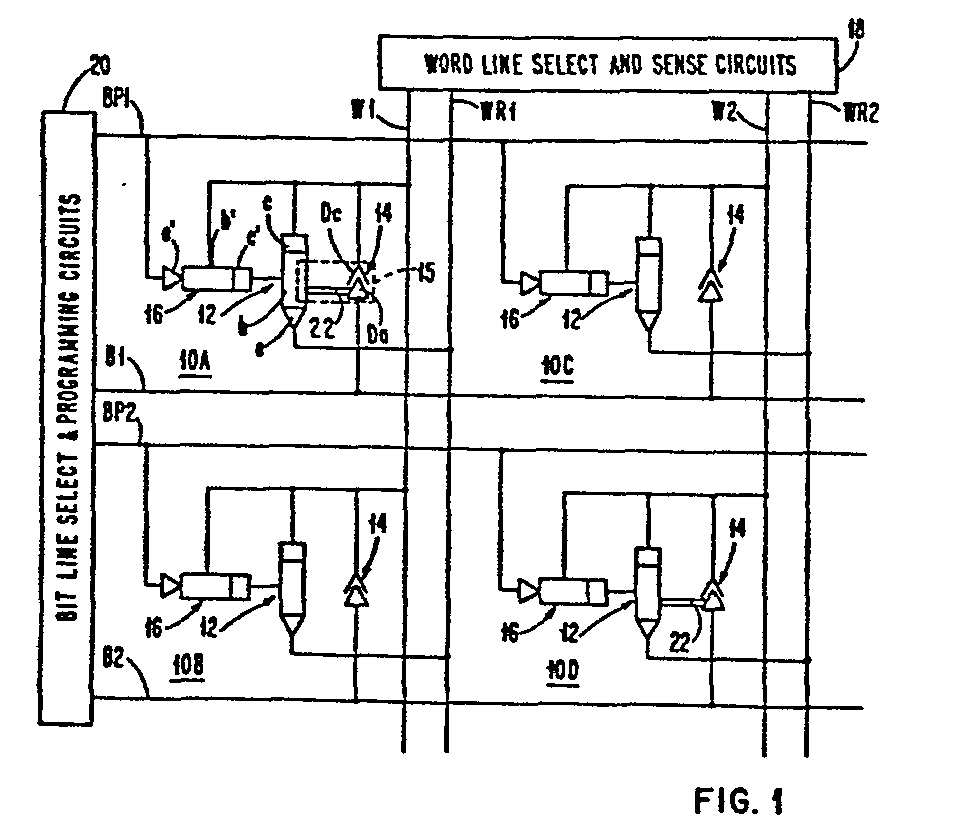
(57) A switchable bipolar structure, suitable for use in a programmable read only memory,
is provided which includes a rectifying contact (Da) disposed on a N type semiconductor
substrate (28) with a P type diffusion region formed in the substrate spaced within
a minority carrier diffusion length from the rectifying contact. A conductive filament
(22) is selectively formed between the rectifying contact (Da) and the P type diffusion
region by applying a reverse bias voltage between the rectifying contact and the N
type substrate having a magnitude sufficiently large so as to form a liquid alloy
having a front moving in the direction of current flow. By maintaining the P type
diffusion region at a positive voltage with respect to the voltage on the rectifying
contact, the liquid alloy front moves from the rectifying contact to the P type diffusion
region forming a conductive filament or segment therebetween. If the rectifying contact
(Da) is aluminum and the semiconductor substrate (28) is made of silicon, the filament
(22) becomes a silicide made of aluminum and silicon. By arranging the rectifying
contact within a minority carrier diffusion length of, e.g., the base of a NPN transistor
(12), a dense programmable read only memory system may be formed which is programmed
by merely applying appropriate pulses of relatively low magnitude to the access lines
of the memory system after the system has been fabricated. Alternatively, a dense
Schottky barrier diode (14) read only memory system may be provided by arranging a
first rectifying contact within a minority carrier diffusion length of a P type diffusion
region which is connected to a second rectifying contact of a Schottky barrier diode
to selectively provide parallel current paths through the two rectifying contacts.
In either embodiment, the presence or absence of the filament (22) corresponds to
the storing of a 0 or 1 binary digit of information in the memory systems.
|
|
