|
(11) | EP 0 067 569 B1 |

| (12) | EUROPEAN PATENT SPECIFICATION |
|
|
| (54) |
Thiazolidine derivatives Thiazolidin-Derivate Dérivés de thiazolidine |
|
|
|||||||||||||||||||||||||||||||
| Note: Within nine months from the publication of the mention of the grant of the European patent, any person may give notice to the European Patent Office of opposition to the European patent granted. Notice of opposition shall be filed in a written reasoned statement. It shall not be deemed to have been filed until the opposition fee has been paid. (Art. 99(1) European Patent Convention). |
[0001] An immunomodulator is a compound which regulates the immune response. Accordingly, it covers both immunostimulation and immunoinhibition. Certain immunomodulators are known, however, a carboxy thiazolidine derivative having immunomodulatory action was not previously known.
[0002] This invention relates to novel thiazolidine derivatives which are useful immunomodulators, more especially to a thiazolidine derivative of the formula
wherein R1 and R2 are each alkyl having 1 to 3 carbon atoms, or R1 and R2 together with the nitrogen atom to which they are attached form morpholino, piperazino, piperidino or pyrrolidino, each one of which is optionally substituted with 1 or 2 methyl groups and the pharmaceutically acceptable salts thereof.
[0003] Preferred compounds of the present invention are the compounds of formula I wherein R1 and R2 are each alkyl having 1 or 2 carbon atoms, and R1 and R2 together with the nitrogen atom to which they are attached form pyrrolidino, morpholino, piperidino, 3,5-dimethylpiperidino and 4-methylpiperazino.
[0004] The most preferred compounds of the present invention are the compounds of formula I wherein R1 and R2 are each methyl, and R1 and R2 together with the nitrogen atom to which they are attached form 4-methylpiperazino.
[0005] The compound of formula I may be, for example, prepared by condensing penicillamine with an acetvlacetamide of the formula
wherein R1 and R2 are as defined above.
[0006] This condensation may be carried out with or without a condensing agent in the presence or absence of a solvent, at room temperature to the refluxed temperature of the solvent used.
[0007] The reaction time may be widely varied from tens of minutes to tens of hours depending upon the reaction conditions such as the variety and amount of the solvent and the condensing agent, and reaction temperature employed. However, the reaction is completed within several hours in many cases.
[0008] Examples of the solvent employed are organic solvents, for example, a protic solvent (e.g., methyl alcohol, ethyl alcohol, or isopropyl alcohol), and an aprotic solvent (e.g. benzene, chloroform, isopropyl ether, tetrahydrofuran, ethyl acetate or dimethylformamide). These solvents may be used either alone or mixed with each other.
[0009] Examples of the condensing agent are neutral substances capable of capturing water formed by condensation (e.g. magnesiuim sulfate or a molecular sieve). Alternatively, the water formed by the condensation can be removed azeotropically without any condensing agent.
[0010] The compounds of formula 1 may be converted in a conventional manner to the pharmaceutically acceptable salts thereof such as an alkali metal (e.g. sodium) salt, or an alkaline earth metal (e.g. calcium) salt.
[0011] The compound of formula II may be prepared, for example, by the reaction of diketone with a secondary amine of the formula
wherein R1 and R2 are as defined above. The compound of formula II prepared by the above reaction may be directly used without isolation as the starting material in the method for preparing the compounds of formula I described above.
[0012] The compounds of the present invention are useful immunomodulators in mammals for the treatment of autoimmune diseases induced by irregular stimulation or inhibition of immunity, e.g. rheumatoid arthritis, autoimmune hemolytic anemia, and lupoid hepatitis.
[0013] The compounds of the present invention are formulated for use as immunomodulators according to pharmaceutical practice in oral dosage forms such as tablets, capsules or powders, or in a subcutaneously injectable form in a sterile aqueous vehicle prepared in according to conventional pharmaceutical practice. 1-3 divided daily doses provided on a basis of 90 to 1500 mg/ 70 kg/day are appropriate.
[0014] The 50% lethal dose of each compound of the present invention in male or female ddY strain mice is in excess of 10000 mg/kg of the body weight.
Example 1
[0016] A suspension of 2.00 g (13.4 mmoles) of D-penicillamine and 1.73 g (13.4 mmoles) of N,N-dimethylacetoacetamide in 15 ml of dry benzene, and 0.6 g of anhydrous magnesium sulfate was refluxed for 3.5 hours under a stream of argon. The reaction mixture became clear and then the solvent was distilled off. The resulting residue was dissolved in hot methyl alcohol. Insolubles were removed by filtration and the solvent was again distilled off. The residue was crystallized from chloroform and further recrystallized from ethyl alcohol - ether to give 2.3 g of 4-carboxy-2,5,5-trimethylthiazolidine-2-N,N-dimethylacetamide as colorless prisms.
Yield: 66%
m.p. 140-142°C
IR (Nujol): 3560, 3450, 1595 cm-1
NMR (CDCI3)
δ=1.33(3H, s), 1.70(3H, s), 1.75(3H, s), 3.00 (3H, s), 3.10 (3H, s), 4.07 (1H, s)
Example 2
[0017] In 40 ml of a mixture of chloroform and ethyl alcohol (1:1) were suspended 1.49 g (10 mmoles) of D-penicillamine and 1.89 g (15 mmoles) of N,N-dimethylacetoacetamide. The suspension was heated at 80-90°C with stirring under a stream of argon to concentrate to a half its volume. 20 ml of a mixture of chloroform and ethyl alcohol (1:1) was added. The concentration and addition of the solvent were repeated until the reaction mixture turned completely clear and a small amount of insolubles was removed by filtration. The solvent was distilled off, and the resulting residue was treated according to the same procedure as in Example 1 to give 1.98 g of 4-carboxy-2,5,5-trimethylthiazolidine-2-N,N-dimethylacetamide as colorless prisms.
Yield: 76%
m.p. 140-142°C
Example 3
[0018] To a solution of 3.6 g (50 mmoles) of pyrrolidine in 50 mg of anhydrous benzene was added dropwise a solution of 4.2 g (50 mmoles) of diketene in 50 ml of anhydrous benzene at 0-5°C over 2 hours. The mixture was allowed to stand at room temperature for 2 hours, and the solvent was distilled off to a half its volume under reduced pressure. To the residue was added 5 g (34 mmoles) of D-penicillamine. The mixture was heated at 80°C with stirring under a stream of argon for an hour to obtain a pale yellow and clear reaction mixture. The reaction mixture was filtered, the solvent was distilled off and the resulting residue was washed with a mixture of n-hexane and ether. The viscous residue thus obtained was crystallized from hot benzene and further recrystallized from benzene to give 9.5 g of 4-carboxy-2,5,5-trimethylthiazolidine-2-acetopyrrolidide as colorless prisms.
Yield: 90%
m.p. 101-102°C.
IR (Nujol): 3500―3400, 1600 cm-1
NMR (CDCI3
5=1.32 (3H, s), 1.68 (3H, s), 1.72 (3H, s), 2.9 (2H, s), 4.07 (1H, s)
Example 4-8
[0019] Following the procedure of the above Examples 1-3 using corresponding starting materials, there were obtained the compounds shown in Table I.
[0020] The immunomodulatory activity of the compounds of the present invention was demonstrated in the following tests.
[0021] Hemolytic plaque assay: 8 to 12 weeks old female BDF, (C57BU6 x DBA/2) mice were purchased from Charles River Japan, maintained under laminar-air-flow isolation, and were intravenously injected with 4 x 10⁶ sheep red blood cells (SRBC). Number of hemolytic plaque cells (PFC) in the spleen was determined 4 days after immunization according to the method of Cunningham and Szenberg (Immunology, 14, 599, 1968). To 0.4 ml of spleen cell suspension were added 0.05 ml of SRBC (8 x 10⁹ cells/ml) and 0.05 ml of guinea pig complement (Toshiba Kagaku). 0.1 ml of the resulting mixture was dispersed into a three-part Cunningham chamber (Takahashi Giken Glass) using a lambda pipette. After sealing with Vaseline (registered Trade Mark), the slides were incubated for one hour at 37°C. In hemolytic assay, treated group were compared with the controls by Student's t-test.
[0022] The results are shown in Table II. The number in the compound column of Table II means a compound which corresponds and is prepared in the manner specified in the Example corresponding to said number. It is apparent from the results shown in Table I that the compounds of the present invention have the excellent activity such as immunomodulation.
[0023] Lymphcyte transformation test: Lymphocytes of the spleen of the same mice as those used in the above test (9 weeks old) were cultured on a medium (RPMI-1640, product of GIBCO Co.) containing mitogen (concanavalin A, 3 pg/ml) and the test compound (4-carboxy-2,5,5-trimethylthiazolidine-2-acetopiperidide) at 37°C for 48 hours in atmosphere of 5% carbon dioxide gas. After addition of 0.25 pCi of 3H-thymidine to the medium, cultivation was further continued for 22 hours. Lymphocytes were collected and their radio activities were measured.
1. A thiazolidine derivative having the following general formula
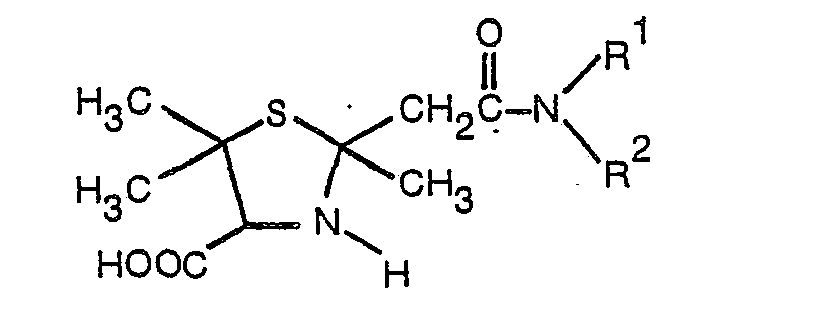
wherein R1 and R2 are each alkyl having 1 to 3 carbon atoms, or R1 and R2 together with the nitrogen atom to which they are attached from morpholino, piperazino, piperidino or pyrrolidino, each one of which is optionally substituted with 1 or 2 methyl groups and the pharmaceutically acceptable salts thereof.
wherein R1 and R2 are each alkyl having 1 to 3 carbon atoms, or R1 and R2 together with the nitrogen atom to which they are attached from morpholino, piperazino, piperidino or pyrrolidino, each one of which is optionally substituted with 1 or 2 methyl groups and the pharmaceutically acceptable salts thereof.
2. 4-carboxy-2,5,5-trimethylthiazolidine-2-N,N-dimethylacetamide.
3. 4-carboxy-2,5,5-trimethylthiazolidine-2-acetopyrrolidide.
4. 4-carboxy-2,5,5-trimethylthiazolidine-2-acetomorpholide.
5. 4-carboxy-2,5,5-trimethylthioazolidine-2-aceto-N-methylpiperazide.
6. 4-carboxy-2,5,5-trimethylthiazolidine-2-aceto-3,5-dimethylpiperidide.
7. 4-carboxy-2,5,5-trimethylthiazolidine-2-acetopiperidide.
8. 4-carboxy-2,5,5-trimethylthiazolidene-2-N,N-diethylacetamide.
9. A pharmaceutical composition comprising a thiazolidine derivative as claimed in
any one of claims 1 to 8, disposed in a pharmaceutically acceptable diluent or carrier
therefor.
10. An immunomodulator composition comprising a pharmaceutically effective amount
of a derivative as claimed in any one of claims 1 to 8.
1. Thiazolidin-Derivat der folgenden allgemeinen Formel
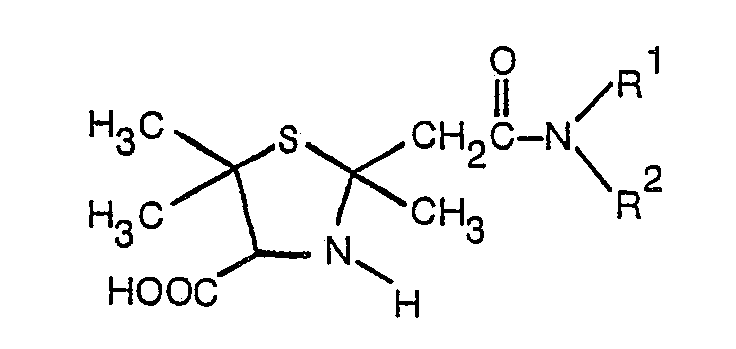
in der R1 und R2 jeweils Alkyl mit 1 bis 3 Kohlenstoffatomen sind, oder R1 und R2 bilden zusammen mit dem Stickstoffatom, an das sie gebunden sind, einen Morpholin-, Piperazin-, Piperidin- oder Pyrrolidin-Ring, von denen jeder ggf. mit einer oder zwei Methylgruppen substituiert ist, sowie die pharmazeutisch annehmbaren Salze davon.
in der R1 und R2 jeweils Alkyl mit 1 bis 3 Kohlenstoffatomen sind, oder R1 und R2 bilden zusammen mit dem Stickstoffatom, an das sie gebunden sind, einen Morpholin-, Piperazin-, Piperidin- oder Pyrrolidin-Ring, von denen jeder ggf. mit einer oder zwei Methylgruppen substituiert ist, sowie die pharmazeutisch annehmbaren Salze davon.
2. 4-Carboxy-2,5,5-trimethylthiazolidin-2-N,N-dimethylacetamid.
3. 4-Carboxy-2,5,5-trimethylthiazolidin-2-acetopyrrolidid.
4. 4-Carboxy-2,5,5-trimethylthiazolidin-2-acetomorpholid.
5. 4-Carboxy-2,5,5-trimethylthiazolidin-2-aceto-N-methylpiperazid.
6. 4-Carboxy-2,5,5-trimethylthiazolidin-2-aceto-3,5-dimethylpiperidid.
7. 4-Carboxy-2,5,5-trimethylthiazolidin-2-acetopiperidid.
8. 4-Carboxy-2,5,5-trimethylthiazolidin-2-N,N-diethylacetamid.
9. Pharmazeutische Zusammensetzung, die ein Thiazolidin-Derivat, wie es in einem der
Ansprüche 1 bis 8 beansprucht wird, enthält, das in einem pharmazeutisch annehmbaren
Verdünnungsmittel oder Träger dafür angeordnet ist.
10. Eine Immunmodulator-Zusammensetzung, die eine pharmazeutisch wirksame Menge eines
Derivats umfaßt, wie es in einem beliebigen der Ansprüche 1 bis 8 beansprucht wird.
1. Dérivé de thiazolidine ayant la formule générale
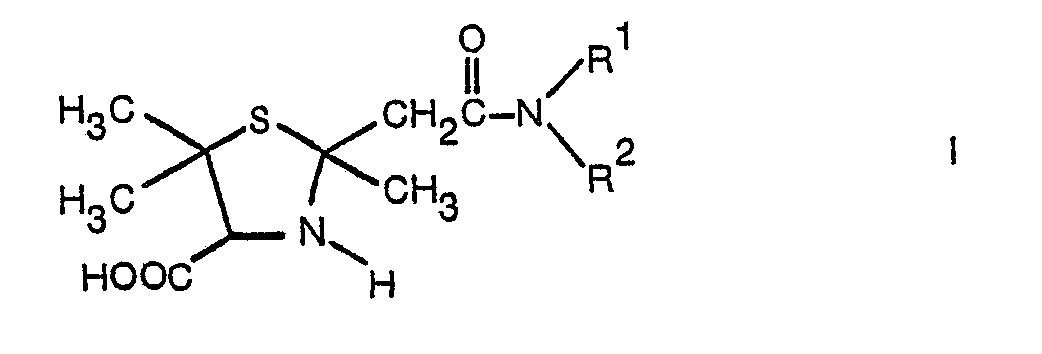
dans laquelle R1 et R2 sont chacun un alkyle ayant de 1 à 3 atomes de carbone, ou R1 et R2 forment ensemble avec l'atome d'azote auquel ils sont fixés des groupes morpholino, pipérazino, pipéridino ou pyrrolidino, chacun d'entre eux pouvant être substitué éventuellement par 1 ou 2 groupes méthyle et leurs sels acceptables pour un usage pharmaceutique.
dans laquelle R1 et R2 sont chacun un alkyle ayant de 1 à 3 atomes de carbone, ou R1 et R2 forment ensemble avec l'atome d'azote auquel ils sont fixés des groupes morpholino, pipérazino, pipéridino ou pyrrolidino, chacun d'entre eux pouvant être substitué éventuellement par 1 ou 2 groupes méthyle et leurs sels acceptables pour un usage pharmaceutique.
2. 4-carboxy-2,5,5-triméthylthiazolidine-2-N,N-diméthylacétamide.
3. 4-carboxy-2,5,5-triméthylthiazolidine-2-acétopyrrofidide.
4. 4-carboxy-2,5,5-triméthylthiazolidine-2-acétomorpholide.
5. 4-carboxy-2,5,5-triméthylthiazolidine-2-acéto-N-méthylpipérazide.
6. 4-carboxy-2,5,5-triméthylthiazolidine-2-acéto-3,5-diméthylpipéridide.
7. 4-carboxy-2,5,5-triméthylthiazolidine-2-acétopipéridide.
8. 4-carboxy-2,5,5-triméthylthiazolidine-2-N,N-diéthylacétamide.
9. Composition pharmaceutique comprenant un dérivé de thiazolidine selon l'une quelconque
des revendications 1 à 8, présenté dans un diluant acceptable pour un usage pharmaceutique
ou un véhicule.
10. Composition immunomodulatoire comprenant une quantité pharmaceutiquement active
d'un dérivé selon l'une quelconque des revendications 1 à 8.