| (19) |
 |
|
(11) |
EP 0 069 708 B1 |
| (12) |
EUROPEAN PATENT SPECIFICATION |
| (45) |
Mention of the grant of the patent: |
|
09.04.1986 Bulletin 1986/15 |
| (22) |
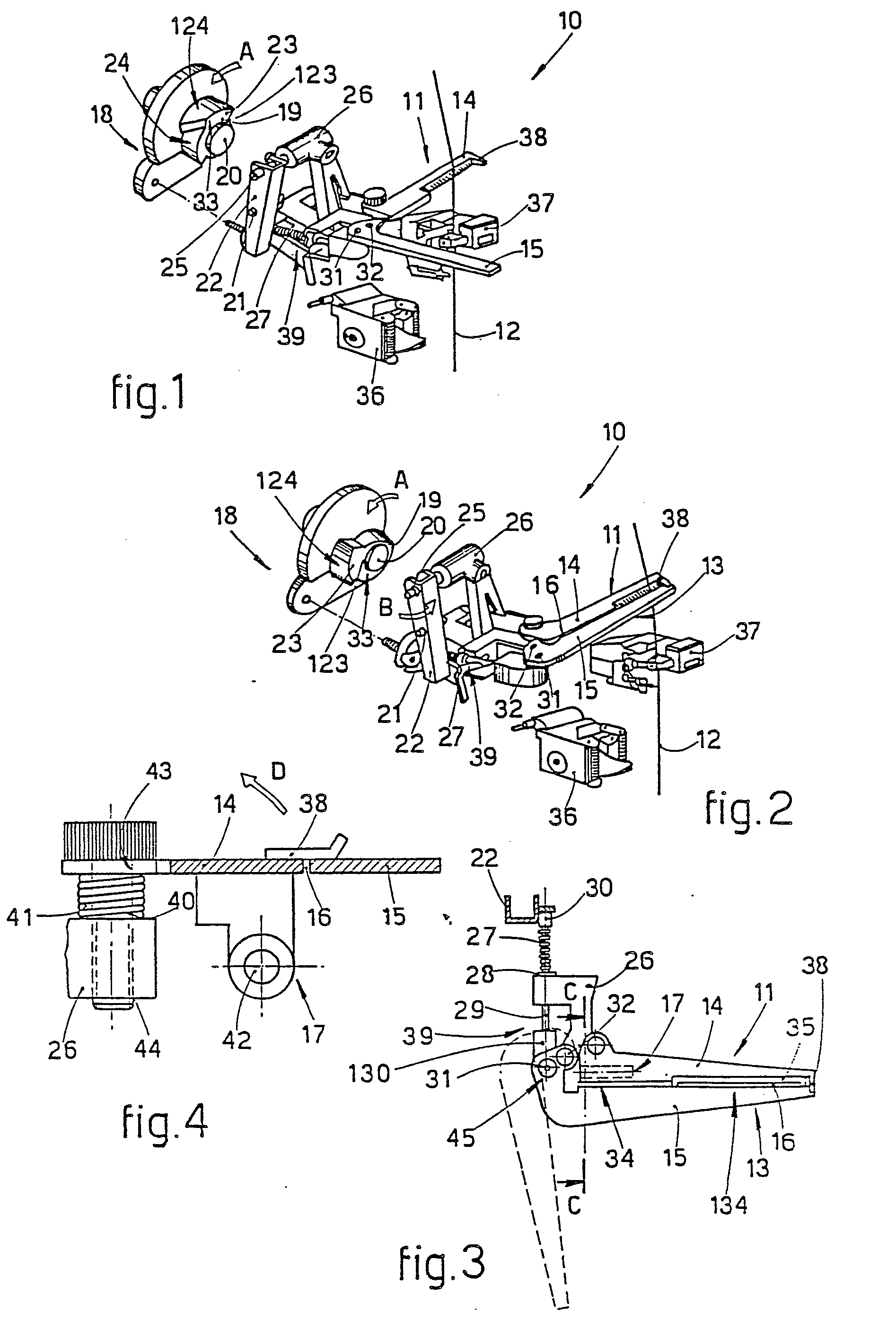
Date of filing: 31.05.1982 |
|
|
| (54) |
Device for checking the yarn and the knots downstream of a slubcatcher and a knotter
in yarn winding machines
Vorrichtung für die Garn- und Knotenüberwachung abwärts des Flusenfängers und des
Knotens in Wickelmaschinen
Dispositif pour le contrôle du fil et du nouage en aval de l'épurateur et du noueur
dans les bobinoirs
|
| (84) |
Designated Contracting States: |
|
AT BE CH DE FR GB LI LU NL SE |
| (30) |
Priority: |
25.06.1981 IT 8342381
|
| (43) |
Date of publication of application: |
|
12.01.1983 Bulletin 1983/02 |
| (71) |
Applicant: Officine Savio S.p.A. |
|
33170 Pordenone (IT) |
|
| (72) |
Inventors: |
|
- Speranzin, Claudio
I-33170 Pordenone (IT)
- Gaiotti, Ugo
I-33170 Pordenone (IT)
|
| (74) |
Representative: Petraz, Gilberto Luigi |
|
GLP S.r.l.
Piazzale Cavedalis 6/2
33100 Udine
33100 Udine (IT) |
|
| |
|
| Note: Within nine months from the publication of the mention of the grant of the European
patent, any person may give notice to the European Patent Office of opposition to
the European patent
granted. Notice of opposition shall be filed in a written reasoned statement. It shall
not be deemed to
have been filed until the opposition fee has been paid. (Art. 99(1) European Patent
Convention).
|
[0001] This invention concerns a device for checking the yarn and the knots downstream of
a slubcatcher and a knotter in yarn winding machines.
[0002] To be more exact, the invention concerns a device which enables the quality of the
knots to be checked as soon as knotting has taken place and which makes it possible
to ascertain whether the yarn rising towards the yarn package during winding contains
tangles, slubs, broken ends of thread or other like faults.
[0003] Some devices are known which perform the task of a slubcatcher and check the knots
as soon as the latter are formed.
[0004] Various devices of this type are known and are described in DE-A-2.705.080, DE-B-2.934.544,
GB-A-726,294, GB-A-596,999, CH-A-597.145 and DE-B-2.543.983.
[0005] Nevertheless these known devices are rather complicated and require complicated actuation
means.
[0006] Furthermore, alongside some of such devices for better results another device may
be required to carry out proper controls downstream from the slubcatcher and to be
able to eliminate tangles in the yarn rising towards the yarn package, thereby improving
the control already performed by the slubcatcher.
[0007] A purpose of the invention is to embody an improved single device for checking knots
and for the controls downstream from the slubcatcher, whereby said device is simple
in construction and reliable and provides easy operation and adjustment.
[0008] Another purpose of the invention is that the control on the yarn to be wound may
also be conducted while such yarn is being transferred from the knotting position
to the position of the slubcatcher, thereby substantially providing a continuous inspection
of such yarn during the whole winding cycle.
[0009] So as to fulfil these purposes, the device of the invention comprises two blade means
for controlling and guiding the yarn which extend lengthwise above the knotter and
above the slubcatcher so as to cooperate with both of them, whereby one of such blade
means is located in a pre-set and perhaps adjustable position, and whereby the other
blade can be moved or rotated from its open position of rest to its closed working
position.
[0010] The length of time of the conditions of rest or work can be varied by altering the
reciprocal positions of reading means and two-cam means which cooperate with each
other, whereby the position of such reading means can be regulated axially.
[0011] This invention is therefore embodied in a device for checking the yarn and the knots
downstream of a slubcatcher and a knotter in yarn winding machines, which comprises
blade means, means for opening and closing the blade means, and means for adjusting
the width of a slit between such blade means (such a device being known from DE-A-2705080
or GB-A-726234), the device being characterized in that the slit comprises a first
portion downstream of a knotter, which first portion checks knots formed in the yarn,
and a second portion contiguous with the first portion and downstream of a slubcatcher,
which second portion checks the yarn leaving the slubcatcher.
[0012] We shall give hereinafter a description of a preferred embodiment of the invention
as a non- restrictive example and shall make references to the attached figures, in
which:-
Fig. 1 gives a three-dimensional view of the device of the invention in its position
of rest;
Fig. 2 gives a three-dimensional view of the device of Fig. 1 in its working position;
Fig. 3 shows a plan view of the two-blade means which check the yarn;
Fig. 4 gives a side view of a detail, cut away along the line C-C, of the means which
regulate the opening of the two blades.
[0013] In the figures the same parts or parts performing the same functions bear the same
reference numbers.
[0014] In particular, the device 10 of the invention comprises means 11 for checking the
yarn 12 with blade means 13, whereby such blade means 13 consist of a fixed blade
means 14 and of a blade means 15 which can be moved and be at least partially rotated,
such two blade means being reciprocally positionable.
[0015] An opening or slit 16 between the two blade means 14 and 15 within which the yarn
12 is guided and slides, is obtained by regulating the reciprocal positions of the
blade means 14-15 by means of suitable adjustment means 17.
[0016] In particular, such slit is dimensioned to suit the count of the yarn 12 and therefore
the diameter thereof and in relation to the size of the faults and knots to be eliminated.
[0017] For this purpose it is enough to regulate the axial position of a screw 40 engaged
in a threaded through hole 43 in the blade 14 and connected (44) corresponding to
the stationary structure 26.
[0018] The position of such blade 14 and such stationary structure 26 are maintained temporarily
by the action of a thrust spring 41, wehreby the blade 14 is hinged (42) onto the
stationary structure 26 and rotates as an outcome of axial displacement of the screw
40 so as to enable the breadth of the lengthwise slit 16 to be varied, as shown in
Fig. 4.
[0019] Figs. 1 and 2 show the means 18 which operate the opening of the blades 14-15 and
which consist of a cam 19 shown in an exploded view and keyed to the horizontal knotting
shaft 20, and of a reading pin 21 passing through an oscillating arm 22.
[0020] The axial position of the reading pin 21 can be regulated so that the pin 21 can
cooperate with one of two circular crowns 23-123, which are radially superimposed
one above the other and into which the cam 19, rotating in direction A (Figs. 1 and
2), is divided so as to obtain a differing length of time for the opening or closing
of the blades 14-15.
[0021] In our example the circular crown 23 permits the blades 14-15 to be closed for a
period limited to the knotting phase, whereas the crown zone 123 causes the blades
14-15 to be closed during the normal winding phase.
[0022] When the reading pin 21 acts on the sloping sector 24 of the radial crown 23 (Fig.
1), the oscillating arm 22, being hinged at its top 25 to the stationary structure
26, is kept in its position of rest by suitable re-positioning means 39, which consist
of a piston 29 pressed by a thrust spring 27 with which such piston cooperates coaxially.
[0023] In particular, the spring 27 is kept under axial compression between the end 30 of
the piston 29 pushing against the oscillating arm 22, and a resistance point 28 on
the stationary structure 26.
[0024] The other end 130 of the piston 29 keeps in a retracted or non-operational position
the rotating blade 15, onto which such end 130 is hinged (31).
[0025] The rotating blade 15 comprises a second pivot 32 near to the preceding pivot 31,
whereby such pivot 32 enables the blade 15 to rotate around the stationary structure
26 with an arm of rotation of which the length is equal to the distance between the
two pivots 31-32 located in the end 45 of the rotating blade 15.
Fig. 1 shows the position of rest of the device 10, whereas Fig. 2 shows the same
device 10 in its working position.
[0026] In particular, in Fig. 2 the reading pin 21 cooperates with the sector 124 of the
circular crown 123 of the double cam 19 and, to be more exact, with the front part
33 thereof 19.
[0027] In such working conditions the oscillating arm 22 is rotated in direction B and pushes
against the pivot 29, thereby compressing the thrust spring 27.
[0028] In its turn the piston 29 makes the blade 15 revolve into the closed or working position
by means of its end 130 hinged 31 onto the blade 15. Thus the checking of the knot
just formed can be carried out in a position or zone 34 of the lengthwise slit 16
above the knotter 36.
[0029] The yarn 12 can be transferred thereafter by sliding tangentially on the fixed blade
14 up to the opposite zone 134 of the slit 16 above the slubcatcher 37, the zone 134
corresponding to the position where the yarn 12 passes during the winding phase, as
shown in Fig. 3. In Fig. 3 the movable blade 15 is shown with lines of dashes when
it is in its position of rest (opened) and with a continuous line when it is in its
(closed) working position.
[0030] The fixed blade 14 comprises in the zone 134 a tangential porcelain guide 35, which
enables the fixed blade 14 to cooperate better with the yarn 12 tangentially thereupon,
and also comprises a protruding terminal stop 38, which prevents the yarn 12 from
escaping the control of the blade means 13.
[0031] When the reading pin 21 acts on the radial zone 23 of the cam 19, the movable blade
means 15 is returned to its retracted position as soon as such reading pin 21 enters
the sector 24.
[0032] Instead, when the reading pin 21 cooperates with the circular crown 123, the rotating
blade 15 stays closed against the fixed blade 14 so as to carry out therewith its
controls downstream from the slubcatcher.
[0033] We have described here a preferred embodiment of the invention, but variants are
possible for a technician in this field.
[0034] Thus the shapes and sizes can be changed. It is possible to envisage a different
system of cooperation between the means which re-position 39 the blade, or else it
is possible to foresee the use of means which are mechanically different but which
are able to perform the functions described. It is possible to visualise the employment
of multiple-cam means having a number of circular crowns other than two.
[0035] These and other variants are all possible for a technician in this field within the
scope of the idea of the solution of the invention as set out in the appended claims.
1. Device (10) for checking the yarn and the knots downstream of a slubcatcher and
a knotter in yarn winding machines, which comprises blade means (13), means for opening
and closing the blade means, and means (17) for adjusting the width of a slit (16)
between such blade means, the device (10) being characterized in that the slit (16)
comprises a first portion (34) downstream of a knotter (36), which first portion (34)
checks knots formed in the yarn (12), and a second portion (134) contiguous with the
first portion (34) and downstream of a slubcatcher (37), which second portion (134)
checks the yarn (12) leaving the slubcatcher (37).
2. Device (10) for checking the yarn and the knots downstream of a slubcatcher and
a knotter in yarn winding machines as claimed in Claim 1, in which the means (11)
for checking with blade means (13) comprise fixing blade means (14) and also corresponding
blade means (15) which can be moved and be at least partially rotated, whereby such
blade means (14-15) can be reciprocally positioned at least partially and are aligned
above the knotter (36) and slubcatcher (37) of such winding machines, and whereby
a slit (16) for the checking and sliding of the yarn is located between such temporarily
closed blade means (14-15).
3. Device (10) for checking the yarn and the knots downstream of a slubcatcher and
a knotter in yarn winding machines as claimed in Claim 2, in which the movable blade
means (15) is hinged at two points (31-32) and is linked at one of its ends (45) to
the stationary structure (26) and to reposition means (39) respectively, whereby such
end hinged at two points (31-32) acts as an arm of rotation for the movable blade
means (15).
4. Device (10) for checking the yarn and the knots downstream of a slubcatcher and
a knotter in yarn winding machines as claimed in Claim 2 or 3, in which the fixed
blade (14) comprises a protruding stop (38) which delimits the crosswise travel of
the yarn (12).
5. Device (10) for checking the yarn and the knots downstream of a slubcatcher and
a knotter in yarn winding machines as claimed in Claim 2, 3 or 4, in which the fixed
blade (14) comprises a lengthwise guide (35) for the yarn (12) in at least part of
the second portion (134).
6. Device (10) for checking the yarn and the knots downstream of a slubcatcher and
a knotter in yarn winding machines as claimed in any claim hereinbefore, in which
the means (18) which cause the opening of the blade means (13) comprise a cam (19)
having at least one distinct circular crown (23-123) which cooperates radially with
a reading pin (21) passing through an oscillating arm (22), whereby the position of
such reading pin (21) can be regulated so as to cooperate or interfere with at least
one of the circular crowns (23-123) of the cam (19).
7. Device (10) for checking the yarn and the knots downstream of a slubcatcher and
a knotter in yarn winding machines as claimed in Claim 6, in which the re-position
means (39) comprise a piston (29) which cooperates at one of its ends (30) with the
oscillating arm (22), whereby its other end (130) is hinged (31) onto the movable
blade (15), and whereby the piston (29) moves so as to keep the movable blade (15)
in a retracted or open position, the piston (29) being thus moved owing to the action
of a thrust spring (27) which is positioned coaxially with the piston (29) and is
compressed axially between the end (30) and a resistance point (28) on the stationary
structure (26).
8. Device (10) for checking the yarn and the knots downstream of a slubcatcher and
a knotter in yarn winding machines as claimed in any claim hereinbefore, in which
the means (17) which regulate the opening of the blade means (13) consist of a screw
(40) engaged in a threaded through hole (43) in the fixed blade (14) and connected
correspondingly (44) to the stationary structure (26), whereby the positions of the
blade (14) and the stationary structure (26) are maintained temporarily owing to the
action of the thrust spring (41), which is pre-arranged coaxially with the screw (40)
between the blade (14) and the stationary structure (26), and whereby the blade (14)
is hinged (42) onto the stationary structure (26) and rotates as an outcome of the
axial displacement of the screw (40) so as to enable the breadth of the lengthwise
slit (16) to be varied.
1. Vorrichtung (10) zur Kontrolle des Garnes und der Knoten abwärts eines Schlitzfadenreinigers
und einer Knotenmaschine in Spulmaschinen, die Messermittel (13), Mittel zum Öffnen
und Schließen der Messermittel, und Mittel (17) zum Einstellen der Breite eines Schlitzes
(16) zwischen den genannten Messermitteln enthält, wobei die Vorrichtung (10) dadurch
gekennzeichnet ist, daß der Schlitz (16) einen ersten Teil (34) abwärts einer Knotenmaschine
(36), wobei dieser erste Teil die im Garn (12) gebildeten Knoten kontrolliert, und
einen zweiten den ersten Teil (34) anliegenden Teil (134) abwärts eines Schlitzfadenreinigers
(37) ennthält, wobei dieser zweite Teil (134) das Garn kontrolliert, das den Schlitzfadenreiniger
(37) verläßt.
2. Vorrichtung (10) zur Kontrolle des Garnes und der Knoten abwärts eines Schlitzfadenreinigers
und einer Knotenmaschine in Spulmaschinen nach Anspruch 1, bei der die Mittel (11)
zur Kontrolle mit Messermitteln (13) feste Messermittel (14) und auch entsprechende
Messermittel (15) enthalten, die bewegt werden können und mindestens teilweise gedreht
werden können; wobei die genannten Messermittel (14-15) mindestens teilweise gegenseitig
positioniert werden können, und oberhalb der Knotenmaschine (36) und des Schlitzfadenreinigers
(37) der genannten Spulmaschinen ausgerichtet sind, wobei ein Schlitz (16) zur Kontrolle
und zum Gleiten des Garnes zwischen den genannten, vorübergehend geschlossenen Messermitteln
(14-15) angeordnet ist.
3. Vorrichtung (10) zur Kontrolle des Garnes und der Knoten abwärts eines Schlitzfadenreinigers
und einer Knotenmaschine in Spulmaschinen nach Anspruch 2, bei der die Mittel mit
beweglicher Klinge (12) in zwei Punkten (31-32) aufklappbar sind und an einem der
Enden (45) mit der festen Struktur (26) bzw. mit den Wiederpositioniermitteln (39)
verbunden sind, wodurch das genannte in zwei Punkten (31-32) aufklappbare Ende als
Dreharm für die Mittel mit beweglichem Messer (15) wirkt.
4. Vorrichtung (10) zur Kontrolle des Garnes und der Knoten abwärts eines Schlitzfadenreinigers
und einer Knotenmaschine in Spulmaschinen nach Anspruch 2 oder 3, bei der das feste
Messer (14) einen vorstehenden Anschlag (38) enthält, der den Quergang des Garnes
(12) abgrenzt.
5. Vorrichtung (10) zur Kontrolle des Garnes und der Knoten abwärts eines Schlitzfadenreinigers
und einer Knotenmaschine in Spulmaschinen nach Anspruch 2, 3 oder 4, bei der das feste
Messer (14) mindestens in einem Teil des zweiten Teiles (134) eine Langführung (35)
des Garnes (12) enthält.
6. Vorrichtung (10) zur Kontrolle des Garnes und der Knoten abwärts eines Schlitzfadenreinigers
und einer Knotenmaschine in Spulmaschinen nach irgendeinem der vorstehenden Ansprüche,
bei der die Mittel (18), die das Öffnen der Messermittel (13) bewirken, einen Nocken
(18) enthalten, der mindestens einen getrennten kreisförmigen Kranz (23-123) aufweist,
der radial mit einem Ablesungszapfen (21) mitwirkt, der durch einen Schwingarm (22)
geht, wobei die Stellung des genannten Ablesungszapfens (21) so eingestellt werden
kann, daß er mit mindestens einem der kreisförmigen Kränze (23-123) des Nockens (19)
mitwirken oder interferieren kann.
7. Vorrichtung (10) zur Kontrolle des Garnes und der Knoten abwärts eines Schlitzfadenreinigers
und einer Knotenmaschine in Spulmaschinen nach Anspruch 6, bei der die Wiederpositioniermittel
(39) einen Kolben (29) enthalten, der an einem der Enden (30) mit dem Schwingarm (22)
mitwirkt, wobei sein anderes Ende (130) auf dem beweglichen Messer (15) aufklappbar
ist (31) und bei der sich der Kolben (29) so bewegt, daß er das bewegliche Messer
(15) in einer zurückgezogenen oder offenen Stellung hält, wobei der Kolben (29) durch
die Wirkung einer Druckfeder (27) so bewegt wird, die koaxial mit dem Kolben (29)
positioniert ist und an der stationären Struktur (26) zwischen dem Ende (30) und einem
Widerstandspunkt (28) axial gedrückt ist.
8. Vorrichtung (10) zur Kontrolle des Garnes und der Knoten abwärts eines Schlitzfadenreinigers
und einer Knotenmaschine in Spulmaschinen nach irgendeinem der vorstehenden Ansprüche,
bei der die Mittel (17), die das Öffnen der Messermittel (13) regulieren, aus einer
Schraube (40) bestehen, die in ein Durchgangsgewindeloch (43) in dem festen Messer
(14) einfällt, das mit der festen Struktur (26) entsprechend (44) verbunden ist, wobei
die Stellungen des Messers (14) und der festen Struktur (27) durch die Wirkung der
Druckfeder (41) zeitlich erhalten werden, die zwischen dem Messer (14) und der festen
Struktur (26) koaxial mit der Schraube (40) vorgesehen ist, wobei das Messer (14)
an der stationären Struktur (26) aufklappbar (42) ist und als Folge der axialen Verschiebung
der Schraube (40) rotiert, so daß es gestattet wird, daß die Breite des longitudinalen
Schlitzes (16) geändert wird.
1. Dispositif (10) destiné à contrôler le fil et les noeuds en aval d'un épurateur
et d'un noueur dans des bobinoirs, dispositif qui comprend des moyens à lames (13),
des moyens destinés à ouvrir et fermer les moyens à lames, et des moyens (17) destinés
à régler la largeur d'une fente (16) formée entre les moyens à lames, le dispositif
(10) étant caractérisé en ce que la fente (16) comprend une première partie (34) située
en aval d'un noueur (36), laquelle première partie (34) vérifie les noeuds formés
dans le fil (12), et une deuxième partie (134) contiguë à la première partie (34)
et située en aval d'un épurateur (37), laquelle deuxième partie (134) vérifie le fil
(12) qui sort de l'épuratuer (37).
2. Dispositif (10) destiné à contrôler le fil et les noeuds en aval d'un épurateur
et d'un noueur dans des bobinoirs, selon la revendication 1, dans lequel les moyens
(11) destinés à vérifier à l'aide de moyens à lames (13) comprennent un moyen du type
lame fixe (14) et également un moyen du type lame correspondant (15) qui peut être
déplacé et au moins partiellement tourné, les moyens du type lame (14, 15) pouvant
être positionnés l'un par rapport à l'autre au moins partiellement et étant alignés
au-dessus du noueur (36) et de l'épurateur (37) de bobinoir, et une fente (16) destinée
au contrôle et au coulissement du fil étant située entre les moyens du type lame (14,
15) lorsqu'ils sont fermés temporairement.
3. Dispositif (10) destiné à contrôler le fil et les noeuds en aval d'un épurateur
et d'un noueur dans des bobinoirs de fil, selon la revendication 2, dans lequel le
moyen du type lame mobile (15) est articulé en deux points (31, 32) et est relié à
l'une de ses extrémités (45) à la structure fixe (26) et aux moyens de déplacement
(39) respectivement, ladite extrémité articulée en deux points (31, 32) se comportant
comme un bras de manivelle pour le moyen du type lame mobile (15).
4. Dispositif (10) destiné à contrôler le fil et les noeuds en aval d'un épurateur
et d'un noueur dans des bobinoirs de fil, selon la revendication 2 ou 3, dans lequel
la lame fixe (14) comprend une butée saillante (38) qui délimite la course de déplacement
transversal du fil (12).
5. Dispositif (10) destiné à contrôler le fil ou les noeuds en aval d'un épurateur
et d'un noueur dans des bobinoirs de fil, selon la revendication 2, 3 ou 4, dans lequel
la lame fixe (14) comprend un guide longitudinal (35) pour le fil (12) dans au moins
une fraction de la deuxième partie (134).
6. Dispositif (10) destiné à contrôler le fil et les noeuds en aval d'un épurateur
et d'un noueur dans des bobinoirs de fil, selon l'une quelconque des revendications
précédentes, dans lequel les moyens (18) qui déterminent l'ouverture des moyens à
lame (13) comprennent une came (19) possédant au moins une couronne circulaire distincte
(23, 123) qui coopère radialement avec une tige de lecture (21) qui passe à travers
un bras oscillant (22), la position de cette tige de lecture (21) pouvant être réglée
pour coopérer ou interférer avec au moins l'une des couronnes circulaires (23, 123)
de la came (19).
7. Dispositif (10) destiné à contrôler le fil ou les noeuds en aval d'un épurateur
et d'un noueur dans des bobinoirs de fil, selon la revendication 6, dans lequel les
moyens de déplacement (39) comprennent un piston (29) aui coopère à l'une de ses extrémités
(30) avec le bras oscillant (22), son autre extrémité (130) étant articulée (en 31)
sur la lame mobile (15) et le piston (29) se déplaçant de manière à maintenir la lame
mobile (15) dans une position réactée ou ouverte, le piston (29) se déplaçant de cette
façon sous l'action d'un ressort de poussée (27) qui est positionné coaxialement au
piston (29) et est comprimé axialement entre l'extrémité (30) et un point de résistance
(28) prévu sur la structure fixe (26).
8. Dispositif (10) destiné à contrôler le fil et les noeuds en aval d'un épurateur
et d'un noueur dans des bobinoirs de fil selon l'une quelconque des revendications
précédentes, dans lequel les moyens (17) qui règlent l'ouverture des moyens à lames
(13), sont constitués par une vis (40) vissée dans un trou traversant fileté (43)
formé dans la lame fixe (14) et reliée de façon appropriée (en 44) à la structure
fixe (26), les positions de la lame (14) et de la structure fixe (26) étant maintenues
temporairement grâce à l'action du ressort de poussée (41) qui est pré-agencé coaxialement
à la vis (40) entre la lame (14) et la structure fixe (26), et la lame (14) étant
articulée (en 42) sur la structure (26) et tournant sous l'effet du déplacement axial
de la vis (40) de manière à permettre de modifier la largeur de la fente longitudinale
(16).