|
(11) | EP 0 070 321 B1 |

| (12) | EUROPEAN PATENT SPECIFICATION |
|
|
| (54) |
PROCESS FOR PREPARING CARBONACEOUS MATERIAL FOR USE IN DESULFURIZATION VERFAHREN ZUR AUFBEREITUNG KOHLENSTOFFHALTIGEN MATERIALS ZUR VERWENDUNG BEI DER ENTSCHWEFELUNG PROCEDE DE PREPARATION D'UN MATERIAU CARBONE DESTINE A ETRE U TILISE DANS LA DESULFURATION |
|
|
|||||||||||||||||||||||||||||||
| Note: Within nine months from the publication of the mention of the grant of the European patent, any person may give notice to the European Patent Office of opposition to the European patent granted. Notice of opposition shall be filed in a written reasoned statement. It shall not be deemed to have been filed until the opposition fee has been paid. (Art. 99(1) European Patent Convention). |
Field of technology
[0001] This invention relates to a process for producing carbon material for de-sulfurization with coal as the raw material. More particularly, it is concerned with a process for producing granular activated carbon excellent in adsorptibility and mechanical strength.
Background of technology:
[0002] In recent years, granular activated carbon produced from coal as the raw material has become used as the carbon material for removing sulfur from discharge gas from thermoelectric power plants, chemical plants, metal refineries, and others.
[0003] And, the de-sulfurizing operations of discharge gas with the activated carbon is classified into the so-called dry method and wet method. In either method, since adsorption and reproduction are repeatedly done over a long period of time, the activated carbon is required to have, along with its adsorptibility, various mechanical strength such as impact resistance strength, wear-resistance strength, and so forth.
[0004] In case, however, coal is used as the raw material, it is a general trend that, when the adsorptibility is increased, the mechanical strength decreases, and, on the contrary, when the mechanical strength is to be increased, the adsorptibility is lost. Therefore, emergence of the carbon material for de-sulfurization excellent in its adsorptibility and mechanical strength has heretofore been desired.
[0005] Furthermore, the carbonization treatment of shaped raw material coal is done by heating the raw material to the ultimate temperature of approximately 600 to 1,000°C using a heating furnace such as rotary kiln, fluidized bed, mobile bed, etc. However, this treatment has shortcomings such that, depending on the manner of handling the raw material for the carbonization treatment, the shaped coal is subjected to crush and wear to cause poor rate of yield, and, further, the mechanical strength of the resulting carbon material is lowered because of such crush and wear. Such shortcomings are particularly remarkable when the rotary kiln is used as the heating furnace.
Summary of the invention:
[0006] The object of the present invention is to provide the carbon material having large adsorptibility to oxides of sulfur, from coal as the raw material, without impairing the mechanical strength. The other object of the present invention is to provide a method capable of producing such carbon material with good rate of recovery.
[0007] And, such objects can be readily achieved in accordance with the present invention to be described hereinbelow.
[0009] For non-coking coal to be used for the purpose of the present invention, there may be enumerated one or more than two kinds of lignite, brown coal, sub-bituminous coal, and anthracite having no coking property. For coking coal, there may be used one or more than two kinds of sub-bituminous coal and bituminous coal having slight coking property, weak coking property, or strong coking property. In particular, favorable results can be obtained when brown coal is used as the non-coking coal, and strongly coking bituminous coal as the coking coal. A blending ratio of the coking coal in the blended coal is at least a few percent by weight and above, usually 5% by weight or so and above, e.g., 15 to 60% by weight. These raw material coals are crushed either after the blending or before the blending. The degree of crushing should preferably be such that the entire raw material pass through a 60-mesh (0.25 mm) sieve, of which 40 to 70% by weight, or preferably 50 to 60% by weight be a 200-mesh (0.074 mm) under-sieve.
[0010] The mean reflecting power (R.) of the blended coal is a value calculated from a value of each simple coal measured in accordance with Japanese Industrial Standards (JIS) M8816, depending on the blending ratio. In the present invention, it is desirable that the blending ratio of the non-coking coal and the coking coal be so adjusted as to bring this value to a range of from 0.3 to 1.0, or preferably from 0.4 to 1.0. When the mean reflecting power (R.) is 1.0 and above, the adsorptibility of the resulted carbon material to be oxides of sulfur lowers, which is not preferable.
[0011] For the binder, there is no particular limitation provided that it has appropriate fluidity and tackiness under the shaping conditions, and moreover it retains the shaped product in its designated shape even by high temperature calcination. Usually, there may be used one or more than two kinds of distilled residuum of coal or petroleum series such as pitch, asphalt, etc., thermosetting resin such as phenol resin, urethane resin, etc., inorganic binder such as water glass, etc., and various other materials. The binder is added to the blended coal at dry standard in a range of from 5 to 50% by weight. Its adding quantity should desirably be adjusted such that the Gieseler maximum fluidity (GP-MF), the crucible swelling number (CSN) and the Roga-microstrength Index (RI) of a mixture after the binder has been added to the blended coal may fall under a range to be described later. Since these physical values are affected by the band of coal and the kind of the binder, the adding quantity of the binder had better be found in advance based on experiments.
[0012] The Gieseler maximum fluidity (GP-MF) of the mixture is a value which is measured in accordance with the fluidity test method (Gieseler plastometer method) defined in JIS M8801. In the present invention, this value should desirably be adjusted in a range of from 0 to 3,000 DDPM, or preferably from 50 to 3,000 DDPM. When the Gieseler maximum fluidity (GP-MF) exceeds 3,000 DDPM, the adsorptibility of the resulted carbon material to the oxides of sulfur lowers unfavorably.
[0013] The crucible swelling number (CSN) of the mixture is a value which is measured in accordance with the gas heating method belonging to the crucible swelling method (coke button method) defined in JIS M8801. In the present invention, this value should desirably be adjusted to 0,1/2,1,1-1/2 or 2. When the index number becomes larger than 2-1/2, the adsorptibility of the resulted carbon material to the oxides of sulfur lowers unfavorably.
[0014] The Roga-microstrength Index (RI) of the mixture is a value which is measured in the following manner.
[0015] That is to say, 5 g of a specimen is placed in a-crucible of 30 ml capacity. After making its surface even and horizontal, a steel weight of 110 g is put on the specimen, and then a load of 6 kg is applied onto the weight by means of a compressing device to impart compressive force to the specimen for 30 seconds. Subsequently, the weight is taken away, and the crucible is covered with a lid, after which it is placed in a Muffle furnace maintained at a temperature of 850±10°C for calcination under heat for 15 minutes. After the calcined specimen has been cooled, it is taken out of the crucible, followed by quartering the same, and the total quantity of the quartered specimen is charged in an I-type drum (a cylindrical container of 25 mm in diameter and 300 mm in length, within which five pieces of steel balls of 10 mm in diameter are placed). After the drum has been rotated for 100 times, the content is screened with a sieve of 1 mm mesh, and a percentum by weight of the over-sieve specimen is designated as the Roga-microstrength Index thereof.
[0016] In the present invention, it is desirable that the value of the Roga-microstrength Index (RI) to be measured in the above-described manner be adjusted in a range of from 10 to 95, or preferably from 30 to 95. When the Roga-microstrength Index (RI) does not reach a value of 10, the mechanical strength of the resulted carbon material is not sufficient, and, on the other hand, when the value exceeds 95, the adsorptibility of the carbon material to the oxides of sulfur lowers unfavorably.
[0017] The mixture which has been adjusted its physical property in the above-described manner is kneaded by a kneader, if necessary, and then shaped by a well known shaping means. Shaping of the mixture is done by means of a shaping machine such as, for example, briquetting machine, pelletizer, extrusion machine, rolling type granulating machine, and so forth, whereby the mixture is shaped into various shapes such as spherical shape, almond-shape, pillow-shape, column shape, and others having a diameter of from 3 to 100 mm, or preferably from 5 to 50 mm. The shaping is carried out at a temperature which does not cause substantial decomposition of the non-coking coal, e.g., usually at 250°C in the case of brown coal.
[0018] The thus obtained shaped coal is usually subjected to the carbonization treatment by means of the rotary kiln, until it is heated to an elevated temperature of approximately 600 to 1,000°C.
[0019] For the rotary kiln, there may be used various types such as an internal heating type and an external heating type which introduce heating gas in the counter-current or concurrent direction with respect to the shaped coal, or a combination of the internal heating type and the external heating type, and so forth. In particular, the counter-current, internal heating type is used preferably.
[0020] In the present invention, it is desirable for the purpose of the abovementioned carbonization treatment that the initial temperature elevating rate, i.e., an average speed of temperature elevation until the temperature of the shaped coal reaches 400°C, be so adjusted as to be in a range from 15 to 120°C/min., or preferably from 20 to 110°C/min. In so doing, the shape retaining property of the shaped coal becomes favorable in the treatment after the surface of the shaped coal has immediately undergone appropriate carbonization with the result that the carbon material for de-sulfurization, which is excellent in property, can be obtained under the conditions where the rate of crushing and wear of the raw material is extremely low. When the temperature elevating rate exceeds 120°C, there take place fusion, swelling, and deformation in the shaped coal, whereby the mechanical strength of the resulted coal lowers.
[0021] The adjustment of the abovementioned temperature elevating rate can be readily carried out by contacting the shaped coal with heating gas of from about 450 to 750°C in the case of, for example, the internal heating type rotary kiln. When the heating gas exceeds 750°C, cracks tend to occur readily in the shaped coal, which is not favorable. By the way, such temperature elevating rate is unique with the present invention in view of the fact that a rate of from 0.5 to 5°C/min. is considered appropriate in the production of the activated carbon in general.
[0022] For the heating gas, there may usually be used combustion waste gases such as coke furnace gas, natural gas, oil gas, naphtha, and so forth. These gases should desirably contain oxygen gas at a ratio of 10% by volume or less, or preferably from 3 to 10% by volume. Moreover, when the carbonization treatment is to be conducted at a temperature of 700°C and above, they should desirably contain water vapor at a ratio of from 20 to 80% by volume, or preferably from 40 to 60% by volume.
[0023] In this way, the temperature of the shaped coal in the rotary kiln is gradually elevated as it proceeds from the inlet end part of the kiln toward its outlet end part, and finally the shaped coal is elevated to a temperature of approximately 600 to 1,000°C to be carbonized. As the method for maintaining the shaped coal at such high temperature, there is no necessity for taking any special measures in the case of using the internal heating type rotary kiln, in which the shaped coal is made to contact in counter-current with the above-mentioned oxygen containing heating gas at a temperature of about 450 to 750°C, because the heating gas temperature at the inlet end part of the rotary kiln having an ordinary length, i.e., the gas phase temperature of the shaped coal at the outlet end part thereof is determined to a range of from 600 to 1,000°C; however, when use is made of, for example, the internal heating type rotary kiln, in which the shaped coal and the abovementioned heating gas are concurrently introduced thereinto, there is adopted a method of introducing a high temperature heating gas from a half way of the rotary kiln.
[0024] The carbonization treatment of the shaped coal is effected by keeping the shaped coal within the rotary kiln for a time period of from 2 to 8 hours in an ordinary case, or preferably from 4 to 6 hours. It is desirable that the resident time at a temperature level of 700°C or so and above where the shaped coal brings about the water-gas reaction be set in a range of from 0.5 to 2 hours, or preferably from 1 to 1.5 hours.
[0025] In the foregoing, explanations have been given in detail as to a case of using the rotary kiln for the carbonization treatment. However, the carbonization treatment can also be effected by use of a fixed bed, a fluidized bed, or a moving type bed such as Herreshoff furnace, or various other types of heating furnace. Incidentally, even in such case, it is desirable that the abovementioned particular temperature elevating rate be adopted and the heating gas at the above-mentioned particular temperature be used, until the temperature of the shaped coal reaches 400°C.
[0026] The thus obtained carbon material is subjected, if necessary, to further activating treatment with water vapor, etc., after which it is charged in an adsorption tower or vessel and used for de-sulfurization of waste gas in the form of the fixed bed or the fluidized bed.
[0027] The carbon material for de-sulfurization to be produced in accordance with the method of the present invention has large mechanical strength, while maintaining high adsorptibility to the oxides of sulfur, in spite of it being made of coal as the raw material, hence it is difficult to be reduced to powder even after repeated adsorption and reproduction operations over a long period of time, and is extremely useful as the carbon material for de-sulfurization.
[0028] Furthermore, according to the present invention, the carbonization treatment of the shaped coal can be done with good rate of recovery by adjusting the initial temperature elevating rate of the shaped coal to a particular range.
[0029] Accordingly, the process of the present invention is useful as the industrial process for producing the carbon material for desulfurization.
Preferred embodiment of the invention:
[0030] In the following, the present invention will further be explained in detail with reference to embodiments thereof.
[0031] Note should be taken that the tumbler coke strength and the S02 adsorptibility in the examples are measured by the under-mentioned methods of measurement. Also, the temperature of the shaping coal at the outlet end part of the rotary kiln is substantially coincident with the gas phase temperature at that location, hence it is indicated as such.
Method of measuring tumbler coke strength:
[0032] 400 g of a specimen and 20 pieces of steel ball, each having a diameter of 14 mm are placed in a drum having an inner diameter of 208 mm and a length of 270 mm, inside of which 8 sheets of lifter, each having a width of 25 mm and a length of 270 mm, are provided at an equal space interval therebetween, and the drum is rotated for 15 minutes at a speed of 40 rpm. Subsequently, the content, except for the steel balls, is screened with a sieve having a mesh interval of 6.73 mm, and a percentum by weight of the granular material on the sieve is determined to be the tumbler coke strength of the specimen.
Method of measuring S02 adsorptibility:
[0033] 25 ml of a specimen crushed to a size of 1 to 1.2 mm is charged in a glass tube having an inner diameter of 21 mm and in which a perforated plate for supporting the specimen is provided at the lower end part, and the glass tube is maintained at 125°C. Then, S02 containing gas consisting of 0.1 % by volume of S02, 5% by volume of Oz, 10% by volume of moisture, and a remainder of N2 is continuously supplied at a rate of 0.5 I (at 25°C)/min. into the glass tube from the bottom thereof, and a time (hr.) taken until the S02 concentration in the gas led out of the top of the glass tube indicates 0.005% by volume is determined to be the S02 adsorptibility of the specimen.
Example 1:
[0034] Non-coking coal A (brown coal of Ro=0.4), non-coking coal B (sub-bituminous coal of Ro=0.6), coking coal C (bituminous coal of Ro=1.2), and coking coal D (bituminous coal of R°=1.0) were blended at respective ratios as shown in the following Table, and then crushed by use of a ring, roller mill in such a manner that the entire blend passes through a 60-mesh (0.25 mm) sieve, of which 50% by weight constitutes a 200-mesh (0.074 mm) under-sieve. 90 Parts by weight of the powdery coal blend thus obtained and 10 parts by weight of coal-series pitch (binder) were sufficiently mixed by use of a kneader.
[0035] The thus obtained mixture was measured for its Gieseler maximum fluidity (GP-MF), crucible swelling number (CSN) and Roga-microstrength Index (RI), the results of measurement being shown in Table 1 below.
[0036] The abovementioned mixture was shaped by use of a briquetting machine into an almond-shape of 15 mm long, 10 mm wide, and 7 mm thick, after which the shaped product was subjected to the heat-treatment.
[0037] The heat-treatment was done by use of the internal heating type rotary kiln, wherein the shaped products were continuously introduced from one end of the kiln, while combustion waste gas from the coke furnace containing 3% by volume of oxygen and 45% by volume of water vapor was introduced from the other end thereof, and the maximum temperature of the shaped product in the kiln was maintained at 850°C. The heat-treated shaped products were continuously cooled and taken out of the other end of the kiln.
[0038] The tumbler coke strength and the S02 adsorptibility of the thus obtained carbon material were measured, the results of which are shown in Table 1 below.
[0039] For the sake of comparison, a carbon material was obtained by conducting the exactly same operations as in Example 1 above with the exception that the adding quantity of the coal-series pitch was reduced, and the Roga-microstrength Index of the mixture of the blended coal and the binder was made outside the range of the present invention. The results of measurement of the physical properties of the obtained carbon material are shown in Table 1 below in parallel with those of the present invention.
Example 2:.
[0040] The same treatments as in Example 1 above were conducted with the exception that, in the process of Example 1, the blending ratio of each coal and the ratio of use of the powdery blended coal and the binder were changed to modify the physical properties of the raw material coal before its shaping.
[0041] The results of measurement of the physical properties of the obtained carbon material are indicated in Table 2 below in parallel with the physical properties of the raw material coal. Incidentally, the shaped coal was prepared by mixing 85 parts by weight of the powdery blended coal and 15 parts by weight of coal-series pitch (binder).
Example 3:
[0042] 62 Parts by weight of brown coal having a mean reflecting power of 0.4 and 38 parts by weight of bituminous coal having a mean reflecting power (Ro) of 1.2 were mixed, and the mixture was crushed by use of the ring roller mill in such a manner that the entire mixture passes through a 60-mesh (0.25 mm) sieve, of which 50% by weight constitutes a 200-mesh (0.074 mm) under-sieve. 90 Parts by weight of the powdery blended coal as obtained and 10 parts by weight of coal-series pitch (binder) were sufficiently mixed by use of a kneader. The Gieseler maximum fluidity (GP-MF) of the thus obtained mixture was 1 DDPM, its crucible swelling number (CSN) was 1, and its Roga-microstrength Index (RI) was 40.4.
[0043] This mixture was shaped by use of a briquetting machine into an almond-shape of 15 mm long, 10 mm wide, and 7 mm thick.
[0044] Subsequently, the carbonation treatment of the shaped coal as obtained was carried out by use of an internal heating type rotary kiln having an inner diameter of 2.5 m and a length of 21 m.
[0045] That is to say, shaped coal products were continuously introduced from one end of the kiln at a rate of 600 kg/hr., while combustion waste gas of the coke furnace gas containing 6% by volume of oxygen and 40% by volume of water vapor was continuously introduced from the other end thereof at a rate of 2,200 Nm3/hr., and the temperature in the rotary kiln and the temperature elevating rate (average temperature elevating speed until the temperature of the shaped coal reaches 400°C) were maintained at respective temperatures as shown in Table below. The shaped coal as treated for carbonization was continuously cooled and taken out of the other end of the rotary kiln. Incidentally, the resident time of the shaped coal was approximately 4 hours.
[0046] The thus obtained carbon material was measured for its rate of yield (a ratio of the shaped product with respect to a quantity of the heat-treated product as taken out, which maintains the original shape in the heat-treated product), the tumbler coke strength, and the S02 adsorptibility, the results of which are shown in Table 3 below.
[0047] For the sake of comparison, a carbon material was obtained in exactly the same manner as in Example 3 above with the exception that the gas phase temperature of the shaped coal at the inlet end part of the rotary kiln and the temperature elevating rate of the shaped coal were made outside the range of the present invention. The rate of yield and the results of measurement of the physical properties of the carbon material as obtained are indicated in Table 3 in parallel with those of the present invention.
Industrial utility:
1. A process for producing carbon material for desulfurization, wherein a binder is
mixed with a blended coal containing non-coking coal and coking coal, a mixture as
obtained is subjected to shaping, and then the shaped coal as obtained is subjected
to carbonization treatment by elevating the temperature thereof until it reaches 600
to 1,000°C, characterized in that the physical properties of said blended coal and
the mixture of the blended coal and the binder are adjusted to the following items
(a) to (d):
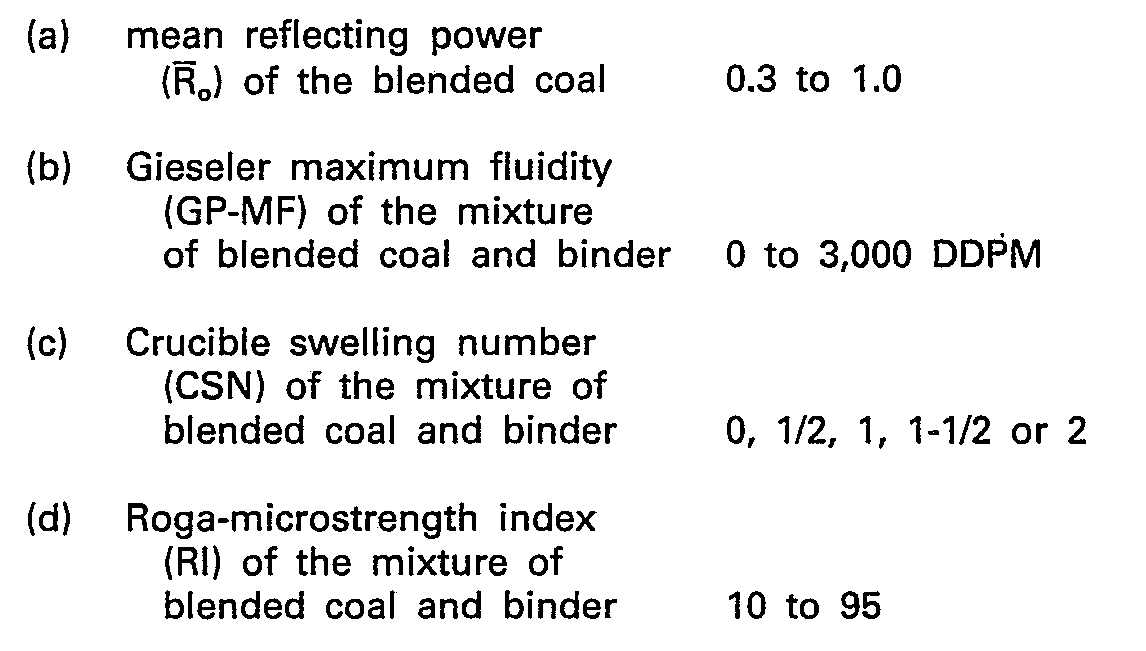
2. The process for producing carbon material for desulfurization as set forth in Claim
1, characterized in that an average temperature elevating rate of the shaped coal
is controlled within a range of about 15 to 120°C/min. until the temperature of the
shaped coal reaches 400°C.
3. The process for producing carbon material for desulfurization as set forth in Claim
2, characterized in that the average temperature elevating rate of the shaped coal
is controlled in a range of from 15 to 120°C/min. by causing the shaped coal to contact
with heating gas at about 450 to 750°C.
4. The process for producing carbon material for desulfurization as set forth in any
of Claims 1 to 3, characterized in that the shaped coal is subjected to carbonization
treatment in an atmosphere of gas containing 3 to 10% by volume of oxygen.
5. The process as set forth in any of Claims 1 to 3, characterized in that, for the
carbonization treatment, the ultimate temperature of the shaped carbon is elevated
to 700 to 1,000°C in an atmosphere of gas containing therein 3 to 10% by volume of
oxygen and 20 to 80% by volume of water vapor.
6. The process for producing carbon material for desulfurization as set forth in Claim
1 or 2, characterized in that a counter-current, internal heating type rotary kiln
is used as a heating device, a heating gas containing therein 3 to 10% by volume of
oxygen and 20 to 80% by volume of water vapor is supplied to the rotary kiln at a
rate of 1 to 10 Nm3/hr. for 1 kg of the shaped body to be fed into said rotary kiln, and the gas phase
temperature at the inlet end part in the rotary kiln for the shaped coal is maintained
at 450 to 750°C, and the gas phase temperature at the outlet end part thereof at 700
to 1,000°C.
7. The process for producing carbon material for desulfurization as set forth in any
of Claims 1 to 6, characterized in that brown coal is used as the non-coking coal.
8. The process for producing carbon material for desulfurization as set forth in Claim
7, characterized in that strong coking bituminous coal is used as the coking coal.
1. Verfahren zur Herstellung von Kohlenstoffmaterial zur Entschwefelung, bei dem ein
Bindemittel mit einer gemischten Kohle, enthaltend nicht-verkokbare Kohle und verkokbare
Kohle, vermischt wird, die erhaltene Mischung der Formgebung unterzogen wird und die
so erhaltene, geformte Kohle dann einer Carbonisierungsbehandlung unterzogen wird,
indem deren Temperatur erhöht wird, bis diese 600 bis 1000°C erreicht, dadurch gekennzeichnet,
daß die physikalischen Eigenschaften der gemischten Kohle und der Mischung aus der
gemischten Kohle und dem Bindemittel gemäß den folgenden Punkten (a) bis (d) eingestellt
werden:
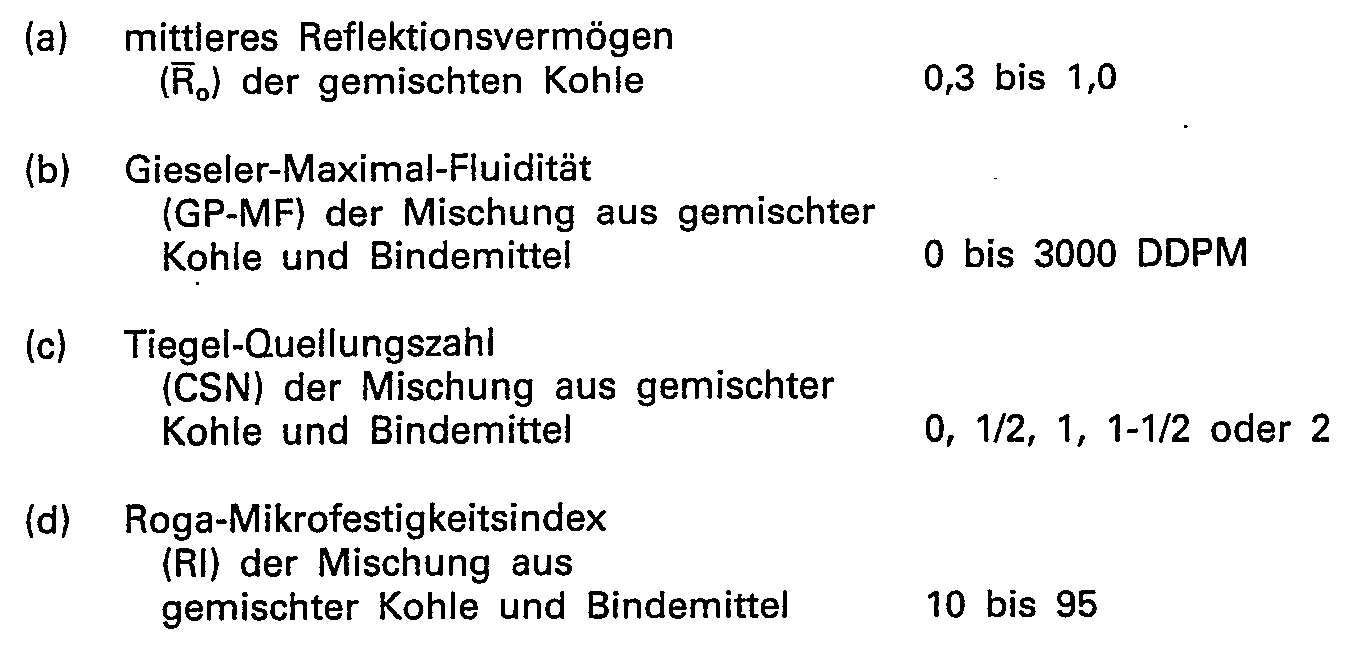
2. Verfahren zur Herstellung von Kohlenstoffmaterial zur Entschwefelung nach Anspruch
1, dadurch gekennzeichnet, daß eine durchschnittliche Temperaturerhöhungsgeschwindigkeit
der geformten Kohle innerhalb eines Bereiches von etwa 15 bis 120°C/min einreguliert
wird, bis die Temperatur der geformten Kohle 400°C erreicht.
3. Verfahren zur Herstellung von Kohlenstoffmaterial zur Entschwefelung nach Anspruch
2, dadurch gekennzeichnet, daß die durchschnittliche Temperaturerhöhungsgeschwindigkeit
der geformten Kohle in einem Bereich von 15 bis 120°C/min einreguliert wird, indem
die geformte Kohle mit einem Heizgas bei 450 bis 750°C in Berührung gebracht wird.
4. Verfahren zur Herstellung von Kohlenstoffmaterial zur Entschwefelung nach einem
der Ansprüche 1 bis 3, dadurch gekennzeichnet, daß die geformte Kohle der Carbonisierungsbehandlung
in einer Atmosphäre aus Gas, die 3 bis 10 Volumenprozent Sauerstoff enthält, unterzogen
wird.
5. Verfahren nach einem der Ansprüche 1 bis 3, dadurch gekennzeichnet, daß für die
Carbonisierungsbehandlung die letztendliche Temperatur der geformten Kohle auf 700
bis 1000°C in einer Atmosphäre aus Gas, enthaltend 3 bis 10 Volumenprozent Sauerstoff
und 20 bis 80 Volumenprozent Wasserdampf, erhöht wird.
6. Verfahren zur Herstellung von Kohlenstoffmaterial zur Entschwefelung nach Anspruch
1 oder 2, dadurch gekennzeichnet, daß ein Gegenstrom-Drehofen mit Innenfeuerung als
Erhitzungsvorrichtung verwendet wird, ein Heizgas, enthaltend 3 bis 10 Volumenprozent
Sauerstoff und 20 bis 80 Volumenprozent Wasserdampf dem Drehofen zugeführt wird mit
einer Rate von 1 bis 10 Nm3/h pro kg des in den Drehofen einzuspeisenden, geformten Körpers und daß die Gasphasentemperatur
am Einlaßendteil in dem Drehofen für die geformte Kohle bei 450 bis 750°C und die
Gasphasentemperatur an dessen Auslaßendteil bei 700 bis 1000°C gehalten werden.
7. Verfahren zur Herstellung von Kohlenstoffmaterial zur Entschwefelung nach einem
der Ansprüche 1 bis 6, dadurch gekennzeichnet, daß Braunkohle als nicht-verkokbare
Kohle verwendet wird.
8. Verfahren zur Herstellung von Kohlenstoffmaterial zur Entschwefelung nach Anspruch
7, dadurch gekennzeichnet, daß stark verkokbare, bitumenhaltige Kohle als verkokbare
Kohle verwendet wird.
1. Procédé de préparation d'un matériau carboné pour la désulfuration, suivant lequel
on mélange un liant avec un charbon mélangé, contenant du charbon non-cokéfiable et
du charbon cokéfiable, on soumet un mélange tel qu'obtenu à un façonnage, et, ensuite,
on soumet le charbon façonné, tel qu'obtenu, à un traitement de carbonisation en élevant
sa température jusqu'à ce qu'elle atteigne 600 à 1 000°C, caractérisé par le fait
qu'on ajuste les propriétés physiques dudit charbon mélangé et du mélange du charbon
mélangé et du liant sur les points (a) à (d) suivants:
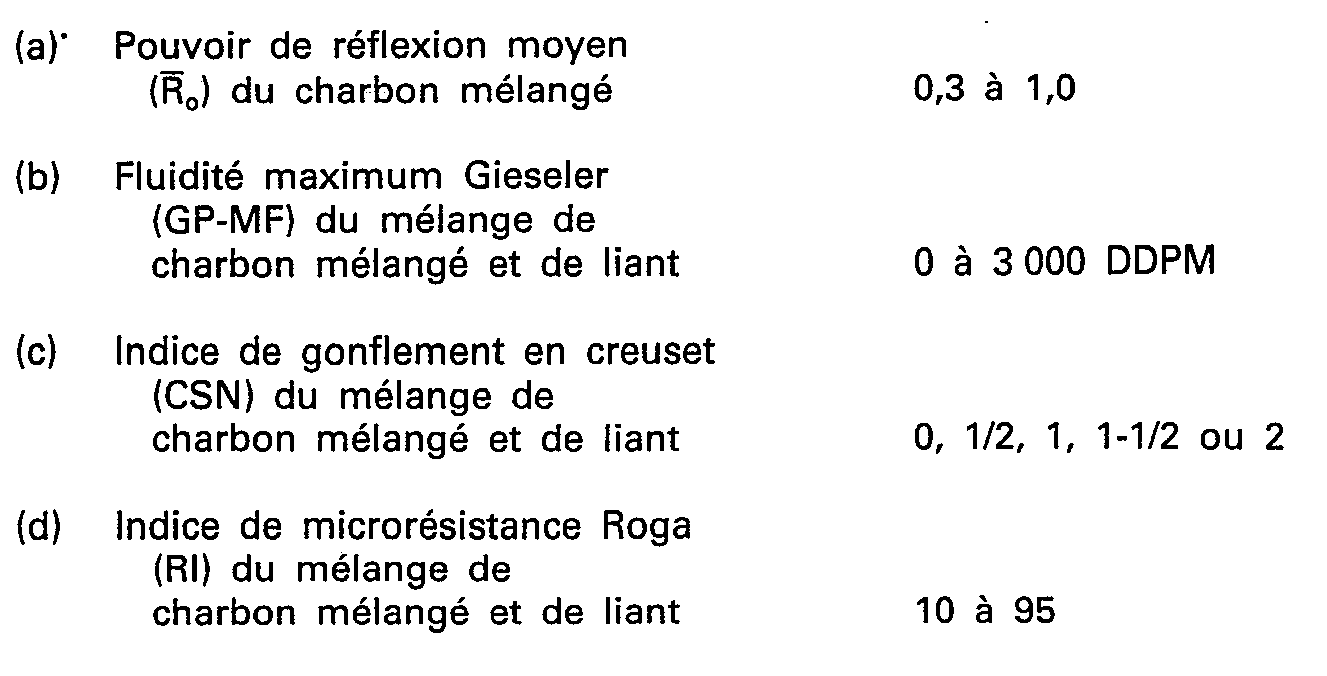
2. Procédé de préparation d'un matériau carboné pour la désulfuration, tel que défini
à la revendication 1, caractérisé par le fait qu'on contrôle la vitesse moyenne d'élévation
de la température du charbon façonné pour qu'elle se situe dans une plage d'environ
15 à 120°C/minute jusqu'à ce que la température du charbon façonné atteigne 400°C.
3. Procédé de préparation d'un matériau carboné pour la désulfuration, tel que défini
à la revendication 2, caractérisé par le fait qu'on contrôle la vitesse moyenne d'élevation
de la température du charbon façonné pour qu'elle se situe dans la plage de 15 à 120°C/minute,
en faisant entrer le charbon façonné en contact avec un gaz de chauffage à environ
450 à 750°C.
4. Procédé de préparation d'un matériau carboné pour la désulfuration, tel que défini
à l'une des revendications 1 à 3, caractérisé par le fait qu'on soumet le charbon
façonné à un traitement de carbonisation dans une atmosphère de gaz contenant de 3
à 10% en volume d'oxygène.
5. Procédé selon l'une des revendications 1 à 3, caractérisé par le fait que, pour
le traitement de carbonisation, on élève la température du charbon façonné jusqu'à
au maximum 700 à 1 000°C, dans une atmosphère de gaz contenant en son sein de 3 à
10% en volume d'oxygène et de 20 à 80% en volume de vapeur d'eau.
6. Procédé de préparation d'un matériau carboné pour la désulfuration, tel que défini
à la revendication 1 ou 2, caractérisé par le fait qu'on utilise, comme dispositif
de chauffage, un fourneau rotatif du type à chauffage interne, à contre-courant, on
alimente le fourneau rotatif en gaz de chauffage, contenant en son sein de 3 à 10%
en volume d'oxygène et de 20 à 80% en volume de vapeur d'eau, à une vitesse de 1 à
10 Nm'/heure pour 1 kg du corps façonné à introduire dans ledit fourneau rotatif,
et on maintient la température de la phase gazeuse à la partie d'extrémité d'entrée
du fourneau rotatif pour le charbon façonné, à une valeur de 450 à 750°C, et la température
de la phase gazeuse à la partie d'extrémité de sortie de celui-ci, à une valeur de
700 à 1 000°C.
7. Procédé de préparation d'un matériau carboné pour la désulfuration, tel que défini
à l'une des revendications 1 à 6, caractérisé par le fait qu'on utilise de la lignite
comme charbon non-cokéfiable.
8. Procédé de préparation d'un matériau carboné pour la désulfuration, tel que défini
à la revendication 7, caractérisé par le fait qu'on utilise, comme charbon cokéfiable
du charbon bitumineux fortement cokéfiable.