| (19) |
 |
|
(11) |
EP 0 076 619 B1 |
| (12) |
EUROPEAN PATENT SPECIFICATION |
| (45) |
Mention of the grant of the patent: |
|
08.05.1985 Bulletin 1985/19 |
| (22) |
Date of filing: 28.09.1982 |
|
| (51) |
International Patent Classification (IPC)4: B29C 51/42 |
|
| (54) |
Heat transfer between processing rolls and sheet film
Wärmeübertragung zwischen Formwalzen und einer Folienbahn
Transfert de chaleur entre des cylindres de formation et une feuille continue
|
| (84) |
Designated Contracting States: |
|
BE DE FR GB IT LU NL |
| (30) |
Priority: |
29.09.1981 US 306734
|
| (43) |
Date of publication of application: |
|
13.04.1983 Bulletin 1983/15 |
| (71) |
Applicant: E.I. DU PONT DE NEMOURS AND COMPANY |
|
Wilmington
Delaware 19898 (US) |
|
| (72) |
Inventor: |
|
- Levy, Stanley Burton
Wilmington
Delaware 19803 (US)
|
| (74) |
Representative: Jones, Alan John et al |
|
CARPMAELS & RANSFORD
43 Bloomsbury Square
London, WC1A 2RA
London, WC1A 2RA (GB) |
|
| |
|
| Note: Within nine months from the publication of the mention of the grant of the European
patent, any person may give notice to the European Patent Office of opposition to
the European patent
granted. Notice of opposition shall be filed in a written reasoned statement. It shall
not be deemed to
have been filed until the opposition fee has been paid. (Art. 99(1) European Patent
Convention).
|
Background of the Invention
[0001] The subject invention relates to a process and apparatus for heat transfer between
a processing roll and sheets of organic thermoplastic crystallizable or crystalline
polymeric film.
[0002] For years, numerous film manufacturing processes have been operating at relatively
slow processing speeds because the rate determining step of these processes has been
the heat transfer between a processing roll and the sheet film. If the processing
speed is increased, an air layer forms between the film and the roll substantially
reducing the heat transfer therebetween, resulting in sub-standard film properties.
To overcome this speed deficiency, devices such as electrostatic pinners and vacuum
chambers have been used to eliminate the air layer between roll and film.
Summary of the Invention
[0003] The subject invention is a method for heat transfer between a processing roll and
sheets of organic thermoplastic crystallizable or crystalline polymeric film at processing
speeds up to four times that of conventional heat transfer processes. Also provided
is an apparatus for carrying out the process.
[0004] More specifically, the subject invention is a process for high speed heat transfer
between processing rolls and sheets of organic thermoplastic crystallizable or crystalline
polymeric film comprising providing a processing roll having 70 to 150 circumferential
grooves per centimeter on the surface of the roll, the top width of said grooves on
the surface of the roll being .04 to 0.13 millimeter and the depth of said grooves
being at least .02 millimeter such that the ratio of depth to width is greater, than
0.25, maintaining the roll at a temperature different from that of said film and contacting
said film with said roll for a time sufficient to bring the temperature of the film
to processing temperature.
[0005] Also provided is an apparatus to carry out the ·process, an improvement over those
of the past for high speed heat transfer between a processing roll and sheets of organic
thermoplastic crystallizable or crystalline polymeric film of the type having a rotatably
mounted processing roll, means for maintaining said roll at a temperature different
from that of said film and means for contacting said film with said roll, the improvement
which comprises 70 to 150 circumferential grooves per centimeter on the surface of
the roll, the top width of said grooves on the surface of the roll being .04 to 0.13
millimeter and the depth of said grooves being at least .02 millimeter such that the
ratio of depth to width is greater than 0.25.
Brief Description of the Figure
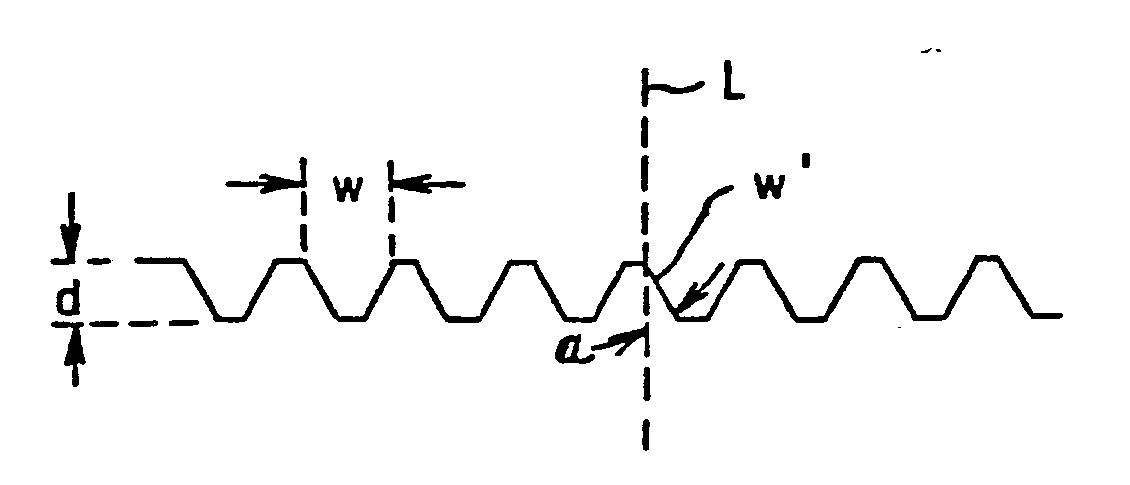
[0006] The figure is a schematic representation of a magnified cross-section of the microgrooved
surface of the processing roll of the subject invention.
Detailed De"c':ption
[0007] Many thermoplastic and thermoset film manufacturing operations include processing
rolls used to transfer heat between these rolls and the film, common examples including
quench rolls, heat set rolls and heated or cooled stretch rolls. During high speed
film processing, an air layer is trapped between the film and the roll resulting in
a reduction of heat transfer therebetween. Further, this air layer reduces the friction
between the roll and the film allowing undesirable transverse shrinkage, or neck-in,
during operations requiring heating of the film to near melt temperatures.
[0008] In order to minimize the air layer trapped between the film and the processing roll
while at the same time maximizing the heat transfer therebetween, a well defined microgrooved
escape path for the air on the surface of the roll has been discovered which surprisingly
does not result in objectionable embossing of the film surface. This microgrooving
allows heretofore unobtainable high speed film processing.
[0009] A magnified portion of the processing roll useful in the practice of the subject
invention is seen in the Figure. The subject invention provides for 70 to 150 circumferential
grooves per centimeter on the surface of the heat set roll. Other groove patterns,
e.g., a chevron pattern, as well as patterns utilizing greater than 150 grooves per
centimeter, exhibit unacceptable air movement from under the film and hence the air
layer between the film and the roll hampers heat transfer therebetween. Further, if
less than about 60 to 70 grooves per centimeter are used, undesirable embossing of
the film surface takes place.
[0010] To minimize this air layer and maximize heat transfer, the grooves must have a top
width w of .04 to 0.13 millimeter and a depth d greater than .02 millimeter such that
the ratio of depth to width is greater than 0.25. Wider grooves result in a loss of
contact area between film and roll and hence an undesirable loss of heat transfer
therebetween. Shallower grooves do not allow sufficient air movement to eliminate
the air layer between film and roll. The grooves preferred to practice the subject
invention have a width w of about .09 millimeter and a depth d of about .08 millimeter.
[0011] Ideally, the walls of the grooves are etched such that line L drawn perpendicular
to the surface of the roll is parallel to or superimposed on wall w'. However, practically
speaking, etching such a groove is difficult as the residue created by the etching
process has no means to escape. Therefore, the grooves are etched with sloping walls
to allow etching residue to slide up and out of the grooves. Consistent with the above
mentioned depth and width requirements of the grooves, the grooves are preferably
etched such that wall w' of the groove and line L drawn perpendicular to the surface
of the roll to intersect wall w' form an acute angle alpha (a) of less than 60 degrees.
[0012] The subject invention can be utilized in any film manufacturing process where a processing
roll is used as a heat source or heat sink thereby transferring heat between film
and roll. Where the manufacturing speed of the film is dependent upon this step of
heat transfer, the processing speed can be increased up to four fold as seen in the
Examples below.
[0013] In one embodiment of the subject invention, high speed heat setting of polyester
film is carried out on a heat setting apparatus having a heat set roll with a grooved
surface as defined above. The apparatus can also include means, such as nip rolls,
for forcing the film onto the heat set roll along the line where the film contacts
the heat set roll and along the line where the film leaves the heat set roll to assure
intimate contact between the film and the tops of the grooves. The heat set roll is
maintained at a heat setting temperature of between 170 and 205°C and the film contacted
with such a roll until the film reaches a processing temperature of 165 to 200°C,
generally the contact time being .05 to 0.2 second.
[0014] In another embodiment of the subject invention, high speed casting of polyester film
onto a quench roll is carried out using a quench roll with a grooved surface as defined
above. The roll is maintained at 20 to 50°C and molten polyester materials extruded
onto the quench roll so that the polyester solidifies into film form.
[0015] In still another embodiment of the subject invention, high speed orientation of polyolefin
or polyamide film is carried out utilizing stretch rolls i.e., a first slow roll and
a second fast roll, both of which may have a grooved surface as defined above. Therefore,
for orientation of polyamide film, the slow roll is maintained at a temperature between
120 and 190°C and the film contacted with this roll for 0.2 to 0.3 second or until
the film reaches a processing temperature of 115 to 185°C. For orientation of polyolefin
film, the slow roll is maintained at a temperature between 100 and 140°C and the film
contacted with this roll for 0.2 to 0.4 seconds or until the film reaches a processing
temperature of 95 to 135°C to allow it to be oriented. Due to the soft nature of polyolefin
film, however, it is preferred that there be 95 to 150 grooves per centimeter in the
surface of the slow stretch roll. As is well known in the art, these slow rolls are
followed in the orientation process by faster turning rolls to effectuate the machine
direction stretching of the film. This fast roll can also be utilized as a heat set
roll if desired as illustrated in Example III.
[0016] The subject invention can be utilized in any process where minimizing the air layer
between a flat sheet web and a processing roll is important both to the maximization
of heat transfer therebetween and transverse shrinkage restraint and should not be
limited to the processes described in the Examples that follow.
Example I
[0017] Polyester terephthalate film having a thickness of .038 millimeter was heat set at
366 meters per minute on a 20 centimeter heat set roll having 70 grooves per centimeter
on the surface of the roll, the top width of said grooves being .096 millimeter and
the depth of said grooves being .087 millimeter. The roll was maintained at about
190°C to bring the film to a processing temperature of about 185°C, the contact time
between the film and the roll being about .05 seconds. Runs were made with both a
single nip roll at the line where the film comes into contact with the heat set roll
and dual nip rolls, one at the line where the film comes into contact with the heat
set roll, the other at the line where the film leaves the heat set roll. The resulting
heat set film showed a transverse width loss of 140 millimeters with the single nip
roll and 114 millimeters with the dual nip rolls.
Comparative Example I
[0018] The procedure of Example I was repeated using a conventional smooth heat set roll..Due
to the air layer formed between the film and the roll at such a high processing speed,
the film was not properly heat set and the film showed a transverse width loss of
276 millimeters with the single nip roll and 216 millimeters with the dual nip rolls.
Example II
[0019] A polyolefin film consisting of 97.5% propylene and 2.5% ethylene and having a thickness
of .025 millimeter was heated for machine direction stretching at 61.0 meters per
minute on a 20 centimeter heat processing roll having 118 grooves per centimeter on
the surface of the roll, the top width of said grooves being .02 millimeter and the
depth of said grooves being .025 millimeter. The roll was maintained at about 135°C
to bring the film to a processing temperature of 133°C, the contact time between the
film and the roll being about 0.10 second. The film was then run over a cool processing
roll at 110 meters per minute to effectuate stretching of the film between the two
processing rolls. This cool roll was maintained at 38°C to bring the film to a temperature
of 39°C to retain the effect of the machine direction stretch. The contact time between
the film and this roll being about 0.17 second. The cool roll had 80 grooves per centimeter
on the surface of the roll, the top width of the grooves being 0.10 millimeter and
the depth of the grooves being .025 millimeter. The edges of the resulting film laid
flat passing over the first roll and did not display puckering, i.e., did not evidence
air trapped under the film, as it passed over the second roll.
Comparative Example II
[0020] The procedure of Example II was repeated with two smooth rolls. The edges of the
film curled up as the film passed over the first roll, tending to cause film breaks,
and puckering was evidenced as the film passed over the second roll.
Example III
[0021] Polyamide film having a thickness of .038 millimeter was heated for machine direction
stretching at 122 meters per minute at a 20 centimeter heat processing roll prior
to stretching. This slow roll had 72 grooves per centimeter on its surface, the top
width of the grooves being .096 millimeter and the depth of the grooves being .087
millimeter. The roll was maintained at about 171°C to bring the film to a processing
temperature of about 170°C, the contact time being about 0.15 seconds. The film was
subsequently passed over a fast heat set roll running at about 366 meters per minute
with a groove pattern identical to that of the slow roll. The temperature of the fast
roll was maintained at about 205°C to bring the film to a heat setting temperature
of about 200°C, the contact time being about .05 seconds. The processing speed of
366 meters per minute was four times faster than the orientation process using smooth
heat processing rolls.
Example IV
[0022] A molten polyester terephthalate web was extruded onto a quench roll which was microgrooved
over half of its surface and smooth over the other half of its surface. The grooves
were spaced at 80 grooves per centimeter, the top width of the grooves were .10 millimeter
and the depth of the grooves were .025 millimeter. The resulting film portion which
was quenched on the microgrooved portion of the quench roll did not show signs of
detrimental embossing and disposed good gauge uniformity. The resulting film portion
which was quenched on the smooth portion of the quench roll evidenced gauge nonuniformities
and surface irregularities due to air entrapped between the molten web and the quench
roll.
1. An apparatus for heat transfer between a processing roll and sheets of organic
thermoplastic crystallizable or crystalline polymeric film of the type having a rotatably
mounted processing roll, means for maintaining said roll at a temperature different
from that of said film and means for contacting said film with said roll, wherein
the apparatus further comprises 70 to 150 circumferential grooves per centimeter in
the surface of the roll, the top width of said grooves on the surface of the roll
being .04 to 0.13 millimeter and the depth of said grooves being at least .02 millimeter
such that the ratio of depth to width is greater than 0.25.
2. The apparatus of Claim 1 wherein an acute angle between the wall of a groove and
a line drawn perpendicular to the surface of the roll intersecting said wall is less
than 60 degrees.
3. The apparatus of Claim 1 or Claim 2 wherein exists means for forcing the film onto
the roll along the line where the film contacts the roll and along the line where
the film leaves the roll.
4. An apparatus for heat setting polyester film of the type having a rotatably mounted
heat set roll, means for maintaining said roll at 170 to 205°C and means for contacting
said film with said roll, wherein the apparatus further comprises 70 to 150 circumferential
grooves per centimeter in the surface of the heat set roll, the top width of said
grooves on the surface of the roll being .04 to 0.13 millimeter and the depth of said
grooves being at least .02 millimeter such that the ratio of depth to width is greater
than 0.25.
5. The apparatus of Claim 4 wherein an acute angle between the wall of a groove and
a line drawn perpendicular to the surface of the roll intersecting said wall is less
than 60 degrees.
6. The apparatus of Claim 4 or Claim 5 wherein exists means for forcing the film onto
the roll along the line where the film contacts the roll and along the line where
the film leaves the roll.
7. An apparatus for quenching molten polyester film of the type having an extruder
die extruding the polymer in web form onto a rotatably mounted quench roll and means
for-maintaining said roll at 20 to 50°C, wherein the apparatus further comprises 70
to 150 circumferential grooves per centimeter on the surface of the quench roll, the
top width of said grooves on the surface of the roll being .04 to 0.13 millimeter
and the depth of said grooves being at least .02 millimeters such that the ratio of
depth to width is greater than 0.25.
8. The apparatus of Claim 7 wherein an acute angle between the wall of a groove and
a line drawn perpendicular to the surface of the roll intersecting said wall is less
than 60 degrees.
9. The apparatus of Claim 7 or Claim 8 wherein exists means for forcing the film onto
the roll r'along the line where the film contacts the roll and along the line where
the film leaves the roll.
10. An apparatus for orientation of polyolefin film of the type having a rotatably
mounted heating roll followed by a stretching zone, means for maintaining said roll
at 100 to 140°C and means for contacting said film with said roll, wherein the apparatus
further comprises 95 to 150 circumferential grooves per centimeter on the surface
of the heating roll, the top width of said grooves on the surface of the roll being
.04 to .13 millimeter and the depth of said grooves being at least .02 millimeter
such that the ratio of depth to width is greater than 0.25.
11. The apparatus of Claim 10 wherein an acute angle between the wall of a groove
and a line drawn perpendicular to the surface of the roll intersecting said wall is
less than 60 degrees.
12. The apparatus of Claim 10 or Claim 11 wherein exists means for forcing the film
onto the roll along the line where the film contacts the roll and along the line where
the film leaves the roll.
13. An apparatus for orientation of polyamide film of the type having a rotatably
mounted heating roll followed by a stretching zone, means for maintaining said roll
at 120 to 190°C and means for contacting said film with said roll, wherein the apparatus
further comprises 70 to 150 circumferential grooves per centimeter in the surface
of the heating roll, the top width of said grooves on the surface of the roll being
.04 to 0.13 millimeter and the depth of said grooves being at least .02 millimeter
such that the ratio of depth to width is greater than 0.25.
14. The apparatus of Claim 13 wherein an acute angle between the wall of a groove
and a line drawn perpendicular to the surface of the roll intersecting said wall is
less than 60 degrees.
15. The apparatus of Claim 13 or Claim 14 wherein exists means for forcing the film
onto the roll along the line where the film contacts the roll and along the line where
the film leaves the roll. 16. A process for heat transfer between a processing roll
and sheets of organic thermoplastic crystallizable or crystalline polymeric film comprising:
(i) providing a processing roll having 70 to 150 circumferential grooves per centimeter
in the surface of the roll, the top width of said grooves on the surface of the roll
being .04 to 0.13 millimeters and the depth of said grooves being at least.02 millimeters
such that the ratio of depth to width is greater than 0.25;
(ii) maintaining the roll at a temperature different from that of said film
(iii) bringing the film to processing temperature by contacting of the film with the
roll.
17. The process of Claim 16 further comprising forcing the film onto the roll along
the line where the film contacts the roll and along the line where the film leaves
the roll.
18. The process of Claim 16 or Claim 17 wherein the film is a polyolefin film, the
temperature of the roll of step (ii) is between 100 and 140°C and the processing temperature
of step (iii) is from 95 to 135°C.
19. The process of Claim 16 or Claim 17 wherein the film is a polyester film, the
temperature of the roll of step (ii) is between 170 and 205°C and the processing temperature
of step (iii) is from 165 to 200°C.
20. The process of Claim 16 or Claim 17 wherein the film is a polyolefin film, there
is provided 95 to 150 circumferential grooves per centimeter on the surface of the
roll, the temperature of the. roll of step (ii) is between 100 and 140°C and the processing
temperature of step (iii) is from 95 to 135°C.
21. The process of Claim 16 or Claim 17 wherein the film is a polyamide film, the
temperature of the roll of step (ii) is between 120 and 190°C and the processing temperature
of step (iii) is from 115 to 185°C.
22. The process of Claim 16 or Claim 17 wherein the film is a polyimide film, the
temperature of the roll of step (ii) is between 200 and 210°C and the processing temperature
of step (iii) is from 190 to 210°C.
1. Vorrichtung zur Wärmeübertragung zwischen einer Formwalze und Folienbahnen aus
organischen, thermoplastischen, kristallisierbaren oder kristallinen Polymeren der
Bauform, die eine drehbar gelagerte Formwalze, eine Einrichtung zum Halten der Walze
auf einer von der Folie unterschiedlichen Temperatur und eine Einrichtung zum Kontaktieren
der Folie mit der Walze hat, worin die Vorrichtung ferner 70 bis 150 Umfangsnuten
pro Zentimeter in der Oberfläche der Walze aufweist, deren obere Breite auf der Oberfläche
der Walze 0,04 bis 0,13 mm und deren Tiefe wenigstens 0,02 Millimeter beträgt, derart,
daß das Verhältnis von Tiefe zur Breite größer als 0,25 ist.
2. Vorrichtung nach Anspruch 1, dadurch gekennzeichnet, daß ein spitzer Winkel zwischen
der Wand einer Nut und einer senkrecht zur Oberfläche der Walze gezogenen Linie, die
die Wand schneidet, kleiner als 60 Grad ist.
3. Vorrichtung nach Anspruch 1 oder 2, dadurch gekennzeichnet, daß eine Einrichtung
vorhanden ist, die die Folie auf die Walze längs der Linie drückt, an der die Folie
die Walze berührt, und längs der Linie, an der die Folie die Walze verläßt.
4. Vorrichtung zum Thermofixieren einer Polyesterfolie der Bauart, die eine drehbar
geiagerte Thermofixierwalze, eine Einrichtung zum Halten der Walze auf einer Temperatur
von 170 bis 205°C und eine Einrichtung zum Kontaktieren der Folie mit der Walze aufweist,
worin die Vorrichtung ferner 70 bis 150 Umfangsnuten pro Zentimeter in der Oberfläche
der Thermofixierwalze aufweist, deren obere Breite auf der Oberfläche der Walze 0,04
bis 0,13 Millimeter und deren Tiefe wenigstens 0,02 Millimeter beträgt, derart, daß
das Verhältnis von Tiefe zu Breite größer als 0,25 ist.
5. Vorrichtung nach Anspruch 4, dadurch gekennzeichnet, daß ein spitzer Winkel zwischen
der Wand einer Nut und einer senkrecht zur Oberfläche der Walze gezogenen Linie, die
die Wand schneidet, kleiner als 60 Grad ist.
6. Vorrichtung nach Anspruch 4 oder 5, dadurch gekennzeichnet, daß eine Einrichtung
vorhanden ist, die die Folie auf die Walze längs der Linie drückt, an der die Folie
die Walze berührt und längs der Linie an der die Folie die Walze verläßt.
7. Vorrichtung zum Abschrecken einer erschmolzenen Polyesterfolie der Bauart, die
ein Extruderwerkzeug, das das Polymer in Bahnform auf eine drehbar gelagerte Abschreckwalze
extrudiert und eine Einrichtung hat, die die Walze bei - 20 bis 50°C hält, worin die
Vorrichtung ferner 70 bis 150 Umfangsnuten pro Zentimeter auf der Oberfläche der Abschreckwalze
aufweist, deren obere Breite auf der Oberfläche der Walze 0,04 bis 0,13 Millimeter
und deren Tiefe wenigstens 0,02 Millimeter beträgt, derart, daß das Verhältnis von
Tiefe zu Breite größer als 0,25 ist.
8. Vorrichtung nach Anspruch 7, dadurch gekennzeichnet, daß ein spitzer Winkel zwischen
der Wand einer Nut und einer senkrecht zur Oberfläche der Walze gezeichneten Linie,
die die Wand schneidet, kleiner als 60 Grad ist.
9. Vorrichtung nach Anspruch 7 oder 8, dadurch gekennzeichnet, daß eine Einrichtung
vorhanden ist, die die Folie auf die Walze längs der Linie drückt, an der die Folie
die Walze berührt und längs der Linie, an der die Folie die Walze verläßt.
10. Vorrichtung zur Orientierung einer Polyolefinfolie der Bauform, die eine drehbar
gelagerte Heizwalze, gefolgt von einer Streckzone, eine Einrichtung zum Halten der
Walze bei 100 bis 140°C und eine Einrichtung zum Kontaktieren der Folie mit der Walze
aufweist, worin die Vorrichtung ferner 95 bis 150 Umfangsnuten pro Zentimeter auf
der Oberfläche der Heizwalze aufweist, deren obere Breite auf der Oberfläche der Walze
0,04 bis 0,13 Millimeter und deren Tiefe wenigstens 0,02. Millimeter beträgt derart,
daß das Verhältnis von Tiefe zu Breite größer als 0,25 ist.
11. Vorrichtung nach Anspruch 10, dadurch gekennzeichnet, daß ein spitzer Winkel zwischen
der Wand einer Nut und einer senkrecht zur Oberfläche der Walze gezogenen Linie, die
die Wand schneidet, kleiner als 60 Grad ist.
12. Vorrichtung nach Anspruch 10 oder 11, dadurch gekennzeichnet, daß eine Einrichtung
vorhanden ist, die die Folie auf die Walze längs der Linie drückt, an der die Folie
die Walze berührt und längs der Linie, an der die Folie die Walze verläßt.
13. Vorrichtung zur Orientierung eines Polyamidfilms der Bauform, die eine drehbar
gelagerte Heizwalze, gefolgt von einer Streckzone, eine Einrichtung zum Halten der
Walze bei 120 bis 190°C und eine Einrichtung zum Kontaktieren der Folie mit der Walze
hat, worin die Vorrichtung ferner 70 bis 150 Umfangsnuten pro Zentimeter in der Oberfläche
der Heizwalze aufweist, deren obere Breite auf der Oberfläche der Walze 0,04 bis 0,13
Millimeter und deren Tiefe wenigstens 0,02 Millimeter beträgt derart, daß das Verhältnis
von Tiefe zu Breite größer als 0,25 ist.
14. Vorrichtung nach Anspruch 13, dadurch gekennzeichnet, daß ein spitzer Winkel zwischen
der Wand einer Nut und einer senkrecht zur Oberfläche der Walze gezogenen Linie, die
die Wand schneidet, kleiner als 60 Grad ist.
15. Vorrichtung nach Anspruch 13 oder 14, dadurch gekennzeichnet, daß eine Einrichtung
vorhanden ist, die die Folie auf die Walze längs der Linie drückt, an der die Folie
die Walze berührt und längs der Linie, an der die Folie die Walze verläßt.
16. Verfahren zur Wärmeübertragung zwischen einer Formwalze und Folienbahnen aus organischen,
thermoplastischen, kristallisierbaren oder kristallinen Polymeren, das aufweist:
(i) Vorsehen einer Formwalze, die 70 bis 150 Umfangsnuten pro Zentimeter in der Oberfläche
der Walze hat, deren obere Breite auf der Oberfläche der Walze 0,04 bis 0,13 Millimeter
und deren Tiefe wenigstens 0,02 Millimeter beträgt, derart, daß das Verhältnis von
Tiefe zu Breite größer als 0,25 ist;
(ii) Halten der Walze auf einer Temperatur, die sich von jener der Folie unterscheidet,
und
(iii) Bringen der Folie auf die Formtemperatur durch Kontaktieren der Folie mit der
Walze.
17. Verfahren nach Anspruch 16, dadurch gekennzeichnet, daß ferner die Folie auf die
Walze längs der Linie gedrückt wird, an der die Folie die Walze berührt und längs
der Linie, an der die Folie die Walze verläßt.
18. Verfahren nach Anspruch 16 oder 17, dadurch gekennzeichnet, daß die Folie eine
Polyolefinfolie ist, die Temperatur der Walze im Schritt (ii) zwischen100 und 140°C
liegt und daß die Formtemperatur des Schritts (iii) 95 bis 135°C ist.
19. Verfahren nach Anspruch 16 oder 17, dadurch gekennzeichnet, daß die Folie eine
Polyesterfolie ist, die Temperatur der Walze des Schritts (ii) zwischen 170 und 205°C
liegt und die Formtemperatur des Schritts (iii) 165 bis 200°C ist.
20. Verfahren nach Anspruch 16 oder 17, dadurch gekennzeichnet, daß die Folie eine
Polyolefinfolie ist, daß 95 bis 150 Umfangsnuten pro Zentimeter auf der Oberfläche
der Walze vorgesehen sind, daß die Temperatur der Walze im Schritt (ii) zwischen 100
und 140°C liegt und die Bearbeitungstemperatur des Schritts (iii) 95 bis 135°C ist.
21. Verfahren nach Anspruch 16 oder 17, dadurch gekennzeichnet, daß die Folie eine
Polyamidfolie ist, die Temperatur der Walze des Schritts (ii) zwischen 120 und 190°C
liegt und die Formtemperatur des Schritts (iii) 115 bis 185°C ist.
22. Verfahren nach Anspruch 16 oder 17, dadurch gekennzeichnet, daß die Folie eine
Polyimidfolie ist, die Temperatur der Walze des Schritts (ii) zwischen 200 und 210°C
liegt und die Formtemperatur des Schritts (iii) 190 bis 210°C ist.
1. Appareil de transfert de chaleur entre un cylindre de traitement et des feuilles
pelliculaires de polymère organique thermoplastique cristallisable ou cristallin,
du type comportant un cylindre de traitement monté rotatif, des moyens propres à maintenir
ledit cylindre à une température différente de celle de ladite pellicule et des moyens
propres à mettre en contact ladite pellicule avec ledit cylindre, dans lequel l'appareil
comprend en outre 70 à 150 rainures circonférentielles par centimètre dans la surface
du cylindre, la largeur au sommet desdites rainures sur la surface du cylindre étant
de 0,04 à 0,13 millimètre et la profondeur desdites rainures étant d'au moins 0,02
millimètre de telle sorte que le rapport de la profondeur à la largeur soit supérieur
à 0,25.
2. Appareil selon la revendication 1, dans lequel un angle aigu entre la paroi d'une
rainure et une droite menée perpendiculairement à la surface du cylindre et coupant
ladite paroi est inférieur à 60 degrés.
3. Appareil selon la revendication 1 ou 2, dans lequel il existe un moyen propre à
forcer la pellicule à s'appliquer sur le cylindre le long de la ligne où la pellicule
vient en contact avec le cylindre et le long de la ligne où la pellicule quitte le
cylindre.
4. Appareil de durcissement thermique de pellicule de polyester, du type comportant
un cylindre de durcissement thermique monté rotatif, des moyens propres à maintenir
ledit cylindre à une température de 170 à 205°C et des moyens propres à mettre en
contact ladite pellicule avec ledit cylindre, dans lequel l'appareil comprend en _outre
70 à 150 rainures circonférentielles par centimètre dans la surface du cylindre de
durcissement thermique, la largeur au sommet desdites rainures sur la surface du cylindre
étant de 0,04 à 0,13 millimètre et la profondeur desdites rainures étant d'au moins
0,02 millimètre de telle sorte que le rapport de la profondeur à la largeur soit supérieur
à 0,25.
5. Appareil selon la revendication 4, dans lequel un angle aigu entre la paroi d'une
rainure et une droite menée perpendiculairement à la surface du cylindre et coupant
ladite paroi est inférieur à 60 degrés.
6. Appareil selon la revendication 4 ou 5, dans lequel existe un moyen propre à forcer
le pellicule à s'appliquer sur le cylindre le long de la ligne où la pellicule vient
en contact avec le cylindre et le long de la ligne où la pellicule quitte le cylindre.
7. Appareil de trempe de pellicule de polyester à l'état fondu, du type comportant
une filière d'extrusion extrudant le polymère sous forme de bande continue sur un
cylindre de trempe monté rotatif et des moyens propres à maintenir ledit cylindre
à une température de 20 à 50°C, dans lequel l'appareil comprend en outre 70 à 150
rainures circonférentielles par centimètre sur la surface du cylindre de trempe, la
largeur au sommet desdites rainures sur la surface du cylindre étant de 0,04 à 0,13
millimètre et la profondeur desdites rainures étant d'au moins 0,02 millimètre de
telle sorte que le rapport de la profondeur à la largeur soit supérieur à 0,25.
8. Appareil selon la revendication 7, dans lequel un angle aigu entre la paroi d'une
rainure et une droite menée perpendiculairement à la surface du cylindre et coupant
ladite paroi est inférieur à 60 degrés.
9. Appareil selon la revendication 7 ou 8, dans lequel existe un moyen propre à forcer
la pellicule à s'appliquer sur le cylindre le long de la ligne où la pellicule vient
en contact avec le cylindre et le long de la ligne où la pellicule quitte le cylindre.
10. Appareil d'orientation de pellicule de polyoléfine, du type comportant un cylindre
chauffant monté rotatif suivi par une zone d'étirage, des moyens propres à maintenir
ledit cylindre à une température de 100 à 140°C et des moyens propres à mettre en
contact ladite pellicule avec ledit cylindre, dans lequel l'appareil comprend en outre
95 à 150 rainures circonférentielles par centimètre sur la surface du cylindre chauffant,
la largeur au sommet desdites rainures sur la surface du cylindre étant de 0,04 à
0,13 millimètre et la profondeur desdites rainures étant d'au moins 0,02 millimètre
de telle sorte que le rapport de la profondeur à la largeur soit supérieur à 0,25.
11. Appareil selon la revendication 10, dans lequel un angle aigu entre la paroi d'une
rainure et une droite menée perpendiculairement à la surface du cylindre et coupant
ladite paroi est inférieur à 60 degrés.
12. Appareil selon la revendication 10 ou 11, dans lequel il existe un moyen propre
à forcer la pellicule à s'appliquer sur le cylindre le long de la ligne où la pellicule
vient en contact avec le cylindre et le long de la ligne où la pellicule quitte le
cylindre.
13. Appareil d'orientation de pellicule de polyamide, du type comportant un cylindre
chauffant monté rotarif suivi par une zone d'étirage, des moyens propres à maintenir
ledit cylindre à une température de 120 à 190°C et des moyens propres à mettre en
contact ladite pellicule avec ledit cylindre, dans lequel l'appareil comprend en outre
70 à 150 rainures circonférentielles par centimètre dans la surface du cylindre chauffant,
la largeur au sommet desdites rainures sur la surface du cylindre étant de 0,04 à
0,13 millimètre et la profondeur desdites rainures étant d'au moins 0,02 millimètre
de telle sorte que le rapport de la profondeur à la largeur soit supérieur à 0,25.
14. Appareil selon la revendication 13, dans lequel un angle aigu entre la paroi d'une
rainure et une droite menée perpendiculairement à la surface du cylindre et coupant
ladite paroi est inférieur à 60 degrés.
15. Appareil selon la revendication 13 ou 14, dans lequel il existe un moyen propre
à forcer la pellicule à s'appliquer sur le cylindre le long de la ligne où la pellicule
vient en contact avec le cylindre et le long de la ligne où la pellicule quitte le
cylindre.
16. Procédé de transfert de chaleur entre un cylindree de traitement et des feuilles
pelliculaires de polymère organique thermoplastique cristallisable ou cristallin,
selon lequel:
(i) on prend un cylindre de traitement comportant 70 à 150 rainures circonférentielles
par centimètre dans la surface du cylindre, la largeur au sommet desdites rainures
sur la surface du cylindre étant de 0,04 à 0,13 millimètre et la profondeur desdites
rainures étant d'au moins 0,02 millimètre de telle sorte que le rapport de la profondeur
à la largeur soit supérieur à 0,25;
(ii) on maintient le cylindre à une température différente de celle de ladite pellicule;
(iii) on porte la pellicule à la température de traitement par mise en contact de
la pellicule avec le cylindre.
17. Procédé selon la revendication 16, selon lequel en outre on applique avec force
la pellicule sur le cylindre le long de la ligne où la pellicule vient et contact
avec le cylindre et le long de la ligne où la pellicule quitte le cylindre.
18. Procédé selon la revendication 16 ou 17, dans lequel la pellicule est une pellicule
de polyoléfine, la température du cylindre de l'opération (ii) est comprise entre
100 et 140°C et la température de traitement de l'opération (iii) est de 95 à 135°C.
19. Procédé selon la revendication 16 ou 17, dans lequel la pellicule est une pellicule
de polyester, la température du cylindre de l'opération (ii) est comprise entre 170
et 205°C et la température de traitement de l'opération (iii) est de 165 à 200°C.
20. Procédé selon la revendication 16 ou 17, dans lequel la pellicule est une pellicule
de polyoléfine, 95 à 150 rainures circonférentielles par centimètre sont prévues sur
la surface du cylindre, la température du cylindre de l'opération (ii) est comprise
entre 100 et 140°C et la température de traitement de l'opération (iii) est de 95
à 135°C.
21. Procédé selon la revendication 16 ou 17, dans lequel la pellicule est une pellicule
de polyamide, la température du cylindre de l'opération (ii) est comprise entre 120
et 190°C et la température de traitement de l'opération (iii) est de 115 à 185°C.
22. Procédé selon la revendication 16 ou 17, dans lequel la pellicule est une pellicule
de polyimide, la température du cylindre de l'opération (ii) est comprise entre 200
et 210°C et la température de traitement de l'opération (iii) est de 190 à 210°C.