|
(11) | EP 0 078 067 B1 |

| (12) | EUROPEAN PATENT SPECIFICATION |
|
|
| (54) |
Process for the preparation of (omega-carbalkoxy-n-alkyl) dialkyl amines Verfahren zur Herstellung von (omega-Carbalkoxy-n-alkyl)-dialkylaminen Procédé de préparation d'(oméga-carbalkoxy-n-alkyl)-dialkylamines |
|
|
|||||||||||||||||||||||||||||||
| Note: Within nine months from the publication of the mention of the grant of the European patent, any person may give notice to the European Patent Office of opposition to the European patent granted. Notice of opposition shall be filed in a written reasoned statement. It shall not be deemed to have been filed until the opposition fee has been paid. (Art. 99(1) European Patent Convention). |
[0001] This invention relates to a process for the production of [omega-carb(alk)oxy-n.alkyl] dialkylamines having a staight linear alkyl chain, which are useful as additives for the industries of the synthetic fibres, for example as viscosity stabilizers for polycaprolactam.
[0002] Processes for preparing amines starting from olefin compounds which contain functional groups, wherein the functional group is substituted by the amine function are known.
[0003] Such reactions are favourably catalyzed, so that they can be carried out under bland conditions, by complexes of palladium and nickel.
[0004] According to the prior art (see for example: Akemark and Zetterberg, Tetrahedron Letters, 3733 (1975); Atkins, Walter and Manyk, Tetrahedron Letters, 3821 (1970); Trost and Keinan, J. Org. Chem. 44, 3451 (1979); Furukawa, Kiji, Yamamoto and Tokyo, Tetrahedron, 29 3149 (1973), the amination of allyl compounds, catalyzed by palladium, produces, besides the straight-line product, considerable amounts of the product resulting from the attachment to the internal allyl carbon atom.
[0005] It has now been found that olefin compounds, wherein the allylic carbon atom belongs to a cyclopropane ring which contains one or two carboxyl or carbalkoxy groups on the carbon atom adjacent to the allylic carbon atom, or wherein the allylic carbon atom belongs to a lactone ring, may, in the presence of specific complexes of palladium or nickel, selectively add dialkylamines to the end carbon atom of the olefin, with a concurrent cleavage of the cyclopropane or lactone ring, thus originating straight-line amine derivatives.
[0006] This kind of addition is still more unpredictable, in that, when no catalyst is present, the amination, upon the cleavage of the cyclopropane ring, takes place integrally on the internal allyl carbon atom, that is, on the atom which is adjacent to the unsaturated carbon atom which has been originated by the ring cleavage, so that a branched-structure product is only originated. (see: S. Danishefsky,Acc. Chem. Res., 12, 66 (1979).
[0007] According to the present invention a process is provided, for the preparation of [omega-carb(alk)oxy-n-alkyll-dialkylamines having a straight-line aliphatic chain, said process being characterized by comprising the steps of selectively attaching dialkylamines wherein the alkyl radicals contain up to 20 carbon atoms to the end position of an allyl compound having the general formula
wherein R' is either H or COOR2 and R2 is H or an alkyl radical containing from 1 to 4 carbon atoms in the presence of catalysts consisting of triarylphosphine complexes of palladium, or trialkylphosphite complexes of nickel, and subsequently hydrogenating the thus obtained unsaturated amine.
[0008] More particularly, the substrates to be used in the present invention, namely 1,1-di-substituted vinyl- cyclopropane, gamma-vinylbutyro-lactone and the lactone of 6-hydroxy-4-hexenoic acid, are specifically aminated at the terminal allyl carbon atom, by using, as catalysts, triarylphosphine complexes or palladium ortrialkylphosphite complexes of nickel, more particularly tris- or tetrakis-(triphenylphosphine)-palladium, and tris- or tetrakis-(triisopropylphosphite)nickel.
[0009] The reaction is preferably carried out at a temperature comprised between 0°C and 120°C for the cyclopropane compounds and from 70°C to 110°C for the lactone compounds.
[0010] The reaction takes place favourably in solution; the solvent can be composed of the reagents themselves, or can be an ether or ester, having, if possible, a boiling point temperature below 150°C (this for questions of cheapness in the separation of the solvents, if any, from the end products).
[0011] The catalytic complexes used herein permits to achieve high values of catalytic efficiency, when used in dialkylamine-to-catalyst molar ratios up to 50,000 and more.
[0012] Even without totally optimizing the process, values have been attained, in the case of palladium complexes, as high as 4,000 converted molecules per molecule of catalytic complex, and, in the case of nickel complexes, values of 15 molecules per molecules of nickel complex. The molar ratio of the dialkylamine to the olefin substrate may preferably be varied from 1 to 3, the extreme values included.
[0013] It has thus been made possible by the addition of dialkylamines, in which the alkyl group contained up to 20 carbon atoms, to cyclopropane compounds of the type:
wherein R' is H or COOR2, and R2 is H or an alkyl containing from 1 to 4 carbon atoms, and also to gamma-vinyl-butyrolactone and to the lactone of 6-hydroxy-4-hexenoic acid
and by subsequent hydrogenation, to arrive at interesting straight-line amines which contain carboxyl or carbalkoxy groups, which are useful as additives, for the synthetic fibre industry, as viscosity stabilizers for polycaprolactam, for example.
Example 1
[0015] A 25-ml flask is charged, in a nitrogen atmosphere, with 0.020g of Pd(PPh3)4. Then, 7 ml of anhydrous and de-aerated tetrahydrofuran are added and, thereafter, 1.94 g of gamma-vinylbutyrolactone and 2.15 g of diethylamine. A yellow homogeneous solution is now formed, which, by means of an oil bath, is maintained at 80°C for 20 hours. The mixture is allowed to cool and both the excess tetrahydrofuran and diethylamine are removed by evacuation. The oily residue is supplemented with 10 ml of anh.methanol and gaseous hydrogen chloride is bubbled for two hours through the solution. The solution is evaporated to dryness and the residue is taken up with water, whereupon the acidic solution is extracted with ethyl ether. The aqueous solution, made alkaline with sodium carbonate, is extracted with ethyl ether once again. The ethereal extract essentially contains the compound (5-carbomethoxy)-2-pentenyldiethylamine.
[0016] By hydrogenation in methanol with Ni-Raney as the catalyst, there are obtained 2.61 g of (5-carbomethoxy-n.pentyl)-diethylamine, which correspond to a yield of 75% relative to the lactone fed to the reaction, and to a catalytic efficiency of 750 mols of product per mol of palladium complex.
[0017] Starting from 2.67 g of vinylbutyrolactone, 3.0 g of diethylamine and 0.0065 g of Pd(PPh3)4 in 5 mls of tetrahydrofuran, there are obtained 3.28 g (0.01633 mol) of end product, (69%, 2916 mols per mol of Pd complex).
[0019] Similar results are obtained by using, instead of diethylamine, diisopropylamine, morpholine and dodecylmethylamine.
Example 2
[0020] Under the same conditions as in Example 1, a reaction is carried out with 0.008 g of Pd(PPh3)4 in 7 mls of acetonitrile and 0.780 g of gamma-vinylbutyrolactone, with 0.85 g of diethylamine. By heating to 80°C, there is obtained, after a short time, a homogeneous solution, which is maintained at that temperature (80°C) for 20 hours. By operating as in Example 1, there is obtained 1.1 g of (5-carbomethoxy-n.pentyl) diethylamine, which corresponds to a yield of 79% relative to the lactone, and to a catalytic efficiency of 799 mols of product per mol of palladium complex.
Example 3
[0021] Under the same conditions as in Example 1, there are reacted 0.076 g of Ni [P(OisoPr)314 in 10 mls of acetonitrile with 0.30 g of gamma-vinylbutyrolactone and 0.87 g of diethylamine. The reaction mixture is heated to 110°C for 40 hours. By operating as in Example 1, there are obtained 0.13 g of (5-carbomethoxy- n.pentyl) diethylamine, corresponding to a yield of 24% relative to the lactone, and to a catalytic efficiency of 8 mols of product per mol of nickel complex.
Example 4
[0022] Under the same conditions as in Example 1, there are reacted without using any solvent 0.052 g of Pd(PPh3)4 0.91 g of gamma-vinyl-butyrolactone and 1.18 g of diethylamine. There are obtained 0.92 g of final hydrogenation product, which corresponds to a yield of 56% relative to the lactone used, and to a catalyst efficiency of 101 mols of produce per mol of catalytic complex.
Example 5
[0023] Under the conditions of Example 4 the lactone of 6-hydroxy-4-hexenoic acid, which has been prepared together with the vinylbutyrolactone in the ratio of about 1:1 1 by treating the vinylcyclopropanedicarboxylic ester at 160°C (bath temperature) under a vacuum of about 1 mm of mercury, and separating by chromatography on silica-gel, is reacted, in an amount of 0.715 g with 0.012 g of Pd(PPh3)4, 0.0790 g of Et2NH, and 5 mls of tetrahydrofuran for 17 hours at 80°C.
[0024] After hydrogenation the same end product as in Example 4 is obtained (0.858 g, i.e. 415 mols per mol of catalyst).
Example 6
[0025] Under the conditions of Example 1, there are reacted 0.013 g of Pd(PPh3)4 with 0.84 g of 1,1-dicarbo- ethoxy-2-vinytcyciopropane and 0.860 g of diethylamine.
[0026] After 24 hours at room temperature, the reaction mixture is distilled under vacuum and there is obtained 1.1 g of (5,5-dicarboethoxy-2-pentenyl) diethylamine, corresponding to an analytical yield of about 100% and to a catalytic efficiency of 343 mols of product per mol of palladium complex. Upon addition, after the first 24 hours, of 0.717 g of dicarboethoxyvinylcyclopropane 224 additional moles are converted per mol of Pd-complex.
[0027] The hydrogenation in ethanol in the presence of Ni-Raney, followed by decarboxylation on acetic acid:sulphuric acid (95% conc.):water in the proportion of 1:1:1 and the subsequent esterification with ethanol and gaseous HCI produce 1.24 g of (5-carbomethoxypentyl) diethylamine, corresponding to a yield of 94% relative to the cyclopropane with has been used.
Example 7
[0028] Under the same conditions as in Example 5 there are used 0.005 g of Pd(PPh3)4 in 3 mls oftetrahydro- furan, 0.63 g of 1,1-dicarboethoxy-2-vinylcyclopropane and 0.56 g of diethylamine. By operating as in Example 5, there is obtained 0.395 g of (5-carbomethoxy-pentyl)diethylamine, corresponding to a yield of 66% relative to the cyclopropane which has been used and to a catalytic efficiency of 446 mols of product per mol of palladium complex. In addition, there is recovered 0.20 g of the unreacted cyclopropane, corresponding to 32% of that which had been introduced originally.
[0029] The catalytic efficiency is in the order of magnitude of 4,000 mols per mol of Pd-complex and can be attained after several days at room temperature.
Example 8
[0030] Under the same conditions as in Example 5, there are reacted 0.011 g of Pd(PPh3)4 in 2.3 mls of acetonitrile with 0.52 g of 1,1-dicarboethoxy-2-vinylcyclopropane and 0.53 g of diethylamine.
[0031] By operating as in Example 5 there is obtained 0.41 g of (5-carbomethoxy-n.pentyl) diethylamine, which correspondds to a yield of 83% on the originally fed cyclopropane and to a catalytic efficiency of 210 mols per mol of palladium complex. Similar results can be obtained when operating with 1,1-dicarboxy-2- vinylcyclopropane instead of the corresponding diester.
Example 9
[0033] There are reacted 0.038 g of Ni[P(OisoPr)3]4 in 4 mls of tetrahydrofuran with 0.455 g of 1,1-dicarboethoxy-2-vinylcyclopropane and 0.46 g of diethylamine at 80°C for 24 hours.
1. A process for the preparation of (omega-carbaloxy-n.alkyl)- or (omega-carboxy-n.alkyl)
dialkylamine having a straight-line aliphatic chain, by amination of allylic compounds
in the presence of complexes of palladium or nickel as catalysts and subsequent hydrogenation
of the unsaturated amine thus obtained, characterized in that the amination reaction
is carried out between dialkylamines of the formula NHR3R4, wherein R3 and R4 are alkyl radicals containing up to 20 carbon atoms which can be equal to, or different
from each other, and an allyl-groups-containing compound selected from cyclopropane-type
compounds having the formula:
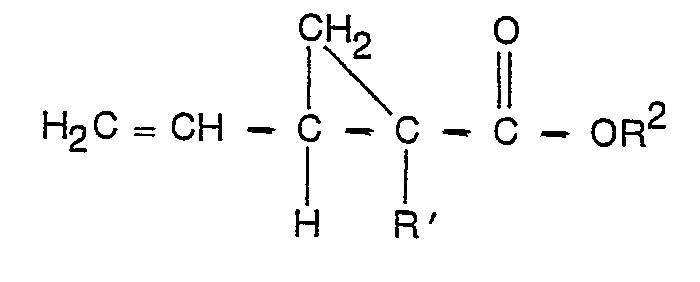
wherein R' is H or COOR2 and R2 is H or an alkyl radical containing from 1 to 4 carbon atoms, or from lactone-type compounds having the formula:
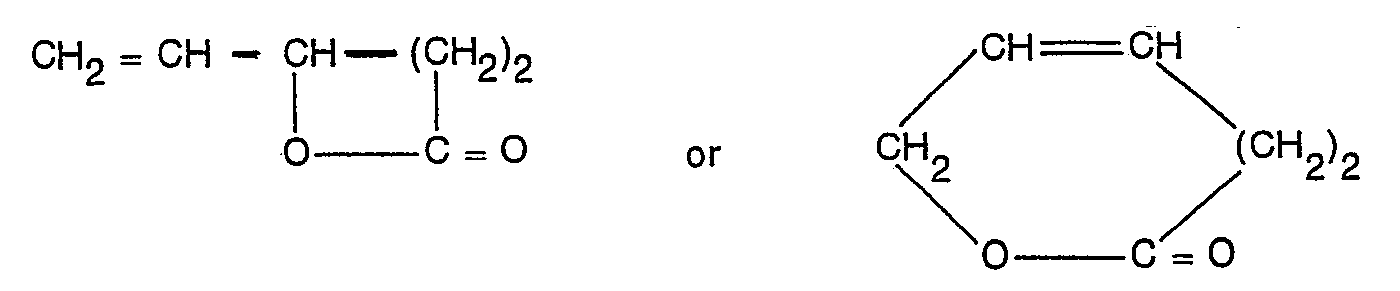
in the presence of triarylphosphine complexes of palladium or trialkylphosphite complexes of nickel as catalysts.
wherein R' is H or COOR2 and R2 is H or an alkyl radical containing from 1 to 4 carbon atoms, or from lactone-type compounds having the formula:
in the presence of triarylphosphine complexes of palladium or trialkylphosphite complexes of nickel as catalysts.
2. Process according to claim 1, characterized in that the dialkylamine is selected
from diethylamine, diisopropylamine, morpholine, and dodecylmethylamine.
3. Process according to claim 1, characterized in that the allyl compound is 1,1-dicarboethoxy-2-
vinylcyclopropane.
4. Process according to claim 1, characterized in that the allyl compound is selected
from gamma-vinyl- butyrolactone and the lactone of 6-hydroxy-4-hexenoic acid.
5. Process according to claim 1, characterized in that the triarylphosphine complex
of palladium is tris-, or tetrakis-(triphenylphosphine) palladium.
6. Process according to claim 1, characterized in that the trialkylphosphite complex
of nickel is tris- or tetrakis-(triisopropylphosphite) nickel.
7. Process according to claim 1, characterized in that a molar ratio of the dialkylamine
to the catalyst is used, which is at least 50.000.
8. Process according to claim 1, characterized in that a molar ratio of the dialkylamine
to the olefin substrate is used, which is comprised between 1 and 3.
9. Process according to claim 1, characterized in that the reaction is carried out
in ethers or esters as solvents.
10. Process according to claim 1, characterized in that the solvent is tetrahydrofuran
or acetonitrile.
11. Process according to Claim 1, characterized in that the amination reaction is
carried out at a temperature comprised between 0°C and 120°C, and preferably between
10°C and 30°C for the cyclopropane compounds and from 70°C to 110°C for the lactone
compounds.
1. Verfahren zur Herstellung von (omega-Carbalkoxy-n-alkyl)- oder (omega-Carboxy-n-alkyl)-dialkylaminen
mit einer geraden aliphatischen Kette durch Aminierung von Allylverbindungen in Gegenwart
von Palladium- oder Nickelkomplexen als Katalysatoren und anschließende Hydrierung
des solcherart erhaltenen ungesättigten Amins, dadurch gekennzeichnet, daß die Aminierungsreaktion
zwischen Dialkylaminen der Formel NHR3R4, worin R3 und R4 Alkylreste mit bis zu 20 Kohlenstoffatomen bedeuten, die gleich oder voneinander
verschieden sein können, und einer Allylgruppen enthaltenden Verbindung, ausgewählt
unter Verbindungen vom Cyclopropan-Typ mit der Formel:
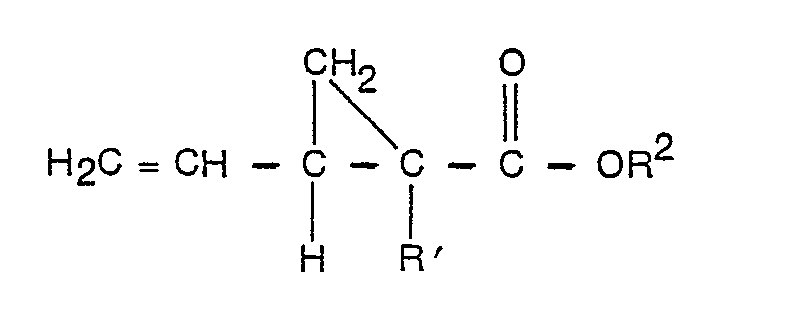
worin R' für Wasserstoff oder cOOR2 steht und R2 Wasserstoff oder einen Alkylrest mit 1 bis 4 Kohlenstoffatomen bedeutet, oder unter Verbindung von Lacton-Typ mit der Formel:
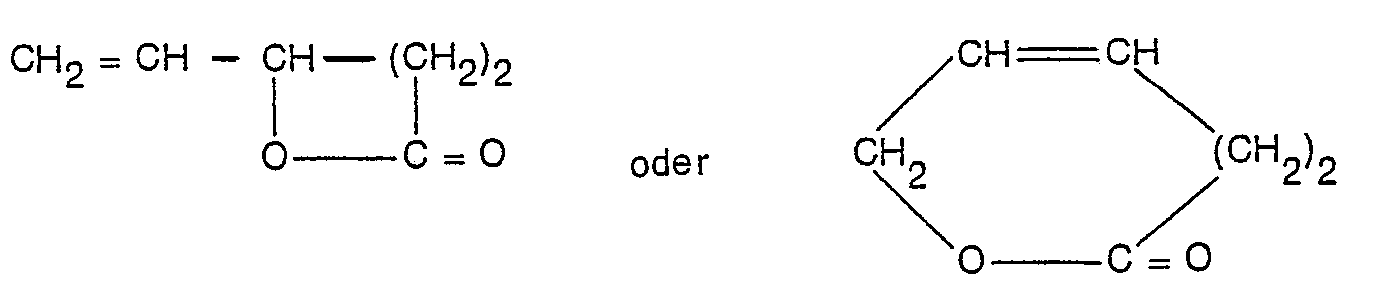
in Gegenwart von Triarylphosphinkomplexen des Palladiums oder von Trialkylphosphitkomplexen des Nickels als Katalysatoren ausgeführt wird.
worin R' für Wasserstoff oder cOOR2 steht und R2 Wasserstoff oder einen Alkylrest mit 1 bis 4 Kohlenstoffatomen bedeutet, oder unter Verbindung von Lacton-Typ mit der Formel:
in Gegenwart von Triarylphosphinkomplexen des Palladiums oder von Trialkylphosphitkomplexen des Nickels als Katalysatoren ausgeführt wird.
2. Verfahren nach Anspruch 1, dadurch gekennzeichnet, daß das Dialkylamin unter Diethylamin,
Diisopropylamin, Morpholin und Dodecylmethylamin ausgewählt wird.
3. Verfahren nach Anspruch 1, dadurch gekennzeichnet, daß die Allylverbindung 1,1-Dicarboethoxy-2-
vinylcylcopropan ist.
4. Verfahren nach Anspruch 1, dadurch gekennzeichnet, daß die Allylverbindung unter
gamma-Vinylbutyrolacton und dem Lacton von 6-Hydroxy-4-hexensäure ausgewählt wird.
5. Verfahren nach Anspruch 1, dadurch gekennzeichnet, daß der Triarylphosphinkomplex
des Palladiums Tris- oder Tetrakis-(triphenylphosphin)palladium ist.
6. Verfahren nach Anspruch 1, dadurch gekennzeichnet, daß der Trialkylphosphitkomplex
des Nickels Tris- oder Tetrakis-(triisopropylphosphit)nickel ist.
7. Verfahren nach Anspruch 1, dadurch gekennzeichnet, daß ein Molverhältnis von Dialkylamin
zu Katalysator angewendet wird, welches wenigstens 50.000 beträgt.
8. Verfahren nach Anspruch 1, dadurch gekennzeichnet, daß ein Molverhältnis von Dialkylamin
zu dem Olefinsubstrat angewendet wird, das zwischen 1 und 3 beträgt.
9. Verfahren nach Anspruch 1, dadurch gekennzeichnet, daß die Reaktion in Ethern oder
Estern als Lösungsmittel ausgeführt wird.
10. Verfahren nach Anspruch 1, dadurch gekennzeichnet, daß das Lösungsmittel Tetrahydrofuran
oder Acetonitril ist.
11. Verfahren nach Anspruch 1, dadurch gekennzeichnet, daß die Aminierungsreaktion
bei einer Temperatur zwischen 0°C und 120°C und vorzugsweise zwischen 10°C und 30°C
für die Cyclopropanverbindungen und von 70°C bis 110°C für die Lactonverbindungen
ausgeführt wird.
1. Procédé pour la préparation de (oméga-carbalcoxy-n-alkyl)- ou (oméga-carboxy-n-alkyl)-dialkylamine
ayant une chaîne aliphatique à chaîne droite, par amination de composés allyliques
en présence de complexes de palladium ou de nickel comme catalyseurs et hydrogénation
ultérieure de l'amine insaturée ainsi obtenue, caractérisé par le fait que la réaction
d'amination est effectuée entre des dialkylamines ayant la formule NHR3R4, dans laquelle R3 et R4 sont des radicaux alkyle contenant jusqu'à 20 atomes de carbone, qui peuvent être
identiques ou différents les uns des autres, et un composé contenant des groupes allyle
choisis parmi les composés du type cyclopropane ayant la formule:
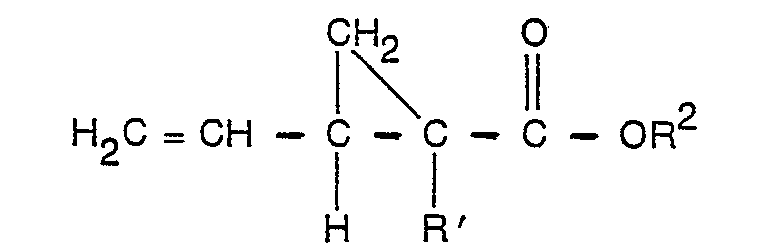
dans laquelle R' est H ou cOOR2, et R2 est H ou un radical alkyle contenant de 1 à 4 atomes de carbone, ou parmi les composés du type lactone ayant l'une des formules:

en présence de complexes triarylphosphines de palladium ou de complexes trialkylphosphites de nickel comme catalyseurs.
dans laquelle R' est H ou cOOR2, et R2 est H ou un radical alkyle contenant de 1 à 4 atomes de carbone, ou parmi les composés du type lactone ayant l'une des formules:
en présence de complexes triarylphosphines de palladium ou de complexes trialkylphosphites de nickel comme catalyseurs.
2. Procédé selon la revendication 1, caractérisé par le fait que la dialkylamine est
choisie parmi la diéthylamine, la diisopropylamine, la morpholine, et la dodécylméthylamine.
3. Procédé selon la revendication 1, caractérisé par le fait que le composé allylique
est le 1,1-dicarbo- éthoxy-2-vinylcyclopropane.
4. Procédé selon la revendication 1, caractérisé par le fait que le composé allylique
est choisi parmi la gamma-vinyl-butyrolactone et la lactone de l'acide 6-hydroxy-4-hexénoïque.
5. Procédé selon la revendication 1, caractérisé par le fait que le complexe triarylphosphine
de palladium est le tris-, ou tétrakis-(triphénylphosphine)-palladium.
6. Procédé selon la revendication 1, caractérisé par le fait que le complexe trialkylphosphite
de nickel est le tris- ou tétrakis-(triisopropylphosphite)-nickel.
7. Procédé selon la revendication 1, caractérisé par le fait qu'un rapport molaire
de la dialkylamine au catalyseur est utilisé qui est égal au moins à 50 000.
8. Procédé selon la revendication 1, caractérisé par le fait qu'un rapport molaire
de la dialkylamine au substrat oléfinique est utilisé qui est compris entre 1 et 3.
9. Procédé selon la revendication 1, caractérisé par le fait que la réaction est effectuée
dans des éthers ou des esters comme solvants.
10. Procédé selon la revendication 1, caractérisé par le fait que le solvant est le
tétrahydrofuranne ou l'acétonitrile.
11. Procédé selon la revendication 1, caractérisé par le fait que la réaction d'amination
est effectuée à une température comprise entre 0°C et 120°C, et de préférence entre
10°C et 30°C pour les composés cyclopropanes et entre 70°C et 110°C pour les composés
lactones.