|
(11) | EP 0 078 518 A1 |

| (12) | EUROPEAN PATENT APPLICATION |
|
|
|
|
|||||||||||||||||||||||||||
| (54) | A new p-chlorophenoxyacetic acid derivative, its method of preparation and pharmaceutical composition |
| (57) A new compound derived from the p-chlorophenoxyacetic acid, the p-chlorophenoxyacetate
of 1-aminoadamantine-2-ethanol of the following structural formula l:
as well as its pharmaceutically acceptable salts, possessing properties for the treatment of various pathological conditions of the central nervous system; its method of preparation; pharmaceutical compositions containing the said compounds; and the treatment of various pathological conditions of the central nervous system with the use of the said compositions. |
[0001] This present invention refers to a new compound derived from p-chlorophenoxyacetic acid, the p-chlorophenoxyacetate of 1-aminoadamantine-2-etlianol of structural formula I
[0002] The invention also refers to the salts thereof, which are of pharmacological interest, to its method of preparation, to the pharmaceutical compositions containing it and to its therapeutic applications.
[0003] The compound I and its salts are new agents which are active on the central nervous system, being of use in the treatment of various pathological conditions of the system.
METHOD OF PREPARATION
[0004] To prepare the p-chlorophenoxyacetate of I-aminoadam- antine-2-ethanol the esterification reaction is carried out between the acylic compound of the following structural formula II
where X can be an OH group or a halogen atom (Cl or Br), with the l-aminoadamantine-2-ethanol of the structural formula III
in a suitable inert solvent.
[0005] The salts of the compound I are obtained by the same procedure, noting that in order to finalize the reaction the resulting product is treated with the stoichiometric quantity of the acid in question (hydrochloric, sulphuric, tartaric, etc.)
EXAMPLES OF THE CHEMICAL PREPARATION
[0006] Some examples of the method of preparation of the compounds of formula I are detailed below, all such details as are not essential to the invention being considered variables and not limititive thereto.
Example 1. Obtention of the p-chlorophenoxyacetate of 1-amino- adamantine-2-ethanol, starting from a p-chlorophenoxyacetic acid halide.
[0007] In a 500 ml flask fitted with a mechanical stirrer, 22 g (0,11 mol) of 1-aminoadamantine-2-ethanol dissolved in 250 ml of benzene are poured using a decanting funnel. 23 g (0, 11 m) of p-chlorophenoxyacetyl chloride added in drops while stirring, the the mixture then being stirred for 30 minutes. 120 ml of a 10% solution of sodium carbonate is then added and the resulting mixture is stirred for 10 minutes. The organic phase is decanted and the benzene removed by distillation. The residue is crystallized with petroleum ether. This yields 37 g (93%) of a white solid.
Example 2. Obtention of the p-chlorophenoxyacetate of 1-amino- adamantine-2-ethanol, starting from p-chlorophenoxyacetic acid.
[0009] In a 1 litre flask, provided with a Dean-Stark separator tube and reflux refrigerant, a mixture of 20,5 g (0,011 m) of p-chlorophenoxyacetic acid, 22 g (0, 11m) of 1-aminoadamantine-2-ethanol, 98 g of conc sulphuric acid and 700 ml of toluene is heated to boiling point during 24 hours. At the end of this period it is treated with an acqueous solution of 5% sodium carbonate to an alkali pH and washed with water; it is dried on anhydrous sodium sulphate and the toluene removed by distillation at reduced pressure. The crude so obtained is crystallized with petroleum ether. The yield is 35,2 g (88%) of a white solid.
Example 3. Obtention of the chlorhydrate of p-chlorophenoxyacetate
of 1-azriinoadamantine-2-ethanol
[0012] A solution of 60 g (0,16 m) of p-chlorophenoxyacetate of 1-aminoadamantine-2-ethanol in 300 ml of ether is subjected to the passage of CIH gas until the precipitation of the solid product is complete. It is left to cool in a refrigerator during 6 hours and it is then filtered. The resulting solid is recrystallized with a mixture of ether and methanol. 61 g (92%) of the product are obtained.
[0015] In a similar manner and by using the stoichiometric quantities of the acid in question, the following salts are obtained.
EVALUATION OF THE PHARMACOLOGICAL ACTIVITY
OF THE COMPOUND I
Nootropa activity
[0017] Tests were carried out on rats by the method of estimating the loss of memory induced by electric shock, loss of memory which was measured by the number of errors made in seeking the outlet from an acquatic labrinth (Giurgea C. J. Pharmacol (Paris) 3, 1, 17, *1972).
[0018] The compound I showed itself to be notably active, giving a 46,5% protection against the loss of memory, as is shown in the table 1. hereunder;
Activity on learning
[0019] This was studied by the test of learning in the acquatic labrinth (Giurgea C.J. Pharmacol (Paris) 3, 1, 17 (1972), the learning resulting in a decrease in the errors made and the, time spent in reaching the exit. In another learning test ( conditioning cage) the animals placed in the cage receive an electric shock which they can avoid by passing from one cell to another. Sara, S.J. and Col. Psychopharmacol (Ber.) 25, 32, (1972). The compound I has resulted in an increased learning facility as may be seen in the table 1.
Anti-depressant activity
[0020] This activity was evaluated by the method of examining the desperation behaviour in mice (Porsalt, T.D., Arch. Int Pharmacodyn 229, 327 (1977).
[0021] The state of despair was induced by placing the animal in a cylinder containing water and from which escape was impossible, then finding itself obliged to treadmill continually. After a period of vigorous activity the mouse takes up a characteristic immobile posture, this . being capable of reduction by the use of various types of pharmaceutical anti-depressants. It was shown that the administration of the compound I resulted in moderate anti-depressant effects, as is shown in the ----table I.
Anti-catalepsy activity
[0022] This was the subject of Morpurgo tests (Arch. Int. Pharmacodyn, 137, 84 (1962), based on antagonizing the cataleptic condition in rats, induced by fluphenazine.
[0023] The compound I reduced slightly the cataleptic activity of the fluphenazine, as is shown in the table I.
TOXICITY
[0024] From the Irwin or "screening" multi-dimensional test (Phsychopharmacologia (Berl), 13, 222-257 (1968), there was no evidence as to effects of non toxic doses. Toxic doses caused death accompanied by trembling and clonic convulsions.
THERAPEUTICAL RECOMMENDATIONS
[0027] Neuropsychic asthenia, problems of attention, memory defects, difficulty in learning, disorders in the capacity for mental concentration, mental involution in senility, amnesia, assistance in the treatment of Parkinson's desease, physical and mental debility, a propensity to a state of depression, irritability and lack of social adaptation due to depression, neuronal hypoxia, cerebral metabolism inadequacies, acute vascular complications, nervous sequelae to cerebral circulatory disorders, vascular, toxic and traumatic comas, etc. Cerebral atherosclerosis.
PHARMACEUTICAL PRESENTATION AND DOSAGE
I. A new compound derived from p-chlorophenoxy acetic acid, the p-chlorophenoxyacetate
of 1-aminoadamantine-2-ethanol, of the following structural formula I :
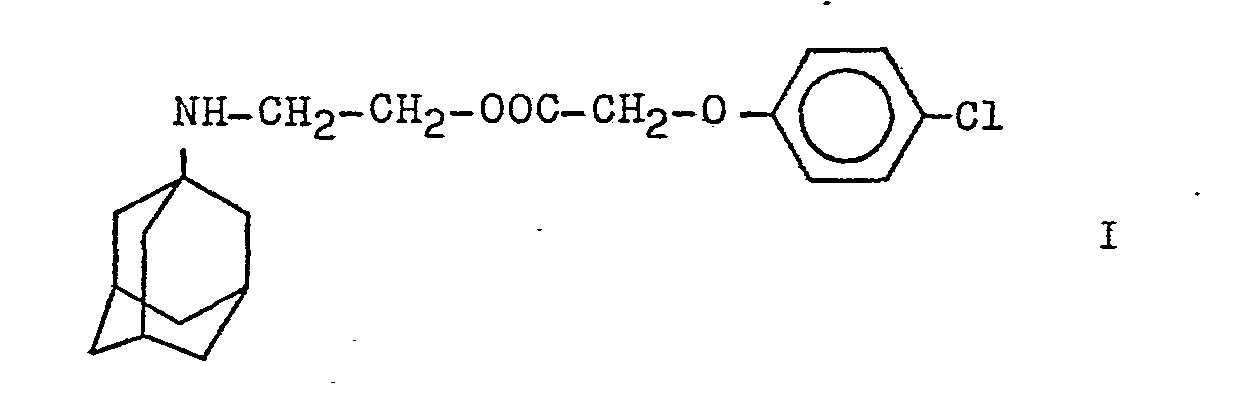
as well as its pharmaceutically acceptable salts.
as well as its pharmaceutically acceptable salts.
2. The method of preparation of the new compound of general formula I, characterized
inthat, in accordance therewith an esterification reaction is carried out between
the acylic compound of the following structural formula II :
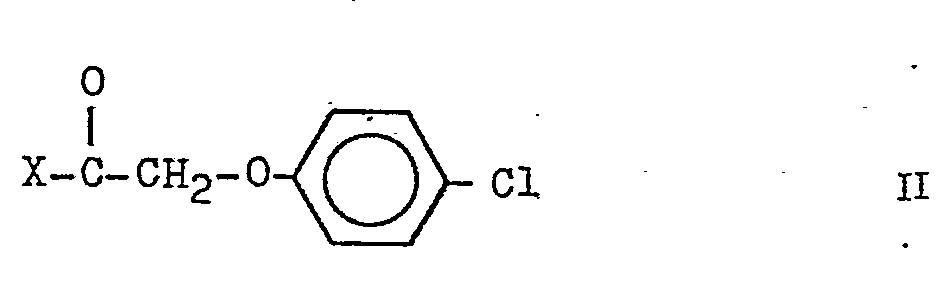
in which X can be an OH group or a halogen atom; ( Cl or Br), and the I-aminoadamantine-2-ethanol of the following structural formula III

in a suitable inert solvent.
in which X can be an OH group or a halogen atom; ( Cl or Br), and the I-aminoadamantine-2-ethanol of the following structural formula III
in a suitable inert solvent.
3. The method of preparation as in claim 2, characterized in that the salts of the
compound of formula I are obtained starting from the said compound I, treating it
with the stoichiometric quantity of the acid under consideration, such as hydrochloric,
sulphuric, tartaric, or similar.
4. A pharmaceutical composition characterized by having as active ingredient the compound
derived from the p-chlorophenoxyacetic acid of the structural formula I, as defined
in claim 1.
5. A pharmaceutical composition characterized by having as active ingredient the compound
derived from the p-chlorophenoxyacetic acid of the structural formula I, obtained
by carrying out the procedure in accordance with either of the claims 2 or 3.