|
(11) | EP 0 081 581 B1 |

| (12) | EUROPEAN PATENT SPECIFICATION |
|
|
| (54) |
COMPOSITIONS FOR TREATING GLAUCOMA ZUSAMMENSETZUNGEN ZUR BEHANDLUNG VON GLAUKOMA COMPOSITIONS DE TRAITEMENT DU GLAUCOME |
|
|
|||||||||||||||||||||||||||||||
| Note: Within nine months from the publication of the mention of the grant of the European patent, any person may give notice to the European Patent Office of opposition to the European patent granted. Notice of opposition shall be filed in a written reasoned statement. It shall not be deemed to have been filed until the opposition fee has been paid. (Art. 99(1) European Patent Convention). |
[0001] Glaucoma is a condition of the eye characterized by increased intraocular pressure. Untreated, the condition can eventually lead to irreversible retinal damage and blindness. Conventional therapy for glaucoma has involved topical administration of pilocarpine and/or epinephrine, administered to the eye several times daily.
[0002] Various beta-blocking agents may also be used to lower intraocular pressure. Such use is described, for example, in reviews by W. P. Boger in Drugs, 18, 25-32 (1979) and by T. J. Zimmerman and W. P. Boger in Survey Ophthmol., 23(6), 347 (1979). The use of beta-blockers for the treatment of glaucoma is also described in the patent literature. For example, U.S. Patent No. 4,195,085 to Stone discloses a method for treatment of glaucoma by the ocular administration of a beta-blocking compound, timolol maleate. U.S. Patent No. 4,127,674 discloses treating glaucoma with labetalol, a known antagonist of both alpha and beta adrenergic receptors. However, these methods also possess significant drawbacks, in that the absorption of the beta-blocking compound into the systemic circulation can cause undesirable side effects. Such side effects result from prolonged beta-blocking action on the heart, bronchioles and blood vessels. For example, according to Physicians'Desk Reference, Charles E. Baker, Jr., 35th Edition, 1981, p. 1233, adverse reactions to the topical use of timolol maleate can include bronchospasm, heart failure, as well as cardiac conduction defects. Accordingly, there is a need for a method of treatment for glaucoma or for lowering intraocular pressure which is relatively free of unwanted systemic side-effects.
[0003] Certain beta-blocking agents which contain enzymatically labile ester groups are known to exhibit short-acting beta-blocking effects in the systemic circulation. Such short-acting beta-blocking compounds (SABBs) have been suggested for treatment or prophylaxis of cardiac disorders as a means for reducing heart work or improving rhythmicity for a short duration. Such short-acting beta-blocking compounds avoid the sometimes counterproductive effects of conventional beta-blocking agents, whose effects are long-lived and therefore difficult to precisely control.
Summary of the Invention
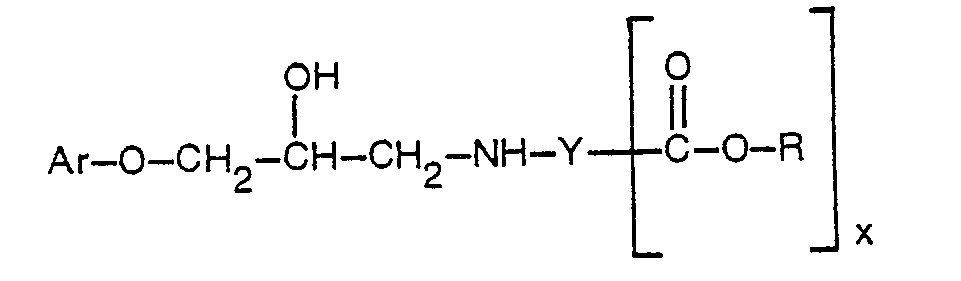
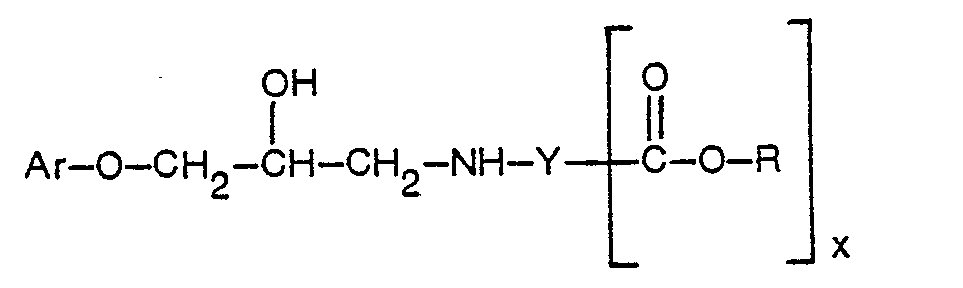
[0004] In accordance with the present invention, disclosed herein is a compound of the formula
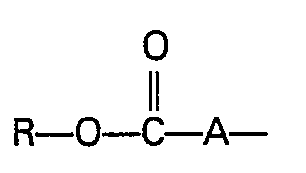
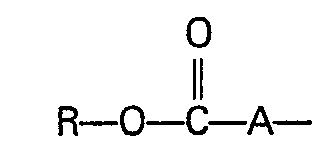
wherein Y is a straight or branched alkylene radical of from 1 to 10 carbon atoms or aralkylene of from 8 to 20 carbon atoms; R is alkyl of from 1 to 10 carbon atoms, alkenyl of from 2 to 10 carbon atoms or alkynyl of from 3 to 10 carbon atoms; x is an integer from 1 to 3; Ar is phenyl or naphthyl optionally additionally substituted with C1―C5 alkyl, C2-Cs alkenyl, C2―C5 alkynyl, C1―C5 alkoxy, halogen, cyano, or a group of the formula
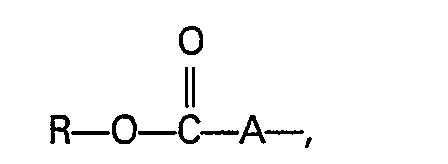
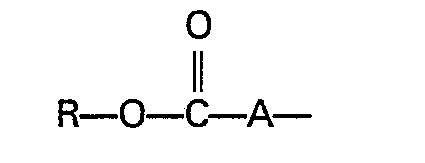
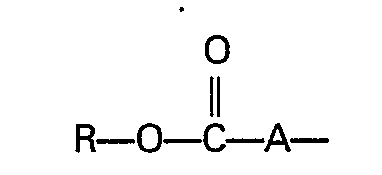
wherein A is a direct bond, alkylene of from 1 to 10 carbon atoms, or alkenylene of from 2 to 10 carbon atoms; or a pharmaceutically acceptable salt thereof, for use for the manufacture of a medicament for the treatment of glaucoma or lowering of intraocular pressure.
[0005] Earlier EP-A-0 041 492 discloses substituted 3-phenxoy-1-alkoxycarbonyl-alkylamino-2-propanols having beta receptor blocking properties and used for treating acute myocardial infarction.
[0006] Earlier EP-A-0 053 434 and PCT Application WO 82/01870 of the same applicant both disclose short-acting beta-blocking compounds structurally related to those of the present application, which are used for treatment or prophylaxis of cardiac disorders.
[0007] However, all the above three applications were published after the date of filing of the present application.
[0008] US-A-3,793,365 discloses amino acid derivatives structurally related to the compounds of the present application, which are useful as beta-adrenergic agents.
[0009] Also disclosed herein is an ophthalmological composition for the topical treatment of glaucoma or lowering of intraocular pressure which comprises an intraocular pressure-lowering effective amount of a compound as defined hereinabove.
Detailed Description of the Invention
[0010] The above-mentioned short-acting beta-blocking compounds have been found to effectively reduce intraocular pressure in the eyes of mammals when topically administered. Because of their short-lived duration of action in the systemic circulation, toxic side-effects produced by their migration out of the eye are consequently reduced. It has further been discovered that certain of these compounds show an increased longevity of effect when present in the ocular fluid compared to the duration of their systemic effects. Consequently, the present invention resides in a composition for the treatment of glaucoma or lowering intraocular pressure comprising a beta-blocking compound which exhibits relatively long duration of action while in the ocular fluid, but which is subject to relatively rapid breakdown into inactive metabolites upon passage to the systemic circulation.
[0011] In vitro studies in human whole blood indicate that the ester functions of the compounds used in the method of the invention are subject to enzymatic cleavage. Compounds of the present invention in which the aromatic portion, Ar, is also substituted with an ester-containing group, have two or more potentially labile sites for enzymatic hydrolysis. The time required for substantially complete disappearance of the beta-blocking effects of the compounds of the present invention ranges from about 5-10 minutes to about 1 hour or more in the systemic circulation.
[0012] The preferred compounds of the present invention are represented by the formula:
wherein Y may be a straight or branched alkylene radical of from 1 to 10 carbon atoms, e.g., methylene, ethylene, propylene, 2-ethylhexylene and 1,1-dimethylethylene, or aralkylene of from 8 to 20 carbon atoms, such as dialkylene phenyl, e.g., 4-ethylenebenzyl and 1-(1-naphthyl)-2-butylpropylene.
[0013] R may be alkyl of from 1 to 10 carbon atoms, such as methyl, propyl, t-butyl and 3-propylheptyl; alkenyl of from 2 to 10 carbon atoms, such as ethenyl, propenyl and 4-ethyl-2-hexenyl; or alkynyl of from 3 to 10 carbon atoms, such as propynyl and 4-ethyl-3-octynyl.
[0014] The amine substituent may contain one or more ester groups, thus x is an integer from 1 to 13.
[0015] Ar represents phenyl or naphthyl optionally additionally substituted lower alkyl of from 1 to 10 carbon atoms, alkenyl of from 2 to 10 carbon atoms, alkynyl of from 2 to 10 carbon atoms, alkoxy of from 1 to 10 carbon atoms, halogen, or a group of the formula
wherein A is a direct bond, alkylene of from 1 to 10 carbon atoms, or alkenylene of from 2 to 10 carbon atoms. When two or more groups of the same designation occur in the same formula, those groups are not necessarily identical. The compounds described herein are not limited to any particular stereoisomeric configuration.
[0016] In preferred compounds Y is a straight or branched alkylene radical of from 1 to 6 carbon atoms or aralkylene of from 8 to 12 carbon atoms. Most preferably, Y is a straight or branched alkylene radical of from 1 to 4 carbon atoms. R is preferably alkyl of from 1 to 5 carbon atoms, alkenyl of from 2 to 5 carbon atoms, alkynyl of from 3 to 5 carbon atoms. Most preferably, R is alkyl of from 1 to 4 carbon atoms. Particularly preferred R groups are methyl and ethyl. The integer x is preferably 1 or 2; most preferably 1.
[0017] Ar is preferably phenyl or naphthyl optionally substituted with alkyl of from 1 to 5 carbon atoms, alkenyl of from 2 to carbon atoms, alkynyl of from 2 to 5 carbon atoms, alkoxy of from 1 to 5 carbon atoms, fluoro, chloro, or a group of the formula
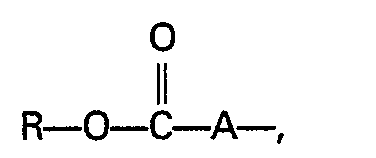
wherein A is a direct bond, alkylene of from 1 to 5 carbon atoms, such as methylene, ethylene and butylene or alkylene of from 2 to 5 carbon atoms, such as ethenyl, 2-propenyl and 2-butenyl, and R is alkyl of from 1 to 5 carbon atoms. Most preferably, Ar is 2-alkylphenyl, e.g., 2-methylphenyl; 2-alkoxyphenyl, e.g., 2-methoxyphenyl; or 2-alkoxycarbonylphenyl, e.g., 2-methoxycarbonylphenyl.
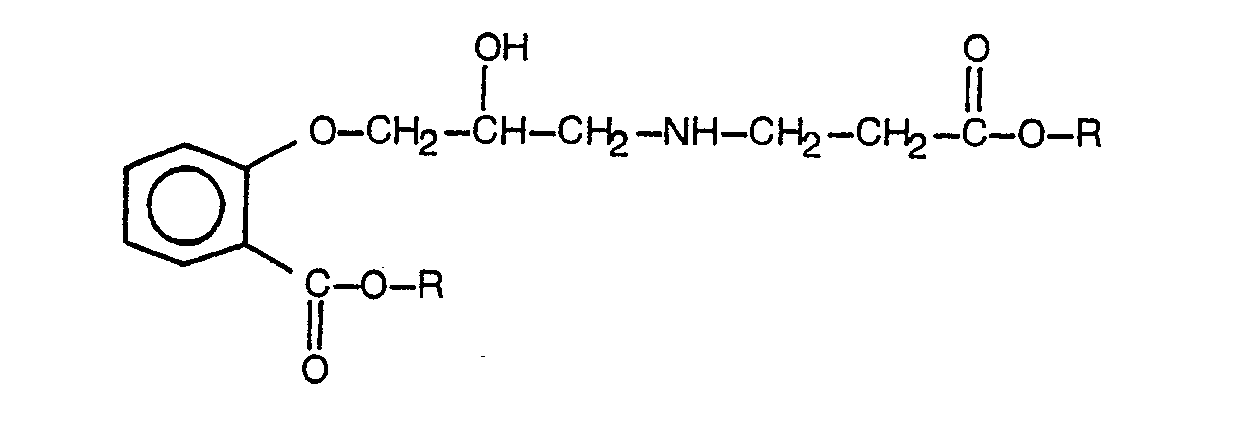
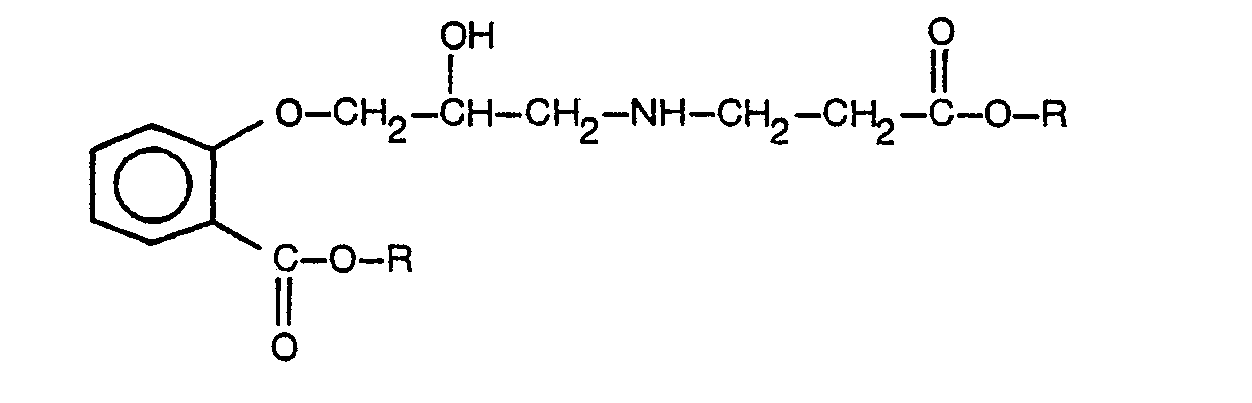
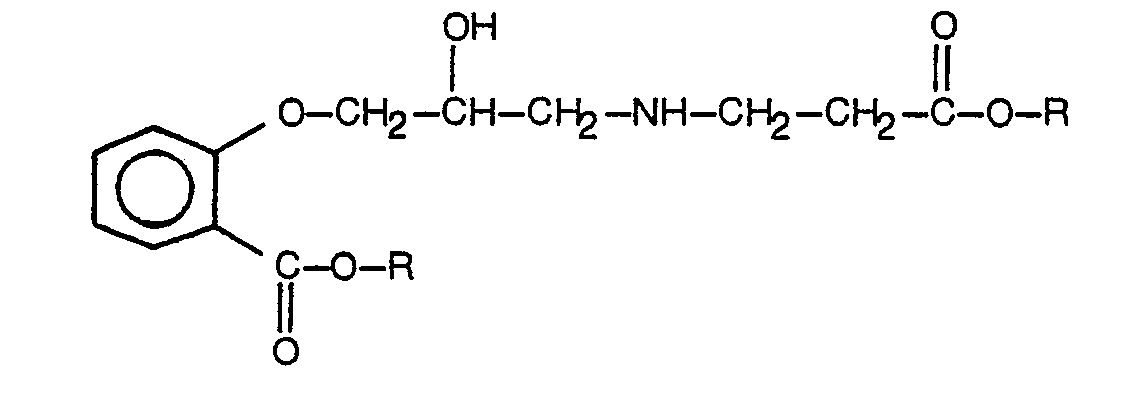
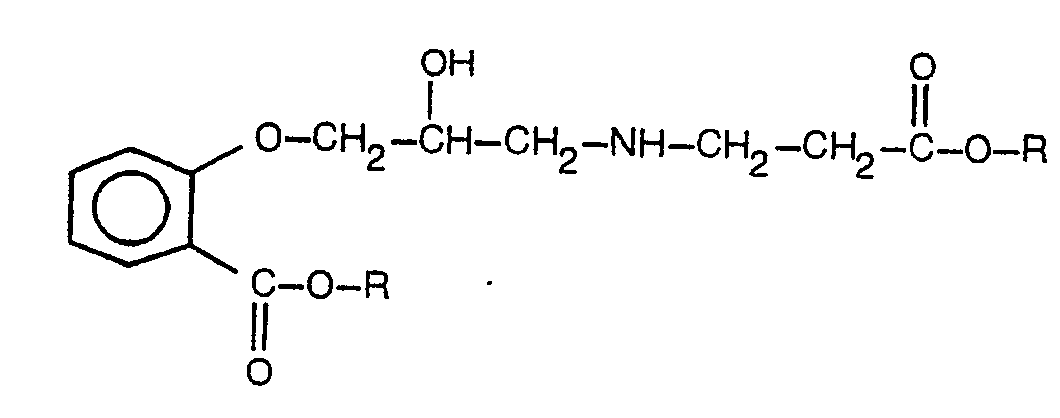
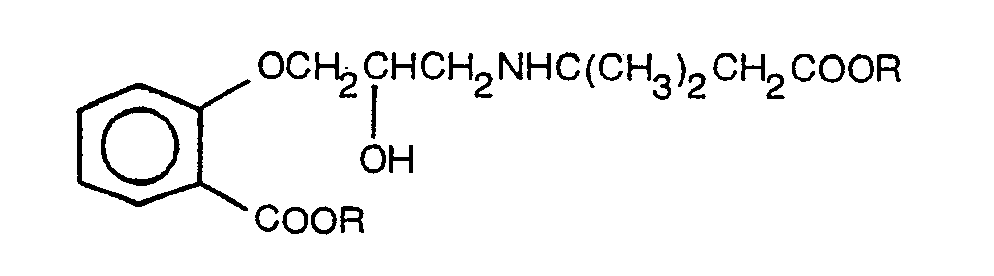
[0018] Most preferred compositions of the invention, which are topically applied, contain as the active ingredient thereof a compound of the formula
wherein R is methyl or ethyl, preferably methyl, or
or
or a pharmaceutically acceptable salt thereof.
[0019] The compounds of this invention may be administered as their pharmaceutically acceptable acid addition salts, e.g., as the hydrochloride, sulfate, phosphate, gluconate, tartrate, et cetera.
[0020] The beta-blocking compounds used in the present invention along with methods for their preparation are disclosed in EP-A-0 053 434.
[0021] The compounds of this invention are advantageously administered topically to the eye in the form of a solution, ointment, or solid insert such as is described in U.S. Patent No. 4,195,085 to allow controlled or delayed release formulations. Formulations may contain the active compound, preferably in the form of a soluble acid addition salt, in amounts ranging from 0.01 to 10% by wt., preferably, from 0.5% to 5% by wt. Unit dosages of the active compound can range from 0.001 to 5.0 mg., preferably from 0.05 to 2.0 mg. The dosage administered to a patient will depend upon the patient's needs and the particular compounds employed.
[0022] Carriers used in the preparations of the present invention are preferably non-toxic pharmaceutical organic or inorganic compositions such as water; mixtures of water and water-miscible solvents, such as lower alcohols; mineral oils; petroleum jellies; ethyl cellulose; polyvinylpyrrolidone and other conventional carriers. In addition, the pharmaceutical preparations may also contain additional components such as emulsifying, preserving, wetting and sterilizing agents. These include polyethylene glycols 200, 300, 400 and 600, carbowaxes 1,000, 1,500, 4,000, 6,000 and 10,000, bacteriocidal components, such as quaternary ammonium compounds, phenylmercuric salts known to have cold sterilizing properties and which are non-injurious in use, thimerosal, methyl and propyl paraben, benzyl alcohol, phenyl ethanol, buffering ingredients such as sodium chloride, sodium borate, sodium acetates, gluconate buffers, and other conventional ingredients such as sorbitan monolaurate, triethanolamine, oleate, polyoxyethylene sorbitan monopalmitylate, dioctyl sodium sulfosuccinate, monothioglycerol, thiosorbitol, ethylenediamine tetracetic acid, and the like. Additionally, suitable ophthalmic vehicles can be used as carrier media for the present purpose including conventional phosphate buffer vehicle systems, isotonic boric acid vehicles, isotonic sodium chloride vehicles, isotonic sodium borate vehicles and the like.
[0023] The composition of this invention is advantageously topically administered as eye drops containing the active compound. Formulations for eye drops preferably include the active compound as a soluble acid addition salt in a properly buffered, sterile, aqueous isotonic solution.
[0024] The compounds of the present invention are ester group-containing beta-blockers that have a selective, localized, beta-blocking effect in the eye after topical administration. Such compounds are thought to be rapidly metabolized by plasma and/or liver esterases into inactive by-products, upon entering the systemic circulation, and are also thought to be relatively stable in ocular fluids, i.e., lacrimal fluids and aqueous humor. Consequently, such compounds are useful for the treatment of glaucoma or for lowering intraocular pressure since they remain stable when topically applied to the eye but rapidly metabolize when subsequently absorbed into the systemic circulation.
[0025] Some of the compounds break down in the aqueous humor more rapidly than others. Such compounds may advantageously be employed when only a temporary reduction in intraocular pressure is desired, say for diagnostic procedures. Longer-acting compounds are generally used for effecting longer- term reductions in intraocular pressure, such as is desired when treating chronic glaucoma. Thus, the compositions of the present invention provide a very useful therapeutic alternative for the treatment of glaucoma or for lowering intraocular pressure.
[0026] The present invention is further illustrated by the following examples which are not intended to be limiting.
Examples I-V
Example VI
Ethyl 3-(Benzylamino)-3-methylbutyrate Hydrochloride
[0030] A mixture of 14 ml (0.1 mole) of ethyl 3,3-dimethylacrylate and 11 ml (0.1 mole) of benzylamine in 50 ml of USP alcohol previously dried over 3 x 10⁻¹ µm (3A) molecular sieves, was heated to reflux for five days. The reaction medium was then evaporated under reduced pressure and the resulting oil taken up in 100 ml of ether. The etheral solution was refrigerated for fifteen hours, filtered and then washed twice with 100 ml portions of water. The ethereal phase was then extracted with 100 ml of 1N HCI. The aqueous extract was washed twice with 100 ml portions of ether and then basified to pH 8 with solid K2CO3 while under a third 100 ml portion of ether. These phases were separated and the ethereal phase retained and washed once with 100 ml of water. The ethereal solution was dried over MgS04 and evaporated under reduced pressure to provide a mobile clear oil: NMR (CDCI3) 5 1.2 (t, J=7Hz, 3, ―CH2CH3), 1.2 (s, 6, two -CH3), 7.2 (s, 5, Ar). The free amine was converted to its hydrochloride salt by dissolving the oil in 25 ml of reagent alcohol followed by treatment with 75 ml ethereal HCI. An additional 200 ml of ether was added and the solution placed in the freezer to effect crystallization. 7.2 gm (31%) of white crystals were obtained: mp 154-155°C.; NMR (CD30D) δ 1.2 (t, 7 + 7Hz, 3,-CH2CH3), 1.5 (s, 6, two-CH3), 7.5 (m, 4, Ar). Analysis Calculated for C14H22NO2Cl: C. 61.86; H, 8.16; N, 5.15. Found: C, 61.96; H, 8.46; N, 5.00.
Ethyl 3-Amino-3-methylbutyrate Hydrochloride
[0031] A mixture of 25 g (0.1 mole) of ethyl 3-(benzylamino)-3-methylbutyrate hydrochloride and approximately 2 g of 10% Pd-C in 250 ml of dried USP alcohol was hydrogenated under 3.75 (55 psi) H2 for four days. The reaction medium was then filtered and evaporated under reduced pressure to provide 18 g (100%) of an amber oil which gradually crystallized upon standing: mp 82-83°C; NMR (CD3OD) δ 1.2 (t, J=7, Hz, 3, -CH2CH3) 1.5 (s, 6, two -CH3), 2.8 (s, 2, ―CH2―), 4.2 (q, J=7, Hz, 2, ―CH2CH3). Analysis Calculated for C7H16NO2Cl: C, 46.28; H, 8.88; N, 7.71. Found: C, 46.46; H, 8.98; N, 7.90.
[0033] A 5 g (0.028 mole) quantity of ethyl 3-amino-3-methylbutyrate hydrochloride was dissolved in 25 ml of water. The aqueous solution was placed under 50 ml of ethyl acetate and then basified to pH 8 with solid K2CO3. The phases were separated and the aqueous layer extracted two additional times with 50 ml portions of ethyl acetate. The combined organic phase was dried over 5 g of MgS04 and then evaporated under reduced pressure with temperature not exceeding 55°C. The free amine was obtained as a clear oil: 3.1 g (75%; 0.021 mole); NMR (CD30D) δ 1.1 (s, 6, two -CH3), 1.2 (t, J=7Hz, 3, -CH2CH3), 2.4 (s, 2, ―CH2―),4.1 (q, J=7Hz, 2,―CH2CH3). The free amine was taken up in 25 ml of USP alcohol previously dried over 3 x 10⁻⁴ µm (3A) molecular sieves, and combined with 3.4 g (0.021 mole) of 1-(2-methylphenoxy)-2,3-epoxypropane.
[0034] The resulting solution was heated to reflux for six hours. The reaction medium was then evaporated under reduced pressure to an oil which was taken up in 25 ml portions of water. The ethereal phase was then extracted with 25 ml portions of water. The ethereal phase was then extracted with 25 ml of 1 N HCI. The aqueous acid solution was washed with two 25 ml portions of ether and then basified to pH 8 with solid K2CO3 while under a third 50 ml portion of ether. The ethereal phase was separated, washed with 25 ml of water, dried over MgS04 and evaporated under reduced pressure. 2.2 g (0.007 mole) of this free amine was thus obtained as a faintly yellow oil. The oil was taken up in 10 ml of acetone and added dropwise to a solution of 0.9 g (0.007 mole) of oxalic acid dihydrate in 15 ml acetone. This solution was placed in a freezer to effect crystallization. An initial, small crop of crystals was obtained which did not agree within ± 0.4% of the theoretical elemental analysis. A second, larger crop, 1 g (14%) was then obtained from the mother liquor after returning to the freezer: mp 127-128°C; NMR (CD30D) δ 1.3 (t, J=7Hz, 3,―CH2CH3), 1.5 (s, 6, two -CH3), 2.2 (s, 3, Ar-CH3), 7 (m, 4, Ar). Analysis Calculated for C18H28NO6.1/2 H20: C, 59.48; H, 8.04; N, 3.86. Found: C, 59.56; H, 8.03; N, 3.60. Beta-Blocking Activity in vitro: PA2 = 8.6 (atria).
Example VII
Ethyl-3-[2-Hydroxy-3-[2-(methoxycarbonyl)phenoxy]propylamino]-3-methylbutyrate Oxalate.
[0036] A mixture of 4 g (0.028 mole) of ethyl 3-amino-3-methylbutyrate free amine and 3.8 g (0.018 mole) of ethyl 2-(2,3-epoxypropoxy)benzoate in 50 ml of isopropyl alcohol was heated to reflux for six hours. The reaction medium was then evaporated under reduced pressure to provide an oil which was taken up in 50 ml of ether. The ethereal solution was washed five times with 50 ml portions of water, dried over MgSO4 and then evaporated under reduced pressure. 2.4 g (0.007 mole) of a faint yellow oil was obtained and taken up in 15 ml of acetone. The acetone solution was added dropwise to 0.9 g (0.007 mole) of oxalic acid dihydrate in 25 ml of acetone. This solution was treated with 50 ml of ether and crystallization occurred after refrigeration to provide 1.8 g (23%) of white crystalline clusters: mp 96-98°C; NMR (CD30D) 1.1 (t, J=7Hz, 3, ―CH2CH3), 1.5 (s, t, two -CH3), 3.8 (s, 3, -C02CH3), 7.4 (m, 4, Ar); Analysis Calculated for C20H29NO10: C, 54.17; H, 6.59; N, 3.16. Found: C, 54.33; H, 6.87; N, 2.91. Beta-blocking Activity in vitro: PA2 = 7.8 (atria). /n vivo Duration of action: 5 min. (180 min infusion) (80% recovery time). Potency: 5.0 mg/ kg/180 min.
Example VIII
[0037] The intraocular pressure lowering effect of the compounds described in Examples I―VII are demonstrated in rabbits with normotensive eyes.
[0038] Sterile, isotonic saline solutions of each of the compounds used in procedures of Examples I to VII are prepared by dissolving 10,30 and 100 mg samples of each of the active compounds in 1 ml of saline to give 1%, 3% and 10% solutions with pH about 6.0-7.0. Free amines require one equivalent of HCI to effect dissolution.
[0039] The intraocular pressure lowering effect of each compound is determined by treating the eyes of healthy rabbits with the above solutions. Three rabbits are used to evaluate the effect of each drug concentration. A standard dose of 50 pl of each drug solution is applied to one eye of each of the three rabbits. Intraocular pressure of both eyes is measured with a pressure tonograph of a Mackay-Marg Tonometer before drug administration and at 15, 30, 45, 60, 120, 180, 240, 300, 360, 420 and 480 min. after dosing. Control rabbits are treated similarly with sterile isotonic saline solution. Intraocular pressure lowering in the treated eyes is compared with the untreated eyes, with saline treated eyes and with predrug pressures. Each of the compounds tested exhibits intraocular pressure-lowering activity.
Example IX
[0040] The experiment of Example VIII is repeated in all essential details, except that rabbits which have cortuosteroid-induced ocular hypertension, as described by Bonomi, L., et al. Glaucoma, Eds. R. Pittscrick, A.D.S. Caldwell, Academic Press, New York, pp. 99-107 (1980), are substituted for the normotensive rabbits. Each of the test compounds exhibits intraocular pressure-lowering activity in this model.
1. A compound of the formula
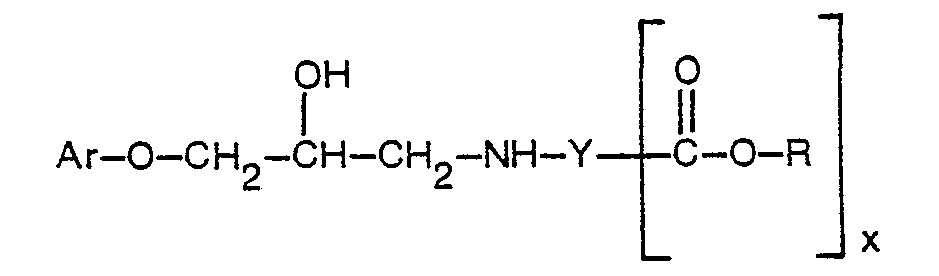
wherein Y is a straight or branched alkylene radical of from 1 to 10 carbon atoms or aralkylene of from 8 to 20 carbon atoms; R is alkyl of from 1 to 10 carbon atoms, alkenyl of from 2 to 10 carbon atoms or alkynyl of from 3 to 10 carbon atoms; x is an integer from 1 to 3; Ar is phenyl or naphthyl optionally additionally substituted with C1―C5 alkyl, C2―C5 alkenyl, C2-Cs alkynyl, C1―C5 alkoxy, halogen, cyano, or a group of the formula
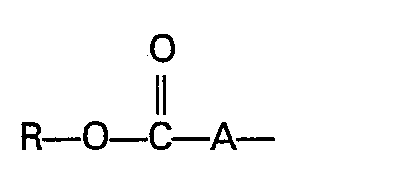
wherein A is a direct bond, alkylene of from 1 to 10 carbon atoms, or alkenylene of from 2 to 10 carbon atoms; or a pharmaceutically acceptable salt, for use for the manufacture of a medicament for the treatment of glaucoma or lowering of intraocular pressure.
wherein Y is a straight or branched alkylene radical of from 1 to 10 carbon atoms or aralkylene of from 8 to 20 carbon atoms; R is alkyl of from 1 to 10 carbon atoms, alkenyl of from 2 to 10 carbon atoms or alkynyl of from 3 to 10 carbon atoms; x is an integer from 1 to 3; Ar is phenyl or naphthyl optionally additionally substituted with C1―C5 alkyl, C2―C5 alkenyl, C2-Cs alkynyl, C1―C5 alkoxy, halogen, cyano, or a group of the formula
wherein A is a direct bond, alkylene of from 1 to 10 carbon atoms, or alkenylene of from 2 to 10 carbon atoms; or a pharmaceutically acceptable salt, for use for the manufacture of a medicament for the treatment of glaucoma or lowering of intraocular pressure.
2. The compound of claim 1, wherein Y is a straight or branched alkylene radical of
from 1 to 6 carbon atoms or aralkylene of from 8 to 12 carbon atoms and R is alkyl
of from 1 to 5 carbon atoms, alkenyl offrom 2 to 5 carbon atoms, or alkynyl of from
3 to 5 carbon atoms.
3. The compound of claim 2 wherein Ar is phenyl or naphthyl optionally substituted
with alkyl of from 1 to 5 carbon atoms, alkenyl of from 2 to 5 carbon atoms, alkoxy
of from 1 to 5 carbon atoms, fluoro, chloro, or a group of the formula
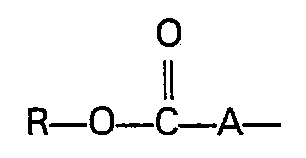
wherein A is a direct bond, alkylene of from 1 to 5 carbon atoms, or alkylene of from 2 to 5 carbon atoms.
wherein A is a direct bond, alkylene of from 1 to 5 carbon atoms, or alkylene of from 2 to 5 carbon atoms.
4. The compound of claim 3, wherein Y is a straight or branched alkylene radical of
from 1 to 4 carbon atoms R is alkyl of from 1 to 4 carbon atoms, and x is 1 or 2.
5. The compound of claim 4, wherein Ar is unsubstituted phenyl or phenyl substituted
with alkyl of from 1 to 5 carbon atoms, fluoro, chloro, or a group of the formula
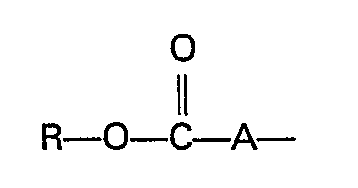
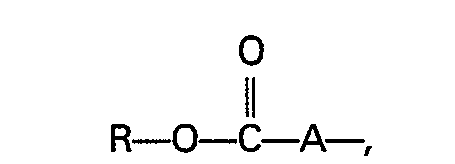
wherein A is alkylene of from 1 to 5 carbon atoms, or alkenylene of from 2 to 5 carbon atoms, x is 1, and R is as defined in claim 4.
wherein A is alkylene of from 1 to 5 carbon atoms, or alkenylene of from 2 to 5 carbon atoms, x is 1, and R is as defined in claim 4.
6. The compound of claim 4, wherein Ar is phenyl, 2-methylphenyl, or 2-methoxyphenyl
and x is 1.
7. The compound of claim 4, wherein R is methyl or ethyl.
8. The compound of claim 1, having the formula
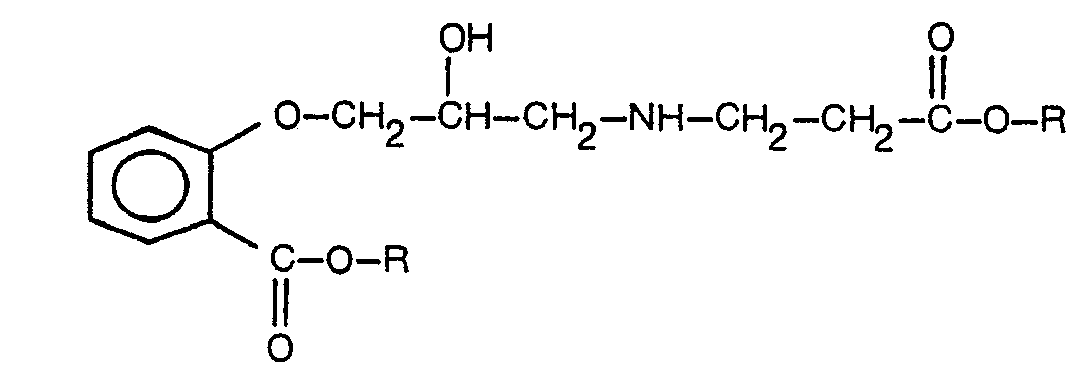
wherein R is methyl or ethyl; or a pharmaceutically acceptable salt thereof.
wherein R is methyl or ethyl; or a pharmaceutically acceptable salt thereof.
9. The compound of claim 1, having the formula
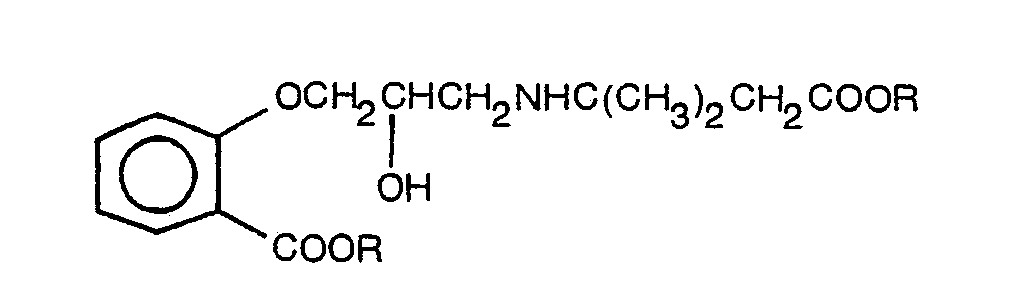
wherein R is methyl or ethyl; or a pharmaceutically acceptable salt thereof.
wherein R is methyl or ethyl; or a pharmaceutically acceptable salt thereof.
10. The compound of claim 1, having the formula
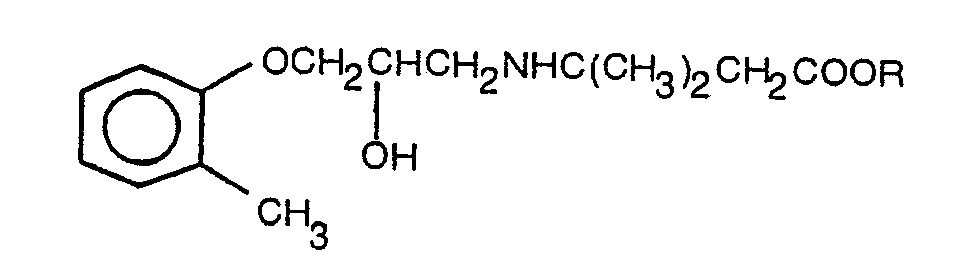
wherein R is methyl or ethyl; or a pharmaceutically acceptable salt thereof.
wherein R is methyl or ethyl; or a pharmaceutically acceptable salt thereof.
11. The compound of claim 1, having the formula
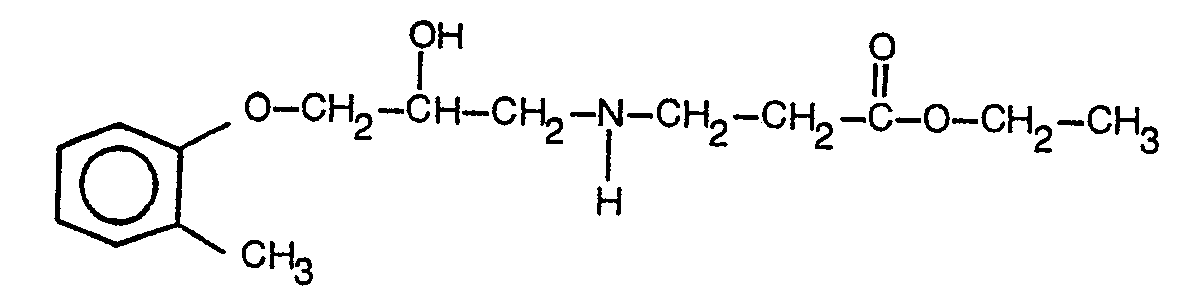
or a pharmaceutically acceptable salt thereof.
or a pharmaceutically acceptable salt thereof.
12. The compound of claim 1, having the formula
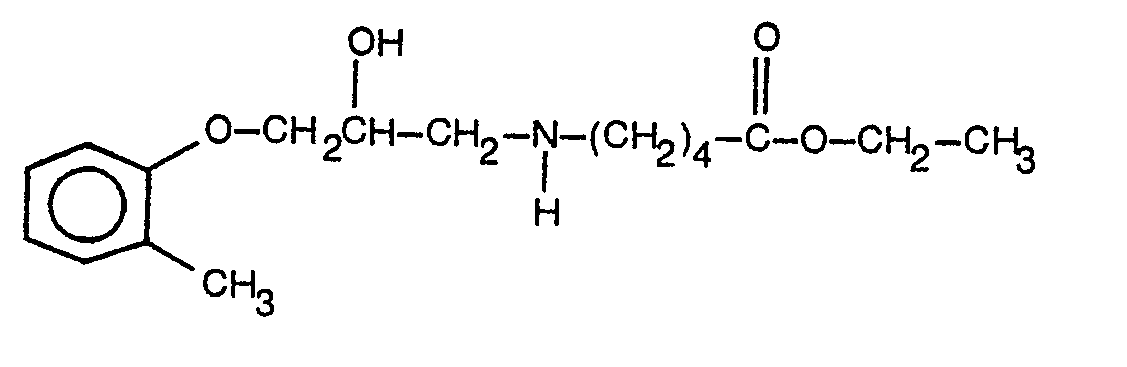
or a pharmaceutically acceptable salt thereof.
or a pharmaceutically acceptable salt thereof.
13. An ophthalmological composition for the topical treatment of glaucoma or lowering
of intraocular pressure which comprises an intraocular pressure-lowering effective
amount of a compound of the formula
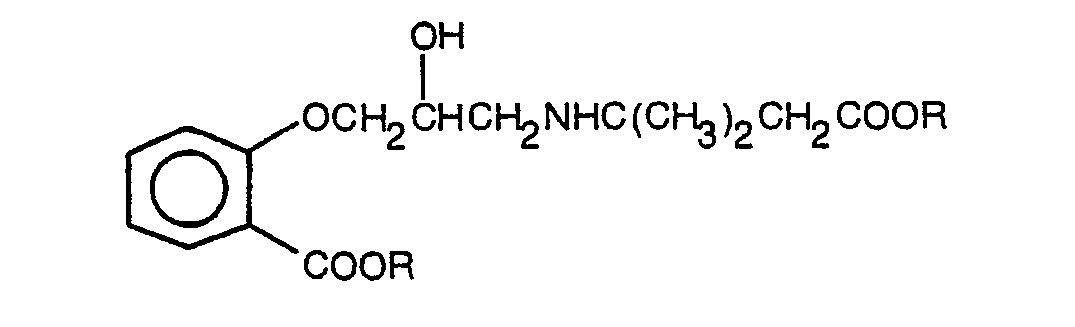
wherein R is methyl or ethyl; or a pharmaceutically acceptable salt thereof; and an ophthalmologically acceptable carrier.
wherein R is methyl or ethyl; or a pharmaceutically acceptable salt thereof; and an ophthalmologically acceptable carrier.
14. An ophthalmological composition for the topical treatment of glaucoma or lowering
of intraocular pressure which comprises an intraocular pressure-lowering effective
amount of a compound of the formula
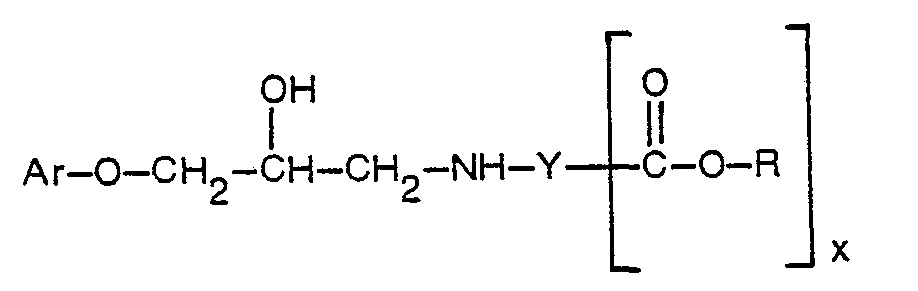
wherein Y is a straight or branched alkylene radical of from 1 to 10 carbon atoms or aralkylene of from 8 to 20 carbon atoms; R is alkyl of from 1 to 10 carbon atoms, alkenyl of from 2 to 10 carbon atoms or alkynyl of from 3 to 10 carbon atoms; x is an integer from 1 to 3; Ar is phenyl or naphthyl optionally additionally substituted with C1―C5 alkyl, C2-Cs alkenyl, C2 CS alkynyl, Cl-Cs alkoxy, halogen, cyano, or a group of the formula
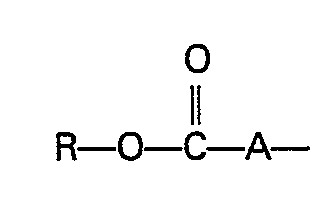
wherein A is a direct bond, alkylene of from 1 to 10 carbon atoms, or alkenylene of from 2 to 10 carbon atoms; or a pharmaceutically acceptable salt thereof; and an ophthalmologically acceptable carrier comprising a sterile buffered aqueous isotonic solution and an effective amount of a preserving agent.
wherein Y is a straight or branched alkylene radical of from 1 to 10 carbon atoms or aralkylene of from 8 to 20 carbon atoms; R is alkyl of from 1 to 10 carbon atoms, alkenyl of from 2 to 10 carbon atoms or alkynyl of from 3 to 10 carbon atoms; x is an integer from 1 to 3; Ar is phenyl or naphthyl optionally additionally substituted with C1―C5 alkyl, C2-Cs alkenyl, C2 CS alkynyl, Cl-Cs alkoxy, halogen, cyano, or a group of the formula
wherein A is a direct bond, alkylene of from 1 to 10 carbon atoms, or alkenylene of from 2 to 10 carbon atoms; or a pharmaceutically acceptable salt thereof; and an ophthalmologically acceptable carrier comprising a sterile buffered aqueous isotonic solution and an effective amount of a preserving agent.
15. The composition of claim 14, wherein the preserving agent is selected from quaternary
ammonium compounds, phenylmercuric salts, timerosal, methyl paraben, propyl paraben,
benzyl alcohol and phenylethanol.
16. The composition of claim 14 or 15, wherein Y is a straight or branched alkylene
radical of from 1 to 6 carbon atoms or aralkylene of from 8 to 12 carbon atoms and
R is alkyl of from 1 to 5 carbon atoms, alkenyl of from 2 to 5 carbon atoms, or alkynyl
of from 3 to 5 carbon atoms.
17. The composition of claim 16, wherein Ar is phenyl or naphthyl optionally substituted
with alkyl of from 1 to 5 carbon atoms, alkenyl of from 2 to 5 carbon atoms, alkoxy
of from 1 to 5 carbon atoms, fluoro, chloro, or a group of the formula
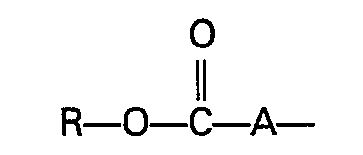
wherein A is a direct bond, alkylene of from 1 to 5 carbon atoms, or alkenylene of from 2 to 5 carbon atoms.
wherein A is a direct bond, alkylene of from 1 to 5 carbon atoms, or alkenylene of from 2 to 5 carbon atoms.
18. The composition of claim 17, wherein Y is a straight or branched alkylene radical
of from 1 to 4 carbon atoms, R is alkyl of from 1 to 4 carbon atoms, and x is 1 or
2.
19. The composition of claim 18, wherein Ar is unsubstituted phenyl or phenyl substituted
with alkyl of from 1 to 5 carbon atoms, fluoro, chloro or a group of the formula
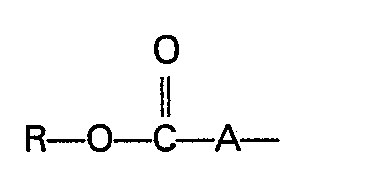
wherein A is alkylene of from 1 to 5 carbon atoms, or alkenylene of from 2 to 5 carbon atoms, x is 1, and R is as defined in claim 4.
wherein A is alkylene of from 1 to 5 carbon atoms, or alkenylene of from 2 to 5 carbon atoms, x is 1, and R is as defined in claim 4.
20. The composition of claim 18, wherein Ar is phenyl, 2-methylphenyl, or 2-methoxyphenyl
and x is 1.
21. The composition of claim 18, wherein R is methyl or ethyl.
22. The composition of claim 14 or 15, wherein the topically applied compound is
wherein R is methyl or ethyl; or a pharmaceutically acceptable salt thereof.
wherein R is methyl or ethyl; or a pharmaceutically acceptable salt thereof.
23. The composition of claim 15, further comprising ethyl cellulose, polyvinylpyrrolidone,
or polyethylene glycol.
24. The composition of claim 14, wherein the compound is present in a concentration
of from 0.01 % to 10% by wt.
25. The composition of claim 14, wherein the compound is present in a concentration
of from 0.5% to 5% by wt.
1. Verbindung der Formel
wobei Y ein geradkettiger oder verzweigter Alkylenrest mit von 1 bis 10 Kohlenstoffatomen oder Aralkylen mit von 8 bis 20 Kohlenstoffatomen ist; R Alkyl mit von 1 bis 10 Kohlenstoffatomen, Alkenyl mit von 2 bis 10 Kohlenstoffatomen oder Alkinyl mit von 3 bis 10 Kohlenstoffatomen ist; x eine ganze Zahl von 1 bis 3 ist; Ar Phenyl oder Naphthyl ist, wahlweise zusätzlich substituiert mit C1―C5-Alkyl, C2―C5-Alkenyl, C2-C,-Alkinyl, C1―C5-Alkoxy, Halogen, Cyan oder einer Gruppe der Formel
wobei A ein direktgebundenes Alkylen mit von 1 bis 10 Kohlenstoffatomen oder Alkenylen mit von 2 bis 10 Kohlenstoffatomen ist; oder ein pharmazeutisch akzeptables Salz, zur Verwendung bei der Herstellung eines Medikaments zur Behandlung von Glaucom oder zum Absenken des Augeninnendrucks.
wobei Y ein geradkettiger oder verzweigter Alkylenrest mit von 1 bis 10 Kohlenstoffatomen oder Aralkylen mit von 8 bis 20 Kohlenstoffatomen ist; R Alkyl mit von 1 bis 10 Kohlenstoffatomen, Alkenyl mit von 2 bis 10 Kohlenstoffatomen oder Alkinyl mit von 3 bis 10 Kohlenstoffatomen ist; x eine ganze Zahl von 1 bis 3 ist; Ar Phenyl oder Naphthyl ist, wahlweise zusätzlich substituiert mit C1―C5-Alkyl, C2―C5-Alkenyl, C2-C,-Alkinyl, C1―C5-Alkoxy, Halogen, Cyan oder einer Gruppe der Formel
wobei A ein direktgebundenes Alkylen mit von 1 bis 10 Kohlenstoffatomen oder Alkenylen mit von 2 bis 10 Kohlenstoffatomen ist; oder ein pharmazeutisch akzeptables Salz, zur Verwendung bei der Herstellung eines Medikaments zur Behandlung von Glaucom oder zum Absenken des Augeninnendrucks.
2. Verbindung nach Anspruch 1, wobei Y ein geradkettiger oder verzweigter Alkylenrest
mit von 1 bis 6 Kohlenstoffatomen oder Aralkylen mit von 8 bis 12 Kohlenstoffatomen
ist und R Alkyl mit von 1 bis 5 Kohlenstoffatomen, Alkenyl mit von 2 bis 5 Kohlenstoffatomen
oder Alkinyl mit von 3 bis 5 Kohlenstoffatomen ist.
3. Verbindung nach Anspruch 2, wobei Ar Phenyl oder Naphthyl ist, wahlweise substituiert
mit Alkyl mit von 1 bis 5 Kohlenstoffatomen, Alkenyl mit von 2 bis 5 Kohlenstoffatomen,
Alkoxy mit von 1 bis 5 Kohlenstoffatomen, Fluor, Chlor oder eine Gruppe der Formel
wobei A ein direkt gebundenes Alkylen mit von 1 bis 5 Kohlenstoffatomen oder Alkenylen mit von 2 bis 5 Kohlenstoffatomen ist.
wobei A ein direkt gebundenes Alkylen mit von 1 bis 5 Kohlenstoffatomen oder Alkenylen mit von 2 bis 5 Kohlenstoffatomen ist.
4. Verbindung nach Anspruch 3, wobei Y ein geradkettiger oder verzweigter Alkylenrest
mit von 1 bis 4 Kohlenstoffatomen ist, R Alkyl mit von 1 bis 4 Kohlenstoffatomen ist
und x 1 oder 2 ist.
5. Verbindung nach Anspruch 4, wobei Ar unsubstituiertes Phenyl oder mit Alkyl mit
von 1 bis 5 Kohlenstoffatomen, Fluor, Chlor oder einer Gruppe der Formel
substituiertes Phenyl ist, wobei A Alkylen mit von 1 bis 5 Kohlenstoffatomen oder Alkenylen mit von 2 bis 5 Kohlenstoffatomen ist, x 1 ist und R wie in Anspruch 4 definiert ist.
substituiertes Phenyl ist, wobei A Alkylen mit von 1 bis 5 Kohlenstoffatomen oder Alkenylen mit von 2 bis 5 Kohlenstoffatomen ist, x 1 ist und R wie in Anspruch 4 definiert ist.
6. Verbindung nach Anspruch 4, wobei Ar Phenyl, 2-Methylphenyl oder 2-Methoxyphenyl
ist und x 1 ist.
7. Verbindung nach Anspruch 4, wobei R Methyl oder Ethyl ist.
8. Verbindung nach Anspruch 1 mit der Formel
wobei R Methyl oder Ethyl ist; oder ein pharmazeutisch akzeptables Salz davon.
wobei R Methyl oder Ethyl ist; oder ein pharmazeutisch akzeptables Salz davon.
9. Verbindung nach Anspruch 1 mit der Formel
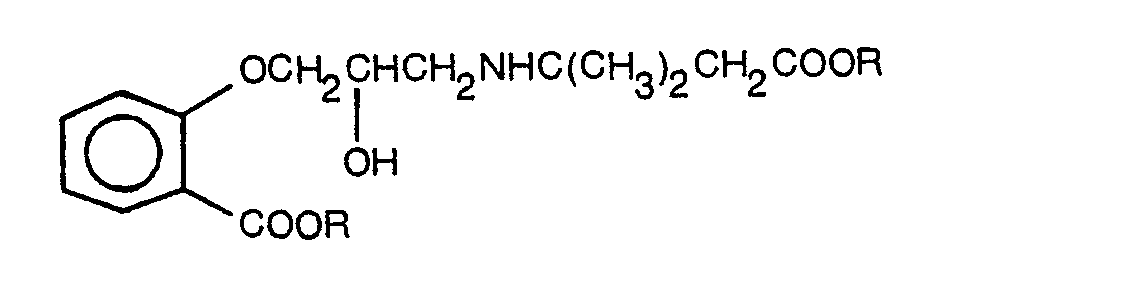
wobei R Methyl oder Ethyl ist; oder ein pharmazeutisch akzeptables Salz davon.
wobei R Methyl oder Ethyl ist; oder ein pharmazeutisch akzeptables Salz davon.
10. Verbindung nach Anspruch 1 mit der Formel
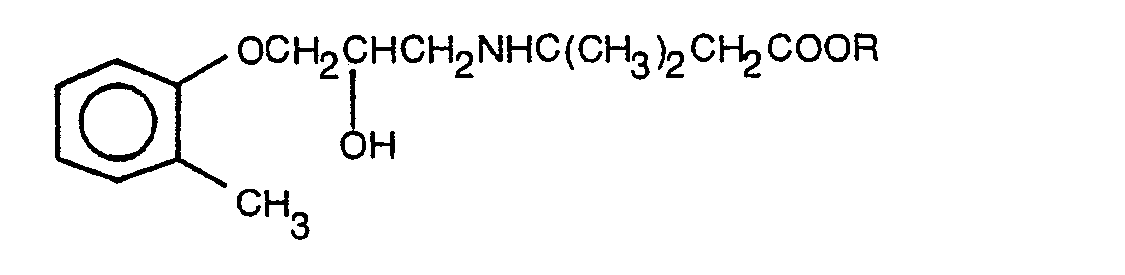
wobei R Methyl oder Ethyl ist; oder ein pharmazeutisch akzeptables Salz davon.
wobei R Methyl oder Ethyl ist; oder ein pharmazeutisch akzeptables Salz davon.
11. Verbindung nach Anspruch 1 mit der Formel
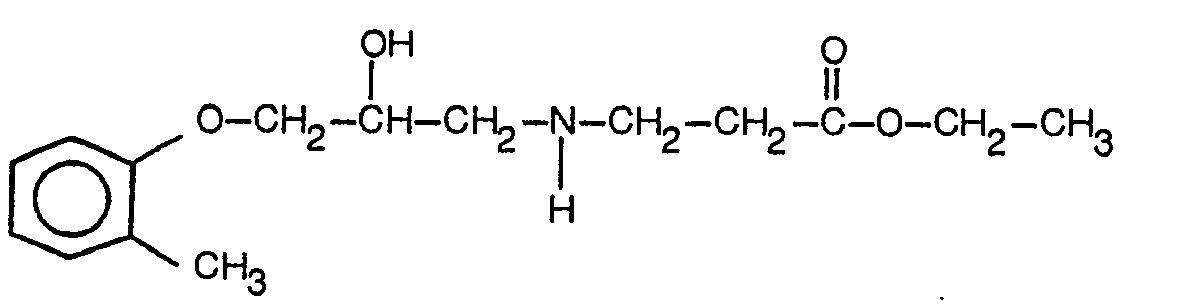
oder ein pharmazeutisches akzeptables Salz davon.
oder ein pharmazeutisches akzeptables Salz davon.
12. Verbindung nach Anspruch 1 mit der Formel
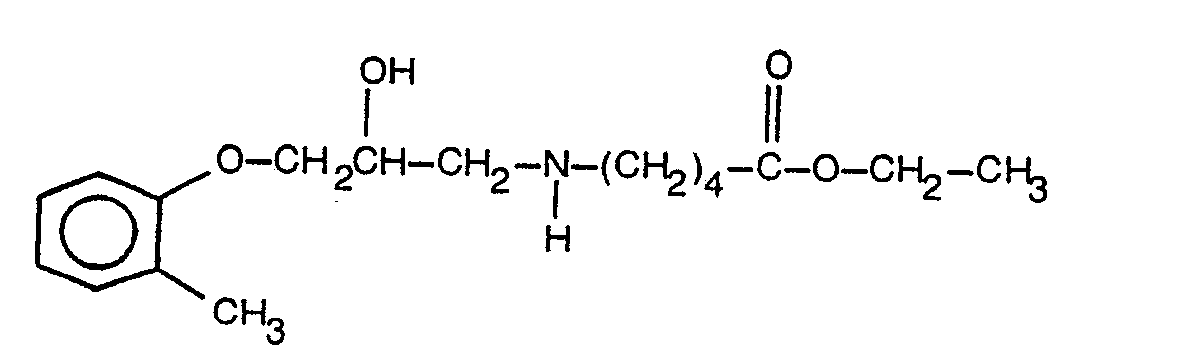
oder ein pharmazeutisch akzeptables Salz davon.
oder ein pharmazeutisch akzeptables Salz davon.
13. Ophthalmologische Zusammensetzung zur topischen Therapie von Glaucom oder zum
Absenken des Augeninnendrucks, die eine augeninnendruckabsenkende wirksame Menge einer
Verbindung der Formel
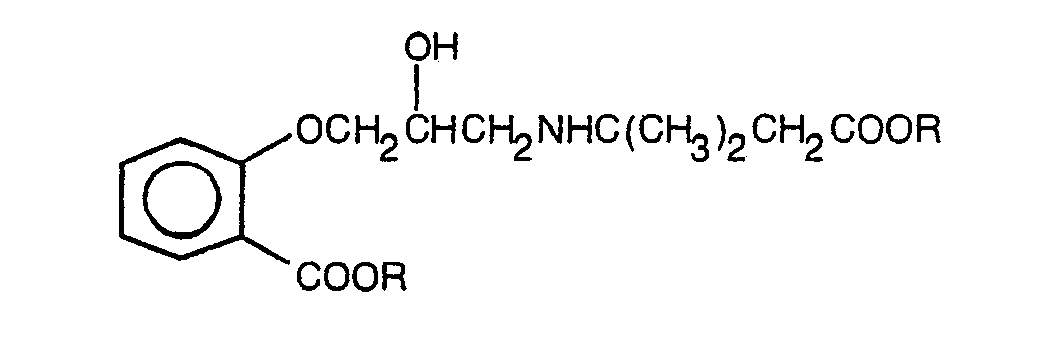
wobei R Methyl oder Ethyl ist; oder ein pharmazeutisch akzeptables Salz davon; und eine ophthalmologisch akzeptable Trägersubstanz umfaßt.
wobei R Methyl oder Ethyl ist; oder ein pharmazeutisch akzeptables Salz davon; und eine ophthalmologisch akzeptable Trägersubstanz umfaßt.
14. Ophthalmologische Zusammensetzung für die topische Therapie von Glaucom oder zum
Absenken des Augeninnendrucks, die eine augeninnendruckabsenkende wirksame Menge einer
Verbindung der Formel
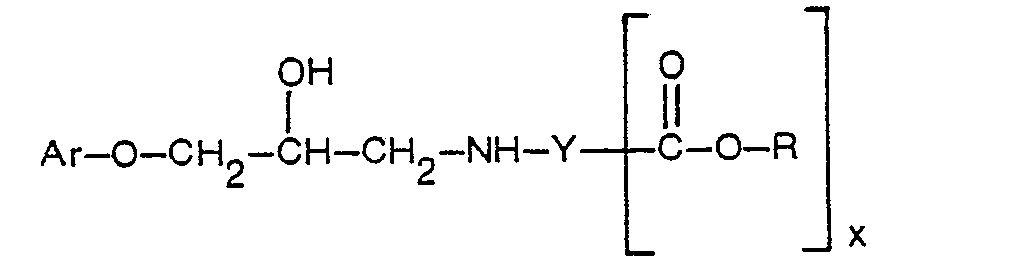
wobei Y ein geradkettiger oder verzweigter Alkylenrest mit von 1 bis 10 Kohlenstoffatomen oder Aralkylen mit von 8 bis 20 Kohlenstoffatomen ist; R Alkyl mit von 1 bis 10 Kohlenstoffatomen, Alkenyl mit von 2 bis 10 Atomenstoffatomen oder Alkinyl mit von 3 bis 10 Kohlenstoffatomen ist; x eine ganze Zahl von 1 bis 3 ist; Ar Phenyl oder Naphthyl ist, wahlweise zusätzlich substituiert mit C,-C5-Alkyl, C2―C5-Alkenyl, C2-CS-Alkinyl, C1―C5-Alkoxy, Halogen, Cyan oder einer Gruppe der Formel
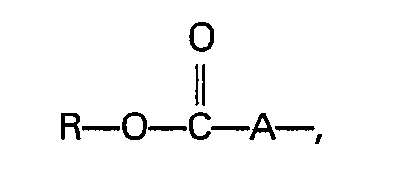
wobei A ein direkt gebundenes Alkylen mit von 1 bis 10 Kohlenstoffatomen oder Alkenylen mit von 2 bis 10 Kohlenstoffatomen ist; oder ein pharmazeutisch akzeptables Salz davon; und eine ophthalmologisch akzeptable Trägersubstanz umfaßt, die eine sterile gepufferte wässrige isotonische Lösung und eine wirksame Menge eines Konservierungsmittels umfaßt.
wobei Y ein geradkettiger oder verzweigter Alkylenrest mit von 1 bis 10 Kohlenstoffatomen oder Aralkylen mit von 8 bis 20 Kohlenstoffatomen ist; R Alkyl mit von 1 bis 10 Kohlenstoffatomen, Alkenyl mit von 2 bis 10 Atomenstoffatomen oder Alkinyl mit von 3 bis 10 Kohlenstoffatomen ist; x eine ganze Zahl von 1 bis 3 ist; Ar Phenyl oder Naphthyl ist, wahlweise zusätzlich substituiert mit C,-C5-Alkyl, C2―C5-Alkenyl, C2-CS-Alkinyl, C1―C5-Alkoxy, Halogen, Cyan oder einer Gruppe der Formel
wobei A ein direkt gebundenes Alkylen mit von 1 bis 10 Kohlenstoffatomen oder Alkenylen mit von 2 bis 10 Kohlenstoffatomen ist; oder ein pharmazeutisch akzeptables Salz davon; und eine ophthalmologisch akzeptable Trägersubstanz umfaßt, die eine sterile gepufferte wässrige isotonische Lösung und eine wirksame Menge eines Konservierungsmittels umfaßt.
15. Zusammensetzung nach Anspruch 14, wobei das Konservierungsmittel ausgewählt ist
aus quaternären Ammoniumverbindungen, Phenylquecksilbersalzen, Thimerosal, Methylparaben,
Propylparaben, Benzylalkohol und Phenylethanol.
16. Zusammensetzung nach Anspruch 14 oder 15, wobei Y ein geradkettiger oder verzweigter
Akylenrest mit von 1 bis 6 Kohlenstoffatomen oder Aralkylen mit von 8 bis 12 Kohlenstoffatomen
ist und R Alkyl mit von 1 bis 5 Kohlenstoffatomen, Alkenyl mit von 2 bis 5 Kohlenstoffatomen
oder Alkinyl mit von 3 bis 5 Kohlenstoffatomen ist.
17. Zusammensetzung nach Anspruch 16, wobei Ar Phenyl oder Naphthyl ist, wahlweise
substituiert mit Alkyl mit von 1 bis 5 Kohlenstoffatomen, Alkenyl mit von 2 bis 5
Kohlenstoffatomen, Alkoxy mit von 1 bis 5 Kohlenstoffatomen, Fluor, Chlor oder einer
Gruppe der Formel
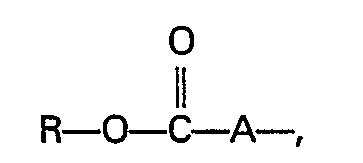
wobei A ein direkt gebundenes Alkylen mit von 1 bis 5 Kohlenstoffatomen oder Alkenylen mit von 2 bis 5 Kohlenstoffatomen ist.
wobei A ein direkt gebundenes Alkylen mit von 1 bis 5 Kohlenstoffatomen oder Alkenylen mit von 2 bis 5 Kohlenstoffatomen ist.
18. Zusammensetzung nach Anspruch 17, wobei Y ein geradkettiger oder verzweigter Alkylenrest
mit von 1 bis 4 Kohlenstoffatomen ist, R Alkyl mit von 1 bis 4 Kohlenstoffatomen ist
und x 1 oder 2 ist.
19. Zusammensetzung nach Anspruch 18, wobei Ar unsubstituiertes Phenyl oder mit Alkyl
mit von 1 bis 5 Kohlenstoffatomen, Fluor, Chlor oder einer Gruppe der Formel
substituiertes Phenyl ist, wobei A Alkylen mit von 1 bis 5 Kohlenstoffatomen oder Alkenylen mit von 2 bis 5 Kohlenstoffatomen ist, x 1 ist und R wie in Anspruch 4 definiert ist.
substituiertes Phenyl ist, wobei A Alkylen mit von 1 bis 5 Kohlenstoffatomen oder Alkenylen mit von 2 bis 5 Kohlenstoffatomen ist, x 1 ist und R wie in Anspruch 4 definiert ist.
20. Zusammensetzung nach Anspruch 18, wobei Ar Phenyl, 2-Methylphenyl oder 2-Methoxyphenyl
ist und x 1 ist.
21. Zusammensetzung nach Anspruch 18, wobei R Methyl oder Ethyl ist.
22. Zusammensetzung nach Anspruch 14 oder 15, wobei die topisch angewendete Verbindung
ist, wobei R Methyl oder Ethyl ist; oder ein pharmazeutisch akzeptables Salz davon.
ist, wobei R Methyl oder Ethyl ist; oder ein pharmazeutisch akzeptables Salz davon.
23. Zusammensetzung nach Anspruch 15, die weiterhin Ethylzellulose, Polyvinylpyrrolidon
oder Polyethylenglycol umfaßt.
24. Zusammensetzung nach Anspruch 14, wobei die Verbindung in einer Konzentration
von 0,01 Gew.- % bis 10 Gew.-% vorhanden ist.
25. Zusammensetzung nach Anspruch 14, wobei die Verbindung in einer Konzentration
von 0,5 Gew.- % bis 5 Gew.-% vorhanden ist.
1. Composé de formule
dans laquelle Y est un radical alkylène à chaîne droite ou ramifiée de 1 à 10 atomes de carbone ou un radical aralkylène de 8 à 20 atomes de carbone; R est un radical alkyle de 1 à 10 atomes de carbone, alcényle de 2 à 10 atomes de carbone ou alcynyle de 3 à 10 atomes de carbone; x est un nombre entier de 1 à 3; Ar est un radical phényle ou naphtyle éventuellement substitué par un radical alkyle en C1―C5, alcényle en C2―C5, alcynyle en C2-Cs, alcoxy en Cl-C5, par un atome d'halogène, par un groupement cyano, ou par un groupement de formule
dans laquelle A est une liaison directe, un groupement alkylène de 1 à 10 atomes de carbone, ou un groupement alcénylène de 2 à 10 atomes de carbone; ou bien un sel pharmaceutiquement acceptable, destiné à être utilisé pour la fabrication d'un médicament pour le traitement du glaucome ou pour abaisser la pression intra-oculaire.
dans laquelle Y est un radical alkylène à chaîne droite ou ramifiée de 1 à 10 atomes de carbone ou un radical aralkylène de 8 à 20 atomes de carbone; R est un radical alkyle de 1 à 10 atomes de carbone, alcényle de 2 à 10 atomes de carbone ou alcynyle de 3 à 10 atomes de carbone; x est un nombre entier de 1 à 3; Ar est un radical phényle ou naphtyle éventuellement substitué par un radical alkyle en C1―C5, alcényle en C2―C5, alcynyle en C2-Cs, alcoxy en Cl-C5, par un atome d'halogène, par un groupement cyano, ou par un groupement de formule
dans laquelle A est une liaison directe, un groupement alkylène de 1 à 10 atomes de carbone, ou un groupement alcénylène de 2 à 10 atomes de carbone; ou bien un sel pharmaceutiquement acceptable, destiné à être utilisé pour la fabrication d'un médicament pour le traitement du glaucome ou pour abaisser la pression intra-oculaire.
2. Composé selon la revendication 1, dans la formule duquel Y est un radical alkylène
à chaîne droite ou ramifiée de 1 à 6 atomes de carbone ou un radical aralkylène de
8 à 12 atomes de carbone et R est un radical alkyle de 1 à 5 atomes de carbone, alcényle
de 2 à 5 atomes de carbone, ou alcynyle de 3 à 5 atomes de carbone.
3. Composé selon la revendication 2, dans la formule duquel Ar est un radical phényle
ou naphtyle éventuellement substitué par un radical alkyle de 1 à 5 atomes de carbone,
alcényle de 2 à 5 atomes de carbone, alcoxy de 1 à 5 atomes de carbone, par un atome
de fluor ou de chlore, ou par un groupement de formule
dans laquelle A est une liaison directe, un groupement alkylène de 1 à 5 atomes de carbone, ou un groupement alcénylène de 2 à 5 atomes de carbone.
dans laquelle A est une liaison directe, un groupement alkylène de 1 à 5 atomes de carbone, ou un groupement alcénylène de 2 à 5 atomes de carbone.
4. Composé selon la revendication 3, dans la formule duquel Y est un radial alkylène
à chaîne droite ou ramifiée de 1 à 4 atomes de carbone, R est un radical alkyle de
1 à 4 atomes de carbone, et x est égal à 1 ou 2.
5. Composé selon la revendication 4, dans la formule duquel Ar est un radical phényle
éventuellement substitué par un radical alkyle de 1 à 5 atomes de carbone, par un
atome de fluor ou de chlore, ou par un groupement de formule
dans laquelle A est un groupement alkylène de 1 à 5 atomes de carbone ou alcénylène de 2 à 5 atomes de carbone, x est égal à 1, et R est tel que défini dans la revendication 4.
dans laquelle A est un groupement alkylène de 1 à 5 atomes de carbone ou alcénylène de 2 à 5 atomes de carbone, x est égal à 1, et R est tel que défini dans la revendication 4.
6. Composé selon la revendication 4, dans la formule duquel Ar est un radical phényle,
2-méthylphényle ou 2-méthoxyphényle et x est égal à 1.
7. Composé selon la revendication 4, dans la formule duquel R est un radical méthyle
ou éthyle.
8. Composé selon la revendication 1, ayant pour formule
dans laquelle R est un radical méthyle ou éthyle; ou sel pharmaceutiquement acceptable de ce composé.
dans laquelle R est un radical méthyle ou éthyle; ou sel pharmaceutiquement acceptable de ce composé.
9. Composé selon la revendication 1, ayant pour formule
dans laquelle R est un radical méthyle ou éthyle; ou sel pharmaceutiquement acceptable de ce composé.
dans laquelle R est un radical méthyle ou éthyle; ou sel pharmaceutiquement acceptable de ce composé.
10. Composé selon la revendication 1, ayant pour formule
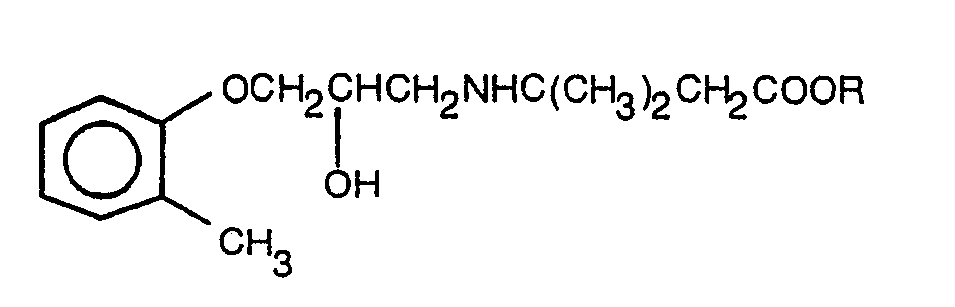
dans laquelle R est un radical méthyle ou éthyle; ou sel pharmaceutiquement acceptable de ce composé.
dans laquelle R est un radical méthyle ou éthyle; ou sel pharmaceutiquement acceptable de ce composé.
11. Composé selon la revendication 1, ayant pour formule
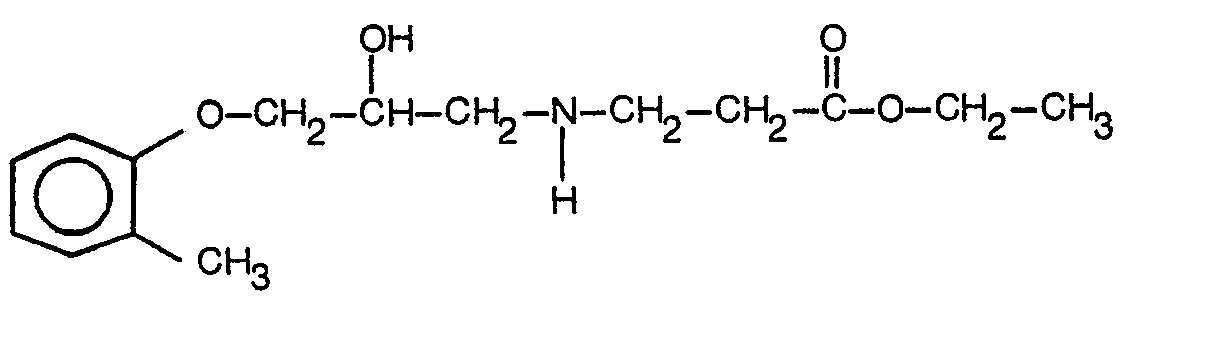
ou sel pharmaceutiquement acceptable de ce composé.
ou sel pharmaceutiquement acceptable de ce composé.
12. Composé selon la revendication 1, ayant pour formule
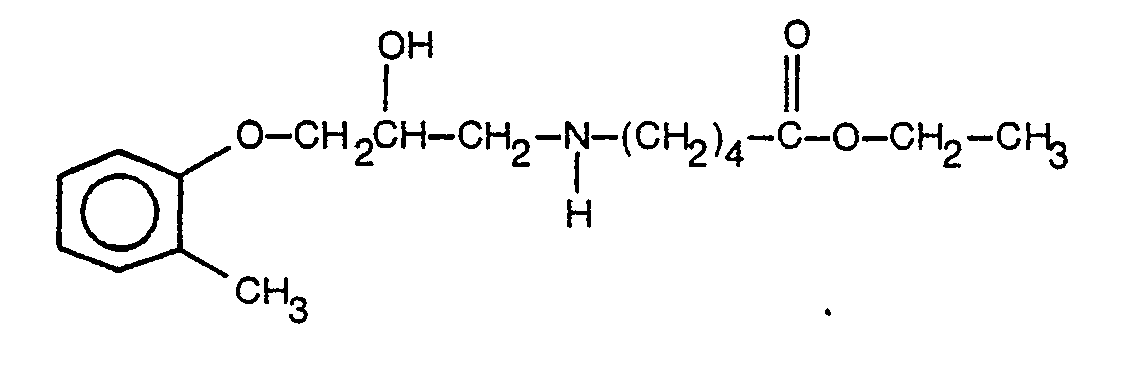
ou sel pharmaceutiquement acceptable de ce composé.
ou sel pharmaceutiquement acceptable de ce composé.
13. Composition ophtalmologique pour le traitement topique de glaucome ou pour abaisser
la pression intra-oculaire, comprenant une quantité propre à abaisser la pression
intra-oculaire, d'un composé de formule
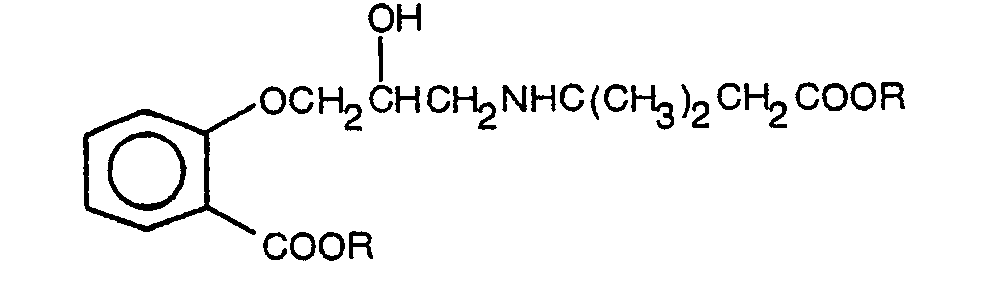
dans laquelle R est un radical méthyle ou éthyle; ou d'un sel pharmaceutiquement acceptable de ce composé; et un porteur ophtalmologiquement acceptable.
dans laquelle R est un radical méthyle ou éthyle; ou d'un sel pharmaceutiquement acceptable de ce composé; et un porteur ophtalmologiquement acceptable.
14. Composition ophtalmologique pour le traitment topique de glaucome ou pour abaisser
la pression intra-oculaire, comprenant une quantité propre à abaisser la pression
intra-oculaire, d'un composé de formule
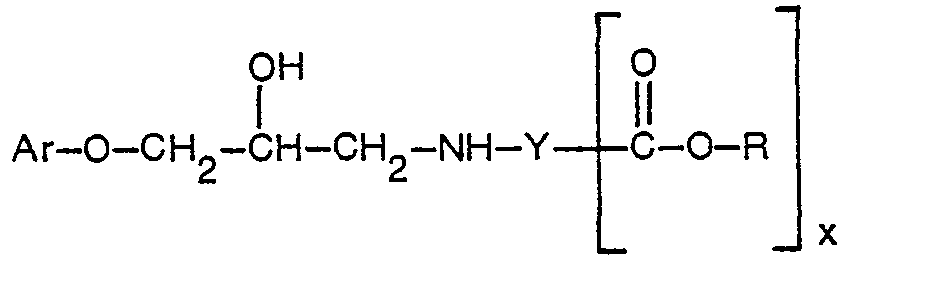
dans laquelle Y est un radical alkylène à chaîne droite ou ramifiée de 1 à 10 atomes de carbone ou aralkylène de 8 à 20 atomes de carbone; R est un radical alkyle de 1 à 10 atomes de carbone, alcényle de 2 à 10 atomes de carbone ou alcynyle de 3 à 10 atomes de carbone; x est un nombre entier de 1 à 3; Ar est un radical phényle ou naphtyle évenuellement substitué par un radical alkyle en Cl-C5, alcényle en C2―C5, alcynyle en C2―C5, alcoxy en C1―C5, par un atome d'halogène, par un groupement cyano, ou par un groupement de formule
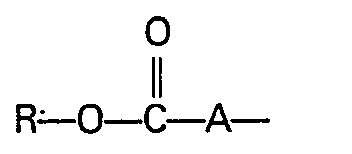
dans laquelle A est une liaison directe, un groupement alkylène de 1 à 10 atomes de carbone, ou un groupement alcénylène de 2 à 10 atomes de carbone; ou bien d'un sel pharmaceutiquement acceptable de ce composé; et un porteur ophtalmologiquement acceptable comprenant une solution isotonique aqueuse tampounée stérile et une quantité efficace d'un agent de conservation.
dans laquelle Y est un radical alkylène à chaîne droite ou ramifiée de 1 à 10 atomes de carbone ou aralkylène de 8 à 20 atomes de carbone; R est un radical alkyle de 1 à 10 atomes de carbone, alcényle de 2 à 10 atomes de carbone ou alcynyle de 3 à 10 atomes de carbone; x est un nombre entier de 1 à 3; Ar est un radical phényle ou naphtyle évenuellement substitué par un radical alkyle en Cl-C5, alcényle en C2―C5, alcynyle en C2―C5, alcoxy en C1―C5, par un atome d'halogène, par un groupement cyano, ou par un groupement de formule
dans laquelle A est une liaison directe, un groupement alkylène de 1 à 10 atomes de carbone, ou un groupement alcénylène de 2 à 10 atomes de carbone; ou bien d'un sel pharmaceutiquement acceptable de ce composé; et un porteur ophtalmologiquement acceptable comprenant une solution isotonique aqueuse tampounée stérile et une quantité efficace d'un agent de conservation.
15. Composition selon la revendication 14, dans laquelle l'agent de conservation est
choisi entre les composés d'ammonium quaternaire, les sels phénylmercuriques, le thimérosal,
le para-hydroxybenzoate de méthyle, le para-hydroxybenzoate de propyle, l'alcool benzylique
et le phényléthanol.
16. Composition selon la revendication 14 ou 15, dans laquelle Y est un radical alkylène
à chaîne droite ou ramifiée de 1 à 6 atomes de carbone ou aralkylène de 8 à 12 atomes
de carbone et R est un radical alkyle de 1 à 5 atomes de carbone, alcényle de 2 à
5 atomes de carbone ou alcynyle de 3 à 5 atomes de carbone.
17. Composition selon la revendication 16, dans laquelle Ar est un radical phényle
ou naphtyle éventuellement substitué par un radical alkyle de 1 à 5 atomes de carbone,
alcényle de 2 à 5 atomes de carbone alcoxy de 1 à 5 atomes de carbone, par un atome
de fluor ou de chlore, ou par un groupement de formule
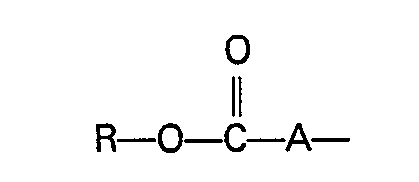
dans laquelle A est une liaison directe ou un radical alkylène de 1 à 5 atomes de carbone alcénylène de 2 à 5 atomes de carbone.
dans laquelle A est une liaison directe ou un radical alkylène de 1 à 5 atomes de carbone alcénylène de 2 à 5 atomes de carbone.
18. Composition selon la revendication 17, dans laquelle Y est un radical alkylène
à chaîne droite ou ramifiée de 1 à 4 atomes de carbone, R est un radical alkyle de
1 à 4 atomes de carbone et x est égal à 1 ou 2.
19. Composition selon la revendication 18, dans laquelle Ar est un radical phényle
éventuellement substitué par un radical alkyle de 1 à 5 atomes de carbone, par un
atome de fluor ou de chlore, ou par un groupement de formule
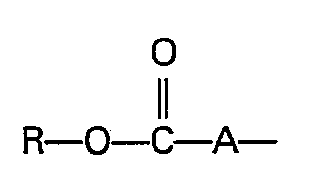
dans laquelle A est un radical alkylène de 1 à 5 atomes de carbone ou alcénylène de 2 à 5 atomes de carbone, x est égal à 1, et R est tel que défini dans la revendication 4.
dans laquelle A est un radical alkylène de 1 à 5 atomes de carbone ou alcénylène de 2 à 5 atomes de carbone, x est égal à 1, et R est tel que défini dans la revendication 4.
20. Composition selon la revendication 18, dans laquelle Ar est un radical phényle,
2-méthylphényle ou 2-méthoxyphényle et x est égal à 1.
21. Composition selon la revendication 18, dans laquelle R est un radical méthyle
ou éthyle.
22. Composition selon la revendication 14 ou 15, dans laquelle le composé qui est
appliqué topiquement est
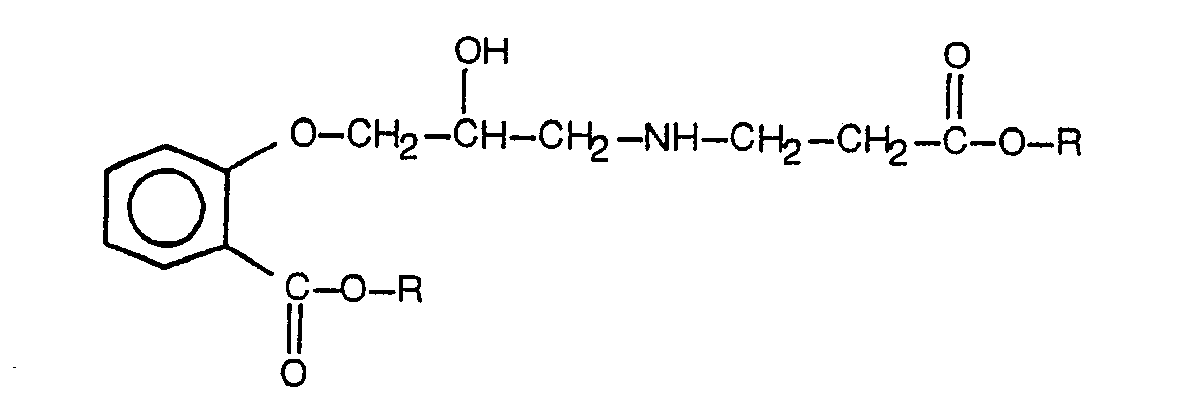
où R est un radical méthyle ou éthyle; ou bien un sel pharmaceutiquement acceptable de celui-ci.
où R est un radical méthyle ou éthyle; ou bien un sel pharmaceutiquement acceptable de celui-ci.
23. Composition selon la revendication 15, comprenant en outre de l'éthylcellulose,
de la polyvinylpyrrolidone ou du polyéthylène glycol.
24. Composition selon la revendication 14, dans laquelle le composé est présent à
une concentration de 0,01% à 10% en poids.
25. Composition selon la revendication 14, dans laquelle le composé est présent à
une concentration de 0,5% à 5% en poids.