|
(11) | EP 0 082 636 B2 |

| (12) | NEW EUROPEAN PATENT SPECIFICATION |
|
|
| (54) |
Luminescent labelling materials and procedures Lumineszierende Markierungssubstanzen und -verfahren Composés et procédé pour le marquage luminescent |
|
|
|||||||||||||||||||||||||||||||
[0001] This invention relates to methods designed for use in the analysis, assay, or location of proteins, polypeptides, and other substances of biological interest by linking ("labelling") them to another molecule or molecules which can take part in a reaction resulting in the emission of light. The labelled substance, to be termed "luminescent reagent", may be used in various types of biological investigations, preferably immunoassays and protein binding assays. The amount of the "luminescent reagent" is measured by recording the light emitted after producing the appropriate conditions required for the luminescent reaction to take place. Here, the luminescent reaction is one which generates chemiluminescence which is distinguished from fluorescence or phosphoresence. The use of the "luminescent reagent" enables the analysis, assay, or location of proteins or other substances of biological interest to be carried out without experiencing any of the disadvantages associated with the use of radioactive labelled substances such as are commonly used at present. These disadvantages are as follows. Firstly, the formation of such a radioactive reagent involves the use of highly radioactive and hence potentially hazardous species. Secondly, the shelf-life of such a radioactive reagent is often short because of its continuous decay. Further, the emission of radiation from the radio-isotope may be deleterious to the substance to which the radio-isotope is linked. Thirdly, it is often difficult to label proteins sufficiently to provide a sensitively and rapidly detectable reagent.
[0002] In contrast, a "luminescent reagent" is non-radiotoxic, stable, and can be quantified both rapidly and in small amounts.
[0003] It has been proposed in British Patent 2008247 to use a chemiluminescent substance as a label to be attached to a molecule of biological interest in immunoassay purposes. Amongst large numbers of possible luminescent labels it was proposed to use various acridinium derivatives.
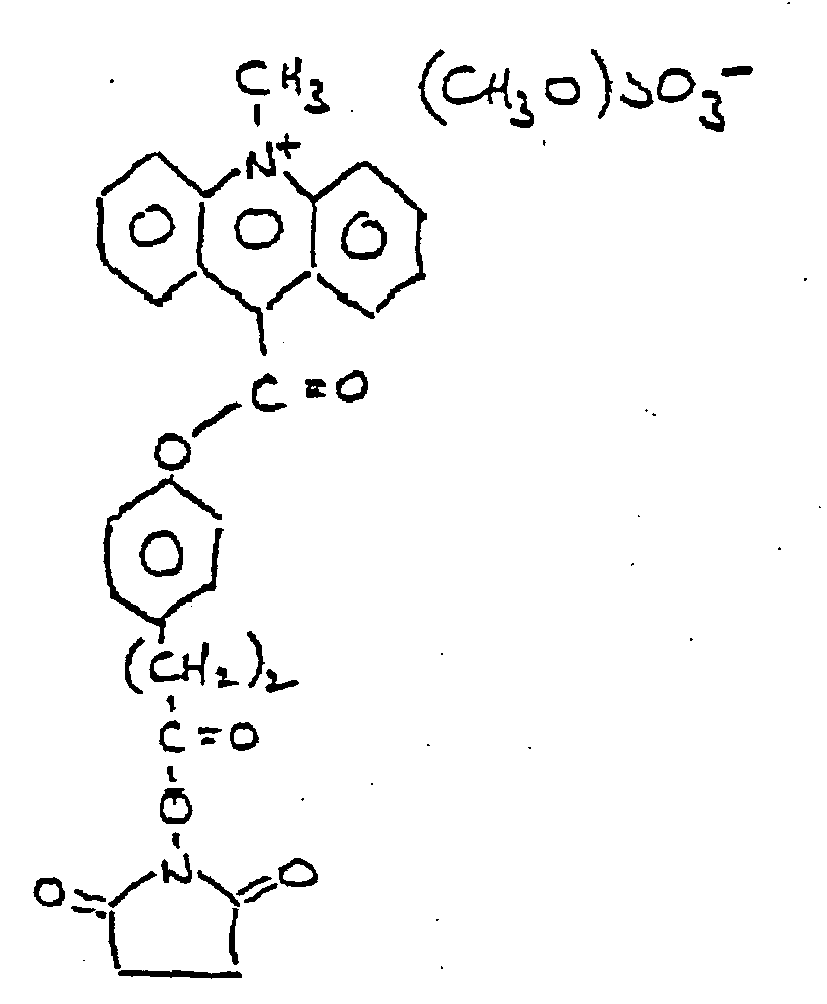
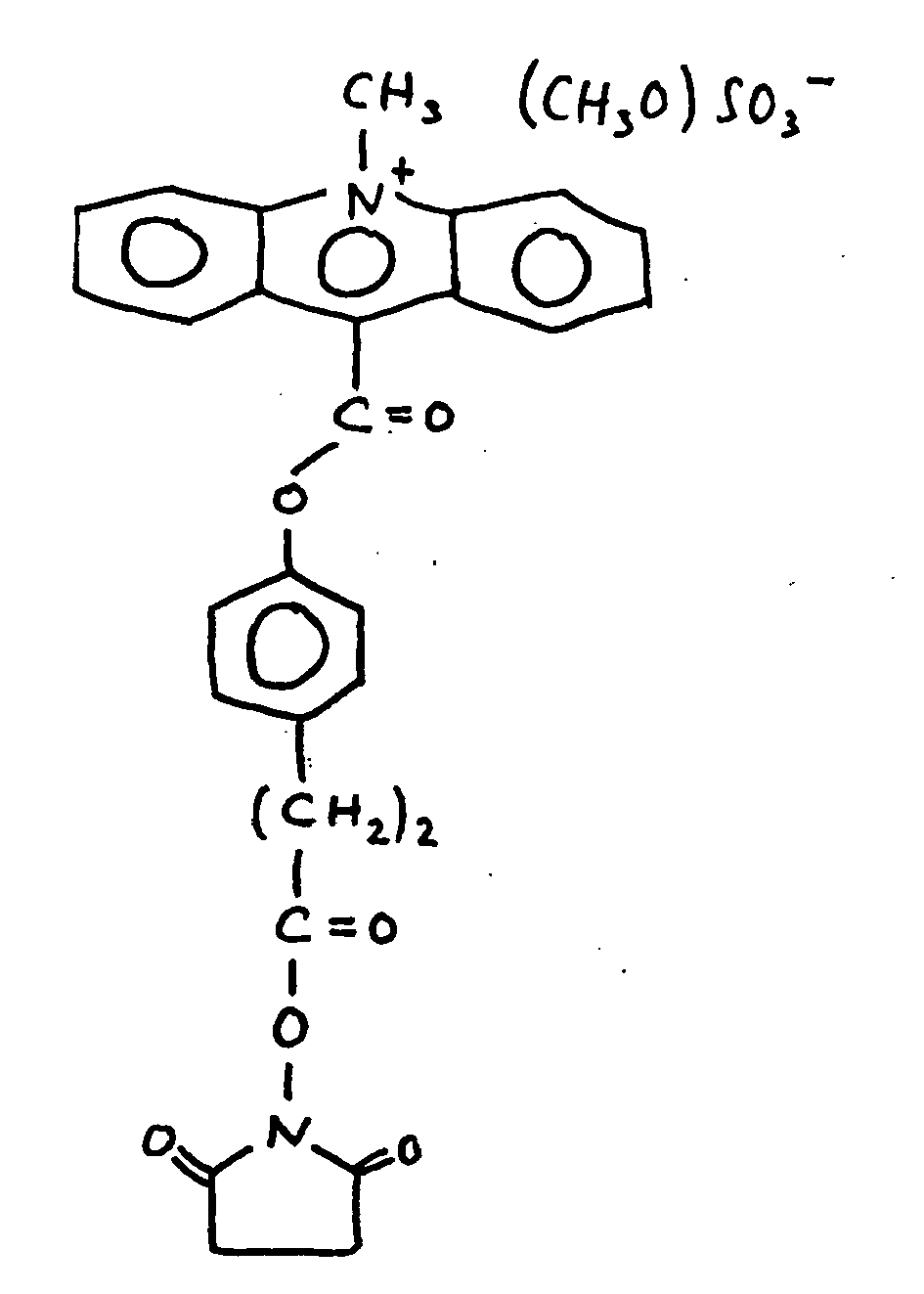
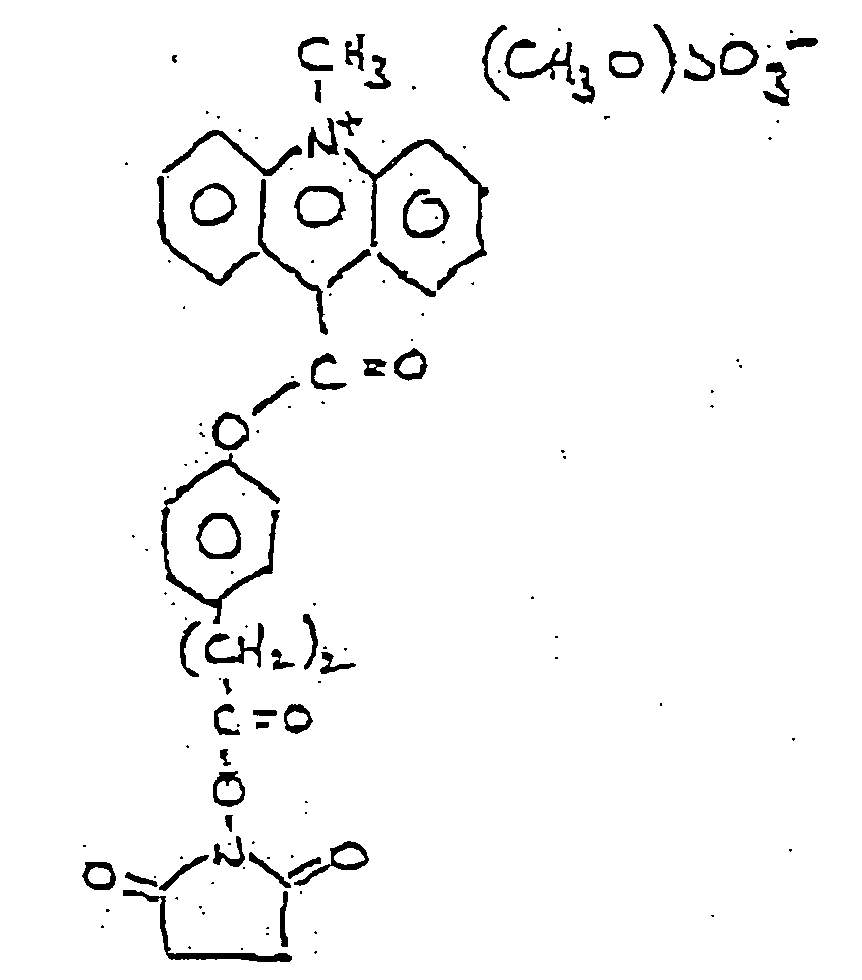
[0004] The present invention consists in a luminescent labelling compound for use as a "label" with a substance of biological interest, of the following formula:
[0005] The compound according to the invention undergoes a light emitting reaction In the presence of a dilute aqueous solution of sodium hydroxide and hydrogen peroxide and the amount of compound can be quantified by measurement of the intensity of the emitted light or rate of photon emission. Further the compound reacts with other substances containing primary and secondary aliphatic amines to yield chemiluminescent derivatives. The compound has the advantage of being stable under normal storage conditions and of reacting with the aforementioned amines under mild reaction conditions.
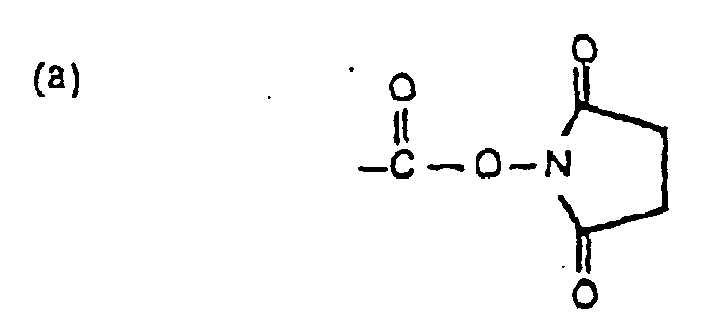
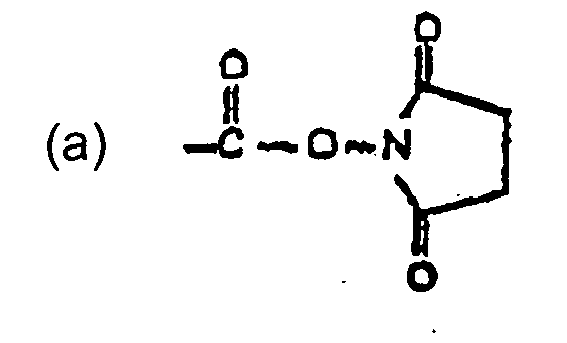
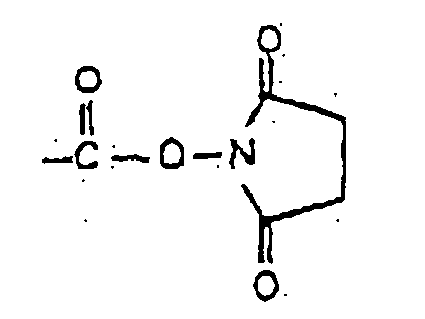
[0006] From another aspect of the invention the labelling compound is prepared by reacting an acridine with a cyanide, and thence converting the product via a carboxy derivative to a halocarbonyl acridine derivative. The acridine derivative is further reacted with a phenolic moiety substituted with
and the product may be methylated at position 10. In some cases the R8 moiety, or part thereof, or the linking group is protected before methylation, for example by amidation, esterification or acylation.
[0007] Thus, in a particular example a N-hydroxysuccinimidyl ester is synthesised via the following route. Acridine is reacted with potassium cyanide and benzoyl chloride so as to yield a 9-cyano-derivative which is subsequently purified by recrystallisation. The material so obtained is reacted with sulphuric acid, thence sodium nitrite to yield the 9-carboxy-derivative which is purified, dried and reacted with thionyl chloride to give the 9-chloro-carbonyl-derivative. This is allowed to react with N-succinimidyl 3-(4-hydroxyphenyl) proprionate to yield the corresponding ester of 9-carboxyacridine. The product is methylated at the 10-position, preferably using dimethyl sulphate or methyl fluorosulphonate to yield the final chemiluminescent product which is isolated by trituration with ether followed by filtration and dessication. An alternative method involves the formation of 9-chlorocarbonyl acridine as described above thence formation of the corresponding methyl ester using methanol followed by methylation at the 10-position preferably using dimethyl sulphate or methyl fluorosulphonate. This is then converted to the corresponding carboxylic acid by hydrolysis thence to the corresponding acyl chloride by reaction with thionyl chloride. The product of this reaction is then mixed with N-succinimidyl-3-(4-hyroxyphenyl) propionate to yield the final product which is isolated by trituration.
[0008] The invention relates to a luminescent labelling material comprises an acridinium compound as defined, linked to a protein or polypeptide or other organic substance of biological interest to provide a stable immunologically reactive luminescent reagent. The compound above is capable of reacting with proteins at temperatures between 0 and 40°C under aqueous conditions optionally in the presence of organic solvents to yield luminescent reagents which are preferably stable and immunologically active. The reaction which results in the formation of the "luminescent reagent" is complete preferably within 30 minutes, more preferably within 5 minutes, such that at least one mole, and preferably at least three or ten moles of chemiluminescent compound are incorporated into each 1 mole of protein, excess chemiluminescent label is inactivated with lysine which also acts to dissociate non-covalent interactions between chemiluminescent compound and protein.
[0009] Preferably the labelled reagents are antibodies more preferably monoclonal antibodies which, when labelled, can be purified so as to be free of excess chemiluminescent compound by gel permeation chromatography preferably in a buffer system containing non-immune gamma globulins.
[0010] The invention also relates to an assay procedure in which a luminescent labelling compound as defined above is linked with a substance of biological interest, a light emitting reaction is triggered and the amount of the substance is quantified or detected by measuring or sensing the emitted light. The invention is especially applicable to immuno assay, and preferably two-site immunometric assays for the quantitation of polypeptide antigens. Here a solid phase derivative of a polyclonal or monoclonal antibody, which may be an antibody coated tube, microtiter plate well or particulate solid phase, preferably a cellulose derivative, is used to bind antigen molecules. The uptake of antigen, which depends on the antigen concentration, is measured by allowing the resultant solid phase to come into contact with the labelled reagent and measuring the luminescence activity associated with the solid phase following its preparation from the assay mixture. Such an assay is preferably performed by adding the solid phase antibody and the "labelled reagent" simultaneously to the antigen containing solution thence allowing the immunological reaction to proceed, preferably for 4 hours, more preferably for 1 hour, before isolation and luminometric measurement of the solid phase. Alternatively, the antigen may be reacted first with labelled antibody for a short period of say ½ to 1½ hours and then subsequently with solid phase antibody for a similar period. After isolation of the solid phase, the luminescence activity associated with the solid phase is quanitified.
[0011] Alternatively indirect determination of the antigen concentration may be performed by using a labelled second antibody which selectively binds the soluble antibody used initially, that is, using unlabelled soluble first antibody. Such a labelled anti (globulin) antibody has the advantage of being a universal labelled reagent.
Example
[0012] Acridine (10g) is suspended in water (133 cm3) in which is dissolved potassium cyanide (22 g). Benzoyl chloride (27.5 cm3) is added in a dropwise manner with vigorous shaking of the reaction flask after the addition of each 1 cm3 of benzoyl chloride. The mixture is left to stand for several hours at room temperature, thence filtered and the residual solid washed with distilled water. The solid is then recrystallised from ethanol containing activated decolourising charcoal.
[0013] Part of the product of the above procedure, that is, 9-cyano acridine (4 g) is dissolved in sulphuric acid containing 10% by weight of distilled water (total volume equals 40 cm3). The mixture thus obtained is heated at a temperature of 100°C for 2 hours after which time sodium nitrite (10.7 g) is added slowly with continuous stirring. The resulting mixture is heated at 100°C for 2 hours then poured into cold, distilled water (650 cm3). The solid material which precipitates at this stage is isolated by filtration and allowed to dissolve in the minimum quantity of one molar sodium hydroxide solution; the solution thus obtained is filtered and the filtrate made slightly acidic by the addition of a 50%, by volume, solution of sulphuric acid in water. The 9-carboxyl-acridine so formed is then dried in vacuo.
[0014] 9-carboxyacridine (1.5 g) is added to freshly distilled thionyl chloride (11 cm3) and the mixture heated under reflux for 4 hours. Boiling dichloromethane (100 cm3) is added and the resulting solution filtered. The filtrate is concentrated by distillation and dry heptane added in order to precipitate the 9-chlorocarbonylacridine hydrochloride which is subsequently filtered, washed with dry heptane and dried in vacuo. A portion of the resultant material (0.5 g) is added to dry pyridine (5 cm3) and the mixture stirred for fifteen minutes. Then a molar equivalent of N-succinimidyl 3-(4-hydroxyphenyl)-propionate is added. The mixture is stirred at room temperature for twelve hours under anhydrous conditions. The reaction mixture is poured into cold distilled water (100 cm3) acidified to pH2 with hydrochloric add and the solid material which precipitates collected by filtration and dried in vacuo. Part of the dried material 200 mg) is suspended in freshly distilled dimethyl sulphate (1 cm3) and the mixture heated at 100°C for ten minutes, the solution formed at this stage is cooled in ice and triturated with dry diethyl ether. The mixture is then filtered and the solid dried in vacuo. The filtrate is retained and evaporated to dryness in vacuo. Both fractions contain chiefly 4-(2-Succinimidyl-oxycarbonylethyl)-phenyl-10-methylacridinium-9-carboxylate methosulphate hereinafter referred to as compound (A).
[0015] A solution of compound (A) in dry dimethylformamide is made at a concentration of 0.1 mg cm-3. Ten microlitres of a 5 mg cm-3 solution of monoclonal mouse (anti-human α1-fetoprotein) antibodies are diluted with 300 µl of 0.1 molar phosphate buffer (pH 8.0) containing sodium chloride at a concentration of 0.15 moles per litre. Ten microlitres of the above solution of compound (A) is added to 100 µl dimethyl formamide and a 10 µl aliquot of this solution removed to a glass test tube. The solution of monoclonal antibodies is then transferred to this tube and the mixture set aside for 15 minutes in the dark at room temperature. One hundred microlitres of a solution of lysine monohydrochloride, in the phosphate buffer described above, at a concentration of 10 mg cm-3, is then added and the mixture left for a further 15 minutes as described above. The resulting mixture is purified by gel exclusion chromatography using a column of pre-swollen "Sephadex G50" (Trade Mark), medium grade, of height 250 mm and diameter 10 mm, which has been previously equilibrated with a 0.1 molar phosphate buffer (pH 6.5) containing sodium chloride at a concentration of 0.15 moles per litre, sheep immunoglobulin G at a concentration of 20 mg 1-1, 0.1% by weight of human serum albumin and 0.01% by weight of thiornersal. The labelled reagent mixture is transferred to the top of the gel column and eluted with the protein-containing buffer whilst collecting 1 cm3 fractions of the column effluent. A 10 µl aliquot of each fraction is measured luminometrically by diluting it to 0.5 cm3 with distilled water and then adding 1 cm3 of a solution of 0.1 moles 1-1 sodium hydroxide containing 1% by volume of a 100 volume solution of hydrogen peroxide, thence measuring the emitted light by means of a photon counter.
[0016] The fraction yielding the greatest emission of light is further purified in a similar manner to that described above and the fraction containing the greatest chemiluminescence emission retained for further use.
[0017] The purified "labelled reagent" is used in a two-site immuno-chemiluminometric assay in the following manner. A solid phase antibody is prepared by linking an immunoglobulin G fraction of sheep (anti-human α1-fetoprotein) antiserum to a diazonium derivative of reprecipitated aminoaryl cellulose and is stored as a 2 mg cm-3 suspension.
[0018] This is diluted by a factor of ten such that 100 µl in each assay tube gives 20 µg of solid phase suspended in 0.1 m phosphate buffer (pH 7.4) containing 0.15 moles 1-1 of sodium chloride and 0.1% by weight of bovine serum albumin.
[0019] The "labelled reagent" diluted with the same buffer such that 100 µl in each assay tube yields approximately 30,000 luminescent counts in twenty seconds. A standard solution of human α1-fetoprotein in the same buffer is serially diluted by a factor of two to yield a series of solutions ranging from 400 ng cm-3 to 3.2 ng cm-3.
[0020] Into each of 30 assay tubes is placed 100 µl of the "labelled reagent" solution. One hundred microlitres of the immunoadsorbent suspension is placed into 27 of the same tubes followed by 100 µl of normal male human serum. Into each of 50 assay tubes is placed 100 µl each of the "labelled reagent" solution and immunoadsorbent suspension followed by 100 µl of the diluent buffer. One hundred microlitre aliquots of the standard solutions are added to the human serum containing tubes such that each standard solution was determined in triplicate, three of the first 27 tubes possessed 100 µl of diluent buffer so as to act as a zero α1-fetoprotein standard.
[0021] Two 100 µl aliquots are taken from each of 25 serum samples obtained from pregnant women at between 14 and 18 weeks gestational age and added to the remaining 50 assay tubes such that each serum sample is determined in duplicate.
[0022] All tubes are incubated for one hour at room temperature after which 2 cm3 of diluent buffer added to each tube except for those three tubes containing "labelled reagent" only. The tubes are centrifuged to sediment the immunoadsorbent, then gently inverted to discard the supernatant. 0.5 cm3 of distilled water is added in turn, with mixing, to each tube which is then placed in the luminometer and the "labelled reagent" determined as described previously.
[0023] A dose response curve is constructed for the standards and used to convert the luminescence emission from the serum sample assay tubes to α1-fetoprotein concentration.
[0024] Referring to the example above of a synthesis of a N-hydroxysuccinimidyl ester the yield and purity of the final product may be improved by incorporating protection and subsequent deprotection stages in the synthesis. An example of this aspect involves the reaction of the benzylester of 4-hydroxyphenyl propanoic acid with the halocarbonyl acridine followed by removal of the protecting benzyl group and subsequent formation of the N-succinimidyl moiety by esterification of the free acid with N-hydroxysuccinimide.
[0025] In the labelling procedure referred to above involving reaction between excess chemiluminescent label and protein, separation of non-protein bound label can also be achieved by prior reaction with other amine containing species such as polylysine or certain solid phase derivatives of amine containing species.
[0026] This invention enables the preparation of a chemiluminescent label suitable for use in immuno assay systems which has a sensitivity of detection close to or better than that of the widely used radioisotope label 125I.
[0027] While luminol has been used as a non-isotopic luminescent label for immuno assays it suffers the disadvantages that it is difficult to link to proteins without loss of quantum yield and it requires a catalyst for its oxidative excitation which may generate high background luminescence. The acridinium ester derivative described here is stable, it can be coupled to proteins under mild conditions such that the quantum yield is unaffected and the immunoreactivity of the protein is preserved and it reacts under mild oxidative conditions where background luminescence is minimal.
[0028] The assay procedure carried out with acridinium ester labelled antibody is a two-site immunometric assay. Such assays offer advantages over conventional competitive techniques in terms of speed and sensitivity by their use of excess binding reagent as opposed to limiting binding reagent. In the past the advantages of the two-site assay have not been fully realised since incorporation of large amounts of 125I to increase specific activity inevitably results in radiolytic damage to antibodies. The chemiluminescent label described in the present invention does not have this disadvantage so that high specific activity labelled antibodies can be prepared without loss of immunoreactivity. The use of acridinium ester labelled antibodies in two-site assays provides a means of improving the sensitivity of measurement of proteins and polypeptides by one or two orders of magnitude by comparison with existing techniques.
1. A luminescent labelling compound for use as a "label" with a substance of biological
interest, of the following formula:
2. A process of preparing a luminescent labelling compound according to Claim 1 by reacting
an acridine with a cyanide and then converting the product via a carboxy derivative
to a halocarbonyl acridine derivative, which is further reacted with a phenolic moiety
substituted with one of the following:
3. A process according to Claim 2, in which the final product of Claim 2 is methylated
at position 10 (ring nitrogen).
4. A process according to Claim 3, in which the final product is protected before methylation
at position 10.
1. Lumineszierende Markierungsverbindung der folgenden Formel zur Verwendung als "Marker"
mit einer Substanz von biologischem Interesse:
2. Verfahren zur Herstellung einer lumineszierenden Markierungsverbindung nach Anspruch
1 durch Umsetzen eines Acridins mit einem Cyanid und dann Umwandeln des Produkts über
ein Carboxyderivat in ein Halogencarbonylacridinderivat, das weiter mit einem Phenolrest
umgesetzt wird, der mit einem der folgenden substituiert ist:
3. Verfahren nach Anspruch 2, bei dem das Endprodukt von Anspruch 2 an der Position 10
(Ringstickstoff) methyliert wird.
4. Verfahren nach Anspruch 3, bei dem das Endprodukt vor der Methylierung an der Position
10 geschützt wird.
1. Composé de marquage luminescent pour une utilisation comme « marqueur » avec une substance
d'intérêt biologique, de la formule suivante :
2. Procédé de préparation d'un composé de marquage luminescent tel que défini à la revendication
1, par réaction d'une acridine avec un cyanure, puis conversion du produit, par l'intermédiaire
d'un dérivé carboxy, en un dérivé d'halogènocarbonyl acridine, que l'on fait réagir
ensuite avec une fraction phénolique substituée par l'élément suivant :
3. Procédé selon la revendication 2, dans lequel le produit final de la revendication
2 est méthylé en position 10 (azote du noyau).
4. Procédé selon la revendication 3, dans lequel le produit final est protégé avant méthylation
en position 10.