|
(11) | EP 0 086 281 B2 |

| (12) | NEW EUROPEAN PATENT SPECIFICATION |
|
|
| (54) |
Preparation of carbamates using a palladium-containing catalyst Herstellung von Carbamaten unter Verwendung eines Palladium enthaltenden Katalysators Préparation de carbamates en utilisant un catalysateur qui contient un palladium |
|
|
|||||||||||||||||||||||||||||||
[0001] The present invention relates to a process for the preparation of carbamates or derivatives thereof from organic nitrogenous compounds as defined hereinafter, carbon monoxide and organic hydroxyl group-containing compounds in the presence of a palladium-based catalyst.
[0002] Carbamates are important chemicals, in particular since they can be converted easily into the corresponding isocyanates which are valuable and versatile starting materials, for example for the production of polyurethanes and related compounds.
[0003] Numerous attempts have been made over the years to find alternative routes to the well-known preparation of isocyanates (or their precursors the carbamates), especially the most important ones such as toluene di-isocyanate (TDI) and methylene-4,4'-diphenyl di-isocyanate (MDI) via the so-called « phosgene route ». Reference is made in this respect to « Recent Advances in Isocyanate Chemistry by S. Ozaki (Chem. Rev., 72, (1972) 457-496).
[0004] For instance, much emphasis has been laid on the reduction of aromatic nitro compounds with carbon monoxide and a lower alkanol in the presence of a sulphur, selenium or tellurium catalyst. A seemingly unavoidable disadvantage of such process is the presence of small but definite amounts of catalyst (especially selenium or selenium compounds) in the product so that even more research is devoted to solve the impurity problem.
[0005] Another approach is based on the use of a Group VIII metal compound or complex as catalyst together with one or more cocatalysts. Reference is made in this respect to U.K. Specification 1,129,551, disclosing inter alia the use of a catalyst comprising iridium, rhodium, platinum, palladium, molybdenum or iron and a ligand together with a molar excess of ferric chloride as co-catalyst, and to German Offenlegungsschrift 2,903,950 disclosing the use of a co-catalyst system based on iron oxide and/or iron oxide hydrate together with specific chlorides (particularly Fe(II) chloride and/or Fe(III) chloride complexes or hydrochlorides of tertiary amines). It is clear from the art that a promoter based on a salt of a metal which can exist in two or more valencies, notably iron, is not only essential but, moreover, also has to be used in a substantial molar excess calculated. on the main catalyst. Even more complex catalytic systems have been proposed to remedy substantial corrosion problems inherent to the use of ferrous or ferric chloride.
[0006] Its has now surprisingly been found that carbamates and/or derivatives thereof can be produced with high selectivity without the need of a co-catalyst, let alone a substantial molar excess of co-catalyst calculated on the main catalyst, when an organic nitrogenous compound is reacted with carbon monoxide and an organic hydroxyl group-containing compound in the presence of palladium and a distinct type of ligand. Furthermore, it has surprisingly been found that both the reaction rate and the selectivity of the process can be increased by carrying out the reaction in the presence of an acid. This favourable effect of the addition of an acid only occurs when the reaction is carried out with the distinct type of ligand used according to the invention, and not with ligands such as, for example, triphenyl phosphine or pyridine.
[0007] The present invention therefore relates to a process for the preparation of carbamates and/or derivatives thereof by reacting an organic compound containing at least one hydroxyl group with carbon monoxide and an organic nitrogenous compound as defined hereinafter in the presence of a catalytic system based o.n palladium and/or a palladium compound and a Group VA ligand, characterised in that use is made of a ligand according to the general formula :
wherein each L which may be the same or different, represents a nitrogen, phosphorus, arsenic or antimony moiety ; R, R', R2 and R3 which may be the same or different, each represent an alkyl, aryl, alkaryl or aralkyl group which may be substituted by one or more inert substituents or R and R1 and/or R2 and R3 may form a ring structure together with the atom L to which they are attached ; R4 and R5 which may be the same or different, each represent a hydrogen atom or a lower alkyl group and n = 2, 3 or 4, or use is made of 2,2'-bipyridine or 1,10-phenantroiine and in that the process is performed in the absence of metal salts other than palladium salts.
[0008] The process according to the present invention is not only advantageous in that the organic nitrogenous compound can be converted completely into the appropriate carbamate with selectivities above 90 %, but also because neither corrosion problems nor the formation of dimethyl ether as by-product from methanol are of any significance. Furthermore, the recovery of palladium is far less cumbersome than the recovery/separation of small amounts of palladium or other Group VIII metals from large amounts of iron compounds when using the multi-metal catalytic systems referred to hereinbefore. Another important feature of the process of the invention is that it enables the preparation of carbamates from nitrogenous compounds and CO under moderate conditions in a high yield and with a high reaction rate. In view of this the process is of great practical interest.
[0009] The process according to the present invention relates in particular to the use of ligands according to formula I, wherein L represents a nitrogen or a phosphorus atom ; R, Rl, R2 and R3 are as defined hereinbefore ; R4 and R5 which may be the same or different, each represent a hydrogen atom or a methyl group, and n = 2, 3 or 4, and to the use of 2,2'-bipyridine or 1,10-phenantroline.
[0010] Preference is given to the use of ligands according to the general formula I, wherein L represents a nitrogen or a phosphorus atom ; R, R1, R2 and R3 which may be the same or different, each represent an (alk)aryl group which may contain one or more halogen, alkoxy or aryloxy substituents ; R4 and R5 which may be the same or different, each represent a hydrogen atom or a methyl group, and n = 2, 3 or 4, whereas carbon atoms between the groups L are part of cyclic structures when L represents a nitrogen atom.
[0011] The specific ligands to be used in the process according to the present invention belong to the general class of bidentate ligand, i. e. complexing groups or molecules which contain two hetero atoms through which bonds with the metal may be formed.
[0012] Examples of ligands according to the general formula I wherein L represents a phosphorus moiety are tetramethyl diphosphinoethane, tetramethyl diphosphinopropane, tetraethyl diphosphinoethane, tetrabutyl diphosphinoethane, dimethyl diethyl diphosphinoethane, tetraphenyl diphosphinoethane, tetraperfluorophenyl diphosphinoethane, tetraphenyl diphosphinopropane, tetraphenyl diphos- phinobutane, dimethyl diphenyl diphosphinoethane, diethyl diphenyl diphosphinopropane, tetratolyl diphosphinoethane, ditolyl diphenyl diphosphinoethane, tetratrifluoromethyl diphosphinotetraf- luoroethane, and derivatives thereof. Preference is given to the use of tetraphenyl diphosphinoethane, tetraphenyl diphosphinopropane and tetraphenyldiphosphinobutane, in particular to tetraphenyl diphosphinoethane and tetraphenyl diphosphinopropane.
[0013] Examples of ligands according to the general formula I, wherein L represents a nitrogen atom are 1,2- bis(dimethylamino) ethane, 1,2-bis(diethylamino) ethane, 1,2-bis(dimethylamino) propane, 1,2-bis(di-t.- butylamino) ethane, 1,2-bis(diphenylamino) ethane, 1,2-bis(diphenylamino) propane, 1,2- bis(diphenylamino) butane, and derivatives thereof. Preference is given to the use of 2,2'-bipyridine and 1,10-phenantroline.
[0014] Examples of ligands according to the general formula I wherein L represents an arsenic or antimony atom comprise tetraphenyl diarsaethane, tetraphenyl distibaethane and derivatives thereof.
[0015] Examples of inert substituents which may be present in ligands according to the general formula I comprise fluorine or chlorine atoms, alkoxy or aryloxy groups, in particular methoxy or phenoxy groups, cyano groups as well as groups - LRR1 and/or - LR2R3, wherein L and R, Rl, R2 and R3 are as defined hereinbefore. It should be noted that in compounds according to the general formula I which contain additional substituents - LRR' and/or - LR2R3, at least two of the L moieties present are considered to exert the metal - L bonding.
[0016] As stated hereinbefore, the carbamates are prepared from organic nitrogenous compounds, i. e. compounds containing at least one non-cyclic group in which a nitrogen atom is directly attached to a single carbon atom and through a double bond to oxygen or another nitrogen atom such as organic nitro, nitroso, azo or azoxy compounds. Preference is given to aliphatic and, in particular, aromatic mono- and polynitro compounds.
[0017] Examples of aromatic nitro compounds include nitrobenzene. alkyl and alkoxy nitrobenzenes, aryl and aryloxy nitrobenzenes, dinitrobenzenes, alkyl and alkoxy, aryl and aryloxy dinitrobenzenes, such as 2,4-dinitrotoluene, 2,6-dinitrotoluene and 4,4'-dinitrodiphenylmethane, and polynitrobenzenes. Examples of aliphatic nitro compounds include nitromethane, nitroethane, 2,2-dimethylnitrobutane, nitrocyclop- ropane, 3-methyl nitrobutane, phenyl nitromethane, p-bromophenyl nitromethane, p-methoxyphenyl nitromethane, dinitroethane and dinitromethyl cyclohexane. Preferred organic nitro compounds are nitrobenzene, m-dinitrobenzene, nitrotoluene, 2,4-dinitrotoluene, 2.6-dinitrotoluene and 4,4'-dinitrodiphenylmethane.
[0018] Examples of nitroso compounds comprise aromatic nitroso compounds such as nitrosobenzene, nitrosotoluene, dinitrosobenzene and dinitrosotoluene as well as aliphatic nitroso compounds, such as nitrosobutane and nitrosocyclohexane.
[0019] Examples of azo compounds which can be used as starting materials in the process according to the present invention comprise azobenzene, nitroazobenzene. chloroazobenzene as well as alkyl- and aryl-substituted azobenzenes.
[0020] Examples of azoxy compounds which may be used as starting materials in the process according to the present invention include azoxybenzene, nitroazoxybenze. chloroazoxybenzene as well as alkyl- and aryl-substituted azoxybenzenes.
[0021] Mixtures of two or more organic nitrogenous compounds belonging to the same or different classes as defined hereinbefore can also be applied, e. g. a mixture of two dinitrotoluenes or a mixture of a nitro compound and an azoxy compound.
[0022] It has further surprisingly been found that the preparation of carbamates from organic nitrogenous compounds containing a nitrogen-oxygen bond, in particular from aromatic nitro compounds, can even be improved further when the reaction is carried out in the presence of a primary or secondary amine or a urea (derivative). The conversion of the organic nitrogenous compound can be increased whilst maintaining a high selectivity towards the desired carbamate, the primary or secondary amine or urea (derivatives) being co-converted into the desired carbamate.
[0023] Primary amines according to the general formula R6NH2, wherein R6 represents a substituted or unsubstituted alkyl, aryl, alkaryl, aralkyl or cycloalkyl group can be suitably applied. Preference is given to the use of primary amines containing up to 14 carbon atoms, especially to the use of aromatic primary mono- and diamines having of from 6 to 13 carbon atoms, such as aniline, p-aminotoluene, 2,4-diaminotoluene, 2,6-diaminotoluene and 4,4'-methylene dianiline. Very good resuls have been obtained using aniline as a co-reactant.
[0024] It has been found that the presence of a primary amine may lead to the production of urea derivatives. For instance, when the reaction between nitrobenzene, carbon monoxide and methanol is carried out in the presence of aniline and at a rather low temperature, i. e. a temperature between 90 °C and 120°C, a high amount of 1,3-diphenylurea is produced which can be isolated as such. When raising the temperature to 130-150 °C, it appears that the 1,3-diphenylurea produced is converted quantitatively into the expected carbamate. Carefully tuning the reaction conditions thus has the additional benefit that the product ratio between urea derivative and carbamate can be controlled either way.
[0025] Urea (derivatives) can also be used as co-reactants in the process according to the present invention. Examples of suitable urea derivatives comprise dialkyl and diaryl ureas, especially symmetrical diaryl ureas, such as diphenylurea and di-p-tolylurea, in particular diphenylurea.
[0026] The amount of primary or secondary amines or urea (derivatives) to be used in conjunction with the organic nitrogenous compound referred to hereinabove is not very critical and can vary between rather wide limits. Ratios in the range of from 1 to 10 to 10 to 1 mol amine or urea (derivative) per mol organic nitrogenous compound can be suitably applied.
[0027] As stated hereinabove, the process according to the present invention is carried out by reacting an organic nitrogenous compound with carbon monoxide and an organic compound containing at least one hydroxyl group. Mono- or polyhydric alcohols containing primary, secondary or tertiary hydroxyl groups as well as mixtures of such compounds can be used. The organic compounds containing at least one hydroxyl group can be represented by the general formula R7(OH}m' wherein m is an integer up to 4 and R7 represents a substituted or unsubstituted alkyl, aryl, alkaryl or aralkyl group containing up to 20, preferably up to 6 carbon atoms.
[0028] Examples of compounds according to the general formula R7(OH}m. wherein m and R7 are as defined hereinbefore comprise monohydric alcohols, such as methanol, ethanol, n-propanol, sec.- propanol, the butanols, amyl alcohol, hexyl alcohol, lauryl alcohol, cetyl alcohol, benzyl alcohol, chlorobenzyl alcohol, methoxy benzyl alcohol, methoxy ethanol, butoxy ethanol, cyclohexyl alcohol, phenol and the cresols. Examples of polyhydric alcohols comprise diols, e. g. ethylene glycol, diethylene glycol, propylene glycol, dipropylene glycol and triols, such as glycerol, trimethylolpropane and the hexane triols. Ethers of the polyhydric compounds can also be used provided that they contain at least one free hydroxyl group in the molecule. Preference is given to the use of lower alcohols, such as methanol, ethanol, propanol, isopropanol, butanol, sec.-butanol, isobutanol, ethylene glycol, glycerol and trimethylolpropane, in particular to methanol and ethanol.
[0029] The ratio of the organic nitrogenous compound to organic hydroxyl group-containing compound is not critical since any of those compounds can be used in excess to serve as solvent for the process according to the present invention. It has been found convenient to operate the process in the presence of a (large) excess of the organic hydroxyl group-containing compound but the use of an excess of the appropriate organic nitrogenous compound is by no means excluded. It is also possible to operate the process in the presence of an inert diluent such as an aliphatic or aromatic hydrocarbon, e. g. hexane, benzene or toluene, a halogenated hydrocarbon, such as a perfluoroalkane, or a ketone, ester or ether.
[0030] The process according to the present invention is carried out in the presence of a catalyst based on palladium. Palladium can be used as such, deposited on an inert carrier such as carbon or alumina, or in the form of palladium compounds, especially palladium salts. Good results can also be obtained when a palladium compound is used which is substantially soluble in the prevailing reaction mixture. Examples of convenient palladium salts include palladium chloride, palladium bromide, palladium iodide, sodium tetrachloropalladate, potassium tetrachloropalladate, potassium tetra-iodopalladate, palladium acetate, palladium propionate, palladium isobutyrate, palladium acetylacetonate and similar palladium compounds. Preference is given to the use of palladium salts of organic acids, in particular palladium acetate.
[0031] It will be appreciated that the presence of a compound according to the general formula I together with palladium and/or a palladium compound is essential for obtaining the desired carbamates in high yields and with high selectivity.
[0032] The amount of palladium or palladium compound to be used in the process according to the present invention is conveniently between 0.001 %w and 10 %w, in particular between 0.005 %w and 3 %w, calculated on the amount of nitrogenous compound present in the reaction mixture. The use of rather small amounts of palladium compounds, e. g. less than 0.5 %w, calculated on nitrogenous compound present in the reaction mixture, is preferred. It is very surprising that the use of a co-catalyst is not required, even when very small amounts of palladium compounds are used.
[0033] The compounds according to the general formula I should be used in such an amount that the ratio palladium (compound) : compound according to the general formula I is conveniently between 0.05 and 50, preferably between 0.1 and 20.
[0034] As mentioned above the reaction is preferably carried out in the presence of an acid which causes an increase of the rate of conversion of the organic nitrogenous compound, and in most cases also an increase of the selectivity to the desired carbamate.
[0035] When the atoms L of the ligand represent phosphor, arsenic or antimony the acid preferably has a pKa > 3.5. Preferred acids are organic acids having a pKa > 3.5, particularly carboxylic acids. Carboxylic acids having 1-6 carbon atoms, particularly acetic acid, are preferred.
[0036] When the atoms L of the ligand represent nitrogen the acid preferably has a pK, < 3.5 because in that event stronger acids cause a larger increase of the reaction rate than acids having a pKa > 3.5. Although hydrogen halides, such as HCI, may be used, preference is given to acids which have a pKa < 3.5 and do not contain halogen anions. Hydrogen halides are less active as promoter and may give rise to corrosion. Examples of suitable acids which do not contain halogen anions are sulphuric, phosphoric, perchloric, fluoboric, fluosilicic and fluosulphonic acid. Sulphonic acids RBS03H in which R8 represents an optionally substituted hydrocarbon group are particularly preferred. The hydrocarbon group may be an alkyl, aryl, aralkyl or alkaryl group having 1-30, preferably 1-14 carbon atoms. The hydrocarbon group may be substituted with, for example, halogen atoms, particularly fluorine atoms. Preferred acids are p-toluene, sulphonic acid and trifluormethyl sulphonic acid. The acid R8S03H may also be an ionic exchange resin containing sulphonic acid groups such as, for example, Amberlite 252H, the group R8 being a polymeric hydrocarbon group, for-example a polystyrene group substituted with sulphonic acid groups.
[0037] The amount of acid present in the reaction mixture preferably lies between 0.01 and 150, more preferably between 0.1 and 100, and most preferably between 1 and 50 equivalents per gram atom of palladium. Carboxylic acids such as acetic acid are preferably used in excess calculated on the molar amount of the compound according to the general formula I.
[0038] The process according to the present invention can be carried out conveniently at temperatures up to 300 °C. Preference is given to the use of temperatures in the range between 75 °C and 200°C, in particular between 85 °C and 150 °C. The reaction is normally carried out at superatmospheric pressure ; pressures of up to 500 bar can be applied. Preferably, the process is operated at rather low pressures. Good results can already be obtained using initial pressures between 30 and 70 bar. Mixtures of carbon monoxide and hydrogen containing up to about 20 %w of hydrogen can also be applied. The presence of hydrogen may cause the in situ formation of an amine from the organic nitrogenous compound, in particular aniline from nitrobenzene, which may then be converted into the desired carbamate.
[0039] The process according to the present invention is of interest for the preparation of monocarbamates or derivatives thereof by reacting a mononitro, mononitroso, monoazo or monoazoxy compound with carbon monoxide and an organic monohydroxy compound. The process is further of particular interest for the preparation of polycarbamates or derivatives thereof by reacting a polynitro, polynitroso, nitro-substituted azo or nitro-substituted azoxy compound, preferably 2,4-dinitrotoluene, with carbon monoxide and an organic mono-hydroxy compound.
[0040] The process according to the present invention can be carried out batchwise, semi-continuously or continuously. The reaction time is, of course, related to the temperature and pressure adopted. In general, reaction times between 1 and 20 hours appears to be adequate.
[0041] The carbamates produced according to the process according to the present invention can be used as such, for example as starting materials for agrochemicals, dyes, pharmaceuticals or polyurethanes, or may be converted into the corresponding isocyanates by methods known in the art. A suitable method therefore comprises heating the appropriate carbamate. The present invention therefore also relates to a process for the preparation of organic isocyanates by converting a carbamate and/or derivatives thereof which have been obtained by reacting an organic nitrogenous compound, carbon monoxide and an organic compound containing at least one hydroxyl group in the presence of a catalytic system based on palladium and a ligand according to the general formula I.
[0042] The invention will now be illustrated by means of the following Examples which should not be considered to restrict the scope of the present invention. Variations in process conditions will be understood by those skilled in the art.
Example 1
[0043] A 300 ml autoclave (Hastelloy C) was charged with nitrobenzene (7.5 mi), methanol (50 ml), palladium acetate (0.7 mmol) and tetraphenyl diphosphinoethane (4 mmol). The autoclave was then pressurized with carbon monoxide (initial pressure 40 bar). The temperature was raised to 135 °C and the reaction mixture was kept at this temperature during 15 hours. The reaction mixture was then allowed to cool and was analyzed thereafter using gas-liquid chromatography. The conversion of nitrobenzene amounted to 60 % with a selectivity to methylcarbanilate of 82 % and to aniline of 18 %. The experiment was repeated using twice the amount of tetraphenyl diphosphinoethane. The conversion of nitrobenzene amounted to 85 % with a selectivity to methylcarbanilate of 80 %.
[0044] The experiment described in Example 1 using 4 mmol tetraphenyl disphosphinoethane was repeated in the presence of acetic acid (10 mmol). The conversion of nitrobenzene amounted to 95 % with a selectivity to methylcarbanilate of 92 % and to aniline of 8 %.
Example 3
[0045] An experiment as described in the previous Example was carried out but using a smaller amount of nitrobenzene (2.5 ml). From gas-liquid chromatography it appeared that nitrobenzene had been converted completely with a selectivity to methylcarbanilate of 92 %.
Example 4
[0046] An experiment as described in Example 3 was carried out but using 1 g Pd/C (5 %w) instead of palladium acetate. Under otherwise similar conditions the conversion of nitrobenzene amounted to 30 % with a selectivity to methylcarbanilate of 90 %.
[0047] Another experiment was carried out using 1 g Pd/C (5 %w), tetraphenyl diphosphinopropane (0.7 mmol) and acetic acid (16 mmol). After 5 hours it appeared that the conversion of nitrobenzene amounted to 98 % with a selectivity of methylcarbanilate of 97 %.
Example 5
[0048] An experiment as described in Example 2 was carried out using 2,4-dinitrotoluene (5 g, containing 50 %w of water, used as such) instead of nitrobenzene. Under otherwise similar conditions, it appeared that 2,4-dinitrotoluene had been converted completely. Only two products were observed : the desired dicarbamate and the intermediate amino carbamate in a ratio of about 1.
Example 6
[0049] - An autoclave (Hastelloy C) was charged with nitrobenzene (7.5 ml), methanol (50 ml), palladium acetate (0.7 mmol), tetraphenyl diphosphinoethane (4 mmol) and acetic acid (2%w calculated on total amounts of nitrobenzene and methanol). The autoclave was then pressurized with carbon monoxide (initial pressure 60 bar). The temperature was raised to 135 °C and the reaction mixture kept at this temperature during 15 hours. The reaction mixture was allowed to cool and was analyzed thereafter using gas-liquid chromatography. The conversion to nitrobenzene amounted to 95 % with a selectivity to methylcarbanilate of 92 %.
Example 7
[0050] The experiment as described in the previous Example was carried out using only 1/10 of the amount of palladium acetate (0.066 mmol) and tetraphenyl diphosphinopropane (0.36 mmol). Moreover, the reaction time was shortened to 5 hours. The conversion of nitrobenzene amounted to 50 % with a selectivity to methylcarbanilate of 97 %.
Example 8
[0051] The experiment described in the previous Example was repeated in the additional presence of aniline (2 ml). The conversion of nitrobenzene amounted to 70% and the conversion of aniline amounted to 80 %. Both nitrobenzene and aniline had been converted into methylcarbanilate with almost 100% selectivity. No other products were observed.
Example 9
[0052] The experiment described in Example 7 was repeated using half the amount of palladium acetate (0.033 mmol) and half the amount of tetraphenyl diphosphinopropane (0.18 mmol). The autoclave was pressurized with carbon monoxide and hydrogen (initial partial pressures : carbon monoxides 52 bar and hydrogen 8 bar). The conversion of nitrobenzene amounted to 84 % with a selectivity to methylcarbanilate of 70 %, the remainder of the product being aniline. The experiment was repeated using a quarter of the amount of tetraphenyl diphosphinopropane (0.045 mmol). The conversion of nitrobenzene amounted to 95 % with a selectivity towards methylcarbanilate of 70 %.
Example 10
[0053] An autoclave (Hastelloy C) was charged with 2,4-dinitrotoluene (5 g, containing 50 %w of water, used as such), aniline (4 ml), methanol (50 ml), palladium acetate (0.033 mmol), tetraphenyl diphosphinopropane (0.045 mmol) and pressurized with carbon monoxide (initial pressure 60 bar). The temperature was raised to 135 °C and the reaction mixture kept at this temperature among 5 hours. From gas-liquid chromatography it appeared that 2,4-dinitrotoluene had been converted to an amount of 95 % and aniline to an amount of 60 %. The 2,4-dinitrotoluene was converted with 70 % selectivity, into the dicarbamate and with 30 % into aminocarbamates. Aniline was converted into methylcarbanilate with almost 100 % selectivity.
Example 11
[0054] The experiment as described in Example 10 was repeated at a temperature of 110°C using nitrobenzene (7.5 ml) and aniline (4 ml) as feed. Gas-liquid chromatography indicated that the initial amount of aniline had been converted completely and that 1,3-diphenylurea had been formed in high yield (90 %, based on aniline). Methyl carbanilate had been obtained in 60 % yield, based on nitrobenzene with a nitrobenzene conversion of about 70 %). The reaction temperature was then raised to 135 °C and the reaction was allowed to proceed at that temperature for another 5 hours. The total conversion of nitrobenzene amounted to 90% and more methylcarbanilate had been formed, corresponding to the amount of 1.3-diphenylurea converted.
Example 12
[0055] An experiment as described in Example 4 was carried out using 1 g Pd/C (5 %w), tetraphenyl diphosphinopropane (0.17 mmol), acetic acid (16 mmol) and aniline (2 ml). The donversion of nitrobenzene was complete after 5 hours whilst the conversion of aniline amounted to 50 %. Both nitrobenzene and aniline had been converted into methylcarbanilate. No other products were observed.
Example 13
[0056] An autoclave (Hastelloy C) was charged with nitrobenzene (7.5 ml), methanol (50 ml), palladium acetate (0:1 mmol), 2,2'-bipyridine (4 mmol) and acetic acid (8 mmol). The autoclave was then pressurized with carbon monoxide (initial pressure 60 bar). The temperature was raised to 135 °C and the reaction mixture kept at this temperature for 5 hours. The reaction mixture was allowed to cool and was analysed thereafter using gas-liquid chromatography. The conversion of nitrobenzene amounted to 66 % with a selectivity to methylcarbanilate of 80 %. Azoxybenzene was found as by-product.
Example 14
[0057] The experiment described in the previous Example was repeated using 1,10-phenantroline (4 mmol) instead of 2,2'-bipyridine. The conversion of nitrobenzene amounted to 98 % with a selectivity towards methylcarbanilate of 91 %. Aniline (5 %) and azobenzene (4 %) were identified as by-product.
Example 15
[0058] The experiment described in the previous Example was repeated with the additional presence of aniline (2 ml). The conversion of nitrobenzene amounted to 100% and the conversion of aniline amounted to 10 %. The selectivity of converted starting material to methylcarbanilate amounted to 94 %. Only azobenzene was found as by-product.
Example 16
[0059] The experiment described in Example 14 was repeated with the additional presence of triethylamine (3 ml). The conversion of nitrobenzene amounted to 100 %. Azobenzene was found as main product (63 %) together with methylcarbanilate (37 %).
Example 17
[0060] The experiment described in Example 15 was repeated at a reaction temperature of 115 °C. 1.3-Diphenylurea was obtained in a yield of 3.3 g together with a 80 % yield of methylcarbanilate (based on nitrobenzene intake).
[0061] When the experiment described in Example 15 was carried out using 1.3-diphenyiurea (2 g) instead of aniline, the nitrobenzene conversion amounted to 95 % with a selectivity of 100 % to methylcarbanilate. In addition, 1,3-diphenylurea was converted into methylcarbanilate and aniline.
Example 18
[0062] A 300 ml autoclave (Hastelloy C) was charged with nitrobenzene (7.5 ml), methanol (50 ml), palladium acetate (0.033 mmol), and amounts of ligand and acid as indicated in Table A. The autoclave was then pressurized with carbon monoxide (initial pressure 60 bar). The temperature was raised to 135 °C and the reaction mixture kept at this temperature for the time indicated in Table A. The reaction mixture was allowed to cool and was analysed thereafter using gas-liquid chromatography. The conversion of nitrobenzene, the selectivity to methylcarbanilate and the reaction rate in g methylcarbanilate per g Pd per hour have been indicated in Table A. Comparative experiments show that notwithstanding the presence of an acid promoter no or hardly any methylcarbanilate is formed when ligands different from those to be used according to the invention, namely triphenyl phosphine, tetraphenyl diphosphino methane, tributyl phosphine or pyridine, are applied. In experiments 9, 10, 12 and 13 0.7 mmol of palladium acetate was used instead of 0.033 mmol.
Example 19
[0063] An experiment as described in Example 18 was carried out using nitrobenzene (7.5 ml), methanol (50 ml), palladium acetate (0.033 mmol), aniline (4 ml), 1,10-phenanthroline (1.5 mmol) and p-toluene sulphonic acid (0.33 mmol). After a reaction time of 3 hours the conversion of nitrobenzene and aniline amounted to 93 and 50 % respectively with a yield of methylcarbanilate of 60 %. In addition about 4 g of 1,3-diphenylurea were obtained.
Example 20
[0064] An experiment as described in Example 19 was carried out using 2 g 1,3-diphenylurea instead of 4 ml aniline. After a reaction time of 3 hours the conversion of both nitrobenzene and 1.3-diphenylurea amounted to 100 % with a selectivity to methylcarbanilate and aniline of 90 and 10 % respectively.
1. Process for the preparation of carbamates and/or derivatives thereof by reacting
an organic compound containing at least one hydroxyl group with carbon monoxide and
an organic nitrogenous compound as defined hereinbefore in the presence of a catalytic
system based on palladium and/or a palladium compound and a Group VA ligand, characterized
in that use is made of a ligand according to the general formula :
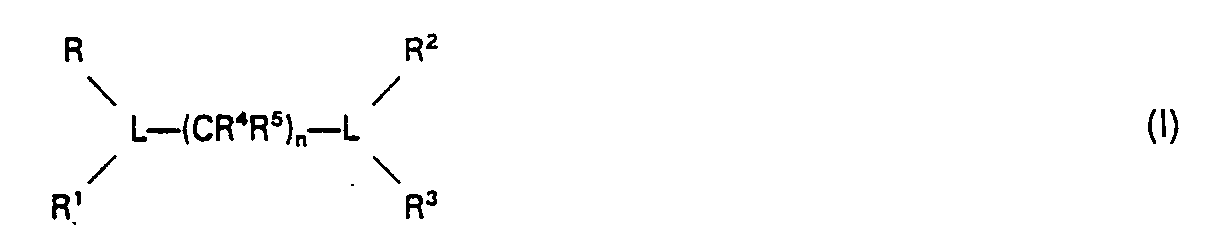
wherein each L which may be the same or different, represents a nitrogen, phosphorous, arsenic or antimony moiety ; R, Rl, R2 and R3 which may be the same or different, each represent an alkyl, aryl, alkaryl or aralkyl group which may be substituted by one or more inert substituents or R and R1 and/or R2 and R3 may form a ring structure together with the atom L to which they are attached ; R4 and R5 which may be the same or different, each represent a hydrogen atom or a lower alkyl group and n = 2, 3 or 4, or use is made of 2,2'-bipyridine or 1,10-phenantroline and in that the process is performed in the absence of metal salts other than palladium salts.
wherein each L which may be the same or different, represents a nitrogen, phosphorous, arsenic or antimony moiety ; R, Rl, R2 and R3 which may be the same or different, each represent an alkyl, aryl, alkaryl or aralkyl group which may be substituted by one or more inert substituents or R and R1 and/or R2 and R3 may form a ring structure together with the atom L to which they are attached ; R4 and R5 which may be the same or different, each represent a hydrogen atom or a lower alkyl group and n = 2, 3 or 4, or use is made of 2,2'-bipyridine or 1,10-phenantroline and in that the process is performed in the absence of metal salts other than palladium salts.
2. Process according to claim 1, characterized in that in the ligand according to
the general formula I, wherein R, Rl, R2 and R3 are phenyl groups, L is phosphorus, R4 and R5 are hydrogen and n is as defined hereinbefore.
3. Process according to claim 2, characterized in that the ligand is tetraphenyl diphosphinoethane
or tetraphenyl diphosphinopropane.
4. Process according to claim 1, characterized in that the ligand according to the
general formula I is 2,2'-bipyridine or 1,10-phenantroline.
5. Process according to any one of claims.1-4, characterized in that the reaction
is carried out in the presence of a primary or secondary amine or a urea (derivative).
6. Process according to any one of claims 1-5, characterized in that the reaction
is carried out in the presence of an acid.
7. Process according to claim 6, characterized in that the reaction is carried out
in the presence of an acid having a pKa > 3.5.
8. Process according to claim 7, characterized in that the acid is a carboxylic acid
containing 1-6 carbon atoms.
9. Process according to claim 6, characterized in that the reaction is carried out
in the presence of an acid having a pKa < 3.5.
10. Process according to claim 9, characterized in that the acid is a sulphonic acid
R8S03H, in which R8 represents an alkyl, aryl, aralkyl or alkaryl group having 1-30, preferably 1-14
carbon atoms.
11. Process according to claim 10, characterized in that the acid is p-toluene sulphonic
acid or trifluormethyl sulphonic acid.
12. Process according to any one of claims 6-11, characterized in that the amount
of acid present in the reaction mixture lies between 0.01 and 150, preferably between
0.1 and 100, and more preferably between 1 and 50 equivalents per gram atom of palladium.
13. Process according to any one of claims 1-12, characterized in that the reaction
is performed at a temperature between 75 °C and 200 °C, preferably between 85 °C and
150 °C.
14. Process according to any one of claims 1-13, characterized in that the reaction
is performed at a pressure up to 500 bar.
15. Use of carbamates and/or derivatives thereof prepared according to the process
of claim 1 in the preparation of organic isocyanates by applying heat.
1. Verfahren zur Herstellung von Carbamaten und/oder deren Derivaten durch Umsetzung
einer organischen Verbindung, welche mindestens eine Hydroxylgruppe aufweist, mit
Kohlenmonoxid und einer organischen, stickstoffhaltigen Verbindung, wie vorstehend
definiert, in Anwesenheit eines katalytischen Systems auf der Basis von Palladium
und/oder einer Palladiumverbindung und einem Liganden der Gruppe VA, dadurch gekennzeichnet,
daß ein Ligand gemäß der allgemeinen Formel

verwendet wird, in welcher jedes L, welches gleich oder verschieden sein kann, einen Stickstoff-, Phosphor-, Arsen- oder Antimonmolekülteil bedeutet ; R, R1, R2 und R3, welche gleich oder verschieden sein können, jeweils eine Alkyl-, Aryl-, Alkaryl- oder Aralkylgruppe bedeuten, welche durch einen oder mehrere inerte Substituenten substituiert sein können, oder in welcher R und R1 und/oder R2 und R3 zusammen mit dem Atom L, an welches sie gebunden sind, eine Ringstruktur bilden können ; in welcher R4 und R5, welche gleich oder verschieden sein können, jeweils ein Wasserstoffatom oder eine niedrige Alkylgruppe bedeuten und in welcher n den Wert 2, 3 oder 4 hat oder 2,2'-Bipyridin oder 1,10-Phenantrolin verwendet werden, und dadurch, daß das Verfahren bei Abwesenheit anderer Metallsalze als Palladiumsalze durchgeführt wird.
verwendet wird, in welcher jedes L, welches gleich oder verschieden sein kann, einen Stickstoff-, Phosphor-, Arsen- oder Antimonmolekülteil bedeutet ; R, R1, R2 und R3, welche gleich oder verschieden sein können, jeweils eine Alkyl-, Aryl-, Alkaryl- oder Aralkylgruppe bedeuten, welche durch einen oder mehrere inerte Substituenten substituiert sein können, oder in welcher R und R1 und/oder R2 und R3 zusammen mit dem Atom L, an welches sie gebunden sind, eine Ringstruktur bilden können ; in welcher R4 und R5, welche gleich oder verschieden sein können, jeweils ein Wasserstoffatom oder eine niedrige Alkylgruppe bedeuten und in welcher n den Wert 2, 3 oder 4 hat oder 2,2'-Bipyridin oder 1,10-Phenantrolin verwendet werden, und dadurch, daß das Verfahren bei Abwesenheit anderer Metallsalze als Palladiumsalze durchgeführt wird.
2. Verfahren gemäß Anspruch 1, dadurch gekennzeichnet, daß in dem Liganden gemäß der
allgemeinen Formel (I), in welcher R, R1, R2 und R3 Phenylgruppen sind, L Phosphor ist, R4 und R5 Wasserstoff bedeuten und n wie vorstehend definiert ist.
3. Verfahren gemäß Anspruch 2, dadurch gekennzeichnet, daß der Ligand Tetraphenyldiphosphinäthan
oder Tetraphenyldiphosphinpropan ist.
4. Verfahren gemäß Anspruch 1, dadurch gekennzeichnet, daß der Ligand gemäß der allgemeinen
Formel (I) 2,2'-Bipyridin oder 1,10-Phenantrolin ist.
5. Verfahren gemäß irgendeinem der Ansprüche 1 bis 4, dadurch gekennzeichnet, daß
die Umsetzung in Anwesenheit eines primären oder sekundären Amins oder eines Harnstoffs
(Derivates) durchgeführt wird.
6. Verfahren gemäß irgendeinem der Ansprüche 1 bis 5, dadurch gekennzeichnet, daß
die Umsetzung in Anwesenheit einer Säure durchgeführt wird.
7. Verfahren gemäß Anspruch 6, dadurch gekennzeichnet, daß die Umsetzung in Anwesenheit
einer Säure mit einem pKa-Wert von mehr als 3,5 durchgeführt wird.
8. Verfahren gemäß Anspruch 7, dadurch gekennzeichnet, daß die Säure eine Carbonsäure
mit 1 bis 6 Kohlenstoffatomen ist.
9. Verfahren gemäß Anspruch 6, dadurch gekennzeichnet, daß die Umsetzung in Anwesenheit
einer Säure mit einem pKa-Wert von weniger als 3,5 durchgeführt wird.
10. Verfahren gemäß Anspruch 9, dadurch gekennzeichnet, daß die Säure eine Sulfonsäure
R8SO3H ist, in welcher R8 eine Alkyl-, Aryl-, Aralkyl- oder Alkarylgruppe mit 1 bis 30 Kohlenstoffatomen, vorzugsweise
1 bis 14 Kohlenstoffatomen, bedeutet.
11. Verfahren gemäß Anspruch 10, dadurch gekennzeichnet, daß die Säure p-Toluolsulfonsäure
oder Trifluormethylsulfonsäure ist.
12. Verfahren gemäß irgendeinem der Ansprüche 6 bis 11, dadurch gekennzeichnet, daß
die Menge der in der Reaktionsmischung vorliegenden Säure im Bereich von 0,01 bis
150, vorzugsweise von 0,1 bis 100 und insbesondere von 1 bis 50 Äquivalenten je Grammatom
Palladium liegt.
13. Verfahren gemäß irgendeinem der Ansprüche 1 bis 12, dadurch gekennzeichnet, daß
die Umsetzung bei einer Temperatur zwischen 75 und 200 °C, vorzugsweise zwischen 85
und 150 °C. durchgeführt wird.
14. Verfahren nach irgendeinem der Ansprüche 1 bis 13, dadurch gekennzeichnet, daß
die Umsetzung bei einem Druck bis zu 500 bar durchgeführt wird.
15. Verwendung von Carbamaten und/oder Derivaten derselben und/oder deren nach dem
Verfahren gemäß Anspruch 1 hergestellten Derivaten bei der Herstellung von organischen
Isocyanaten unter Einwirkenlassen von Wärme.
1. Un procédé pour la préparation de carbamates et/ou de leurs dérivés en faisant
réagir un composé organique contenant au moins un groupe hydroxyle avec de l'oxyde
de carbone et un composé organique azoté comme défini ci-dessus en présence d'un système
catalytique à base de palladium et/ou d'un composé du palladium et d'un ligand du
groupe VA, caractérisé en ce qu'on utilise un ligand de la formule générale :

où les L, qui peuvent être identiques ou différents, représentent chacun une portion azote, phosphore, arsenic ou antimoine : R, R1, R2 et R3, qui peuvent être identiques ou différents, représentent chacun un groupe alcoyle, aryle, alcaryle ou aralcoyle qui peut être substitué par un ou plusieurs substituants inertes ou R et R1 et/ou R2 et R3 peuvent former une structure cyclique en même temps que l'atome L auquel ils sont attachés ; R4 et R5, qui peuvent être identiques ou différents, représentent chacun un atome d'hydrogène ou un groupe alcoyle inférieur et n = 2, 3 ou 4, ou bien on utilise la 2,2'-bipyridine ou la 1,10- phénanthroline et en ce qu'on met en œuvre le procédé en l'absence de sels de métal autres que les sels de palladium.
où les L, qui peuvent être identiques ou différents, représentent chacun une portion azote, phosphore, arsenic ou antimoine : R, R1, R2 et R3, qui peuvent être identiques ou différents, représentent chacun un groupe alcoyle, aryle, alcaryle ou aralcoyle qui peut être substitué par un ou plusieurs substituants inertes ou R et R1 et/ou R2 et R3 peuvent former une structure cyclique en même temps que l'atome L auquel ils sont attachés ; R4 et R5, qui peuvent être identiques ou différents, représentent chacun un atome d'hydrogène ou un groupe alcoyle inférieur et n = 2, 3 ou 4, ou bien on utilise la 2,2'-bipyridine ou la 1,10- phénanthroline et en ce qu'on met en œuvre le procédé en l'absence de sels de métal autres que les sels de palladium.
2. Un procédé selon la revendication 1, caractérisé en ce que dans le ligand de la
formule générale 1, où R, R1, R2 et R3 sont des groupes phényle, L est du phosphore, R4 et R5 sont de l'hydrogène et n est tel que défini ci-dessus.
3. Un procédé selon la revendication 2, caractérisé en ce que le ligand est du tétraphényl
diphosphinoéthane ou du tétraphényl diphosphinopropane.
4. Un procédé selon la revendication 1, caractérisé en ce que le ligand de la formule
générale I est de la 2,2'-bipyridine ou de la 1,10-phénanthroline.
5. Un procédé selon l'une quelconque des revendications 1 à 4, caractérisé en ce que
la réaction est conduite en présence d'une amine primaire ou secondaire ou d'une urée
(ou d'un dérivé d'urée).
6. Un procédé selon l'une quelconque des revendications 1 à 5, caractérisé en ce que
la réaction est conduite en présence d'un acide.
7. Un procédé selon la revendication 6, caractérisé en ce que la réaction est conduite
en présence d'un acide ayant un pKa supérieur à 3,5.
8. Un procédé selon la revendication 7, caractérisé en ce que l'acide est un acide
carboxylique contenant 1-6 atomes de carbone.
9. Un procédé selon la revendication 6, caractérisé en ce que la réaction esf conduite
en présence d'un acide ayant un pKa inférieur à 3,5.
10. Un procédé selon la revendication 9, caractérisé en ce que l'acide est un acide
sulfonique R8SO3H, où R8 représente un groupe alcoyle, aryle, aralcoyle ou alcaryle ayant 1-30, de préférence
1-14 atomes de carbone.
11. Un procédé selon la revendication 10, caractérisé en ce que l'acide est de l'acide
p-toluène sulfonique ou de l'acide trifluorométhyl sulfonique.
12. Un procédé selon l'une quelconque des revendications 6 à 11, caractérisé en ce
que la quantité d'acide présente dans le mélange réactionnel est comprise entre 0,01
et 150, de préférence entre 0,1 et 100 et en particulier entre 1 et 50 équivalents
par atome-gramme de palladium.
13. Un procédé selon l'une quelconque des revendications 1 à 12, caractérisé en ce
que la réaction est conduite à une température comprise entre 75 °C et 200 °C, de
préférence entre 85 °C et 150 °C.
14. Un procédé selon l'une quelconque des revendications 1 à 13, caractérisé en ce
que la réaction est conduite à une pression allant jusqu'à 500 bars.
15. L'utilisation de carbamates et/ou de leurs dérivés préparés selon le procédé de
la revendication 1 dans la préparation d'isocyanates organiques par application de
chaleur.