|
(11) | EP 0 087 234 B1 |

| (12) | EUROPEAN PATENT SPECIFICATION |
|
|
| (54) |
Ashless dispersant compounds, their preparation, and their use in providing dispersancy in lubricating oils or liquid fuels Aschefreie dispersante Verbindungen, ihre Verfahren, und ihre Verwendung um Schmieröle oder flüssige Heizöle mit Dispergiereigenschaften zu versehen Composés dispersants sans cendres, leurs préparations et leurs utilisations pour donner des propriétés dispersantes dans des huiles lubrifiantes ou des combustibles liquides |
|
|
|||||||||||||||||||||||||||||||
| Note: Within nine months from the publication of the mention of the grant of the European patent, any person may give notice to the European Patent Office of opposition to the European patent granted. Notice of opposition shall be filed in a written reasoned statement. It shall not be deemed to have been filed until the opposition fee has been paid. (Art. 99(1) European Patent Convention). |
[0001] This invention relates to compounds which can serve as useful ashless dispersants in lubricating oils and liquid fuels.
[0002] Ashless dispersants suitable for use in lubricating oil are known. One such additive is made by reacting a hydrocarbon-substituted succinic anhydride with an amine such as ethylene polyamine (U.S. Patent Specification No. 3,272,746). More recently, effective dispersants have been made by grafting maleic anhydride and a comonomer such as alkyl methacrylate onto a high molecular weight olefin backbone followed by amidation (U.S. Patent Specification No. 4,160,739). Another effective dispersant can be made by simply grafting a vinyl-substituted nitrogen compound such as vinyl pyridine or N-vinylpyrrolidone onto a high molecular weight olefin backbone (U.S. Patent Specification No. 4,146,489).
[0003] DE-A-1929811 also discloses dispersant additives for lubricating oils. The disclosed compounds are polymers comprising a backbone of an oxidised, degraded interpolymer of ethylene and propylene. Onto this backbone is grafted an oxygen-containing polymerisable monomer, as an example of which there is mentioned N-allylacrylamide.
[0004] It has now been discovered that very effective lubricating oil dispersant substances, especially useful in the crankcase of an internal combustion engine, can be obtained by grafting particular N-allyl amides onto certain olefin polymer backbones.
[0005] Thus, the invention provides a polymeric compound which is an olefin polymer having an average molecular weight of 500-500,000 to which is grafted an N-allyl amide having the structure
wherein R, is hydrogen or a hydrocarbon group containing from 1 to 30 carbon atoms or R, may be absent, R2 is hydrogen, an alkyl group containing from 1-30 carbon atoms, a cycloalkyl group containing from 6-10 carbon atoms, an aryl group containing from 6-10 carbon atoms or allyl, and n is 1 or 2; provided that when R, is hydrogen n is 1, when R, is a hydrocarbon group containing from 1 to 30 carbon atoms n is either 1 or 2, and when R, is absent n is 2.
[0006] A preferred embodiment of the invention is an ashless dispersant suitable for use in lubricating oil comprising an olefin polymer backbone having a molecular weight of 500-500,000 to which is grafted an N-allyl amide having the structure
wherein R, is selected from hydrogen and hydrocarbon groups containing 1 to 30 carbon atoms or may be absent, and R2 is selected from the group consisting of hydrogen, alkyls containing 1-30 carbon atoms, cycloalkyls containing 6-10 carbon atoms, aryls containing 6-10 atoms, and allyl, and n is such that when R, is hydrogen, n is 1, when R, is a hydrocarbon group containing 1 to 30 carbon atoms, n is either 1 or 2, but is preferably 1, and when R1 is absent, n is 2.
[0007] The above ashless dispersants can be made by a process comprising reacting an olefin polymer having an average molecular weight of 500-500,000 with an N-allyl amide having the structure
wherein R1 is selected from hydrogen and hydrocarbon groups containing 1 to 30 carbon atoms or may be absent, and R2 is selected from the group consisting of hydrogen, alkyls containing 1-30 carbon atoms, cycloalkyls containing 6-10 carbon atoms, aryls containing 6-10 carbon atoms, and allyl, and n is 1 or 2 such that when R1 is hydrogen, when R1 is a hydrocarbon group containing 1 to 30 carbon atoms, n is either 1 or 2, but is preferably 1, and when R1 is absent, n is 2, said reaction being conducted in the presence of a free radical generating catalyst at a temperature high enough to generate free radicals preferably up to a temperature of about 250°C.
[0008] When R1 is absent and n is 2 in the above formula, the N-allyl amide is an N-allyl oxamide derivative.
[0009] Useful olefin polymers include the polymers of ethylene, propylene, isobutene, 1-Octene and other alpha-olefins containing up to 12 carbon atoms. A useful olefin homopolymer is polybutene, especially polyisobutylene having an average molecular weight of 500-10,000.
[0010] Ethylene/propylene copolymers are also quite useful. Such copolymers can have a molecular weight of from 500 to 500,000 or higher. When the polymer substituent has a molecular weight above 10,000, the resulting dispersant will also have viscosity index improving properties.
[0011] Ethylene/propylene diene polymers are preferred. Such polymers preferably contain 30-79 weight percent ethylene units, 20-69 weight percent propylene units, and 1-10 weight percent diene units. Representative dienes include 1,4-hexadiene, 1,5-hexadiene, 1,5-cyclopentadiene, 1,4-pentadiene, 2-methyl-1,5-hexadiene, dicyclopentadiene, methylene norbornene, 2,4-dimethyl-1,7-octadiene, isoprene, butadiene, ethyl norbornadiene, and the like. Preferred dienes are 1,4-hexadiene, 2,5-norbornadiene, dicyclopentadiene and ethylidene norbornene.
[0012] Useful olefin copolymers are described in U.S. Patent Specifications Nos. 3,522,180; 3,551,336; 3,598,738; 3,790,480; 3,691,078; 3,389,087 and 3,697,429. Suitable ethylene/propylene copolymers or ethylene/propylene/diene copolymers are available commercially in a wide range of molecular weights.
[0013] A wide variety of N-allyl amides are useful in making the additives. Some non-limiting examples include N,N-diallyl formamide, N,N-diallyl acetamide, N,N-diallyl propionamide, N,N-diallyl butyramide, N,N-diallyl, dodecamide, N,N-diallyl octadecamide, N,N-diallyl triacontamide, N,N-diallyl benzamide, N,N-diallyl naphthamide, N,N-diallyl-p-methyl benzamide, N-allyl formamide, N-allyl-N-methyl acetamide, N-allyl-N-ethyl propionamide, N-allyl-N-dodecyl formamide, N-allyl-N-eicosyl dodecamide, N-allyl-N-triacontyl benzamide, N-allyl-p-methyl benzamide, N,N'-diallyl oxamide, N,N,N'-triallyl oxamide, N,N,N',N'-tetra-allyl oxamide, N,N-diallyl acrylamide, N-allyl-N-methyl acrylamide, N,N,N',N'-tetra-allyl malonamide, N,N'-diallyl succinamide, N,N,N',N'-tetra allyl adipamide, N,N,N',N'-tetra-allyl azelamide, and N,N,N',N'- tetra-allyl roccellamide.
[0014] The R, group may contain functional groups such as ester, amino, amido, carboxyl, hydroxyl, ether, thioether, sulfonate, phosphorus-containing groups, cyano, sulfonyl, sufinyl, keto and aldehyde groups. Examples are N,N-diallyl lactamide, N,N-diallyl levulinamide, N,N-diallyl ethyl thioacetamide, 3-(N',N'-diethylamino) N,N-diallyl propionamide, N,N-diallyl 3-cyanopropionamide, N,N-diallyl 3-methyl sufonyl propionamide, ethyl N,N-diallyl oxamate, and the like, including mixtures thereof.
[0015] The more preferred N-allyl amides are the N-allyl formamides and the most preferred is N,N-diallyl formamide.
[0016] Other ethylenically unsaturated monomers can be co-grafted onto the olefin polymer backbone together with the N-allyl amides. These co-grafted products are within the scope of the invention. For example, other co-graft monomers include vinyl pyridine, N-vinyl pyrrolidone, Cl-30 alkyl methacrylate, and the like including mixtures thereof.
[0017] The amount of the co-grafted monomer used in addition to the N-allyl amide can vary over a wide range. When used, they are preferably reacted in the same concentration range as will be set forth for the N-allyl amides. The other monomers can be grafted before or after the N-allyl amide graft but are preferably grafted concurrently with the N-allyl amide.
[0018] The N-allyl amide can be grafted to the olefin polymer by forming a mixture of olefin polymer, N-allyl amide and a small amount of a free radical-generating catalyst and heating the mixture to a temperature high enough to cause the graft reaction to proceed at a reasonable rate but not so high as to cause destructive decomposition of the reactants or products.
[0019] The amount of N-allyl amide or other co-grafted monomer can vary over a wide range. A useful range is 10 to 500 grams of each Kg of olefin polymer. A more preferred range is 20 to 250 grams of each Kg of olefin polymer and most preferably 50 to 200 grams of N-allyl amide for each Kg of olefin polymer. An excess amount of the N-allyl amide can be used and any that remains unreacted after the reaction can be removed by distillation.
[0020] The graft reaction is catalysed by a free radical-generating compound such as a peroxide or dialkyl, diacyl, alkyl-acyl peroxide, hydroperoxide, ketone peroxide, or azo compound when each is used in an appropriate temperature range or reaction is initiated by a co-catalyst such as metal salts or complexes or externally by means of irradiation. Representative examples of such catalysts include di-tert-butyl peroxide, dicumyl peroxide, tert-butyl perbenzoate, benzoyl peroxide, cyclohexanone peroxide, Lupersol 130 (product of Pennwalt Corp.) azo-bisiso-butyronitrile and the like, including mixtures thereof. Di-tert-butyl peroxide and dicumyl peroxide and mixtures thereof are preferred.
[0021] The amount of free-radical-generating catalysts need only be a catalytic amount. A useful range is 1-200 grams per Kg of olefin polymer. A more preferred range is 20-100 grams per Kg of olefin polymer. The catalyst may all be added at the start of the graft reaction or made by adding in portions during the course of the reaction.
[0022] The mixture of olefin polymer and N-allyl amide and any other co-grafted monomer together with the catalyst is stirred at reaction temperature. The temperature should be high enough to cause the catalyst to form free radicals. A useful range in which to experiment is from an ambient temperature up to 250°C depending upon the catalyst used. When using di-tert-butyl- peroxide or dicumyl peroxide, the preferred temperature range is 100-2000C.
[0023] Olefin polymers having molecular weights above 2000 are very viscous, and in fact, above 10,000, such olefin polymers are usually rubber-like materials. When the olefin polymer is too viscous to stir or is a rubber, it is preferred to conduct the reaction in an inert solvent. Useful solvents include aliphatic hydrocarbons such as nonane, decane, and the like. Likewise, chlorinated hydrocarbons can be used such as chlorobenzene, dichlorobenzene, dichlorotoluene and the like. The presence of olefins and aromatics is generally deleterious although small amounts may be tolerated if the amounts of reactants are increased.
[0024] The preferred solvent is a neutral mineral oil commonly referred to as process oil. This oil is preferably a hydrogen-treated oil which has been processed through a refinery procedure such as hydrocracking or hydrotreating.
[0025] . The amount of oil diluent used should be sufficient to produce a handleable product. When effective grafting is obtained, the viscosity of the product may increase significantly. Thus, the higher molecular weight polymers require greater dilution. To improve handleability the product may be mechanically homogenized.
[0026] The amount of oil diluent used should be the amount required to dissolve the olefin polymer and form a stirrable mixture. This can vary from none in the case of low molecular weight olefin polymers (e.g., 500-2000 molecular weight) up to 20 Kg per Kg of olefin polymer in the case of high molecular weight olefin polymer (e.g.. ethylene/ propylene copolymers and ethylene/propylene/ diene copolymers having molecular weights of 20,000-500,000). Molecular weights are number average.
[0027] The rubber-like polymers can be dissolved in the solvent by cutting the polymer into small pieces and stirring the pieces in the solvent oil at an elevated temperature (e.g., 50-250°C) until a homogeneous solution forms.
[0028] The graft reaction is conducted for a time long enough to permit the N-allyl amides to graft onto the olefin polymer backbone. The time is not a critical limitation. A useful period is 30 minutes to 4 hours, although longer or shorter periods may be used.
Example 1
[0030] In a reaction vessel was placed 6230 grams of an 80 neutral hydrocracked mineral oil. This was heated and stirred under nitrogen at 180°C while adding 770 grams of an ethylene propylene non-conjugated diene rubbery tetrapolymer (Or- tholeum 2052 Reg. T.M., E.I. dePont de Nemours and Co.) cut up into small pieces. The copolymer contained 53 weight percent ethylene units, 42 weight percent propylene units, approximately 5 percent non-conjugated diene units (Mn 40,000, Mw 100,000). This resulted in a mineral oil solution containing 11 weight percent olefin copolymer. The solution was cooled to 160°C and to it was added 60.1 grams of N,N-diallyl formamide, 13.3 grams of di-tert-butyl peroxide, and 31.3 grams of dicumyl peroxide. Stirring was continued under nitrogen for one hour while gradually heating to 170°C. The temperature was maintaine-I for 30 minutes longer. The reaction mixture was cooled resulting in an oil solution of an N,N-diallyl formamide grafted olefin polymer which had both dispersancy and viscosity index improving properties in lubricating oil.
Example 2
[0031] In a reaction vessel was placed 273 grams of an 11 weight percent oil solution of the copolymer described in Example 1. This was stirred and heated under nitrogen to under 160°C at which time there was added 2.3 grams diallyl formamide, 0.4 ml di-tert-butyl peroxide and 0.1 gram of dicumyl peroxide. The mixture was stirred for one hour under nitrogen while gradually heating to 170°C. The product was then cooled resulting in an oil solution of an active dispersant VI improving additive.
Example 3
[0032] In a reaction vessel was placed 288.7 grams of an 11 weight percent mineral oil solution of the copolymer described in Example 1. To this was added 15.2 grams of N,N-diallyl acetamide and 0.3 ml di-tert-butyl peroxide. The mixture was stirred and heated under nitrogen for 1.5 hours while heating to 180°C. Stirring was continued at 180°C for 30 minutes. The product was then cooled to 100°C and an additional 0.3 ml of di-tert-butyl peroxide was added. The mixture was stirred and heated to 180°C over a 30 minute period and stirred at that temperature for one hour. The resulting product was vacuum-stripped by applying 688.686 gr/cm2 Hg vacuum. The reaction product was then cooled resulting in a very effective dispersant VI improving additive.
Example 4
[0033] In a reaction vessel was placed 230.8 grams of an 11 weight percent solution of the copolymer of Example 1 in 80 neutral mineral oil. To this was added 3 grams of N,N-diallyl formamide, and the mixture was heated under nitrogen to 150°C. At that temperature, 0.15 ml of di-tert-butyl peroxide was added, and the solution stirred for 30 minutes while gradually heating to 170°C. At that temperature, an additional 0.15 ml of di-tert-butyl peroxide was added and stirring continued for one hour. A vacuum of 964.16 gr/cm2 Hg was then applied to remove volatiles while passing a stream of nitrogen through the reaction mixture. The product was then cooled, giving a viscous mineral oil solution of an effective dispersant VI improver for use in lubricating oil.
Example 5
[0034] In a reaction vessel was placed 171.6 grams of 11 weight percent copolymer solution as described in Example 1. To this was added one gram of N,N-diallyl formamide and 1.6 ml of a 50 percent solution of dicumyl peroxide. The mixture was then stirred under nitrogen and heated to 160°C. Stirring was continued at 160-165°C for a 30 minute period while slowly adding 5 ml of chlorobenzene solution which contained 1.5 grams of N,N-diallyl formamide and 0.9 grams of dicumyl peroxide. Stirring was continued for 30 minutes while heating to 170 °C. The product was then cooled resulting in a very effective lubricating oil additive.
Example 6
[0035] This Example illustrates the preparation of a diallyl formamide grafted olefin polymer which contains additional grafts of a second monomer.
[0036] In a reaction vessel was placed 271.8 grams of an 11 weight percent 80 neutral oil solution of the copolymer described in Example 1. To this was then added 1.1 grams of N,N-diallyl formamide and 1.1 gram of N-vinyl pyrrolidone. This' was stirred and heated under nitrogen to 145°C at which time 3.8 ml of a 50 percent solution of dicumyl peroxide in chlorobenzend was added. Heating was continued for one hour while gradually raising the temperature to 165°C. Stirring was continued at that temperature for 3 hours and 17 minutes at which time the reaction product was cooled resulting in an effective lubricating oil additive.
Example 7
[0037] In a reaction vessel was placed 174.2 grams of an 11 weight percent 80 neutral oil solution of the copolymer of Example 1. To this was added 1.7 gram N,N-diallyl formamide, and 0.5 gram N-vinyl pyrrolidone. The mixture was stirred and heated under nitrogen to 160°C at which time 2.4 ml of a 50 percent solution of dicumyl peroxide in chlorobenzene and 0.6 ml of di-tert-butyl peroxide were added. Stirring was continued for one hour and 36 minutes while gradually heating to 170°C. The product was cooled, leaving an oil solution of an effective dispersant VI improver.
Example 8
[0038] In a reaction vessel was placed 271.5 grams of an 11 weight percent solution of the copolymer of Example 1 in 80 neutral mineral oil. To this was added 2.6 grams of N,N-diallyl acetamide. This mixture was stirred and heated under nitrogen to 150°C. At that temperature, 1.6 ml of di-tert-butyl peroxide was added and stirring and heating continued for one hour and 35 minutes while gradually increasing the temperature to 170°C. The mixture was cooled, resulting in a very effective lubricating oil additive.
[0039] The additives are used in lubricating oil at a concentration which achieves the desired level of dispersancy and, in the case of the high molecular weight polymers, VI improvement. They may also be used in combination with other dispersants and VI improvers to achieve desired properties. A useful concentration range is 0.1 to 10 weight percent of the grafted polymer excluding diluent oil.
[0040] The additives can be used in mineral oil or in synthetic oils of viscosity suitable for use in the crankcase of an internal combustion engine. Crankcase lubricating oils have a viscosity up to 80 SUS at 210°F (1.5 x 10-smz/sec at 99°C). Crankcase lubricating oils of the present invention have a viscosity up to SAE 50. Sometimes such motor oils are given a classification at both 0° and 210°F (-17.78° and 99°C), such as SAE 10W 40 or SAE 5W 30.
[0041] Mineral oils include those of suitable viscosity refined from crude oil, from all sources including Gulfcoast, mid-continent, Pennsylvania, California, Mideast, North Sea, Alaska and the like. Various standard refinery operations can be used in processing the mineral oil.
[0042] Synthetic oil includes bith hydrocarbon synthetic oil and synthetic esters. Useful synthetic hydrocarbon oils include liquid polymers of alpha-olefins having the proper viscosity. Especially useful are the hydrogenated liquid oligomers of C6-12 alpha-olefins such as alpha-decene trimer. Likewise, alkylbenzenes of proper viscosity can be used, such as didodecylbenzene.
[0043] Useful synthetic esters include the esters of both monocarboxylic acid and polycarboxylic acid as well as monohydroxy alkanols and polyols. Typical examples are didodecyl adipate, trimethylol propane triperlargonate, pentaerythritol tetracaproate, di-(2-ethylhexyl) adipate, dilauryl sebacate and the like. Complex esters prepared from mixtures of mono- and di- carboxylic acid and mono- and polyhydroxyl alkanols can also be used.
[0044] Blends of mineral oil with synthetic oil are particularly useful. For example, blends of 10-25 weight percent hydrogenated alpha-decene trimer with 75-90 weight percent 150 SUS at 100°F (3.2 x 10⁻⁶m2/sec at 37.8°C) mineral oil results in an excellent lubricant. Likewise, blends of about 15-25 weight percent di-(2-ethylhexyl) adipate with mineral oil of proper viscosity results in a superior lubricating oil. Also blends of synthetic hydrocarbon oil with synthetic esters can be used. Blends of mineral oil with synthetic oil are especially useful when preparing low viscosity oil (e.g., SAE 5W 20) since they permit these low viscosities without contributing excessive volatility.
[0045] The more preferred lubricating oil composition include zinc dihydrocarbyldithiophosphate (ZDDP) in combination with the present additives. Both zinc dialkyldithiophosphates and zinc dialkaryldithiophosphates as well as mixed alkylaryl ZDDP are useful. A typical alkyl-type ZDDP contains a mixture of isobutyl and isoamyl groups. Zinc di-(nonylphenyl)dithiophosphate is a typical aryl-type ZDDP. Good results are achieved using sufficient ZDDP to provide 0.01-0.5 weight percent zinc. A preferred concentration supplies 0.05-0.3 weight percent zinc.
[0046] Another additive used in the oil compositions are the alkaline earth metal petroleum sulfonates or alkaline earth metal alkaryl sulfonates. Examples of these are calcium petroleum sulfonates, magnesium pertroleum sulfonates. barium alkaryl sulfonates, calcium alkaryl sulfonates or magnesium alkaryl sulfonates. Both the neutral and the overbased sulfonates having base numbers up to 400 can be beneficially used. These are used in an amount to provide 0.05-1.5 weight percent alkaline earth metal and more preferably 0.1-1.0 weight percent. In a most preferred embodiment, the lubricating oil composition contains a calcium petroleum sulfonate or alkaryl (e.g.. alkylbenzene) sulfonate.
[0047] Other viscosity index improvers can be included such as the polyalkylmethacrylate type or the ethylene-propylene copolymer type. Likewise, styrene-diene VI improvers or styrene-acrylate copolymers can be used. Alkaline earth metal salts of phosphosulfurized polyisobutylene are useful.
[0048] Most preferred crankcase oils also contain supplemental ashless dispersants such as the polyolefin-substituted succinamides and succinimides of polyethylene polyamines such as tetraethylenepentamine. The polyolefin succinic sub- stituant is preferably a polyisobutene group having a molecular weight of from 800 to 5000. Such ashless dispersants are more fully described in U.S. Patent Specification Nos. 3,172,892 and 3,219,666.
[0049] Another useful class of ashless dispersants are the polyolefin succinic esters of mono- and poly- hydroxy alcohols containing 1 to 40 carbon atoms. Such dispersants are described in U.S. Patent Specifications Nos. 3,381,022 and 3,522,179.
[0050] Likewise, mixed ester amides of polyolefin substituted succinic acid made using alkanols, amines and/or aminoalkanols represents a useful class of ashless dispersants.
[0051] The succinic amide, imide and/or ester type ashless dispersants may be boronated by reaction with a boron compound such as boric acid. Likewise, the succinic amide, imide, and/or ester may be oxyalkylated by reaction with an alkylene oxide such as ethylene oxide or propylene oxide.
[0052] Other useful ashless dispersants include the Mannich condensation product of polyolefin-substituted phenols, formaldehyde and polyethylene polyamine. Preferably, the polyolefin phenol is a polyisobutylene-substituted phenol in which the polyisobutylene group has a molecular weight from 800 to 5000. The preferred polyethylene polyamine is tetraethylene pentamine. Such Mannich ashless dispersants are more fully described in U.S. Patent Specifications Nos. 3,368,972, 3,413,347, 3,442,808, 3,448,047, 3,539,633, 3,591,598, 3,600,372, 3,634,515, 3,697,574, 3,703,536, 3,704,308, 3,725,480, 3,726,882, 3,736,357, 3,751,365, 3,756,953, 3,792,202, 3,798,165, 3,798,247 and 3,803,039.
[0053] The effectiveness of the additives as lubricating oil dispersants was measured using a bench dispersancy test. In this test, an asphaltene sludge was made by air oxidation of 100 neutral oil using an iron naphthenate catalyst. The oxidized oil containing precipitated sludge was diluted with heptane to dissolve that part of the sludge which was soluble in heptane. The sludge saturated heptane solution was filtered and stabilized with a a small amount of butanol and used as the test sludge solution.'
[0054] The test was conducted by mixing 1 ml ot sludge solution into TO ml 100 neutral mineral oil containing various concentrations of test additives. The test samples were left standing for 16 plus hours and then rated visually. The test criterion was the lowest concentration of dispersant that prevent any precipitate formation. Thus, the lower the concentration, the more effective the dispersant. A present commercial dispersant VI improver is effective down to 0.25 weight percent giving a precipitate at 0.125 weight percent.
1. A polymeric compound which is an olefin polymer having an average molecular weight
of 500-500,000 to which is grafted an N-allyl amide having the structure
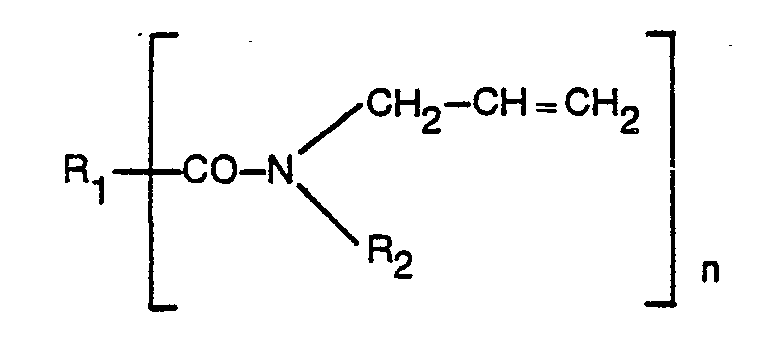
wherein R, is hydrogen or a hydrocarbon group containing from 1 to 30 carbon atoms or R, may be absent, R2 is hydrogen, an alkyl group containing from 1-30 carbon atoms, a cycloalkyl group containing from 6-10 carbon atoms, an aryl group containing from 6-10 carbon atoms or allyl, and n is 1 or 2; provided that when R1 is hydrogen n is 1, where R, is hydrocarbon group containing from 1 to 30 carbon atoms n is either 1 or 2, and when R, is absent n is 2.
wherein R, is hydrogen or a hydrocarbon group containing from 1 to 30 carbon atoms or R, may be absent, R2 is hydrogen, an alkyl group containing from 1-30 carbon atoms, a cycloalkyl group containing from 6-10 carbon atoms, an aryl group containing from 6-10 carbon atoms or allyl, and n is 1 or 2; provided that when R1 is hydrogen n is 1, where R, is hydrocarbon group containing from 1 to 30 carbon atoms n is either 1 or 2, and when R, is absent n is 2.
2. A compound as claimed in claim 1, wherein the olefin polymer is a copolymer of
ethylene and a C3-12 alpha-olefin and said copolymer has an average molecular weight of from 10,000-200,000.
3. A compound as claimed in claim 1 or claim 2, wherein the olefin polymer is a copolymer
of ethylene, a C3-12 alpha-olefin and at least one diene containing 4 to 15 carbon atoms.
4. A compound as claimed in claim 3, wherein said copolymer contains from 30-79 percent
ethylene units, from 20-69 weight percent propylene units, and from 1 to 10 weight
percent diene units.
5. A compound as claimed in claim 3 or claim 4, wherein said diene is 1,4-hexadiene,
2,5-norbornadiene or dicyclopentadiene.
6. A compound as claimed in any one of claims 1 to 5, wherein said N-allyl amide is
an N-allyl formamide, e.g. N,N-diallyl formamide, or is N,N-diallyl acetamide.
7. A process for preparing a compound as claimed in claim 1 comprising reacting said
N-allyl amide and said olefin polymer to graft the former onto the latter in the presence
of a free radical-generating catalyst.
8. A process as claimed in claim 7, wherein the reaction is effected in the presence
of a free radical generating catalyst at a temperature high enough to generate free
radicals up to a tempera- tu re of 250°C.
9. An ashless dispersant suitable for use in lubricating oils and liquid fuels comprising
a compound as claimed in any one of claims 1 to 6 which is oil-soluble or an oil-soluble
grafted polymer which has been prepared by a process as claimed in claim 7 or claim
8.
10. A lubricating oil composition comprising a major amount of an oil having a lubricating
viscosity and a minor amount sufficient to improve dispersancy of a compound as claimed
in any of claims 1 to 6 or an oil-soluble grafted polymerwhich has been prepared by
a process as claimed in claim 7 or claim 8.
1. Polymere Verbindung, die ein Olefin-Polymer mit einem durchschnittlichem Molekulargewicht
von 500 bis 500 000 ist, an die ein N-Allyamid anpolymerisiert ist, das die folgende
Struktur aufweist
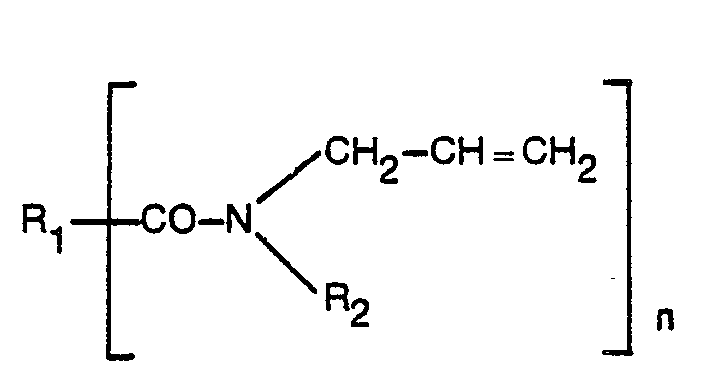
worin R, Wasserstoff oder eine Kohlenwasserstoffgruppe mit 1 bis 30 Kohlenstoffatomen bedeutet oder R, fehlen kann, R2 Wasserstoff, eine Alkylgruppe mit 1 bis 30 Kohlenstoffatomen, eine Cycloalkylgruppe mit 6 bis 10 Kohlenstoffatomen, eine Arylgruppe mit 6-10 Kohlenstoffatomen oder eine Allylgruppe bedeutet, und n 1 oder 2 ist, mit der Maßgabe, daß, wenn R, Wasserstoff ist, n 1 ist, wenn R1 eine Kohlenwasserstoffgruppe mit 1 bis 30 Kohlenstoffatomen ist, n entweder 1 oder . 2 ist und wenn R1 fehlt, n 2 bedeutet.
worin R, Wasserstoff oder eine Kohlenwasserstoffgruppe mit 1 bis 30 Kohlenstoffatomen bedeutet oder R, fehlen kann, R2 Wasserstoff, eine Alkylgruppe mit 1 bis 30 Kohlenstoffatomen, eine Cycloalkylgruppe mit 6 bis 10 Kohlenstoffatomen, eine Arylgruppe mit 6-10 Kohlenstoffatomen oder eine Allylgruppe bedeutet, und n 1 oder 2 ist, mit der Maßgabe, daß, wenn R, Wasserstoff ist, n 1 ist, wenn R1 eine Kohlenwasserstoffgruppe mit 1 bis 30 Kohlenstoffatomen ist, n entweder 1 oder . 2 ist und wenn R1 fehlt, n 2 bedeutet.
2. Verbindung nach Anspruch 1, worin das Olefinpolymer ein Copolymer aus Ethylen und
einem C3-12 alpha-Olefin ist und das Copolymer ein durchschnittliches Molekulargewicht von 10
000 bis 200 000 hat.
3. Verbindung nach Anspruch 1 oder 2, worin das Olefinpolymer ein Copolymer aus Ethylen,
einem C3-12 alpha-Olefin und zumindest einem Dien, enthaltend 4 bis 15 Kohlenstoffatome, ist.
4. Verbindung nach Anspruch 3, worin das Copolymer von 30 bis 79% Ethylen-Einheiten,
von 20 bis 69 Gew.-% Propylen-Einheiten und 1 bis 10 Gew.-% Dieneinheiten enthält.
5. Verbindung nach Anspruch 3 oder 4, worin das Dien 1,4-Hexadien, 2,5-Norbornadien
oder Dicyclopentadien ist.
6. Verbindung nach Anspruch 1 bis 5, worin das n-Allylamid ein n-Allylformamid, z.
B. N,N-Diallyl- formamid oder N,N-Diallyl-acetamid, ist.
7. Verfahren zur Herstellung einer Verbindung nach Anspruch 1, bei dem man das N-Allylamid
mit dem Olefinpolymer zum Umsetzung bringt, um das erstere auf das letztere in Gegenwart
eines freie Radikale erzeugenden Katalysators aufzupolymerisieren.
8. Verfahren nach Anspruch 7, bei dem man Reaktion in Gegenwart eines freie Radikale
erzeugenden Katalysators bei einer Temperatur durchführt, die hoch genug ist, freie
Radikale bis zu einer Temperatur von 250°C zu erzeugen.
9. Aschefreie dispersante Verbindung zur Verwendung in Schmierölen und flüssigen Heizölen,
wobei das Dispersant eine Verbindung nach Anspruch 1 bis 6 enthält, die Öl-löslich
oder ein Pfropfpolymerisat ist, das nach einem Verfahren gemäß Anspruch 7 oder 8 hergestellt
wurde.
10. Schmierölzubereitung, enthaltend als Hauptbestandteil ein Öl mit einer Schmierviskosität
und als Nebenbestandteil; ausreichend zur Verfesserung der Dispersionsfähigkeit, eine
Verbindung nach Anspruch 1 bis 6 oder ein Öllösliches Pfropfpolymer, das nach einem
Verfahren gemäß Anspruch 7 oder 8 hergestellt wurde.
1. Composé polymérique qui est un polymère oléfinique ayant un poids moléculaire moyen
de 500 à 500 000, auquel est greffé un N-allylamide répondant à la formule
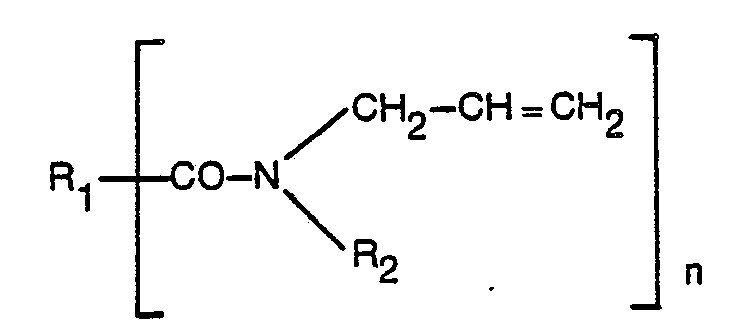
dans laquelle R1 est l'hydrogène.ou un groupe hydrocarboné contenant 1 à 30 atomes de carbone, ou bien R1 peut être absent, R2 est un atome d'hydrogène, un groupe alkyle contenant 1 à 30 atomes de carbone, un groupe cycloalkyle contenant 6 à 10 atomes de carbone, un groupe aryle contenant 6 à 10 atomes de carbone ou allyle et n a la valeur 1 ou 2; sous réserve que lorsque R1 est l'hydrogène, n soit égal à 1, que lorsque R1 est un groupe hydrocarboné contenant 1 à 30 atomes de carbone, n ait la valeur 1 ou 2 et que lorsque R1 est absent, n ait la valeur 2.
dans laquelle R1 est l'hydrogène.ou un groupe hydrocarboné contenant 1 à 30 atomes de carbone, ou bien R1 peut être absent, R2 est un atome d'hydrogène, un groupe alkyle contenant 1 à 30 atomes de carbone, un groupe cycloalkyle contenant 6 à 10 atomes de carbone, un groupe aryle contenant 6 à 10 atomes de carbone ou allyle et n a la valeur 1 ou 2; sous réserve que lorsque R1 est l'hydrogène, n soit égal à 1, que lorsque R1 est un groupe hydrocarboné contenant 1 à 30 atomes de carbone, n ait la valeur 1 ou 2 et que lorsque R1 est absent, n ait la valeur 2.
2. Composé suivant la revendication 1, dans lequel le polymère oléfinique est un copolymère
d'éthylène et d'une alpha-oléfine en C3 à C12 et ledit copolymère a un poids moléculaire moyen de 10 000 à 200 000.
3. Composé suivant la revendication 1 ou la revendication 2, dans lequel le polymère
oléfinique est un copolymère d'éthylène, d'une alpha-oléfine en C3 à C12 et d'au moins un diène contenant 4 à 15 atomes de carbone.
4. Composé suivant la revendication 3, dans lequel le copolymère contient 30 à 79%
de motifs éthylène, 20 à 69% en poids de motifs propylène et 1 à 10% en poids de motifs
diène.
5. Composé suivant la revendication 3 ou la revendication 4, dans lequel le diène
est le 1,4-hexadiène, le 2,5-norbornadiène ou le dicyclopen- tadiène.
6. Composé suivant l'une quelconque des revendications 1 à 5, dans lequel le N-allylamide
est un N-allylformamide, par exemple le N,N-diallyl- formamide, ou est le N,N-diallylacétamide.
7. Procédé de préparation d'un composé suivant la revendication 1, qui consiste à
faire réagir le N-allylamide et le polymère oléfinique pour greffer le premier sur
le second en présence d'un catalyseur engendrant des radicaux libres.
8. Procédé suivant la revendication 7, dans lequel la réaction est conduite en présence
d'un catalyseur engendrant des radicaux libres à une temperature assez haute pour
engendrer des radicaux libres, allant jusqu'à une température de 250°C.
9. Dispersant sans cendres apte à être utilisé dans des huiles lubrifiantes et dans
des combustibles liquides, comprenant un composé suivant l'une quelconque des revendications
1 à 6 qui est soluble dans l'huile ou un polymère greffé soluble dans l'huile qui
a été préparé par un procédé suivant la revendication 7 ou la revendication 8.
10. Composition d'huile lubrifiante comprenant une quantité dominante d'une huile
ayant une viscosité propre à la lubrification et une quantité secondaire suffisante
pour améliorer les propriétés dispersantes d'un composé suivant l'une quelconque des
revendications 1 à 6 ou d'un polymère greffé soluble dans l'huile qui a été préparé
par un procédé suivant la revendication 7 ou la revendication 8.