| (19) |
 |
|
(11) |
EP 0 087 463 B1 |
| (12) |
EUROPEAN PATENT SPECIFICATION |
| (45) |
Mention of the grant of the patent: |
|
23.12.1987 Bulletin 1987/52 |
| (22) |
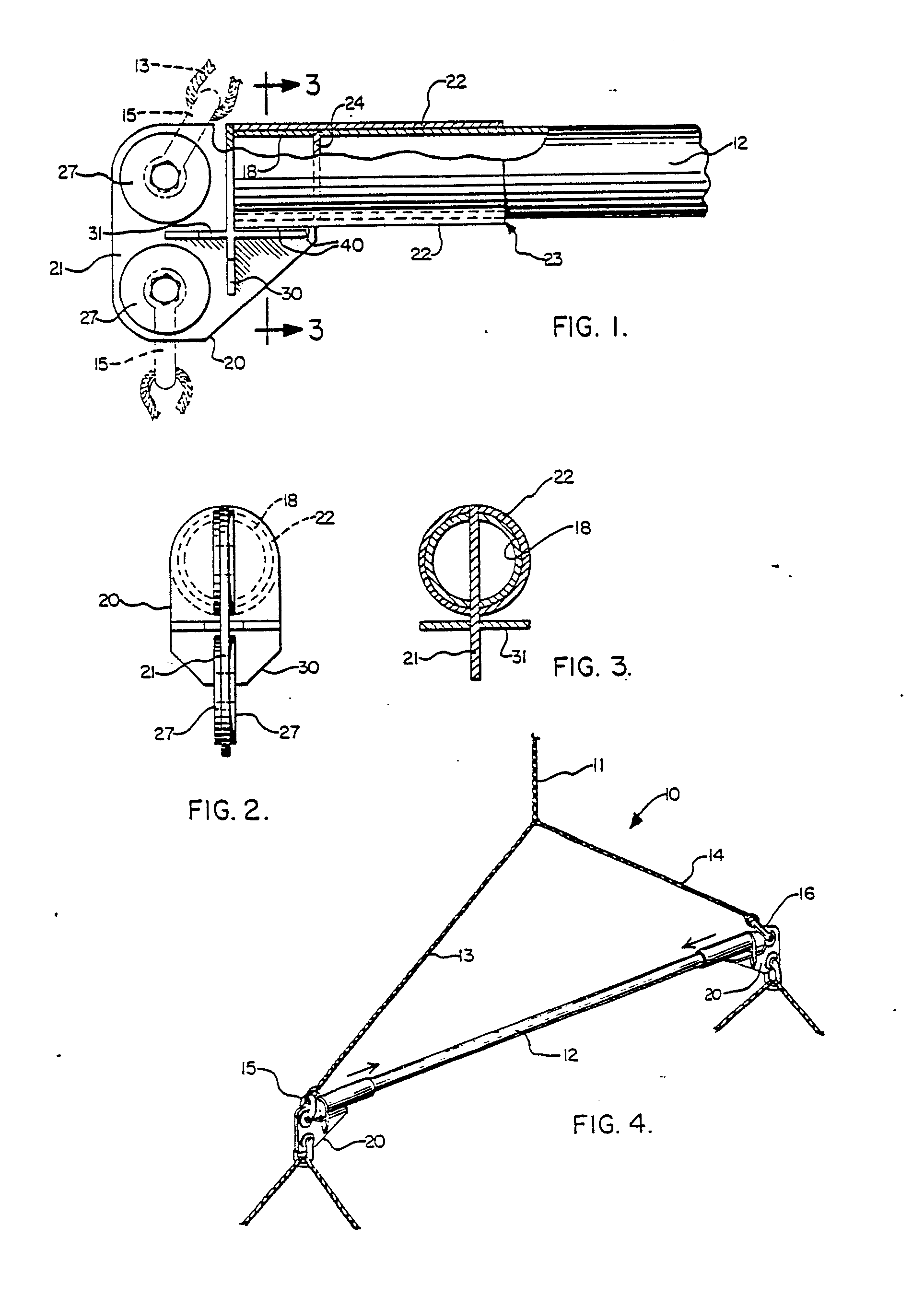
Date of filing: 08.09.1982 |
|
| (51) |
International Patent Classification (IPC)4: B66C 1/12 |
| (86) |
International application number: |
|
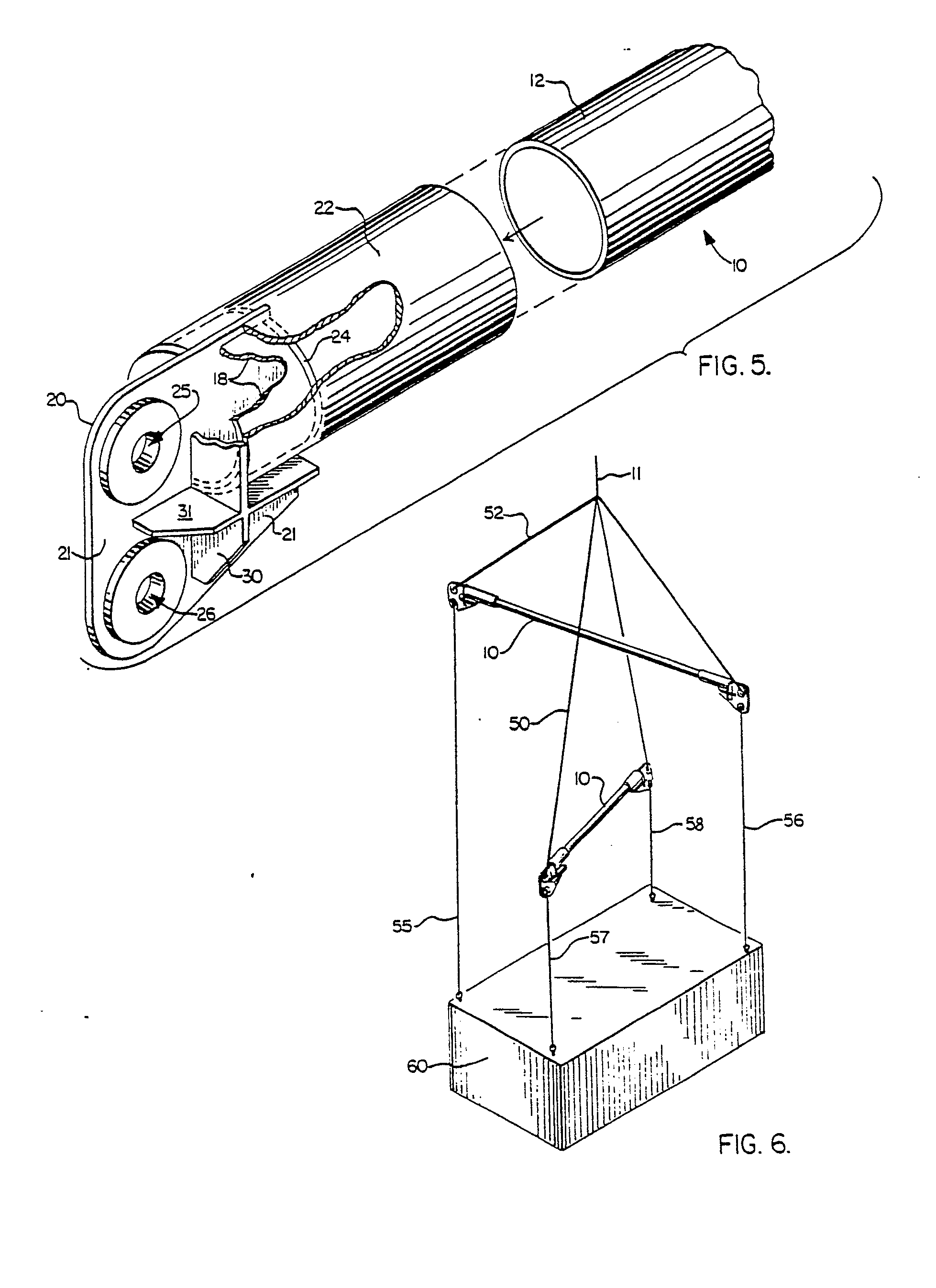
PCT/US8201/207 |
| (87) |
International publication number: |
|
WO 8300/855 (17.03.1983 Gazette 1983/07) |
|
| (54) |
SPREADER BAR ASSEMBLY
MONTAGE MIT ABSTANDSSTANGE
ASSEMBLAGE A BARRE D'ECARTEMENT
|
| (84) |
Designated Contracting States: |
|
AT BE CH DE FR GB LI LU NL SE |
| (30) |
Priority: |
08.09.1981 US 300059
|
| (43) |
Date of publication of application: |
|
07.09.1983 Bulletin 1983/36 |
| (71) |
Applicant: VERSABAR, INC. |
|
Harvey, LA 70058 (US) |
|
| (72) |
Inventors: |
|
- KHACHATURIAN, Jon E.
Harvey, LA 70058 (US)
- CHARLES, Joseph P.
Harvey, LA 70058 (US)
|
| (74) |
Representative: Massey, Alexander et al |
|
MARKS & CLERK,
Sussex House,
83-85 Mosley Street
Manchester M2 3LG
Manchester M2 3LG (GB) |
|
| |
|
| Note: Within nine months from the publication of the mention of the grant of the European
patent, any person may give notice to the European Patent Office of opposition to
the European patent
granted. Notice of opposition shall be filed in a written reasoned statement. It shall
not be deemed to
have been filed until the opposition fee has been paid. (Art. 99(1) European Patent
Convention).
|
[0001] The present invention relates to spreader bars and like lifting devices. More particularly,
the present invention relates to a spreader bar assembly having end portions which
can be removably fitted to the ends of a section of pipe, for example, or a like structural
member which has been precut to a desired length.
[0002] In the lifting of equipment such as for loading onto ships or for construction, a
crane normally provides a single load line which branches at a bridle and attaches
in two portions to an elongated bar known in the art as a spreader bar. The spreader
bar then has one or more depending load lines lowered from it at each end which are
affixed to a piece of equipment to be lifted. This apparatus per se and the use of
spreader bars is generally known in the art.
[0003] Spreader bars are normally custom constructed to fit a piece of equipment of a given
load and dimension, and thus cannot be reused except on a piece of equipment of similar
dimension and equal or lesser load. Attempts have been made to teach a method for
providing an adjustable spreader bar which could be used over a variety of spreader
lengths.
[0004] In U.S. Patent No. 2,020,174 there is disclosed a vehicle hoist frame comprising
a pair of normally- disposed spreader bar assemblies, each comprising a rigid elongated
support bar having at each end a lifting eye means in the form of a stirrup. Bridle
lines connect the stirrups of each support bar to a common main suspension line, and
from each stirrup depends a load lifting line.
[0005] In U.S. Patent No. 2,730,398 there is disclosed a lift device comprising a spreader
bar assembly from which depends a load lifting arrangement including lifting lines.
The spreader bar assembly comprises a rigid elongated tubular support bar on each
end of which is fitted lifting eye means comprising a surrounding sleeve, each sleeve
and the end portion of the tubular support bar surrounded thereby being traversed
by the bolts of two swivel rings to one of which is connected an upward lifting line
and to the other of which is connected one of the depending load lifting lines.
[0006] The use of bolted connections in spreader bar assemblies used for load lifting purposes
is considered disadvantageous in that holes require to be made through the support
bar thus weakening its cross-sectional load carrying capacity. Also, the disposition
of bolts in these holes to carry the full axial load of the support bar causes a high
stress to be created at the bolts.
[0007] Thus it is an object of the present invention to provide a spreader bar assembly
which is not only adapted to cope with a variety of load and dimensional situations
but which is also free of disadvantageous bolt connections.
[0008] According to the present invention there is provided a spreader bar assembly comprising
a rigid elongated support bar, a pair of lifting eye means removably connected at
each respective end portion of said support bar for forming a connection with an above
supporting bridle line and at least one depending lift line, the spreader bar assembly
being characterised in that each of said lifting eye means comprises a cylindrical
socket providing an open end for receiving a cylindrical end portion of the support
bar thereinto and having a corresponding internal cross-sectional area equal to or
slightly larger than the external cross-sectional area of the support bar, a transverse
inner stop within each cylindrical socket against which the respective end portion
of the support bar butts to limit the penetration of said respective end portion into
the cylindrical socket, a plate rigidly fixed to the cylindrical socket and extending
downwardly of, and away . from said open end there being at least one opening in the
plate for receiving a lifting line, and gusset means on the plate for stiffening same.
[0009] Also according to the present invention there is provided a load lifting assembly
comprising a primary common load lifting line, a pair of bridles depending from the
primary common lifting line, each bridle comprising a pair of downwardly-extending
branch lines connected to the ends of a respective spreader bar assembly, each comprising
a rigid elongated support bar, a pair of lifting eye means removably connected at
each respective end .portion of said support bar to form a connection with the branch
lines of a respective supporting bridle, each spreader bar assembly being characterised
in that each of said lifting eye means comprises a cylindrical socket providing an
open end for receiving a cylindrical end portion of the support bar thereinto and
having a corresponding internal cross-sectional area equal to or slightly larger than
the external cross-sectional area of the support bar, a transverse inner stop within
each cylindrical socket against which the respective end portion of the support bar
butts to limit the penetration of said respective end portion into the cylindrical
socket, a plate rigidly fixed to the cylindrical socket and extending downwardly of,
and away from, said open end, and gusset means on the plate for stiffening same and
each plate of each lifting eye means having an opening therein in which is attached
one end of a depending secondary load line with the other end of each of the latter
being adapted for attachment to a load, and the branch lines of each bridle being
of equal length with the branch lines of one bridle being shorter than those of the
other branch line.
[0010] The use of transverse stops within the lifting eye cylindrical sockets against which
the ends of the support bar abut results in stress being developed around the entire
section of the support bar so that the full section of the support bar carries the
load and avoids localised high stress concentrations at the support bar ends.
[0011] Embodiments of the present invention will now be described, by way of example, with
reference to the accompanying drawings, in which:
Figure 1 is a partial side view of the preferred embodiment of the apparatus of the
present invention;
Figure 2 is an end view of the preferred embodiment of the apparatus of the present
invention illustrating one of the end portions thereof;
Figure 3 is a sectional view taken along lines 3-3 of Figure 2;
Figure 4 is a perspective view of the preferred embodiment of the apparatus of the
present invention illustrating a general lifting arrangement;
Figure 5 is a perspective partially cut away view of the apparatus of the present
invention illustrating one end connector portion thereof; and
Figure 6 is a perspective view of the apparatus of the present invention illustrating
an alternate lifting arrangement using the preferred embodiment of the apparatus of
the present invention, replacing the necessity of a lifting frame.
Figures 1 to 5 illustrate the preferred embodiment of the apparatus of the present
invention designated generally in the drawings by the numeral 10.
[0012] In Figure 4 there can be seen a lift line 11 which would be, for example, the lift
line of a crane, or like lifting device. Line 11 branches into a pair of bridle lines
13, 14 which terminate at shackles 15, 16 or like connection means for attaching bridle
lines 13,14 to the end lifting eye assembly 20 at opening 25. At opening 26, shackles
15, 16 are affixed to which one or more depending load lines 55 which attach'with
the lower end of load lines 55 attaching to the load to be lifted. A central structural
bar 12 such as pipe, for example, attaches at its end portions to lifting eye assemblies
20 in a slip-on freely removable manner as will be described more fully. The compression
applied to each lifting eye assembly 20, forcing it inwardly in the direction shown
by the arrows in Figure 4, is the only force necessary to retain the lifting eyes
20 upon bar 12 during operation. An auxiliary line (not shown) could connect eye assemblies
20 during assembly or prior to a lift to prevent inadvertent removal of either eye
assembly 20 prior to lifting. Such a line could be of light material as rope, for
example.
[0013] In Figure 1, a side partially sectional view of lifting eye assembly 20 is shown
providing a cylindrical socket 22 which slips over bar 12. Figure 5 shows a partially
cut away perspective view of lifting eye assembly 20. Note from sectional view 3,
that socket 22 would be of an internal diameter substantially equal to or slightly
larger than bar 12 and would be of a corresponding cross-section with cylindrical
cross-sections being preferred. Bar 12 should slip into socket 22 with minimum tolerance
thus providing a good structural connection during the lifting operation. A stop 24
would limit the degree of penetration of bar 12 into socket 22 once bar 12 was placed
into the open end 23 portion of socket 22 to complete the spreader bar assembly. Behind
stop 24, reinforcing tube 18 is placed extending from vertical gusset plate 30 to
stop 24. Reinforcing tube 18 would be cylindrical and preferably of the same diameter
and wall thickness as bar 12, thus reinforcing stop 24 against failure by compressive
force applied thereto by bar 12.
[0014] A flattened plate 21 would provide a pair of lifting openings 25, 26 which could
be thickened by plate 27 if desired. While two separate plates 27 are shown in the
preferred embodiment, a continuous plate could also be used for thickening the plate
about openings 25, 26. A pair of gussets 30, 31 can also be seen in the drawings including
a vertical gusset plate 30 and a horizontal plate 31. Vertical gusset plate 30 as
seen in Figure 2 forms a closure over socket 22 opposite open end 23 and could, in
fact, be used as the desired stop as an alternate construction.
[0015] Horizontal gusset 31 could be affixed to socket 22 at 40 shown in Figure 1 by welding,
for example, to provide additional reinforcement to flattened plate 21 if desired.
[0016] From the above, it can be seen that lifting eye assembly 20 could be manufactured
in a variety of dimensional sizes and even in different cross-sectional shapes within
the teaching of the present invention such as square using square structural tubing,
for example.
[0017] It can also be seen that center bar 12 could be precut to a desired dimensional length
thus allowing a spreader bar to be instantly constructed in the field at any length.
[0018] A load chart could be constructed knowing the structural characteristics of each
lifting eye assembly 20 which would permit field welders to know the lifting capability
of any spreader bar so assembled without the benefit of extensive structural calculations..
[0019] Thus, the present invention provides a very versatile, highly structurally sound
lifting device. In figure 6, two spreader bar assemblies 10 are shown providing an
easily constructed versatile lifting frame with two bridles 50, 52 depending from
load line 11. Four individual downwardly depending lines 55-59 attach to load 60.
Using this arrangement, load could be lifted using spreader bars 10 substituting for
a complex expensive lifting frame.
[0020] The spreader bar assemblies 10 as shown in Figure 6 thus provide a lifting frame
with the primary load line 11 branching to a provided bridle in the form of four radially
and downwardly branching load lines 50, 52 which are connected at one respective end
of each thereof together and at the lower end thereof to bar assemblies 10. Otherwise,
bar assemblies 10 would be constructed as shown in Figures 1 through 5.
[0021] The four depending secondary load lines 55-58 would attach respectively at the upper
end thereof to one of the lifting eye assemblies 20 and at the lower end thereof to
a load 60 to be lifted. The lines 52 would be of a shorter length generally than the
lines 50 forming the bridle and would thus place spreader bar assemblies 10 atop one
another and at angles (generally right angles or perpendicular, for example, with
square loads) to one another. Depending upon the load to be lifted, the elongated
bar portion of each spreader bar assembly could be of any desired length and adjustable
within the teaching of the present invention. Thus a highly versatile lifting arrangement
can be provided for within the teaching of the present invention. The spreader bar
assemblies 10 of Figure 6 could be of the same length or of different lengths as desired.
[0022] The present invention could be manufactured of any suitable structural material such
as structural steel and could be manufactured by fabrication, welding, or any other
such techniques of metal construction.
1. A spreader bar assembly comprising a rigid elongated support bar (12), a pair of
lifting eye means (20) removably connected at each respective end portion of said
support bar (12) for forming a connection with an above supporting bridle line (13,
14) and at least one depending lift line (11), the spreader bar assembly being characterised
in that each of said lifting eye means (20) comprises a cylindrical socket (22) providing
an open end (23). for receiving a cylindrical end portion of the support bar (12)
thereinto and having a corresponding internal cross-sectional area equal to or slightly
larger than the external cross-sectional area of the support bar (12), a transverse
inner stop (24) within each cylindrical socket (22) against which the respective end
portion of the support bar (12) butts to limit the penetration of said respective
end portion into the cylindrical socket (22), a plate (21) rigidly fixed to the cylindrical
socket (22) and extending downwardly of, and away from said open end (23) there being
at least one opening (25,26) in the plate (21) for receiving a lifting line, and gusset
means (30, 31) on the plate (21) for stiffening same.
2. A spreader bar assembly as claimed in claim 1, characterised in that the gusset
means (30, 31) comprises a vertical gusset (30) rigidly fixed to the plate (21) at
an angle thereto, the vertical gusset (30) being fixed to one end of the cylindrical
socket (22) at substantially right angles with the longitudinal axis thereof, and
a horizontal gusset (31) fixed rigidly to the plate (21) at an angle thereto, the
horizontal gusset (31) being fixed in part to the cylindrical socket (22).
3. A spreader bar assembly as claimed in claim 2, characterised in that the cylindrical
socket (22) provides a cylindrical side wall to which the horizontal gusset (31) is
tangentially attached.
4. A spreader bar assembly as claimed in claim 1, characterised in that the pair of
lifting eye means (20) are freely separable from the support bar (12), being held
thereto during a lifting operation by forces applied to the lifting eye means (20)
by the bridle and lifting lines (11, 13, 14) and load attachment lines attached thereto.
5. A spreader bar assembly as claimed in any one of claims 1 to 4, characterised in
that each plate (21) has at least one lift opening (25) for receiving an end of one
of the bridle lines (13, or 14), there being an attachment means (15, 16) connectable
to the lift opening (25) for securing the end of the bridle line (13 or 14) to the
lift opening (25).
6. A spreader bar assembly as claimed in any one of claims 1 to 5, characterised in
that the inner stop (24) is a plate extending across the bore of the cylindrical socket
(22) and in that a reinforcing sleeve (18) is located in the cylindrical socket (22)
on the opposite side of the stop plate (24) from the open end (23) of the cylindrical
socket (22).
7. A spreader bar assembly as claimed in claim 5 or 6, characterised in that each
lifting eye assembly (20) provides a pair of spaced apart lift openings (25, 26),
one to receive the attachment means (15 or 16) of the respective bridle line (13 or
14) and the other an attachment means (15 or 16) of a load attachment line.
8. A spreader bar assembly as claimed in claim 7, characterised in that the lift openings
(25, 26) are generally vertically aligned.
9. A spreader bar assembly as claimed in claim 7 or 8, characterised in that a thickened
portion (27) of the plate (21) surrounds each of the lift openings (25, 26).
10. A load lifting assembly comprising a primary common load lifting line (11), a
pair of bridles (50, 52) depending from the primary common lifting line (11), each
bridle (50, 52) comprising a pair of downwardly-extending branch lines connected to
the ends of a respective spreader bar assembly (10), each comprising a rigid elongated
support bar (12), a pair of lifting eye means (20) removably connected at each respective
end portion of said support bar (12) to form a connection with the branch lines of
a respective supporting bridle (50, 52), each spreader bar assembly being characterised
in that each of said lifting eye means (20) comprises a cylindrical socket (22) providing
an open end (23) for receiving a cylindrical end portion of the support bar (12) thereinto
and having a corresponding internal cross-sectional area equal to or slightly larger
than the external cross-sectional area of the support bar (12), a transverse inner
stop (24) within each cylindrical socket (22) against which the respective end portion
of the support bar (12) butts to limit the penetration of said respective end portion
into the cylindrical socket (22), a plate (21) ridigly fixed to the cylindrical socket
(22) and extending downwardly of, and away from, said open end (23), and gusset means
(30, 31) on the plate (21) for stiffening same and each plate (21) of each lifting
eye means (20) having an opening (26) therein in which is attached one end of a depending
secondary load line (55, 56, 57, 58) with the other end of each of the latter being
adapted for attachment to a load (60), and the branch lines of each bridle (50, 52)
being of equal length with the branch lines of one bridle being shorter than those
of the other branch line.
1. Hebegeschirr, umfassend eine steife, längliche Stützstange (12), ein Paar von Aufhängeösen-Eckbeschlägen
(20), die lösbar mit dem jeweiligen Endteil der Stützstange (12) verbunden sind, um
eine Verbindung mit einem obenliegenden, tragenden Spannseil (13, 14) und mindestens
einem herunterhängenden Hebeseil (11) zu bilden, wobei das Hebegeschirr dadurch gekennzeichnet
ist, daß jeder der Aufhängeösen-Eckbeschläge (20) eine zylindrische Fassung (22),
die ein offenes Ende (23) zur Aufnahme eines zylindrischen Enteiles der Stützstange
(12) in ihrem Inneren aufweist und eine entsprechende innere Querschnittsfläche hat,
die gleich der oder etwas größer als die äußere Querschnittsfläche der Stützstange
(12) ist, einen quer angeordneten Innenanschlag (24) innerhalb jeder zylindrischen
Fassung (22), gegen den das jeweilige Endteil der Stützstange (12) anliegt, um das
Eindringen des jeweiligen Endteiles in die zylindrische Fassung (22) zu begrenzen,
eine Platte (21), die starr an der zylindrischen Fassung (22) befestigt ist und sich
nach unten erstreckt, wobei entfernt von dem offenen Ende (23) mindestens eine Öffnung
(25, 26) in der Platte (21) ausgebildet ist, um ein Hebeseil aufzunehmen, sowie Eckversteifungen
(30, 31) an der Platte (21) aufweist, um diese zu versteifen.
2. Hebegeschirr nach Anspruch 1, dadurch gekennzeichnet, daß die Eckversteifungen
(30, 31 ) ein vertikales Knotenblech (30), das starr an der Platte (21) unter einem
Winkel gegenüber dieser befestigt ist, wobei das vertikale Knotenblech (30) an einem
Ende der zylindrischen Fassung (22) im wesentlichen unter einem rechten Winkel zu
deren Längsachse befestigt ist, und ein horizontales Knotenblech (31) aufweist, das
starr an der Platte (21) unter einem Winkel gegenüber dieser befestigt ist, wobei
das horizontale Knotenblech (31) teilweise an der zylindrischen Fassung (22) befestigt
ist.
3. Hebegeschirr nach Anspruch 2, dadurch gekennzeichnet, daß die zylindrische Fassung
(22) eine zylindrische Seitenwand aufweist, an der das horizontale Knotenblech (31)
tangential angebracht ist.
4. Hebegeschirr nach Anspruch 1, dadurch gekennzeichnet, daß das Paar von Aufhängeösen-Eckbeschlägen
(20) von der Stützstange (12) frei trennbar sind und an dieser während eines Hebevorganges
durch Kräfte gehalten sind, welche die Aufhängeösen-Eckbeschläge (20) über die Spann-und
Hebeseile (11, 13, 14) sowie daran angebrachte Lastbefestigungsseile beaufschlagen.
5. Hebegeschirr nach einem der Ansprüche 1 bis 4, dadurch gekennzeichnet, daß jede
Platte (21) mindestens eine Hebeöffnung (25) zur Aufnahme eines Endes von einem der
Spannseile (13 oder 14) aufweist, wobei Befestigungseinrichtungen (15, 16) vorgesehen
sind, die mit der Hebeöffnung (25) verbindbar sind, um das Ende des Spannseiles (13
oder 14) an der Hebeöffnung (25) zu befestigen.
6. Hebegeschirr nach einem der Ansprüche 1 bis 5, dadurch gekennzeichnet, daß der
Innenanschlag (24) eine Platte ist, die sich quer durch die Bohrung der zylindrischen
Fassung (22) erstreckt, und daß eine Verstärkungsbuchse (18) in der zylindrischen
Fassung (22) von dem offenen Ende (23) der zylindrischen Fassung (22) auf der gegenüberliegenden
Seite der Anschlagplatte (24) angeordnet ist.
7. Hebegeschirr nach Anspruch 5 oder 6, dadurch gekennzeichnet, daß jeder Aufhängeösen-Eckbeschlag
(20) ein Paar von beabstandeten Hebeöffnungen (25, 26) aufweist, eine zur Aufnahme
der Befestigungseinrichtung (15 oder 16) des jeweiligen Spannseiles (13 oder 14) und
die andere für eine Befestigungseinrichtung (15 oder 16) eines Lastbefestigungsseiles.
8. Hebegeschirr nach Anspruch 7, dadurch gekennzeichnet, daß die Hebeöffnungen (25,
26) im allgemeinen vertikal ausgefluchtet sind.
9. Hebegeschirr nach Anspruch 7 oder 8, dadurch gekennzeichnet, daß ein dickeres Teil
(27) der Platte (21) jede der Hebeöffnungen (25, 26) umgibt.
10. Lasthebevorrichtung, umfassend ein primäres gemeinsames Lasthebeseil (11), ein
Paar von Spannseilen (50, 52), die von dem primären, gemeinsamen Hebeseil (11) herunterhängen,
wobei jedes Spannseil (50, 52) ein Paar von nach unten verlaufenden Zweigseilen aufweist,
die mit den Enden eines jeweiligen Hebegeschirrs (10) verbunden sind, die jeweils
eine steife längliche Stützscheine (12) aufweisen, wobei ein Paar von Aufhängeösen-Eckbeschlägen
(20) lösbar mit dem jeweiligen Endteil der Stützstange (12) verbunden ist, um eine
Verbindung mit den Zweigseilen des jeweiligen tragenden Spannseiles (50, 52) zu bilden,
wobei jedes Hebegeschirr dadurch gekennzeichnet ist, daß jeder der Aufhängeösen-Eckbeschläge
(20) eine zylindrische Fassung (22), die ein offenes Ende (23) zur Aufnahme eines
zylindrischen Endteiles der Stützstange (12) in ihrem Innenraum bildet und die eine
entsprechende innere Querschnittsfläche hat, die gleich der oder etwas größer als
die äußere Querschnittsfläche der Stützstange (12) ist, einen quer verlaufenden Innenanschlag
(24) innerhalb jeder zylindrischen Fassung (22), gegen den das jeweilige Endteil der
Stützstange (12) anliegt, um das Eindringen des jeweiligen Endteiles in die zylindrische
Fassung (22) zu begrenzen, eine Platte (21), die starr an der zylindrischen Fassung
(22) befestigt ist und sich unterhalb des offenen Endes (23) weg von diesem erstreckt,
sowie Eckversteifungen (30, 31) auf der Platte (21) aufweist, um diese zu versteifen,
wobei jede Platte (21) jedes Aufhängeösen-Eckbeschlages (20) eine eingearbeitete Öffnung
(26) besitzt, in der das eine Ende eines herunterhängenden sekundaären Lastseiles
(55, 56, 57, 58) angebracht ist, dessen jeweils anderes Ende zur Anbringung an einer
Last (60) ausgelegt ist, und daß die Zweigseile jedes Spannseiles (50, 52) von gleicher
Länge sind, wobei die Zweigseile des einen Spannseiles kürzer sind als die des anderen
Spannseiles.
1. Assemblage à barre d'écartement comprenant une barre de support (12) rigide, de
forme allongée une paire de moyens d'étrier de suspension (20) reliés de façon amovible
à chaque partie d'extrémité respective de la barre de support (12) pour former une
liaison avec une suspente oblique de suspension supérieure (13,14) et au moins une
suspente oblique de levage dépendante (11), l'assemblage à barre d'écartement étant
caractérisé en ce que chacun des dits moyens d'étrier de suspension (20) comprend
un manchon cylindrique (22) présentant une extrémité ouverte (23) pour y recevoir
une partie d'etrémité cylindrique de la barre de support (12), et ayant une section
transversale intérieure correspondante égale ou légèrement supérieure à la section
transversale extérieure de la barre de support (12), un butoir intérieur transversal
(24) à l'intérieur de chaque manchon cylindrique intérieur (22), contre lequel vient
buter la partie d'éxtrémité respective de la barre de support (12) pour limiter la
pénétration de cette partie d'extrémité respective dans le manchon cylindrique (22),
une plaque (21) fixée de façon rigide au manchon cylindrique (22) et s'étendant vers
le bas et en s'éloignant de l'extrémité ouverte (23), avec au moins une ouverture
(25, 26) de la plaque (21) pour recevoir une suspente de levage, et un moyen de gousset
d'angle (30, 31 ) de la plaque (21) pour rendre cette plaque rigide.
2. Assemblage à barre d'écartement selon la revendication 1,. caractérisé en ce que
le moyen de gousset d'angle (30, 31) comprend un gousset vertical (30) fixé de façon
rigide à la plaque (21) en formant un angle avec celle-ci, le gousset vertical (30)
étant fixé a une extrémité du manchon cylindrique (22) en formant pratiquement un
angle droit avec l'axe longitudinal de celui-ci, et un gousset horizontal (31) fixé
d'une façon rigide à la plaque (21) en formant un angle avec celle-ci, le gousset
horizontal (31 étant fixé en partie au manchon cylindrique (22).
3. Assemblage à barre d'écartement selon la revendication 2, caractérisé en ce que
le manchon cylindrique (22) présente une paroi latérale cylindrique à laquelle est
fixé tangentiellement le gousset horizontal (31).
4. Assemblage à barre d'écartement selon la revendication 1, caractérisé en ce que
la paire de moyens d'étrier de suspension (20) est librement séparable de la barre
de support (12), en étant maintenue à celle-ci pendant une opération de levage par
des forces appliquées aux moyens d'étrier de suspension (20) par les suspentes obliques
et de levage (11,13,14) et les suspentes de fixation de charge qui y sont attachées.
5. Assemblage à barre d'écartement selon l'une quelconque des revendications 1 à 4,
caractérisé en ce que chaque plaque (21) présente au moins un orifice de levage (25)
pour recevoir une extrémité d'une des suspentes obliques (13 ou 14), avec un moyen
de fixation (15, 16) pouvant être relié à l'orifice de levage (25) pour fixer l'extrémité
de la suspente oblique (13 ou 14) à l'orifice de levage (25).
6. Assemblage à barre d'écartement selon l'une quelconque des revendications 1 à 5,
caractérisé en ce que le butoir intérieur (24) est une plaque s'étendant à travers
l'orifice du manchon cylindrique (22) et qu'une douille de renforcement cylindrique
(18) est placée dans le manchon cylindrique (22) sur la face opposée de la plaque
(24), à partir de l'extrémité ouverte (23) du manchon cylindrique (22).
7. Assemblage à barre d'écartement selon l'une quelconque des revendications 5 ou
6, caractérisé en ce que chaque assemblage d'étrier de suspension (20) présente une
paire d'orifices de levage (25, 26) espacés, l'un étant destiné à recevoir le moyen
de fixation (15 ou 16) de la suspente oblique (13 ou 14) et l'autre un moyen de fixation
(15 ou 16) de la suspente de fixation de charge.
8. Assemblage à barre d'écartement selon la revendication 7, caractérisé en ce que
les orifices de levage (25, 26) sont alignés verticalement.
9. Assemblage à barre d'écartement selon l'une quelconque des revendications 7 ou
8, caractérisé en ce qu'une partie plus épaisse (27) de la plaque (21) entoure chacun
des orifices de levage (25, 26).
10. Assemblage à barre d'écartement comprenant une suspente de levage de charge commune
principale (11), une paire de suspentes obliques (50, 52) comprenant une paire de
branches de suspente s'étendant vers le bas reliées aux extrémités d'un assemblage
à barre d'écartement (10) respectif, chacune comprenant une barre de support (12)
rigide, de forme allongée, une paire de moyens d'étrier de suspension (20) reliés
de façon amovible à chaque partie d'extrémité respective de la barre de support (12)
pour former une liaison avec les branches de suspente d'une suspente oblique de suspension
respective (50, 52), chaque assemblage à barre d'écartement étant caractérisé en ce
que chacun des moyens d'étrier de suspension (20) comprend un manchon cylindrique
(22) présentant une extrémité ouverte (23) pour y recevoir une partie d'extrémité
cylindrique de la barre de support (12), et ayant une section transversale intérieure
correspondante égale ou légèrement supérieure à la section transversale extérieure
de la barre de support (12), un butoir intérieur transversal (24) à l'intérieur de
chaque manchon cylindrique intérieur (22), contre lequel vient buter la partie d'extrémité
respective de la barre de support (12) pour limiter la pénétration de cette partie
d'extrémité respective dans le manchon cylindrique (22), une plaque (21) fixée de
façon rigide au manchon cylindrique (22) et s'étendant vers le bas et en s'éloignant
de l'extrémité ouverte (23), et un moyen de gousset d'angle (30, 31) de la plaque
(21) pour rendre cette plaque rigide, et chaque plaque (21) de chaque moyens d'étrier
de suspension (20) ayant une ouverture (26) dans laquelle est fixée une extrémité
d'une suspente de charge secondaire dépendante (55, 56, 57, 58), l'autre extrémité
de chacune de ces dernières étant adaptée pour être fixée à une charge (60), et les
branches de suspente de chaque suspente oblique (50, 52) étant de longueur égale à
celle des branches d'une suspente oblique et plus courtes que celles de l'autre branche
de suspente.