|
(11) | EP 0 088 395 A1 |

| (12) | EUROPEAN PATENT APPLICATION |
|
|
|
|
|||||||||||||||||||||||||||
| (54) | A process for the preparation of pyrazine derivatives |
| (57) Aprocess for the preparation of a pyrazine derivative of formula I:
wherein R1 represents hydroxy, C1-C6 alkoxy or a group of formula NR2R3, wherein R2 and R3 are independently hydrogen or C1-C6 alkyl or, R 2 and R3 form together with the nitrogen atom to which they are linked, a ring which may contain one or more additional heteroatoms; which process comprises reacting a compound of formula II: wherein R represents hydrogen, C1-C6 alkyl or C1-C6 alkoxy, Y represents hydrogen, sodium, lithium or potassium, and A is a nitrile group or a substituent of formual COR1, wherein R1 is as defined above, either with pyruvic aldehyde oxime of formula III: or with a pyruvic aldehyde oxime acetal derivative of formula IV: wherein R4 and R5 are independently hydrogen or C1-C6 alkyl or may be linked together in such a way that the compound of formula IV is a cyclic acetal; and when A is a nitrile group, hydrolyzing the reaction product; and, if desired, converting a compound of formula I so produced into another compound of formula I by a method known per se. |
[0001] The present invention relates to a process for the preparation of pyrazine derivatives of the general formula I
wherein R1 represents a hydroxyl group, an alkoxy group with 1 to 6 carbon atoms, or a group of formula NR2R3; wherein both R2 and R3 are independently hydrogen, an alkyl group with 1 to 6 carbon atoms, or they are linked together to form a ring which may comprise other heteroatoms, such as 0, N and S.
[0002] The meaning of "alkoxy group with 1 to 6 carbon atoms" as used in this specification comprises methoxy, ethoxy, n- and iso-propoxy, n-, iso-, sec.- and tert.-butoxy as well as isomers of pentoxy and hexoxy.
[0003] The meaning of "alkyl group with 1 to 6 carbon atoms" as used in this specification comprises methyl, ethyl, n- and iso-propyl as well as the isomeric froms of butyl, pentyl and hexyl. In particular, the method according to the invention is useful for the preparation of 5-methylpyrazine-2-carboxylic-4-oxido acid (R1 = OH).
[0004] Compounds of formula I as above defined have been recognized as having hypolipoemic or hypolycaemic activity as is demonstrated in GB-PS 1,361,967.
[0005] Said patent also provides a method for preparing compounds of formula I which comprises the oxidation of a compound of the following formula:
wherein R1 is as above defined, by means of hydrogen peroxide. While this previously described process may be satisfactory to obtain small quantities, the use of a dangerous oxidizing reagent, such as hydrogen peroxide, is not suitable for industrial scale.
[0006] Now, the applicant surprisingly found a safe and new method for preparing compounds of formula I on a large scale without the use of an oxidizing reagent.
[0007] Pyrazine derivatives of the general formula (I), wherein Rl is as defined above, can be prepared according to this invention following a procedure which comprises condensation of a compound of the general formula (II)
wherein R represents hydrogen, or an alkyl or alkoxy group with 1 to 6 carbon atoms, Y represents hydrogen, sodium, potassium or lithium, and A is a nitrile group or a substituent of the formula COR1, in which R1 has the same significance as defined above, with pyruvic aldehyde oxime of formula (III)
which can be used in the form of its acetal derivative (IV)
wherein R4 and R5 are independently hydrogen, an alkyl group with 1 to 6 carbon atoms, or they may be linked together to form a cyclic acetal of the formula IV; and, if A is a nitrile group, hydrolyzation of the reaction product; and, if desired, convertion of a compound of formula I produced in this way into another compound of formula I by a method known per se.
[0008] Acetal derivatives of formula (IV) may possibly be generated "in situ" by the reaction between a pyruvic aldehyde di-alkyl or cyclic acetal (V)
wherein R4 and R5 are as defined above, with hydroxylamine according to methods known to experts in this field.
[0009] Compounds of formula (II) have been prepared according to the methods described by Ellis V. Brown, "Chemistry of penicillin", Princetown University Press 1949, pages 473 - 534, or by extensions or modifications of this method which are quite obvious to experts in the field.
[0010] It should be noted that such compounds can be indicated not only by formula (II) (adopted in the present specification according to E.V. Brown), but also by formula VI, wherein R, A and Y have the same meaning as described above:
[0011] In the fact, II and VI constitute limit formulae and it is presumed that both forms are present together and in equilibrium, and suitable for indicating one and the same compound.
[0012] Compounds of formula III and IV have been prepared according to conventional methods (see e.g. G.T. Newbold, W. Sharp and F.S. Spring, J. Chem. Soc., 1951, 2679).
[0013] The reaction between compounds of formula II with compounds of formula III and/or IV, to which the present invention refers, is preferably carried out in a suitable solvent in the presence of organic or inorganic acids at a temperature falling between 150C and the boiling point of the chosen solvent.
[0014] The preferable acids are hydrochloric, hydrobromic, hydroiodic, sulphuric, nitric, p-toluenemethanesulphonic, formic, phosphoric, methanesulphonic, trifluoroacetic and trifluoromethanesulphonic acid.
[0015] The solvent is preferably chosen from among R7OH alcohols, R7OR6 ethers,
ketones,
esters or organic acids, in which both R7 and R6 are independently hydrogen and branched, linear or cyclic alkyl residues containing 1 to 6 carbon atoms, and where both are present, they can be joined together to form either a cyclic ether, a cyclic ketone or a lactone.
[0016] The reaction according to the invention is carried out preferably using equimolecular quantities of II and III, or II and IV, or II with a mixture of pyruvaldehyde V and hydroxylamine capable of forming III.
[0017] The dilution proportions between II (or III) and the solvent preferably range from 1:10 and 1:100, but even higher dilutions may be used.
[0018] When A in formula III is equal to nitrile, the compounds of formula I can be prepared by hydrolysing the product obtained by condensation of II with III and/or IV according to methods known per se.
[0019] A compound of formula I prepared according to the invention may be converted into another compound of formula I by methods known per se. The conversion of a compound of formula I wherein R1 is an alkoxy group or a NR2R3 group into a compound of formula I wherein R1 is hydroxy group may be performed for example by saponification with an aqueous alkali or by hydrolysis.
[0020] The examples given below are merely indicative, and should in no way limit the field of the present invention.
Example 1
[0021] The following components are placed in the reactor: 50 ml dioxane, 2 g methyl α -formyl-N-formyl glycinate, sodium salt (II, wherein R = H, R1 = OCH3, Y = Na), 1.6 g methyl glyoxime-dimethyl acetal (IV, wherein R4 = R5 = CH3) and 2 ml 35 % HC1 solution.
[0022] The whole is stirred for 5 hours at a temperature of 45°C to 50°C; the temperature is maintained thermostatically.
[0023] The white solid which forms (NaCl) is filtered off. The solvent is eliminated under vacuum and the residue is taken up and recrystallized from methanol, obtaining 1.1 g methyl-4-oxide 5-methyl-pyrazine-2-carboxylate. Yield: 56 % Melting point: 146 to 147°C
Example 2
[0024] 25 ml isopropyl alcohol, 1 g ethyl α-formyl-N-formyl glycinate, sodium salt (II wherein R = H, R1 = OC2H5, Y = Na), 0.75 g methylglyoxime dimethylacetal (IV, R4 = R5 = CH3), and 1 ml 35 % HC1 solution are placed in the reactor.
[0025] The mixture is stirred for 5 hours at 60°C and the solvent is then evaporated under vacuum. 25 ml of ethanol are added and the whole is allowed to stand for 10 hours.
Example 3
[0027] 5 g ethyl α -formyl-N-formyl glycinate, sodium salt (II, R = H, R1 = OEt, Y = Na) is introduced into the reaction flask, along with 3.7 g methyl glyoxime dimethyl acetal (IV, wherein R4 = R5 = CH3), 125 ml isopropyl alcohol and 5 ml conc. HC1 (35 %).
[0030] Cooled to 0°C and saturated with gaseous NH3, the filtrate gives after 10 hours a precipitate of 1.9 g of 5-methylpyrazine-2-carboxamide-4-oxide, which is isolated and in equivalent to a yield of 45 %.
Example 4
[0031] 1 g ethyl α -formyl-N-formyl glycinate, sodium salt (II, wherein R = H, R1 = OC2H5, Y = Na), 0.75 g methylglyoxime dimethylacetal (IV, wherein R4 = R5 = CH3) and 25 ml 85 % HCOOH in water, are placed in a reaction flask.
[0035] The mixture is then refluxed for 3 hours. 0.33 g of ethyl-4-oxide 5-methyl-pyrazine-2-carboxylate are obtained (33 % yield).
Example 5
[0036] 1 g ethyl α -formyl-N-formyl-glycinate, sodium salt (II, R = H, R1 = OC2H5, Y = Na), 0.75 g methylglyoxime dimethylacetal (IV, wherein R4 = R5 = CH3), 25 ml ethyl acetate and 1 ml conc. HC1 (35 %), are introduced into a reaction flask.
[0037] The mass is stirred for 8 hours at 50 to 55°C. On operating as described in example 2, 0.45 g of ethyl-4-oxide 5-methyl-pyrazine-2-carboxylate are obtained, equal to a yield of 45 %.
Example 6
[0038] Operating according to the method and quantities given for the first part of example 3, and replacing the conc. HC1 with 2 g para-toluenesulphonic acid, 0.37 g (= 37 % yield) of ethyl-4-oxide 5-methyl-pyrazine-2-carboxylate are obtained.
Example 7
[0039] Operating according to the quantities and method established in example 5, but replacing the ethyl acetate with the same quantity (25 ml) of acetone, 0.36 g of ethyl-4-oxide 5-methyl-pyrazine-2-carboxylate are obtained (36 % yield).
Example 8
[0040] 1 g ethyl α -formyl-N-formyl glycinate, sodium salt (II, wherein R = H, R1 = OEt, Y = Na), 0.5 g pyruvic aldehyde oxime (III), 1 ml conc. HC1 (35 %) and 25 ml isopropyl alcohol, are introduced into the reaction flask.
[0041] The mass is kept at 60°C for 8 hours. On operating as described in example 5, 0.31 g of ethyl-4-oxide 5-methyl-pyrazine-2-carboxylate are obtained.
Example 9
[0043] 2.45 g of NH20H.HC1, dissolved in 10 ml of H20 and brought to pH 7 with Na2C03, are then added to the flask. This operation is carried out at 5 to 10°C. 120 ml of 98 % HCOOH, 5.6 g of ethyl α-formyl-N-formyl glycinate, sodium salt (II, R = H, R1 = OEt, Y = Na) are added after 30 minutes. The mixture is stirred for 5 hours at 50°C. On operating as described in example 4, 1.4 g of ethyl-4-oxide 5-methyl-pyrazine-2-carboxylate are obtained. 25 % yield.
Example 10
[0044] 1 g ethyl α -formyl-N-carbethoxyglycinate, sodium salt (II, wherein R = R1 =OC2H5, Y = Na), 0.6 g methylglyoxime dimethylacetal (IV, wherein R4 = R5 = CH3), 25 ml isopropyl alcohol and 0.8 ml HC1 (35 %) are placed in the reaction flask.
[0047] 5-methyl-pyrazine-2-carboxylate, equivalent to a yield of 27.3 %, are obtained after the usual treatment.
Example 11
1. A process for the preparation of a pyrazine derivative of the formula I:
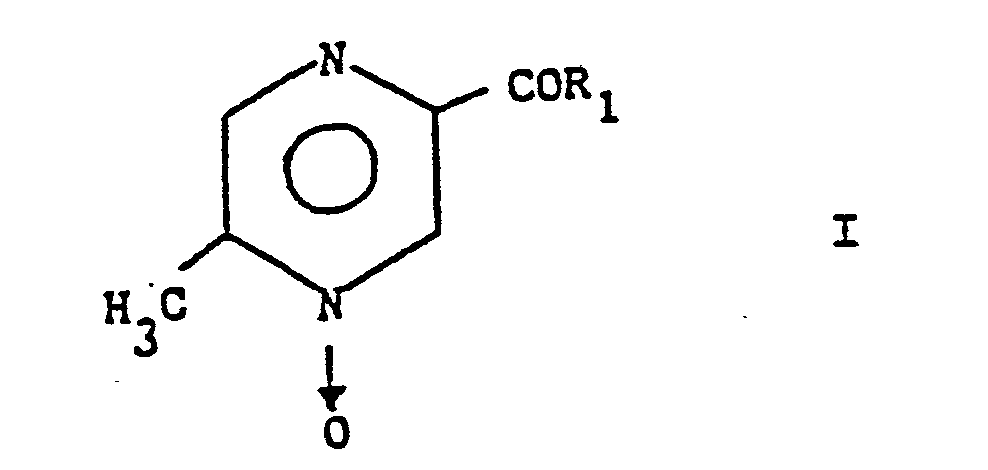
wherein R1 represents hydroxy, C1-C6 alkoxy or a group of the formula NR2R3, in which R2 and R3 are independently hydrogen or C1-C6 alkyl or, together with the nitrogen atom to which they are linked, they may form a ring which may contain one or more additional heteroatoms; which process comprises reacting a compound of formula II:
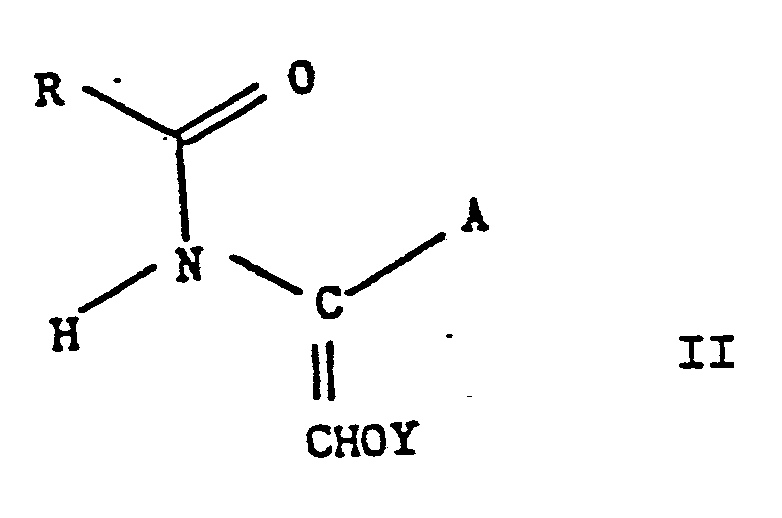
wherein R represents hydrogen, C1-C6 alkyl or C1-C6 alkoxy, Y represents hydrogen, sodium, lithium or potassium, and A is a nitrile group or a substituent of the formula COR1, wherein R1 is as defined above, either with pyruvic aldehyde oxime of formula III:
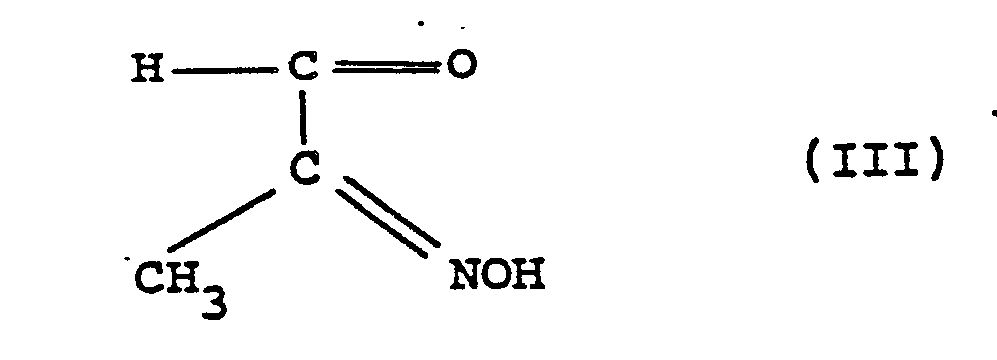
or with a pyruvic.aldehyde oxime acetal derivative of formula IV:
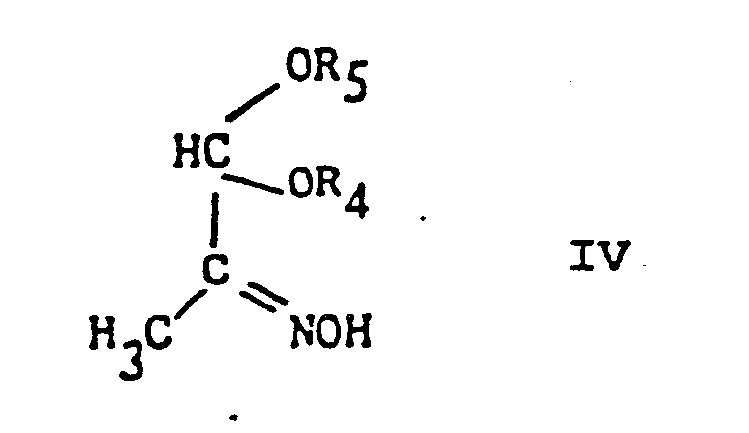
wherein R4 and R5 are independently hydrogen or C1-C6 alkyl or may be linked together so that the compound of formula IV is a cyclic acetal; and, when A is a nitrile group, hydrolysing the reactions product; and, if desired, converting a compound of formula I so produced into another compound of formula I by a method known per se.
wherein R1 represents hydroxy, C1-C6 alkoxy or a group of the formula NR2R3, in which R2 and R3 are independently hydrogen or C1-C6 alkyl or, together with the nitrogen atom to which they are linked, they may form a ring which may contain one or more additional heteroatoms; which process comprises reacting a compound of formula II:
wherein R represents hydrogen, C1-C6 alkyl or C1-C6 alkoxy, Y represents hydrogen, sodium, lithium or potassium, and A is a nitrile group or a substituent of the formula COR1, wherein R1 is as defined above, either with pyruvic aldehyde oxime of formula III:
or with a pyruvic.aldehyde oxime acetal derivative of formula IV:
wherein R4 and R5 are independently hydrogen or C1-C6 alkyl or may be linked together so that the compound of formula IV is a cyclic acetal; and, when A is a nitrile group, hydrolysing the reactions product; and, if desired, converting a compound of formula I so produced into another compound of formula I by a method known per se.
2. A process according to claim 1 wherein the reaction is between a compound of formula
II and an acetal derivative of formula IV, the acetal derivative being generated in
situ by reacting hydroxylamine with a pyruvic aldehyde derivative of formula V:
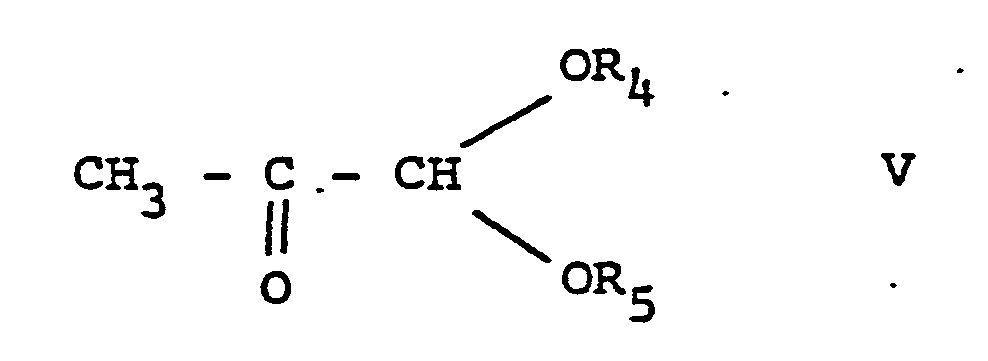
wherein R4 and R5 are as defined in claim 1.
wherein R4 and R5 are as defined in claim 1.
3. A process according to claim 1 wherein the reaction is carried out in a suitable
solvent, in the presence of an organic or inorganic acid, at a temperature from 15°C
to the boiling point of the solvent.
4. A process according to claim 3 wherein the acid is hydrochloric, hydrobromic, hydroiodic,
sulphuric, nitric, p-toluene-sulphonic, formic, phosphoric, methanesulphonic, trifluoroacetic
or trifluoromethanesulphonic acid.
5. A process according to claim 4 wherein the acid is hydrochloric acid.
6. A process according to claim 3, wherein the solvent is an alcohol of formula R70H, an ether of formula R7OR6, a ketone of formula R7COR6, an ester of formula R7COOR6 or an organic acid, R7 and R6 being independently hydrogen, a linear, branched or cyclic alkyl group of 1 to 6
carbon atoms or, where R6 and R7 are both present, they may be linked together so that the solvent is a cyclic ether,
a cyclic ketone, or a lactone.
7. A process according to claim 6 wherein the solvent is dioxane.
8. A process according to claim 6 wherein the solvent is isopropyl alcohol.
9. A process according to claim 1 wherein R1 represents hydroxy.
10. A process according to claim 1 wherein R represents methoxy.
11. A process according to claim 1 wherein R1 represents an amine group.