|
(11) | EP 0 088 612 B1 |

| (12) | EUROPEAN PATENT SPECIFICATION |
|
|
| (54) |
Detergent Detergens Détergent |
|
|
|||||||||||||||||||||||||||||||
| Note: Within nine months from the publication of the mention of the grant of the European patent, any person may give notice to the European Patent Office of opposition to the European patent granted. Notice of opposition shall be filed in a written reasoned statement. It shall not be deemed to have been filed until the opposition fee has been paid. (Art. 99(1) European Patent Convention). |
[0001] This invention relates to detergent particularly but not exclusively for use in domestic dishwashing although it may find industrial or alternative domestic applications.
[0002] European Patent Specifications Nos. 34393 and 34039 disclose detergents which contain in excess of 20% water.
[0004] According to the present invention a mobile liquid detergent comprising not more than 8% water and not less than 90% of active detergents including an anionic surface active agent, an ethanolamide derivative of coconut oil and a non-ionic polyether, wherein a 0.01 % w/w solution of the active detergent exhibits a surface tension at 20°C of not more than 4.5x 10⁻² Nm-2 (45 dyne cm-1) characterised in that the said mobile liquid detergent contains a total of not less than 50% of the ethanolamide derivative of coconut oil and the non-ionic polyether, and in that the liquid detergent may be diluted to form an aqueous solution having a strength in the range 7 to 50% by weight, which has a viscosity not less than 2× 10⁻⁴m2s-1 (200 centistokes) in the absence of an inorganic thickening agent.
[0006] An active detergent is a surface active agent, an 0.01 % aqueous solution of which exhibits a surface tension at 20°C of not more than 4.5×10⁻²Nm-1 (45 dyne/cm).
[0007] Preferred detergents in accordance with this invention comprise not less than 92% active detergent, not more than 1% polyethylene glycol and not more than 4% glycerine.
[0008] Detergents in accordance with this invention have an advantage that they do not contain a large proportion of water, thereby facilitating economical transportion and packing. Furthermore, use of inactive thickening agents such as sodium chloride in compositions which have been diluted for use is unnecessary since detergents in accordance with this invention thicken upon dilution with water alone.
[0009] A preferred high foaming composition may be diluted to a 15% to 45% aqueous solution having a viscosity not less than 2x10⁻⁴m2s-1 (200 centistokes) and being capable of passing a dishwashing and foam test as hereinafter defined.
[0010] The non-ionic polyether may comprise an alkylphenyl polyether or a polyether derivative of an alcohol. Preferred alcohol polyethers may be derived from C13/C15 or C17/C18 aliphatic alcohols or from mixtures of oleyl and cetyl alcohols.
[0011] Especially preferred compositions may be diluted to 8% to 10% of their strength to produce solutions preferably having viscosities of 5×10⁻⁴ to 10×10-4m2s-1 (500 to 1000 centistokes), but solutions showing viscosities up to 20×10-4m2s-1 (2000 centistokes) may also be obtained.
[0012] The dishwashing and foam test is performed as follows. Sodium chloride (2.5%), gelatine (2.5%), caramel (5%), instant potato (9.5%), fat (Trex or Tesco (Registered Trade Mark) lard 68%), and water (12.5%) are warmed and mixed together. The mixture is placed in a refrigerator for 24 hours and is removed from the refrigerator at least 30 minutes before use. A portion (5 g) of the mixture is applied to the surface of each plate used in the test and the plates are then left to stand for 1 hour. The plates are 23 cm in diameter and are white in colour.
[0013] A portion (0.5 g) of the detergent solution is placed in one end of a polyethylene bowl having internal dimensions of 33 cmx29 cm and a depth of 13 cm and which is inclined at an angle of 25° to the horizontal. Water (5 1) at a temperature of 54°C is allowed to run onto the detergent through an aperture 6 mm in diameter located 40 cm above the detergent. The bowl is arranged horizontally when half of the water has been added and the remaining water is allowed to pour into the opposite end of the bowl thereby providing a good foam covering the entire water surface. A second bowl is filled with water for rinsing the plates. Two soiled plates are immersed into the water and a stopclock is immediately started. After 20 seconds the first plate is washed and rinsed. A third plate is then immersed below the second plate and the second plate is then washed. A fourth plate is then immersed below the third and the process is repeated until there is no foam remaining on the surface of the water. The final temperature of the water must not be less than 45°C. The test is repeated ten times and the mean taken.
[0014] The detergent passes this test if eight or more plates can be washed before the foam dissipates when using a diluted solution equivalent to a maximum concentration of 0.01 % of the concentrated detergent.
[0015] The ethanolamide derivative of coconut oil may be a monoethanolamide or diethanolamide derivative. These may be formed by reacting coconut oil or the methyl ester thereof with either monoethanolamine or diethanolamine in the presence of sodium methoxide. The major constituent of coconut oil is the triglyceride of dodecanoic acid although shorter and longer chain triglycerides are also present.
[0016] Preferably the anionic detergent is a salt of dodecylbenzenesulphonic acid or a mixture of salts of alkylbenzenesulphonic acids of which a major constituent is dodecylbenzenesulphonic acid. Suitable mixtures may be either broad cut or narrow cut, that is there may be greater or lesser variation in the lengths of the alkyl chains. Narrow cut mixtures are preferred. The dodecylbenzenesulphonate is soft. There should be no propylene tetramer present.
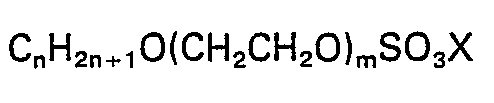
[0017] Alternatively or in addition the anionic detergent may comprise an alkyl sulphate, or an alkyl ether sulphate. These sulphates are advantageous for production of detergents with good foaming properties. Alkyl sulphates may be derived from linear alk-1-ene having 12 to 18 carbon atoms for example sodium lauryl sulphate. Preferred alcohol sulphates may be derived from products of the OXO or Ziegler processes. Preferred ether sulphates are derived from ethylene oxide and may comprise a major proportion having the general formula:-
wherein n is 13 or 15, m is 2 or 3 and X is Na, K, NH4 or an ethanolamine.
[0018] Preferred detergents in accordance with the invention incorporate an alkylphenyl polyether such as OH terminated polyether. The latter may be formed by reacting an alkyl phenol with ethylene oxide. Preferred polyethers incorporate nonyl or octyl alkyl chains or mixtures including major proportions of such chains. Preferred polyethers may comprise mixtures of polyether chains with major proportions of chains having 6 or 9 (CH2CH20) units or, more preferably, major proportions of both 6 and 9 (CH2CH20) unit containing chains. A greater proportion of chains having 6 (CH2CH20) units to chains having 9 (CH2CH20) units is particularly preferred. Smaller proportions of polyethers with larger ether chain lengths may be incorporated for example having 12 (CH2CH20) units.
[0019] Preferred detergents in accordance with this invention incorporate a base. Preferred bases include monoethanolamine, diethanolamine, triethanolamine or potassium or sodium hydroxides. Monoethanolamine and triethanolamine are particularly preferred.
[0020] Detergents in accordance with this invention may be selected from a wide range of compositions in which the proportions of the ingredients are chosen so that they may be diluted to form an aqueous solution having a strength in the range 7 to 50% by weight, which has a viscosity of at least 2x10⁻⁴m2s-' (200 centistokes) in the absence of an inorganic thickening agent, and which has adequate cleaning properties in accordance with the plate washing test.
[0021] The cleaning capabilities and foam end point of detergents in accordance with this invention are dependent on a number of factors.
[0022] The ratio of anionic detergent to nonionic detergent is important, an excess of nonionic detergent being essential.
[0023] The ratio of anionic detergent to insoluble polyethers is also important, a greater proportion of anionic detergent having been found to increase the solubility of the polyether constituent.
[0024] Preferably the detergent composition of this invention incorporates not more than 30% of anionic detergent estimated as the free acid. More preferably there is between 15% and 25% of dodecylbenzenesulphonic acid present in detergents which do not contain alkyl or ether sulphates. If the latter compounds are present the preferred proportion of dodecylbenzenesulphonic acid is 8% to 25%. The proportion of alkyl or ether sulphate is preferably 10% to 30% based on the weight of the commercially available solutions, the latter containing approximately 70% of the pure compounds.
[0025] The proportion of the ethanolamide derivative of coconut oil has an important effect of the viscosity of the detergent. The derivative also serves to stabilise the foam. Preferably there is 10% to 40% of coconut oil ethanolamide present. More preferably there is 15% to 33% of the ethanolamide, a range of 20% to 30% being especially preferred.
[0026] It has been found that incorporation of alkylphenyl polyethers having a side chain incorporating a small number of (CH2CH20) groups is a key factor effecting the viscosity of detergents in accordance with the invention. However, such polyethers alone may be insoluble in water. Preferably the cloud point of the insoluble polyether is less than zero. Mixtures incorporating nonylphenyl polyether are particularly preferred ingredients, a wide range of ether chain lengths being advantageous.
[0027] Optimum cleansing capacity has been achieved with alkylphenyl polyethers incorporating six or nine (CH2CH20) groups of mixtures thereof. Nonylphenyl polyethers are particularly efficacious in control of the viscosity of the diluted detergent. Nonylphenyl polyethers having a low solubility in water, notably those comprising six (CH2CH20) groups are particularly preferred as a major proportion of total polyethers in the detergent. Preferred detergent compositions of this invention incorporate between 25% and 55% of nonylphenyl polyether. More preferably there is between 40% and 55% of the polyether. Detergent compositions of this invention often incorporate a blend of nonylphenyl polyethers. For example a detergent which can be diluted to from 8-20% solutions having a viscosity not less than 0.3 Pa . s (300 cp) may comprise 1―5% of nonylphenyl polyether incorporating 12 (CH2CH2O) units, 25―45% of nonylphenyl polyether incorporating 6 (CH2CH20) units and 2-10% of nonylphenyl polyethers having 8 or 9 (CH2CH20) units. The actual percentages of these three components are chosen so that the total percentage of polyether falls within the aforementioned range of 25-55%. A particular efficacious range for the three aforementioned polyethers is 1-3% with 12 (CH2CH20) units, 30-45% with 6 (CH2CH20) units and 5-10% with 8 or 9 (CH2CH20) units.
[0028] Bases having a low molecular weight are preferred, monoethanolamine having been found to provide more viscous detergents than diethanolamine. Use of triethanolamine has the advantage of maintaining a constant pH in the detergent. Ethanolamines may be used in conjunction with sodium or potassium hydroxides, the ratio of alkali metal hydroxide to ethanolamine being important.
[0029] Preferably the amount of mono-, di- and triethanolamine present is approximately 1.01.5× the stoichiometric amount based on the sulphonate and sulphate present being desirable. The amount of mono, di- or triethanolamine is preferably selected so that a 10% aqueous solution of the detergent has a pH of 6.8 to 9, more preferably of 7.5 to 8.5. A relatively larger proportion of diethanolamine or triethanolamine is required if this reagent is used in place of ethanolamine since the mono derivative is the most active.
[0030] Detergent in accordance with this invention may be diluted to form aqueous solutions of more than 7% strength, for example 8%, 10%, 20%, 25% and 40%.
[0032] A particular preferred detergent comprises ingredients not exceeding a total of 100% and comprising, 7% to 30% of dodecylbenzenesulphonic acid, 10% to 30% of a solution equivalent to a 70% solution of anionic detergent of the formula:
wherein n is 13 or 15 and m is 3; X is Na or NH4 or an ethanolamine, 25% to 50% of nonylphenyl polyether; 5% to 40% of coconut oil diethanolamide and residual percentages of ethanolamine and triethanolamine.
[0033] More preferably the detergent may comprise: 7% to 15% of dodecylbenzenesulphonic acid; 15% to 25% of the said solution of anionic detergent; 30% to 45% of nonylphenyl polyether; 20% to 35% of coconut oil diethanolamide; 1% to 4% of ethanolamine and 2% to 5% of triethanolamine.
[0034] The total percentage of nonylphenyl polyether and coconut oil diethanolamide is preferably 50% to 65%. The total percentage of dodecylbenzenesulphonic acid and the said anionic detergent is preferably 20% to 35%. The percentage of coconut oil diethanolamide is preferably 15% to 35%. This detergent yields self-thickening 10-25% aqueous solutions. Such detergents having a total percentage of polyether and coconut oil diethanolamide less than 50% form self thickening 15% to 45% aqueous solutions.
[0035] The invention is further described by means of the following Examples and with reference to Table 2 and Figures 1 to 6 of the accompanying drawings which illustrate detergent formulations in accordance with the invention.
[0036] Table 2 shows the compositions and properties of preferred detergents including the viscosities of 7%, 8%, 10% and 20% aqueous solutions;
Fig. 1 shows a 3 dimensional representation of detergent compositions in accordance with the invention;
Fig. 2 is a plan view of the diagram shown in Figure 1;
Figs. 3 to 6 show sections taken through the diagram shown in Figures 1 and 2.
[0037] In the following examples, and in Table 2, viscosity is expressed in centistokes (cs) 1 cs=10-6m2s-1.
Example 1
[0038] A detergent was prepared from a nonylphenyl polyether incorporating six (CH2CH20) units in the side chain (36%), dodecylbenzenesulphonic acid (30%) monoethanolamine (9%), coconut oil diethanolamide (25%). A 72% aqueous solution of the detergent had a viscosity of 300 cs an 8% solution was found to have a viscosity of 1000 cs and a 10% solution was found to be thixotropic and to have a viscosity of 2000 cs on a Ford Cup No. 4. 5 gm of the 10% solution was found to clean 9 plates according to the plate test.
Example 2
[0039] A detergent was prepared from nonylphenyl polyether incorporating six (CH2CH20) units (18%), dodecylbenzenesulphonic acid (20%) monoethanolamine (7%), coconut oil diethanolamide (37%) and nonylphenyl polyether incorporating 9 (CH2CH20) units (18%). An 8% aqueous solution of the detergent was found to have a viscosity of 210 cs and a 10% solution was found to have a viscosity of 2000 cs 5 g of the 10% solution was found to clean 12 plates.
Example 3
[0040] A detergent was prepared from nonylphenyl polyether containing six (CH2CH20) units (20%) dodecylbenzenesulphonic acid (20%), monoethanolamide (7%), coconut oil diethanolamide (33%) and nonylphenyl polyether containing nine (CH2CH20) units (20%). An 8% aqueous solution of the detergent was found to have a viscosity of 200 cs and a 10% solution was found to have a viscosity of 2000 cs. The detergent (5 g of 10% solution) was found to clean 13 plates.
Example 4
[0041] A detergent was prepared from coconut oil diethanolamide (33%) nonylphenylpolyether containing 9 (CH2CH20) units (5%), nonylphenylpolyether containing 6 (CH2CH20) units (35%), dodecylbenzenesulphonic acid (21 %) and monoethanolamine (6%). A (10%) aqueous solution of the detergent was found to have a viscosity of 1600 cs and 7% aqueous solution was found to have a viscosity of 700 cs. The detergent (5 g of 10% solution was found to clean 10 plates).
Example 5
[0042] A detergent was prepared from coconut oil diethanolamide (32.8%) nonylphenylpolyether containing 9 (CH2CH20) groups (10.8%), nonylphenylpolyether containing 6 (CH2CH20) groups (29.5%), narrow cut dodecylbenzenesulphonic acid (20.9%) and monoethanolamine (5.9%).
Example 6
[0043] A detergent was prepared from coconut oil diethanolamide (25.94%), nonylphenylpolyether containing 12 (CH2CH20) groups (0.89%), nonylphenylpolyether containing 8 (CH2CH20) groups (4.47%), nonylphenylpolyether containing 6 (CH2CH20) groups (30.41 %), a sodium sulphated C13/C15 alcohol with 3 (CH2CH20) groups (Synperonic 3S70 a 70% commercial solution manufactured by ICI, 24.15%), dodecylbenzenesulphonic acid (8.68%), monoethanolamine (0.54%), triethanolamine (4.47%) and preservative (0.45%; Ketrol T, Cochrane and Keane Chemicals).
[0044] The resultant detergent yielded viscous, high foaming solutions upon dilution to a strength of 10%, 15% or 20%.
Example 7
[0045] A detergent was prepared from coconut oil diethanolamide (20%), nonylphenylpolyether containing 9 (CH2CH20) groups (2%), nonylphenylpolyether containing 6 (CH2CH20) groups (43%), Synperonic 3S70 (20%), dodecylbenzenesulphonic acid (10%), monoethanolamine (1%) and triethanolamine (4%). The resultant detergent yielded viscous detergents upon dilution to a strength of 9% to 10%.
Example 8
[0046] A detergent was prepared from coconut oil diethanolamide (25%), nonylphenylpolyether containing 6 (CH2CH20) groups (25%), Synperonic 3S70 (20%), dodecylbenzenesulphonic acid (20%), monoethanolamine (2%) and triethanolamine (8%).
[0047] The resultant detergent produced viscous detergents when diluted to strengths of 15%, 20%, 25%, 30% and 40%.
[0048] A number of abbreviations are used in the following description and in Table 2 and Figures to which the description relates. These are set out below:-
diethanolamine derivative of coconut oil=CD
nonylphenylpolyether containing six (CH2CH20) units=N6
nonylphenylpolyether containing 9 (CH2CH20) units=N9
nonylphenylpolyether containing twelve (CH2CH20) units=N12
dodecylbenzenesulphonic acid="acid"
monoethanolamine=MEO
[0049] Table 2 shows the composition and properties of preferred detergents. The compositions of the detergents indicated by the reference numbers 18, 20, 26, 28 and 29 may be determined from Figure 6. Figure 1 is a three-dimensional diagram showing the proportions of N6, N9, CD and dodecylbenzenesulphonic acid which may be present in detergents in accordance with the invention. Figure 2 is a plan view of the latter diagram. Figures 3 to 6 are sections through the diagram shown in Figures 1 and 2 showing variation of the ingredients N6, N9 and CD at constant proportions of dodecylbenzenesulphonic acid.
[0050] Figure 3 illustrates the variation at D of Figure 2 of a total of 40% of N9, N6 and CD in detergents containing constant proportions of 40% Acid, 11 % MEO and 9% CD. The shaded area shows the preferred compositions.
[0051] Figure 4 shows the variation at B of Figure 2 of a total of 60% of N9, N6 and CD in detergents containing constant proportions of 30% Acid, 9% MEO and 1 % CD. The shaded area shows preferred compositions.
[0052] Figure 5 shows the variations at A of Figure 2 of a total of 70% of N9, N6 and CD in detergents containing constant properties of 20% Acid, 7% MEO and 3% CD. The first shaded area shows preferred compositions including diethanolamide prepared from coconut oil or from the methyl ester thereof. The second shaded area shows additional preferred compositions including diethanolamide prepared from coconut oil only.
[0053] Figure 6 is a section of Figure 2 taken close to Figure 6 and showing variation of a total of 70% of N6, N9 and CD, in compositions containing constant proportions of 21 % Acid, 6% MEO and 3% of CD. The two shaded areas show preferred and especially preferred compositions.
[0054] Detergents including 65% or more of dodecylbenzenesulphonic acid have been found to form gels or to be unstable. Detergents comprising less than 17% of the acid have been found to have poor cleaning capacity and to exhibit low foam stability. Compositions containing 10-25% of ether sulphate need only contain 8% to 15% of the acid.
[0055] The ingredients NP6, NP9 and NP12 are manufactured under the Registered Trade Mark Synperonic by ICI although alternative brands may also be used. Coconut oil derivatives which are useful in accordance with the invention may be obtained under the Registered Trade Mark Ethylan, manufactured by Diamond Shamrock Process Chemicals Limited. Coconut oil may also be obtained from Rewo Chemicals Limited and Baxenden Chemicals Limited. Dodecylbenzenesulphonic acid may be obtained from Shell, BP, CFC or Henkel. Ethanolamine should preferably be the last ingredient which is added when making detergents in accordance with this invention.
1. A mobile liquid detergent comprising not more than 8% by weight water and not less
than 90% by weight of active detergent including an anionic surface active agent,
an ethanolamide derivative of coconut oil and a non-ionic polyether, (wherein a 0.01%
w/w solution of the active detergent exhibits a surface tension at 20°C of not more
than 4.5x10-ZNm-2 (45 dyne cm-1) characterised in that the said mobile liquid detergent contains a total of not less
than 50% by weight of the ethanolamide derivative of coconut oil and the non-ionic
polyether, and in that the liquid detergent may be diluted to form an aqueous solution
having a strength in the range 7 to 50% by weight, which has a viscosity not less
than 2×10⁻⁴m2s-1 (200 centistokes) in the absence of an inorganic thickening agent.
2. A detergent as claimed in claim 1, characterised in comprising not less than 92%
of active detergent, not more than 1% polyethylene glycol and not more than 4% glycerine.
3. A detergent as claimed in claim 1, characterised in that 8% to 10% aqueous solutions
have a viscosity of from 5×10⁻⁴ to 10×10-4m2s-1 (500 to 1000 centistokes).
4. A detergent as claimed in claim 1 characterised in that 15% to 45% aqueous solutions
have a viscosity not less than 2x 10⁻⁴m2s-1 (200 centistokes).
5. A detergent as claimed in any preceding claim characterised in comprising a polyether
selected from an alkylphenyl polyether or a polyether derived from aliphatic alcohol
selected from: alcohols having 13 to 15 carbon atoms; alcohols having 17 or 18 carbon
atoms or a mixture of oleyl and cetyl alcohols.
6. A detergent as claimed in any preceding claim characterised in that the anionic
surface active agent comprises dodecylbenzenesulphonic acid or a salt thereof.
7. A detergent as claimed in any preceding claim, characterised in comprising an anionic
surface active agent selected from an alkyl sulphate or an anionic surface active
agent represented by the formula:

wherein n is 12 or 15, m is 2 or 3 and X is Na, K, NH4 or an ethanolamine.
wherein n is 12 or 15, m is 2 or 3 and X is Na, K, NH4 or an ethanolamine.
8. A detergent as claimed in any of claims 5 to 7 characterised in comprising a polyether
represented by the formula:

wherein r and s are integers.
wherein r and s are integers.
9. A detergent as claimed in claim 8 characterised in that r is 8 or 9 and s is 6
to 12.
10. A detergent as claimed in claim 9 characterised in that a major proportion of
the polyethers have r equal to 8 or 9 and s equal to 6 or 9 and comprise a greater
proportion of polyethers having s=6 than having s=9.
11. A detergent as claimed in any preceding claim, characterised in comprising a greater
percentage of anionic surface active agent than polyether.
12. A detergent as claimed in any of claims 1 to 6, or claim 11 when not appendent
on claims 7 to 10 characterised in comprising 15% to 25% of dodecylbenzenesulphonic
acid.
13. A detergent as claimed in any of claims 7 to 10 characterised in comprising 8%
to 25% of dodecylbenzenesulphonic acid and an amount equivalent to 10% to 30% of a
70% solution of an alkyl or ether sulphate.
14. A detergent as claimed in any preceding claim, characterised in comprising 15%
to 33% of said ethanolamide.
15. A detergent as claimed in claim 8 characterised in comprising 1 % to 5% of polyether
wherein r is 9 and s is 12, 25% to 45% of polyether wherein r is 9 and s is 6 and
2% to 10% of polyether wherein r is 9 and s is 8 or 9.
16. A detergent as claimed in claim 15 characterised in comprising 1 % to 3% of polyether
wherein r is 9 and s is 12,30% to 45% of polyether wherein r is 9 and s is 6 and 5%
to 10% of polyether wherein r is 9 and s is 8 or 9.
17. A detergent as claimed in any preceding claim characterised in comprising ingredients
selected from: 7% to 30% of a solution equivalent to a 70% solution of an anionic
surface active agent of the formula:

wherein n is 13 or 15, m is 3, X is Na, NH4 or an ethanolamine, 25% to 50% of nonylphenyl polyether; 5% to 40% of coconut oil diethanolamide and residual proportions of ethanolamine and triethanolamine.
wherein n is 13 or 15, m is 3, X is Na, NH4 or an ethanolamine, 25% to 50% of nonylphenyl polyether; 5% to 40% of coconut oil diethanolamide and residual proportions of ethanolamine and triethanolamine.
18. A detergent as claimed in claim 17 characterised in comprising ingredients selected
from: 7% to 15% of dodecylbenzenesulphonic acid; 15% to 25% of the said solution of
anionic detergent; 30% to 45% of nonylphenyl polyether; 20% to 35% of coconut oil
diethanolamide; 1 % to 4% of ethanolamine, and 2% to 5% of triethanolamine.
19. A detergent as claimed in claim 17 or 18, characterised in comprising a total
of 50% to 65% of nonylphenyl polyether and coconut oil diethanolamide.
20. A detergent as claimed in any of claims 18 or 19 characterised in comprising a
total of 20% to 35% of dodecylbenzenesulphonic acid and the said anionic detergent.
1. Bewegliches flüssiges Reinigungsmittel mit nicht mehr als 8 Gew.-% Wasser und nicht
weniger als 90 Gew.-% aktivem Reinigungsmittel einschließlich einem anionischen oberflächenaktiven
Mittel, einem Ethanolamidderivat von Kokosnußöl und einem nicht-ionischen Polyether
(worin eine 0,01 gew.%ige Lösung des aktiven Reinigungsmittels bei 20°C eine Oberflächenspannung
von nicht mehr als 4,5x10⁻²Nm-2 (45 Dyn cm-1) aufweist), dadurch gekennzeichnet, daß das bewegliche flüssige Reinigungsmittel
insgesamt nicht weniger als 50 Gew.-% des Ethanolamidderivates von Kokosnußöl und
des nicht-ionischen Polyethers enthält und daß das flüssige Reinigungsmittel unter
Bildung einer wäßrigen Lösung mit einer Stärke im Bereich von 7 bis 50 Gew.-% verdünnt
werden kann, die in Abwesenheit eines anorganischen Dickungsmittels eine Viskosität
von nicht weniger als 2×10⁻⁴m2s-1 (200 Zentistokes) aufweist.
2. Reinigungsmittel nach Anspruch 1, dadurch gekennzeichnet, daß es nicht weniger
als 92% aktives Reinigungsmittel, nicht mehr als 1% Polyethylenglykol und nicht mehr
als 4% Glyzerin enthält.
3. Reinigungsmittel nach Anspruch 1, dadurch gekennzeichnet, daß 8 bis 10%ige wäßrige
Lösungen eine Viskosität von 5×10⁻⁴ bis 10×10-4m2s-1 (500 bis 1000 Zentistokes) aufweisen.
4. Reinigungsmittel nach Anspruch 1, dadurch gekennzeichnet, daß 15 bis 45%ige wäßrige
Lösungen eine Viskosität von nicht weniger als 2x10⁻⁴m2s-' (200 Zentistokes) aufweisen.
5. Reinigungsmittel nach einem der vorstehenden Ansprüche, dadurch gekennzeichnet,
daß es einen Polyether, ausgewählt aus einem Alkylphenylpolyether oder einem Polyether,
der sich von aliphatischen Alkoholen, ausgewählt aus: Alkoholen mit 13 bis 15 Kohlenstoffatomen,
Alkoholen mit 17 oder 18 Kohlenstoffatomen oder einer Mischung von Oleyl- und Cetylalkoholen
ableitet, enthält.
6. Reinigungsmittel nach einem der vorstehenden Ansprüche, dadurch gekennzeichnet,
daß das anionische oberflächenaktive Mittel Dodecylbenzolsulfonsäure oder ein Salz
hiervon enthält.
7. Reinigungsmittel nach einem der vorstehenden Ansprüche, dadurch gekennzeichnet,
daß es ein anionisches oberflächenaktives Mittel, ausgewählt aus einem Alkylsulfat
oder einem anionischen oberflächenaktiven Mittel der folgenden Formel:

in der n gleich 12 oder 15, m gleich 2 oder 3 und X gleich Na, K, NH4 oder ein Ethanolamin bedeuten, enthält.
in der n gleich 12 oder 15, m gleich 2 oder 3 und X gleich Na, K, NH4 oder ein Ethanolamin bedeuten, enthält.
8. Reinigungsmittel nach einem der Ansprüche 5 bis 7, dadurch gekennzeichnet, daß
es einen Polyether der folgenden Formel:

in der r und s für ganze Zahlen stehen, enthält.
in der r und s für ganze Zahlen stehen, enthält.
9. Reinigungsmittel nach Anspruch 8, dadurch gekennzeichnet, daß r für 8 oder 9 und
s für eine Zahl von 6 bis 12 steht.
10. Reinigungsmittel nach Anspruch 9, dadurch gekennzeichnet, daß bei einem Hauptanteil
des Polyethers r gleich 8 oder 9 und s gleich 6 oder 9 ist und daß es einen größeren
Anteil an Polyether mit s gleich 6 als mit s gleich 9 enthält.
11. Reinigungsmittel nach einem der vorstehenden Ansprüche, dadurch gekennzeichnet,
daß es einen größeren Prozentsatz an anionischem oberflächenaktiven Mittel als Polyether
enthält.
12. Reinigungsmittel nach einem der Ansprüche 1 bis 6 oder 11, falls nicht abhängig
von Ansprüchen 7 bis 10, dadurch gekennzeichnet, daß es 15 bis 25% Dodecylbenzolsulfonsäure
enthält.
13. Reinigungsmittel nach einem der Ansprüche 7 bis 10, dadurch gekennzeichnet, daß
es 8 bis 25% Dodecylbenzolsulfonsäure und eine Menge, die 10 bis 30% einer 70%igen
Lösung eines Alkyl- oder Ethersulfates äquivalent ist, enthält.
14. Reinigungsmittel nach einem der vorstehenden Ansprüche, dadurch gekennzeichnet,
daß es 15 bis 33% des Ethanolamides enthält.
15. Reinigungsmittel nach Anspruch 8, dadurch gekennzeichnet, daß es 1 bis 5% Polyether
mit r gleich 9 und s gleich 12, 25 bis 45% Polyether mit r gleich 9 und s gleich 6
und 2 bis 10% Polyether mit r gleich 9 und s gleich 8 oder 9 enthält.
16. Reinigungsmittel nach Anspruch 15, dadurch gekennzeichnet, daß es 1 bis 3% Polyether
mit r gleich 9 und s gleich 12, 30 bis 45% Polyether mit r gleich 9 und s gleich 6
und 5 bis 10% Polyether mit r gleich 9 und s gleich 8 oder 9 enthält.
17. Reinigungsmittel nach einem der vorstehenden Ansprüche, dadurch gekennzeichnet,
daß es Bestandteile enthält, die ausgewählt sind aus: 7 bis 30% einer Lösung, die
äquivalent ist einer 70%igen Lösung eines anionischen oberflächenaktiven Mittels des
Formel:
worin bedeuten: n gleich 13 oder 15, m gleich 3, X gleich Na, NH4 oder ein Ethanolamin; 25 bis 50% Nonylphenylpolyether; 5 bis 40% Kokosnußöldiethanolamid und resetlichen Anteilen von Ethanolamin und Triethanolamin.
worin bedeuten: n gleich 13 oder 15, m gleich 3, X gleich Na, NH4 oder ein Ethanolamin; 25 bis 50% Nonylphenylpolyether; 5 bis 40% Kokosnußöldiethanolamid und resetlichen Anteilen von Ethanolamin und Triethanolamin.
18. Reinigungsmittel nach Anspruch 17, dadurch gekennzeichnet, daß es Bestandteile
enthält, die ausgewählt sind aus: 7 bis 15% Dodecylbenzolsulfonsäure; 15 bis 25% der
Lösung des anionischen Reinigungsmittels; 30 bis 45% Nonylphenylpolyether; 20 bis
35% Kokosnußöldiethanolamid; 1 bis 4% Ethanolamin und 2 bis 5% Triethanolamin.
19. Reinigungsmittel nach Anspruch 17 oder 18, dadurch gekennzeichnet, daß es insgesamt
50 bis 65% Nonylphenylpolyether und Kokosnußöldiethanolamid enthält.
20. Reinigungsmittel nach Ansprüchen 18 oder 19, dadurch gekennzeichnet, daß es insgesamt
20 bis 35% Dodecylbenzolsulfonsäure und anionisches Reinigungsmittel enthält.
1. Détergent liquide mobile comportant au plus 8% en poids d'eau et au moins 90% en
poids de détergent actif, comprenant un agent tensio-actif anionique, un dérivé éthanolamide
d'huile de coprah et un polyéther non-ionique (où une solution à 0,01% en poids du
détergent actif présente une tension superficielle à 20°C d'au plus 4,5×10⁻²Nm-2) (45 dyne cm-1), caractérisé par le fait que ledit détergent liquide mobile contient un total d'au
moins 50% en poids du dérivé éthanolamide d'huile de coprah et de polyéther non-ionique,
et que le détergent liquide peut être dilué pour former une solution aqueuse ayant
une concentration allant de 7 à 50% en poids, qui a une viscosité d'au moins 2x 10⁻⁴m2s-' (200 centistokes) en l'absence d'un épaississant inorganique.
2. Détergent selon la revendication 1, caractérisé par le fait qu'il comprend au moins
92% de détergent actif, au plus 1% de polyéthylèneglycol et au plus 4% de glycérine.
3. Détergent selon la revendication 1, caractérisé par le fait que des solutions aqueuses
à 8%-10% ont -une viscosité de 5×10⁻⁴ à 10×10-14m2s-1 (500 à 1000 centistokes).
4. Détergent selon la revendication 1, caractérisé par le fait que des solutions aqueuses
à 15%-45% ont une viscosité d'au moins 2×10⁻⁴m2s-1 (200 centistokes).
5. Détergetn selon l'une des revendications précédentes, caractérisé par le fait qu'il
comprend un polyéther choisi dans le groupe des alkylphénylpolyéthers ou des polyéthers
dérivés d'alcools aliphatiques choisis parmi les alcools ayant 13 à 15 atomes de carbone,
les alcools ayant 17 ou 18 atomes de carbone ou les mélanges d'alcools oléique et
cétylique.
6. Détergent selon l'une des revendications précédentes, caractérisé par le fait que
l'agent tensio-actif anionique comprend l'acide dodécylbenzènesulfonique ou un de
ses sels.
7. Détergent selon l'une des revendications précédentes, caractérisé par le fait qu'il
comprend un agent tensio-actif anionique choisi parmi les sulfates d'alkyle ou les
agents tensio-actifs anioniques représentés par la formule

dans laquelle n est 12 ou 15, m est 2 ou 3, et X est Na, K, NH4 ou une éthanolamine.
dans laquelle n est 12 ou 15, m est 2 ou 3, et X est Na, K, NH4 ou une éthanolamine.
8. Détergent selon l'une des revendications 5 à 7, caractérisé par le fait qu'il comprend
un polyéther représenté par la formule

dans laquelle r et s sont des nombres entiers.
dans laquelle r et s sont des nombres entiers.
9. Détergent selon la revendication 8, caractérisé par le fait que r est 8 ou 9 et
s est 6 à 12.
10. Détergent selon la revendication 9, caractérisé par le fait qu'une majeure partie
des polyéthers ont r égal à 8 ou 9 et s égal à 6 ou 9 et comprennent une plus grande
proportion de polyéthers ayant s=6 que de ceux ayant s=9.
11. Détergent selon l'une des revendications précédentes, caractérisé par le fait
qu'il comprend un plus grand pourcentage d'agent tensio-actif anionique que de polyéther.
12. Détergent selon l'une des revendications 1 à 6 ou 11, lorsqu'il ne dépend pas
des revendications 7 à 10, caractérisé par le fait qu'il comprend 15% à 25% d'acide
dodécylbenzènesulfonique.
13. Détergent selon l'une des revendications 7 à 10, caractérisé par le fait qu'il
comprend 8% à 25% d'acide dodécylbenzènesulfonique et une quantité équivalent à 10-30%
d'une solution à 70% d'un sulfate d'alkyle ou d'éther.
14. Détergent selon l'une des revendications précédentes, caractérisé par le fait
qu'il comprend 15% à 33% dudit éthanolamide.
15. Détergent selon la revendication 8, caractérisé par le fait qu'il comprend 1 %
à 5% de polyéther où n est 9 et s est 12, 25 à 45% de polyéther où r est 9 et s est
6 et 2 à 10% de polyéther où r est 9 et s est 8 ou 9.
16. Détergent selon la revendication 15, caractérisé par le fait qu'il comprend 1
à 3% de polyéther où r est 9 et s est 12, 30% à 45% de polyéther où r est 9 et s est
6 et 5-10% de polyéther où r est 9 et s est 8 ou 9.
17. Détergent selon l'une des revendications précédentes, caractérisé par le fait
qu'il comprend des ingrédients choisis parmi 7 à 30% d'une solution équivalent à une
solution à 70% d'un agent tensio-actif anionique de formule

où n est 13 ou 15, m est 3, X est Na, NH4 ou une éthanolamine, 25 à 50% d'un polyéther de nonylphényle, 5 à 40% de diéthanolamide d'huile de coprah et des proportions résiduelles d'éthanolamine et triéthanolamine.
où n est 13 ou 15, m est 3, X est Na, NH4 ou une éthanolamine, 25 à 50% d'un polyéther de nonylphényle, 5 à 40% de diéthanolamide d'huile de coprah et des proportions résiduelles d'éthanolamine et triéthanolamine.
18. Détergent selon la revendication 17, caractérisé par le fait qu'il comprend des
ingrédients choisis parmi: 7 à 15% d'acide dodécylbenzènesulfonique, 15 à 25% de la
dite solution de détergent anionique, 30 à 45% de polyéther de nonylphényle, 20 à
35% de diéthanolamide d'huile de coprah, 1 à 4% d'éthanolamine et 2 à 5% de triéthanolamide.
19. Détergent selon la revendication 17 ou 18, caractérisé par le fait qu'il comprend
un total de 50 à 65% de polyéther de nonylphényle et de diéthanolamide d'huile de
coprah.
20. Détergent selon l'une des revendications 18 ou 19, caractérisé par le fait qu'il
comprend un total de 20 à 35% d'acide dodécylbenzènesulfonique et dudit détergent
anionique.