|
(11) | EP 0 091 231 B1 |

| (12) | EUROPEAN PATENT SPECIFICATION |
|
|
| (54) |
Flux for brazing aluminium and method of employing the same Flussmittel zum Hartlöten von Aluminium und Verfahren zu dessen Verwendung Flux pour le brasage d'aluminium et procédé pour l'utilisation dudit flux |
|
|
|||||||||||||||||||||||||||||||
| Note: Within nine months from the publication of the mention of the grant of the European patent, any person may give notice to the European Patent Office of opposition to the European patent granted. Notice of opposition shall be filed in a written reasoned statement. It shall not be deemed to have been filed until the opposition fee has been paid. (Art. 99(1) European Patent Convention). |
[0001] This invention relates to a method of joining by brazing surfaces of aluminium and aluminium alloy (hereinafter referred to collectively as "aluminium articles") to one another and to other metal articles, such as copper and stainless steel, for example, using a reactive flux.
[0002] Generally, the technique of brazing has been employed in assembling metal articles, consisting wholly or in part of aluminium or aluminium alloys, the parts of which are joined by means of a brazing alloy, which has a lower melting point.
[0003] In the construction of automotive parts, for example, the technique of brazing has been employed for the manufacture of structural members such as intake manifolds and cylinder heads as well as heat exchanges for condensers, evaporators, and engine oil coolers. The technique has also been adopted for the manufacture of rectifier heat sinks for use in electronic devices. In various other industrial fields, it has also found widespread acceptance.
[0004] When for example, two aluminium articles are to be joined by means of a brazing alloy, a flux is used to remove any oxide film on the surfaces to be joined. At the same time, the flux improves the wet spreading or flowing property of the molten brazing alloy over the surfaces to be joined. Chloride fluxes have been widely used for that purpose.
[0005] Since a chloride flux is soluble in water and hygroscopic, it has a disadvantage that when the flux itself or the reaction residue resulting from brazing is permitted to adhere to and remain on the articles being joined, it causes corrosion of the aluminium articles. For this reason, where brazing has been effected with a chloride flux, the brazing operation has had to be followed by a step to remove the residual flux. If some part of the brazed joint being cleaned happens to be inaccessible, there is a possibility that some flux will remain there and eventually lead to corrosion.
[0006] It is already known that the corrosion problem arising from the use of chloride fluxes in a brazing operation can be overcome by the use of a flux based on the AIF3-KF binary system which leaves no water-soluble residues.
[0007] It is already known from U.S. Patent No. 3,951,328 and US-A-3,971,501 to employ fluxes of that type which are free from water-soluble components; particularly fluxes which are free from unreacted KF. Such fluxes can be employed in the form of an aqueous slurry, which is dried off before the commencement of the brazing operation. Since the brazing operation is very advantageously carried out in a very dry atmosphere, particularly a very dry nitrogen atmosphere, it is extremely desirable that the applied flux should be free of hygroscopic components, such as unreacted KF.
[0008] The fluxes described in each of U.S. Patents 3,951,328 and 3,971,501 consist of a mixture of potassium fluoaluminates, which may be formed separately and mixed or be formed in intimate mixture by a separately performed chemical reaction. It was stated in both of these US Patents that the flux could include up to about 5 mole % total of LiF, CaF2 NaF, but such addition was stated to result in an increase in the liquidus temperature ("melting point") of the flux and it was therefore concluded that such addition of alkali metal fluoride or alkaline earth metal fluoride was not advantageous.
[0009] The lowest liquidus temperature of the straight potassium fluoaluminate flux of U.S. Patent No. 3,951,328 is about 560°C (substantially higher than that of the chloride-type fluxes already mentioned). Such a liquidus temperature is considered too high for use in brazing operations where one of the components has a relatively low solidus temperature, for example where it is formed from an Al casting, having a high Si content. Generally it is considered desirable in a brazing operation, in order to achieve a stable product quality and a reliable brazing operation, that, on the one hand, the melting point (liquidus) of the brazing alloy should be 10 to 40°C lower than the solidus temperature of the articles to be joined, while on the other hand the melting point (liquidus) of the flux should be equal to or up to 20°C lower than the solidus temperature of the brazing metal. From this point of view, any reduction in the melting point of the flux itself can be expected to expand the range of aluminium alloys which can be joined by brazing and, as a consequence, widen the range of useful products that can be assembled in this manner.
[0010] Further in the case of the known potassium fluoaluminate flux, if this flux is used for brazing aluminium articles containing magnesium, the wet spreading or flowing property exhibited by the brazing metal on such aluminium articles suffers and the brazing operation itself may be impaired so much as to render achievement of the desired joint strength impracticable. From a practical point of view, therefore, this flux has been considered applicable to the brazing of aluminium alloys having a magnesium (Mg) content of no more than 0.4% (by weight).
[0011] In U.S. Patent No. 3,951,328 the relative content of the potassium fluoaluminate in terms of AIF3 and KF were stated to be (by weight) AIF3 65-45% and KF 35-55% with a preferred composition of about AIF3 54.2% and KF 45.8%.
[0012] According to the present invention it has been discovered that within a more closely controlled range of proportions of AIF3 and KF, the introduction of LiF into the fluoaluminate in an amount somewhat larger than described in U.S. Patent No. 3,951,328 results in a substantial reduction of the flux melting point (liquidus). The phase diagram for the ternary system KF-LiF-AIF3 given in "Phase Diagrams for Ceramists-1969 Supplement," page 375 shows the existence of certain alkali metal fluoaluminates in the system at certain simple fluoride contents. The use of any mixture of alkali metal fluoaluminates as a brazing flux is not, of course, disclosed therein.
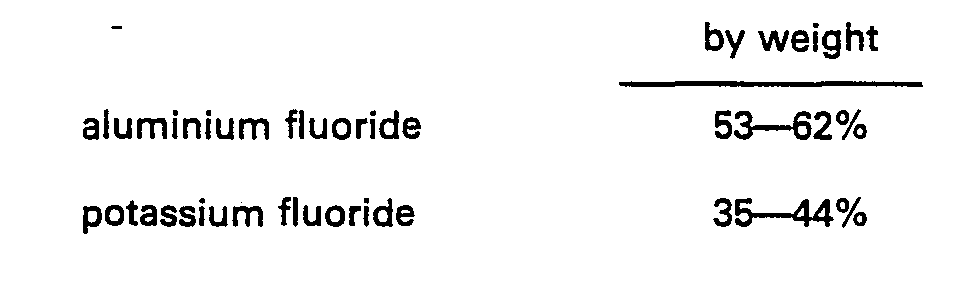
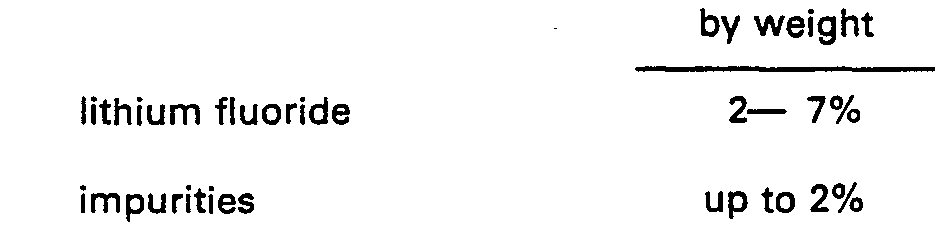
[0013] According o the present invention there is provided a method of producing a brazed joint between an aluminium or aluminium alloy component and another metallic component which comprises interposing between said components a body of a brazing alloy having a lower liquidus temperature than the solidus temperature of said components and a body of a brazing flux containing a mixture of potassium fluoaluminates and heating said assemblage to a temperature above the liquidus temperature of said brazing alloy and below the solidus temeprature(s) of said components characterized in that the brazing flux consists essentially of a mixture of alkali metal fluoaluminates, with or without admixed AIF3, said mixture comprising, in terms of simple compounds
[0014] Thus, the AIF3, KF and LiF exist in the flux in the form of a mixture of fluoaluminate complexes or mixture thereof with aluminium fluoride. The LiF content of the flux corresponds to about 5-17.5 mole % of the flux.
[0015] Flux having a composition in the range defined above has a melting point which can vary over the range of approximately 490 to 560°C, depending on the flux composition. It has been found capable of brazing aluminium articles having a Mg content of up to 2 wt%. In the course of brazing, this flux produces very little insoluble residue and forms a brazed joint of highly desirable qualities.
[0016] The system KF, AIF3, LiF has an eutectic composition of about (by weight %) 43 KF, 54.7 AIF3, 2.3 LiF and with a melting point of about 490°C. The liquidus temperature rises steeply in this compositional region and when a flux of exceptionally low liquidus temperature is required the fluoaluminate flux composition is controlled to be very close to the above stated eutectic.
[0017] The contents of AIF3 and KF should not deviate appreciably from their respective lower and upper limits. For, when they depart from the stated ranges, the resultant flux produces during brazing a white insoluble residue, which impairs further union by brazing, and the melting point of the flux increases above the desired range.
[0018] The content of LiF should not fall short of about 2.0 wt%. When it is less than this level, the flux in use, depending on the proportions of AIF3 and KF present, produces a white insoluble material and fails to manifest the desired brazing property with aluminium alloys containing magnesium. The Lif content should not, on the other hand, exceed about 7.0 wt%. Above this level, the flux produces in use a black insoluble material and consequently impairs further union by brazing and the melting point of the flux itself is elevated.
[0019] In the method of this invention, the components of the flux used therein are required to be present in the form of a mixture of fluoaluminate complexes as such or such complexes in admixture with aluminium fluoride. As distinct forms of such fluoaluminate complexes, such structures as KAIF4, K3AIF6, K2LiAIF6 LiAIF4, and Li3AIF6 have been identified. Depending on the method to be used for the preparation of the present fluxes, compounds such as K2AlF5H20 which are less stable than the aforementioned complex salts may possibly be produced in trace quantities. The presence of trace amount of such compounds is essentially immaterial, because they are converted into the aforementioned complex salts when the temperature is elevated during the brazing operation.
[0020] In the flux used in the present invention, the fluorides are fundamentally desired to be present in the form of fluoaluminate complex salts, because the fluoaluminate complexes have better effects upon the homogeneity and stability of the flux and the reliability of its melting point, for example.
[0021] A flux prepared by simply blending simple fluoride compound would be subject to various problems such as separation of its components during storage due to differences in specific gravity, the effects of the different diffusion speeds of fused compound during brazing upon the reliability of the flux in terms of homogeneity and melting point, and the creation of a defective joint due to the occurrence of insoluble residues resulting from variation in composition. Thus, a flux prepared in that manner would not be suitable in practice for the purpose of brazing operations.
[0022] Fluoaluminate complexes can be produced by the so-called fusion process or by the wet process. One fusion process produces fluoaluminate complexes by fusing the mixture of simple fluoride compounds having aforementioned compositions or their complexes and converting the resultant mixture into a fused coagulation. Fluoaluminate complexes may be formed in other fusion processes; for example a suitable potassium fluoaluminate complex may be formed as a by-product in the manufacture of titanium diboride and further processed to a flux of the invention by addition of LiF, followed by further fusion. The wet process produces fluoaluminate complexes by dissolving hydroxides of the metallic components of the flux (AI(OH)3, KOH, and LiOH) in an aqueous hydrofluoric acid solution, allowing the hydroxides to react with one another and with the acid to form fluoaluminates and drying the resultant complexes.
[0023] The fluxes used in the present invention can be manufactured according to a desired composition by a one-step method which is based on the fusion process or the wet process. Alternatively, they may be manufactured by a more complicated method which comprises preparing individual fluoaluminate complexes in separate steps, homogeneously mixing these fluoaluminates in amounts calculated to give a desired fluoride composition of this invention, converting the resultant mixture into an aqueous slurry, and again drying the slurry. Other similar methods can also be employed as the method of manufacture is not critical.
[0024] While fluxes used in this invention can be manufactured by any of the various methods described above, it is desirable to control the purity of the raw materials to be used and adjust the manufacturing conditions so that the inevitably entrained impurities in the ultimate flux do not exceed the approximate level of 2 wt%. The particle diameter of the flux powder is desired to be as small as possible. Normally, it is appropriate to keep this particle diameter below 74 1..1.
[0025] The fluxes used in this invention have melting points lower than the melting point of conventional AIF3-KF type fluxes. They promote an advantageous wet spreading or flowing action of the brazing metal on magnesium-containing aluminium alloys because of their specific percentage composition and their specific form described below. The present fluxes are, therefore, useful in an expanded range of applications for brazable aluminium materials.
[0026] By the present invention, virtually all aluminium alloy products, whether prefabricated or cast, except Al-Cu type alloys (AA2XXX alloys), AI-Mg alloys containing more than about 2 wt% of Mg, and AI alloys having a melting temperature of below about 530°C, can be brazed independently of their manufacturing steps. The flux can be applied not only to the brazing of two aluminium articles but also the brazing of an aluminium article to a copper, a stainless steel or other metal article.
[0027] Brazing with the flux according to the present invention can be effected in ways similar to those used in brazing operations with the conventional potassium fluoaluminate type flux. Before brazing, the surfaces to be joined may be subjected to known preliminary treatments, such as degreasing and roughening or abrading. Then, the flux is applied to the surfaces by an suitable method, which includes depositing the flux in its original powdered form on the surfaces being joined; mixing the powdered flux with a liquid medium such as water, which is incapable of forming a residue during the brazing operation, to make a slurry (containing 5 to 60 dry wt% of flux), applying this slurry to the surfaces by any suitable technique (brushing, spraying, showering, or immersing, and thereafter drying the applied slurry; or mixing the brazing alloy in powdered form with the flux and subjecting the resultant mixture to the same steps as in any of the preceding methods. The brazing alloy is introduced into the joint in any conventional manner, for example as a coating on one of the components. The flux is introduced in an amount appropriate to the brazing operation and the conditions under which it is to be performed. In most instances the flux is applied in an amount of 3-15 g/m2. However in some instances amounts above or even somewhat below this range may be usefully employed.
[0028] The brazing alloy with which the flux in the present invention is advantageously used in an aluminium alloy having a liquidus temperature in the neighbourhood of 510 to 570°C. Examples of preferred alloys include the AI-5% Si-26% Cu type alloy (liquidus temperature 517 to 530°C) as well as AA4043, AA4045, AA4047, AA4145, AA4245, AA4343 and AA4543. Such an alloy can be used in a suitable form such as, for example, powder or granules, a wire or rod, a plate, a punched plate, or a layer clad on a core, with the selection thereof made in due consideration of the contour of the surfaces to be joined and the ease of brazing work to be involved.
[0029] Then the articles whose joining surfaces have already received the brazing metal thereon are held fast with a suitable jig in a prescribed relative position. Conveniently the materials are held at a brazing temperature of 530-5800C, depending upon the melting point of the brazing alloy and the solidus temperature of the material to be joined for 3 to 20 minutes while surrounded by an atmosphere of inert gas such as nitrogen gas, preferably kept dry by control of the moisture content below the level of about 250 ppm.
[0030] For the brazing operation, proper brazing equipment and devices suitable for the particular shape of article to be joined and the desired productivity can be adopted. Generally, a torch brazing unit, a high-frequency brazing unit, and a furnace brazing unit (either for batchwise or continuous operation) are available.
[0031] The fluxes used according to the present invention as described above have been demonstrated to be equivalent or superior to conventional potassium fluoaluminate type fluxes in all areas of evaluation such as their ability to remove the oxide coating on the joining surfaces, ability to promote wet spreading or flowing of the brazing alloy on aluminium surfaces, ability to inhibit formation of residues during the brazing, and ability to effectively mechanically join the surfaces to be brazed. Since the flux used in this invention has a lower melting point than the conventional flux, it expands the range of aluminium products that can be effectively brazed. Particularly, magnesium-containing aluminium alloy articles may be brazed to some extent by the method of the present invention. Since the flux residue after brazing is composed of water-insoluble fluoaluminate complexes, there is no necessity for removing any residual flux from the joint region, such as by a cleaning treatment. The brazing procedure using this invention is simple in nature and is free from the tendency toward corrosion of the brazed product, as compared with brazing with the conventional chloride flux, both of which advantages are quite important from the practical point of view.
[0032] Now, to illustrate the present invention, typical cases in which a flux was prepared and used in the brazing of fabricated articles and cast articles will be described below as working examples.
Example 1
[0033] K3AIF6, AIF3, and Li3AIF6 were used as raw materials. They were mixed in the proportions of 57.7 parts by weight of K3AIF6, 32.4 parts by weight of AIF3, and 9.9 parts by weight of Li3AIFs, fused and solidified. The resultant solid was crushed to produce a powdered flux.
[0034] This powdered flux had a melting point of 558°C. When it was analyzed by X-ray diffraction, the presence of K3AIF6, and KAIF4, and Li3AIF6 was confirmed. In terms of chemical composition, the powdered flux was found by chemical analysis to consist of 56.3 wt% of AIF3, 39.0 wt% of KF, and 4.7 wt% of LiF.
[0035] This powdered flux was mixed with water to prepare an aqueous slurry having a solids content of 10 dry wt%. The aqueous slurry was spray- applied to a flat tube of AA1050 alloy, degreased in advance with trichloroethylene, and then dried at 150°C for five minutes. Subsequently, a corrugated fin member of an AI-10% Si-4% Cu (equivalent to AA4145 alloy) alloy, clad on the opposite surfaces of a core of AA3003, was integrally combined with the flat tube mentioned above. Within a conveyor type continuous brazing furnace, the combination of both articles was held at 570°C for five minutes in an atmosphere of nitrogen gas. Consequently both articles were connected to form a plurality of automotive condensers.
[0036] The condensers thus produced were tested for quality. The ratio of adhesion between the corrugated fin and the flat tube was 98% or over on the average and the pressure resistance was 100 to 150 kg/cm2. They were further subjected to an accelerated corrosion test in a brine spray. Even after 1,000 hours of such exposure, occurrence of harmful holes of corrosion was not observed. They showed ample brazing strength to prove the outstanding brazing property of the flux of this invention. Further, the flux produced no apparent adverse effect upon corrosion resistance of the product. Thus, the flux was shown to satisfy all the properties expected of a flux.
Example 2
[0037] A flux consisting of 59.3 wt% of AIF3, 37.6 wt% of KF, and 3.1 wt% of LiF was prepared by the wet method which comprised mixing the starting materials in the form of hydroxides in an aqueous hydrofluoric acid solution and causing the components of the mix to react to form isoluble fluoaluminates. The produced flux was found to have a melting point of 550°C. When this flux was analyzed by X-ray diffraction, the presence of KAIF4, K3AIF6, and Li3AIFe, was confirmed.
[0038] This flux was mixed with water to produce an aqueous slurry having a flux content of 50 dry wt%. This aqueous slurry was applied with a brush to the surfaces of the two halves of several die-cast intake manifolds of At-12% Si-0.8% Mg alloy which were to be joined, after such surfaces were roughened with a wire brush. The applied slurry was dried at 200°C for five minutes.
[0039] Subsequently, a brazing metal prepared by punching a plate of AI-10% Si-4% Cu-10% Zn alloy (equivalent to AA4245 alloy) in the shape conforming to the joint surfaces were mounted on one of those surfaces and the manifold halves were fitted together. The manifold assembly with the brazing material interposed between the joint surfaces thereof were placed in a batch type brazing furnace filled with an atmosphere of nitrogen gas and heated at 560°C for 10 minutes to effect brazing.
[0040] The intake manifold thus obtained was tested for quality. In an airtightness test, no leakage was detected under an inner pressure of 2.0 kg/cm2. The pressure resistance was found to be in the range of 60 to 100 kg/cm2. In an accelerated corrosion test with brine spray, no occurrence of holes due to corrosion was observed after 1,000 hours of exposure. The flux was thus shown to satisfy all the properties expected of a flux.
[0041] As an alternative in the above method, the flux may be applied to the opposed face of the brazing alloy sheet in place of or in addition to applying the flux to the face of the cast manifold half.
[0042] This example shows two advantages of the employment of the flux
(i) the brazing of an aluminium alloy component having an Mg content higher than that which would conveniently permit brazing by the use of a potassium fluoaluminate flux free of lithium fluoaluminate phases.
(ii) brazing an aluminium alloy which has a solidus temperature too low to permit it to be brazed conveniently by use of a conventional potassium fluoaluminate flux.
1. A method of producing a brazed joint between an aluminium or aluminium alloy component
and another metallic component which comprises interposing between said components
a body of a brazing alloy having a lower liquidus temperature than the solidus temperature
of said components and a body of a brazing flux containing a mixture of potassium
fluoaluminates and heating said assemblage to a temperature above the liquidus temperature
of said brazing alloy and below the solidus temperature(s) of said components characterized
in that the brazing flux consists essentially of a mixture of alkali metal fluoaluminates,
with or without admixed AIF3, said mixture comprising, in terms of simple compounds
2. A method according to claim 1, further characterized in that at least one of said
components is an AI alloy containing Mg in an amount of 0.4 to 2% by weight.
3. A method according to claim 1 or claim 2 further characterized in that the flux
is applied in the form of an aqueous slurry in an amount of from 3 to 15 g/m2 of solids.
4. A method according to any one of claims 1 to 3 in which the components are aluminium
alloy castings and the brazing alloy is introduced as a preformed sheet member between
the faces to be joined.
5. A method according to any one of claims 1 to 4 further characterized in that the
assemblage is heated in an inert gas atmosphere having a water vapour content below
250 p.p.m.
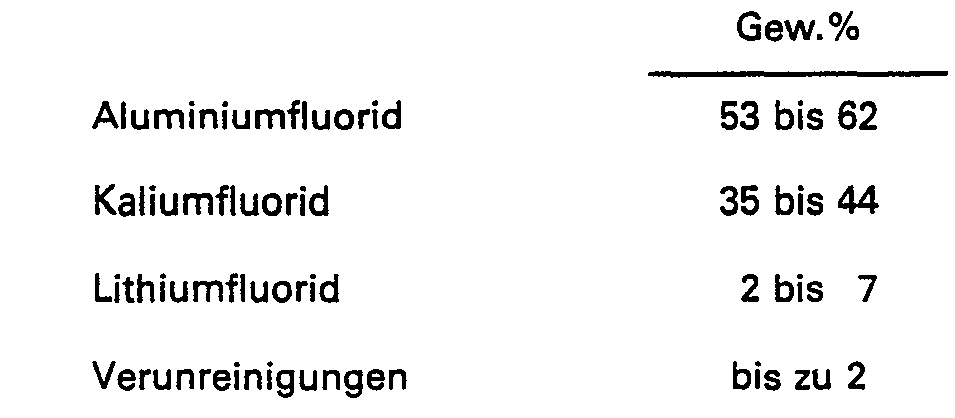
1. Verfahren zur Herstellung einer Lötverbindung zwischen einer Aluminium- oder Aluminiumlegierungskomponente
und einer anderen metallischen Komponente, welches umfasst: Einbringen zwischen die
Komponenten eines Körpers aus einer Lötlegierung mit einer niedrigeren Liquidustemperatur
als der Solidustemperatur der Komponenten und eines Körpers aus einem Lötflussmittel,
enthaltend eine Mischung von Kaliumfluoaluminaten unter Erhitzen der Anordnung auf
eine Temperatur oberhalb der Liquidustemperatur der Lötlegierung und unterhalb der
Liquidustemperatur(en) der Komponenten, dadurch gekennzeichnet, dass das Lötflussmittel
im wesentlichen aus einer Mischung aus Alkalimetallfluoaluminaten, mit oder ohne zugemischtem
AIF3, besteht, wobei die Mischung, ausgedrückt als einfache Verbindungen, umfasst:
2. Verfahren gemäss Anspruch 1, weiter dadurch gekennzeichent, dass wenigstens eine
der Komponenten eine Aluminiumlegierung, enthaltend Mg in einer Menge von 0,4 bis
2 Gew.%, ist.
3. Verfahren gemäss Anspruch 1 oder Anspruch 2, weiter dadurch gekennzeichnet, dass
das Flussmittel in Form einer wässrigen Aufschlämmung in einer Menge von 3 bis 15
g/m2 Feststoffen aufgebracht wird.
4. Verfahren gemäss einem Ansprüche 1 bis 3, bei dem die Komponenten Aluminiumlegierungs-Gussstücke
sind und die Lötlegierung als ein vorgeformter Plattenteil zwischen die zu verbindenden
Flächen eingeführt wird.
5. Verfahren gemäss einem der Ansprüche 1 bis 4, weiter dadurch gekennzeichnet, dass
man die Anordnung in einer Inertgasatmosphäre mit einem Wasserdampfgehalt unterhalb
250 ppm erhitzt.
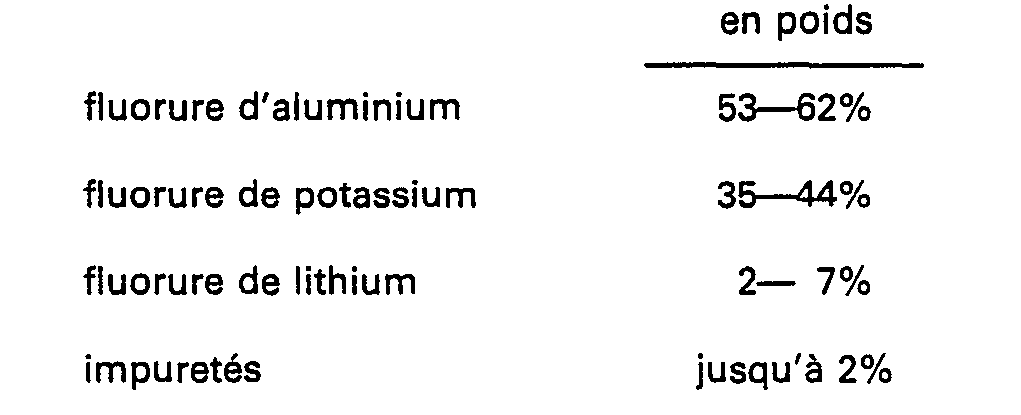
1. Procédé pour la formation d'un joint brasé entre un constituant d'aluminium on
d'alliage d'aluminium et un autre constituant métallique qui comprend l'interposition
entre lesdits constituants d'un corps d'un alliage pour brasure ayant une température
de liquidus inférieure à la température de solidus desdits constituants et d'un corps
d'un flux de brasage contenant un mélange de fluo-aluminates de potassium et le chauffage
dudit assemblage à une température au-dessus de la température de liquidus dudit alliage
pour brasure et au-dessous de la (des) température(s) de solidus desdits constituants,
caractérisé en ce que le flux de brasage se compose essentiellement d'un mélange de
fluo- aluminates de métal alcalin, avec ou sans AIF3 en mélange, ledit mélange comprenant, exprimé par rapport aux composés simples,
2. Procédé selon la revendication 1, caractérisé en outre par le fait qu'au moins
un desdits constituants est un alliage d'AI contenant Mg en une quantité allant de
0,4 à 2% en poids.
3. Procédé selon la revendication 1 ou 2, caractérisé en outre par le fait que l'on
applique le flux sous la forme d'une boue aqueuse en une quantité de matières solides
allant de 3 à 15 g/m2.
4. Procédé selon l'une quelconque des revendications 1 à 3, dans lequel les constituants
sont des pièces coulées en alliage d'aluminium et dans lequel l'alliage pour brasure
est introduit entre les faces à joindre sous forme d'un élément de feuille préformée.
5. Procédé selon l'une quelconque des revendications 1 à 4, caractérisé en outre par
le fait que l'assemblage est chauffé dans une atmosphère de gaz inerte ayant une teneur
en vapeur d'eau au-dessous de 250 ppm.