|
(11) | EP 0 091 753 B1 |

| (12) | EUROPEAN PATENT SPECIFICATION |
|
|
| (54) |
Method for racemization of optically active 2,2-dimethylcyclopropane-1-carboxylic acid halide Methode zum Razemisieren der optisch aktiven 2,2-Dimethylcyclopropan-1-carbonsäurehalogenide Méthode de racémisation de halogénure d'acide 2,2-diméthyl-cyclopropane-1-carboxylique optiquement actif |
|
|
|||||||||||||||||||||||||||||||
|
||||||||||||||||||||||||||||||||
| Note: Within nine months from the publication of the mention of the grant of the European patent, any person may give notice to the European Patent Office of opposition to the European patent granted. Notice of opposition shall be filed in a written reasoned statement. It shall not be deemed to have been filed until the opposition fee has been paid. (Art. 99(1) European Patent Convention). |
[0001] This invention relates to a method for racemization of optically active 2,2-dimethylcyclopropane-1-carboxylic acid halide of the general formula (I);
wherein X is a halogen atom, and, if desired, hydrolyzing the resulting acid halide to produce 2,2-dimethylcyclopropane-1-carboxylic acid of the formula (II);
[0002] 2,2-Dimethylcyclopropane-1-carboxylic acid is useful as an intermediate for medicines and agricultural chemicals. For example, said acid has been reported to be used as an intermediate of inhibitors for Dehydropeptidase-I [see "Kagaku to Seibutsu", 19, 204 (1981)].
[0003] Furthermore, esters of said acid with substituted furfuryl alcohols have been known to exhibit similar actions to those of esters called pyrethroid insecticides which are useful as rapid knock-down insecticides with low mammalian toxicity (see GB-A-1,260,847.)
[0004] Generally, one particular isomer of optically active isomers is often desired for such applications as medicines and agricultural chemicals. This applies in the case of 2,2-dimethylcyclopropane-1-carboxylic acid the use of one particular isomer can provide better results in such applications.
[0005] 2,2-dimethylcyclopropane-1-carboxylic acid is synthesized as a racemate, namely (±) form, by known methods and an optically active form can be obtained by optical resolution of said racemate with optically active organic bases. [See JP-A-55-40669 and GB-A-1,260,847.] The less desirable, less active residual enantiomer remaining after optical resolution of the racemate could in theory be racemized to provide more of the active enantiomer but optically active, 2,2-dimethylcyclopropane-1-carboxylic acid contains a cyclopropane ring having high strain and it is difficult to racemize the acid without cleavage of the ring. Thus far there has been no effective method for the racemization of optically active 2,2-dimethylcyclopropane-1-carboxylic acid.
[0006] US-A-3989750 describes the racemization of optically active, 2,2-dimethyl-3-(1'-alkenyllcyclo- propane-1-carboxylic acids which have two asymmetric carbon atoms (at the 1- and 3-positions) by contacting the corresponding acid halide with a Lewis acid. This racemization is referred to as very difficult and mention is made of epimerization at the 1-position being brought about by methods which rely upon the greater thermodynamical stability of the trans isomer than the cis isomer.
[0007] The present invention provides a method for the racemization of an optically active 2,2-dimethylcyclopropane-l-carboxylic acid halide which comprises heating an optically active 2,2-dimethylcyclopropane-1-carboxylic acid halide represented by formula (I) to a temperature of 80°C to 300°C in the absence of a Lewis acid catalyst.
[0008] The invention also provides a method for racemization of optically active 2,2-dimethylcyclopropane-1-carboxylic acid which comprises converting optically active 2,2-dimethylcyclopropane-1-carboxylic acid to an acid halide thereof represented by formula (I), racemizing the said halide by heating it to a temperature of 80°C to 300°C in the absence of a Lewis acid catalyst and then hydrolyzing the resulting acid halide to obtain 2,2-dimethylcyclopropane-1-carboxylic acid of formula (II).
[0009] The 2,2-dimethylcyclopropane-1-carboxylic acid racemate obtain by the method of the invention can be subjected to optical resolution. Accordingly, the method of the present invention for racemizing the residual enantiomer after optical resolution of one particular isomer, further in combination with a method of optical resolution of the thus obtained racemic modification, makes it possible to convert the acid into desired optically active form although the acid is initially in racemic form. Thus such an efficient method of racemization is industrially very significant.
[0011] In the racemization reaction, any of the optical isomers can be used alone or in combination in an optical proportion as the starting materials. Particularly, the residual enantiomers or antipodes after optical resolution of optically active 2,2-dimethylcyclopropane-1-carboxylic acid into one particular isomer may be advantageously utilized as starting materials.
[0012] The 2,2-dimethylcyclopropane-1-carboxylic acid halides represented by the above general formula (1) may be obtained by conventional methods for halogenation of the corresponding carboxylic acids, for example by chlorination of the acid chloride with thionyl chloride, sulfuryl chloride, oxalyl chloride, phosgene or phosphorus chloride, or by bromination to acid bromide with a brominating agent such as phosphorus bromide. The preferred acid halides are 2,2-dimethylcyclopropane-1-carboxylic acid chloride and 2,2-dimethylcyclopropane-1-carboxylic acid bromide.
[0013] The temperature for carrying out the racemization reaction of this invention is from 80°C to 300°C.
[0014] The speed of racemization increases with an increase in temperature from the minimum of 80°C, but for industrial peformance the temperature should not be higher than 300°C from the viewpoint of heat stability of the acid halides.
[0015] The racemization proceeds irrespective of the reaction pressure without any problems at temperatures from 80°C to 300°C, preferably 100°C to 200°C.
[0016] Solvents are not especially required in the racemization reaction but, if used, it is necessary to choose such solvents which do not substantially inhibit the racemization reaction. Examples of such solvents are saturated hydrocarbons, halogenated hydrocarbons, aromatic hydrocarbons, ethers, and mixtures thereof.
[0018] The reaction may be carried out in either of a batch system or a continuous system and furthermore in either of liquid phase or vapor phase.
[0019] The reaction time varies depending on heating temperature, but generally the purpose can be attained in the range of from several minutes to about 10 hours.
[0020] Progress of racemization can be determined by measuring optical rotation of a sampled reaction liquid or by reacting the sampled reaction liquid with an optically active reagent such as I-menthol to form diastereomers thereof and analyzing the mixture by gas chromatography or liquid chromatography.
[0021] The racemized 2,2-dimethylcyclopropane-1-carboxylic acid halides thus obtained can be, as (±) forms, subjected to esterification, or can be converted to the corresponding racemic carboxylic acids by hydrolysis thereof.
[0022] As explained hereinabove, the method of this invention makes it possible to convert optically active 2,2-dimethylcyclopropane-1-carboxylic acid represented by the above formula (II) into a racemic modification in an industrial scale with a high efficiency. Furthermore, it also becomes possible by combination of this method with a method of optical resolution to convert it to a more effective optically active form.
Example 1
[0024] 2.4 g of 2,2-dimethylcyclopropane-1-carboxylic acid chloride comprising 80.1 % of I-form and 19.9% of d-form was charged in a glass sealed tubed and heated at 135°C for two hours. After cooling, the tube was opened to obtain the same amount of light yellow oil. A part of this product was converted to I-methyl ester and diastereomer ratio of the ester was measured by gas chromatography to obtain 50.9% of I-form and 49.1 % of d-form.
[0025] To 2.0 g of this light yellow oil was added 15.1 g of 10 wt.% aqueous sodium hydroxide solution to hydrolyze the material. The reaction mixture was extracted with methylene chloride to remove the neutral substance. Aqueous layer was acidified with an aqueous hydrochloric acid and then extracted with methylene chloride. The resulting organic layer was washed with water, dried and then concentrated to obtain 1.70 g of colorless oil. This material was distilled to obtain 1.62 g of colorless oily product having a boiling point of 85° to 87°C 1.3 kPa (10 mmHg), which had an infrared absorption spectrum corresponding with that of 2,2-dimethylcyclopropane-1-carboxylic acid.
Example 2
[0026] 10.0 g of 2,2-dimethylcyclopropane-1-carboxylic acid chloride comprising 80.1 % of I-form and 19.9% of d-form was charged in a 25 ml reaction flask under nitrogen atmosphere and heated at 12°C under stirring. During the reaction, sampling was carried out and each of the samples was converted to I-methyl ester and analyzed by gas chromatography. The results are as shown in Table 1.
Example 3
[0028] 1.0 g of an ethyl acetate solution containing 10% by weight of 2,2-dimethylcyclopropane-1-carboxylic acid chloride comprising 70.3% of I-form and 29.7% of d-form was charged in a glass sealed tube and heated at 135°C for two hours. After cooling, the tube was opened to obtain the same amount of an ethyl acetate solution. A part of this solution was converted to I-menthyl ester which had an optical isomer ratio of I-form 50.4% and d-form 49.6% measured by gas chromatography.
Example 4
[0029] 1.0 g of 2,2-dimethylcyclopropane-1-carboxylic acid chloride comprising 80.1 % of I-form and 19.9% of d-form was charged in a glass sealed tube and heated at 150°C for 30 minutes. After the reaction, the resulting product was converted to I-methyl ester and analyzed by gas chromatography to obtain d-form 48.7% and I-form 51.3%.
Example 5
[0030] A 50 ml reaction flask containing 5.0 g of 2,2-dimethy!cyciopropane-1-carboxy!ic acid comprising 80.8% of d-form and 19.2% of I-form and 5.0 g of n-hexane was immersed in an oil bath at 75°C. To the mixture was added dropwise a mixed solution of 7.82 g of thionyl chloride and 2.0 g of n-hexane with stirring. After addition, the reaction mixture was stirred under heating at 75°C for two and a half hours. After the reaction, the solvent was distilled off under a reduced pressure to obtain 5.68 g of residual liquid having a boiling point of 58° to 60°C/73-8 kPa (55-60 mmHg). Then, the liquid was stirred for two hours under nitrogen atmosphere while heating at 135° to 140°C in an oil bath. A part of the resulting reaction product was converted to I-menthyl ester and analyzed by gas chromatography to obtain 51.6% of d-form and 48.4% of I-form.
[0031] Then, to the reaction product was added 19.6 g and 20 wt.% aqueous solution of sodium hydroxide and a hydrolysis was carried out at 80°C for two hours. To the reaction mixture was added 5 g of toluene and neutral matter was removed by extraction. The hydrolyzed product was acidified with aqueous hydrochloric acid and extracted with toluene. The resulting organic layer was washed with water, dried, concentrated and distilled to obtain 4.6 g of a distillate having a boiling point of 85° to 88°C/1-3 kPa (10 mmHg), which had an infrared absorption spectrum corresponding with that of racemic 2,2-dimethylcyclopropane-1-carboxylic acid.
1. A method for the racemization of an optically active 2,2-dimethylcyclopropane-1-carboxylic
acid halide which comprises heating an optically active 2,2-dimethylcyclopropane-1-carboxylic
acid halide of the general formula;
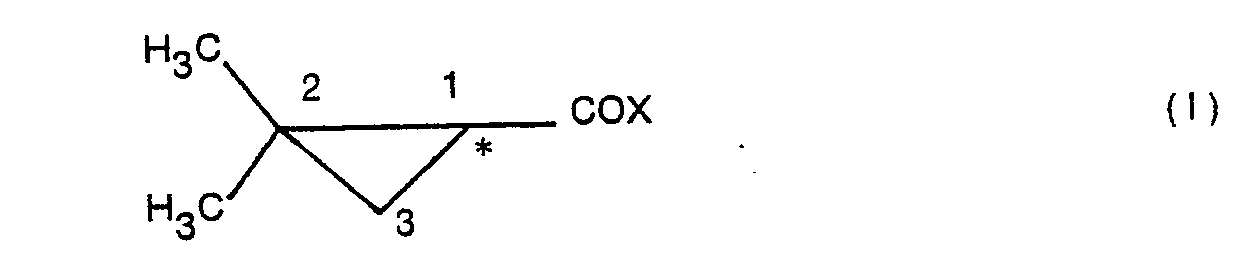
wherein X is a halogen atom to a temperature of 80°C to 300°C in the absence of a Lewis acid catalyst.
wherein X is a halogen atom to a temperature of 80°C to 300°C in the absence of a Lewis acid catalyst.
2. A method for racemization of optically active 2,2-dirnethylcyclopropane-1-carboxylic
acid which comprises converting optically active 2,2-dimethylcyclopropane-1-carboxylic
acid to an acid halide of general formula (I) given in claim 1, racemizing said acid
halide by heating it to a temperature of 80°C to 300°C in the absence of a Lewis acid
catalyst, and then hydrolyzing the resulting acid halide to obtain 2,2-dimethylcyclopropane-1-carboxylic
acid of the general formula (II);
3. A method according to claim 1 or 2 wherein the acid halide (I) is heated at 100°C
to 200°C.
4. A method according to claim 1, 2 or 3 wherein X is a chlorine or bromine.
5. A method according to any one of the preceding claims wherein the racemizing reaction
is carried out in an inert gas atmosphere.
6. A method according to any one of the preceding claims wherein I-form acid halide
or a mixture of I-form and d-form in which the I-form predominates is racemized.
7. Use of racemic 2,2-dimethylcyclopropane-1-carboxylic acid obtained by a method
as claimed in claim 2 or any one of claims 3 to 6 when appendant to claim 2 in the
preparation of an optically active 2,2-dimethylcyclopropane-1-carboxylic acid by optical
resolution.
1. Verfahren zur Racemisierung eines optisch aktiven 2,2-Dimethylcyclopropan-1-carbonsäurehalo-
genids, dadurch gekennzeichnet, daß man ein optisch aktives 2,2-Dimethylcyclopropan-1-carbonsäurehalogenid
der allgemeinen Formel

worin X ein Halogenatom bedeutet, auf eine Temperatur von 80°C bis 300°C in Abwesenheit eines Lewis-Säure-Katalysators erhitzt.
worin X ein Halogenatom bedeutet, auf eine Temperatur von 80°C bis 300°C in Abwesenheit eines Lewis-Säure-Katalysators erhitzt.
2. Verfahren zur Racemisierung von optisch aktivers 2,2-Dimethylcyclopropan-1-carbonsäure,
dadurch gekennzeichnet, daß man optische aktive 2,2-Dimethylcyclopropan-1-carbonsäure
in das Säurehalogenid der allgemeinen Formel (1), die in Anspruch 1 angegeben ist,
überführt, das Säurehalogenid durch Erhitzen auf eine Temperatur von 80°C bis 300°C
in Abwesenheit eines Lewis-Säure-Katalysators racemisiert, und dann das entstehende
Säurehalogenid unter Bildung von 2,2-Dimethylcyclopropan-1-carbonsäure der allgemeinen
Formel (11)
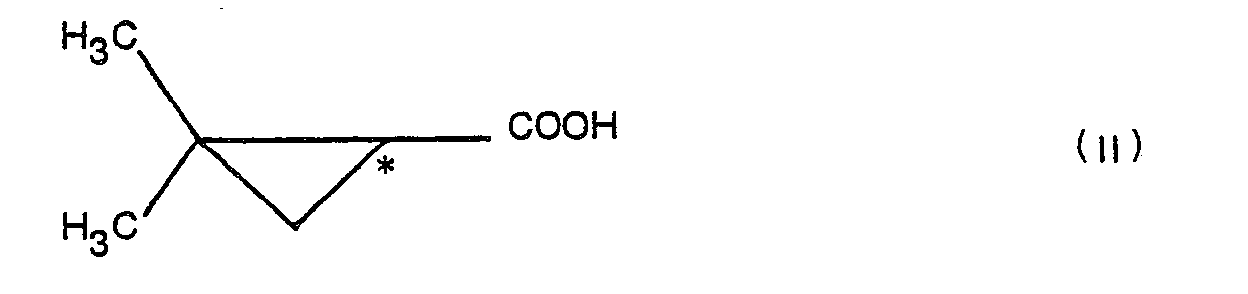
hydrolysiert.
hydrolysiert.
3. Verfahren nach Anspruch 1 oder 2, dadurch gekennzeichnet, daß das Säurehalogenid
(I) auf 100°C bis 200°C erhitzt wird.
4. Verfahren nach Anspruch 1, 2 oder 3, dadurch gekennzeichnet, daß X Chlor oder Brom
bedeutet.
5. Verfahren nach einem der vorhergehenden Ansprüche, dadurch gekennzeichnet, daß
die Racemisierungsreakition in Inertgasatomosphäre durchgeführt wird.
6. Vefahren nach einem der vorhergehenden Ansprüche, dadurch gekennzeichnet, daß die
I-Form des Säurehalogenids oder ein Gemisch der I- und d-Form, in dem die I-Form überwiegt,
racemisiert wird.
7. Verwendung von racemischer 2,2-Dimethylcyclopropan-1-carbonsäure, die nach einem
Verfahren nach Anspruch 2 oder einem der Ansprüche 3 bis 6 erhalten wurde, wenn sie
von Anspruch 2 abhängen, bei der Herstellung einer optisch aktiven 2,2-Dimethylcyclopropan-1-carbonsäure
durch optische Spaltung.
1. Procédé de racémisation d'un halogénure d'acide 2,2-diméthylcyclopropane-1-carboxylique
optiquement actif, qui consiste à chauffer un halogénure d'acide 2,2-diméthylcyclopropane-1-carboxylique
optiquement actif der formule développée:
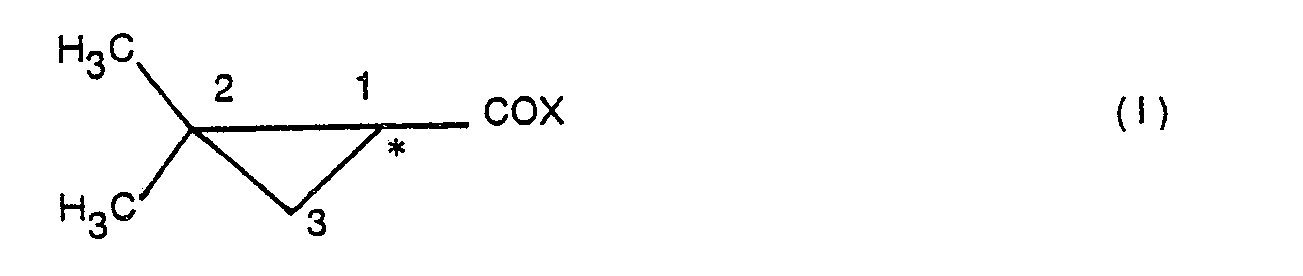
dans laquelle X est un atome d'halogène, à une température de 80°C à 300°C, en l'absence d'un acide de Lewis comme catalyseur.
dans laquelle X est un atome d'halogène, à une température de 80°C à 300°C, en l'absence d'un acide de Lewis comme catalyseur.
2. Procédé de racémisation d'un acide 2,2-diméthylcyclopropane-1-carboxylique optiquement
actif, qui consiste à transformer l'acide 2,2-diméthylcyclopropane-1-carboxylique
optiquement actif en un halogénure d'acide de formule développée (I) donnée à la revendication
1, à racémiser cet halogénure d'acid en le chauffant à une température de 80°C à 300°C,
en l'absence d'un acide de Lewis servant de catalyseur, puis à hydrolyser l'halogénure
d'acide obtenu pour obtenir l'acide 2,2-diméthylcyclopropane-1-carboxylique de formule
développée (II):
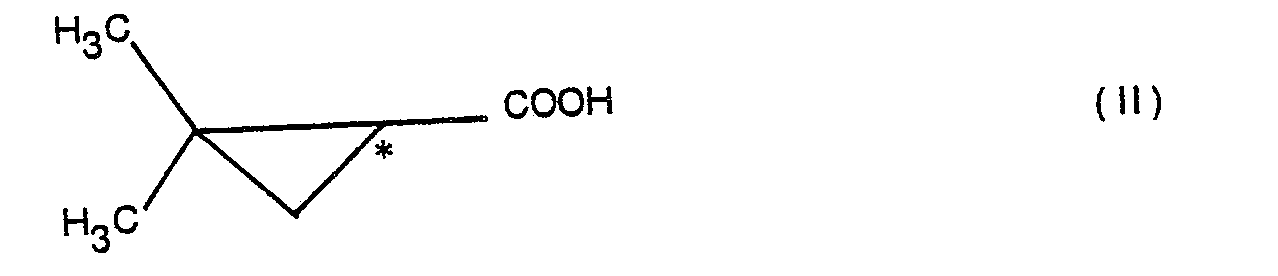
3. Procédé suivant la revendication 1 ou 2, qui consiste à chauffer l'halogénure d'acide
(1) entre 100°C et 200°C.
4. Procédé suivant la revendication 1, 2 ou 3, dans lequel X est le chlore ou le brome.
5. Procédé suivant l'une quelconque des revendications précédentes, qui consiste à
effectuer la réaction de racémisation dans une atmosphère de gaz inerte.
6. Procédé suivant l'une quelconque des revendications précédentes, qui consiste à
racémiser un halogénure d'acide de forme 1 ou un mélange de forme 1 et de forme d,
dans lequel la forme I est prépondérante.
7. Utilisation d'un acide 2,2-diméthylcyclopropane-1-carboxylique racémique obtenu
par un procédé tel que revendiqué à la revendication 2 ou à l'une quelconque des revendications
3 et 6 quand elles dépendent de la revendication 2, pour la préparation d'un acide
2,2-diméthylcyclopropane-1-carboxylique optiquement actif par dédoublement optique.