|
(11) | EP 0 092 883 B1 |

| (12) | EUROPEAN PATENT SPECIFICATION |
|
|
| (54) |
Method of demulsifying emulsions of oil and water with heterocyclic ammonium polyamidoamines Verfahren zum Dumulgieren von Öl-in-Wasser-Emulsionen mit heterozyklischen Ammonium-Polyamidoaminen Procédé de désémulsification d'émulsions d'huile et d'eau avec des polyamidoamines d'ammonium hétérocycliques |
|
|
|||||||||||||||||||||||||||||||
| Note: Within nine months from the publication of the mention of the grant of the European patent, any person may give notice to the European Patent Office of opposition to the European patent granted. Notice of opposition shall be filed in a written reasoned statement. It shall not be deemed to have been filed until the opposition fee has been paid. (Art. 99(1) European Patent Convention). |
[0001] This invention relates to a demulsification method which comprises contacting an emulsion of oil and water with a demulsifying amount of a water soluble heterocyclic ammonium polyamidoamine having amide and amine moieties in its backbone and heterocyclic ammonium moieties in its backbone and/or pendant therefrom.
[0002] Most naturally occurring emulsions of petroleum oil and water take the form of water-in-oil emulsions in which the oil is a continuous phase and tiny drops of water are dispersed in the oil. Occasionally, however, oil-in-water emulsions are encountered either in the production, handling or refining of petroleum oil or fractions thereof. Unfortunately, in both types of emulsions, the emulsions are often extremely stable and will not resolve after standing for long periods. While such emulsions often occur naturally, such emulsions may also occur artificially resulting from one or more of numerous operations encountered in various industries. For example, such emulsions may be obtained from producing wells as a result of enhanced oil recovery methods or from the bottom of crude oil storage tanks. Other such oil-in-water emulsions include steam cylinder emulsions, wax-hexane-water emulsions, butadiene-tar-in-water emulsions, emulsions of flux oil and steam condensate, styrene-in-water emulsions and synthetic latex-in-water emulsions. In all instances, it is generally desirable to resolve the emulsion in order that the oil phase may be separated from the water phase.
[0003] Historically, such emulsions have been resolved or broken by contacting the emulsion with a chemical demulsifying agent, thereby causing the emulsions to resolve and stratify into its component phases of water and oil or brine and oil after the emulsion has been allowed to stand in a relatively quiescent state. In another type of demulsification, the emulsion contains substantial quantities of salt in the aqueous phase and it is necessary to carry out a desalting operation prior to further refinement of the oil phase in order to prevent the accumulation of large deposits of salt in the refining apparatus. In such desalting operations, it is common to employ a chemical demulsifying agent in a manner similar to that mentioned hereinbefore. A wide variety of chemical demulsifying agents has been employed in this manner in the past. For example, such demulsifying agents include oxyalkylated condensation products obtained by reacting phenols, formaldehydes and alkylene polyamines as disclosed in U.S. Patent No. 3,166,516; ultra high molecular weight ethylenically unsaturated polymers, polyalkylene oxylene polymers, polyesters, polyamides, polymer of ketenes and the like as described in U.S. Patent No. 3,557,017; amidoamine polymers as described in U.S. Patent No. 3,528,928; as well as other chemicals such as sulfonates, oxyalkylated amines, oxyalkylated alkylphenols, oxyalkylated alcohols and the like. While each of the foregoing and other conventional demulsifiers are effective in some emulsions, it is found that many are not as effective as desired, particularly in resolving emulsions derived from steam recovery of heavy crudes by processes typical of some of the California oil fields.
[0004] Accordingly, it is highly desirable to provide a demulsification process for resolving emulsions of such heavy crudes as well as other oil-in-water emulsions and the like.
[0005] In EP-A-66 366 the use of branched polyamidoamines containing heterocyclic moieties for breaking up emulsions is described.
[0006] The present invention concerns a demulsification method which is characterized in that the water soluble heterocyclic ammonium polyamidoamine is an adduct of a linear polyamidoamine and an ammoniating compound that contains or is capable of forming a heterocyclic moiety.
[0007] While the demulsification method of the present invention is particularly effective in resolving emulsions of crude oils in water as are commonly recovered from oil fields, such demulsification method is also effective for resolving other emulsions of oil-in-water and water-in-oil.
[0008] Emulsions of oil-in-water that are most effectively resolved by the method of this invention are oil field emulsions containing relatively small proportions of crude petroleum oil dispersed in water or brine and are hereinafter characterized as oil-in-water emulsions. Other such oil-in-water emulsions include emulsions in which traces of lubricating oil are found dispersed in steam from steam engines and steam pumps often called steam-cylinder emulsions; emulsions encountered in the waxing operations in oil refining, often called wax-hexane-water emulsions; emulsions of flux oil in steam condensate produced in the catalytic dehydrogenation of butylene to produce butadiene; styrene-in-water emulsions; and emulsions generated by sewage disposal operations, metal working fluids, oily waters from ship ballast tanks, food processing waste streams and the like. Although not as advantageously resolved as the oil-in-water emulsions, water-in-oil emulsions are suitably treated by the method of this invention. Such water-in-oil emulsions are generally those naturally occurring emulsions of water and petroleum oil wherein the continuous oil phase has tiny droplets of water dispersed thereon.
[0009] The preferred oil-in-water emulsions may contain widely different proportions of dispersed phase, for example, the oil field oil-in-water emulsions may carry crude oil in proportions varying from a few parts per million to about 40 weight percent or higher in rare cases. All of such emulsions are advantageously treated in the practice of this invention, most preferably, however, such oil-in-water emulsions contain from about 0.01 to about 30 weight percent of oil based on the weight of the emulsions. Also, while the method of the present invention is effective in treating emulsions derived from light crudes, the method is also effective in treating emulsions of somewhat heavier crudes.
[0010] The linear polyamidoamines employed in the present invention are polymers having amide moieties and amine moieties in their backbones and heterocyclic ammonium moieties in their backbones and/or pendant therefrom. By "heterocyclic ammonium" is meant an ammonium moiety that contains a heterocyclic moiety, e.g., oxirane or azetidinium, or a moiety capable of forming a heterocyclic moiety. These moieties in the backbone are represented by the formula:
Those moieties which are pendant from the backbone and hereinafter also referred to as Z⊕, are represented by the formula
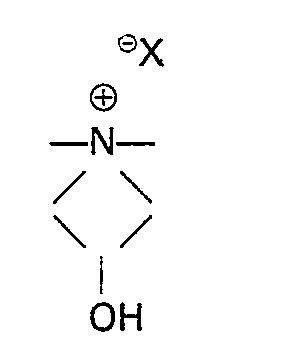
In the foregoing formulas, each R' and each R2 are independently hydrogen, halohydroxyhydrocarbyl, hydrocarbyl, hydroxyhydrocarbyl or aminohydrocarbyl, wherein amino is a secondary or tertiary amino; E is a monovalent hydrocarbon radical bearing an epoxy group or a group or groups capable of being converted to an epoxy group or E and R! are collectively a propylene radical or substituted propylene radical
wherein the a-carbon substituents, if any, are C1-C3 alkyl and the a-carbon substituent, if any, is hydroxy, halo, hydrocarbyl or hydroxyhydrocarbyl; A is a divalent organic radical, e.g., alkylene or amidoamino; X is a monovalent or polyvalent anion common to conventional ammonium salts. For the purposes of this invention, the term "hydrocarbyl" is defined as a monovalent hydrocarbon radical such as alkyl, cycloalkyl, aryl, alkenyl and the like. Preferred ammonium polyamidoamines have at least one quaternary ammonium repeating unit represented by the formula:
wherein A, E, X, R1 and R2 are as defined before except that neither R1 nor R2 is hydrogen; each R3 is independently hydrogen or lower alkyl, e.g., methyl or ethyl, each m is a whole number from 2 to 6; and n is a whole number from 1 to 3, more preferably 1 or 2, most preferably 1.
[0011] In the heterocyclic ammonium polyamidoamine, enough heterocyclic ammonium moieties are present to enable the polyamido amine to function better as a demulsifier for oil-in-water emulsions than the polyamidoamine containing no ammonium moiety. Preferably, the ammonium polyamidoamine contains at least 0.1 mole equivalent, most preferably from about 0.5 to about 1 mole equivalent, of the heterocyclic ammonium moiety per mole equivalent of amine nitrogen in the polyamidoamine. The preferred heterocyclic ammonium polyamidoamines have weight average molecular weights (Mw) in the range from about 1000 to about 100 million, more preferably from about 1000 to about 1 million.
[0012] In the preparation of the heterocyclic ammonium polyamidoamines employed in this invention, it is preferred to react a linear polyamidoamine with epihalohydrin or another compound containing a moiety as defined by E hereinbefore to yield a desired ammonium polyamidoamine having a pendant ammonium moiety containing heterocyclic functionality.
[0013] The linear polyamidoamines are conveniently prepared in the manner described in US patent No. 3,305,493. In general, the essentially linear polyamidoamine is prepared by contacting an alkylenediamine or a polyalkylene polyamine with the ethylenically unsaturated carboxylic compound, e.g., alkyl acrylate or methacrylate, acrylamide, acrylic acid or methacrylic acid, under reactive conditions. Preferably, the foregoing reactants are employed in stoichiometric ratio to form a linear polyamidoamine represented by the formula:
wherein R3, m and n are as defined hereinbefore, y is a terminal group characteristic of polyamidoamines and V is hydrogen or the residue of polymerization to form a polyamidoamine. Advantageously, the linear polyamidoamine has a weight average molecular weight (Mw) of at least about 500, preferably at least 1000, most preferably from about 3000 to about 10,000.
[0014] Exemplary alkylene polyamines and polyalkylene polyamines include ethylenediamine, diethylenetriamine, triethylenetetramine, tetraethylenepentamine, pentaethylenehexamine, hexaethyleneheptamine, 1-aminoethylpiperazyl diethylenetriamine, 1-aminoethylpiperazyl triethylenetetramine, propylenediamine, dipropylenetriamine, butylenediamine, aminoethylpropylenediamine and other polyamines having at least one primary amino group separated from another primary amino or secondary amino group by 2 to 4 carbon atoms. Of these polyalkylene polyamines, the higher molecular weight polyethylene polyamines and polypropylene amines such as those having a weight average of 100 to 15,000 are preferred. Of particular interest are the polyalkylene polyamines that are crosslinked with ethylene dichloride or the like as well as mixtures of such cross-linked polyamines with other polyalkylene polyamines as mentioned hereinbefore.
[0015] In the conversion of all or a portion of the amine moieties of the linear polyamidoamine to ammonium form, the linear polyamidoamine is contacted with an alkylating agent, a mixture of alkylating agents or other agents capable of converting the amine to ammonium form such that the pendant amino nitrogens of the linear polyamidoamines are converted to ammonium moieties represented by the following formula:
and/or the available backbone amine moieties are converted to ammonium moieties represented by the formula:
wherein each R', R2, E and X° are as defined hereinbefore.
[0016] In the preparation of the more preferred quaternized polyamidoamines, the linear polyamidoamine is reacted with an epoxy compound such as an epihalohydrin or an azetidinium forming compound such as a 1,3-dihaloalkane under conditions sufficient to cause the amine groups of the polyamidoamine to be alkylated. It is preferred to carry out this alkylation reaction in a solvent. If a solvent system is used in the formation of the polyamidoamine, then the same solvent or water diluted solvent may be used in the alkylation reaction. Thus, water, lower alkanols such as methanol and mixtures thereof are preferred solvents for the alkylation reaction. In general, sufficient solvent is employed to just solubilize the reactants and to permit easy stirring. Generally, solutions containing from about 30 to about 75 weight percent of the polyamidoamine are employed. Following dissolution of the polyamidoamine, the epihalohydrin or other suitable alkylating agent is added. In the case of epihalohydrin, the reaction is preferably carried out at temperatures in the range from about 0 up to about 35°C. The resulting alkylated polyamidoamine, which is prepared using epihalohydrin, contains an epoxy group and/or halohydrin groups in the quaternary ammonium moiety. This material may be employed as is as a demulsifier. Alternatively, all or a portion of such ammonium groups may be converted to azetidinium rings by dilution with water and heating. Residual halohydrin groups may be converted to epoxy groups by contacting this material with a neutralizing agent for acid such as sodium hydroxide, calcium carbonate, sodium carbonate, sodium bicarbonate and the like under conditions described by Weissberger in "Heterocyclic Compounds with Three and Four Membered Rings", Interscience Publishers, Part 2, page 891 (1964). In instances wherein it is desirable to prepare a quaternary ammonium compound in which the amino nitrogen is substituted with an alkyl or hydroxyalkyl group in addition to an epoxy group or an azetidinium ring, the linear polyamidoamine may be first alkylated with an alkyl halide or hydroxyalkyl halide or alkylene oxide and then subsequently alkylated with epihalohydrin.
[0017] In the practice of this invention, the emulsion to be resolved is contacted with an amount of the ammonium polyamidoamine which is effective to cause the emulsion to separate into two essentially distinct phases upon standing. Generally, such an amount will be in the range from about 1 to about 10,000 weight parts of the adduct per million weight parts (ppm) of the emulsion, preferably from about 3 to about 1000 ppm, more preferably from 5 to 300 ppm, most preferably from 5 to 50 ppm. It should also be understood that factors such as reagents, feed rates, agitation and settling time are interrelated. For example, control of agitation at an optimum level often shortens settling time. Agitation may be achieved by a variety of means, e.g., passing air or other gas through the emulsion.
[0018] The following examples are given to further illustrate the detailed practice of the invention and should not be construed as limiting its scope. Unless otherwise indicated, all parts and percentages are by weight.
Example 1
A. Preparation of linear polyamidoamines
[0019] Into a 250-ml three-neck round bottom flask equipped with a reflux condenser, air driven stirrer and addition funnel is charged 60.1 g (1 mole) of ethylenediamine. To the flask is then added with stirring 86.09 g (1 mole) of methyl acrylate by dripping it slowly into the flask over a period of 35 minutes. The temperature of the reaction mixture rises to 70°C during this addition and analysis of the reaction mixture using proton nuclear magnetic resonance indicates that all of the double bond has disappeared. The reflux condenser and addition funnel are replaced with a nitrogen sparge and a distillation apparatus. Using a steam bath, the reaction mixture is heated to 90°-95°C for a reaction time of 24 hours. After this time, the reaction mixture is a very viscous, light yellow amorphous solid. Analysis of this reaction mixture indicates that all of the ester moieties have reacted thereby yielding linear polyamidoamines having a weight average molecular weight (Mw) as determined by light scattering of 4,000. Following the foregoing procedure except using a reaction time in excess of 48 hours, a linear polyamidoamine having an Mw of 12,000 is prepared.
B. Preparation of branched polyamidoamine (comparative)
[0020] The aforementioned linear polyamidoamine having an Mw of 12,000 is diluted with water to 65 percent solids. A 50-g portion of this solution is charged into a 250 ml three-neck round bottom flask equipped with stirrer and reflux condenser and 24.54 g (stoichiometric amount with respect to amino hydrogens of the linear polyamidoamine of methyl acrylate is added at one time. The temperature of the reaction mixture increases from ambient to 35°C and is then heated with stirring at 80°C for four hours. Analysis of the reaction mixture at this point indicates approximately 95 percent of the methyl acrylate has been added to the polymer to provide a linear polyamidoamine having carboxylate ester branches. To this material is added approximately 70 g of ethylenediamine (4 moles of ethylenediamine per mole of ester) and the heating of the reaction mixture is continued for an additional four hours. Analysis of this mixture using proton NMR indicates complete conversion of the ester moieties to amide moieties. Excess ethylenediamine, methanol and water are removed using a water aspirator vacuum at 60°-95°C.
C. Quaternization of linear polyamidoamine
[0021] Into a 250 ml, three-neck round bottom flask equipped with an air driven stirrer and thermometer is charged 22.33 g of a 65 percent solution of the aforementioned linear polyamidoamine having an Mw of 4,000. The flask is cooled to 5°C and 11.19 g of epichlorohydrin (epi) (1:1 mole ratio of amine hydrogen to epi) is added with stirring to the flask. The reaction mixture is allowed to warm to room temperature over a 5-hour period and then stirred for 2 hours. To the flask is added 68 g of water heated to 65°C. The resulting stirred mixture is heated at 65°C for 1 hour to yield a clear solution and then allowed to cool to room temperature. An -100 percent quaternized linear polyamidoamine (Demulsifier A) is recovered.
D. Quaternization of EDC/cross-linked linear polyamidoamine
[0022] Using the linear polyamidoamine and procedure of the foregoing paragraph C, the polyamidoamine is (1) contacted with 5.8 mole percent of ethylene dichloride (EDC) to increase the Mw of the polyamidoamine to -30,000 and (2) reacted with epichlorohydrin solution to form the quaternized derivative (Demulsifier B).
E. Quaternization of branched polyamidoamine (comparative)
[0023] For purposes of comparison, 10.61 g of a 65 percent solid solution of a 100 percent branched polyamidoamine made by the foregoing procedure and 5.60 g of epichlorohydrin (1:1 mole ratio of amine hydrogens to epichlorohydrin) are reacted to yield a polymer (Demulsifier C) containing quaternary moieties represented by the following formula:
To 22.18 g of a 20 percent solution of this polymer in water is added 0.59 g of an aqueous solution of 50 percent sodium hydroxide and then maintained at room temperature for 6 days. Analysis of the resulting product indicates formation of a (Demulsifier D) polymer having quaternary moieties represented by the following formula:
F. Demulsification
[0024] To 10 grams of an oil-in-water emulsion containing about 10 weight percent of crude oil having a specific gravity of -0.8 g/ml is added about 7.4 parts per million based on the emulsion of the aforementioned Demulsifier A. The emulsion is then shaken on a wrist-action shaker for 5 minutes to effectively disperse the quaternized polyamidoamine into the emulsion. Thereafter, the emulsion is allowed to stand for 1 minute, visually evaluated and allowed to stand for 24 hours and then visually evaluated again.
[0026] For purposes of comparison, the aforementioned Demulsifiers B-D and nonquaternized polyamidoamine (Demulsifier E) are similarly tested as demulsifiers at various concentrations and the results are reported in Table I.
1. A demulsification method which comprises contacting an emulsion of oil and water
with a demulsifying amount of a water soluble heterocyclic ammonium polyamidoamine
having amide and amine moieties in its backbone and heterocyclic ammonium moieties
in its backbone and/or pendant therefrom, the water soluble heterocyclic ammonium
polyamidoamine being an adduct of a linear polyamidoamine and an ammoniating compound
that contains or is capable of forming a heterocyclic moiety.
2. The method of Claim 1 wherein the emulsion is an oil-in-water emulsion.
3. The method of Claim 1 or 2 wherein the heterocyclic ammonium moiety is represented
by the formulas:
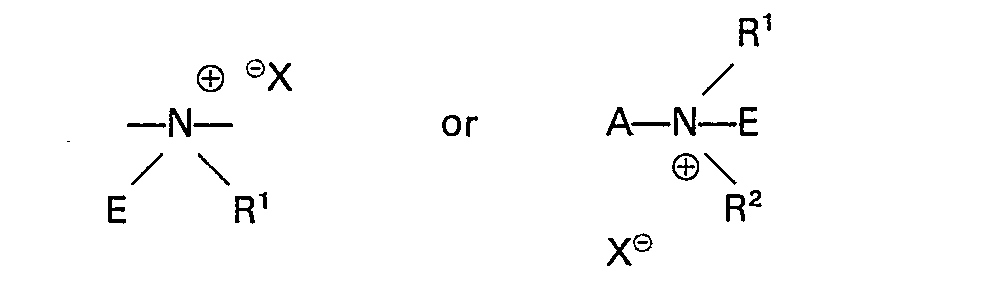
wherein each R1 and each R2 are independently hydrogen, halohydroxyhydrocarbyl, hydrocarbyl, hydroxyhydrocarbyl or aminohydrocarbyl, wherein amino is a secondary or tertiary amino; E is a monovalent hydrocarbon radical bearing an epoxy group or a group or groups capable of being converted to an epoxy group or E and R1 are collectively a propylene radical or substituted propylene radical wherein the a-carbon substituents are C1-C3 alkyl and the β-carbon substituent is hydroxy, halo, hydrocarbyl or hydroxyhydrocarbyl; A is a divalent organic radical; X is a monovalent or polyvalent anion common to conventional ammonium salts.
wherein each R1 and each R2 are independently hydrogen, halohydroxyhydrocarbyl, hydrocarbyl, hydroxyhydrocarbyl or aminohydrocarbyl, wherein amino is a secondary or tertiary amino; E is a monovalent hydrocarbon radical bearing an epoxy group or a group or groups capable of being converted to an epoxy group or E and R1 are collectively a propylene radical or substituted propylene radical wherein the a-carbon substituents are C1-C3 alkyl and the β-carbon substituent is hydroxy, halo, hydrocarbyl or hydroxyhydrocarbyl; A is a divalent organic radical; X is a monovalent or polyvalent anion common to conventional ammonium salts.
4. The method of Claim 3 wherein the polyamidoamine contains a heterocyclic ammonium
repeating unit represented by the formula:
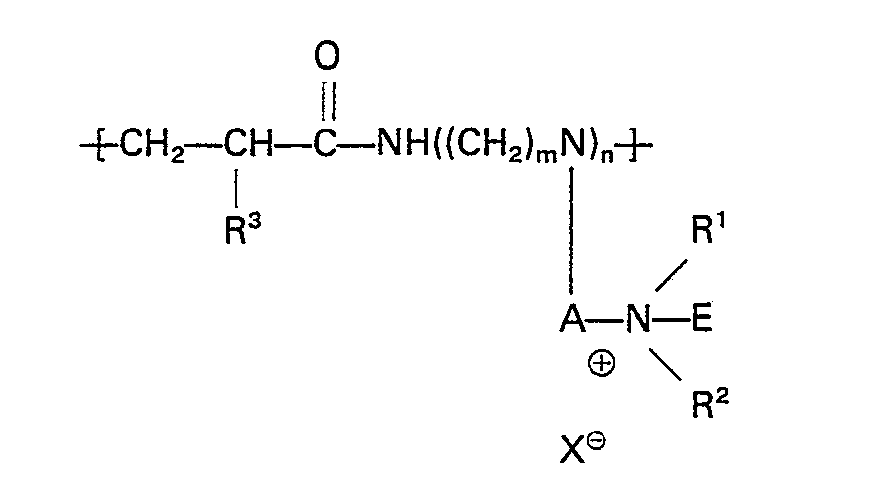
wherein each R1 and each R2 are independently hydrocarbyl, hydroxyhydrocarbyl or aminohydrocarbyl wherein the amino is a secondary or tertiary amino; E is a monovalent hydrocarbon radical bearing an epoxy group or a group or groups capable of being converted to an epoxy group or E and R1 are collectively a propylene radical or substituted propylene radical wherein the a-carbon substituents are C1-C3 alkyl and the β-carbon substituent is hydroxy, halo, hydrocarbyl or hydroxyhydrocarbyl; A is a divalent organic radical, X is a monovalent or polyvalent anion common to conventional ammonium salts; each R3 is independently hydrogen or lower alkyl, e.g., methyl or ethyl; each m is a whole number from 2 to 6; and n is a whole number from 1 to 3.
wherein each R1 and each R2 are independently hydrocarbyl, hydroxyhydrocarbyl or aminohydrocarbyl wherein the amino is a secondary or tertiary amino; E is a monovalent hydrocarbon radical bearing an epoxy group or a group or groups capable of being converted to an epoxy group or E and R1 are collectively a propylene radical or substituted propylene radical wherein the a-carbon substituents are C1-C3 alkyl and the β-carbon substituent is hydroxy, halo, hydrocarbyl or hydroxyhydrocarbyl; A is a divalent organic radical, X is a monovalent or polyvalent anion common to conventional ammonium salts; each R3 is independently hydrogen or lower alkyl, e.g., methyl or ethyl; each m is a whole number from 2 to 6; and n is a whole number from 1 to 3.
5. The method of Claim 3 or 4, wherein the pendant heterocyclic ammonium moiety is
represented by the formula:
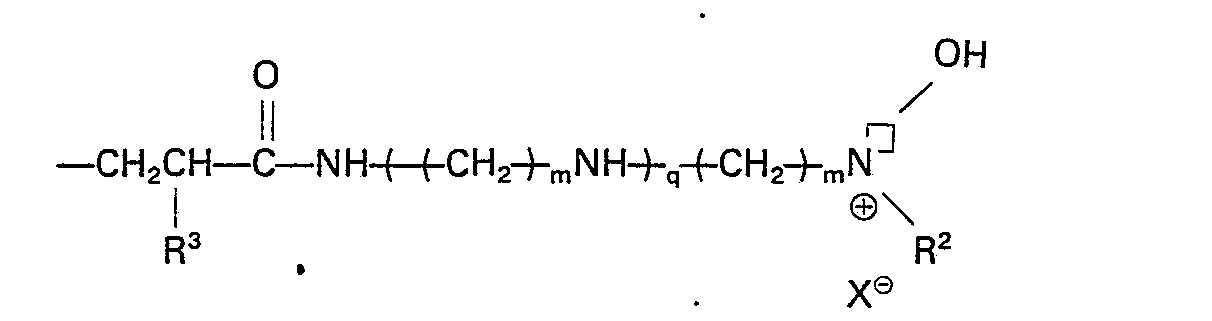
and the backbone heterocyclic ammonium moiety is represented by the formula:
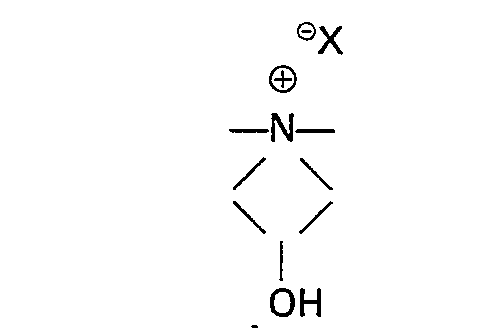
wherein R3 is hydrogen or methyl; m is 2; q is 0, 1, 2 or 3; X is chloride and R2 is alkyl, halohydroxyalkyl or epoxy.
and the backbone heterocyclic ammonium moiety is represented by the formula:
wherein R3 is hydrogen or methyl; m is 2; q is 0, 1, 2 or 3; X is chloride and R2 is alkyl, halohydroxyalkyl or epoxy.
6. The method of Claim 3-5, wherein R3 is hydrogen and R2 is 3-chloro-2-hydroxypropyl or 2,3-epoxypropyl.
1. Verfahren zum Demulgieren, umfassend das Inkontaktbringen einer Öl-in-Wasser-Emulsion
mit einer demulgierenden Menge eines wasserlöslichen heterocyclischen Ammoniumpolyamidoamins
mit Amid- und Aminanteilen im Gerüst und heterocyclischen Ammoniumanteilen im Gerüst
und/oder in der Seitenkette, wobei das wasserlösliche heterocyclische Ammoniumpolyamidoamin
ein Addukt eines linearen Polyamidoamins und einer eine Ammoniumgruppe einführenden
Verbindung ist, die einen heterocyclischen Anteil enthält oder einen heterocyclischen
Anteil zu bilden können.
2. Verfahren nach Anspruch 1, worin die Emulsion eine ÖI-in-Wasser-Emulsion ist.
3. Verfahren nach Anspruch 1 oder 2, worin der heterocyclische Ammoniumanteil dargestellt
wird durch die folgenden Formeln:
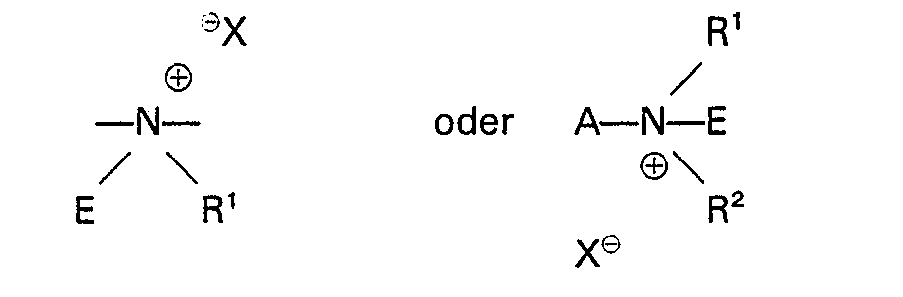
worin jedes R' und jedes R2 unabhängig voneinander Wasserstoff, Halogenhydroxy-Kohlenwasserstoff, Kohlenwasserstoff, Hydroxykohlenwasserstoff oder Aminokohlenwasserstoff bedeutet, worin die Aminogruppe eine sekundäre oder tertiäre Aminogruppe ist; E ein monovalenter Kohlenwasserstoffrest ist, der eine Epoxygruppe trägt oder eine Gruppe oder Gruppen, die in eine Epoxygruppe umgewandelt werden können oder worin E und R' zusammen einen Propylenrest oder eine substituierten Propylenrest bilden, worin die alpha-Kohlenstoffsubstituenten C1―C3-Alkylgruppen sind und die β-Kohlenstoffsubstituenten Hydroxy-, Halogen-, Kohlenwasserstoff- oder Hydroxykohlenwasserstoffgruppen sind; A ein divalenter organischer Rest ist und X ein monovalentes oder polyvalentes Anion, das üblich für gewöhnliche Ammoniumsalze ist.
worin jedes R' und jedes R2 unabhängig voneinander Wasserstoff, Halogenhydroxy-Kohlenwasserstoff, Kohlenwasserstoff, Hydroxykohlenwasserstoff oder Aminokohlenwasserstoff bedeutet, worin die Aminogruppe eine sekundäre oder tertiäre Aminogruppe ist; E ein monovalenter Kohlenwasserstoffrest ist, der eine Epoxygruppe trägt oder eine Gruppe oder Gruppen, die in eine Epoxygruppe umgewandelt werden können oder worin E und R' zusammen einen Propylenrest oder eine substituierten Propylenrest bilden, worin die alpha-Kohlenstoffsubstituenten C1―C3-Alkylgruppen sind und die β-Kohlenstoffsubstituenten Hydroxy-, Halogen-, Kohlenwasserstoff- oder Hydroxykohlenwasserstoffgruppen sind; A ein divalenter organischer Rest ist und X ein monovalentes oder polyvalentes Anion, das üblich für gewöhnliche Ammoniumsalze ist.
4. Verfahren nach Anspruch 3, worin das Polyamidoamin eine heterocyclische, sich wiederholende
Ammoniumeinheit enthält, die durch die folgende Formel dargestellt wird:
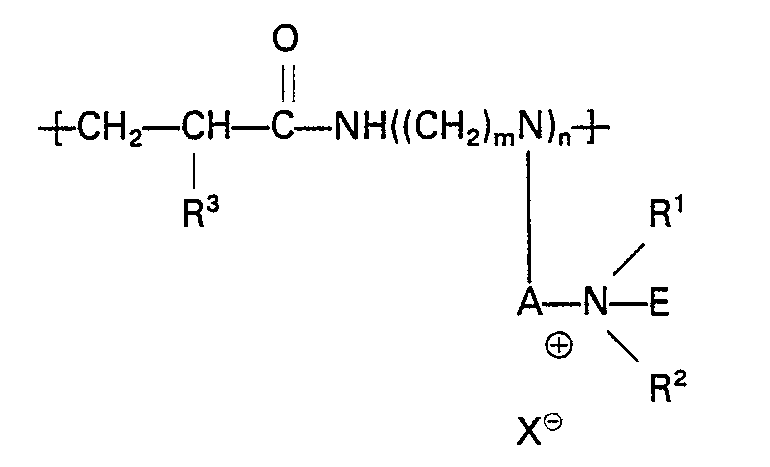
worin jedes R' und jedes R2 unabhängig voneinander einen Kohlenwasserstoff-, Hydroxykohlenwasserstoff- oder Aminokohlenwasserstoffrest bedeutet, worin die Aminogruppe eine sekundäre oder tertiäre Aminogruppe ist; E ein monovalenter Kohlenwasserstoffrest ist, der eine Epoxygruppe trägt oder eine Gruppe oder Gruppen, die in eine Epoxygruppe umgewändelt werden können oder E und R' zusammen einen Propylenrest oder einen substituierten Propylenrest bilden, worin die alpha-Kohlenstoffsubstituenten C1―C3-Alkylgruppen sind und die ß-Kohlenstoffsubstituenten Hydroxy-, Halogen-, Kohlenwasserstoff- oder Hydroxykohlenwasserstoffgruppen sind; A ein divalenter organischer Rest ist, X ein monovalentes oder polyvalentes Anion ist, das üblich für gewöhnliche Ammoniumsalze ist; jedes R3 unabhängig Wasserstoff oder Niedrigalkyl, z.B. Methyl oder Ethyl bedeutet; jedes m eine ganze Zahl von 2 bis 6 und n eine ganze Zahl von 1 bis 3 ist.
worin jedes R' und jedes R2 unabhängig voneinander einen Kohlenwasserstoff-, Hydroxykohlenwasserstoff- oder Aminokohlenwasserstoffrest bedeutet, worin die Aminogruppe eine sekundäre oder tertiäre Aminogruppe ist; E ein monovalenter Kohlenwasserstoffrest ist, der eine Epoxygruppe trägt oder eine Gruppe oder Gruppen, die in eine Epoxygruppe umgewändelt werden können oder E und R' zusammen einen Propylenrest oder einen substituierten Propylenrest bilden, worin die alpha-Kohlenstoffsubstituenten C1―C3-Alkylgruppen sind und die ß-Kohlenstoffsubstituenten Hydroxy-, Halogen-, Kohlenwasserstoff- oder Hydroxykohlenwasserstoffgruppen sind; A ein divalenter organischer Rest ist, X ein monovalentes oder polyvalentes Anion ist, das üblich für gewöhnliche Ammoniumsalze ist; jedes R3 unabhängig Wasserstoff oder Niedrigalkyl, z.B. Methyl oder Ethyl bedeutet; jedes m eine ganze Zahl von 2 bis 6 und n eine ganze Zahl von 1 bis 3 ist.
5. Verfahren nach Anspruch 3 oder 4, worin der heterocyclische Ammoniumanteil in der
Seitenkette dargestellt wird durch die Formel:
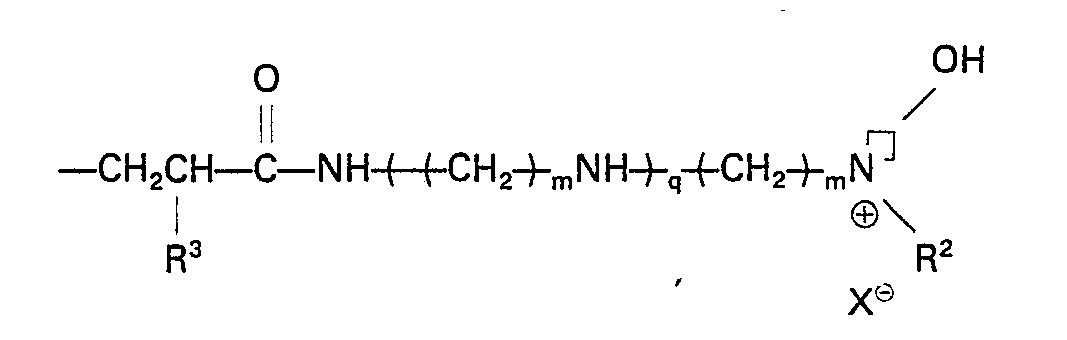
und daß der heterocyclische Ammoniumanteil im Gerüst dargestellt wird durch die Formel:
worin R3 Wasserstoff oder Methyl bedeutet; m 2 ist; q 0, 1, 2 oder 3 ist; X Chlorid ist und R2 eine Alkyl-, Halogenhydroxyalkyl- oder Epoxygruppe ist.
und daß der heterocyclische Ammoniumanteil im Gerüst dargestellt wird durch die Formel:
worin R3 Wasserstoff oder Methyl bedeutet; m 2 ist; q 0, 1, 2 oder 3 ist; X Chlorid ist und R2 eine Alkyl-, Halogenhydroxyalkyl- oder Epoxygruppe ist.
6. Verfahren nach einem der Ansprüche 3 bis 5, worin R3 Wasserstoff ist und R2 3-Chlor-2-hydroxypropyl oder 2,3-Epoxypropyl ist.
1. Procédé dé désémulsification, qui consiste à mettre en contact une émulsion d'huile
et d'eau avec une proportion désémulsifiante d'un polyamido-amine-ammonium hétérocyclique
hydrosoluble, comportant des fragments amide et amine dans son squelette et des fragments
ammonium hétérocycliques dans son squelette et/ou en position latérale par rapport
à celuici, le polyamido-amine-ammonium hétérocyclique hydrosoluble étant un produit
d'addition d'une polyamido-amine linéaire et d'un composé ammoniant qui contient ou
est capable de former un fragment hétérocyclique.
2. Procédé selon la revendication 1, dans lequel l'émulsion est une émulsion huile-dans-eau.
3. Procédé selon la revendication 1 ou 2, dans lequel le,fragment ammonium hétérocyclique
répond à la formule:
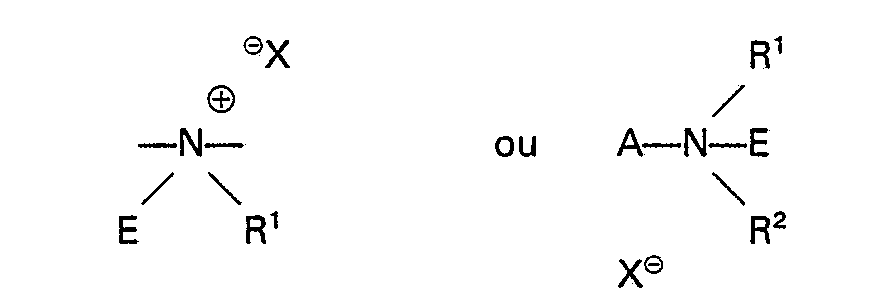
dans laquelle chaque R1 et chaque R2 représentent indépendamment un atome d'hydrogène ou un groupe halohydroxyhydrocarbyle, hydrocarbyle, hydroxyhydrocarbyle ou aminohydrocarbyle, le groupe amino étant un groupe amino secondaire ou tertiaire; E est un radical hydrocarboné monovalent portant un groupe époxy ou un ou des groupes convertissables en un groupe époxy, ou bien E et R1 sont conjointement un radical propylène ou un radical propylène substitué dans lequel les substituants sur le carbone en a sont des groupes alkyle en C1-3 et le substituant sur le carbone en β est un substituant hydroxy, halogéno, hydrocarbyle ou hydroxyhydrocarbyle; A est un radical organique divalent; X est un anion monovalent ou polyvalent qui est courant dans les sels classiques d'ammonium.
dans laquelle chaque R1 et chaque R2 représentent indépendamment un atome d'hydrogène ou un groupe halohydroxyhydrocarbyle, hydrocarbyle, hydroxyhydrocarbyle ou aminohydrocarbyle, le groupe amino étant un groupe amino secondaire ou tertiaire; E est un radical hydrocarboné monovalent portant un groupe époxy ou un ou des groupes convertissables en un groupe époxy, ou bien E et R1 sont conjointement un radical propylène ou un radical propylène substitué dans lequel les substituants sur le carbone en a sont des groupes alkyle en C1-3 et le substituant sur le carbone en β est un substituant hydroxy, halogéno, hydrocarbyle ou hydroxyhydrocarbyle; A est un radical organique divalent; X est un anion monovalent ou polyvalent qui est courant dans les sels classiques d'ammonium.
4. Procédé selon la revendication 3, dans lequel la polyamido-amine contient un motif
récurrent ammonium hétérocyclique répondant à la formule:
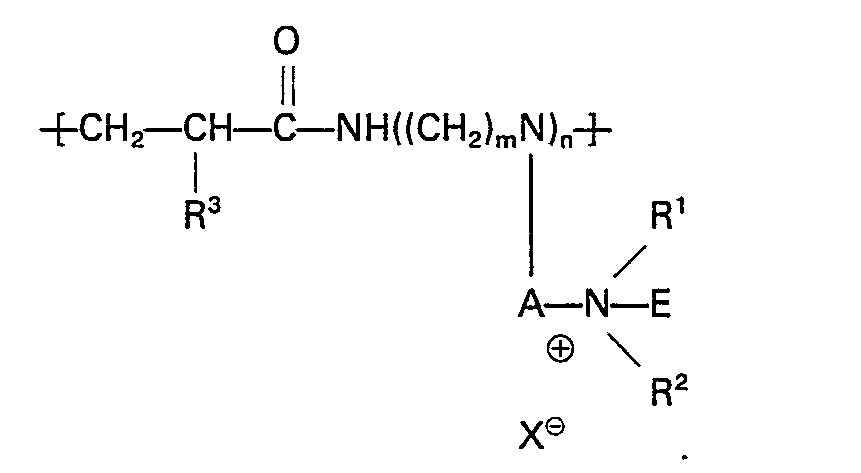
dans laquelle R' et R2 représentent chacun indépendamment un groupe hydrocarbyle, hydroxyhydrocarbyle ou aminohydrocarbyle dont le groupe amino est un groupe amino secondaire ou tertiaire; E est un radical hydrocarboné monovalent portant un groupe époxy ou un ou des groupes convertissables en un groupe époxy, ou bien E et R' représentent conjointement un radical propylène ou un radical propylène substitué dans lequel les substituants sur le carbone en a sont des radicaux alkyle en C1-3 et le substituant sur le carbone en β est un substituant hydroxy, halogéno, hydrocarbyle ou hydroxyhydrocarbyle; A est un radical organique divalent, X est un anion monovalent ou polyvalent qui est courant dans les sels classiques d'ammonium; chaque R3 représente indépendamment un atome d'hydrogène, ou un alkyle inférieur, par exemple méthyle ou éthyle; chaque m est un nombre entier de 2 à 6; et n est un nombre entier de 1 à 3.
dans laquelle R' et R2 représentent chacun indépendamment un groupe hydrocarbyle, hydroxyhydrocarbyle ou aminohydrocarbyle dont le groupe amino est un groupe amino secondaire ou tertiaire; E est un radical hydrocarboné monovalent portant un groupe époxy ou un ou des groupes convertissables en un groupe époxy, ou bien E et R' représentent conjointement un radical propylène ou un radical propylène substitué dans lequel les substituants sur le carbone en a sont des radicaux alkyle en C1-3 et le substituant sur le carbone en β est un substituant hydroxy, halogéno, hydrocarbyle ou hydroxyhydrocarbyle; A est un radical organique divalent, X est un anion monovalent ou polyvalent qui est courant dans les sels classiques d'ammonium; chaque R3 représente indépendamment un atome d'hydrogène, ou un alkyle inférieur, par exemple méthyle ou éthyle; chaque m est un nombre entier de 2 à 6; et n est un nombre entier de 1 à 3.
5. Procédé selon la revendication 3 ou 4, dans lequel le fragment latéral ammonium
hétérocyclique répond à la formule:
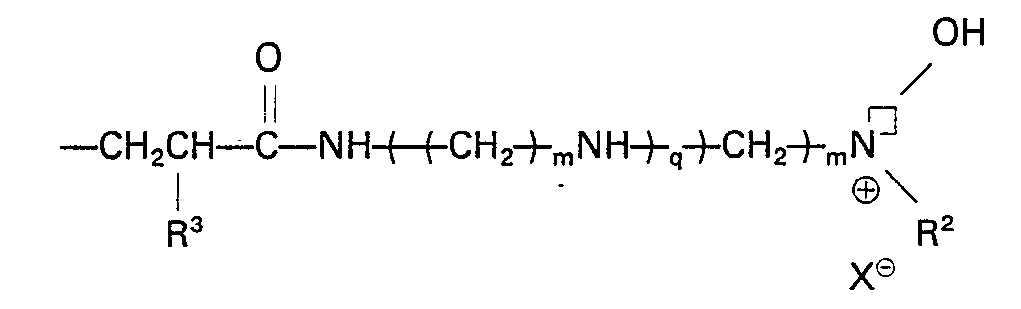
et le fragment ammonium hétérocyclique du squelette répond à la formule:
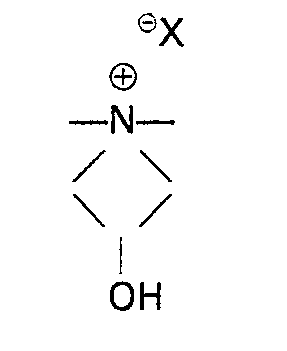
formules dans lesquelles R3 est un atome d'hydrogène ou le groupe méthyle; m vaut 2; q vaut 0, 1, 2 ou 3; X est un chlorure et R2 est un groupe alkyle, halohydroxyalkyle ou époxy.
et le fragment ammonium hétérocyclique du squelette répond à la formule:
formules dans lesquelles R3 est un atome d'hydrogène ou le groupe méthyle; m vaut 2; q vaut 0, 1, 2 ou 3; X est un chlorure et R2 est un groupe alkyle, halohydroxyalkyle ou époxy.
6. Procédé selon l'une quelconque des revendications 3 à 5, dans lequel R3 est un atome d'hydrogène et R2 est un groupe 3-chloro-2-hydroxypropyle ou 2,3-époxypropyle.