|
(11) | EP 0 093 002 B1 |

| (12) | EUROPEAN PATENT SPECIFICATION |
|
|
| (54) |
A direct-positive silver halide photographic material Direktpositives photographisches Silberhalogenidmaterial Matériel photographique directement positif à l'halogénure d'argent |
|
|
|||||||||||||||||||||||||||||||
| Note: Within nine months from the publication of the mention of the grant of the European patent, any person may give notice to the European Patent Office of opposition to the European patent granted. Notice of opposition shall be filed in a written reasoned statement. It shall not be deemed to have been filed until the opposition fee has been paid. (Art. 99(1) European Patent Convention). |
[0001] The present invention relates to a direct-positive-type silver halide photographic light-sensitive material, and more particularly to a low-photographic-speed direct-positive-type silver halide photographic light-sensitive material.
[0002] In recent years, in the field of graphic arts, because of the increasing complexity of prints as well as of the development of scanners, there has been a demand for improvement on the efficiency of the contact printing operation process. To meet such a demand, both improvements from the side of such equipment as printers and from the side of light-sensitive materials have been in progress. In the area of light-sensitive materials, there have been developed such low-speed silver halide photographic light-sensitive materials as called "semi-daylight-type light-sensitive materials" which can be handled under a yellow lamp light or as called "daylight-type light-sensitive materials" which can be handled in an ordinary room light. However, these light-sensitive materials have the disadvantage that the speed thereof becomes unstable to vary, the contrast thereof becomes reduced, or the minimum density thereof becomes increasing when stored over a long period or under a high-temperature-high-humidity condition, so that a still further improvement of these materials is desired.
[0003] In high-speed direct-positive-type silver halide emulsions, many attempts have been made until now to improve the preservability thereof. For example, US―A―3672903 proposes a production of a direct-positive-type silver halide emulsion, which comprises fogging of a silver halide emulsion before adding a gold complex salt thereto. And JP-A-66828/1973 (hereinafter referred to as Japanese Patent O.P.I. Publication) discloses a production of a direct-reversal silver halide light-sensitive material which comprises the addition of a polyamine, a salt of a metal having a more noble potential than does silver, and a certain compound to a silver halide emulsion. However, if the above technique for high-speed emulsions should be applied to low-speed direct-positive-type silver halide emulsions, the application, although useful for the prevention of possible occurrence of speed variations during the storage for a long period or under a high-temperature-high humidity condition has the disadvantage that it causes the emulsion to increase fog.
[0004] US-A-2717833 indicates that direct positive emulsions of high speed and contrast are obtained by precipitating and digesting silver halide in the presence of soluble Group VIII metal salts under basic conditions. US-A-3933498 indicates that incorporating separate heterocyclic compounds as bleach inhibitors and D min maintainers into direct positive silver halide materials based on the Herchel effect prevents latent image formation due to white light exposure.
[0005] It is an object of the present invention to provide a low-speed - direct-positive type silver halide photographic light-sensitive material.
[0006] It is another object of the present invention to provide a low-speed direct-positive-type silver halide photographic light-sensitive material whose speed is stable and whose minimum density is small under a high-temperature-high-humidity condition.
[0007] It is a further object of the present invention to provide a silver halide photographic light-sensitive .material which can be safely handled under a yellow lamp light or in a bright room light free of ultraviolet
rays.
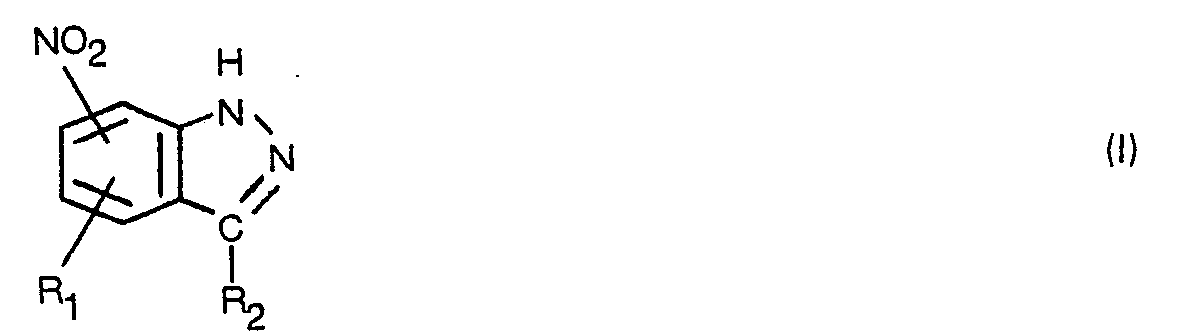
[0008] The above objects of the present invention are accomplished by a direct-positive-type silver halide light-sensitive material comprising a support, a silver halide emulsion layer comprising fogged silver halide particles prepared in the presence of a water soluble iridium salt or a water soluble rhodium salt. In this invention, the emulsion layer, and/or an adjacent hydrophilic colloidal layer contains a compound having the formula (I) or (II) and at least one compound selected from a compound having the formula (III) and a gold compound. Formula (I)
wherein R1 is hydrogen, alkyl (e.g., methyl, ethyl, propyl or butyl), -S03 M or -COOM wherein M is hydrogen, an alkali metal (e.g., sodium or potassium) or ammonium ion, and R2 is hydrogen or lower alkyl (e.g., methyl, ethyl, propyl, or butyl).
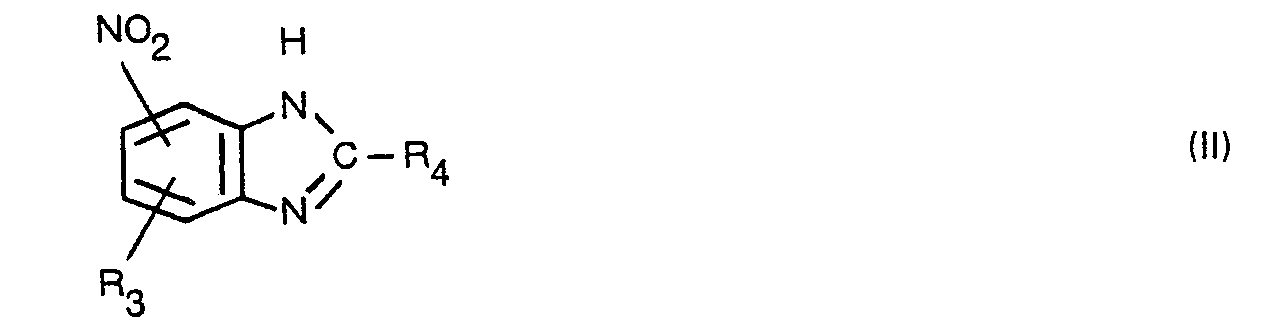
[0009] Formula (II)
wherein R3 is hydrogen, alkyl (e.g., methyl, ethyl, propyl or butyl), ―SO3 M or ―COOM wherein M has the meaning given above, and R4 is hydrogen, (e.g., methyl, ethyl, butyl, pentyl or heptyl) or CH2-S-(CH2)n-Y' wherein n is 1 to 3, and Y' is hydrogen or -S03M wherein M has the meaning given above.
[0010] Formula (III)
wherein n is from 1 to 5, and Y is an alkylene radical having from 2 to 4 carbon atoms (e.g., ethylene, propylene or butylene radical). If not less than two Y groups are present the same molecule, they are allowed to be different alkylene radicals.
[0011] A characteristic of the present invention is that at least two compounds, one selected from among those nitro-substituted nitrogen-containing heterocyclic compounds having Formulae (I) and (II) and another selected from among those having Formula (III) and those gold compounds which will be described hereinafter, are contained in the component hydrophilic colloidal layer of a direct-positive-type silver halide photographic light-sensitive material.
[0012] The hydrophilic colloidal layer which is to contain these at least two compounds is desirable to be comprised of at least one silver halide emulsion layer and/or an adjacent layer thereto (which may be either a light-sensitive layer or nonlight-sensitive layer; the small shall apply hereinafter). These at least two compounds may not necessarily be contained together in a same hydrophilic colloidal layer but are desirable to be contained together in at least one silver halide emulsion layer and/or an adjacent layer thereto.
[0013] The following are examples of those nitro-substituted nitrogen-containing heterocyclic compounds having Formulas [I] and [II] which are applicable to the present invention:
[0014] In order to incorporate any of these compounds having Formulas [I] and [II] into the hydrophilic colloidal layer of a silver halide photographic light-sensitive material, it may be added in the form of a solution dissolved in a solvent such as water or methanol or a mixture thereof to the coating liquid of a silver halide emulsion layer and/or an adjacent layer thereto. The adding quantity of any of these compounds having Formulas [I] and [II], although different according to the kind of the compound to be used or to the kind of the silver halide to be used, is generally from 1.0 x 10⁻⁶ to 1.0 x 10⁻¹ motes, and preferably from 1.0 x 10⁻⁵ to 5.0 x 10⁻² moles per mole of silver halide.
[0015] In the case of adding to a silver halide emulsion layer, the addition, although allowed to be made in any step of the process for the preparation of a direct-positive-type silver halide photographic emulsion, is desirable to be made after completion of the second ripening of the emulsion.
[0016] The following are examples of those compounds having Formula [III] which are applicable to the present invention;
(1) Diethyltriamine
(2) Triethylenetetramine
(3) Tetraethylenepentamine
(4) Pentaethylenehexamine
(5) Hexaethyleneheptamine
(6) Tripropylenetetramine
(7) Dibutylenetriamine
(8) Spermine
(9) Spermidine
(10) N-(4-aminobutyl)cadaverine
[0017] The preferred adding quantity of any of these compounds having Formula [III] is generally from 1.0 x 10⁻⁷ to 1.0 x 10⁻² moles, and preferably from 1.0 x 10⁻⁵ to 5.0 x 10⁻³ moles per mole of silver halide. In the case of adding to a silver halide emulsion layer, the addition although allowed to be made in any step of the process for the preparation of a direct positive silver halide photographic emulsion, is desirable to be made after completion of the second ripening of the emulsion.
[0018] Examples of those gold compounds usable in the present invention are monovalent and trivalent water-soluble gold salts such as chloroauric acid, potassium chloroaurate, gold thiocyanate, sodium chloroaurate, potassium aurate, potassium chloroaurate, potassium bromoaurate, potassium iodoaurate, potassium gold cyanide, potassium gold thiocyanide, gold thioglucose, gold sulfide, gold selenide and the like, but are not limited thereto. The quantity of any of these gold comounds employed should be generally from 1.0 x 10⁻⁷ to 1.0 x 10⁻⁴ moles, and preferably from 1.0 x 10⁻⁶ to 5.0 x 10⁻⁴ moles per mole of silver halide. In the case of adding to a silver halide emulsion layer, the addition of any of these compounds, although permissible in any step of the process for preparation of a direct-positive-type silver halide photographic emulsion, is desirably made upon completion of the chemical ripening because, if made after the desalting and before completion of the chemical ripening, the gold compound would be consumed, or if made before the desalting, the gold compound would be lost during the desalting. If the addition should be made before the completion of the chemical ripening, the quantity added should be increased by the amount expected to be consumed by the chemical ripening as stated above. In addition, in the present invention, at least one selected from among these compounds having Formula (III) and gold compounds described above may be added.
[0019] The silver halide used in the present invention may be produced by any of the acid method, the neutral method and the ammonia method, and includes silver bromide, silver chloride, silver chlorobromide, silver iodobromide, silver chloroiodobromimde, and the like.
[0020] The preferred particle size of the silver halide to be used in the present invention is from 0.01 to 2 µm and more preferably from 0.02 to 1 pm in diameter. The particle size frequency distribution, although allowed to be either wider or narrower, is desirable to be narrower. Further, the form or structure of these silver halides may be either regular or irregular, but is desired to be regular.
[0021] The direct-positive-type silver halide usable in the present invention may contain an organic desensitizer that is to be adsorbed onto the silver halide particle surface.
[0022] In the present invention, the water soluble iridium salt or rhodium salt may be added in the form of an aqueous solution to the silver halide at the time of preparing the particles thereof in order to incorporate the internal electron accepter into the silver halide particles. The iridium salt includes a potassium iridium (III) hexachloride and a sodium iridium (III) hexachloride. The rhodium salt includes a rhodium (III) trichloride, a rhodium (IV) tetrachloride and a potassium rhodium (III) hexabromide. These salts may be added in a quantity of from 10-7 to 10-3 moles, and preferably from 10-5 to 10-3 moles per mole of silver halide.
[0023] The direct-positive-type photographic silver halide to be used in the present invention is in advance fogged. Namely, the silver halide, after the water-soluble salt is removed therefrom, may be fogged by any of conventionally known techniques. The fogging may be made either by use of a reducing agent alone or by combined use of a reducing agent with a gold compound. Useful examples of such reducing agents are typified by, e.g., formalin, hydrazine, polyamines (such as triethylenetramine, tetraethylenepentamine, etc.), thiourea dioxide, tetra(hydroxy-methyl)phosphonium chloride, boron compounds (such as amineborane, sodium borohydride, etc.), stanous chloride, and the like, and any of these agents is desirable to be used generally in a quantity of from 2.0 x 10⁻⁶ to 2.0 x 10⁻³ moles per mole of silver halide.
[0024] A gold compound may be used for the chemical sensitization in fogging the silver halide emulsion to be used in the light-sensitive material of the present invention.
[0025] Typical examples of those gold compounds useful for the present invention are chloroauric acid, potassium chloroaurate, gold sulfide, gold selenide, and the like, and any of these compounds is desired to be used generally in a quantity of from 1.0 x 10⁻⁶ to 1.0 x 10⁻⁴ moles per mole of silver halide.
[0026] The fogging degree of the direct-positive-type photographic silver halide in the present invention is changeable over a wide range. The fogging degree is related not only to the silver halide composition, the particle size, etc., of the silver halide emulsion used but also to the kind and concentration of the fogging agent used, the pH, pAg, temperature, time, etc., of the emulsion at the time of fogging, and the like, so that the fogging degree may be controlled by arbitrarily setting these factors.
[0027] Those organic desensitizers which may be added to the fogged silver halide emulsion include, e.g., those 7-member ring desensitizers as disclosed in Japanese Patent Examined Publication No. 14500/1968, those nitro radical-containing fluorene derivatives as disclosed in Japanese Patent O.P.I. Publication No. 84432/1974, those nitrophenylmercapto radical-containing compounds as disclosed in Japanese Patent O.P.I. Publication No. 84639/1974, those nitrostyryl-type compounds, pinacryptol yellow, 5-metha-nitrobenzylidene-rhodanine, etc., as disclosed in U.S. Patent No. 2,669,515. The preferred adding quantity of these organic desensitizers is from 1.0 x 10⁻⁶ to 1.0 x 10⁻¹ moles, and more preferably from 1.0 x 10⁻⁵ to 1.0 x 10⁻² moles per mole of silver halide.
[0028] The direct-positive-type silver halide emulsion of the present invention may contain at least one solarization accelerator selected from among such solarization accelerators as those selenium compounds as described in Japanese patent O.P.I. Publication No. 4282/1971, and those halogen-liberating photoactive compounds, water-soluble halogenides, nitro-substituted indazoles, nitro-substituted imidazoles, and the like, as described in Japanese Patent O.P.I. Publication No. 89020/1975.
[0029] Further, the direct-positive-type silver halide photographic light-sensitive material of the present invention may also contain a dye capable of absorbing visible rays to be cut so that the light-sensitive material can be handled in a relatively bright place where ultraviolet rays-free fluorescent lamp light is used. The dye includes, for example, oxonol dyes, azo dyes, benzylidene dyes, and the like.
[0030] The direct-positive-type silver halide photographic light-sensitive material of the present invention may also contain generally used various other photographic additives which include stabilizers such as, e.g., triazoles, azaindenes, quaternary benzothiazolium compounds, mercapto compounds, water-soluble inorganic salts of cadmium, cobalt, nickel, manganese, thallium and the like; hardeners such as aldehydes including formalin, glyoxal, mucochromic acid, etc., s-triazines, epoxys, aziridines, vinyl-sulfonic acid and the like; coating aics such as, e.g., saponin, sodium polyalkylenesulfonate, lauryl- or oleyl-monoether of polyethylene glycol, amylated alkylurethane, fluorine-containing compounds, and the like; and sensitizers such as, e.g., polyalkylene oxide and the derivatives thereof. Besides, the light-sensitive material may further contain color couplers and, if necessary, a brightening agent, ultraviolet absorbing agent, preservative, matting agent, antistatic agent, and the like.
[0031] As the binder for the silver halide photogrpahic light-sensitive material of the present invention, for example, gelatin is used, and in addition to this, there may also be used together gelatin derivatives, such a natural substance as albumin, agar-agar, gum arabic, alginic acid, or the like, polyvinyl alcohol, polyvinyl acrylate, polyvinyl pyrolidone, cellulose ethers, partially hydrolyzed cellulose acetate, hydrophilic polymers such as poly(N-hydroxyl-alkyl)o-cyanine derivative obtained by the graft-polymerization of ethylene oxide, or the like. Further, as the binder for the silver halide emulsion, dispersion-polymerized vinyl compounds may be used as well; for example, a polymer latex obtained by the emulsion polymerization in the presence of an active agent of an unsaturated ethylene-type monomer, or a polymer latex obtained by the graft-polymerization with use of a ceric salt of a hydroxyl group-having macromolecular compound and an unsaturated ethylene-type monomer. The use of these latexes is desirable for the improvement on the physical characteristics of the emulsion layer.
[0032] In addition, there may be allowed to incorporate into the emulsion layer a developer in the protected form, such a higher fatty acid as liquid paraffin, such a higher unsaturated fatty acid as stearyl- acetoglyceride, etc., in the protected form for the purpose of improving the physical characteristics of the emulsion layer, and further, according to purposes, color couplers, stabilizer, ultraviolet absorbing agent, and the like, also in the protected form.
[0033] For the support of the direct-positive-type silver halide photographic light-sensitive material of the present invention, any appropriate, arbitrary photographic support material may be used which includes, e.g. glass, wood, metal, film, paper, or the like, the film including, e.g., cellulose acetate, cellulose acetate- butyrate, cellulose nitrate, polyester, polyamine, polystyrene and the like, the paper including, e.g., baryta- coated paper, polyolefin-coated paper such as polyethylene- or polypropylene-coated paper, and the like; particularly, the use of polyolefin-coated paper, if subjected to an electron-impact treatment such as corona-discharge treatment, may be useful for the improvement on the adhesion of an emulsion layer.
[0034] The direct-positive-type silver halide photographic light-sensitive material of this invention may be used for various purposes such as, e.g., for duplicating, for reproduction, as photographic light-sensitive materials for graphic arts use in making offset printing masters, as special photographic light-sensitive materials for use in radiography, speed-light exposures, electron photography, and the like, or as various direct-positive-type silver halide photographic light-sensitive materials for general copying use, micrographic use, direct-positive-type color photography use, quick-stabilization-type copying use, diffusion transfer process use, color diffusion transfer process use, developer-fixer monobath processing use, and the like. These direct-positive-type silver halide photographic light-sensitive materials have low minimum density and low contrast as compared to conventional ones, and are highly stable during the storage thereof over an extensive period or under a high-temperaure-high-humidity condition.
[0035] The following examples further illustrate in detail the present invention, but the embodiment of the invention is not limited thereto.
Example 1
[0036] An aqueous solution containing 1 mole of silver nitrate and an aqueous solution containing 0.25 mole of potassium bromide and 1.0 mole of sodium chloride were simultaneously addedto and mixed, spending about 3 minutes, by the double jet method with an aqueous gelatin solution prepared so as to contain 40 mg per mole of silver of potassium iridium hexachloride, kept at 45°C. Subsequently, the water-soluble salt was removed from the mixture by an ordinary aggregation method, and then gelatin was added to the desalted mixture to thereby obtain a silver chlorobromide emulsion whose mean particle size is about 0.3 pm.
[0037] To this emulsion were added 10 mg per mole of silver halide of thiourea dioxide, and then the emulsion was ripened at 65°C and the ripening was continued until the highest characteristics were obtained, thereby fogging the emulsion.
[0038] The thus fogged emulsion was divided into 10 equal parts, to which were then added the foregoing exemplified compounds as shown in Table 1, tartrazine as a dye, saponin as a coating aid, and formalin as a hardener, and the respective parts of the emulsion each was coated on a film base so that the coating amount of silver becomes 3.5 g/m2, and then dried.
[0039] These samples were allowed to stand over a period of five days in an atmospheric condition of 55°C and 50% RH, and after that the aged samples were compared with those non-aged.
[0040] Each of the thus obtained samples was exposed through an optical wedge to light in a printer Model P-605FS manufactured by Dainippon Screen, Co., Ltd. The exposed samples each was processed for 20 seconds at 38°C in a SAKURADOL type 621 developer (produced by Konishiroku Photo Ind. Co., Ltd.), fixed, washed, and then dried in a SAKURA Automatic Processor model QS-25 (manufactured by Konishiroku Photo Ind. Co., Ltd.). The samples were subjected to sensitometry tests and the test results are as shown in Table 2 wherein the photographic speeds are relative values to the non-aged speed value of sample No. 2 regarded as 100. The same will apply to Table 3.
[0041] As apparent from Table 2, samples No. 8 to No. 10 for the invention, after being aged under the condition of 55°C/50% RH for 5 days show little deteriorated, very stable and excellent photographic characteristics.
[0042] The same samples were allowed to stand over a period of 6 months under an atmospheric condition of 23°C/50% RH, and after that the aged samples were exposed and processed in the same manner as previously described. The obtained results are as shown in Table 3.
[0043] As apparent from Table 3, like the results shown in Table 2, samples No. 8 to No. 10 show substantially as good photographic characteristics after being aged for 6 months as those of the non-aged.
Example 2
[0044] An aqueous potassium bromide and potassium iodide solution and an aqueous silver nitrate solution were simultaneously added, spending about 50 minutes, to and mixed with an aqueous gelatin solution of pH 2.0 prepared so as to contain 40 mg per mole of silver of potassium iridium (III) hexachloride kept at a temperature of 60°C. This emulsion was neutralized and then cooled. The water-soluble salt was removed from the emulsion by an ordinary arregation method. Gelatin was then added to the desalted emulsion to thereby prepare a silver iodobromide emulsion which contains 1.5 mole% silver iodide and whose mean particle size is about 0.2 pm.
[0045] This emulsion, after adding 8 mg per mole of silver halide of thiourea dioxide thereto, was ripened at 65°C for 60 minutes, and then, after adding 3 mg per mole of silver halide of chloroauric acid thereto, was again ripened at 65°C until the maximum characteristics were obtained, thereby fogging the emulsion.
[0046] Thus fogged emulsion was divided into 9 equal parts, to which were then added the foregoing exemplified compounds as shown in Table 4, saponin as a coating aid, and mucochloric acid as a hardening agent. Each of the parts of the emulsion was coated on a film base so that the coating amount of silver is 3.5 g/m2, thus preparing 9 samples.
[0047] Each sample was exposed, processed and aged in the same manner as in Example 1, and then compared with the non-aged.
[0048] The obtained samples each was exposed through an optical wedge to the tungsten light of a printer, developed in SAKURADOL Lithotype 271 developer (produced by Konishiroku Photo Ind. Co., Ltd.) at 27°C for 1 minute and 40 seconds, fixed, washed and then dried in a SAKURA Automatic Processor Model GQ-25 (manufactured by Konishiroku Photo Ind. Co., Ltd.). The processed samples were subjected to sensitometry tests, and the test results are as shown in Table 5 wherein the speeds are indicated in relative values to the non-aged speed value of sample No. 11 regarded as 100.
[0049] As apparent from Table 5, samples No. 17 to No. 19, after being aged for five days under the condition of 55°C/50%RH, shows little deteriorated, very stable and excellent photographic characteristics.
Example 3
[0050] To an aqueous gelatin solution produced so as to contain 30 mg per mole of silver rhodium trichloride, kept at 30°C, was added an aqueous solution containing 1 mole of silver nitrate and then added an aqueous solution containing aqueous ammonia and 1.1 mole of potassium bromide, and mixed them to thereby prepare an emulsion. This emulsion was neutralized and then treated by an ordinary aggregation method to remove the water-soluble salt therefrom, and subsequently gelatin was added to the emulsion to thereby produce an ammoniacal silver bromide emulsion whose mean particle size is about 0.3 µm.
[0051] Next, the emulsion, after adding 12 mg per mole of silver halide of thiourea dioxide thereto, was ripened at 65°C until the maximum characteristics were obtained, thereby fogging the emulsion.
[0052] The thus fogged emulsion was divided into several equal parts, to which were then added the foregoing exemplified compounds as shown in Table 6, tartrazine as a dye, saponin as a coating aid and formalin as a hardening agent, and each of the respective parts of the emulsion was coated on a film base so that the coating amount of silver is 3.5 g/m2, and then dried, thereby preparing samples. Each of the samples was exposed through an optical wedge to light in a daylight-operatable printer (HMW-215, manufactured by Oku Seisaku-sho), developed in SAKURADOL type 621 developer (produced by Konishiroku Photo Ind. Co., Ltd.) for 20 seconds at 38°C, fixed, washed and then dried in a SAKURA Automatic Processor Model QS-25 (manufactured by Konishiroku Photo Ind. Co., Ltd.). The processed samples were subjected to sensitometry tests. The test results are as shown in Table 7 wherein the speeds are indicated in relative values to the non-aged speed value of sample No. 25 regarded as 100.
1. A direct-positive-type silver halide photographic material comprising a support,
a silver halide emulsion layer comprising fogged silver halide particles prepared
in the presence of a water soluble iridium or rhodium salt, characterised in that
said emulsion layer and/or an adjacent hydrophilic colloidal layer contains a compound
having the Formula [I] or [II] and at least one compound selected from a compound
having the Formula [III] and a gold compound,
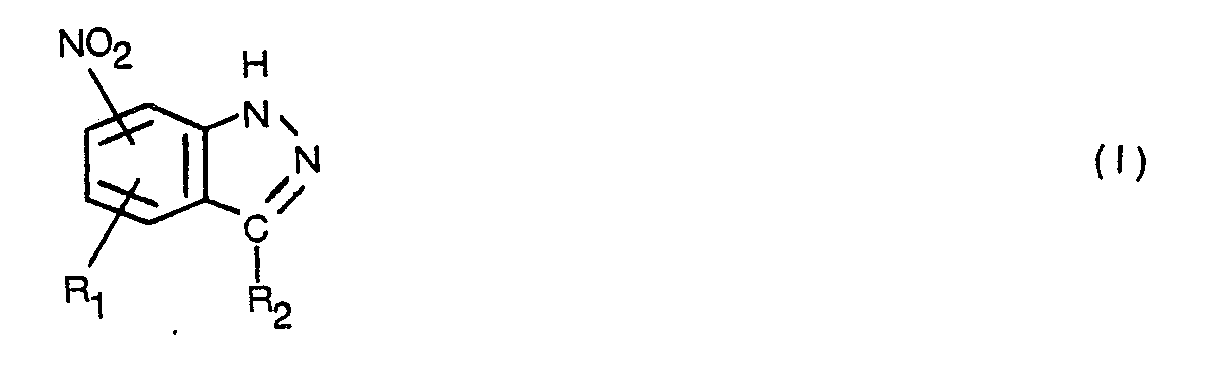
wherein R1 is hydrogen, alkyl, ―SO3M or―COOM (wherein M is hydrogen, alkali metal or ammonium), and R2 is hydrogen or alkyl,
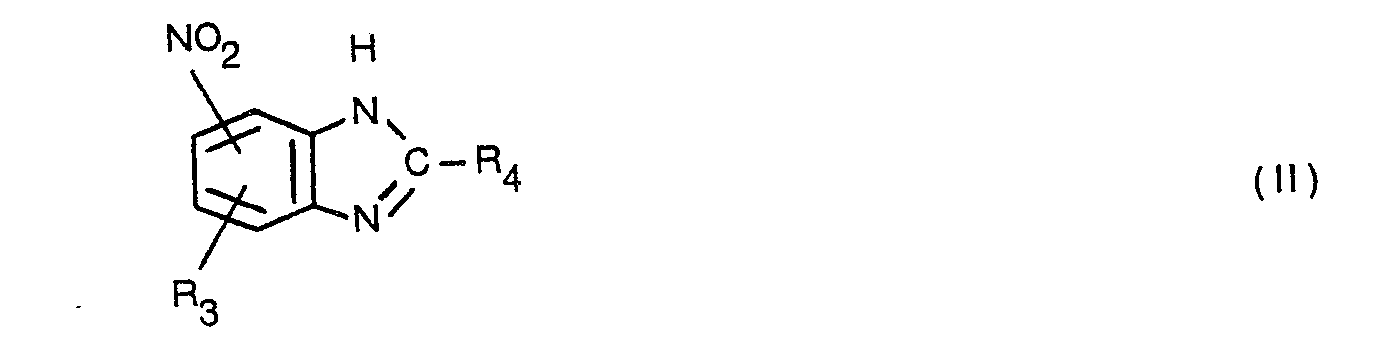
wherein R3 is hydrogen, alkyl, ―SO3M or―COOM (wherein M has the meaning given above, and R4 is hydrogen, alkyl or CH2―S―(CH2)n―Y' (wherein n is 1 to 3, and Y' is hydrogen or -S03M wherein M has the meaning given above).

wherein n is from 1 to 5, and each Y, which may be the same or different, is an alkylene radical having from 2 to 4 carbon atoms.
wherein R1 is hydrogen, alkyl, ―SO3M or―COOM (wherein M is hydrogen, alkali metal or ammonium), and R2 is hydrogen or alkyl,
wherein R3 is hydrogen, alkyl, ―SO3M or―COOM (wherein M has the meaning given above, and R4 is hydrogen, alkyl or CH2―S―(CH2)n―Y' (wherein n is 1 to 3, and Y' is hydrogen or -S03M wherein M has the meaning given above).
wherein n is from 1 to 5, and each Y, which may be the same or different, is an alkylene radical having from 2 to 4 carbon atoms.
2. A material according to Claim 1, characterized in that the compound having Formula
[III] is diethylenetriamine, triethylenetetramine, tetraethylenepentamine, pentaethylenehexamine,
hexaethyleneheptamine, tripropylenetetramine, dibutylenetriamine, spermine, spermidine,
n-(4-aminobutyl)cadaverine.
3. A material according to Claim 1 or 2 characterised in that said iridium salt is
potassium or sodium iridium (III) hexachloride.
4. A material according to Claim 1 or 2 characterised in that said rhodium salt is
rhodium (III) trichloride, rhodium (IV) tetrachloride or potassium rhodium (III) hexabromide.
5. A material according to any of Claims 1 to 4 characterized in that said gold compound
is chloroauric acid, potassium chloroaurate, gold thiocyanate, sodium chloroaurate,
potassium aurate, potassium chloroaurate, potassium bromoaurate, potassium iodoaurate,
potassium gold cyanide, potassium gold thiocyanide, gold thioglucose, gold sulfide
or gold selenide.
6. A material according to any of Claims 1 to 5 characterized in that the quantity
of the compound having Formula [I] or [II] is from 1.0 x 10⁻⁶ to 1.0 x 10⁻¹ mole per mole of silver halide.
7. A material according to any of Claims 1 to 6 characterized in that the quantity
of the compound having Formula [III] is from 1.0 x 10⁻⁷ to 1.0 x 10⁻² mole per mole of silver halide.
8. A material according to any of Claims 1 to 6 characterized in that the quantity
of the gold compound is from 1.0 x 10⁻⁷ to 1.0 x 10⁻⁴ mole per mole of silver halide.
1. Direkt-positives, photographisches Silberhalogenidmaterial, bestehend aus einem
Träger und einer verschleierte, in Gegenwart eines wasserlöslichen Iridium- oder Rhodiumsalzes
hergestellte Silberhalogenidteilchen enthaltenden Silberhalogenidemulsionsschicht,
dadurch gekennzeichnet, dass diese Emulsionsschicht und/oder eine benachbarte hydrophile
kolloidale Schichteine Verbindung der Formel [I] oder [II] und mindestens eine unter
einer Verbindung der Formel [III] und einer Goldverbindung ausgewählte Verbindung
enthält,
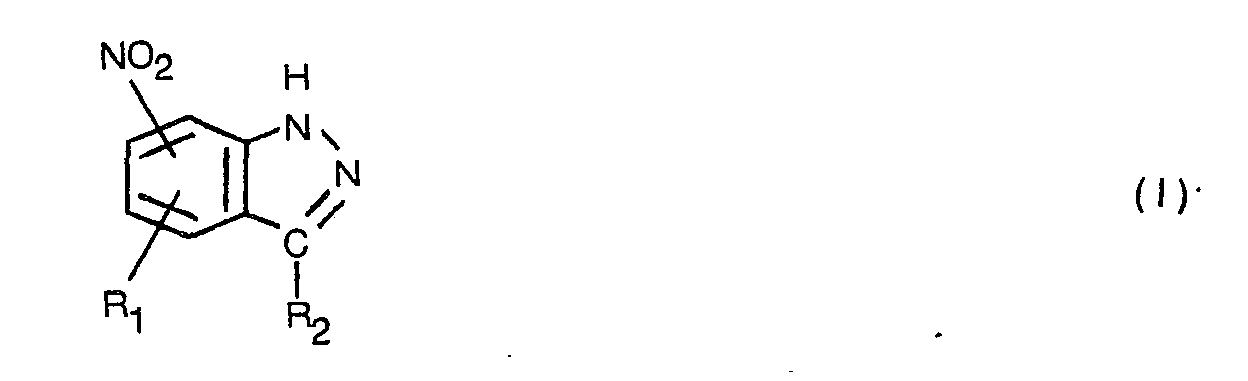
worin R1 für Wasserstoff, Alkyl, -S03M oder -COOM (wobei M Wasserstoff, ein Alkalimetall oder Ammonium bedeutet) und R2 für Wasserstoff oder Alkyl stehen,
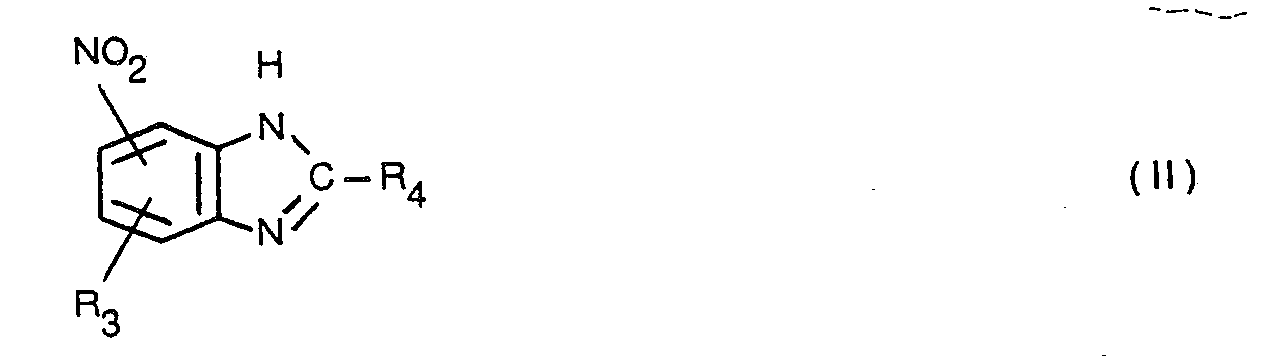
worin R3 für Wasserstoff, Alkyl,-SO3M oder -COOM (wobei M die oben angegebene Bedeutung hat) und R4 für Wasserstoff, Alkyl oder―CH2―S―(CH2)nY' (wobei n 1 bis 3 und Y' Wasserstoff oder―S03M mit m in der oben angegebenen Bedeutung darstellen) stehen,

worin n 1 bis 5 beträgt und die Y, die gleich oder verschieden sein könne, je einen Alkylenrest mit 2 bis 4 Kohlenstoffatomen darstellen.
worin R1 für Wasserstoff, Alkyl, -S03M oder -COOM (wobei M Wasserstoff, ein Alkalimetall oder Ammonium bedeutet) und R2 für Wasserstoff oder Alkyl stehen,
worin R3 für Wasserstoff, Alkyl,-SO3M oder -COOM (wobei M die oben angegebene Bedeutung hat) und R4 für Wasserstoff, Alkyl oder―CH2―S―(CH2)nY' (wobei n 1 bis 3 und Y' Wasserstoff oder―S03M mit m in der oben angegebenen Bedeutung darstellen) stehen,
worin n 1 bis 5 beträgt und die Y, die gleich oder verschieden sein könne, je einen Alkylenrest mit 2 bis 4 Kohlenstoffatomen darstellen.
2. Material nach Anspruch 1, dadurch gekennzeichnet, dass als Verbindung der Formel
[III] Diäthylentriamin, Triäthylentetramin, Tetraäthylenpentamin, Pentaäthylenhexamin,
Hexaäthylenheptamin, Tripropylenetetramin, Dibutylentriamin, Spermin, Spermidin oder
n-(4-Aminobutyl)-cadaverin vorliegt.
3. Material nach Anspruch 1 oder 2, dadurch gekennzeichnet, dass besagtes Iridiumsalz
Kalium- oder Natriumiridium-(III)-hexachlorid ist.
4. Material nach Anspruch 1 oder 2, dadurch gekennzeichnet, dass besagtes Rhodiumsalz
Rhodium-(III)-trichlorid, Rhodium-(lV)-tetrachlorid oder Kaliumrhodium-(III)-hexabromid
ist.
5. Material nach einem der Ansprüche 1 bis 4, dadurch gekennzeichnet, dass besagte
Goldverbindung Goldchlorwasserstoffsäure, Kaliumchloroaurat, Goldrhodanid, Natriumchloroaurat,
Kaliumaurat, Kaliumchloroaurat, Kaliumbromoaurat, Kaliumjodoaurat, Kaliumgoldcyanid,
Kaliumgoldrhodanid, Goldthioglukose, Goldsulfid oder Goldselenid ist.
6. Material nach einem der Ansprüche 1 bis 5, dadurch gekennzeichnet, dass die Menge
der Verbindung der Formel [I] oder [II] 1,0 . 10-6 bis 1,0 10-1 Mol pro Mol Silberhalogenid beträgt.
7. Material nach einem der Ansprüche 1 bis 6, dadurch gekennzeichnet, dass die Menge
der Verbindung der Formel [III] 1,0 10-7 bis 1,0 . 10-2 Mol pro Mol Silberhalogenid beträgt.
8. Material nach einem der Ansprüche 1 bis 6, dadurch gekennzeichnet, dass die Menge
der Goldverbindung 1,0 10-7 bis 1,0 10-4 Mol pro Mol Silberhalogenid beträgt.
1. Un matériau photographique autopositif à l'halogénure d'argent comprenant un support,
une couche d'émulsion d'halogénure d'argent comprenant des particules d'halogénure
d'argent brumisées préparées en présence d'un sel d'iridium ou de rhodium hydrosoluble,
caractérisé en ce que ladite couche d'émulsion et/ou une couche colloïdale hydrophile
adjacente contient un composé ayant la formule [I] ou [II] et au moins un composé
choisi parmi un composé ayant la formule [III] et un composé contenant de l'or,
dans laquelle R1 est l'hydrogène, un alkyle,―SO3M ou―COOM (dans lesquels M est l'hydrogène, un métal alcalin ou un ammonium) et R2 est l'hydrogène ou un alkyle,
dans laquelle R3 est l'hydrogène, un alkyle, ―S03M ou ―COOM (dans lesquels M a la signification donnée ci-dessus), et R4 est l'hydrogène, un alkyle ou ―CH2―S―(CH2)n―Y' (dans lequel n est compris entre 1 et 3, et Y' est l'hydrogène ou -S03M, dans lequel M a la signification donnée ci-dessus).

dans laquelle n est comprise entre 1 et 5, et tous les Y, qui peuvent être les mêmes ou différents, sont un radical alkylène ayant de 2 à 4 atomes de carbone.
dans laquelle R1 est l'hydrogène, un alkyle,―SO3M ou―COOM (dans lesquels M est l'hydrogène, un métal alcalin ou un ammonium) et R2 est l'hydrogène ou un alkyle,
dans laquelle R3 est l'hydrogène, un alkyle, ―S03M ou ―COOM (dans lesquels M a la signification donnée ci-dessus), et R4 est l'hydrogène, un alkyle ou ―CH2―S―(CH2)n―Y' (dans lequel n est compris entre 1 et 3, et Y' est l'hydrogène ou -S03M, dans lequel M a la signification donnée ci-dessus).
dans laquelle n est comprise entre 1 et 5, et tous les Y, qui peuvent être les mêmes ou différents, sont un radical alkylène ayant de 2 à 4 atomes de carbone.
2. Un matériau selon la revendication 1, caractérisé en ce que le composé ayant la
formule [III] est la diétheylènetriamine, la triéthylènetétramine, la tétraéthylènepentamine,
la pentaéthylènehexamine, la hexaéthylèneheptamine, la tripropylènetétramine, la dibutylènetriamaine,
la spermine, la spermidine, et la n-(aminobutyl-4)cadavérine.
3. Un matériau selon la revendication 1 ou la revendication 2 caractérisé en ce que
ledit sel d'iridium est l'hexachlorure d'iridium (III) et de potassium ou de sodium.
4. Un matériau selon la revendication 1 ou la revendication 2 caractérisé en ce que
ledit sel de rhodium est le trichlorure de rhodium (III), le tétrachlorure de rhodium
(IV) ou l'hexabromure de rhodium (III) et de potassium.
5. Un matériau selon l'une quelconque des revendications 1 à 4 caractérisé en ce que
ledit composé contenant de l'or est l'acide chloroaurique, le chloroaurate de potassium,
le thiocyanate d'or, le chloroaurate de sodium, l'aurate de potassium, le chloroaurate
de potassium, le bromoaurate de potassium, l'iodoaurate de potassium, le cyanure d'or
et de potassium, le thiocyanure d'or et de potassium, l'or thioglucose, le sulfure
d'or ou le séléniure d'or.
6. Un matériau selon l'une quelconque des revendications 1 à 5 caractérisé en ce que
la quantité du composé ayant la formule [I] ou [II] est comprise entre 1,0 . 10-6 et 1,0 . 10-1 mole par mole d'halogénure d'argent.
7. Un matériau selon l'une quelconque des revendications 1 à 6 caractérisé en ce que
la quantité du composé ayant la formule [III] est comprise entre 1,0. 10-7 et 1,0. 10-2 mole par mole d'halogénure d'argent.
8. Un matériau selon l'une quelconque des revendications 1 à 6 caractérisé en ce que
la quantité du composé contenant de l'or est comprise entre 1,0 . 10-7 et 1,0 . 10-4 mole par mole d'halogénure d'argent.