|
(11) | EP 0 093 945 B1 |

| (12) | EUROPEAN PATENT SPECIFICATION |
|
|
| (54) |
1,4-Dihydropyridine derivatives 1,4-Dihydropyridin-Derivate Dérivés de 1,4-dihydropyridine |
|
|
|||||||||||||||||||||||||||||||
| Note: Within nine months from the publication of the mention of the grant of the European patent, any person may give notice to the European Patent Office of opposition to the European patent granted. Notice of opposition shall be filed in a written reasoned statement. It shall not be deemed to have been filed until the opposition fee has been paid. (Art. 99(1) European Patent Convention). |
[0001] The present invention relates to 1,4-dihydropyridine derivatives. More specifically, the present invention relates to a 1,4-dihydropyridine compound of the general formula:
wherein R, represents a hydrogen atom, an alkyl group having 1-5 carbon atoms, an alkenyl group having 2-5 carbon atoms, an aralkyl group having 7-13 carbon atoms or an acyl group having 1-7 carbon atoms, R2 and R3 are the same or different groups and each represents an alkyl group having 1-5 carbon atoms which group may be substituted by a halogen atom or a Cl-5 alkoxy group, an alkenyl group having 2-5 carbon atoms, a disubstituted aminoalkyl group having 1-5 carbon'atoms the substituents being chosen from a C1-5 alkyl and a benzyl group or a heterocyclic group selected from a thienyl, furyl, piperidyl, pyranyl and a pyrrolidinyl group which group may be substituted by an alkyl group having 1-5 C atoms, an aralkyl group having 7-8 C atoms and an acyl group having 1-7 C atoms, R4 and R5 are the same or different groups and each represents a hydrogen atom, a halogen atom or a nitro group, and R6 and R7 are the same or different groups and each represents an alkyl group having 1-5 carbon atoms, a pharmaceutically acceptable acid addition salt thereof and a pharmaceutical composition containing, as the active ingredient, a 1,4-dihydropyridine compound of the general formula (I) as well as to the use of such compounds.
[0002] There has always been a need for the development of excellent drugs for cardiovascular disease having hypotensive and vasodilating activities. The inventors, as the result of extensive studies for this purpose, have found that a 1,4-dihydropyridine compound of the general formula (I) and pharmaceutically acceptable acid salts thereof are compounds which have excellent effects to dilate coronary artery and peripheral blood vessels and to depress the blood pressure and which are useful as drugs for cardiovascular disease, such as hypotensives, vasodilators etc., and thus have accomplished the present invention.
[0003] In the general formula (I), the alkyl group having 1-5 carbon atoms for Ri, R2, R3, R6 and R7 includes a methyl group, an ethyl group, a propyl group, a butyl group, a pentyl group etc., the alkenyl group having 2-5 carbon atoms for Ri, R2 and R3 includes a vinyl group, an allyl group, a methallyl group etc., the aralkyl group having 7-13 carbon atoms for R, includes a benzyl group, a phenethyl group, a diphenylmethyl group, the acyl group having 1-7 carbon atoms for R, includes a formyl group, an acetyl group, a pivaloyl group, a benzoyl group etc., and the halogen atom for R4 and Rs includes a fluorine atom, a chlorine atom, a bromine atom or an iodine atom. Substituents for the substituted alkyl group having 1-5 carbon atoms for R2 and R3 include a halogen atom such as a fluorine atom, a chlorine atom, a bromine atom and an iodine atom or an alkoxy group having 1-5 carbon atoms such as a methoxy group, an ethoxy group, a propoxy group, a butoxy group etc., and examples of the substituted alkyl group are a methoxyethyl group, an ethoxyethyl group, an n-propoxyethyl group, an isopropoxyethyl group, a fluoroethyl group, a chloroethyl group, a bromoethyl group, an iodoethyl group, a chloropropyl group, a bromopropyl group, an iodopropyl group etc.
[0004] The aminoalkyl group having 1-5 carbon atoms in the disubstituted aminoalkyl group having 1-5 carbon atoms for R2 and R3 includes an aminoethyl group, an aminopropyl group etc., and substituents, which are the same or different groups, include alkyl groups having 1-5 carbon atoms such as a methyl group, an ethyl group, a propyl group, a butyl group etc. and aralkyl groups such as a benzyl group etc., and examples of the disubstituted aminoalkyl group having 1-5 carbon atoms are an N,N-dimethylaminoethyl group, an N,N-diethylaminoethyl group, an N-methyl-N-benzylaminoethyl group, an N-ethyl-N-benzylaminoethyl group, an N,N-dimethylaminopropyl group, an N-methyl-N-benzylaminopropyl group etc.
[0005] The unsubstituted heterocyclic group for R2 and R3 includes a thienyl group, a furyl group, a piperidyl group, a pyranyl group, a pyrrolidinyl group etc.
[0006] Substituents for the substituted heterocyclic group include a hydrogen atom, an alkyl group having 1-5 carbon atoms such as a methyl group, an ethyl group, a propyl group etc., an aralkyl group having 7-8 carbon atoms such as a benzyl group, a phenethyl group etc., and an acyl group having 1-7 carbon atoms such as a formyl group, an acetyl group, a benzoyl group etc., and examples of the substituted heterocyclic group are a tetrahydrofuryl group, a tetrahydrothienyl group, a tetrahydrothiopyranyl group, a thienylmethyl group, a thienylethyl group, an N-methylpiperidyl group, an N-ethylpiperidyl group, an N-isopropylpiperidyl group, an N-benzylpiperidyl group, an N-phenethylpiperidyl group, an N-formyl- piperidyl group, an N-acetylpiperidyl group, an N-benzoylpiperidyl group, an N-methylpyrrolidinyl group, an N-ethylpyrrolidinyl group etc.
[0007] The pharmaceutically acceptable acid addition salt of the 1,4-dihydropyridine compound of the general formula (I) is selected from the group consisting of inorganic acid salts such as hydrochloride, hydrobromide, phosphate or sulfate, and organic acid salt such as formate, acetate, fumarate, maleate, malate, aspartate or glutamate.
[0008] Representative processes for production of the compounds of the present invention are illustrated below.
Process 1
[0009] The present compound of the general formula (la) (referred to as Compound la), i.e. a 1-hydroxy-1,4-dihydropyridine compound may be produced by reacting a 1,5-diketone compound of the general formula (II) (referred to as Compound II) with hydroxylamine.
wherein R2, R3, R4, R5, R6 and R7 have the same meaning as defined above.
[0010] The mixing molar ratio of Compound II and hydroxylamine is 1.0:0.8-1.0:2.0, preferably 1.0:1.0-1.0:1.3.
[0011] The reaction is carried out in the presence or absence of an alcohol such as methanol, ethanol, or isopropanol, an aromatic hydrocarbon such as benzene or toluene, a halogenated hydrocarbon such as dichloromethane, chloroform or carbon tetrachloride, an ether such as diethyl ether, tetrahydrofuran, dioxane or 1,2-dimethoxyethane, an ester such as ethyl acetate or butyl acetate, an aprotic polar solvent such as acetonitrile, dimethylformamide or dimethylsulfoxide, or water, at -20°C to 150°C, preferably at 0°C to 50°C. Separation of the desired product from the reaction mixture may be effected by conventional operations such as concentration, extraction, column chromatography or crystallization.
[0012] Compound II employed as the starting material in the present process may be obtained by the following process i) or ii).
[0013] i) A process for the Production by Reaction of Aldehyde (III) with Acylacetic Acid Ester (IV)
wherein R2, R4, R5 and R6 have the same meaning as defined above.
[0014] The mixing molar ratio of Compound III and Compound IV is 1.0:1.5-1.0:4.0, preferably 1.0:2.0-1.0:2.5. The reaction is carried out in the presence or absene of a solvent, for example, ethers such as diethyl ether, 1,2-dimethoxyethane, tetrahydrofuran or dioxane, halogenated hydrocarbons such as dichloromethane, chloroform or carbon tetrachloride, esters such as ethyl acetate or butyl acetate, using, as a catalyst, a Lewis acid such as zinc chloride, tin tetrachloride, boron trifluoride, titanium tetrachloride or aluminum chloride at 0°C to 100°C, preferably at 20°C to 80°C.
[0015] ii) A process for the Production by Reaction of Benzylideneacylacetic Acid Ester (V) with Acylacetic Acid Ester (IV)
wherein R2, R3, R4, R5, R6 and R7 having the same meaning as defined above.
[0016] The mixing molar ratio of Compound V and the Compound IV is 1.0:0.8-1.0:8.0, preferably 1.0:1.0-1.0:6.0. The reaction is carried out in the presence or absence of a solvent, for example, aromatic hydrocarbons such as benzene, toluene or xylene, ethers such as diethyl ether, 1,2-dimethoxyethane, tetrahydrofuran or dioxane, alcohols such as methanol or ethanol, using, as a catalyst, a fluoride such as potassium fluoride or cesium fluoride at -20°C to 140°C, preferably at 0°C to 60°C.
[0017] Both of Compound IV and Compound V employed as the starting materials in the present process are either known compounds which may be produced by a known process [A. B. Boese, Ind. Eng. Chem., 32,16 (1940); G. Jones, "The Knoevenagel Condensation", Org. Reaction, XV, 204 (1967)].
Process 2
[0018] The present compounds other than Compounds la according to Process 1, may be obtained by 0-alkylating or O-acylating Compounds la with an alkylating agent such as dimethyl sulfate, benzyl chloride, phenethyl bromide, allyl chloride, allyl bromide or methyl iodide or an acylating agent such as acetyl chloride or benzoyl chloride.
[0019] Typical examples of the present compound are listed below. The structure, melting point and NMR of each of these compounds are set forth in Table 1.
[0020] In the description hereinbelow, the compounds of Compound No. 1, 2, 3, ... and 25 are referred to as Compounds 1, 2, 3, ... and 25, respectively.
[0021] Results of the hypotensive effect test and vasodilating effect test of the representative examples of the present compound are shown below.
(1) Hypotensive Effect
[0022] Groups, each of which was consisting of 4 mongrel adult dogs (both male and female, weighing 15-20 kg), were anesthetized by intravenously administrating 30 mg/kg of sodium pentobarbital. Each anesthetized dog was fixed in the supine position, and subsequently a cannula was inserted into the femoral artery. The blood pressure was measured with a blood pressure transducer (Nippon Koden, MPU-0.5) and recorded on a polygraph. Thereafter, a suspension of the test compound in a 0.3% CMC solution was administered via the cannula planted in the duodenum of the anesthetized dog, and the change in blood pressure was observed. The results are given in Table 2.
[0023] As evident from Table 2, the present compounds have a superior and long-lasting hypotensive effect and thus are compounds useful as hypotensives.
(2) Vasodilating Effect
[0024] Groups, each of which was consisting of 3 mongrel adult dogs (both male and female, weighing 15-20 kg), were anesthetized by intravenously administrating 30 mg/kg of sodium pentobarbital. Thereafter, the chest of each anesthetized dog was incised, then probes for measuring the blood flow were fitted to the circumflex branch of left coronary artery, the vertebral artery and the femoral artery, and the blood flow of each artery was measured with a square wave electromagnetic flowmeter (Nippon Koden).
[0025] A suspension of the test compound in a 0.3% CMC solution was administered via a cannula planted in the duodenum of the anesthetized dog. The results are given in Table 3.
[0026] From Table 3, it is obvious that the compounds of the present invention have an excellent effect to increase the blood flow and thus are compounds useful as vasodilators.
[0027] The compounds of the present invention, in consideration of their pharmaceutical effect, may be employed in various pharmaceutical forms for the intended administration, and in particular, they are preferably employed in oral forms such as tablets or powders.
[0028] In the case of tablets, the compound of the present invention may be contained in an amount of 5-30% (W/W) per tablet. As other components (carriers), commonly employed excipients, disintegrants, lubricants, binders, coating agents may be employed.
[0029] For example, there may be mentioned excipients such as glucose or lactose, disintegrators such as starch or calcium carboxymethyl cellulose, lubricants such as magnesium stearate or talc, binders such as simple syrup, polyvinyl alcohol, gelatin or hydroxypropyl cellulose, and coating agents such as dispersants (e.g. methyl cellulose and ethyl cellulose) and plasticizers (e.g. glycerin and polyethylene glycol). Microcrystalline cellulose partakes of the properties of disintegrators of binders and of excipients.
[0030] In the case of powders, the compound of the present invention may be contained in an amount of 1-20% (W/W). As the carriers, excipients such as glucose or lactose, binders such as hydroxypropyl cellulose, may be employed. The dose is preferably in the range of 1-100 mg per day for a human adult (weighing about 60 kg). Certain specific embodiments of the invention are illustrated by the following representative examples.
[0031] The physicochemical properties of the compounds obtained in the following Examples 1-25 are given in Table 1.
Example 1
[0032] To a mixture of 72.1 g of zinc chloride in 200 ml of ethyl acetate was added dropwise a mixture of 40.0 g of m-nitrobenzaldehyde and 61.5 g of methyl acetoacetate at room temperature over 50 minutes. The mixture was stirred at room temperature for further 15 minutes, and further stirred while heating at 60-65°C for 6.5 hours. After completion of the reaction, the reaction mixture was concentrated under reduced pressure, then 800 ml of ether and 800 ml of water were added thereto, and the desired product was extracted with ether. The aqueous layer was extracted again with 300 ml of ether, which was combined with the first ether layer. The combined layer was washed with 200 ml of a 5% aqueous sodium bicarbonate solution, and then with 200 ml of saturated saline. This substance was dried over anhydrous magnesium sulfate, and the ether was distilled off to obtain 92.7 g of crude crystals. The crystals were recrystallized from methanol to obtain 47.7 g (yield 49.3%) of 3,5-bis(methoxycarbonyl)-4-(3-nitrophenyl)-2,6-heptanedione.
m.p.: 94-96°C
NMR (CDCI3, 5): 2.10, 2.26 (6H in total), 3.52, 3.70 (6H in total), 3.97-4.57 (3H, m), 7.40-8.30 (4H, m).
[0033] Thereafter, 2.85 g of hydroxylamine hydrochloride and 1.64 g of sodium hydroxide were stirred in 100 ml of methanol, and the formed sodium chloride was removed by filtration. The filtrate was added dropwise to a mixture of 15.0 g of 3,5-bis-(methoxycarbonyl)-4-(3-nitrophenyl)-2,6-heptanedione in 120 ml of methanol at room temperature over 15 minutes. After stirring the mixture at room temperature for 3 hours, the methanol was distilled off under reduced pressure. Upon addition of 180 ml of ether, a small amount of sodium chloride crystallized out. The crystallized sodium chloride was filtered off, and the ether was distilled off to obtain 14.7 g of crude crystals. The crude crystals were recrystallized from ether:n-hexane (3:1 V/V) to obtain 9.4 g (yield 63.2%) of 1-hydroxy-2,6-dimethyl-4-(3-nitrophenyl)-1,4-dihydropyridine-3,5-dicarboxylic acid dimethyl ester (Compound 1).
Examples 2-3
[0034] By procedures similar to those in Example 1, except that the starting materials used in Example 1 were replaced by those set forth in Table 4, there were obtained 1-hydroxy-2,6-dimethyl-4-(3-nitrophenyl)-1,4-dihydropyridine-3,5-dicarboxylic acid diethyl ester (Compound 2) and 4-(4-chloro-3-nitrophenyl)-1-hydroxy-1,4-dihydropyridine-3,5-dicarboxylic acid dimethyl ester (Compound 3).
Example 4
[0035] In this example, 14.4 g of isopropyl acetoacetate was dissolved in 60 ml of 1,2-dimethoxyethane and 0.2 g of potassium fluoride was added thereto. The mixture was stirred at room temperature for 30 minutes, and 4.98 g of methyl m-nitrobenzylideneacetoacetate was added thereto. The solution was stirred for 4.5 hours. After completion of the reaction, 200 ml of chloroform and 100 ml of water were added to the reaction mixture to carry out extraction. The extracted chloroform layer was dried over anhydrous sodium sulfate, and then the chloroform and the excess isopropyl acetoacetate were distilled off under reduced pressure to obtain 7.9 g as an oily residue.
[0036] Thereafter, a solution of hydroxylamine in methanol obtained from 1.38 g of hydroxylamine hydrochloride, 0.79 g of sodium hydroxide and 60 ml of methanol was added to a solution of 7.9 g of the oily residue obtained above in 50 ml of methanol, and stirred at room temperature for 3.5 hours. After completion of the reaction, the reaction mixture was concentrated under reduced pressure. The concentrate was dissolved in 150 ml of chloroform, then washed with 70 ml of water, and dried over anhydrous sodium sulfate. After drying, the chloroform was distilled off under reduced pressure, and then column chromatography on silica gel (eluent; chloroform:ethanol = 20:1 V/V) was conducted to separate the desired product. The fractions containing the desired product were concentrated, and crystallized from ether-n-hexane to obtain 3.77 g (yield 49.2%) of 1-hydroxy-2,6-dimethyl-4-(3-nitrophenyl)-1,4-dihydropyridine-3,5-dicarboxylic acid 3-isopropyl-5-methyl ester (Compound 4).
Examples 5-16
[0037] By procedures similar to those in Example 4, except that the starting materials used in Example 4 were replaced by those set forth in Table 5, there were obtained 1-hydroxy-2,6-dimethy)-4-(3-nitrophenyi)-1,4-dihydropyridine-3,5-dicarboxylic acid 3-ethyl-5-methyl ester (Compound 5), 1-hydroxy-2,6-dimethyl-4-(3-nitrophenyl)-1,4-dihydropyridine-3,5-dicarboxylic acid 3-methyl-5-n-propyl ester (Compound 6), 1-hydroxy-2,6-dimethyl-4-(3-nitrophenyl)-1,4-dihydropyridine-3,5-dicarboxylic acid 3-isobutyl-5-methyl ester (Compound 7), 1-hydroxy-2,6-dimethyl-4-(3-nitrophenyl)-1 A-dihydropyridine-3,5-dicarboxylic acid 3-ethyl-5-isopropyl ester (Compound 8), 1-hydroxy-2,6-dimethyl-4-(3-nitrophenyl)-1,4-dihydropyridine-3,5-dicarboxylic acid 3-allyl-5-methyl ester (Compound 9), 1-hydroxy-2,6-dimethyl-4-(3-nitrophenyl)-1,4-dihydropyridine-3,5-dicarboxylic acid 3-methoxyethyl-5-methyl ester (Compound 10), 1-hydroxy-2,6-dimethyl-4-(3-nitrophenyl)-1,4-dihydropyridine-3,5-dicarboxylic acid-3-methyl-5-(3-tetrahydrofuryl) ester (Compound 11), 1-hydroxy-2,6-dimethyl-4-(3-nitrophenyl)-1,4-dihydropyridine-3,5-dicarboxylic acid 3-methyl-5-[2-(2-thienyl)ethyl] ester (Compound 12), 1-hydroxy-2,6-dimethyl-4-(3-nitrophenyl)-1,4-dihydropyridine-3,5-dicarboxylic acid 3-(2-chloroethyl)-5-methyl ester (Compound 13), 1-hydroxy-2,6-dimethyl-4-(3-nitrophenyl)-1,4-dihydropyridine-3,5-dicarboxylic acid 3-(1-formyl-4-piperidyl)-5-methyl ester (Compound 14), 1-hydroxy-2,6-dimethyl-4-(3-nitrophenyl)-1,4-dihydropyridine-3,5-dicarboxylic acid 3-(1-formyl-3-piperidyl)-5-methyl ester (Compound 15) and 4-(2,3-dichlorophenyl)-1-hydroxy-2,6-dimethyl-1,4-dihydropyridine-3,5-dicarboxylic acid 3-isopropyl-5-methyl ester (Compound 16).
Example 17
[0038] A mixture of 10.4 g of Compound 14 obtained in Example 14, 4.75 g of p-toluenesulfonic acid, 36 ml of methanol and 36 ml of ethanol was stirred under reflux for 7 hours and the reaction mixture was diluted with 120 ml of water, and the dilute solution was neutralized with a 5% aqueous sodium bicarbonate solution, and extracted with 200 ml, 100 ml and 50 ml of chloroform, respectively. The chloroform layers extracted respectively were combined, washed with water, dried over anhydrous sodium sulfate, and then concentrated to dryness under reduced pressure to obtain 9.8 g (yield 100%) of 1-hydroxy-2,6-dimethyl-4-(3-nitrophenyl)-1,4-dihydropyridine-3,5-dicarboxylic acid 3-methyl-5-(4-piperidyl) ester (Compound 17).
Example 18
[0039] By procedures similar to those in Example 17, except that Compound 14 used in Example 17 was replaced by 8.9 g of Compound 15, there was obtained 8.37 g of 1-hydroxy-2,6-dimethyl-4-(3-nitrophenyl)-1,4-dihydropyridine-3,5-dicarboxylic acid 3-methyl-5-(3-piperidyl) ester (Compound 18).
Example 19
[0040] A mixture of 9.8 g of Compound 17 obtained in Example 17, 4.3 g of benzyl chloride, 3.4 g of triethylamine and 120 ml of toluene was stirred under reflux for 7 hours. After completion of the reaction, the reaction mixture was dissolved in 500 ml of chloroform, and washed with 250 ml of water. The resulting washed chloroform layer was dried over anhydrous sodium sulfate, and then the solvent was distilled off under reduced pressure to obtain 16.9 g of an oily residue. The residue was subjected to silica gel chromatography (eluent; chloroform:methanol = 15:1 VN) to separate the desired product. The fractions containing the desired product were concentrated, and then the concentrate was dissolved in a mixed solvent of 30 ml of acetone and 10 ml of water. Thereafter, 26 ml of 1 N hydrochloric acid was added thereto and the mixture was stirred, whereby yellow crystals were separated out. The crystals were collected by filtration, washed with water and dried to obtain 4.1 g (yield 33.1%) of 1-hydroxy-2,6-dimethyl-4-(3-nitrophenyl)-1,4-dihydropyridine-3,5-dicarboxylic acid 3-(1-benzyl-4-piperidyl)-5-methyl ester hydrochloride (Compound 19).
Example 20
[0041] By procedures similar to those in Example 19, except that Compound 17 and 4.3 g of the benzyl chloride were replaced by 8.31 g of Compound 18 and 2.66 g of benzyl chloride, there was obtained 3.78 g of 1-hydroxy-2,6-dimethyl-4-(3-nitrophenyl)-1,4-dihydropyridine-3,5-dicarboxylic acid 3-(1-benzyl-4-piperidyl)-5-methyl ester hydrochloride (Compound 20).
Example 21
[0042] In this example, 3.2 g of Compound 13 obtained in Example 13 was dissolved in 24 ml of acetonitrile, and to the solution was added 2.3 g of sodium iodide. The mixture was stirred under reflux in N2 atmosphere for 7.5 hours. After completion of the reaction, the reaction mixture was cooled, then the crystallized salt was filtered off, and the filtrate was concentrated. The concentrate was dissolved in 30 ml of toluene, and to the solution was added 2.34 g of N-methylbenzylamine. The mixture was stirred at 80-90°C under N2 atmosphere for 13 hours. After completion of the reaction, the reaction mixture was diluted with 80 ml of ethyl acetate, then washed with a 10% aqueous citric acid solution and water, and dried over anhydrous sodium sulfate. The solvent was distilled off under reduced pressure, and column chromatography on silica gel (eluent; chloroform:methanol = 20:1 VN) was conducted to separate the desired product. The fractions containing the desired product were concentrated, dissolved in 6 ml of ethyl acetate, and 1 ml of ether saturated with hydrogen chloride was added thereto. The solution was concentrated to dryness to obtain 1.12 g (yield 26.5%) of 1-hydroxy-2,6-dimethyl-4-(3-nitrophenyl)-1,4-dihydropyridine-3,5-dicarboxylic acid 3-[2-(N-benzyl-N-methylamino)ethyl] ester-5-methylester hydrochloride (Compound 21).
Example 22
[0043] In this example, 4.00 g of Compound 1 obtained in Example 1 was dissolved in 40 ml of methanol, and 2.34 g of sodium methylate (28% methanol solution) was added to the solution. Thereafter, a solution of 1.53 g of dimethyl sulfate in 20 ml of methanol was added thereto dropwise at room temperature over 10 minutes. Stirring was effected at room temperature for further 2 hours, and the reaction mixture was cooled to obtain 2.83 g (yield 68.0%) of 2,6-dimethyl-1-methoxy-4-(3-nitrophenyl)-1,4-dihydropyridine-3,5-dicarboxylic acid dimethyl ester (Compound 22).
Example 23
[0044] In this example, 2.00 g of Compound 1 obtained in Example 1 was dissolved in 20 ml of tetrahydrofuran, and then to the solution were added 0.46 g of sodium hydroxide and 1.40 g of benzyl chloride. Stirring was effected at room temperature for 7 hours, and the reaction mixture was concentrated under reduced pressure. To the concentrate were added 15 ml of chloroform and 15 ml of water to carry out extraction. The extracted chloroform layer was washed with water, then dried over anhydrous sodium sulfate, and was concentrated under reduced pressure to obtain crude crystals. Then, the crystals were recrystallized from methanol to obtain 1.52 g (yield 60.8%) of 1-benzyloxy-2,6-dimethyl-4-(3-nitrophenyl)-1,4-dihydropyridine-3,5-dicarboxylic acid dimethyl ester (Compound 23).
Example 24
[0045] By procedures similar to those in Example 23, except that 1.40 g of the benzyl chloride was replaced by 1.33 g of allyl bromide, there was obtained 1.61 g (yield 72.5%) of 1-allyloxy-2,6-dimethyl-4-(3-nitrophenyl)-1,4-dihydropyridine-3,5-dicarboxylic acid dimethyl ester (Compound 24).
Example 25
[0046] In this example, 1.42 g of pyridine was added to a solution of 5.00 g of Compound 1 obtained in Example 1 in 25 ml of tetrahydrofuran, and the mixture was cooled to -10°C or below. To the solution was added dropwise a solution of 1.25 g of acetyl chloride in 10 ml of tetrahydrofuran while keeping the temperature not higher than -10°C. Further, stirring was continued at -10°C or below whereby crystals were deposited. 2.5 Hours later, 40 ml of water was added thereto, and the mixture was stirred with ice cooling for 1.5 hours. Thereafter, the crystals were collected by filtration, washed with water and dried to obtain 4.14 g (yield 74.2%) of 1-acetoxy-2,6-dimethyl-4-(3-nitrophenyl)-1,4-dihydropyridine-3,5-dicarboxylic acid dimethyl ester (Compound 25).
Example 26
(Example of Preparation of 10,000 10-mg Tablets)
[0048] The above components were mixed on a mixer for 5 minutes. The mixed powder was compressed on a tabletting machine (Kikusui Seisakusho, Model HU-37) using round-cornered flat punches of 6.0 mm in a diameter to obtain 10,000 tablets of 6.0 mm in a diameter, 2.5 mm in thickness and 90 mg in weight.
Example 27
(Example of Preparation of Powder)
1. A 1,4-dihydropyridine compound having the general formula:
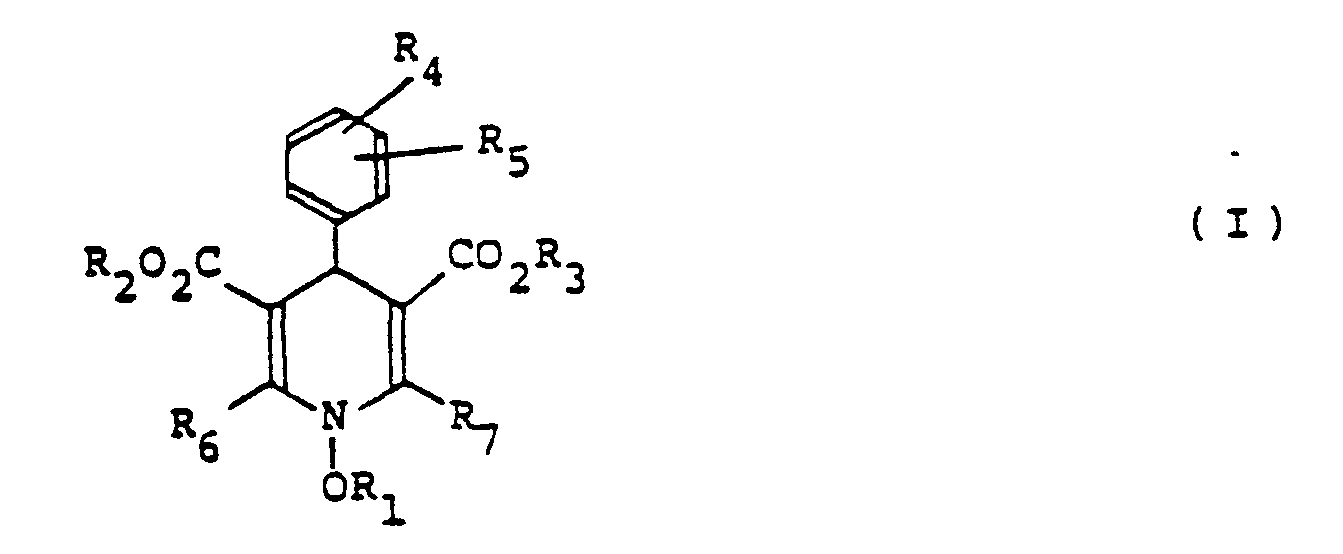
wherein R, represents a hydrogen atom, an alkyl group having 1-5 carbon atoms, an alkenyl group having 2-5 carbon atoms, an aralkyl group having 7-13 carbon atoms or an acyl group having 1-7 carbon atoms, R2 and R3 are the same or different groups and each represents an alkyl group having 1-5 carbon atoms which group may be substituted by a halogen atom or a Cl-5 alkoxy group, an alkenyl group having 2-5 carbon atoms, a disubstituted aminoalkyl group having 1-5 carbon atoms the substituents being chosen from a C1-5 alkyl and a benzyl group or a heterocyclic group selected from a thienyl, furyl, piperidyl, pyranyl and a pyrrolidinyl group which group may be substituted by an alkyl group having 1-5 C atoms, an aralkyl group having 7-8 C atoms and an acyl group having 1-7 C atoms, R4 and Rs are the same or different groups and each represents a hydrogen atom, a'halogen atom or a nitro group, and R6 and R7 are the same or different groups and each represents an alkyl group having 1-5 carbon atoms; or a pharmaceutically acceptable acid addition salt thereof.
wherein R, represents a hydrogen atom, an alkyl group having 1-5 carbon atoms, an alkenyl group having 2-5 carbon atoms, an aralkyl group having 7-13 carbon atoms or an acyl group having 1-7 carbon atoms, R2 and R3 are the same or different groups and each represents an alkyl group having 1-5 carbon atoms which group may be substituted by a halogen atom or a Cl-5 alkoxy group, an alkenyl group having 2-5 carbon atoms, a disubstituted aminoalkyl group having 1-5 carbon atoms the substituents being chosen from a C1-5 alkyl and a benzyl group or a heterocyclic group selected from a thienyl, furyl, piperidyl, pyranyl and a pyrrolidinyl group which group may be substituted by an alkyl group having 1-5 C atoms, an aralkyl group having 7-8 C atoms and an acyl group having 1-7 C atoms, R4 and Rs are the same or different groups and each represents a hydrogen atom, a'halogen atom or a nitro group, and R6 and R7 are the same or different groups and each represents an alkyl group having 1-5 carbon atoms; or a pharmaceutically acceptable acid addition salt thereof.
2. A compound according to claim 1, namely, 1-hydroxy-2,6-dimethyl-4-(3-nitrophenyl)-1,4-dihydropyridine-3,5-dicarboxylic
acid dimethyl ester.
3. A compound according to claim 1, namely, 1-hydroxy-2,6-dimethyl-4-(3-nitrophenyl)-1,4-dihydropyridine-3,5-dicarboxylic
acid diethyl ester.
4. A compound according to claim 1, namely, 4-(4-chioro-3-nitrophenyi)-1-hydroxy-1,4-dihydropyridine-3,5-dicarboxylic
acid dimethyl ester.
5. A compound according to claim 1, namely, 1-hydroxy-2,6-dimethyl-4-(3-nitrophenyl)-1,4-dihydropyridine-3,5-dicarboxylic
acid 3-isopropyl-5-methyl ester.
6. A compound according to claim 1, namely, 1-hydroxy-2,6-dimethyl-4-(3-nitrophenyl)-1,4-dihydropyridine-3,5-dicarboxylic
acid 3-ethyl-5-methyl ester.
7. A compound according to claim 1, namely, 1-hydroxy-2,6-dimethyl-4-(3-nitrophenyl)-1,4-dihydropyridine-3,5-dicarboxylic
acid 3-methyl-5-n-propyl ester.
8. A compound according to claim 1, namely, 1-hydroxy-2,6-dimethyl-4-(3-nitrophenyl)-1,4-dihydropyridine-3,5-dicarboxylic
acid 3-isobutyl-5-methyl ester.
9. A compound according to claim 1, namely, 1-hydroxy-2,6-dimethyl-4-(3-nitrophenyl)-1,4-dihydropyridine-3,5-dicarboxylic
acid 3-ethyl-5-isopropyl ester.
10. A compound according to claim 1, namely, 1-hydroxy-2,6-dimethyl-4-(3-nitrophenyl)-1,4-dihydropyridine-3,5-dicarboxylic
acid 3-allyl-5-methyl ester.
11. A compound according to claim 1, namely, 1-hydroxy-2,6-dimethyl-4-(3-nitrophenyl)-1,4-dihydropyridine-3,5-dicarboxylic
acid 3-methoxyethyl-5-methyl ester.
12. A compound according to claim 1, namely, 1-hydroxy-2,6-dimethyl-4-(3-nitrophenyl)-1,4-dihydropyridine-3,5-dicarboxylic
acid 3-methyl-5-(3-tetrahydrofuryl) ester.
13. A compound according to claim 1, namely, 1-hydroxy-2,6-dimethyl-4-(3-nitrophenyl)-1,4-dihydropyridine-3,5-dicarboxylic
acid 3-methyl-5-[2-(2-thienyl)ethyl] ester.
14. A compound according to claim 1, namely, 1-hydroxy-2,6-dimethyl-4-(3-nitrophenyl)-1,4-dihydropyridine-3,5-dicarboxylic
acid 3-(2-chloroethyl)-5-methyl ester.
15. A compound according to claim 1, namely, 1-hydroxy-2,6-dimethyl-4-(3-nitrophenyl)-1,4-dihydropyridine-3,5-dicarboxylic
acid 3-(1-formyl-4-piperidyl)-5-methyl ester.
16. A compound according to claim 1, namely, 1-hydroxy-2,6-dimethyl-4-(3-nitrophenyl)-1,4-dihydropyridine-3,5-dicarboxylic
acid 3-(1-formyl-3-piperidyl)-5-methyl ester.
17. A compound according to claim 1, namely, 4-(2,3-dichlorophenyl)-1-hydroxy-2,6-dimethyl-1,4-dihydropyridine-3,5-dicarboxylic
acid 3-isopropyl-5-methyl ester.
18. A compound according to claim 1, namely, 1-hydroxy-2,6-dimethyl-4-(3-nitrophenyl)-1,4-dihydropyridine-3,5-dicarboxylic
acid-3-methyl-5-(4-piperidyl) ester.
19. A compound according to claim 1, namely, 1-hydroxy-2,6-dimethyl-4-(3-nitrophenyl)-1,4-dihydropyridine-3,5-dicarboxylic
acid-3-methyl-5-(3-piperidyl) ester.
20. A compound according to claim 1, namely, 1-hydroxy-2,6-dimethyl-4-(3-nitrophenyl)-1,4-dihydropyridine-3,5-dicarboxylic
acid-3-(1-benzyl-4-piperidyl)-5-methyl ester hydrochloride.
21. A compound according to claim 1, namely, 1-hydroxy-2,6-dimethyl-4-(3-nitrophenyl)-1,4-dihydropyridine-3,5-dicarboxylic
acid-3-(1-benzyl-3-piperidyl)-5-methyl ester hydrochloride.
22. A compound according to claim 1, namely, 1-hydroxy-2,6-dimethyl-4-(3-nitrophenyl)-1,4-dihydropyridine-3,5-dicarboxylic
acid-3-[2-(N-benzyl-N-methylamino)ethyl] ester-5-methyl ester hydrochloride.
23. A compound according to claim 1, namely, 2,6-dimethy!-1-methoxy-4-(3-nitropheny!)-1,4-dihydropyridine-3,5-dicarboxylic
acid dimethyl ester.
24. A compound according to claim 1, namely, 1-benzyloxy-2,6-dimethyl-4-(3-nitrophenyl)-1,4-dihydropyridine-3,5-dicarboxylic
acid dimethyl ester.
25. A compound according to claim 1, namely, 1-allyloxy-2,6-dimethyl-4-(3-nitrophenyl)-1,4-dihydropyridine-3,5-dicarboxylic
acid dimethyl ester.
26. A compound according to claim 1, namely, 1-acetoxy-2,6-dimethyl-4-(3-nitrophenyl)-1,4-dihydropyridine-3,5-dicarboxylic
acid dimethyl ester.
27. A pharmaceutical composition comprising a pharmaceutical carrier and as active
ingredient, an effective amount of the 1,4-dihydropyridine compound defined in claim
1.
28. Use of a compound according to claim 1 or of a composition containing such a compound
for the manufacture of a medicament having hypotensive and/or vasodilating activity.
1. 1,4-Dihydropyridin-Verbindung der allgemeinen Formel
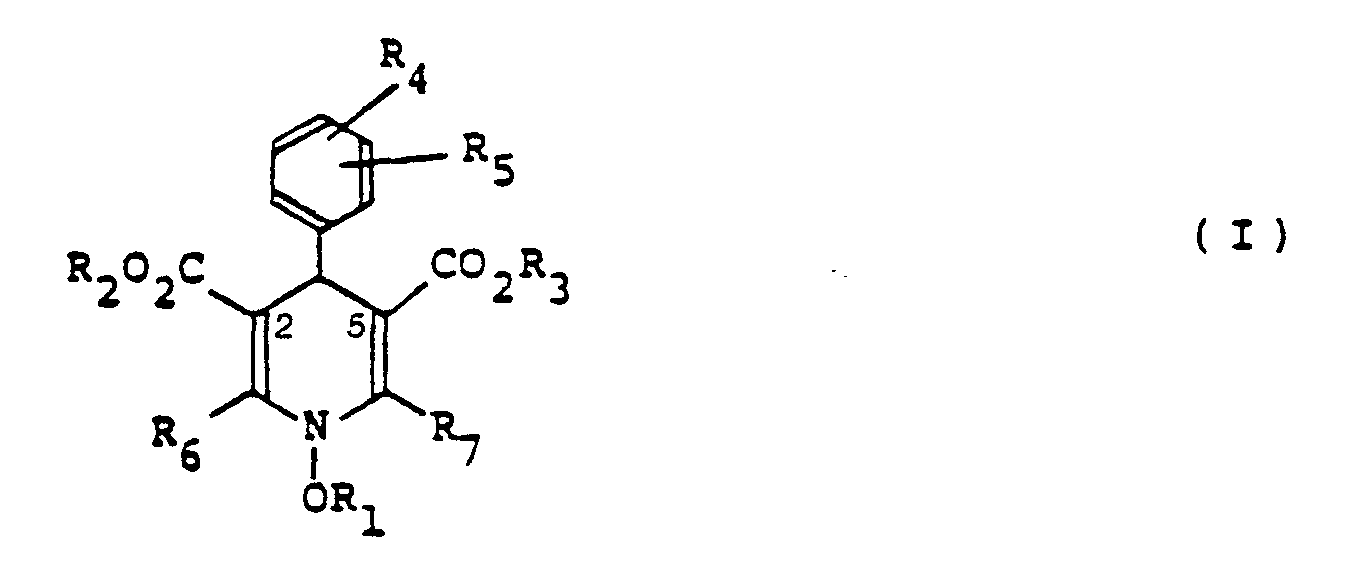
in der R, ein Wasserstoffatom, ein Alkylrest mit 1 bis 5 Kohlenstoffatomen, ein Alkenylrest mit 2 bis 5 Kohlenstoffatomen, ein Aralkylrest mit 7 bis 13 Kohlenstoffatomen oder ein Acylrest mit 1 bis 7 Kohlenstoffatomen ist, R2 und R3 gleich oder verschieden sind und jeweils einen gegebenenfalls durch ein Halogenatom oder einen C1―C5-Alkoxyrest substituierten Alkylrest mit 1 bis 5 Kohlenstoffatomen, einen Alkenylrest mit 2 bis 5 Kohlenstoffatomen, einen disubstituierten Aminoalkylrest mit 1 bis 5 Kohlenstoffatomen, in dem die Substituenten ausgewählt sind aus einem C1-5-Alkylrest und einer Benzylgruppe oder einen heterocyclischen Rest darstellen, wobei der heterocyclische Rest eine Thienyl-, Furyl-, Piperidyl-, Pyranyl- oder Pyrrolidingruppe ist, die gegebenenfalls durch einen Alkylrest mit 1 bis 5 Kohlenstoffatomen, einen Aralkylrest mit 7 bis 8 Kohlenstoffatomen oder einen Acylrest mit 1 bis 7 Kohlenstoffatomen substituiert ist, R4 und R5 gleich oder verschieden sind und jeweils ein Wasserstoff-oder Halogenatom oder eine Nitrogruppe bedeuten, und R6 and R7 gleich oder verschieden sind und jeweils einen Alkylrest mit 1 bis 5 Kohlenstoffatomen bedeuten, oder deren physiologisch verträgliches Säureadditionssalz.
in der R, ein Wasserstoffatom, ein Alkylrest mit 1 bis 5 Kohlenstoffatomen, ein Alkenylrest mit 2 bis 5 Kohlenstoffatomen, ein Aralkylrest mit 7 bis 13 Kohlenstoffatomen oder ein Acylrest mit 1 bis 7 Kohlenstoffatomen ist, R2 und R3 gleich oder verschieden sind und jeweils einen gegebenenfalls durch ein Halogenatom oder einen C1―C5-Alkoxyrest substituierten Alkylrest mit 1 bis 5 Kohlenstoffatomen, einen Alkenylrest mit 2 bis 5 Kohlenstoffatomen, einen disubstituierten Aminoalkylrest mit 1 bis 5 Kohlenstoffatomen, in dem die Substituenten ausgewählt sind aus einem C1-5-Alkylrest und einer Benzylgruppe oder einen heterocyclischen Rest darstellen, wobei der heterocyclische Rest eine Thienyl-, Furyl-, Piperidyl-, Pyranyl- oder Pyrrolidingruppe ist, die gegebenenfalls durch einen Alkylrest mit 1 bis 5 Kohlenstoffatomen, einen Aralkylrest mit 7 bis 8 Kohlenstoffatomen oder einen Acylrest mit 1 bis 7 Kohlenstoffatomen substituiert ist, R4 und R5 gleich oder verschieden sind und jeweils ein Wasserstoff-oder Halogenatom oder eine Nitrogruppe bedeuten, und R6 and R7 gleich oder verschieden sind und jeweils einen Alkylrest mit 1 bis 5 Kohlenstoffatomen bedeuten, oder deren physiologisch verträgliches Säureadditionssalz.
2. Verbindung nach Anspruch 1, nämlich 1-Hydroxy-2,6-dimethyl-4-(3-nitrophenyl)-1,4-dihydropyridin-3,5-dicarbonsäure-dimethylester.
3. Verbindung nach Anspruch 1, nämlich 1-Hydroxy-2,6-dimethyl-4-(3-nitrophenyl)-1,4-dihydropyridin-3,5-dicarbonsäure-diäthylester.
4. Verbindung nach Anspruch 1, nämlich 4-(4-Chlor-3-nitrophenyl)-1-hydroxy-1,4-dihydropyridin-3,5-dicarbonsäure-dimethylester.
5. Verbindung nach Anspruch 1, nämlich 1-Hydroxy-2,6-dimethyl-4-(3-nitrophenyl)-1,4-dihydropyridin-3,5-dicarbonsäure-isopropyl-5-methylester.
6. Verbindung nach Anspruch 1, nämlich 1-Hydroxy-2,6-dimethyl-4-(3-nitrophenyl)-1,4-dihydropyridin-3,5-dicarbonsäure-3-äthyl-5-methylester.
7. Verbindung nach Anspruch 1, nämlich 1-Hydroxy-2,6-dimethyl-4-(3-nitrophenyl)-1,4-dihydropyridin-3,5-dicarbonsäure-3-methyl-5-n-propylester.
8. Verbindung nach Anspruch 1, nämlich 1-Hydroxy-2,6-dimethyl-4-(3-nitrophenyl)-1,4-dihydropyridin-3,5-dicarbonsäure-3-isobutyl-5-methylester.
9. Verbindung nach Anspruch 1, nämlich 1-Hydroxy-2,6-dimethyl-4-(3-nitrophenyl)-1,4-dihydropyridin-3,5-dicarbonsäure-3-äthyl-5-isopropylester.
10. Verbindung nach Anspruch 1, nämlich 1-Hydroxy-2,6-dimethyl-4-(3-nitrophenyl)-1,4-dihydropyridin-3,5-dicarbonsäure-3-allyl-5-methylester.
11. Verbindung nach Anspruch 1, nämlich 1-Hydroxy-2,6-dimethyl-4-(3-nitrophenyl)-1,4-dihydropyridin-3,5-dicarbonsäure-3-methoxyäthyl-5-methylester.
12. Verbindung nach Anspruch 1, nämlich 1-Hydroxy-2,6-dimethyl-4-(3-nitrophenyl)-1,4-dihydropyridin-3,5-dicarbonsäure-3-methyl-5-(3-tetrahydrofuryl)-ester.
13. Verbindung nach Anspruch 1, nämlich 1-Hydroxy-2,6-dimethyl-4-(3-nitrophenyl)-1,4-dihydropyridin-3,5-dicarbonsäure-3-methyl-5-[2-(2-thienyl)-äthyl]-ester.
14. Verbindung nach Anspruch 1, nämlich 1-Hydroxy-2,6-dimethyl-4-(3-nitrophenyl)-1,4-dihydropyridin-3,5-dicarbonsäure-3-(2-chloräthyl)-5-methylester.
15. Verbindung nach Anspruch 1, nämlich 1-Hydroxy-2,6-dimethyl-4-(3-nitrophenyl)-1,4-dihydropyridin-3,5-dicarbonsäure-3-(1-formyl-4-piperidyl)-5-methylester.
16. Verbindung nach Anspruch 1, nämlich 1-Hydroxy-2,6-dimethyl-4-(3-nitrophenyl)-1,4-dihydropyridin-3,5-dicarbonsäure-3-(1-formyl-3-piperidyl)-5-methylester.
17. Verbindung nach Anspruch 1, nämlich 4-(2,3-dichlorphenyl)-1-hydroxy-2,6-dimethyl-1,4-dihydropyridin-3,5-dicarbonsäure-3-isopropyl-5-methylester.
18. Verbindung nach Anspruch 1, nämlich 1-Hydroxy-2,6-dimethyl-4-(3-nitrophenyl)-1,4-dihydropyridin-3,5-dicarbonsäure-3-methyl-5-(4-piperidyl)-ester.
19. Verbindung nach Anspruch 1, nämlich 1-Hydroxy-2,6-dimethyl-4-(3-nitrophenyl)-1,4-dihydropyridin-3,5-dicarbonsäure-3-methyl-5-(3-piperidyl)-ester.
20. Verbindung nach Anspruch 1, nämlich 1-Hydroxy-2,6-dimethyl-4-(3-nitrophenyl)-1,4-dihydropyridin-3,5-dicarbonsäure-3-(1-benzyl-4-piperidyl)-5-methylester-hydrochlorid.
21. Verbindung nach Anspruch 1, nämlich 1-Hydroxy-2,6-dimethyl-4-(3-nitrophenyl)-1,4-dihydropyridin-3,5-dicarbonsäure-3-(1-benzyl-3-piperidyl)-5-methylester-hydrochlorid.
22. Verbindung nach Anspruch 1, nämlich 1-Hydroxy-2,6-dimethyl-4-(3-nitrophenyl)-1,4-dihydropyridin-3,5-dicarbonsäure-3-[2-(N-benzyl-N-methylamino)-äthyl]-ester-5-methylester-hydrochlorid.
23. Verbindung nach Anspruch 1, nämlich 2,6-Dimethyl-1-methoxy-4-(3-nitrophenyl)-1,4-dihydropyridin-3,5-dicarbonsäure-dimethylester..
24. Verbindung nach Anspruch 1, nämlich 1-Benzyloxy-2,6-dimethyl-4-(3-nitrophenyl)-1,4-dihydropyridin-3,5-dicarbonsäure-dimethylester.
25. Verbindung nach Anspruch 1, nämlich 1-Allyloxy-2,6-dimethyl-4-(3-nitrophenyl)-1,4-dihydropyridin-3,5-dicarbonsäure-dimethylester.
26. Verbindung nach Anspruch 1, nämlich 1-Acetoxy-2,6-dimethyl-4-(3-nitrophenyl)-1,4-dihydropyridin-3,5-dicarbonsäure-dimethylester.
27. Arzneimittel, enthaltend einen pharmazeutischen Träger und eine wirksame Menge
der 1,4-Dihydropyridin-Verbindung nach Anspruch 1 als Wirkstoff.
28. Verwendung einer Verbindung nach Anspruch 1 oder einer Zusammensetzung, enthaltend
diese Verbindung, zur Herstellung eines Arzneimittels mit blutdrucksenkender und/oder
vasodilatorischer Wirkung.
1. Composé de 1,4-dihydropyridine, de formule générale:
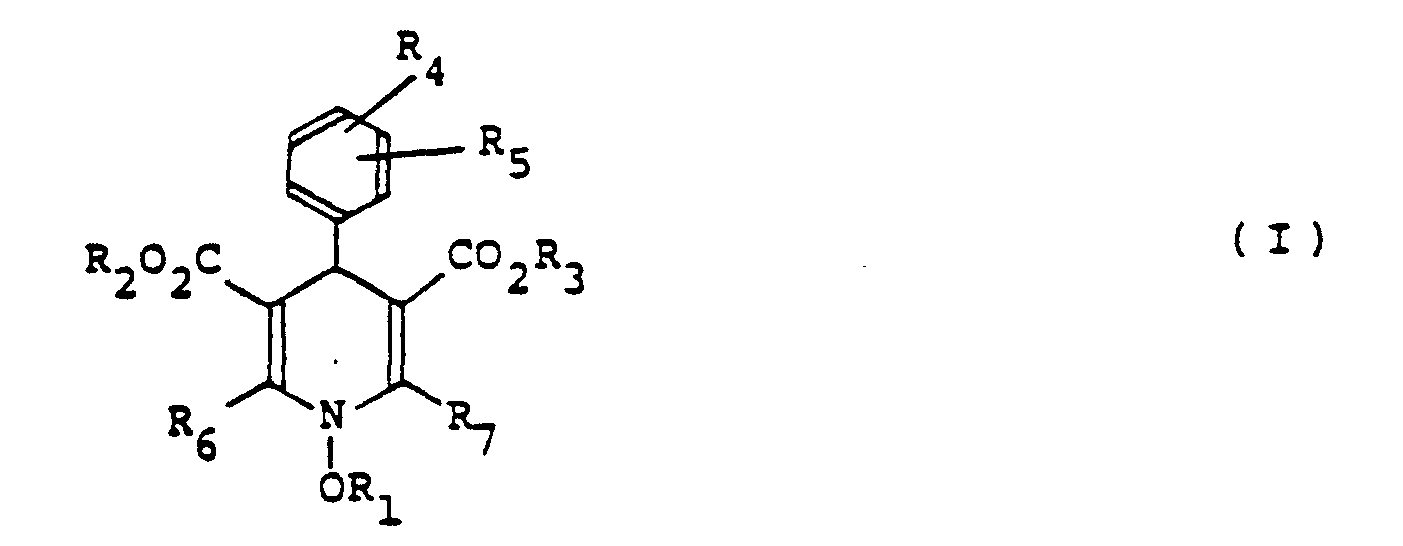
dans laquelle R, représente un atome d'hydrogène, un groupe alkyle comportant 1-5 atomes de carbone, un groupe alcényle comportant 2-5 atomes de carbone, un groupe aralkyle comportant 7-13 atomes de carbone ou un groupe acyle comportant 1-7 atomes de carbone, R2 et R3 sont des groupes identiques ou différents et représentent chacun un groupe alkyle comportant 1-5 atomes de carbone, ce groupe pouvant être substitué par un atome d'halogène ou un groupe alcoxy en C1―C5, un groupe alcényle comportant 2-5 atomes de carbone, un groupe aminoalkyle disubstitué comportant 1-5 atomes de carbone, dont les substituants sont choisis parmi un groupe alkyle en C1―C5 et un groupe benzyle, ou un groupe hétérocyclique choisi parmi les groupes thiényle, furyle, pipéridyle, pyrannyle et pyrrolidinyle, ce groupe pouvant être substitué par un groupe alkyle comportant 1-5 atomes de carbone, un groupe aralkyle comportant 7-8 atomes de carbone et un groupe acyle comportant 1-7 atomes de carbone, R4 et R5 sont des groupes identiques ou différents et représentent chacun un atome d'hydrogène, un atome d'halogène ou un groupe nitro, et R6 et R7 sont des groupes identiques ou différents et représentent chacun un groupe alkyle comportant 1-5 atomes de carbone; ou un de ses sels d'addition d'acides pharmaceutiquement acceptables.
dans laquelle R, représente un atome d'hydrogène, un groupe alkyle comportant 1-5 atomes de carbone, un groupe alcényle comportant 2-5 atomes de carbone, un groupe aralkyle comportant 7-13 atomes de carbone ou un groupe acyle comportant 1-7 atomes de carbone, R2 et R3 sont des groupes identiques ou différents et représentent chacun un groupe alkyle comportant 1-5 atomes de carbone, ce groupe pouvant être substitué par un atome d'halogène ou un groupe alcoxy en C1―C5, un groupe alcényle comportant 2-5 atomes de carbone, un groupe aminoalkyle disubstitué comportant 1-5 atomes de carbone, dont les substituants sont choisis parmi un groupe alkyle en C1―C5 et un groupe benzyle, ou un groupe hétérocyclique choisi parmi les groupes thiényle, furyle, pipéridyle, pyrannyle et pyrrolidinyle, ce groupe pouvant être substitué par un groupe alkyle comportant 1-5 atomes de carbone, un groupe aralkyle comportant 7-8 atomes de carbone et un groupe acyle comportant 1-7 atomes de carbone, R4 et R5 sont des groupes identiques ou différents et représentent chacun un atome d'hydrogène, un atome d'halogène ou un groupe nitro, et R6 et R7 sont des groupes identiques ou différents et représentent chacun un groupe alkyle comportant 1-5 atomes de carbone; ou un de ses sels d'addition d'acides pharmaceutiquement acceptables.
2. Composé selon la revendication 1, qui est l'ester diméthylique de l'acide 1-hydroxy-2,6-diméthyl-4-(3-nitrophényl)-1,4-dihydropyridine-3,5-dicarboxylique.
3. Composé selon la revendication 1, qui est l'ester diéthylique de l'acide 1-hydroxy-2,6-diméthyl-4-(3-nitrophényl)-1,4-dihydropyridine-3,5-dicarboxylique.
4. Composé selon la revendication 1, qui est l'ester diméthylique de l'acide 4-(4-chloro-3-nitrophényl)-1-hydroxy-1,4-dihydropyridine-3,5-dicarboxy)ique.
5. Composé selon la revendication 1, qui est l'ester 3-isopropyl-5-méthylique de l'acide
1-hydroxy-2,6-diméthyl-4-(3-nitrophényl)-1,4-dihydropyridine-3,5-dicarboxylique.
6. Composé selon la revendication 1, qui est l'ester 3-éthyl-5-méthylique de l'acide
1-hydroxy-2,6-diméthyl-4-(3-nitrophényl)-1,4-dihydropyridine-3,5-dicarboxylique.
7. Composé selon la revendication 1, qui est l'ester 3-méthyl-5-n-propylique de l'acide
1-hydroxy-2,6-diméthyl-4-(3-nitrophényl)-1,4-dihydropyridine-3,5-dicarboxylique.
8. Composé selon la revendication 1, qui est l'ester 3-isobutyl-5-méthylique de l'acide
1-hydroxy-2,6-diméthyl-4-(3-nitrophényl)-1,4-dihydropyridine-3,5-dicarboxylique.
9. Composé selon la revendication 1, qui est l'ester 3-éthyl-5-isopropylique de l'acide
1-hydroxy-2,6-diméthyl-4-(3-nitrophényl)-1,4-dihydropyridine-3,5-dicarboxylique.
10. Composé selon la revendication 1, qui est l'ester 3-allyl-5-méthylique de l'acide
1-hydroxy-2,6-diméthyi-4-(3-nitrophényi)-1,4-dihydropyridine-3,5-dicarboxyiique.
11. Composé selon la revendication 1, qui est l'ester 3-méthoxyéthyl-5-méthylique
de l'acide 1-hydroxy-2,6-diméthyl-4-(3-nitrophényl)-1,4-dihydropyridine-3,5-dicarboxylique.
12. Composé selon la revendication 1, qui est l'ester 3-méthyl-5-(3-tétrahydrofurylique)
de l'acide 1-hydroxy-2,6-diméthyi-4-(3-nitrophényi)-1,4-dihydropyridine-3,5-dicarboxyiique.
13. Composé selon la revendication 1, qui est l'ester 3-méthyl-5-[2-(2-thiényl)éthylique]
de l'acide 1-hydroxy-2,6-diméthyl-4-(3-nitrophényl)-1,4-dihydropyridine-3,5-dicarboxylique.
14. Composé selon la revendication 1, qui est l'ester 3-(2-chloroéthyl)-5-méthylique
de l'acide 1-hydroxy-2,6-diméthyl-4-(3-nitrophényl)-1,4-dihydropyridine-3,5-dicarboxylique.
15. Composé selon la revendication 1, qui est l'ester 3-(1-formyl-4-pipéridyl)-5-méthylique
de l'acide 1-hydroxy-2,6-diméthyl-4-(3-nitrophényl)-1,4-dihydropyridine-3,5-dicarboxylique.
16. Composé selon la revendication 1, qui est l'ester 3-(1-formyl-3-pipéridyl)-5-méthylique
de l'acide 1-hydroxy-2,6-diméthyl-4-(3-nitrophényl)-1,4-dihydropyridine-3,5-dicarboxylique.
17. Composé selon la revendication 1, qui est l'ester 3-isopropyl-5-méthylique de
l'acide 4-(2,3-dichlorophényl)-1-hydroxy-2,6-diméthyl-1,4-dihydropyridine-3,5-dicarboxylique.
18. Composé selon la revendication 1, qui est l'ester 3-méthyl-5-(4-pipéridylique)
de l'acide 1-hydroxy-2,6-diméthyl-4-(3-nitrophényl)-1,4-dihydropyridine-3,5-dicarboxylique.
19. Composé selon la revendication 1, qui est l'ester 3-méthyl-5-(3-pipéridylique)
de l'acide 1-hydroxy-2,6-diméthyl-4-(3-nitrophényl)-1,4-dihydropyridine-3,5-dicarboxylique.
20. Composé selon la revendication 1, qui est le chlorhydrate d'ester 3-(1-benzyl-4-pipéridyl)-5-méthylique
de l'acide 1-hydroxy-2,6-diméthyl-4-(3-nitrophényl)-1,4-dihydropyridine-3,5-dicarboxylique.
21. Composé selon la revendication 1, qui est le chlorhydrate d'ester 3-(1-benzyl-3-pipéridyl)-5-méthylique
de l'acide 1-hydroxy-2,6-diméthyl-4-(3-nitrophényl)-1,4-dihydropyridine-3,5-dicarboxylique.
22. Composé selon la revendication 1, qui est le chlorhydrate d'ester 3-[2-(N-benzyl-N-méthylamino)éthyl]-5-méthylique
de l'acide 1-hydroxy-2,6-diméthyl-4-(3-nitrophényl)-1,4-dihydropyridine-3,5-dicarboxylique.
23. Composé selon la revendication 1, qui est l'ester diméthylique de l'acide 2,6-diméthyl-1-méthoxy-4-(3-nitrophényl)-1,4-dihydropyridine-3,5-dicarboxylique.
24. Composé selon la revendication 1, qui est l'ester diméthylique de l'acide 1-benzyloxy-2,6-diméthyl-4-(3-nitrophényl)-1,4-dihydropyridine-3,5-dicarboxylique.
25. Composé selon la revendication 1, qui est l'ester diméthylique de l'acide 1-allyloxy-2,6-diméthyl-4-(3-nitrophényl)-1,4-dihydropyridine-3,5-dicarboxylique.
26. Composé selon la revendication 1, qui est l'ester diméthylique de l'acide 1-acétoxy-2,6-diméthyl-4-(3-nitrophényi)-1,4-dihydropyridine-3,5-dicarboxyiique.
27. Composition pharmaceutique comprenant un véhicule pharmaceutique et, comme substance
active, une quantité efficace du composé de 1,4-dihydropyridine défini dans la revendication
1.
28. Utilisation d'un composé selon la revendication 1 ou d'une composition contenant
un tel composé pour fabriquer un médicament ayant une activité hypotensive et/ou vasodilatatrice.