|
(11) | EP 0 095 787 B1 |

| (12) | EUROPEAN PATENT SPECIFICATION |
|
|
| (54) |
Coupling process for living polymers Kupplungsverfahren für lebende Polymere Procédé de couplage des polymères vivants |
|
|
|||||||||||||||||||||||||||||||
| Note: Within nine months from the publication of the mention of the grant of the European patent, any person may give notice to the European Patent Office of opposition to the European patent granted. Notice of opposition shall be filed in a written reasoned statement. It shall not be deemed to have been filed until the opposition fee has been paid. (Art. 99(1) European Patent Convention). |
[0001] The invention relates to a process for the preparation of a polymer comprising reacting a living lithium-terminated polymer having the formula P-Li wherein P is selected from the group consisting of polymer chains of one or more conjugated alkadienes having 4-12 carbon atoms and copolymer chains of one or more conjugated alkadienes having 4-12 carbon atoms and one or more monoalkenyl arenes of 8-18 carbon atoms, having the alkenyl radical attached to an arene ring carbon atom, with a coupling agent.
[0002] The coupling of lithium metal-terminated polymers is a process known in the art. In accordance with this known process, a lithium metal-terminated polymer is treated with a compound having two or more functional groups containing two or more reactive sites capable of reacting with the carbon-lithium metal bonds of the lithium metal-terminated polymer. In many cases the multifunctional coupling agent thereby becomes a nucleus for the resulting structure. From this nucleus long chain polymeric branches radiate and such coupled polymers have specific properties that render them useful for particular applications.
[0003] Linear polymers are formed by employing coupling agents having two reactive sites, like phenyl benzoate or a dihalo alkane such as dibromoethane. The preparation of radial polymers is described in GB-A-985,614; such polymers are formed by employing coupling agents having more than two reactive sites. Examples of such coupling agents include among others: SiC14 polyepoxides, polyisocyanates, polyimines, polyaldehydes, polyketones, polyanhydrides, polyesters, polyhalides, diesters, methoxy silanes, divinyl benzene, 1,3,5-benzenetricarboxylic acid trichloride and glycidoxy-methoxy silanes.
[0004] A new coupling agent has now been discovered that results in polymers having a site of unsaturation at the coupling agent residue which is available for further reaction or derivation.
[0005] Accordingly, the present invention provides a process for the preparation of a polymer comprising reacting a living lithium-terminated polymer having the formula P-Li wherein P is selected from the group consisting of polymer chains of one or more conjugated alkadienes having 4-12 carbon atoms and copolymer chains of one or more conjugated alkadienes having 4-12 carbon atoms and one or more monoalkenyl arenes of 8-18 carbon atoms, having the alkenyl radical attached to an arene ring carbon atom, with a coupling agent, characterized in that a coupling agent is used which has the general formula
where n is 0 or an integer from 1 to 10, and where each X is selected from the group consisting of hydrogen, a halogen or an alkyl radical having from 1 to 10 carbon atoms, each Y is selected from the group consisting of a halogen and -OR where R is an alkyl group having from 1 to 10 carbon atoms, a is 0,1 1 or 2 and b is 3-a.
[0006] It is observed that US-A-3,664,403 describes rubber compounds comprising a silica-filled unsaturated rubber compound and a reactive olefinic coupling agent such as bicycloheptenyltriethoxysilane. However, in these known compositions the coupling agent forms a bond between silica and rubber, no site of unsaturation being left for further reaction or derivation. The coupling agents according to the present invention have a number of advantages. Specifically, coupling with the previous described coupling agents form star-branched polymers which contain reactive olefin bonds, which can be further utilized for polymer derivatization. The preferred coupling agents are: (bicycloheptenyl)methyldichlorosilane, bicycloheptenyl-2-trichlorosilane, and bicycloheptenyltriethoxysilane. Upon coupling through the reactive silicon-chlorine or silicon-alkoxy bonds, the reactive olefin double-bond in the bicycioheptenyl group is left for further reaction. This double bond is ideal for copolymerization with a-olefins through a Ziegler-Natta mechanism employing a vanadium halide, transition metal catalyst and alkyl aluminium cocatalyst. Likewise, high-activity titanium based transition metal catalysts with alkyl aluminium cocatalyst can be employed.
[0007] The preferred group of acyclic conjugated alkadienes that can be polymerized into the polymer chain P are those containing 4-8 carbon atoms. Examples of preferred alkadienes are 1,3-butadiene, 2,3-dimethyl-1,3-butadiene, piperylene, 3-butyl-1,3-octadiene, isoprene and 2-phenyl-1,3-butadiene.
[0008] Monoalkenyl arenes that can be polymerized together with the alkadienes to form the polymer chain P preferably are those selected from the group of styrene, the methylstyrenes, particularly 3-methylstyrene, the propylstyrenes, particularly 4-propylstyrene, vinyl naphthalene, particularly 1-vinylnaphthalene, cyclohexylstyrenes, particularly 4-cyclohexylstyrene, p-tolylstyrene, and 1-vinyl-5-hexylnapthalene.
[0009] The polymer chains P can be homopolymers of the alkadiene monomers defined or can be copolymers of alkadiene monomers and monoalkenyl-substituted aromatic monomers. These copolymers, in turn, can be random or tapered copolymers, as well as block copolymers of these various monomers. Preferred monomers are isoprene, 1,3-butadiene and styrene. Preferred polymer chains P are those in which the conjugated dienes are present in a minor amount and the monovinyl-substituted arenes are present in a major amount.
[0010] The molecular weight of the polymers of this invention can vary in broad ranges. For the usual applications of the coupled polymers, the number average molecular weight will be in the range of 6,000 to 2,000,000.
[0011] Those polymers in which the polymer chain P has a structure A-B- so that B is attached to the coupling agent, and in which A represents a block of monoalkenylarenes, preferably a polystyrene block, and B represents a block that confers rubbery properties to the polymer chain, such as a polyalkadiene block, a copolymer block of an alkadiene and a monoalkenyl-substituted arene, or a combination of such blocks constitutes a presently preferred polymer. Such a polymer exhibits properties both of an elastomer and of a thermoplastic polymer. Therefore, such polymers can be formed into articles by standard procedures known for producing articles from thermoplastic polymers while the finished article exhibits elastomeric properties.
[0012] The quantity of coupling agent employed with respect to the quantity of living polymers P-Li present depends largely upon the degree of coupling and the properties of the coupled polymers desired. Preferably the coupling agent defined above will be employed in a range of about 4:1 to about 1:4, preferably about 1:1 1 to about 1:3 moles of coupling agent based upon the moles of lithium metal present in the polymer.
[0014] These coupling agents are prepared by contacting cyclopentadiene with a vinyl silane having the general formula H2C = CH(CH2),SiX,,Yl,, where n is 0 or an integer from 1 to 10, and where each X is selected from the group consisting of hydrogen, a halogen or an alkyl radical having from 1 to 10 carbon atoms, each Y is selected from the group consisting of a halogen and -OR where R is an alkyl group having from 1 to 10 carbon atoms, a is 0, 1 or 2 and b is 3-a.
[0015] Preferably, n is 0, the halogen is chlorine and R is an alkyl group having 1 or 2 carbon atoms. A preferred group of vinyl silanes includes vinyltrichlorosilane, vinyltriethoxysilane and methyldichlorovinylsilane. Accordingly, a preferred group of coupling agents includes bicycloheptenyl-2-trichlorosilane, bicycloheptenyltriethoxysilane, and (bicycloheptenyl)methyldichlorosilane.
[0016] The coupling agents are typically prepared by a Diels-Alder reaction whereby the vinylsilanes (e.g., vinyltrichlorosilane, vinylmethyldichlorosilane, and vinyltriethoxysilane) are reacted with cyclopentadiene to give the bicycloheptenylsilane derivatives. The reaction can be carried out using cyclopentadiene as the solvent under an argon or nitrogen blanket at temperatures between 20°C and 100°C, and preferably between 30°C and 70°C. A typical reaction is:
[0017] The reaction can also be achieved by refluxing with dicyclopentadiene whereby at the high reflux temperatures (160°C-170°C), dicyclopentadiene dissociates to form cyclopentadiene, which then adds to the desired vinylsilane. This procedure is most useful for the reaction with vinyltriethoxy silane which adds more slowly with cyclopentadiene than vinyltrichloro- or vinylmethyldichlorosilane.
[0018] The temperature at which the coupling reaction (i.e., the reaction between P-Li and the coupling agent) is carried out can vary over a broad range and, for convenience, often is the same as the temperature of polymerization. Although the temperature can vary broadly from 0°C to 150°C, it will preferably be within the range from 20°C to 100°C.
[0019] The coupling reaction is normally carried out by simply mixing the coupling agent, neat or in solution, with the living polymer solution. The reaction period is usually quite short. The normal duration of the coupling reaction will be in the range of 1 minute to 1 hour. Longer coupling periods may be required at lower temperatures.
[0020] After the coupling reaction, the coupled polymers are recovered by treating the reaction mixture with terminating agents containing active hydrogens such as alcohols or water or aqueous acid solutions or mixtures thereof. It is usually preferred to add an antioxidant to the reaction mixture before isolation of polymer.
[0021] The polymer is separated from the reaction mixture by standard techniques, such as steam stripping or coagulation with a suitable non-solvent such as an alcohol. The coagulated or stripped polymer is then removed from the resulting medium by, e.g., centrifugation or extrusion. Residual solvent and other volatiles can be removed from the isolated polymer by heating, optionally under reduced pressure or in a forced air flow.
[0022] The process for the preparation of the living polymer chain P-Li is carried out by reacting a monofunctional lithium metal initiator system with the respective monomer or monomers to form the living polymer chain P-Li. This polymerization step can be carried out in one step or in a sequence of steps. In the case where the polymer chain P is a homopolymer or a random or tapered copolymer of two or more monomers, the monomers are simultaneously polymerized with the lithium metal initiator. In the case where the polymer chain P is a block copolymer comprising two or more homo- or copolymer blocks, these individual blocks can be generated by incremental or sequential monomer addition.
[0023] The lithium metal-based initiator systems used in the first step of the process to make the coupled polymers of this invention are based on lithium having the general formula R'Li wherein R' is a hydrocarbyl radical of 1 to about 20 carbon atoms. Examples of such lithium initiators are methyllithium, isopropyl- lithium, n-butyllithium, sec-butyllithium, t-octyllithium, n-dodecyllithium, n-eicosyllithium, phenyllithium, naphthyllithium, p-tolyllithium, 4-phenylbutyllithium, cyclohexyllithium, and 4-cyclohexylbutyllithium. The amount of the lithium metal initiator employed depends upon the desired properties of the polymer, particularly the desired molecular weight. Normally, the organomonolithium initiator is employed in the range of 0.1 to 100 gram millimoles per 100 grams of total monomers.
[0024] The polymerization reaction is carried out in the presence of a hydrocarbon diluent or solvent. Preferably the hydrocarbon diluent is a paraffinic, cycloparaffinic or aromatic hydrocarbon having 4-10 carbon atoms or a mixture of such diluents. Examples for the diluent are n-hexane, n-heptane, 2,2,4-trimethylpentane, cyclohexane, benzene and toluene. The reaction is generally carried out with a weight ratio of diluent to monomers exceeding 1. Preferably the diluent is employed in a quantity between about 400 to about 1500 parts by weight per 100 parts by weight of total monomers. In a preferred embodiment, a minor amount (0.1 to 10% volume) of a polar compound is added to the diluent. Specific examples of polar compounds include dimethylether, diethylether, ethylmethylether, ethylpropylether, di-n-propylether, di-n-octylether, dibenzylether, diphenylether, anisole, tetramethyleneoxide (tetrahydrofuran), 1,2-di-methoxyethane, dioxane, paraldehyde, dimethylsulphide, diethylsulphide, di-n-propylsulphide, di-n-butylsulphide, methylethylsulphide, dimethylethylamine, tri-n-propylamine, tri-n-butylamine, trimethylamine, thriethylamine, N,N-dimethylamine, pyridine, quinoline, N-ethylpiperidine, N-methyl-N-ethylaninile and N-methylmorpholine. It is to be understood also that mixtures of polar compounds can be employed in the practice of the present invention. A preferred polar compound is diethylether.
[0025] The polymerization reaction usually occurs within a period of time ranging from a few minutes up to 6 hours. Preferably the reaction is carried out within a time period of 10 minutes to 2 hours. The polymerization temperature is not critical and will generally be in the range of 15° to 150°C, preferably in a range of 40° to 90°C.
[0026] At the conclusion of the polymerization in order to carry out the coupling step, the polymerization mixture is blended with the coupling agent. This is done before any material that would terminate the polymerization reaction and that would remove the lithium metal atom from the polymer chain is added to the reaction mixture. Thus the blending of the polymerization mixture and the coupling agent is carried out before any material such as water, acid or alcohol, is added to inactivate the living polymer. The step of coupling the living polymer is thus carried out as described in detail above.
[0027] Various materials are known to be detrimental to the lithium metal-initiated polymerization. Particularly, the presence of carbon dioxide, oxygen, water and alcohols should be avoided during an organomonolithium-initiated polymerization reaction. Therefore, it is generally preferred that the reactants, initiators and the equipment be free of these materials and that the reaction is carried out under an inert gas such as nitrogen.
[0028] In a preferred embodiment, coupling efficiency is improved by (1) polymerization in the presence of a minor amount of a polar compound, such as an ether (2) slow incremental addition of the coupling agent to the living polymer/solvent mixture and (3) where styrene polymer (P) chains are desired, it is preferable to add a few butadiene units to cap the polystyrene chains. By employing all three of the above techniques, it is possible to obtain coupling efficiencies above 85%.
Example I
[0030] In Example I, three different coupling agents were prepared using the following vinylsilanes: vinyltrichlorosilane, vinyltriethoxysilane and methyldichlorovinylsilane.
[0031] The coupling agents are prepared by a Diels-Alder cycloaddition reaction of the vinylsilanes with cyclopentadiene. Bicycloheptenyltrichlorosilane was prepared by reacting vinyltrichlorosilane (0.845 moles) with excess cyclopentadiene (50 grams) prepared by cracking dicyclopentadiene. The mixture was reacted at 70°C for three hours. Fractional distillation of unreacted vinyltrichlorosilane and cyclopentadiene, followed by bicycloheptenyltrichlorosilane gave a 69% yield of bicycloheptenyltrichlorosilane (b.p. 108°-110°C, 35 mm Hg).
[0032] In a similar fashion, bicycloheptenylmethyldichlorosilane was prepared by heating methyldichloro- vinyl silane (0.66 moles) with cyclopentadiene at 70°C for 3-4 hours. Fractional distillation resulted in 0.3 mol of bicycloheptenylmethyldichlorosilane (45% yield) which was collected at 105-106°C (at 35 mm of mercury).
[0033] The preparation of bicycloheptenyltriethoxysilane was carried out by refluxing 150 grams of dicyclopentadiene with 325 grams of vinyltriethoxysilane. The mixture was refluxed in a 1 litre flask for 16 hours at 180°C. Fractional distillation resulted in 180 grams (41% yield) of bicycloheptenyltriethoxysilane fraction distilled at 106-108°C (8 mm Hg).
Example II
[0034] In Example II, polymers were prepared using the bicycloheptenylmethyldichlorosilane and bicycloheptenyltriethoxysilane coupling agents prepared in Example I.
[0035] One might anticipate that coupling polymer chains with bicycloheptenylmethyldichlorosilane and bicycloheptenyltriethoxysilane will be suppressed for steric reasons. Therefore, experiments were performed to evaluate the influence of the polymer chain end on coupling efficiency. A comparison was made between "living" polystyrene and polystyrene chains which had been end-capped with a few units of butadiene prior to the coupling step. Table 1 summarizes the reaction history and coupling efficiencies for polystyrene chain ends with both bicycloheptenylmethyldichlorosilane and bicycloheptenyltriethoxysilane, respectively. As evidenced from Table 1, coupling efficiencies for polystyrene chain ends with either bicycloheptenylmethyldichlorosilane or bicycloheptenyltriethoxysilane are low, hence it appears that the steric hindrance associated with coupling is significant in this case.
[0036] Table 2 summarizes the data obtained for polystyrene chains to which have been added a few units of butadiene. As can be evidenced from Table 2, butadiene capping of polystyrene chain ends results in significant improvement in coupling efficiency. Likewise, it appears that coupling at 6G-70°C is more efficient than at 50°C.
[0037] For the samples 12-17, which were coupled at 60° to 70°C, the GPC analysis indicate evidence of di-and tricoupled polymers, with total coupling efficiencies of 54% and 51 %. For sample 17, an additional amount of coupling agent bicycloheptenyltriethoxysilane was introduced at 70°C after the initial 20-hour reaction period. The coupling efficiency in this case increased from 43% to 51 % upon addition of bicycloheptenylmethyldichlorosilane.
[0038] In summary, "living" homopolystyrene chain ends couple poorly with either coupling agents bicycloheptenylmethyldichlorosilane or bicycloheptenyltriethoxysilane. However, upon end-capping these chain ends with butadiene, significant improvements in coupling can be realized as both dicoupled and tricoupled polymer chains result as evidenced from GPC analysis.
Example III
[0039] Example III shows the effect of coupling in the presence of diethylether as well as by incrementally adding coupling agent. Initial results indicate considerable enhanced coupling efficiencies when diethylether is present in the solvent. Likewise, higher coupling yields were observed when chlorosilane derivatives are employed versus alkoxy silane derivatives.
[0040] To further test these observations, bicycloheptenyltrichlorosilane was investigated as a coupling agent. The goal was to establish optimum process conditions for coupling butadiene-capped poly(styrene) chain ends to form three-armed star polymers.
[0041] Table 3 summarizes the coupling yields under different process conditions. It can be observed that the incremental addition of the coupling agent (4) results in coupling yields of 81.4 and 87%. It should be noted, however, that sample 20, coupled in the presence of diethyl ether is essentially quantitatively coupled into a trifunctional star polymer. On the other hand, sample 19, showing 87% coupling yield, was observed by G.P.C. Analysis to be 60% dicoupled. These results suggest that the ether modifier accelerates the reaction with coupling agent (4), as well as facilitating the attachment of the third polymeric arm onto the coupling agent.
[0042] In conclusion, incremental addition of bicycloheptenyltrichlorosilane to butadiene-capped poly-(styrene) chain-ends in the presence of diethyl ether is the favoured technique for maximizing coupling yield and tricoupled efficiency. In the presence of ethers the coupling reaction appears to be complete after 1 hour at 70°C.
1. A process for the preparation of a polymer comprising reacting a living lithium-terminated
polymer having the formula P-Li wherein P is selected from the group consisting of
polymer chains of one or more conjugated alkadienes having 4-12 carbon atoms and copolymer
chains of one or more conjugated alkadienes having 4-12 carbon atoms and one or more
monoalkenyl arenes of 8-18 carbon atoms, having the alkenyl radical attached to an
arene ring carbon atom, with a coupling agent, characterized in that a coupling agent
is used, which has the general formula
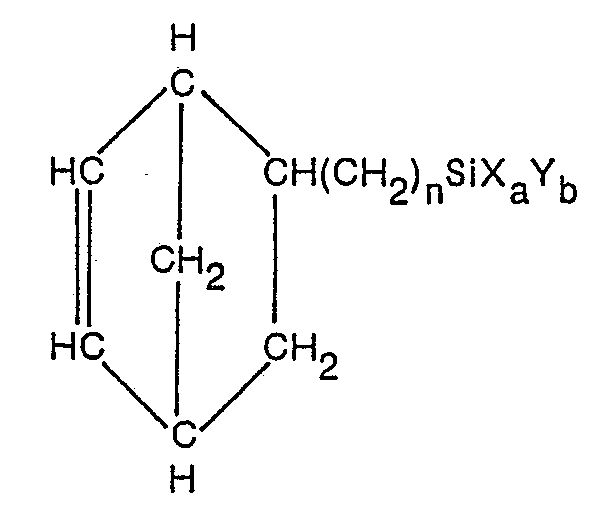
where n is 0 or an integer from 1 to 10, and where each X is selected from the group consisting of hydrogen, a halogen or an alkyl radical having from 1 to 10 carbon atoms, each Y is selected from the group consisting of a halogen and -OR where R is an alkyl group having from 1 to 10 carbon atoms, a is 0, 1 or 2 and b is 3-a.
where n is 0 or an integer from 1 to 10, and where each X is selected from the group consisting of hydrogen, a halogen or an alkyl radical having from 1 to 10 carbon atoms, each Y is selected from the group consisting of a halogen and -OR where R is an alkyl group having from 1 to 10 carbon atoms, a is 0, 1 or 2 and b is 3-a.
2. The process according to claim 1, characterized in that n is zero.
3. The process according to claim 2, characterized in that said coupling agent is
bicycloheptenyl-2-trichlorosilane, bicycloheptenyltriethoxysilane, or (bicycloheptenyl)methyldichlorosilane.
4. The process according to claim 3, characterized in that said coupling agent is
bicycloheptenyl-2-trichlorosilane.
5. The process according to claim 1 characterized in that P is a chain of polystyrene
in association with a polymer of a conjugated alkadiene having 4-12 carbon atoms.
6. The process according to claim 1, characterized in that P is a polystyrene-polybutadiene
polymer.
7. The process according to claim 1, characterized in that said P-Li polymers are
contacted with said coupling agent in the presence of a diluent and 0.1 to 10% by
volume of a polar compound, calculated on diluent.
8. The process according to claim 6 or claim 7, characterized in that said coupling
agent is added incrementally.
1. Verfahren zur Herstellung eines Polymers, umfassend die Umsetzung eines lebenden
Polymers mit endständigem Lithium der Formel P-Li, in der P ausgewählt ist aus der
Gruppe bestehend aus Polymerketten aus einem oder mehreren konjugierten Alkadienen
mit 4 bis 12 Kohlenstoffatomen und Copolymerketten aus einem oder mehreren konjugierten
Alkadienen mit 4 bis 12 Kohlenstoffatomen und einem oder mehreren Monoalkenylarenen
mit 8 bis 18 Kohlenstoffatomen, wobei die Alkenylkette an ein Arenring-Kohlenstoffatom
gebunden ist, mit einem Kupplungsmittel, dadurch gekennzeichnet, daß ein Kupplungsmittel
angewandt wird, der allgemeinen Formel
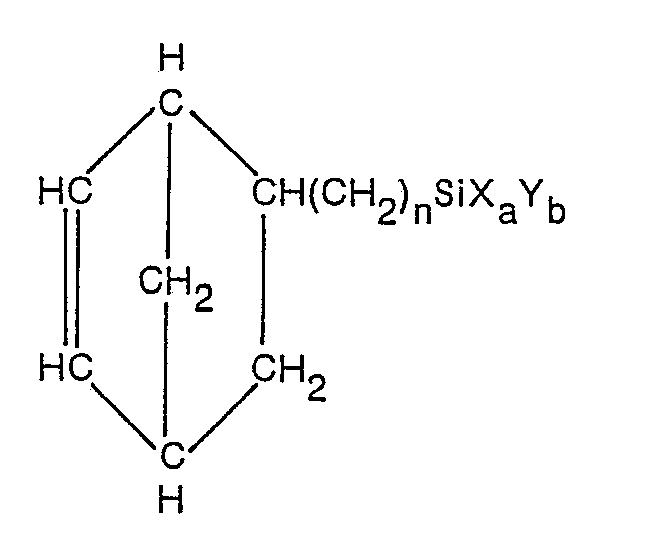
in der n = 0 oder eine ganze Zahl von 1 bis 10 ist, und jedes X ausgewählt ist aus der Gruppe, bestehend aus Wasserstoff, Halogen oder einem Alkylrest mit 1 bis 10 Kohlenstoffatomen, jedes Y ausgewählt ist aus der Gruppe, bestehend aus Halogen und -OR, wobei R eine Alkylgruppe mit 1 bis 10 Kohlenstoffatomen ist, a 0, 1 oder 2 und b 3-a ist.
in der n = 0 oder eine ganze Zahl von 1 bis 10 ist, und jedes X ausgewählt ist aus der Gruppe, bestehend aus Wasserstoff, Halogen oder einem Alkylrest mit 1 bis 10 Kohlenstoffatomen, jedes Y ausgewählt ist aus der Gruppe, bestehend aus Halogen und -OR, wobei R eine Alkylgruppe mit 1 bis 10 Kohlenstoffatomen ist, a 0, 1 oder 2 und b 3-a ist.
2. Verfahren nach Anspruch 1, dadurch gekennzeichnet, daß n 0 ist.
3. Verfahren nach Anspruch 2, dadurch gekennzeichnet, daß das Kupplungsmittel Bicycloheptenyl-2-trichlorsilan,
Bicycloheptenyltriethoxysilan oder (Bicycloheptenyl)methyldichlorsilan ist.
4. Verfahren nach Anspruch 3, dadurch gekennzeichnet, daß das Kupplungsmittel Bicycloheptenyl-2-trichlorsilan
ist.
5. Verfahren nach Anspruch 1, dadurch gekennzeichnet, daß P eine Kette von Polystyrol
in Verbindung mit einem Polymer eines konjugierten Diens mit 4 bis 12 Kohlenstoffatomen
ist.
6. Verfahren nach Anspruch 1, dadurch gekennzeichnet, daß Pein Polystyrol-Polybutadien-Polymer
ist.
7. Verfahren nach Anspruch 1, dadurch gekennzeichnet, daß die P-Li-Polymeren mit dem
Kupplungsmittel zusammengebracht werden in Gegenwart eines Verdünnungsmittels und
von 0,1 bis 10 Vol.-% einer polaren Verbindung, bezogen auf das Verdünnungsmittel.
8. Verfahren nach Anspruch 6 oder 7, dadurch gekennzeichnet, daß das Kupplungsmittel
nach und nach zugesetzt wird.
1. Procédé de préparation d'un polymère, comprenant la réaction d'un polymère vivant
à terminaison lithium de formule P-Li dans laquelle P est choisi dans le groupe constitué
par les chaînes de polymères d'un ou plusieurs alcadiènes conjugués ayant 4 à 12 atomes
de carbone et les chaînes de copolymères de un ou plusieurs alcadiènes conjugués ayant
4 à 12 atomes de carbone et d'un ou plusieurs monoalcényl- arènes de 8 à 18 atomes
de carbone, dont le radical alcényle est fixé à un atome de carbone du noyau arène,
avec un agent de couplage, caractérisé en ce qu'on utilise un agent de couplage répondant
à la formule générale
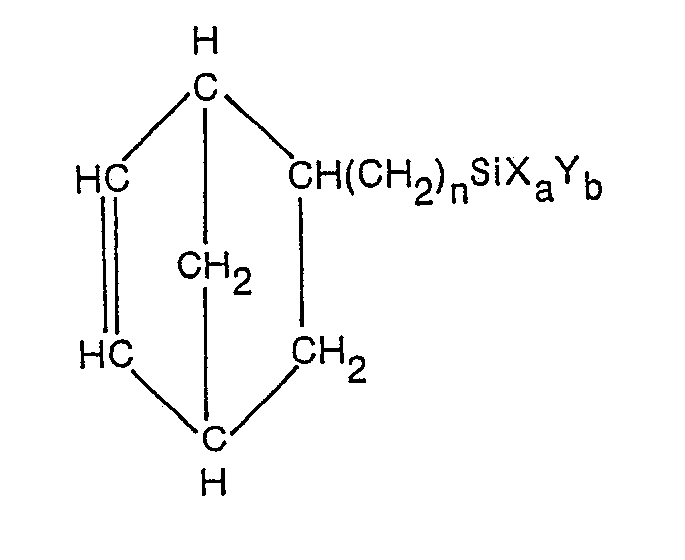
dans laquelle n est 0 ou un nombre entier de 1 à 10 et dans laquelle chaque X est choisi dans le groupe constitué par l'hydrogène, un halogène ou un radical alkyle ayant de 1 à 10 atomes de carbone, chaque Y est choisi dans le groupe constitué par un halogène et -OR où R est un groupe alkyle ayant de 1 à 10 atomes de carbone, a est 0, 1 ou 2 et b est 3-a.
dans laquelle n est 0 ou un nombre entier de 1 à 10 et dans laquelle chaque X est choisi dans le groupe constitué par l'hydrogène, un halogène ou un radical alkyle ayant de 1 à 10 atomes de carbone, chaque Y est choisi dans le groupe constitué par un halogène et -OR où R est un groupe alkyle ayant de 1 à 10 atomes de carbone, a est 0, 1 ou 2 et b est 3-a.
2. Procédé selon la revendication 1, caractérisé en ce que n est nul.
3. Procédé selon la revendication 2, caractérisé en ce que le dit agent de couplage
est le bicyclo- heptényl-2-trichlorosilane, le bicycloheptényltriéthoxysilane ou le
(bicycloheptényl)méthyldichlorosilane.
4. Procédé selon la revendication 3, caractérisé en ce que le dit agent de couplage
est le bicycloheptényl-2-trichlorosilane.
5. Procédé selon la revendication 1, caractérisé en ce que P est une châine de polystyrène
associée à un polymère d'un alcadiène conjugé ayant 4 à 12 atomes de carbone.
6. Procédé selon la revendication 1, caractérisé en ce que P est un polymère polystyrène-polybuta-
diène.
7. Procédé selon la revendication 1, caractérisé en ce que les dits polymères P-Li
sont mis en contact avec le dit agent de couplage en présence d'un diluant et de 0,1
à 10% en volume d'un composé polaire, calculé par rapport au diluant.
8. Procédé selon la revendication 6 ou 7, caractérisé en ce que le dit agent de couplage
est ajouté par portions.