| (19) |
 |
|
(11) |
EP 0 096 671 B1 |
| (12) |
EUROPEAN PATENT SPECIFICATION |
| (45) |
Mention of the grant of the patent: |
|
09.04.1986 Bulletin 1986/15 |
| (22) |
Date of filing: 01.06.1983 |
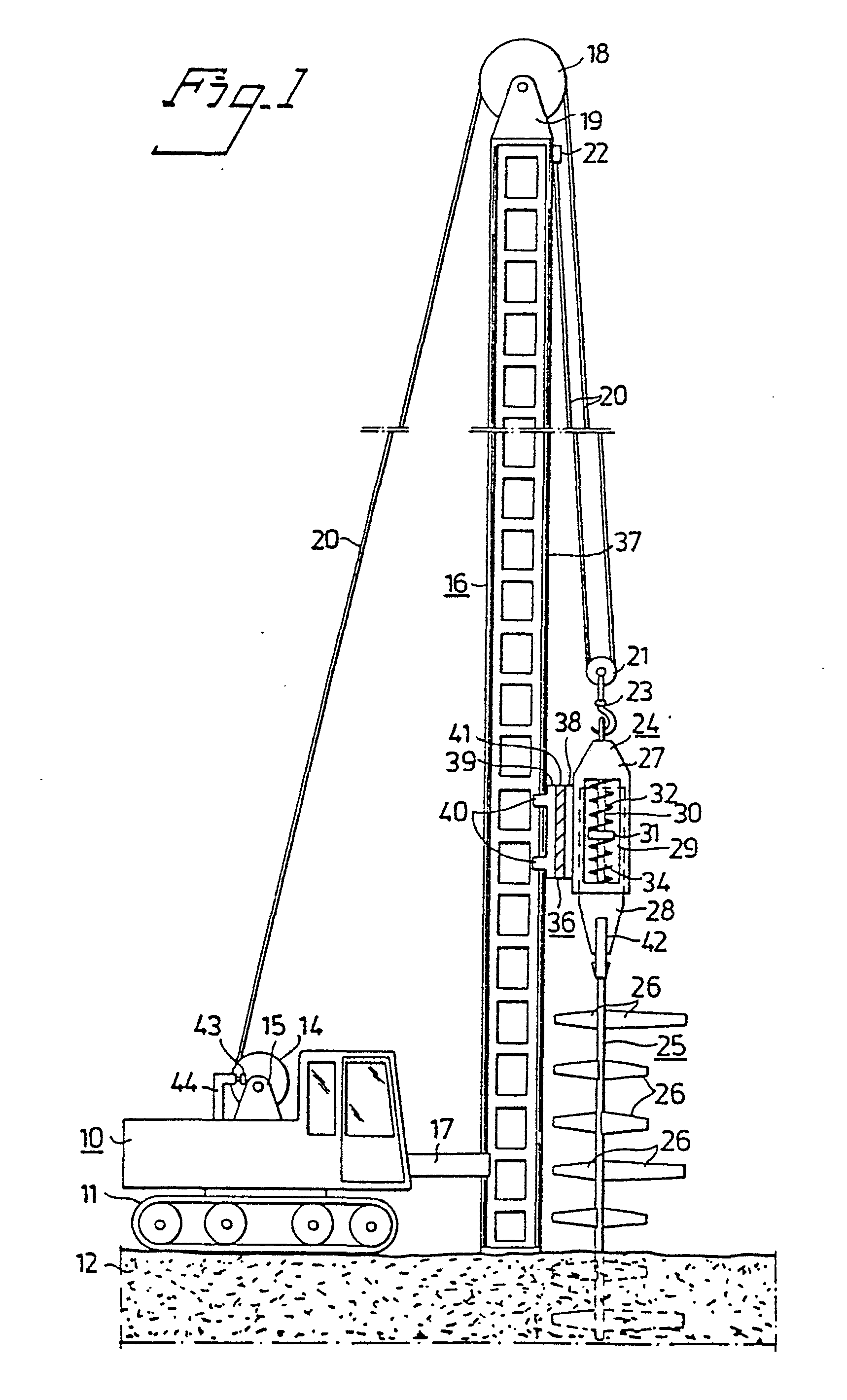
|
| (51) |
International Patent Classification (IPC)4: E02D 3/054 |
|
| (54) |
A method and apparatus for compacting compactable soils by vibration
Verfahren und Vorrichtung zum Verdichten von verdichtungsfähigen Böden durch Rütteln
Méthode et dispositif pour compacter des sols compactables par vibration
|
| (84) |
Designated Contracting States: |
|
DE FR GB NL SE |
| (30) |
Priority: |
02.06.1982 US 384440
|
| (43) |
Date of publication of application: |
|
21.12.1983 Bulletin 1983/51 |
| (71) |
Applicant: Byggnads- & Industriservice AB
BINAB |
|
S-171 54 Solna (SE) |
|
| (72) |
Inventors: |
|
- Lindberg, Bertil J.
S-421 58 Västra Frölunda (SE)
- Elmefjäll, Bernt C. G.
S-752 52 Uppsala (SE)
|
| (74) |
Representative: Nilsson, Karl Ingvar et al |
|
STENHAGEN PATENTBYRA AB
P.O. Box 4630
116 91 Stockholm
116 91 Stockholm (SE) |
|
| |
|
| Note: Within nine months from the publication of the mention of the grant of the European
patent, any person may give notice to the European Patent Office of opposition to
the European patent
granted. Notice of opposition shall be filed in a written reasoned statement. It shall
not be deemed to
have been filed until the opposition fee has been paid. (Art. 99(1) European Patent
Convention).
|
[0001] The present invention relates to a method for compacting compactable soils by vibration,
and to apparatus for carrying out said method.
[0002] In present day methods for compacting compactable soils by vibration, it is difficult
to ascertain what degree of compaction has been achieved without making frequent tests.
Such tests, however, are time consuming, and require a probe provided with pressure
measuring means to be inserted into the compacted soil at frequent intervals.
[0003] The vibratory tubes used in present day soil-compacting methods are also extremely
heavy, necessitating the provision of large, and subsequently heavy vibrators, requiring
a commensurate high input energy and resulting in difficulties in manoeuvering and
transporting such apparatus.
[0004] Moreover, when applying such, known soil-compacting methods it is normal practice
to vibrate and compact the soil in stages, at one level at a time, which means that
movement of the vibratory tube out of the soil is stopped at several different levels.
[0005] Examples of such soil compacting methods and apparatus are to be found in US-A-3865501
and BE-A-850360.
[0006] An object of the present invention is to provide a method and means whereby one or
more of the above drawbacks are overcome.
[0007] To this end there is provided in accordance with the invention a method for compacting
compactable soils by vibration while using a compacting apparatus comprising an elongate
member having a vibrator mounted on one end thereof, and further having laterally
projecting fins arranged along at least part of the length thereof, said method comprising
inserting the elongate member to a given depth into soil to be compacted and vibrating
the elongate member to densify and compact soil surrounding said elongate member while
gradually withdrawing the elongate member from the soil location, characterized by
obtaining an indication of the load required to lift the elongate member and withdrawing
the elongate member from said location when the load required to lift the elongate
member from said location while vibrating is at least equal to a previously established
set-point value corresponding to a desired degree of compaction. In this way it is
possible to ascertain the degree of compaction of the soil with good precision, thereby
obviating the need to run frequent tests.
[0008] According to a preferred aspect of the method of the invention there is used a compacting
apparatus with which the laterally projecting fins are spaced axially over a length
thereof at least substantially equal to the depth to which said member shall be inserted
into the soil. This method enables soil to be densified and compacted over a given
depth to the desired degree of compaction with the use of vibrating compaction apparatus
substantially lighter in weight than apparatus used in known soil compacting methods
using vibration, and at much faster rates.
[0009] When applying the method according to the invention, the major part of said compaction
can be effected as the elongate member is withdrawn while vibrating the elongate member
and, in addition, the degree to which the soil is compacted can be controlled by controlling
the speed at which the elongate member is withdrawn. Thus, the soil may be compacted
during substantially continuous upward movement of the elongate member.
[0010] According to a further aspect of the invention an apparatus for compacting compactable
soils by vibration comprises an elongate member, a vibrator mounted on one end of
the elongate member for setting up vibrations therein, vibration-propagating means
in the form of laterally projecting fins arranged in substantially vertical planes
along at least part of the elongate member, and means for lifting said elongate element,
the apparatus being characterized by means for sensing and indicating the load required
to lift the elongate member and the vibrator mounted thereon.
[0011] Further features of the invention are set forth in the subclaims.
[0012] So that the invention will be more readily understood and further features thereof
made apparent, an exemplary embodiment of the invention will now be described in detail
with reference to the accompanying schematic drawings, in which
Figure 1 illustrates an apparatus for compacting soil by vibration in accordance with
the invention;
Figure 2 is a broken view of an elongate member illustrated in Figure 1;
Figure 3 is a cross-sectional view taken on the line 11I - lll in Figure 2, the Figure
also showing a section through a mast for guiding the elongate member;
Figure 4 is a cross-sectional view taken on the line IV-IV in Figure 2;
Figure 5 is a cross-sectional view taken on the line V-V in Figure 2;
Figure 6 is a fragmentary sectional view of the elongate member, illustrating plate-like
web portions, and
Figure 7 is a diagram illustrating a preferred method of carrying out the invention.
[0013] In Figure 1 there is shown a vehicle 10 supported by track means 11 on ground 12
undergoing compaction. Arranged on the vehicle 10 is a winch mechanism, comprising
a winch drum 14 mounted for rotation on a bracket structure 15.
[0014] As shown in the Figure, the vehicle 10 is connected to a mast 16 via a member 17.
The mast 16 rests on ground 12 and can be lifted free from the ground and moved from
compacting site to compacting site, in a manner not shown. Arranged at the top of
the mast 16 is a pulley 18, which is rotatably mounted in a bracket structure 19.
Extending from the winch drum 14 is a line 20, for example a steel-wire rope, which
passes over the pulley 18, down to a further pulley 21, and from there rearwardly
to a load sensor 22 which is mounted at the top of the mast 16 and which is adapted
to sense the load on line 20, for a purpose made apparent hereinafter.
[0015] Depending from pulley 21 is a hook means 23 from which is hung a vibrator means 24
having connected thereto an elongate member 25 provided with a plurality of vibration
propagating fins 26 arranged in mutually spaced relationship axially along said member
25.
[0016] The vibrator means 24 of the illustrated embodiment comprises a yoke structure 27
which carries the actual vibrator 28, and which has mutually opposite, elongate openings,
of which only one, 29, is shown. Arranged vertically in each opening 29 is a bar 30
which passes freely through a transversal lug 31 fixedly connected to the vibrator
28. An upper spring means 32 is arranged around bar 30 between the transversal lug
31 and an upper defining surface of the opening 29, while a lower spring means 34
is arranged around bar 30 between said lug and a lower defining surface of said opening,
the spring means 32 and 34 preventing excessive transmission of vibrations generated
by the vibrator 28 to the line 20 via the hook means 23 and pulley 21.
[0017] In the illustrated embodiment the yoke 27 is guided for movement along the mast 16
by means of a guide 36, which is slidably mounted on tracks 37 on the mast 16, these
tracks also being shown in Figure 3. The guide 36 of the illustrated embodiment comprises
a first plate-like element 38 fixedly attached to the yoke 27 on a side thereof adjacent
the mast 16, a second plate-like element 39 provided with runners or like guide means
40 for engaging tracks 37 to permit guided movement of the guide 36 therealong, and
cushioning means 41 arranged between said first and said second plate-like elements
for cushioning or deadening vibrations which would otherwise be transmitted to the
mast 16 via said guide 36.
[0018] To ensure substantially maximum transmission of the vibrations from the vibrator
28 to the elongate member 25, the vibrator is preferably connected to said member
by metallic connecting jaw-means, as indicated at 42.
[0019] For the purpose of measuring the extent to which line 20 is payed out and taken up
on the drum 14 during a soitcompacting operation, the winch mechanism 14, 15 is arranged
to co-act with a line-measuring means, which in the illustrated embodiment comprises
a roller 43 which is carried on a rigid arm 44 and which cooperates with the drum
14 in a manner such as to measure the length of line 20 payed out by or taken up on
said drum. It will be understood that the line-measuring means 43, 44 is not limited
to the described roller and arm arrangement but may comprise any suitable means for
measuring line lengths.
[0020] As will be seen more clearly in Figure 2, the elongate member 25 comprises a tube
45 having a head means 46 at the top end thereof and a pointed part 47 at the bottom
thereof. Arranged in the tube 45 adjacent the head means 46 is an inlet opening or
port 48, while at least one outlet opening or port 49 is arranged in the pointed part
47, said inlet and outlet ports 48, 49 being interconnected by a passage formed by
the interior of tube 45. The ports 48, 49 and said passage are intended to permit
a fluid, such as a gas or water, or a liquid slurry of cement to be fed through the
elongate member 25 to the vicinity of the soil being compacted, in order to facilitate
compaction or to further stabilize the soil.
[0021] As shown, the vibration-propagating fins 26 are spaced axially along the tubular
member 45 and extend in substantially vertical planes. The total spacing between the
laterally projecting fins 26 is at most equal to half the effective length of the
tubular member 45, i.e. the length thereof effective in a vibratory compaction operation.
Each of the fins 26 has a fin-length to root-height ratio of from 1:1 to 7:1, preferably
from 1.5:1 to 5:1.
[0022] The fins 26 are arranged in sets of at least two fins, the fins of one set being
located in a vertical plane which forms angles with vertical planes in which the fins
26 of adjacent sets are located. When said sets of fins each comprise two fins 26,
the fins are placed in diametrically opposed relationship with one another, and the
pairs of fins 26 are arranged in groups of three with the fins 26 of three adjacent
fin-pairs of each group being located in vertical planes rotated relative to one another
as more clearly shown in Figure 3. Thus, the fins 26 of each fourth pairs of fins
will lie in mutually the same vertical planes. This ensures effective compaction of
the soil.
[0023] To enable the elongate member 25 to move vertically, relatively close to the mast
16 and substantially parallel therewith, fins 26 extending towards the mast 16 are
shorter than the remaining fins 26, as shown in Figure 3 and 4.
[0024] The defining surfaces of the fins 26 are inclined to the horizontal, and the fins
taper from root to tip, the taper corresponding to a root-height to tip-height ratio
of from 1.5:1 to 8:1.
[0025] To facilitate penetration of the elongate member 25 into the soil to be compacted,
the member is provided in the bottom region thereof with sets of pilot fins 50, 51,
two such sets being shown in the illustrated embodiment.
[0026] The pilot fins 50, 51 are shorter than the fins 26 and the number of pilot fins in
each set corresponds to the total number of vibration- propagating fins 26 in a group
of fins. Thus, each set of pilot fins of the illustrated embodiment comprises six
fins, with the pilot fins arranged in all vertical planes containing vibration- propagating
fins 26. The planes are selected such as to eliminat any tendency of the elongate
member 25 to tilt when being inserted into the soil to be compacted.
[0027] As shown in Figure 6, there is arranged in the transition region of the tubular member
45 and a respective vibration-propagating fin 26 a plate-like web portion 52, which
serves to amplify the vibrations set-up in said fin 26.
[0028] When compacting soil by means of the illustrated and described apparatus, the vehicle
10 is driven to a compacting location and the elongate member 25 inserted, while vibrating,
to a given depth into the soil, the depth to which the elongate member 25 is inserted
being commensurate to the length of line 20 paid out from the drum by winch means
14, 15 and being measured by the line-measuring means 43, 44. The elongate member
25 is then lifted, while vibrating, at a lifting rate corresponding to a desired degree
of compaction, the load required to lift the elongate member 25, together with the
vibrator means 24, being measured by sensor 22, and the length of line 20 taken up
being measured by said line-measuring means 43, 44.
[0029] The load required to lift the elongate member 25 and the vibrator means 24 from a
compacted location is commensurate with the extent to which the soil has been compacted
and to the level at which the elongate member 25 is located in the soil.
[0030] In order to ensure that the soil is compacted to a desired degree of compaction,
the elongate member 25 is withdrawn from the soil at a rate at which the load acting
on the line 20 is at least equal to a pre-established set-point value which corresponds
to said desired degree of compaction, and which varies with the depth at which the
elongate member 25 is located in the soil at any given time during withdrawal, while
vibrating. This set-point value can be established while using the illustrated and
described elongate member 25, by compacting soil in a pattern of selected test locations
while recording the load required to lift the elongate member 25 and vibrator means
24. A probe having pressure measuring means is then inserted into the compacted location,
to measure the degree of compaction. When the soil is found to be compacted to the
degree desired, the recorded load required to lift said elongate member and said vibrator
means through successive levels at respective locations is taken as the set-point
value for further compacting operations at remaining locations on the same site, it
being ensured in this way that the soil in all remaining locations is compacted to
the desired degree without further checks being required at at frequent intervals.
[0031] The above described method of carrying out the invention is illustrated diagrammatically
in Figure 7, in which said load L (measured in Tonnes) and the soil pressure P (measured
in kilogrammes per sq. centimeters) are plotted against the depth D of soil penetration
(measured in meters).
[0032] The jagged line 53 illustrates the result of soil pressure tests prior to compaction
of the soil, while the vertical line 54 illustrates the desired degree of compaction.
The sloping full line 55 (10 Tonnes being the weight of the elongate member 25 and
vibrator means 24) illustrates the established set-point load necessary to obtain
the desired degree of compaction, while the sloping broken line 56 illustrates the
load selected by the operator, this selcted load being slightly higher than the established
set-point load, so as to be on the safe side. The actual degree of compaction when
following line 56 is shown by the jagged line 57.
[0033] As will be seen from the diagram, the top surface layer of the soil 12 must be further
compacted, e.g. by means of a soil-compacting roller.
[0034] As will be readily understood, means can be provided for processing signals received
from the sensor 22 and the line-measuring means 43, 44 and for drawing a line 56 on
paper located in a writer herefor, corresponding to the loads sensed by sensor 22
and the lengths of line measured by the line-measuring means 43, 44 when withdrawing
the elongate member 25, while vibrating, from a compacted location. This recorded
line 56 can be used by the operator firstly as a means for ascertaining that compaction
is progressing as desired, and secondly as proof that the work has been carried out
in accordance with a prescribed manner.
[0035] The above means may be connected to a data processor arranged to effect a prescribed
. compacting operation automatically. The processing means suitable herefor have not
been shown, since they are well known in the art of data-controlled automatic processes
and can be designed for the purpose intended by any one of normal skill in the art.
[0036] The invention is not restricted to the described and illustrated embodiment, but
can be carried into effect in any desired manner lying within the scope of the claims.
1. A method for compacting compactable soils by vibration while using a compacting
apparatus comprising an elongate member (25) having a vibrator (24) mounted on one
end thereof, and further having laterally projecting fins (26) arranged along at least
part of the length thereof, said method comprising inserting the elongate member to
a given depth into soil to be compacted and vibrating the elongate member to densify
and compact soil surrounding said elongate member while gradually withdrawing the
elongate member from the soil location, characterized by obtaining an indication of
the load required to lift the elongate member (25) and withdrawing the elongate member
(25) from said location when the load required to lift the elongate member from said
location while vibrating is at least equal to a previously established set-point value
corresponding to a desired degree of compaction.
2. A method according to claim 1, characterized by using a compacting apparatus with
which the laterally projecting fins (26) are spaced axially along the elongate member
(25) over a length thereof at least substantially egual to the depth to which said
member shall be inserted into said soil.
3. A method according to claim 1 or 2, comprising effecting the major part of the
compaction as the elongate member (25) is withdrawn while vibrating.
4. A method according to any one ot claims 1 - 3, characterized by controlling the
degree of compaction by controlling the speed at which the vibrating elongate member
(25) is withdrawn.
5. An apparatus for compacting compactable soils by vibration, comprising an elongate
member (25), a vibrator (24) mounted on one end of the elongate member for setting
up vibrations therein, vibration-propagating means in the form of laterally projecting
fins (26) arranged in substantially vertical planes along at least part of the elongate
member, and means (14-21, 23) for lifting said elongate member, characterized by means
(22) for sensing and indicating the load required to lift the elongate member (25)
and the vibrator (24) mounted thereon.
6. An apparatus according to claim 5, characterized in that said laterally projecting
fins (26) are axially spaced along substantially the whole of the effective length
of the elongate member (25).
7. An apparatus according to claim 6, characterized in that the total spacing between
the laterally projecting fins (26) is at most equal to half said effective length
of the elongate member (25).
8. An apparatus according to claim 6 or 7, characterized in that the length to root-height
ratio of respective vibration-propagating fins (26) is between 1: 1 and 7: 1, suitably
between 1.5: 1 and 5: 1.
9. An apparatus as claimed in any one of laims 6 - 8, characterized in that the laterally
projecting vibrationpropagating fins (26) are arranged in sets of at least two fins,
the fins of one set being located in vertical planes which form angles with vertical
planes in which the fins of adjacent sets are located.
10. An appratus according to claim 9, characterized in that the laterally projecting
vibration-propagating fins (26) are arranged in diametrically opposed relationship
in pairs.
11. An apparatus according to claim 10, characterized in that diametrically opposed
fins (26) are arranged in groups, each comprising three mutually sequential pairs
of fins located in vertical planes rotated relative to one another.
12. An apparatus according to any one of claims 5 - 11, characterized by at least
one set of pilot fins (51, 52) arranged at the end of the elongate member (25) distal
from said vibrator (24), the length of said pilot fins being shorter than the length
of said vibration-propagating fins (26).
13. An apparatus according to claim 12, characterized in that the pilot fins (51,
52) are arranged in all planes containing vibration- propagating fins (26).
14. An apparatus according to any one of claims 6 - 12, characterized in that the
vibration- propagating fins (26) taper from root to tip and preferably have a root-height
to tipheight ratio between 1.5: 1 and 8: 1.
15. An apparatus according to any one of claims 6 - 14, characterized in that plate-like
web portions (52) are arranged in planes transversal to = the longitudinal axis of
the elongate member (25), in regions where the vibrationpropagating fins (26) are
connected to said elongate member.
16. An apparatus according to any one of claims 5 - 15, characterized in that the
elongate member (25) is provided with duct means (45,49) for supplying fluid to at
least one location externally of the elongate member.
17. An apparatus according to any one of claims 5 - 16, characterized by guide means
(36) for guiding the vibrator (24) along a substantially vertically guide path, said
guide means (36) preferably including cushioning means (41) for preventing transmission
of vibrations from said vibrator (24) to the structure (37) forming said guide path.
1. Verfahren zum Verdichten von verdichtungsfähigen Böden durch Rütteln vermöge einer
Vorrichtung, die ein langgestrecktes Teil (25) mit einem an seinem einen Ende befestigten
Vibrator (24) und seitlich vorstehenden, wenigstens über einen Teilbereich seiner
Länge angeordneten Rippen (26) aufweist, wobei das langgestreckte Teil bis in eine
vorgegebene Tiefe in den zu verdichtenden Boden eingesteckt wird und zum Dichten und
Verdichten des das langgestreckte Teil umgebenden Bodens gerüttelt wird, während es
allmählich aus der Bodenstelle herausgezogen wird, dadurch gekennzeichnet, daß eine
Angabe über die zum Heben des langgestreckten Teils (25) erforderliche Kraft gewonnen
wird und das langgestreckte Teil (25) aus der Bodenstelle herausgezogen wird, wenn
die zum Heben des langgestreckten Teils von der Bodenstelle während der Rüttelbewegung
erforderliche Kraft wenigstens gleich einem vorbestimmten Einstellwert ist, der einem
angestrebten Verdichtungsgrad entspricht.
2. Verfahren nach Anspruch 1, dadurch gekennzeichnet, daß eine Vorrichtung zum Verdichten
verwendet wird, mit der die seitlich vorstehenden Rippen (26) axial über einen Längenbereich
des langgestreckten Teils (25) verteilt sind, der wenigstens etwa der liefe, bis zu
der das langgestreckte Teil in den Boden eingesteckt wird, entspricht.
3. Verfahren nach Anspruch 1 oder 2, wobei der Hauptteil der Verdichtung geleistet
wird, während das langgestreckte Teil (25) während des Rüttelvorgangs zurückgezogen
wird.
4. Verfahren nach einem der Ansprüche 1 bis 3, dadurch gekennzeichnet, daß der Verdichtungsgrad
durch Einstellen der Geschwindigkeit, mit der das rüttelnde langgestreckte Teil (25)
zurückgezogen wird, gesteuert wird.
5. Vorrichtung zum Verdichten von verdichtungsfähigen Böden durch Rütteln, mit einem
langgestreckten Teil (25), einem an einem Ende des langgestreckten Teils befestigten
Vibrator (24) zum Herstellen einer Rüttelbewegung, eine Einrichtung zur Ausbreitung
der Rüttelbewegung in Form von seitlich vorstehenden Rippen (26), die im wesentlichen
in vertikalen Ebenen wenigstens längs eines Teilbereichs des langgestreckten Teils
angeordnet sind, und einer Einrichtung (14-21, 23) zum Anheben des langgestreckten
Teils, gekennzeichnet durch eine Einrichtung (22) zur Feststellung und Angabe der
zum Anheben des langgestreckten Teils (25) und des darauf befestigten Vibrators (24)
erforderlichen Kraft.
6. Vorrichtung nach Anspruch 5, dadurch gekennzeichnet, daß die seitlich vorstehenden
Rippen (26) im wesentlichen längs der gesamten effektiven Länge des langgestreckten
Teils (25) axial verteilt sind.
7. Vorrichtung nach Anspruch 6, dadurch gekennzeichnet, daß der gesamte Abstand zwischen
den seitlich vorstehenden Rippen (26) höchstens gleich der Hälfte der effektiven Länge
des langgestreckten Teils (25) ist.
8- Vorrichtung nach Anspruch 6 oder 7, dadurch gekennzeichnet, daß das Verhältnis
zwischen der Länge und der Höhe im Fußbereich der die Rüttelbewegung ausbreitenden
Rippen (26) zwischen 1: 1 und 7: 1, zweckmäßigerweise zwischen 1,5: 1 und 5: 1 beträgt.
9. Vorrichtung nach einem der Ansprüche 6 bis 8, dadurch gekennzeichnet, daß die seitlich
vorstehenden, die Rüttelbewegung ausbreitenden Rippen (26) in Gruppen von wenigstens
zwei Rippen angeordnet sind, wobei die Rippen einer Gruppe sich in vertikalen Ebenen
befinden, die mit den vertikalen Ebenen, in denen sich die Rippen benachbarter Gruppen
befinden, Winkel bilden.
10. Vorrichtung nach Anspruch 9, dadurch gekennzeichnet, daß die seitlich vorstehenden,
die Rüttelbewegung ausbreitenden Rippen (26) paarweise diametral gegenüberliegend
angeordnet sind.
11. Vorrichtung nach Anspruch 10, dadurch gekennzeichnet, daß die diametral gegenüberliegenden
Rippen (26) in Gruppen angeordnet sind, wobei jede Gruppe drei aufeinanderfolgende
Paare von Rippen aufweist, die sich in zueinander gedrehten vertikalen Ebenen befinden.
12. Vorrichtung nach einem der Ansprüche 5 bis 11, gekennzeichnet durch wenigstens
eine Gruppe von Führungsrippen (51, 52), die an dem vom Vibrator (24) abgewandten
Ende des langgestreckten Teils (25) angeordnet sind, wobei deren Länge kleiner als
die Länge der die Rüttelbewegung ausbreitenden Rippen (26) ist.
13. Vorrichtung nach Anspruch 12, dadurch gekennzeichnet, daß die Führungsrippen (51,
52) in allen Ebenen, die Rippen (26) zur Ausbreitung der Rüttelbewegung enthalten,
angeordnet sind.
14. Vorrichtung nach einem der Ansprüche 6 bis 12, dadurch gekennzeichnet, daß die
die Rüttelbewegung ausbreitenden Rippen (26) sich von ihrem Fuß bis zur Spitze hin
verjüngen und das Verhältnis ihrer Höhe im Fußbereich zu ihrer Höhe an der Spitze
vorzugsweise zwischen 1,5: 1 . und 8: 1 liegt.
15. Vorrichtung nach einem der Ansprüche 6 bis 14, dadurch gekennzeichnet, daß plattenförmige
Teile (52) in Ebenen quer zur Längsachse des langgestreckten Teils (25) angeordnet
sind, und zwar in Bereichen, wo die die Rüttelbewegung ausbreitenden Rippen (26) mit
dem langgestreckten Teil verbunden sind.
16. Vorrichtung nach einem der Ansprüche 5 bis 15, dadurch gekennzeichnet, daß das
langgestreckte Teil (25) eine Leitungseinrichtung (45, 49) aufweist zur Zuführung
von Flüssigkeit zu wenigstens einer Stelle außerhalb des langgestreckten Teils.
17. Vorrichtung nach einem der Ansprüche 5 bis 16, gekennzeichnet durch eine Führungseinrichtung
(36) zur Führung des Vibrators (24) längs eines im wesentlichen vertikalen Führungsweges,
wobei die Führungseinrichtung (36) vorzugsweise eine Dämpfungseinrichtung (41) zur
Verhinderung der Übertragung der Rüttelbewegung von dem Vibrator (24) auf das den
Führungsweg bildende Gerüst (37) aufweist.
1. Un procédé pour compacter des sols compactables par vibration tout en utilisant
un appareil à compacter comprenant une pièce allongée (25) à une extrémité de laquelle
est monté un vibreur (24) et comprenant encore des ailettes dépassant latéralement
(26) disposées le long d'une partie au moins de la longueur de cette pièce, ledit
procédé comprenant l'insertion de la pièce allongée jusqu'à une profondeur donnée
dans le sol à compacter et la mise en vibration de la pièce allongée pour augmenter
la densité et compacter le sol autour de ladite pièce allongée tout en retirant progressivement
la pièce allongée de l'emplacement du sol, caractérisé par l'obtention d'une indication
de la charge nécessaire pour soulever la pièce allongée (25) et retirer la pièce allongée
(25) dudit emplacement quand la charge nécessaire pour soulever la pièce allongée
dudit emplacement pendant qu'elle est en vibration est au moins égale à une valeur
de consigne établie précédemment et correspondant à un degré de compactage désiré.
2. Un procédé selon la revendication 1, caractérisé par l'utilisation d'un dispositif
de compactage dans lequel les ailettes (26) dépassant latéralement sont espacées dans
la direction axiale le long de la pièce allongée (25)sur une longueur de cette dernière
au moins sensiblement égale à la profondeur à laquelle ladite pièce doit être insérée
dans ledit sol.
3. Un procédé selon la revendication 1 ou la revendication 2, comprenant la réalisation
de la plus grande partie du compactage lorsque la pièce allongée (25) est retirée
tout en étant mise en vibration.
4. Un procédé selon l'une quelconque des revendications 1 à 3, caractérisé par le
contrôle du degré de compactage en contrôlant la vitesse à laquelle la pièce allongée
en vibration (25) est retirée.
5. Un dispositif pour compacter les sols compactables par vibration, comprenant une
pièce allongée (25), un vibreur (24) monté à une extrémité de la pièce allongée pour
établir des vibrations dans cette pièce, des moyens de propagation des vibrations
ayant la forme d'ailettes (26) dépassant latéralement et disposées dans des plans
sensiblement verticaux le long d'une partie au moins de la pièce allongée, et des
moyens (14-21,23) pour soulever ladite pièce allongée caractérisé par des moyens (22)
pour détecter et indiquer la charge nécessaire au soulèvement de la pièce allongée
(25) et du vibreur (24) monté sur cette pièce.
6. Un dispositif selon la revendication 5, caractérisé en ce que lesdites ailettes
(26) dépassant latéralement sont espacées dans la direction axiale sensiblement le
long de la totalité de la longueur utile de la pièce allongée (25).
7. Un dispositif selon la revendication 6, caractérisé en ce que l'espace total entre
les ailettes dépassant latéralement (26) est au plus égal à la moitié de la longueur
utile de la pièce allongée (25).
8. Un dispositif selon l'une des revendications 6 ou 7, caractérisé en ce que le rapport
longueur- hauteur de base des ailettes respectives de propagation des vibrations (26)
est compris entre 1:1 et 7:1, et de préférence entre 1,5:1 et 5:1.
9. Un dispositif selon l'une des revendications 6 à 8, caractérisé en ce que les ailettes
dépassant latéralement et propageant les vibrations (26) sont disposées en jeux d'au
moins deux ailettes, les ailettes d'un même jeu étant placées en des plans verticaux
qui font des angles avec les plans verticaux dans lesquels sont situées les ailettes
des jeux adjacents.
10. Un dispositif selon la revendication 9, caractérisé en ce que les ailettes dépassant
latéralement et propageant les vibrations (26) sont disposées par paires en des positions
diamétralement opposées.
11. Un dispositif selon la revendication 10, caractérisé en ce que les ailettes (26)
diamétralement opposées sont disposées dans des groupes, chaque groupe comprenant
trois paires mutuellement séquentielles d'ailettes situées dans des plans verticaux
tournés l'un par rapport à l'autre.
12. Un dispositif selon l'une quelconque des revendications 5 à 11, caractérisé en
ce qu'au moins un jeu d'ailettes directrices (51,52) est disposé à l'extrémité distale
(25) de la pièce allongée par rapport audit vibreur (24), la longeur desdites ailettes
directrices étant plus courte que la longueur desdites ailettes de propagation des
vibrations (26).
13. Un dispositif selon la revendication 12, caractérisé en ce que les ailettes directrices
(51,52) sont disposées dans tous les plans contenant des ailettes (26) de propagation
des ' vibrations.
14. Un dispositif selon l'une quelconque des revendications 6 à 12, caractérisé en
ce que les ailettes propageant les vibrations (26) sont en pointe depuis la base jusqu'à
l'extrémité et ont, de préférence, un rapport hauteur de base sur hauteur de pointe
compris entre 1,5:1 et 8:1.
15. Un dispositif selon l'une quelconque des revendications 6 à 14, caractérisé en
ce que les portions centrales (52) en forme de plaques sont disposées dans des plans
transversaux par rapport à l'axe longitudinal de la pièce allongée (25) dans des régions
où les ailettes (26) de propagation des vibrations sont reliées à ladite pièce allongée.
16. Un dispositif selon l'une quelconque des revendications 5 à 15, caractérisé en
ce que la pièce allongée (25) comprend des moyens de conduit (45,49) pour appliquer
un fluide à au moins un emplacement à l'extérieur de la pièce allongée.
17. Un dispositif selon l'une quelconque des revendications 5 à 16, caractérisé par
des moyens de guidage (36) pour guider le vibreur (24) le long d'un trajet de guidage
sensiblement vertical, lesdits moyens de guidage (36) comprenant de préférence des
moyens amortisseurs (41) pour empêcher la transmission des vibrations depuis ledit
vibreur (24) jusqu'à la structure (37) formant ledit passage de guidage.