|
(11) | EP 0 096 735 B1 |

| (12) | EUROPEAN PATENT SPECIFICATION |
|
|
| (54) |
Piperidine-3-carboxylic acid derivatives, process for their preparation, and pharmaceutical compositions containing them Piperidin-3-carbonsäure-Derivate, Verfahren zu ihrer Herstellung und sie enthaltende pharmazeutische Zusammensetzungen Dérivés de l'acide pipéridine-3-carboxylique, procédé pour leur préparation et compositions pharmaceutiques les contenant |
|
|
|||||||||||||||||||||||||||||||
| Note: Within nine months from the publication of the mention of the grant of the European patent, any person may give notice to the European Patent Office of opposition to the European patent granted. Notice of opposition shall be filed in a written reasoned statement. It shall not be deemed to have been filed until the opposition fee has been paid. (Art. 99(1) European Patent Convention). |
[0001] The present invention relates to certain novel compounds useful as platelet aggregation inhibitory agents.
[0002] Thromboembolic disorders have been shown to be directly related to the susceptibility of blood platelets to adenosine diphosphate (ADP) and thrombin induced platelet aggregation and to other adhesion-release-aggregation chain reactions. Animals wearing prosthetic devices or whose blood is exposed to biomaterials during renal dialysis, blood oxygenation, cardiac catheterization, etc., are especially predisposed to thromboembolic disorders.
[0003] The susceptibility of animal blood platelets to aggregation has also been shown to be directly related to the platelet membrane stability.
[0004] Certain chemical compounds are known to inhibit platelet aggregation. Thus, aspirin, sulfinpyrazone and dipyridamole are known platelet aggregation inhibiting agents. See Quintana et al, Thromb. Res., Vol. 20, pages 405―415 (1980); Cucuianu et al, J. Lab. Clin. Med., Vol. 77, pages 958-974 (1971) and Zucker et al., J. Lab. Clin. Med., Vol. 76, pages 66-75 (1970).
[0005] The present invention is predicated on the discovery that compounds of the following structural formula I exhibit blood platelet aggregation inhibiting activity when administered to animals in need thereof:
wherein R and R1 are each hydrogen or alkyl, containing up to 12 carbon atoms; and Z is an organic diamine radical of the formula R2N-X-NR3, in which X is a hydrocarbyl radical or together with the two amino nitrogens forms a saturated heterocyclic ring and R2 and R3 are each H or alkyl, containing 1 to 6 carbon atoms, and salts of said compounds, including quaternary salts.
[0006] Z is preferably a 1,4-piperazine radical or a diaminoalkylene in which the alkylene chain contains up to 12 carbon atoms.
[0007] The invention also relates to a pharmaceutical composition in unit dosage form suitable for usage in the above described method comprising a pharmaceutically acceptable carrier and a blood platelet aggregation inhibitory amount of a compound of the above structural formulae.
[0008] The compounds are preferably compounded in unit dosage form with pharmaceutically acceptable carriers such as, e.g., (1) tablets: lactose, starch 5% - acacia 2% in water, corn starch, calcium stearate; (ii) capsules: lactose; (iii) parenterals: sterile solid or constituted aqueous solution, including antibacterial, antioxidant, chelating and buffering agents; (iv) suppositories; cocoa butter, and administered orally, parenterally, or rectally to animals in need thereof.
Figure 1 depicts inhibition of ADP-induced human blood platelet aggregation effected by Example 1 in comparison with aspirin.
Figure 2 depicts inhibition of thrombin-induced human blood platelet aggregation effected by Example 1 in comparison with aspirin and chloropromazine.
[0009] The present new compounds can be prepared by reduction of corresponding pyridine compounds. Thus, catalytic hydrogenation, which is preferred, over noble metal catalysts such as palladium on carbon, platinum, platinum oxide and similar catalysts, provides a direct method of synthesis. The catalytic hydrogenation is usually carried out at ambient temperatures under several atmospheres of hydrogen gas for a period until no further hydrogen is taken up, usually up to about 4-5 hours.
[0010] The starting pyridine compounds are prepared by amide forming reaction between a suitable acid and diamine to form the diamide, e.g., using thionyl chloride with nicotinic acid in the presence of an organic base such as pyridine to form the acid chloride and then reacting the acid chloride with piperazine to form the bis acylated piperazine compound.
[0011] The present new compounds can also be prepared by use of the amide forming procedure described for preparation of the pyridine intermediates by substitution of the corresponding piperidine acids in the amide formation reaction. For example, nipecotic acid can be converted to the corresponding acyl halide and then reacted with the selected diamine to form the diamide product of Formula I herein. The diamide products can also be prepared in a two step procedure, the first providing the mono-amide and the second, the diamide.
[0012] The amide forming reaction referred to herein involves the use of known derivatives of the described acids, such as the acyl halides, anhydrides, mixed anhydrides, lower alkyl esters, carbodiimides, carbonyl diimidazoles, and the like. The reactions are carried out in organic solvents such as acetonitrile, tetrahydrofuran, dioxane, acetic acid, toluene, benzene, methylene chloride, ethylene chloride and similar such solvents. The amide forming reaction will occur at room temperature or at elevated temperature. The use of elevated temperature is for convenience in that it permits somewhat shortened reactions periods. Temperatures ranging from 0°C up to the reflux temperature of the reaction system can be used. As a further convenience the amide forming reaction can be effected in the presence of a base such as tertiary organic amides, e.g., trimethylamine, pyridine, picolines and the like, particularly where hydrogen halide is formed by the amide-forming reaction, e.g., acyl halide and amino compound. Of course, in those reactions where hydrogen halide is produced, any of the commonly used hydrogen halide acceptors can also be used.
[0014] Acylation Procedure. Thionyl chloride (71.4 g, 0.600 mole) was added dropwise to a cold stirred mixture of 0.600 mole of the selected acid, 94.9 g (1.20 moles) of pyridine and 196 ml of toluene. After the reaction mixture was gradually heat to 90°C and maintained at this temperature for 1-2 hr 0.300 mole of the selected diamine dissolved in 120 ml of hot toluene was dispensed gradually into the reaction mixture from a dropping funnel in which the solution was maintained hot by circulating steam or hot water through the funnel's jacket. The stirred mixture was maintained at 90°C for an additional 1-2 hr, after which it was poured into 500 ml of ice water and the pH adjusted to 9.0 with sodium carbonate. The resulting suspension was extracted with a total of 950 ml of chloroform, the chloroform extract dried over anhydrous magnesium sulfate, the drying agent was removed, the filtered solution decolorized by boiling with charcoal and the charcoal removed by filtration through Celite°. The filtrate was reduced in volume to obtain the product.
[0015] N-Alkylation Procedure. The starting amino compound, in which R and R1 are each hydrogen, (0.034 mole) was dissolved in 459 ml of 95% ethanol and 292 ml of water, (0.680 mole) of alkyl iodide was added, and the mixture was stirred for 5 min. Sodium carbonate (31.5 g, 0.297 mole) was then introduced, and the contents of the reaction vessel were heated at 42-45°C for 8 hr. The reaction mixture was concentrated, in vacuo, by removing excess methyl iodide, ethanol and most of the water and the product obtained by extraction with chloroform or ethanol.
[0016] Catalytic Hydrogenation Procedure. The starting pyridine or quinoline compound (0.018 mole) was dissolved in a mixture of 125 ml of absolute ethanol and 125 ml of water, and subjected to hydrogenation (at maximum pressures of 3,15-3.50 bar (45-50 psi) and at ambient temperature) in the presence of 1.0 g of platinum oxide (Adams' catalyst). When hydrogen uptake ceased, the catalyst was removed by filtration and the solvent by distillation under reduced pressure.
[0017] The physical characteristics and analyses of the examples prepared according to the above procedures are set forth in Table 1.
[0018] The following examples illustrate the determination of the platelet aggregation inhibiting activity of the compounds of the invention.
[0019] Adenosine diphosphate (ADP) used to induce platelet aggregation was employed as the sodium salt. A 10 mM stock solution was prepared fresh before each use in modified Tyrode's buffer and working dilutions were prepared with modified Tyrode's buffer immediately prior to use. The buffer contained NaCI (137.00 mM), KCI (2.70 mM), NaHC03 (11.90 mM), NaH2P042.H20 (0.36 mM) and glucose (5.60 mM) in redistilled water. Adjustment to pH 7.4 was effected by addition of 1N HCI. A solution of highly purified human a-thrombin (10,624 units/ml) was stored at -70°C in 10 pl aliquots. The latter were diluted with modified Tyrode's buffer to a concentration of 10.0 units/ml immediately prior to use.
[0020] Venous blood for the examples set forth below was collected in plastic syringes from healthy male volunteers (aged 21-30 years) who had fasted overnight and had abstained from all medications, alcohol, tobacco and caffeine for a period of at least one week prior to donations. In experiments employing ADP as the aggregation-inducing agent, the blood was transferred into siliconized centrifuge tubes containing 3.2% sodium citrate (blood/citrate ratio 8:1); in thrombin-induced aggregations, 3.8% sodium citrate (blood/citrate ratio 9:1) was used. The citrated whole blood was centrifuged at 120 x g for 15 minutes at 23°C, yielding platelet-rich plasma (PRP); platelet-poor plasma (PPP) was obtained by centrifugation of citrated whole blood at 1,100 x g for minutes at 23°C. The platelet count of PRP was determined and adjusted to a final count of 300,000 platelets per mm3 by dilution with autologous PPP. (Occasionally, blood from a given donor yielded PRP with a count lower than the stipulated figure; however, this was usually greater than 285,000, and never less than 250,000 platelets per mm3.) The plasma so obtained was transferred in 1.2-ml aliquots to siliconized glass tubes, by means of a siliconized Pasteur pipet. In order to maintain plasma pH in the appropriate range, the air in the tubes was displaced gently (1 minute) with a 5% C02 - 95% air (v/v) mixture and the tubes sealed with Parafilm® according to the method of Han et al, Br. J. Haematol. Vol. 26, pages 373-389 (1974). The plasma was maintained at 37°C in a water bath until used in the aggregation experiments.
[0021] Assays of platelet aggregation were performed at least in duplicate, using plasma acquired from different donors, employing a method developed by Quintana et al (Quintana et al, Thromb. Res., Vol. 22, pages 665-680 (1981); Quintana et al, Thromb. Res., Vol. 20, pages 405―415 (1980) (cf. Born, Nature, Vol. 194, pages 927-929 (1962) and Mustard et al, J. Lab. Clin. Med., Vol. 64, pages 548-559 (1964)). Initially, in each experiment, 0.45-ml aliquots of PRP were placed in siliconized cuvettes and stirred (1,100 rpm) in the aggregometer at 37°C to ascertain the absence of spontaneous aggregation. Appropriate ADP solutions (50 µl) were subsequently injected using a Hamilton microliter° syringe to determine the minimal concentration eliciting maximal biphasic aggregation. This ranged from 2 µM to 8 µM (cf. Quintana et al, Thromb. Res., Vol. 22, pages 665-680 (1981); Quintana et al, Thromb. Res., Vol. 20, pages 405―415 (1980)). In each case, the concentration of ADP so determined was used in eliciting aggregation throughout each specific set of aggregometric evaluations. In all thrombin-induced aggregation experiments the same stimulus was applied; this constituted injection of 50 µl of the solution containing 10.0 units of a-thrombin/mi (affording a final concentration of 1.0 unit of a-thrombin/ml PRP).
[0022] 0.5 pl of a solution of the evaluant compound in redistilled 95% ethanol was injected into a stirred (1,100 rpm) 0.45-ml aliquot of plasma in a siliconized cuvette in the aggregometer-well (37°C). After 15 seconds, the cuvette was transferred to an incubator (also at 37°C) and the contents held at this temperature, without stirring, until 2 minutes post-injection. The cuvette was then returned to the aggregometer well, a base-line being recorded for 2 minutes to detect any spontaneous aggregation. At exactly 4 minutes after injection of the evaluant solution, 50 µl of the appropriate ADP or thrombin solution was injected and aggregation recorded. Evaluants were studied, normally, at one or more of the following final concentrations: 500 pM, 100 pM, 50 pM, and 10 µM. Control experiments (e.g., ethanol in a final concentration of 0.095% v/v) were performed in parallel with those involving the respective evaluants, and were initiated either 1 minute prior to or 1 minute after the start of experiments employing the test compounds. This permitted injections to be made precisely at the specified times. Normally, 2 pairs of aggregations were carried out (at 70/71 and 80/81 minutes post-venipuncture). Evaluant and control aggregations were studied in alternate (Y1 or Y2) channels of the dual-channel aggregometer in order to detect any effects due to malfunction of a specific channel.
[0023] The pH of a sample of the plasma employed in aggregometric studies was routinely measured at 37°C after the injection of aggregation-stimulus at 70/71 minutes post-venipuncture. Also, the pH of a second plasma sample, maintained at 37°C under 5% CO2 - 95% air mixture, was determined at the conclusion of the 80/81 minute aggregation-pair (e.g., 90 minutes from venipuncture). The readings ranged from 7.5-7.7 in both instances. Plasma pH was not affected perceptibly by the addition of representative evaluants in concentrations employed in this investigation.
[0024] In evaluating aggregometric tracings, primary attention was paid to intensity of aggregation, i.e., the maximum change in percentage of light transmittance with special attention to any abolition or diminution of the secondary and even the primary aggregation-waves. Platelet aggregation inhibitory potency was expressed as the % reduction in maximal aggregation intensity effected by the evaluant compound, with respect to the maximal aggregation intensity evident in the corresponding control experiment. In ADP-induced aggregation experiments, as previously observed, the secondary aggregation wave was normally abolished by inhibitory responses of approximately 30% or higher; effects on the primary aggregation wave were evident, normally, in inhibitions of 40% or stronger. (Cf. Roper et al, Am. J. Clin. Pathol., Vol. 71, pages 263-268 (1979)); Mills et al, Life Sci., Vol. 14, pages 659-672 (1974); Newhouse and Clark, in Triplett (Ed.), Platelet Function: Laboratory Evaluation and Clinical Application, Chicago, American Society of Clinical Pathologists, 1978, pages 109―121.)
[0025] Relationships between the molecular constitution of the evaluant-compounds and their inhibitory effects on platelet aggregation (Cf. Quintana et al, Thromb. Res., Vol. 22, pages 665-680 (1981); Quintana et al, Thromb. Res., Vol. 24, pages 379-395 (1981); Quintana et al, Chem-Biol. Interactions, Vol. 38, pages 135-144 (1982); Quintana et al, Biophys., J., Vol. 37, pages 130-133 (1982)) are summarized in Table 2. Under conditions substantially comparable to those reported in Thromb. Res., Vol. 22, pages 665-680 (1981), the compounds of the invention are capable of inhibiting thrombin-induced aggregation without eliminating thrombin-effected clotting.
[0026] Compounds of the invention can be formulated with suitable pharmaceutically acceptable carriers into a unit dosage form containing from about 28 to about 286 milligrams of active ingredient. Accordingly, orally administered dosages in the range of from about 0.38 to about 3.8 mg/kg of body weight per adult animal, every six hours, would be sufficient to inhibit blood platelet aggregation. For infant or young animals, dosages in the range of from about 0.08 to about 0.76 mg/kg would be sufficient. Obviously, parenteral administration should reduce the referenced quantities, and rectal administration could also require a modification in the dosage.
1. A compound of the formula (1)
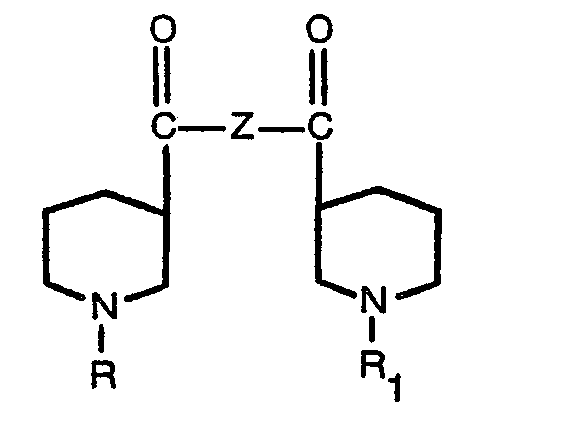
wherein R and R1 are each hydrogen or alkyl, containing up to 12 carbon atoms; and Z is an organic diamine radical of the formula R2N-X-NR3, in which X is an alkylene chain of up to 12 carbons or together with the two amino nitrogens forms a saturated heterocyclic ring and R2 and R3 are each H or alkyl containing 1 to 6 carbon atoms; and salts of said compounds, including quaternary salts.
wherein R and R1 are each hydrogen or alkyl, containing up to 12 carbon atoms; and Z is an organic diamine radical of the formula R2N-X-NR3, in which X is an alkylene chain of up to 12 carbons or together with the two amino nitrogens forms a saturated heterocyclic ring and R2 and R3 are each H or alkyl containing 1 to 6 carbon atoms; and salts of said compounds, including quaternary salts.
2. N,N'-Bis(1-decylnipecotoyl)-piperazine dihydriodide.
3. 1,2-Bis[N-(1-decylnipecotoyl)-N-methylamino]-ethane dihydriodide.
4. 1,2-Bis[N-(1-hexylnipecotoyl)-N-methylamino]-ethane dihydriodide.
5. 1,6-Bis[N-(1-decylnipecotoyl)-N-methylamino]-hexane dihydriodide.
6. 1,6-Bis[N-(1-decylnipecotoyl)-N-butylamino]-hexane dihydriodide.
7. 1,6-Bis[N-(1-hexylnipecotoyl)-N-butylamino]-hexane dihydriodide.
8. Process of preparing a compound as in claim 1 herein, which comprises catalytically
reducing the corresponding unsaturated compound, or acylating a suitable diamine with
a selected acid derivative such as the acid halide to obtain the diamide of formula
(I) and, optionally forming salts thereof with pharmaceutically-acceptable acids or
quaternary salts by reaction with alkyl halides.
9. Pharmaceutical composition characterized in that it contains as active ingredient
a compound as in claim 1.
1. Verbindung der Formel (I)
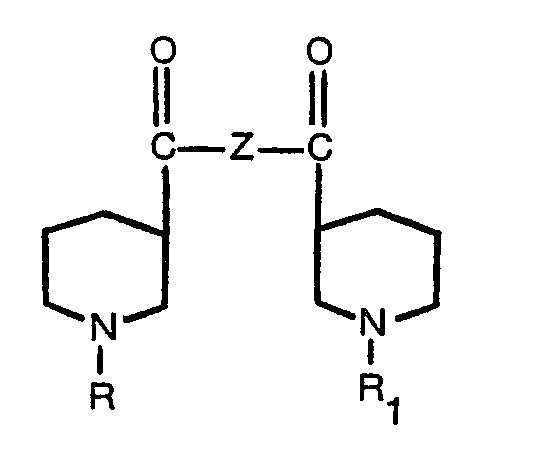
worin R und R1 jeweils Wasserstoff oder Alkyl, enthaltend bis zu 12 Kohlenstoffatome, bedeuten; und Z ein organischer Diaminrest der Formel R2N―X―NR3 ist, worin X eine Alkylenkette mit bis zu 12 Kohlenstoffen bedeutet, oder zusammen mit den beiden Aminostickstoffen einen gesättigten heterocyclischen Ring bildet und R2 und R3 jeweils H oder Alkyl mit 1 bis 6 Kohlenstoffatomen bedeuten, sowie Salze der Verbindungen, einschließlich quaternäre Salze.
worin R und R1 jeweils Wasserstoff oder Alkyl, enthaltend bis zu 12 Kohlenstoffatome, bedeuten; und Z ein organischer Diaminrest der Formel R2N―X―NR3 ist, worin X eine Alkylenkette mit bis zu 12 Kohlenstoffen bedeutet, oder zusammen mit den beiden Aminostickstoffen einen gesättigten heterocyclischen Ring bildet und R2 und R3 jeweils H oder Alkyl mit 1 bis 6 Kohlenstoffatomen bedeuten, sowie Salze der Verbindungen, einschließlich quaternäre Salze.
2. N,N'-Bis(1-decylnipecotoyl)-piperazin-Dihydrojodid.
3. 1,2-Bis[N-(1-decylnipecotoyl)-N-methylamino]-ethan-Dihydrojodid.
4. 1,2-Bis[N-(1-hexylnipecotoyl)-N-methylamino]-ethan-Dihydrojodid.
5. 1,6-Bis[N-(1-decylnipecotoyl)-N-methylamino]-hexan-Dihydrojodid.
6. 1,6-Bis[N-(1-decylnipecotoyl)-N-butylamino]-hexan-Dihydrojodid.
7. 1,6-Bis[N-(1-hexylnipecotoyl)-N-butylamino]-hexan-Dihydrojodid.
8. Verfahren zur Herstellung einer Verbindung gemäß Anspruch 1, bei dem man katalytisch
die entsprechende ungesättigte Verbindung reduziert, oder ein geeignetes Diamin mit
einem ausgewählten Säurederivat wie dem Säurehalogenid acyliert unter Erhalt des Diamids
der Formel (I), worauf man gewünschtenfalls Salze davon mit pharmazeutisch annehmbaren
Säure oder quaternäre Salze durch Umsetzung mit Alkylhalogeniden bildet.
9. Pharmazeutische Zusammensetzung, dadurch gekennzeichnet, daß sie als aktiven Bestandteil
eine Verbindung gemäß Anspruch 1 enthält.
1. Compose de formule (I):
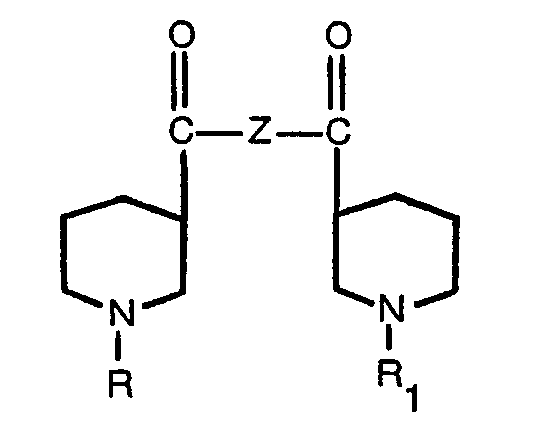
dans laquelle: R et R1 représentent chacun l'hydrogène ou un alkyle contenant jusqu'à 12 atomes de carbone; et Z représente un radical de diamine organique de formule: R2N-X-NR3, dans laquelle: X représente un chaîne alkylène ayant jusqu'à 12 atomes de carbone, ou forme, conjointement avec les deux atomes d'azote des groupes amino, un noyau hétérocyclique saturé; et R2 et R3 représentent chacun H ou un alkyle contenant de 1 à 6 atomes de carbone, et les sels desdits composés, y compris les sels quaternaires.
dans laquelle: R et R1 représentent chacun l'hydrogène ou un alkyle contenant jusqu'à 12 atomes de carbone; et Z représente un radical de diamine organique de formule: R2N-X-NR3, dans laquelle: X représente un chaîne alkylène ayant jusqu'à 12 atomes de carbone, ou forme, conjointement avec les deux atomes d'azote des groupes amino, un noyau hétérocyclique saturé; et R2 et R3 représentent chacun H ou un alkyle contenant de 1 à 6 atomes de carbone, et les sels desdits composés, y compris les sels quaternaires.
2. Diiodhydrate de N,N'-bis(décyl-1 nipécotoyl)-pipérazine.
3. Diiodhydrate de bis[N-(décyl-1 nipécotoyl)-N-méthylamino]-1,2 éthane.
4. Diiodhydrate de bis[N-(hexyl-1 nipécotoy))-N-méthy)amino]-1,2 éthane.
5. Diiodhydrate de bis[N-(décyl-1 nipécotoyl)-N-méthylamino]-1,6 hexane.
6. Diiodhydrate de bis[N-(décyl-1 nipécotoyl)-N-butylamino]-1,6 hexane.
7. Diiodhydrate de bis[N-(hexyl-1 nipécotoyl)-N-butylamino]-1,6 hexane.
8. Procédé de fabrication d'un composé tel que défini à la revendication 1, caractérisé
en ce qu'il consiste à réduire par voie catalytique le composé insaturé correspondant,
ou à acyler une diamine appropriée avec un dérivé acide choisi, tel que l'halogénure
d'acide, pour obtenir le diamide de formule (1) et, de façon facultative, à former
leurs sels avec des acides ou des sels quaternaires pharmaceutiquement acceptables
par réaction avec des halogénures d'alkyle.
9. Composition pharmaceutique caractérisée par le fait qu'elle contient, en tant qu'ingrédient
actif, un composé tel que défini à la revendication 1.