|
(11) | EP 0 098 335 A1 |

| (12) | EUROPEAN PATENT APPLICATION |
|
|
|
|
||||||||||||||||||||||||
| (54) | Cycloaliphatic alcohols |
| (57) Cycloaliphatic polyols of the formula
wherein R, and R2, which may be the same or different, represent hydrogen atoms or methyl groups; R3 and R4, which may be the same or different, represent hydrogen atoms or hydroxymethyl groups; x is an integer of from 3 to 6, and y is an integer of from 6 to 9, the sum of x and y being 12; with the proviso that at least one of R, and R2 represents a hydrogen atom and at least one of R3 and R4 represents a hydroxymethyl group. These polyols are prepared by reduction of acids or derivatives and are used in the preparation of urethane or melamine coatings or mouldings. |
[0001] This invention relates to polyfunctional alcohols which may be utilized among other purposes for the preparation.of polyurethanes.
[0002] It is known that polyfunctional cycloaliphatic acids may be prepared through a Diels-Alder reaction. Such materials are useful in the preparation of polyesters. However, the ester bond itself is subject to attack by a number of chemical agents. It has therefore been found desirable to prepare a compound not subject to an ester attack by eliminating the carboxylic acid functionality. The resultant compounds have been found to possess the advantages of high flexibility when used in urethanes and light stability when the compound is hydrogenated.
[0003] A detailed discussion of the art to which the invention relates may be found in United States Patent 4,216,343 (Rogier) dated August 5, 1980 to which attention is particularly drawn.
[0004] According to one aspect of the invention there are provided compounds of formula I
(wherein R1 and R2, which may be the same or different, represent hydrogen atoms or methyl groups; R3 and R4, which may be the same or different, represent hydrogen atoms or hydroxymethyl groups; Z represents a group -CH=CH- or -CH2-CH2-; x is an integer of from 3 to 6; and y is an integer of from 6 to 9, the sum of x and y being 12; with the proviso that at least one of R1 and R2 represents a hydrogen atom and at least one of R3 and R4 represents a hydroxymethyl group).
[0005] As indicated previously, the novel compounds of the present invention may either contain a saturated or unsaturated bond within the six membered ring in their structure. This is particularly important in that should it be desired to promote ultraviolet stability, the bond within the ring structure may be hydrogenated or if a fire retardant property or some further derivatization is desired, the unsaturation may be left in the molecule thereby providing an active site.
[0006] The novel polyols of this invention which contain all primary alcohol groups can be prepared by reduction of acids or esters.
[0007] According to a further aspect of the invention there is provided a process for the preparation of compounds of formula I which process comprises reducing a compound of formula II
(wherein R1, R2, x, y and Z are as defined above; R5 and R6, which may be the same or different, represent hydrogen atoms or groups of formula - C02R'; and each R', which may be the same or different, represents a hydrogen atom or an alkyl group; with the provisos that at least one of R5 and R6 represents a group of formula -C02R' and that if Z represents a group -CH=CH- then either or both aliphatic chains CH3(CH2)x-and -(CH2)y- may be unsaturated).
[0008] In the acid or ester of formula II, x is preferably 4 or 5, y is preferably 7 or 8, and R', if it represents an alkyl group, preferably contains from 1 to 6 carbon atoms. Further unsaturation in the aliphatic side chains of formula II may be present if a material such as tung oil is employed.
[0009] The carbon-carbon double bonds of the above cyclohexane.derivatives of formula II wherein Z represents a -CH = CH- group can be saturated by catalytic hydrogenation using catalysts such as Raney nickel, supported nickels, palladium or platinum.
[0010] Either unsaturated or saturated esters of formula II can be converted into saturated polyols of formula I by hydrogenolysis using copper chromite catalysts such as those described by Adkins J. Amer. Chem. Soc. 54, 1138 (1932) or commercially available modifications of copper chromite catalysts.
[0011] If the unsaturated polyols of formula I (wherein Z represents a -CH = CH- group) are desired, the ester groups of the unsaturated esters of formula II (wherein Z represents a -CH = CH- group) can be hydrogenolyzed with the carbon-carbon double bonds being preserved by using chemical reducing agents such as alkali metal alcoholates (e.g. sodium metal and alcohols - Bouveault-Blanc reductions) or LiAlH4.
[0012] The acid and ester reagents of formula II may be prepared from a variety of conjugated fatty acids or their derivatives and a dieneophile, suitably by a Diels-Alder reaction as previously described. Basically, the Diels-Alder reaction is conducted after obtaining the methyl ester of a drying or semi-drying oil through methanolysis. Conveniently, the methyl ester may be obtained by methanolysis of tung oil. For the sake of simplicity, methanolysis is mentioned, however, any alcoholysis reaction may be employed.
[0013] Variations in the present invention allow the use of various unsaturated materials which are derived from the semi-drying oils such as those selected from the group consisting of soybean oil, tall oil, tung oil, linseed oil, safflower oil, sunflower oil and other similar materials.
[0014] Various unsaturated acids may be utilized herein as previously indicated including those conveniently having 18 carbon atoms such as 9, 12 - octadecadienoic acid (linoleic acid); 9, 11-octadecadienoic acid; 10, 12-octadecadienoic acid; 9,12,15-octadecatrienoic acid (linolenic acid); 6,9,12-octadecatrienoic acid; 9,11,13-octadecatrienoic acid (eleostearic acid); 10,12,14-octadecatrienoic acid and other similar materials. It is also noted as previously stated that various derivatives of the fatty acids may be employed, particularly the alkyl esters and particularly those containing up to 8 carbon atoms. Most conveniently, however, the methyl ester is employed for reasons of convenience and expense. It is also noted that a particularly interesting variable in the present invention is to conjugate the double bonds of the fatty acids described above and such may be done by known techniques such as alkali conjugation. Conjugation by some method is necessary for the Diels-Alder reaction.
[0015] Dieneophiles which can be used in the preparation of compounds of formula II wherein Z represents a -CH=CH- group include acrylic acid, methacrylic acid, crotonic acid, maleic acid, fumaric acid and the c1 to C8 esters of such acids. Maleic anhydride may also be employed.
[0016] The dieneophile and methyl ester of the drying oil together with a polymerization inhibitor such as para-methoxyphenol are charged into a reactor flushed with nitrogen and heated to a temperature of from about 110 to 180 degrees C for a substantial period of time. After the reaction is complete, any excess dieneophile is then removed and the unpurified unsaturated cycloaliphatic material is obtained.
[0017] Wherein the saturated material is required, the above unsaturated product of formula II can be reduced using a common hydrogenation catalyst. Most practically platinum and palladium on carbon can be utilized. The material as described above is then saturated by placing it in a reaction vessel with the 5 percent palladium on carbon catalyst and the reaction vessel is flushed with nitrogen followed by pressurization with hydrogen gas at from about 1 to about 500 atmospheres (0.1 to 50.7 MNm-2). The temperature is maintained during the hydrogenation at from about 20 to 150, preferably 55 to 135, degrees Celsius. The pressure during the hydrogenation reaction is conveniently maintained at from about 10 to about 200 atmospheres (1.0 to 20.3 MNm-2). The reaction time is simply that required to obtain as high a degree of hydrogenation as is desired. Conveniently, this reaction may be conducted for from about 3 to 8 hours.
[0018] Thereafter, the acid or ester may be reacted utilizing hydrogen gas and copper chromite utilizing conditions for reduction of the acid or ester to the corresponding alcohols of formula I.
[0019] It has been found that such a hydrogenolysis reaction with the copper chromite catalyst may be conducted at from about 240 to about 300 degrees C, preferably from about 250 to about 280 degrees C. The pressure for the hydrogenation reaction may be maintained at from about 200 to 500 atmospheres (20.3 to 50.7 MNm-2), preferably from about 220 to about 480 atmospheres (22.3 to 48.6 MNm ).
[0020] The compounds of the present invention may be used to prepare urethanes and melamine coatings.
[0021] According to a further aspect of the present invention there is provided the use of compounds of formula I in the preparation of urethane or melamine coatings or mouldings.
[0023] Throughout this specification, percentages and ratios are by weight and temperatures in degrees Celsius unless otherwise indicated.
EXAMPLE I (PREPARATIVE)
[0024] The preparation of unsaturated 21 carbon dimethyl ester of tung oil of formula II is conducted as follows: Into a 70-U.S. gallon (265 1) reaction vessel is placed 201 pounds (91.2 kg) of a methyl ester derived by methanolysis of tung oil, 59.7 pounds (27.1 kg) of methyl acrylate and 271 grams (0.6 lbs) of p-methoxyphenol.
[0025] The reaction vessel is then flushed with nitrogen and then heated to about 145 degrees C for a period of approximately 24 hours. The excess methyl acrylate is then removed by distillation at a temperature of approximately 100 degrees Celsius and reduced pressure.
EXAMPLE II (PREPARATIVE)
[0028] A 70-U.S. gallon (265 1) autoclave is charged with 217 pounds (98.4 kg) of the unsaturated dimethyl ester product of Example I, and 4.4 pounds (2.0 kg) of 5 percent palladium on carbon. The reaction vessel is then flushed with nitrogen and pressurized with hydrogen to 7 atmospheres (709 kNm -2).
[0029] The temperature is maintained at 75-115 degrees C during the hydrogenation of the unsaturation in the cyclohexene ring. The pressure utilized during the hydrogenation is from about 2 to 6 atomspheres (203 to 608 kNm-2).
[0030] After hydrogenation is complete (6.5 hours), the reaction vessel is flushed with nitrogen and discharged through a pressure filter to yield 214 pounds (97.1 kg) of the saturated dimethyl ester of formula II (methyl 10-(3-n-butyl-I or 2-methoxycarbonyl- cyclohexyl)-decanoate).
[0031] Any noncyclic material may be removed by a fractional distillation. These materials are primarily those corresponding to the aliphatic acids employed. The final distilled product had a saponification equivalent weight equal to 193.
EXAMPLE III
[0032] The product obtained from Example II which has been distilled using a wiped film still to remove any noncyclic material is utilized in this and the succeeding Examples. Into a 1 liter 316 SS Magne Drive autoclave is place 500 grams of the saturated dimethyl ester of formula II and 50 grams of copper chromite catalyst obtained from the Harshaw Chemical Company. The autoclave is then purged with nitrogen and pressurized with hydrogen gas to 200 atmospheres (20.3 MNm-2).
[0033] The reaction vessel is then heated to 250 degrees C where hydrogen uptake begins. The temperature is increased to 270 degrees C and the pressure maintained at from about 208 to 250 atmospheres (21.1 to 25.3 MNm-2) by hydrogen addition for 6 1/2 hours. The reaction vessel is then cooled to about 200 degrees C and any excess hydrogen and methanol is vented. The product is discharged through a pressure filter and obtained as a colourless liquid diol (of formula I wherein either R3 or R4 represents a hydroxymethyl group, Rl, R2 and the other group R3 or R4 represent hydrogen atoms and x=3 and y=9) having a hydroxyl equivalent weight of approximately 176. Remarkably, the viscosity of the product obtained (10-(3-n-butyl-1 or 2-hydroxymethyl-cyclohexyl)-decan-l-ol) is quite low.
EXAMPLE IV (PREPARATIVE): PREPARATION OF TRIESTER
[0035] Into a 5 litre Pyrex flask equipped with a reflux condenser and source of nitrogen purge is placed 1208 grams of the methyl esters of tung oil fatty acids (77 percent eleostearic acid) and 636 grams of dimethyl maleate. The reaction system is flushed with nitrogen and heated at 180 degrees C for 24 hours.
[0036] The reaction product is combined with the product of a similar run starting with 301 grams of methyl tungate. The combined crude products after stripping of excess dimethyl maleate by distillation under reduced pressure weigh 2222 grams. Thin-film distillation of 2191 grams of this residue yielded the following fractions:
[0037]
The triester product (methyl 10-(3-n-butyl-1,2-di-methoxycarbonyl-cyclohex-5-enyl)-dec-9-enoate) is of formula IV
EXAMPLE V
HYDROGENOLYSIS OF TRIESTER
[0038] Into a litre, 316 SS Magne-Drive autoclave is charged 497 grams of the triester product of Example IV of formula IV (Fraction 2) and 50 grams of copper chromite catalyst (Cu-1910-P, Harshaw Chemical Co.). The autoclave is flushed with nitrogen, then charged with hydrogen to 200 atmosphere (20.3 MNm-2) and heated to 270 degrees C. The reaction is maintained at 270 degrees C and 200-250 atmospheres (20.3 to 25.3 MNm-2) pressure for 12 hours. The reaction is cooled, vented, flushed with nitrogen and filtered under pressure. The filtered product weighed 315 grams after vacuum stripping and had a hydroxyl equivalent weight of 286. The product was essentially the triol of formula V
EXAMPLE VI
1. Compounds of formula I
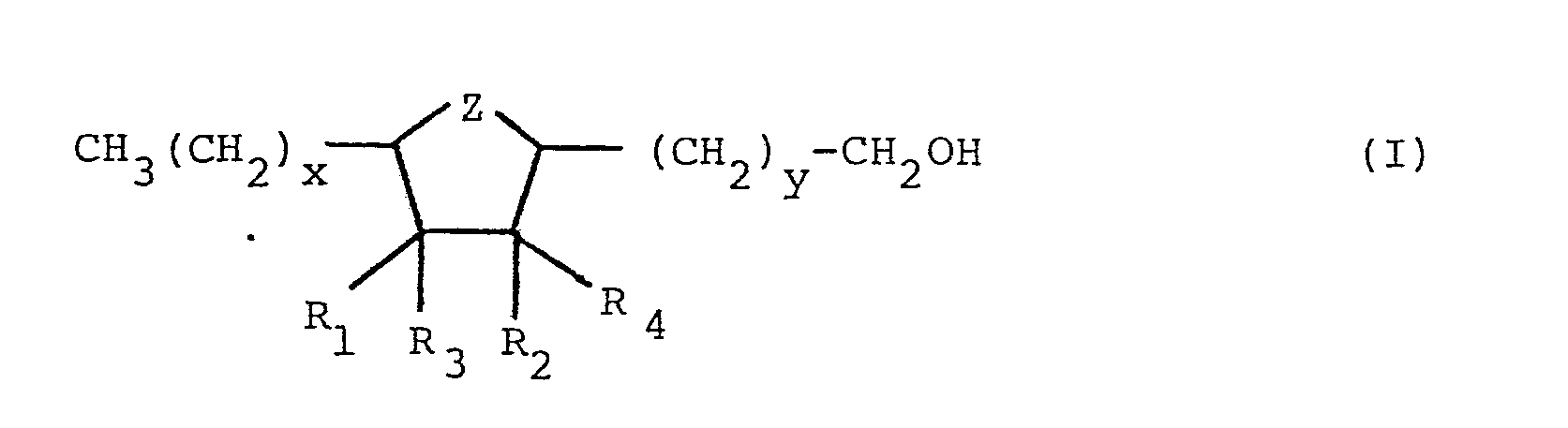
(wherein R1 and R2, which may be the same or different, represent hydrogen atoms or methyl groups; R3 and R4, which may be the same or different, represent hydrogen atoms or hydroxymethyl groups; Z represents a group -CH=CH- or -CH2-CH2-; x is an integer of from 3 to 6; and y is an integer of from 6 to 9, the sum of x and y being 12; with the proviso that at least one of R1 and R2 represents a hydrogen atom and at least one of R3 and R4 represents a hydroxymethyl group).
(wherein R1 and R2, which may be the same or different, represent hydrogen atoms or methyl groups; R3 and R4, which may be the same or different, represent hydrogen atoms or hydroxymethyl groups; Z represents a group -CH=CH- or -CH2-CH2-; x is an integer of from 3 to 6; and y is an integer of from 6 to 9, the sum of x and y being 12; with the proviso that at least one of R1 and R2 represents a hydrogen atom and at least one of R3 and R4 represents a hydroxymethyl group).
2. Compounds as claimed in claim 1 wherein R1 and R2 both represent hydrogen atoms.
3. Compounds as claimed in either of claims 1 and 2 wherein R3 and R4 both represent hydroxymethyl groups.
4. Compounds as claimed in either of claims 1 and 2 wherein one of R3 and R4 represents a hydrogen atom.
5. Compounds as claimed in any one of claims 1 to 4 wherein x is 4 or 5 and y is 7
or 8.
6. Compounds as claimed in claim 1 selected from:
(a) 10-(3-n-butyl-l-hydroxymethyl-cyclohexyl)-decan-1-ol;
(b) 10-(3-n-butyl-2-hydroxymethyl-cyclohexyl)-decan- l-ol; and
(c) 10-(3-n-butyl-l,2-di-hydroxymethyl-cyclohexyl)-decan-l-ol
7. A process for the preparation of compounds of formula I (as defined in claim 1)
which process comprises reducing a compound of formula II
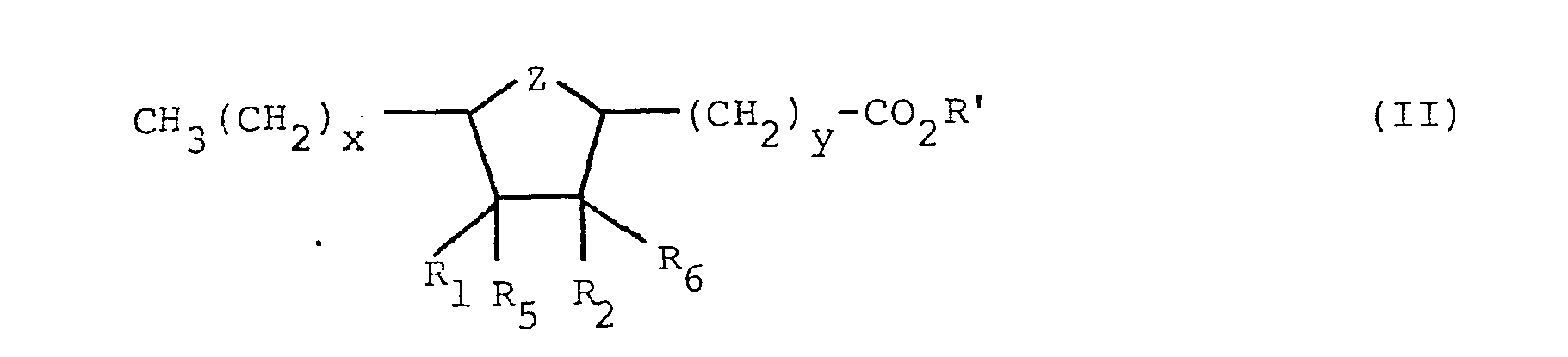
(wherein Rl, R2, x, y and Z are as defined in claim l; R5 and R6, which may be the same or different, represent hydrogen atoms or groups of formula - CO2R ; and each R , which may be the same or different, represents a hydrogen atom or an alkyl group; with the provisos that at least one of R5 and R6 represents a group of formula -CO2R' and that if Z represents a group -CH=CH- then either or both aliphatic chains CH3(CH2)x- and -(CH2)y- may be unsaturated).
(wherein Rl, R2, x, y and Z are as defined in claim l; R5 and R6, which may be the same or different, represent hydrogen atoms or groups of formula - CO2R ; and each R , which may be the same or different, represents a hydrogen atom or an alkyl group; with the provisos that at least one of R5 and R6 represents a group of formula -CO2R' and that if Z represents a group -CH=CH- then either or both aliphatic chains CH3(CH2)x- and -(CH2)y- may be unsaturated).
8. A process as claimed in claim 7 wherein the reduction of the compound of formula
II is effected by catalysed hydrogenolysis or by the use of alkali metal alcoholates
or lithium aluminium hydride.
9. The use of compounds of formula I (as defined in claim 1) in the preparation of
urethane or melamine coatings or mouldings.
1. A process for the preparation of compounds of formula I
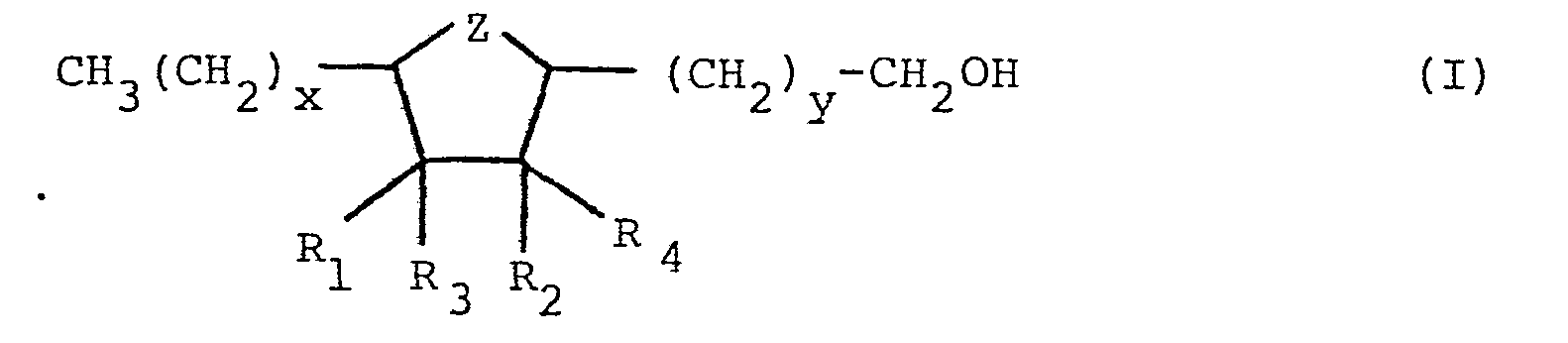
(wherein R1 and R2, which may be the same or different, represent hydrogen atoms or methyl groups; R3 and R41 which may be the same or different, represent hydrogen atoms or hydroxymethyl groups; Z represents a group -CH=CH- or -CH2-CH2-; x is an integer of from 3 to 6; and y is an integer of from 6 to 9, the sum of x and y being 12; with the proviso that at least one of R1 and R2 represents a hydrogen atom and at least one of R3 and R4 represents a hydroxymethyl group) which process comprises reducing a compound of formula II
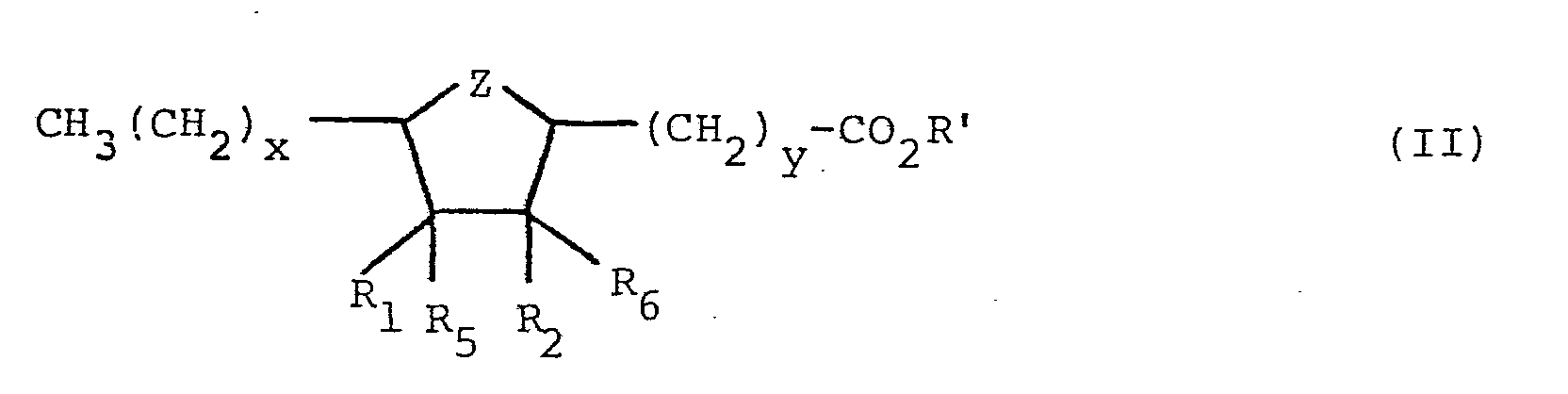
(wherein R1, R2, x, y and Z are as defined above; R5 and R6, which may be the same or different, represent hydrogen atoms or groups of formula - CO2R ; and each R , which may be the same or different, represents a hydrogen atom or an alkyl group; with the provisos that at least one of R5 and R6 represents a group of formula -CO2R' and that if Z represents a group -CH=CH- then either or both aliphatic chains CH3(CH2)x-and - (CH2)y- may be unsaturated).
(wherein R1 and R2, which may be the same or different, represent hydrogen atoms or methyl groups; R3 and R41 which may be the same or different, represent hydrogen atoms or hydroxymethyl groups; Z represents a group -CH=CH- or -CH2-CH2-; x is an integer of from 3 to 6; and y is an integer of from 6 to 9, the sum of x and y being 12; with the proviso that at least one of R1 and R2 represents a hydrogen atom and at least one of R3 and R4 represents a hydroxymethyl group) which process comprises reducing a compound of formula II
(wherein R1, R2, x, y and Z are as defined above; R5 and R6, which may be the same or different, represent hydrogen atoms or groups of formula - CO2R ; and each R , which may be the same or different, represents a hydrogen atom or an alkyl group; with the provisos that at least one of R5 and R6 represents a group of formula -CO2R' and that if Z represents a group -CH=CH- then either or both aliphatic chains CH3(CH2)x-and - (CH2)y- may be unsaturated).
2. A process as claimed in claim 1 wherein a compound of formula II in which Z represents
a -CH=CH- group is reduced to a compound of formula I in which Z represents a -CH2-CH2- group by a reaction involving catalytic hydrogenation.
3. A process as claimed in claim 1 wherein a compound of formula II is reduced by
catalytic hydrogenolysis.
4. A process as claimed in claim 1 wherein a compound of formula II in which Z represents
a -CH=CH- group is reduced by alkali metal alcoholates or lithium aluminium hydride
to a compound of formula I in which Z also represents a -CH=CH- group.
5. A process as claimed in any one of the preceding claims wherein in the compound
of formula II R1 and R2 both represent hydrogen atoms.
6. A process as claimed in any one of the preceding claims wherein in the compound
of formula II R5 and R9 both represent groups of formula -C02R' (in which R is as defined in claim 1).
7. A process as claimed in any one of claims 1 to 5 wherein in the compound of formula
II one of R5 and R6 represents a hydrogen atom.
8. A process as claimed in any one of the preceding claims wherein in the compound
of formula II x is 4 or 5 and y is 7 or 8.
9. A process as claimed in claim 1 wherein the compound of formula II is selected
from:
(a) methyl 10-(3-n-butyl-l-methoxycarbonyl-cyclohex-5-enyl)-dec-9-enoate;
(b) methyl 10-(3-n-butyl-2-methoxycarbonyl-cyclohex-5-enyl)-dec-9-enoate;
(c) methyl 10-(3-n-butyl-l-methoxycarbonyl-cyclohexyl)-decanoate;
(d) methyl 10-(3-n-butyl-2-methoxycarbonyl-cyclohexyl)-decanoate; and
(e) methyl 10-(3-n-butyl-2,3-di-methoxycarbonyl- cyclohex-5-enyl)-dec-9-enoate.
10. The use of compounds of formula I (as defined in claim 1) in the preparation of
urethane or melamine coatings or mouldings.