|
(11) | EP 0 098 623 A1 |

| (12) | EUROPEAN PATENT APPLICATION |
|
|
|
|
|||||||||||||||||||||||||||
| (54) | 2-Hydroxypropane sulphonic acid derivatives; their preparation and curable compositions containing them |
| (57) The invention provides 2-hydroxypropane sulphonic acid derivatives of general formula
wherein n is a number having an average value from 0 to 12, Ⓐ denotes saturation or aromatic unsaturation in an associated carbocyclic ring and the or each of the R1 and R2 groups are independently selected from hydrogen and C1-12 alkyl groups provided that the or each -C(R1)(R2)-group contains not more than 13 carbon atoms; and salts thereof; a process for their preparation and curable compositions containing them. |
[0001] This invention relates to 2-hydroxypropane sulphonic acid derivatives, processes for their preparation and curable compositions containing them.
[0002] UK Patent Specification No. 1,059,984 discloses 2-hydroxy- alkane sulphonic acids and their salts, and their preparation from a bisulphite of a nitrogen base and an alkylene oxide such as ethylene oxide, propylene oxide or butylene oxide. The bisulphite of the nitrogen base and the alkylene oxide are water-soluble and their reaction is effected in aqueous solution.
[0003] In UK Patent Specification No. 983,049 there is disclosed a process in which epoxy compounds, including glycidyl alkyl ethers and glycidyl carboxylic acid esters, are reacted with-adducts of a bisulphite with an oxo compound, e.g. 2-hydroxypropane-2-sulphonic acid, formed by reaction of sodium bisulphite with acetone. Preferred epoxy compounds are those containing 8 to 30 carbon atoms. The resulting sulphonated derivatives possess surface-active properties and are described as suitable for use as detergents and/or wetting agents. No mention is made of any epoxy compounds containing more than one epoxy group per molecule.
[0004] UK Patent Specification No. 1,310,672 describes a process for sulphonating alkyl or polyoxyalkylene glycidyl ethers by reaction with an organic carbonyl bisulphite adduct at an initial pH of from 6 to 8 and at elevated temperature. The bisulphite adduct is formed by reaction of sodium bisulphite with an aqueous aldehyde or ketone, preferably acetone. The resulting sulphonates are surfactants useful as ingredients of detergents and other washing compositions.
[0005] The three UK Patent Specifications referred to above all relate to sulphonation of epoxy compounds containing a single epoxy group per molecule. UK Patent Specification No. 1,530,649 discloses sulphonation of a copolymer of an ethylenically unsaturated monomer, such as styrene or methylmethacrylate, with a glycidyl ester of an α-unsaturated carboxylic acid, such as glycidyl acrylate or glycidyl methacrylate. Sulphonation is achieved by reaction of the polymer in aqueous medium with sulphite ions of a water-soluble inorganic sulphite, e.g. sodium sulphite. Phase separation exists between the epoxy group- containing polymer and the aqueous solution, so sulphonation is effected in the presence of an ionic surface active agent, preferably a quaternary ammonium salt e.g. tetra-a-butyl ammonium bisulphate, bromide, chloride or iodide. Reaction of the epoxy groups is slow and may be incomplete. Thus in the first example after 6 hours only 50% of epoxy groups had been converted to sulphonate groups, in the second example after 7 hours 96X had been converted, and in the third example after 4 hours 62X had been sulphonated. The resulting sulphonated polymers axe soluble or dispersible in water and have potential application as thickeners, impregnating materials, binders, surface coating materials, adhesives, antistatic agents, ion-exchange resins and polymeric catalysts.
[0006] According to the present invention there is provided a 2-hydroxypropane sulphonic acid derivative of general formula
wherein n is a number having an average value from 0 to 12, Ⓐ denotes saturation or aromatic unsaturation in an associated carbocyclic ring and the or each of the R1 and R2 groups are independently selected from hydrogen and C1-12 alkyl groups provided that the or each -C(R1)(R2)-group contains not more than 13 carbon atoms; or a salt thereof.
[0007] The compounds of formula I may be in the form of the free acid or in the form of a salt thereof. When prepared by a process to be described hereinafter, the initial product according to the invention is a tertiary or quaternary ammonium salt, which may readily be converted to the corresponding free acid by addition of a strong acid. Other salts, e.g. potassium and sodium salts, may readily be prepared from the tertiary or quaternary ammonium salt, or from the free acid. The term salt includes partially neutralised acid as well as fully neutralised derivative.
[0008] Preferred compounds of formula I are those wherein each Ⓐ moiety denotes aromatic unsaturation. It is further preferred for n to have an average value from 0 to 9. When n is greater than 0, it will be appreciated that the groups -CR1R2- in the molecule may be the same or different. Conveniently all the groups R and R are methyl groups. When the R1 and R groups on a -CR1R2-moiety are not both methyl groups, it is preferred for one of R1 and R2 to be hydrogen, and the other to be a C6-12 alkyl group. Thus, for example, one or more groups -CR R - in a molecule may conveniently be -C(CH3)2- groups while in another one or more such groups one of R1 and R may be hydrogen, the other being a C6-12 alkyl group.
[0009] The invention also provides a process for preparing a 2-hydroxypropane sulphonic acid derivative of the invention wherein an epoxy resin of general formula
wherein R1, R2, n and Ⓐ are as defined above, is reacted with an ammonium sulphite or bisulphite of formula
or
wherein R3 is hydrogen and either R 4 R5 and R are independently selected from C1-6 alkyl and 2-hydroxyalkyl groups or R4 is a benzyl group optionally substituted by a methyl, methoxy or trifluoromethyl group and/or one or more halogen atoms or nitro groups and R is a methyl group and R is a methyl, ethyl or 2-hydroxyethyl group, provided that the total number of carbon atoms in the groups R4, R5 and R does not exceed 10; or R3, R4, R5 and R6 are independently C1-4 alkyl groups; or R 3 R4 and R5 are methyl groups and R6 is a benzyl group or a C5-16 alkyl group; in homogeneous solution in an inert solvent, optionally followed by evaporation of the solvent to isolate the corresponding ammonium salt of the sulphonic acid of formula I, or by addition of a strong acid followed by separation of the precipitated free acid, or by conversion of the ammonium salt or the free acid to a desired salt.
[0010] Compounds of formula II are either well known compounds, or can be made from known compounds by analogous processes to those used for preparing known compounds, see for example US Patent No. 2,633,458, European Patent Application Publication No. 43612 and European Patent Application No. 82201621.8 (Japanese Patent Application No. 224065/1982). Particularly preferred compounds of formula II, wherein A denotes aromatic unsaturation and all the R1 and R2 groups are methyl groups, are polyglycidyl ethers of 2,2-(4-hydroxyphenyl)propane. Polyglycidyl ethers which have molecular weights below 500 are also known as liquid epoxy resins, and those with higher molecular weights as solid epoxy resins.
[0011] Although the expected product of the process of the invention is a 2-hydroxypropane sulphonic acid derivative, in some cases amounts of product wherein the sulphonic acid moiety is attached at the 2-position and the hydroxy group is at the 1-position may also be produced and be present in the derivatives according to the invention.
[0012] The ammonium sulphites and bisulphites of formulae III and IV are based on tertiary amines or quaternary ammonium compounds, and are readily prepared by passing gaseous sulphur dioxide into a solution of the tertiary amine or the quaternary ammonium hydroxide in an inert solvent, e.g. 2-n-butoxyethanol, in the presence of water, in the case of tertiary amines. 2-Dimethyl- amino-2-methyl-1-propanol is a very suitable tertiary amine. Other suitable tertiary amines include triethylamine, tripropylamine, dimethylethanolamine, diethylethanolamine or triethanolamine. Suitable quaternary ammonium hydroxides include tetramethylammonium hydroxide, tetrabutylammonium hydroxide, tetramethylbenzylammonium hydroxide and cetyl trimethylammonium hydroxide.
[0013] The inert solvent in which the process of the invention is effected may be a single solvent or a mixture of two or more cosolvents. 2-n-butoxyethanol has been found to be a very suitable solvent.
[0014] During the course of the process of the invention the temperature of the homogeneous solution is conveniently brought into the range from 50°C to its reflux temperature.
[0015] Suitable strong acids include for example hydrochloric acid, hydrobromic acid and sulphuric acid.
[0016] The ammonium salt or the free acid may conveniently be converted to the desired salt by treating the ammonium salt with an appropriate metal oxide or hydroxide, or by neutralising, or partially neutralising, the acid in aqueous medium with an appropriate metal oxide or hydroxide, e.g. potassium or sodium hydroxide, or with an amine or a quaternary ammonium hydroxide.
[0017] 2-Hydroxypropane sulphonic acid derivatives of the invention are curable binders. Accordingly the invention further comprises curable compositions comprising a 2-hydroxypropane sulphonic acid of formula I or a salt thereof and a co-curing resin. Suitable co-curing resins include for example urea-formaldehyde resins, melamine-formaldehyde resins, benzo-guanamine-formaldehyde resins and phenolic resins. The co-curing resins may be used in binder/co-curing resin weight ratios known in the art, for example in binder/co-curing resin weight ratios 95:5 to 60:40.
[0018] The curable compositions are particularly suitable for use as thermosetting coating compositions. The compositions may generally be diluted with, and may themselves contain, polar non-aqueous solvents, for example 2-n-butoxyethanol.
[0019] 2-Hydroxypropane sulphonic acids of formula I and their salts are water thinnable, i.e. they may be diluted with water, in the absence of any surfactant or emulsion stabiliser, to give stable aqueous solutions or dispersions. Accordingly thermosetting coating compositions based on acids of formula I or their salts may be aqueous compositions. Such aqueous compositions are conveniently prepared by diluting the acid of formula I or a salt thereof with water to 10X to 30X by weight solids content and adding a water-soluble or water-miscible co-curing resin, although the co-curing resin may be added before dilution with water.
[0020] Coating compositions of the invention may additionally contain conventional paint additives, such as pigments, fillers, plasticisers and thixotropic agents.
[0021] Coating compositions of the invention may be applied to a suitable substrate, e.g. steel, tinplate, aluminium or wood, by any suitable means such as brush, blade, roller, spray or dip. In addition, the aqueous coating compositions may be applied to electrically conductive substrates by electrophoretic deposition. The resulting coatings may be cured by heating at conventional temperatures for conventional periods of time, for example for a metal substrate from 80 to 200°C for 2 to 10 minutes. For a wood substrate curing will be at lower temperatures for longer times, e.g. 40 to 70°C for 15 minutes to 18 hours.
EXAMPLES 1 to 4
Preparation of 2-hydroxypropane sulphonic acids
(a) Preparation of N,N dimethyl-N-(1-hydroxy-2-methylprop-2-yl) ammonium sulphite and bisulphite
[0023] DMAMP-80 (14.8 g, 100 mmol) (DMAMP-80 is an 80X w/w solution of 2-dimethylamino-2-methyl-l-propanol in water) was dissolved in 2-n-butoxyethanol (20 g). The resulting solution was cooled to 0°C and gaseous sulphur dioxide (3.2 g, 50 mmol) was passed in to yield a solution containing N,N-dimethyl-N-(1-hydroxy-2-methylprop-2-yl)ammonium sulphite in equilibrium with the bisulphite.
(b) Preparation of 2-hydroxypropane sulphonates
[0024] A chosen polyepoxide (25 mmol, 1/20 x epoxy molar mass(g)) was dissolved in 2-n-butoxyethanol to give a solution having a solids content from 50% to 60% by weight. This solution was added dropwise at 0°C, with stirring, to the solution trom step (a). The temperature of the resulting reaction mixture was gradually raised to from 50°C to reflux temperature. It is preferred to use higher temperatures within the range 50°C to reflux temperature with polyepoxides of higher epoxy molar mass. Reaction was continued until aliquots, which were taken from the reaction mixture at regular intervals, appeared to be water-dilutable.
[0025] Reaction time was generally of the order of 3 hours. The resulting solution contained the N,N-dimethyl-N-(1-hydroxy-2-methylprop-2-yl) ammonium salt of the 2-hydroxypropane sulphonic acid.
[0026] Dilution of portions of the solutions with water to 10% w solids content and subjection to electrodeposition at electrode distance 3 cm and 200V deposition voltage gave only anodic deposition, confirming that water-solubility is conferred by reaction between epoxy and sulphite moieties and not between epoxy and amine moieties. Infrared spectra of the solutions were fully in accordance with the expected structures.
(c) Preparation of 2-hydroxypropane sulphonic acids
[0027] The resulting solutions from step (b) were acidified with concentrated hydrochloric acid, whereupon the free acids precipitated out as clear to straw-coloured precipitates.
[0028] The precipitates were filtered off (or in some cases were isolated by decantation of supernatant liquid), washed with concentrated hydrochloric acid and dried to give the free acids as glassy solids. Acid contents of the free acids were determined by potentiometric titration.
[0029] The polyepoxides used were polyglycidyl ethers of 2,2-(4-hydroxyphenyl)propane commercially available under the registered Trade Mark "EPIKOTE". The code numbers of the polyepoxides, their epoxy group concentrations (EGC) (and epoxy molar masses(EMM)) and the acid contents of the resulting free acids from step (c) are given in Table I.
EXAMPLE 5
[0030] After dilution with water to solids contents of 25X w, solutions containing N,N-dimethyl-N-(1-hydroxy-2-methylprop-2-yl) ammonium salts of the 2-hydroxypropane sulphonic acids of Examples 3 and 4 (binders)(from step(b)) were mixed at ambient temperature with water-soluble co-curing resins in binder/co-curing resin weight ratios from 95/5 to 70/30. No curing catalyst was added. The resulting lacquers were applied using a bar coater onto undegreased tinplate panels (quality E2, finish 311, thickness 0.23 mm) to give coatings having a film thickness after stoving of 5-6 um. Stoving was effected in a forced air circulation oven.
[0031] Results, including binder/co-curing resin weight ratios, curing schedules (minutes/°C), solvent resistance, pencil hardness and flexibility are given in Table II.
[0032] Solvent resistance is determined by rubbing the cured coating with a piece of cotton cloth soaked in methylethylketone and is expressed as the number of double rubs required to soften the surface (MEK rubs).
[0033] Flexibility of the cured coating is assessed by the wedge bend test, in which a coated tinplate panel is bent over a 3 mm mandrel and impacted into a wedge shape. The panel is then immersed in a CuS04/HCl solution for 2 minutes, whereby any breaks in the coating will become stained. The extent of staining as a % failure of the coating at the bend is recorded.
EXAMPLE 6
[0035] The 2-hydroxypropane sulphonic acids (binders) of Examples 3 and 4 were dissolved in 2-n-butoxyethanol to give 25% w solutions which were mixed at ambient temperature with co-curing resins in binder/co-curing resin weight ratios from 90/10 to 70/30. No curing catalyst was added.
1. A 2-hydroxypropane sulphonic acid derivative of general formula

wherein n is a number having an average value from 0 to 12, Ⓐ denotes saturation or aromatic unsaturation in an associated carbocyclic ring, and the or each of the R1 and R2 groups are independently selected from hydrogen and C1-12 alkyl groups provided that the or each -C(R1)(R2)-group contains not more than 13 carbon atoms; or a salt thereof.
wherein n is a number having an average value from 0 to 12, Ⓐ denotes saturation or aromatic unsaturation in an associated carbocyclic ring, and the or each of the R1 and R2 groups are independently selected from hydrogen and C1-12 alkyl groups provided that the or each -C(R1)(R2)-group contains not more than 13 carbon atoms; or a salt thereof.
2. A derivative according to Claim 1 wherein each Ⓐ moiety denotes aromatic unsaturation,
n has an average value from 0 to 9 and the R1 and R2 groups are methyl groups.
3. A derivative according to claim 1 or 2 in the form of the free acid or a tertiary
or quaternary ammonium salt thereof.
4. A process for preparing a derivative of formula I as defined in claim 1, 2 or 3
characterised in that an epoxy resin of general formula
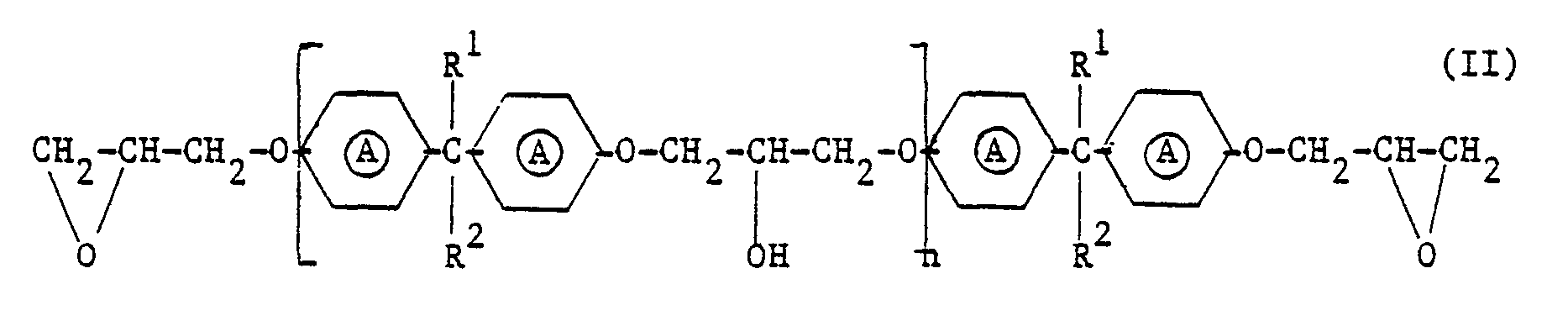
wherein R , R2, n and Ⓐ are as defined in claim 1 or 2, is reacted with an ammonium sulphite or bisulphite of formula
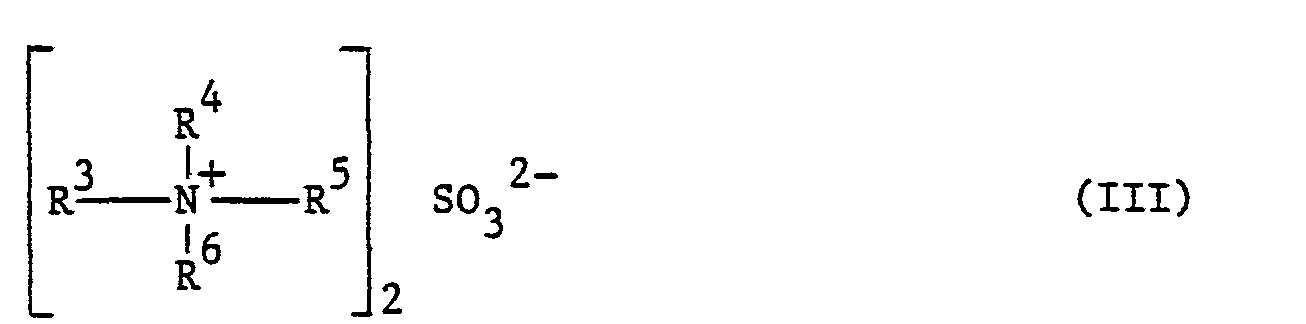
or
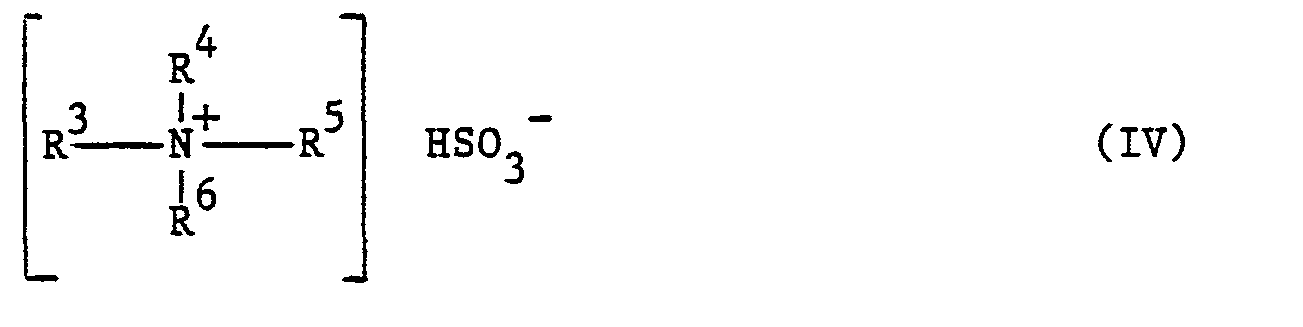
wherein R3 is hydrogen and either R4, R5 and R6 are independently, selected from C1-6 alkyl and 2-hydroxyalkyl groups or R 4 is a benzyl group optionally substituted by a methyl, methoxy or trifluoromethyl group and/or one or more halogen atoms or nitro groups and R5 is a methyl group and R is a methyl, ethyl or 2-hydroxyethyl group, provided that the total number of carbon atoms in the groups R , R5 and R6 does not exceed 10; or R , R , R and R are independently C1-4 alkyl groups; or R , R and R are methyl groups and R6 is a benzyl group or a C5-16 alkyl group; in homogeneous solution in an inert solvent, optionally followed by evaporation of the solvent to isolate the corresponding ammonium salt of the sulphonic acid of formula I, or by addition of a strong acid followed by separation of the precipitated free acid, or by conversion of the ammonium salt or the free acid to a desired salt.
wherein R , R2, n and Ⓐ are as defined in claim 1 or 2, is reacted with an ammonium sulphite or bisulphite of formula
or
wherein R3 is hydrogen and either R4, R5 and R6 are independently, selected from C1-6 alkyl and 2-hydroxyalkyl groups or R 4 is a benzyl group optionally substituted by a methyl, methoxy or trifluoromethyl group and/or one or more halogen atoms or nitro groups and R5 is a methyl group and R is a methyl, ethyl or 2-hydroxyethyl group, provided that the total number of carbon atoms in the groups R , R5 and R6 does not exceed 10; or R , R , R and R are independently C1-4 alkyl groups; or R , R and R are methyl groups and R6 is a benzyl group or a C5-16 alkyl group; in homogeneous solution in an inert solvent, optionally followed by evaporation of the solvent to isolate the corresponding ammonium salt of the sulphonic acid of formula I, or by addition of a strong acid followed by separation of the precipitated free acid, or by conversion of the ammonium salt or the free acid to a desired salt.
5. A curable composition comprising a 2-hydroxypropane sulphonic acid derivative of
formula I or a salt thereof according to any one of claims 1 to 3, and a co-curing
resin.