| (19) |
 |
|
(11) |
EP 0 098 871 B1 |
| (12) |
EUROPEAN PATENT SPECIFICATION |
| (45) |
Mention of the grant of the patent: |
|
10.12.1986 Bulletin 1986/50 |
| (22) |
Date of filing: 25.01.1983 |
|
| (51) |
International Patent Classification (IPC)4: F16D 69/02 |
| (86) |
International application number: |
|
PCT/FI8300/005 |
| (87) |
International publication number: |
|
WO 8302/651 (04.08.1983 Gazette 1983/18) |
|
| (54) |
PROCEDURE FOR MANUFACTURING A BRAKE BLOCK
VERFAHREN ZUR HERSTELLUNG EINES BREMSBLOCKS
PROCEDE DE FABRICATION D'UN SABOT DE FREIN
|
| (84) |
Designated Contracting States: |
|
AT BE CH DE FR GB LI LU NL SE |
| (30) |
Priority: |
26.01.1982 FI 820248
|
| (43) |
Date of publication of application: |
|
25.01.1984 Bulletin 1984/04 |
| (71) |
Applicant: TAPANAINEN, Matti |
|
SF-72600 Keitele (FI) |
|
| (72) |
Inventor: |
|
- TAPANAINEN, Matti
SF-72600 Keitele (FI)
|
| (74) |
Representative: Mrazek, Werner et al |
|
Dr. Ludwig Brann Patentbyra AB
P.O. Box 1344
751 43 Uppsala
751 43 Uppsala (SE) |
|
| |
|
| Note: Within nine months from the publication of the mention of the grant of the European
patent, any person may give notice to the European Patent Office of opposition to
the European patent
granted. Notice of opposition shall be filed in a written reasoned statement. It shall
not be deemed to
have been filed until the opposition fee has been paid. (Art. 99(1) European Patent
Convention).
|
[0001] The present invention concerns a procedure for manufacturing a brake block comprising
a body and a friction pad, in said procedure the friction pad being pressed fast to
the body with the aid of heat effect so that the central part of the friction pad
will be softer than the margins of the friction pad.
[0002] DE-A-2 218 757 discloses a friction pad similar to the pad described above. However,
the known pad has a friction surface the composition and hardness of which arethe
same overthe entire surface. This may lead to foreign abrasive matter getting access
to and destroying the friction pad.
[0003] A brake manufacturing procedure like the one according to the present invention,
is disclosed in FI-B-61.556, published 30.04.1982, that is after the priority date
of the present application. The object of the invention is to develop this manufacturing
procedure further. The procedure of the invention is characterized in that the friction
pad is pressed so that upon the body are placed two friction material courses of different
hardness material, the harder friction material against the body, whereafter the materials
are pressed together and at the same time fast to the body so thatthe harderfriction
material is allowed freely to flow out into a widening in the lower part of the press.
It is possible with the aid of the invention to preselect suitable hardnesses of the
friction pad materials and it is not necessary to leave the central region half-cured,
as has been stated in FI-B-61.556. The harderfriction material, placed against the
body, spreads to the edges, melted by the heat coming from below, as the softer friction
material thereupon is being pressed downwardly from straight above into the centre
of the friction pad. The materials fuse together and to the body so that a friction
pad is obtained which has a friction surface with desired friction coefficient, and
harder margins, whereby is prevented the access of abrasive foreign matter to the
space between the friction surface and the brake disk.
[0004] An advantageous embodiment of the invention is characterized in that the different
friction material courses are pre-pressed to form two coherent pieces, before they
are placed one on top of the other upon the body for the final pressing operation.
Hereby the friction material courses are conveniently and swiftly introducible into
the press in which the final pressing is accomplished.
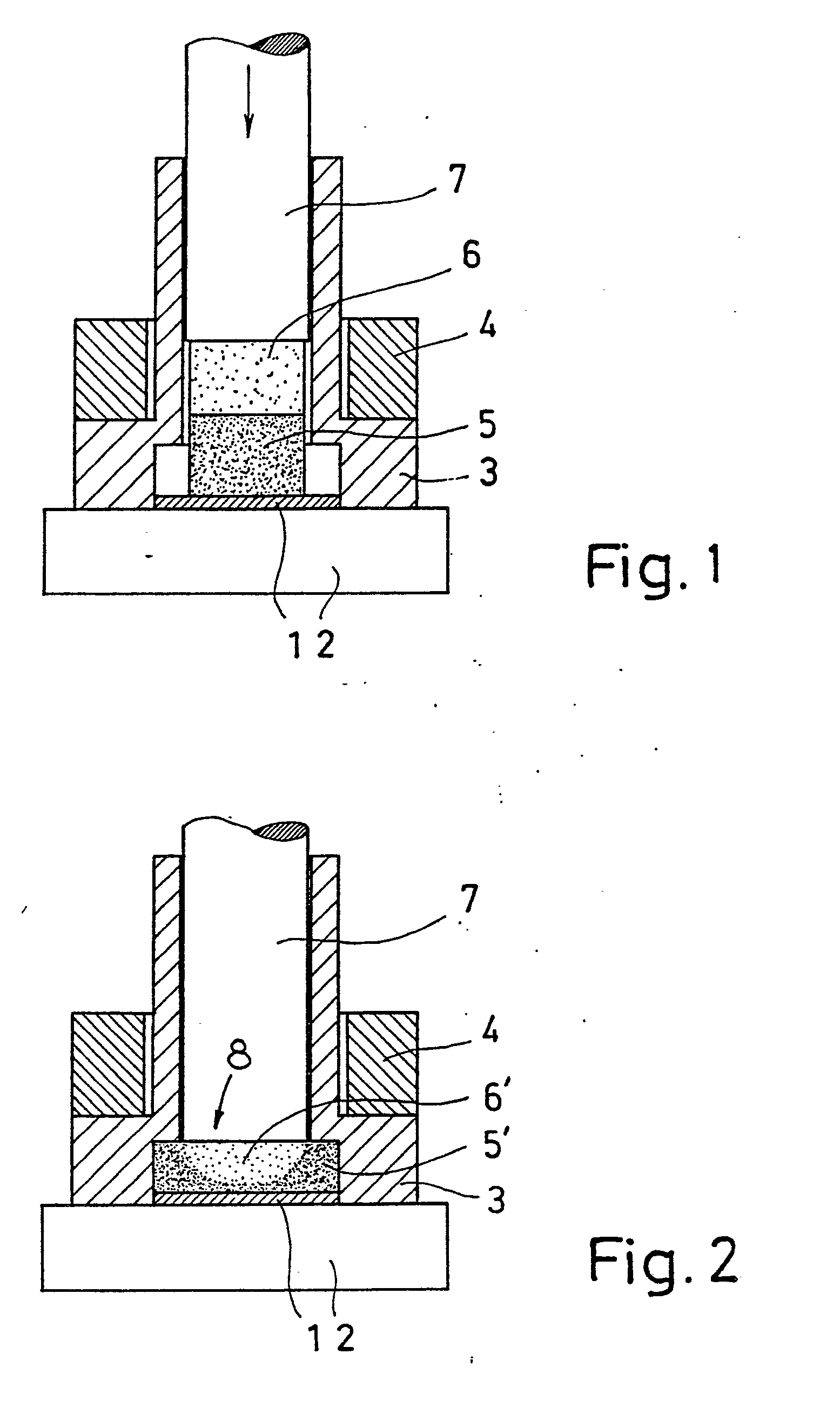
[0005] The invention is described in the following with the aid of an example, with reference
to the attached drawing, wherein,
FIG. 1 presents the brake block before the final pressing, with the press presented
in section.
FIG. 2 shows the same as Fig. 1, but afterthe final pressing.
[0006] The body 1 ofthe brake block is placed on the hot plate 2, and upon the body is fitted
the mould 3. The mould 3 has a heater element 4 on its outer circumference. Through
the opening of the mould 3, two pre-pressed friction material pieces 5, 6 are dropped
to lie one on top of the other upon the body 1, namely first a piece 5 pre-pressed
of harder friction material and on top of this, a piece 6 pre-pressed of softer friction
material and having a higher friction coefficient. The friction material pieces 5,
6 are pressed together and fast to the body 1 by the plunger 7. In this connection,
the piece 5 which abuts on the body 1 will spread to the sides, by action of the heat
coming from below, as the piece 6 lying thereupon is pressed straight downwardly from
above into the centre of the piece. Hereby, a brake block 8 is obtained which has
a friction surface 6 with desired friction coefficient and harder margins 5, by which
is prevented the ingress of abrasive foreign bodies into the space between the friction
surface and the brake disk.
[0007] It is obvious to a person skilled in the art that different embodiments of the invention
may vary within the scope of the claims stated below.
1. Procedure for manufacturing a brake block having a body (1) and a friction pad
(8), wherein the friction pad is pressed fast to the body (1) with the aid of heat
effect so that the central region (6) ofthe friction pad will be softer than the margins
(5) of the friction pad, and wherein the friction pad is pressed in such a manner
that on the body (1) are placed two friction material courses (5, 6) of different
hardness material, the harder friction material against the body and the softer friction
material thereon, whereafter the materials are pressed together and at the same time
pressed fast to the body so that the harder friction material is freely allowed to
flow into a widening in the lower part of the press.
2. Procedure according to claim 1, characterized in that the different friction material
courses (5, 6) are pre-pressed to become two coherent pieces, before they are placed
one on top of the other upon the body (1) for the final pressing operation.
1. Verfahren zur Herstellung eines Bremsklotzes, bestehend aus einem Grundkörper (1)
und einem Reibbelag (8), wobei der Reibbelag dauerhaft an den Grundkörper (1) unter
Zuhilfenahme von Reaktionswärme gepreßtwird, so daß der mittlere Teil (6') des Reibbelages
weicher als die Randzone (5') sein wird, und wobei der Reibbelag in einer solchen
Weise zusammengedrückt wird, daß auf dem Grundkörper (1) zwei Reibungsmaterialschichten
(5, 6) unterschiedlicher Härte angeordnet werden, das härtere Reibungsmaterial direkt
auf dem Grundkörper und das weichere Reibungsmaterial darüber, wonach die Reibungsmaterialien
zusammen und gleichzeitig dauerhaft an den Grundkörper gepreßt werden, so daß das
härtere Reibmaterial frei in eine Erweiterung im unteren Teil der Presse fließen kann.
2. Verfahren nach Anspruch 1, dadurch gekennzeichnet, daß die verschiedenen Reibmaterialschichten
(5, 6) vorgepreßt werden, um zwei zusammenhängende Stücke zu erhalten, bevor diese
übereinander auf den Grundkörper (1) für den endgültigen Preßvorgang gelegt werden.
1. Procédé de fabrication d'une garniture ou bloc de freinage comportant un support
ou corps (1) et une plaquette ou patin de friction (8), dans lequel la plaquette de
friction est pressée et fixée au support (1) à l'aide d'un effet thermique de telle
façon que la zone centrale (6') de la plaquette de friction soit plus tendre que les
bords (5') de la plaquette de friction, et dans lequel la plaquette de friction est
pressée de telle façon que deux couches de matériaux de friction (5, 6) en matériaux
de duretés différentes viennent se placer sur le support, le matériau de friction
le plus dur venant porter sur le support et le matériau de friction le plus tendre
au-dessus, les matériaux étant pressés ensemble et en même temps pour être fixés sur
le support, de telle façon que le matériau de friction le plus dur puisse librement
s'écouler dans un élargissement à la partie inférieure du pressage.
2. Procédé selon la revendication 1, caractérisé en ce que les couches des différents
matériaux de friction (5, 6) sont pressées préalablement pour former deux blocs ou
pièces cohérents avant d'être placées l'une au-dessus de l'autre sur le support (1)
pour l'opération de pressage final.