|
(11) | EP 0 099 622 A1 |

| (12) | EUROPEAN PATENT APPLICATION |
|
|
|
|
|||||||||||||||||||||||||||
| (54) | Process for the hydrogenation of perhalogenated terephthalonitriles to amines, 2,3,5,6-tetrafluoroxylylene diamine and salts thereof |
| (57) A process for the hydrogenation of perhalogenated terephthalonitriles to their corresponding
amines under acid conditions. The process is suitably conducted under a pressure of
1 to 100 atmospheres and at a temperature of from 0 to 200°C in the presence of (i)
a hydrogenation catalyst containing 0.1 to 70% by weight of a metal in Group 8 of
the Periodic Table, (ii) an inorganic acid in an amount at least chemically equivalent
to the amine formed and (iii) a solvent which is inert to the reaction ingredients
and which does not poison the catalyst; the concentration of nitrile in the total
reaction mixture being from 3 to 25% by weight. Preferably water is present in such
amount that the proportion of water to solvent is from 1:50 to 1:1 parts by weight.
The diamines obtained by this process are useful intermediates in the preparation
of pesticidal compounds. 2,3,5,6-Tetrafluoroxylylene diamine and its salts are novel
compounds. |
[0001] This invention relates to a process for hydrogenating perhalogenated terephthalonitriles and to novel compounds which can be obtained therefrom.
[0002] Processes for the hydrogenation of terephthalonitrile have been numerously described and as seen from, for example, UK Patent Specifications Nos.810530, 852972 and 1149251, the hydrogenation is normally carried out under ammoniacal conditions.
[0003] Such conditions are not altogether suitable, however, for the hydrogenation of certain halo-substituted terephthalonitriles. For instance, in the case of tetrafluoroterephthalonitrile a high molecular weight material is produced thought to be the result of nucleophilic substitution of ring fluorine atoms by an amine group of the bifunctional hydrogenation product.
[0004] According to the present invention there is provided a process for hydrogenating a perhalogenated terephthalonitrile of the formula (I):
in which each X is independently fluoro or chloro, to its corresponding amine of formula (II):
which comprises reacting the terephthalonitrile with hydrogen in the presence of a hydrogenation catalyst under acid conditions.
[0005] The diamines obtained by this process are useful intermediates in the preparation of pesticidal compounds. 2,3,5,6-Tetrafluoroxylylene diamine and salts thereof are novel compounds and form another aspect of the present invention.
[0006] Any suitable hydrogenation catalyst may be used. Generally, it will be a metal, particularly a metal in Group 8 of the Periodic Table, and will normally include rhodium, palladium, ruthenium, nickel, cobalt, platinum or copper as a component. The metal will usually be present upon a support such as carbon, alumina, alumina-silica, silica, kiesulguhr, calcium carbonate, barium sulfate or bentonite. The active metal will usually be present in a proportion of from about 0.1 to 70% by weight, and, in the case of noble metals, generally 1 to 20%. A preferred catalyst is palladium preferably supported on charcoal and especially 5X palladium on charcoal. Nickel and cobalt catalysts, which tend to dissolve in acid conditions, may be less suitable.
[0007] The proportions of catalyst to nitrile may be wide-ranging. However, an amount of 0.5 to 5% by weight on nitrile has been found adequate for a catalyst containing a Group 8 noble metal.
[0008] The acid used to create the acid conditions is suitably an inorganic acid, particularly an oxyacid and ideally sulphuric acid, although other strong acids, such as hydrochloric acid, may also be suitable. At least an amount of acid chemically equivalent to the amine formed, should be used and preferably an excess up to, for instance, five times the chemically equivalent amount.
[0009] It may be prudent to add the acid continuously or intermittently during the process in case too high an acid concentration at the start of reaction, particularly when working at high nitrile concentrations, should have a deleterious effect on product yield.
[0010] It is expedient to slurry the barely soluble nitrile, together with all or part of the acid, in a solvent, preferably with waxer added. The solvent should be one that is inert to the reaction ingredients and does not poison the catalyst. Its choice will be influenced by operational considerations, the solubility in it of the reactant and intermediate and final products and obviously its effect on yield. Particularly suitable solvents are alcohols, especially aliphatic monohydric alcohols of the formula ROH, in which R is Cl-6 alkyl, and more especially methanol and ethanol. The presence of water gives processing advantages with respect to yield and an ability to operate at lower temperatures and pressures.
[0011] For ease of operation, it is desirable to have sufficient solvent and/or water present to provide a stirrable nitrile slurry. Suitably, the concentration of nitrile in the total reaction mixture will be from 3 to 15% by weight and even up to 25% by weight, particularly if the acid is added continuously or intermittently during the process. The proportion of water to solvent is usefully in the range of from 1:50 to 1:1 parts by weight.
[0012] The pressure and temperature of hydrogenation may vary within wide limits and will be chosen to suit the hydrogenation equipment available and to avoid too slow a reaction. Suitably pressures of from 1 to 100 or more atmospheres, conveniently from 1 to 30 atmospheres may be used at temperatures ranging from, for example, 0°C to 200°C and typically from 10°C to 120°C. Care must be exercised in working at higher temperatures to avoid dehalogenation of the product. For instance, prolonged processing at 150°C can lead to defluorination of tetrafluoroxylylene diamine.
[0013] In carrying out the process of the invention, the nitrile starting material is conveniently charged to a glass lined or stainless steel rotary or stirred autoclave and slurried with all or part of the acid in the solvent and water. The autoclave is pressurised to the desired extent with hydrogen and rotated or stirred at the desired temperature until sufficient hydrogen has been absorbed.
[0014] The amine hydrogenation product is obtained as a salt which, in the solid phase, may be recrystallised from a water/solvent mixture and isolated by conventional techniques. The amine may be obtained in its pure form by solvent extraction techniques from a strongly alkaline solution of its salt.
[0015] Tetrachloroterephthalonitrile may be obtained from commercially available tetrachloroterephthaloyl chloride by treatment' of the latter with aqueous ammonia to form the diamine which can then be dehydrated with, for example, phosphorus oxychloride. Other starting materials may be obtained by replacement with fluoro of one or more of the chloro substituents of the tetrachloroterephthalonitrile. Thus, tetrafluoroterephthalonitrile may be obtained by fluorinating the corresponding tetrachlorinated compound with potassium fluoride in a polar aprotic solvent.
[0016] The invention is illustrated by the following Examples 1 to 30 in which percentages are by weight. Percentage yields of diamine are molar; yields of byproducts are computed from GLC traces assuming the same molar response factors as for the diamine. In all Examples, save Example 7 (q.v.), conversion of the dinitrile starting material was 100%. Example 31 is included for comparative purposes only.
Example 1
[0017] Tetrafluoroterephthalonitrile (5.0 g), methanol (70 ml), water (2 ml), 98% sulphuric acid (3 g) and 5% palladium on carbon catalyst (0.25 g) were loaded into the glass liner of a rotating autoclave, purged with nitrogen, and then pressurised with hydrogen to 15 atmospheres. The autoclave was rotated for 6 hours at 75°C. The resulting slurry was filtered and the residue slurried with water. The aqueous solution was filtered to remove catalyst, then the water removed by heat until a crust formed on the liquid surface. 74 OP Ethanol was added to give 5.06 g of a white solid precipitate. This was dissolved in 5N sodium hydroxide and extracted repeatedly with ether. The residue after evaporation of the ether was recrystallised from toluene to give pure 2,3,5,6-tetrafluoroxylylene diamine (m.pt.89°C).
[0019] Proton nmr 2.09b and 3.78δ, consistent with (2p, s, -NH2) and (2p, s, Ar-CH2-N) respectively.
Elemental analysis
Example 2
[0022] Tetrafluoroterephthalonitrile (5 g), methanol (70 ml), water (10 ml), 98X sulphuric acid (3.5 g) and 5% palladium on carbon catalyst (0.25 g) were loaded into the glass liner of a rotating autoclave, purged with nitrogen, then pressurised with hydrogen to 30 atmospheres. The autoclave was rotated for 5 hours, during which time the temperature rose from 15°C to 18°C, and the pressure declined to 28 atmospheres. A slurry of catalyst and solid 2,3,5,6-tetrafluoroxylylene diamine sulphate was filtered. The methanol was removed from the filtrate by reduced pressure distillation, and the aqueous residue, together with additional water, used to completely dissolve the separated solid sulphate product. 5 ml. of this aqueous solution was added to 25 ml ION sodium hydroxide solution, and extracted with four 10 ml aliquots of diethyl ether. GLC analysis of the combined aliquots showed the yield of 2,3,5,6-tetrafluoroxylylene diamine to be 94.0% with 0.3% 4-cyano-2,3,5-tetrafluorobenzylamine, and no 4-aminomethyl-2,3,5-tetrafluoro- benzylalcohol or 2,3,5,6-tetrafluorobenzylamine.
Examples 3 to 6
[0023] Further tetrafluoroterephthalonitrile reductions were carried out according to Example 2, but with the autoclave charges and reaction conditions summarised in Table I. It is to be noted that the higher pressure used favoured higher diamine yields.
Example 8
[0024] Tetrafluoroterephthalonitrile (30 g), methanol (420 ml), water (90 ml), 98% sulphuric acid (21 g) and 5X palladium on carbon catalyst (1.5 g) were loaded to a 1 litre 316 stainless steel autoclave, fitted with a glandless agitator and gas recirculation facility. The autoclave was purged with nitrogen, and the contents maintained under 30 atmospheres of hydrogen pressure while agitation was continued for 6 hours. During this time the temperature rose from 20°C to 28°C. The product slurry was treated and analysed as in Example 2. The yield of 2,3,5,6-tetrafluoroxylylene diamine was 91X, with 0.3% of 2,3,5,6-tetrafluorobenzylamine.
Examples 9 to 13
[0025] Further tetrafluoroterephthalonitrile reductions were carried out according to Example 8, but with the autoclave charges and reaction conditions summarised in Table II. Again, the higher pressures gave superior diamine yields.
Example 14
[0026] Tetrafluoroterephthalonitrile (5 g), methanol (70 ml), 98% sulphuric acid (3.5 g) and 5% palladium on carbon catalyst (0.125 g) were vigorously agitated under hydrogen at atmc pheric pressure for 4.25 hours at 20°C. The resulting slurry was filtered, water added to the filtrate and the methanol removed by reduced pressure distillation. The sulphates in the residue from the hydrogenation were dissolved in the resulting aqueous solution. The products of the hydrogenation were assessed by the procedure described in Example 2. Yields were 27.4% 2,3,5,6-tetrafluoroxylylenediamine, 7.6% 4-cyano-2,3,5,6-tetrafluorobenzylamine and 9.2% 2,3,5,6-tetrafluorobenzylamine.
Examples 15 to 25
[0027] Further tetrafluoroterephthalonitrile hydrogenations were carried out according to Example 14, but with varying catalyst and acid additions, and in some Examples, water addition. Results are described in Table III. Water is seen to enhance markedly the diamine yield.
Examples 26, 27 and 28
[0028] Tetrafluoroterephthalonitrile (2.5 g), methanol (70 ml) and 5% palladium on carbon catalyst (0.125 g) were loaded to the glass liner of a rotating autoclave, together with 98% st phuric acid and water in the amounts indicated in Table IV. After purging with nitrogen, the autoclave was pressurised to 10 atmospheres with hydrogen, rotated and heated for the time shown in Table IV. The product suspension was filtered, and the residue and filtrate quantitatively analysed for 2,3,5,6-tetrafluoroxylylene diamine by high pressure liquid chromatography.
[0029] If Examples 26 and 27 were carried out at 75°C, it could be expected that the UV spectrum of the solution phase would indicate the presence of 4-cyano-2,3,5,6-tetrafluorobenzylamine (λmax = 234 nm in 0.5N HC1).
[0030] Examples 26 to 28 illustrate the beneficial effect of water and the better yield obtained when using a higher acid:nitrile molar ratio.
Example 29
[0031] Tetrafluoroterephthalonitrile (10 g), 74 OP ethanol (70 ml), water (5 ml), 98X sulphuric acid (5.4 g) and 5% palladium on charcoal catalyst (0.5 g) were charged to the glass li .er of a rotating autoclave and pressurised to 15 atmospheres with hydrogen. The autoclave was rotated at 60°C for 6 hours. The resulting slurry was filtered; high pressure liquid chromatography showed the 2,3,5,6-tetrafluoroxylylene diamine yield to be 72.2% and all in the solid residue.
Example 30
[0032] Tetrafluoroterephthalonitrile (2.5 g) 5X palladium on charcoal catalyst (0.125 g), sulphuric acid (6.4 g) and methanol (70 ml) were charged to a glass lined rotary autoclave. The autoclave was pressurised to 50 atmospheres with hydrogen, and rotated for 4 hours at 110°C. The resulting slurry was cooled, filtered and the solid phase recrystallised from a mixture of water and methanol. Elemental analysis, fluorine nmr, proton nmr, infra red and mass spectra (the latter after the sample was heated with sodium bicarbonate), were consistent with the recrystallised material being tetrafluoroxylylene diamine sulphate.
[0033] The material gave a single peak on a high pressure liquid chromatogram, when using a mixed ion pair/electrolyte elution system.
Example 31
[0035] Tetrafluoroterephthalonitrile (2.5 g), nickel catalyst (Harshaw 5132P) (0.8 g), methanol (70 ml) and ammonia (12 g) were charged to a glass lined rotating autoclave. After pressurising to 30 atmospheres with hydrogen, the autoclave was rotated at 110°C for 3 hours. After cooling, filtering off the catalyst, and removing residual ammonia and methanol by distillation, a brown solid remained. Infra red spectroscopy indicated this to be a high molecular weight material, with some loss of ring fluorine, and the presence of an amine hydrohalide.
1. A process for hydrogenating a perhalogenated terephthalonitrile of the formula
(I):

in which each X is independently fluoro or chloro, to its corresponding amine of formula (II):

which comprises reaction the terephthalonitrile with hydrogen in the presence of a hydrogenation catalyst under acid conditions.
in which each X is independently fluoro or chloro, to its corresponding amine of formula (II):
which comprises reaction the terephthalonitrile with hydrogen in the presence of a hydrogenation catalyst under acid conditions.
2. A process according to claim 1 for hydrogenating tetrafluoroterephthalonitrile
to form 2,3,5,6-tetrafluoroxylylene diamine.
3. A process for hydrogenating a perhalogenated terephthalonitrile of the formula
(I):
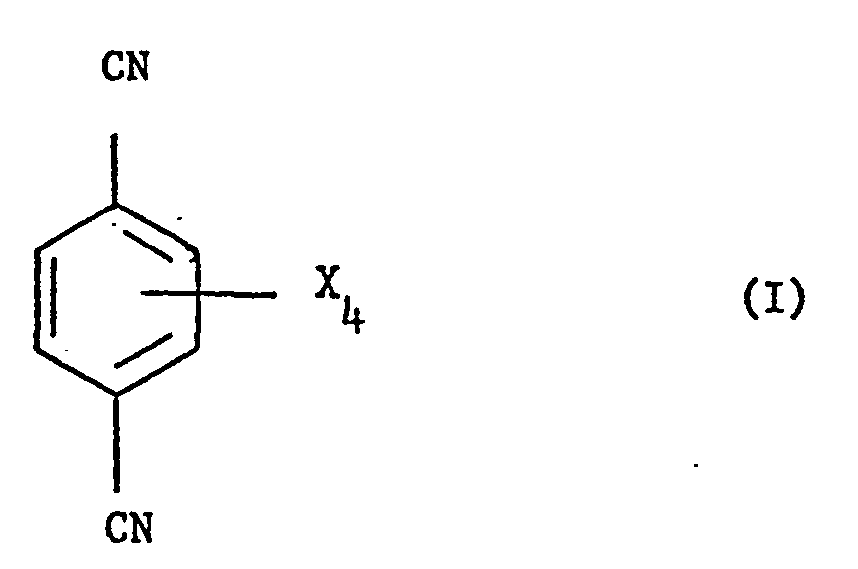
in which each X is independently fluoro or chloro, to its corresponding amine of formula (II):

which comprises reacting the terephthalonitrile with hydrogen under a pressure of 1 to 100 atmospheres and at a temperature of from 0 to 200°C in the presence of (i) a hydrogenation catalyst containing 0.1 to 70% by weight of a metal in Group 8 of the Periodic Table, (ii) an inorganic acid in an amount at least chemically equivalent to the amine formed and (iii) a solvent which is inert to the reaction ingredients and which does not poison the catalyst; the concentration of nitrile in the total reaction mixture being from 3 to 25% by weight.
in which each X is independently fluoro or chloro, to its corresponding amine of formula (II):
which comprises reacting the terephthalonitrile with hydrogen under a pressure of 1 to 100 atmospheres and at a temperature of from 0 to 200°C in the presence of (i) a hydrogenation catalyst containing 0.1 to 70% by weight of a metal in Group 8 of the Periodic Table, (ii) an inorganic acid in an amount at least chemically equivalent to the amine formed and (iii) a solvent which is inert to the reaction ingredients and which does not poison the catalyst; the concentration of nitrile in the total reaction mixture being from 3 to 25% by weight.
4. A process according to claim 3 in which water is present in such amount that the
proportion of water to solvent is from 1:50 to 1:1 parts by weight.
5. A process according to claim 3 or 4 in which the catalyst contains from 1 to 20X
by weight of a metal selected from rhodium, palladium, ruthenium and-platinum.
6. A process according to any one of claims 3 to 5 in which the solvent is an alcohol.
7. A process according to any one of claims 3 to 6 in which the pressure is from 1
to 30 atmospheres.
8. A process according to any one of claims 3 to 7 in which the temperature is from
10 to 120°C.
9. A process for hydrogenating tetrafluoroterephthalonitrile to form 2,3,5,6-tetrafluoroxylylene
diamine, which comprises reacting the nitrile with hydrogen under a pressure of from
1 to 30 atmospheres and at a temperature of from 10 to 120°C in the presence of (i)
0.5 to 5.0% by weight on the nitrile of a hydrogenation catalyst, which contains from
1 to 20% by weight of a metal selected from rhodium, palladium, ruthenium and platinum,
(ii) sulphuric acid in an amount at least chemically equivalent to the amine formed
and up to five times the chemically equivalent amount, (iii) an alcohol and (iv) water;
the proportion of water to alcohol being from 1:50 to 1:1 parts by weight and the
concentration of nitrile in the total reaction mixture being from 3 to 15Z by weight.
10. 2,3,5,6-Tetrafluoroxylylene diamine and salts thereof.