|
(11) | EP 0 099 988 A1 |

| (12) | EUROPEAN PATENT APPLICATION |
|
|
|
|
|||||||||||||||||||||||||||
| (54) | New hydroxybenzenesulfonic acid salts of 5-(0-chlorobenzyl)-4,5,6,7-tetrahydrothieno (3,2,c) pyridine |
| (57) The invention relates to new hydroxybenzenesulfonic acid salts of 5-(o-chlorobenzyl)-4,5,6,7-tetrahydrothieno
[3,2-c] pyridine, to the preparation method thereof and to the pharmaceutical compositions
containing them. The new hydroxybenzenesulfonic acid salts of 5-(o-chlorobenzyl)-4,5,6,7-tetrahydrothieno [3,2-c] pyridine are endowed with platelet aggregation inhibiting activity, with angioprotective activity and with normalizing activity of the blood lipids balance. |
[0001] This invention relates to new hydroxybenzenesulfonic acid salts of 5-(o-chlorobenzyl)-4,5,6,7-tetrahydrothieno [3,2-c] pyridine, to the method for the preparation thereof and to the pharmaceuti= cal compositions containing them.
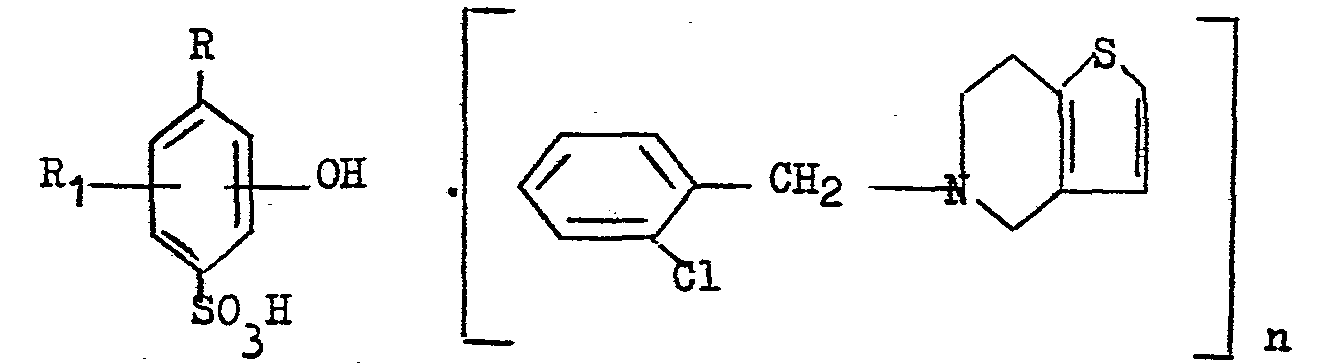
[0002] The new compounds of the present invention are endowed with plate let aggregation inhibiting activity, with angioprotective activi= ty and with normalizing activity of the blood lipids balance. The compounds of this invention may be represented by the general formula (I)
wherein R is H or OH or SO3H; R1 is H or OH, provided that when R= OH, R1 is always H; n is 1 or 2.
[0003] 5-(o-chlorobenzyl)-4,5,6,7-tetrahydrothieno [3,2-c] pyridine (which hereinbelow will be indicated for brevity as ticlopidine) is, as known, a platelet aggregation inhibitor; its mechanism of action consists in an overproduction, at the platelet level, of cAMP, of anti-thrombotic prostaglandins (PGE and PGE2) and prosta cyclins (PGI2). Furthermore, ticlopidine inhibits fibronectine with subsequent antagonism of platelet aggregation and adhesive= ness. A further property of ticlopidine is its action on erythro cytes with subsequent decrease of the viscous properties of red cells.
[0004] The angioprotective activity of some hydroxybenzene sulfonic acids is well known. These acids act selectively on the arterio-venous capillaries thus normalizing their resistance and permeability; mo reover, they are endowed with anti-haemorragic and anti-exudation activity. For these drugs a normalizing activity in the essen= tial dislipidaemia has been proven.
[0005] The Applicant has now found that by salifying ticlopidine with so= me hydroxybenzenesulfonic acids, there are obtained compounds show ing a more complete therapeutical activity, a toxicity lower than that of the starting compounds and a poorer induction of side-ef= fects. Moreover, the therapeutic activity is longer acting becau se of the slow release of the single components after the adminis= tration.
[0006] The amount of the drug able to induce a significative platelet ag= gregation inhibition, as shown by preliminary tests on rats is low er than the amount of ticlopidine necessary to reach an equally in tense effect. This fact results in a remarkable reduction of the undesired effects and expecially results in a reduction of the bleeding time.
[0007] The compounds of this invention have been teste.d in order to cha= racterize them from the pharmacological point of view.
[0008] In particular, and only as example, the Applicant will refer the results when using the salt obtained by salifying 2,5-dihydroxyben zenesulfonic acid with ticlopidine ( the salification product will be indicated hereinbelow for brevity as C-1).
EFFECTS ON THE ADP INDUCED PLATELET AGGREGATION
SINGLE ADMINISTRATION OF THE DRUGS
[0009] The results obtained after single administration of C-1 or of ti= clopidine-HCl, expressed as effect on the ADP induced platelet ag= gregation, in vitro, are summarized in the following Table 1. The effect of both drugs is apparent for all the used doses: Dunnet's test is always significative.
REPEATED ADMINISTRATION OF THE DRUGS
[0011] The results obtained after repeated administration of C-1 or of ti clopidine-HCl expressed as effect on the ADP induced platelet ag= gregation in vitro are summarized in Table 2. The effect of both drugs is apparent for all the doses used in the test: Dunnet's test is always higly significative.
[0012] For equal doses of ticlopidine-HCl and of C-1, the anti-aggrega = tion activity of C-1 is significatively higher than that of ticlo= pidine-HCl, the power ratio being 4.91 and the pertinent confiden= ce limits ( at 95%) being 2.96 and 11.18.
from controls (Dunnet's test).
EFFECT ON THE COLLAGEN INDUCED PLATELET AGGREGATION
[0013] Compound C-1 causes an inhibition significatively higher than that caused by equal doses of ticlopidine-HCl when tested by the method of the collagen induced platelet aggregation. The results are sum marized in Table 3.
PROTECTIVE EFFECT ON THE INDUCED PULMONARY THROMBOSIS
[0014] 3 biological tests have been carried out in order to evaluate the doses of C-1 and ticlopidine-HCl necessary to protect from pulmo= nary thrombosis 50% of Wistar rats (PD50) treated with ADP ( 400 mg/kg i.v.; after administration of the drugs) and with collagen (0.1 ml/10 mg i.v.; 1 h and 3 hours after the administration of the drugs). (Tables 4, 5 and 6).
Tables 4 and 5 indicate that for those tests the PD50 are about equivalent for C-1 and ticlopidine-HCl.
[0015] 0n the contrary, Table 6 shows that C-1 resulted significatively more active in protecting the animals treated from collagen indu= ced pulmonary thnombosis, the power ratio being 1.6
[0016] LD50 of 0-1 both in rat and in mouse, after administration of the drug by oral route, is higher than 3,000 mg/kg.
[0017] In order to test subacute toxicity of C-1, Wistar rats were admin= istered daily p.o., for 6 weeks, with the following doses of C-1: 107.5 mg/kg/day ; 215.0 mg/kg/day ; 430.0 mg/kg/day Hematochemical, hematological and histopathological tests carried out at the end of the treatment did not show any damage caused by the treatment, which did not provoke any mortality.
[0018] The preparation of the compounds of this invention is carried out by allowing a ticlopidine salt to react with an alkaline or earth-alkaline salt of the selected hydroxybenzenesulfonic acid, in a solvent, in equimolar ratio.
[0019] The hydroxybenzenesulfonic acids to be used in this invention can be selected from the group comprising 2,5-dihydroxybenzenesulfonic acid and 2,5-dihydroxybenzene-1,4-disulfonic acid.
[0020] The solvents can be selected from lower aliphatic alcohols, such as for instance methanol, ethanol, propanol; ketones or mixtures thereof.
[0021] This invention relates also to the pharmaceutical compositions con taining as active ingredient one of the compounds comprised in the general formula (I).
[0022] The pharmaceutical compositions may contain the active ingredient together with organic er inorganic, liquid or solid pharmaceutical ly acceptable carriers and may be suitable for oral and topic admi nistration.
[0023] The pharmaceutical preparations may be solid, such as tablets, cap sules, granulates, suppositories, or liquid such as syrups.
[0025] The following examples are given to illustrate the present inven = tion without limiting it in any way.
Example 1
[0026] The solution of 6.75 g of the calcium salt of 2,5-dihydroxybenzene sulfonic acid in 12 ml of water is added dropwise into a stirred solution of 9.39 g of ticlopidine sulfate in 120 ml of anhydrous ethyl alcohol, by keeping the whole at room temperature.
[0027] After having added further 120 ml of anhydrous ethyl alcohol, the mixture is stirred for 1 h, and then is filtered and washed seve = ral times with anhydrous ethyl alcohol.
[0028] The filtered solution is concentrated under vacuum in a rotating evaporator up to about 50 ml and thereafter it is again diluted with anhydrous ethyl alcohol and concentrated to 50 ml.
[0029] After crystallization on ice, the obtained crystalline product is filtered, washed twice with anhydrous ethyl alcohol and finally is dried under vacuum at 40-45°C.
[0030] 9.5 g of 2,5-dihydroxybenzenesulfonic acid salt of 5-(o-chloroben= zyl)-4,5,6,7-5354ahydrothieno [3,2-c] pyridine are obtained. m.p. 164-167 °C.
Example 2
[0032] The solution of 3.47 g of the potassium salt of 2,5-dihydroxybenze ne-1,4-disulfonic acid in 3 ml of water is added dropwise, at room temperature, into a stirred solution of 6.25 g of ticlopidine sul= fate in 100 ml of anhydrous ethyl alcohol.
1. New hydroxybenzenesulfonic acid salts of 5-(o-chlorobenzyl) - 4,5,6,7-tetrahydrothieno
[3,2-c] pyridine endowed with platelet aggregation inhibiting activity, with angioprotective
activity and with normalizing activity of the blood lipids balance, of the gene= ral
formula (I)
wherein R is H or OH or SO3 H; R1 is H or OH, provided that when R = OH, R1 is always H; n is 1 or 2.
wherein R is H or OH or SO3 H; R1 is H or OH, provided that when R = OH, R1 is always H; n is 1 or 2.
2. 2,5 Dihydroxybenzenesulfonic acid salt of 5-(o-chlorobenzyl)-4,5,6,7-tetrahydrothieno
[3,2-c]pyridine.
3. 2,5-Dihydroxybenzene-1,4-disulfonic acid salt of 5-(o-chloro= benzyl)-4,5,6,7-
tetrahydrothieno [3,2-c] pyridine.
4. Process for the preparation of hydroxybenzenesulfonic acid salts of 5-(o-chlorobenzyl)-4,5,6,7-tetrahydrothieno
[3,2-c] py= ridine of the general formula (I)
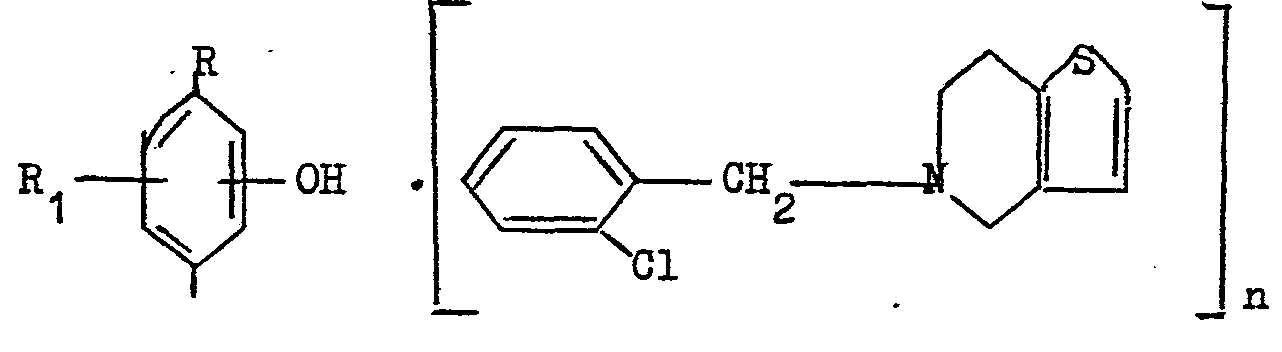
whereinR is H or OH or SO3H; R1 is H or OH, provided that when R = OH, R1 is always H; n is 1 or 2, characterized in that a salt of 5-(o-chlorobenzyl)-4,5,6,7-tetrahydrothieno [3,2-c] pyridine is allowed to react with an alkaline or earth-alkaline salt of a hy= droxybenzenesulfonic acid, in a solvent, in equimolar ratio.
whereinR is H or OH or SO3H; R1 is H or OH, provided that when R = OH, R1 is always H; n is 1 or 2, characterized in that a salt of 5-(o-chlorobenzyl)-4,5,6,7-tetrahydrothieno [3,2-c] pyridine is allowed to react with an alkaline or earth-alkaline salt of a hy= droxybenzenesulfonic acid, in a solvent, in equimolar ratio.
5. Pharmaceutical compositions containing as active ingredient o ne compound of the
general formula (I)
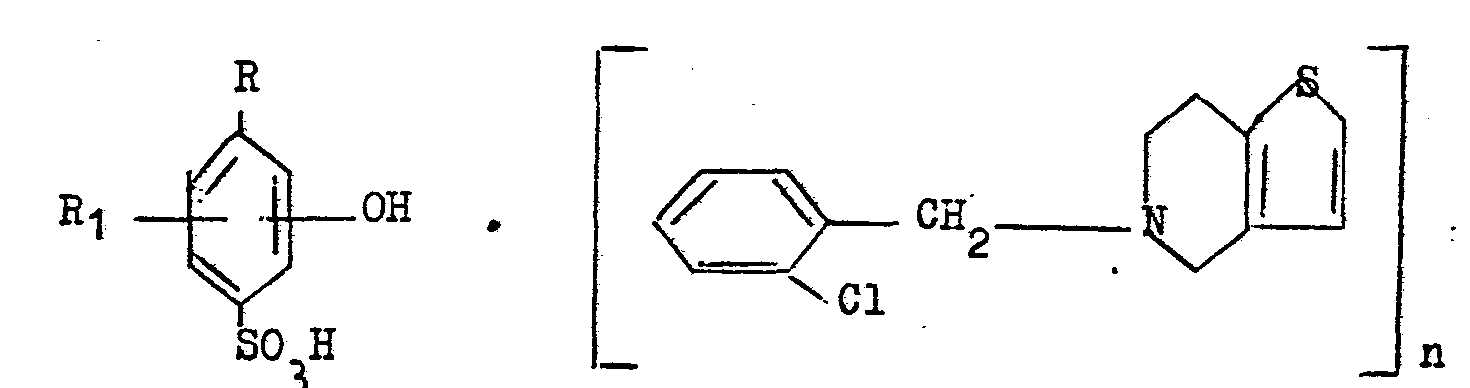
(wherein R is H or OH or S03H; R1 is H or OH, provided that when R=OH, R1 is always H; n is 1 or 2 ) together with one or more phar maceutically acceptable carriers and / or excipients.
(wherein R is H or OH or S03H; R1 is H or OH, provided that when R=OH, R1 is always H; n is 1 or 2 ) together with one or more phar maceutically acceptable carriers and / or excipients.