| (19) |
 |
|
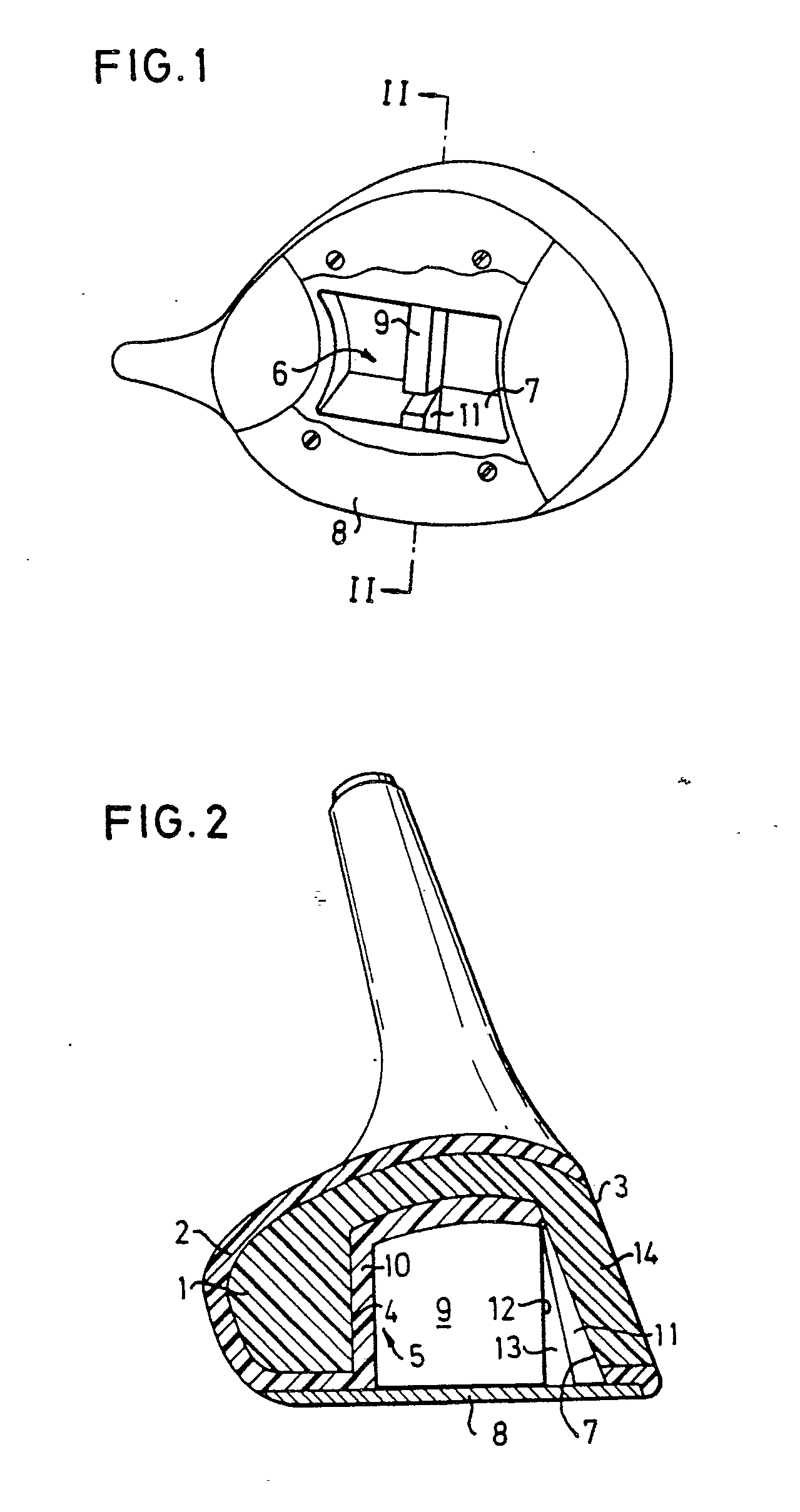
(11) |
EP 0 101 426 B1 |
| (12) |
EUROPEAN PATENT SPECIFICATION |
| (45) |
Mention of the grant of the patent: |
|
17.09.1986 Bulletin 1986/38 |
| (22) |
Date of filing: 15.08.1983 |
|
| (51) |
International Patent Classification (IPC)4: A63B 53/04 |
|
| (54) |
Golf club head
Golfschlägerkopf
Tête de club de golf
|
| (84) |
Designated Contracting States: |
|
BE DE FR GB IT |
| (30) |
Priority: |
16.08.1982 SE 8204717
|
| (43) |
Date of publication of application: |
|
22.02.1984 Bulletin 1984/08 |
| (71) |
Applicants: |
|
- Wätterbäck, Paul Gunnar
S-640 24 Sköldinge (SE)
- Lundin, Bengt
S-131 50 Saltsjö-Duvnäs (SE)
|
|
| (72) |
Inventor: |
|
- Wätterbäck, Paul Gunnar
S-640 24 Sköldinge (SE)
|
| (74) |
Representative: Winblad, Hans Peter et al |
|
H. Albihns Patentbyra AB,
P.O. Box 3137
103 62 Stockholm
103 62 Stockholm (SE) |
|
| |
|
| Note: Within nine months from the publication of the mention of the grant of the European
patent, any person may give notice to the European Patent Office of opposition to
the European patent
granted. Notice of opposition shall be filed in a written reasoned statement. It shall
not be deemed to
have been filed until the opposition fee has been paid. (Art. 99(1) European Patent
Convention).
|
[0001] The present invention relates to a golf club head and more particularly relates to
an improvement of the golf club head revealed in Swedish Patent Application 8101069-6.
Said head comprises a core body of a first plastics material and a housing tightly
surrounding the core body, said housing having a lateral opening which defines a free
striking surface on the core body, said core body having an exterior shape and dimensions
essentially corresponding to the exterior shape and dimensions of the finished club
head and said housing having the shape of a relatively thin-walled shell of at least
one other plastics material which has a higher modulus of elasticity than the first
plastics material and which surrounds the core body while exerting an initial stress
thereon, said core body having a cavity, the walls of which are at least partially
covered by a shell portion made in one piece with the shell, said shell portion defining
an interior chamber the bottom of which is covered by a sole plate.
[0002] One problem in the known club head is that cracks or ruptures can occur in the wall
of the core body which forms the striking surface of the head due to excessive deformation
of the wall when the golf ball is struck extremely hard. In order to eliminate this
problem, a further development according to the invention suggests that a bracing
wall be arranged which extends transversely to the striking surface from the rear
wall, as viewed in the direction of swing, of the chamber towards the forward wall
of the chamber and in that a heel-like projection is arranged on the forward wall
of the chamber directly in front of the end surface of the bracing wall, whereby the
facing end surfaces of the bracing wall and the heel define an pwardly narrowing slot.
Thus, when the striking wall is deformed by a powerful impact, the end surface of
the heel will come into contact against the end surface of the bracing wall. The harder
the impact is, the greater will be the effective area of contact between the heel
and the bracing wall. This provides a controlled deformation of the impact wall at
the same time as the shock wave generated when the wall is struck by the club head
will return to the striking surface via the bracing wall and the heel imparting an
extra acceleration force to the ball. Furthermore, the wedge-shaped slot between the
end surface of the bracing wall and the heel will result in an asymmetrical deformation
of the impact wall, so that it will yield more towards the bottom of the club head,
whereby the ball will be imparted a back-spin when leaving the club head, which is
desirable for the golfer to obtain an ideal ball path.
[0003] The invention will be described in more detail below with reference to the accompanying
drawing. Fig 1 is a view from below of the golf club head according to the invention
and Fig 2 is a cross-section along the line II-II in Fig 1..
[0004] The embodiment of the golf club head shown comprises a core body 1 which is made
of a suitable plastics material of high modulus of elasticity, e.g. a polyamide plastic,
such as "ZY-TEL"
@. The core body 1 has essentially the same exterior shape as the intended finished
club head, but is proportionally somewhat smaller. The core body 1 is surrounded by
a housing or shell 2 of a suitable plastics material which has a higher modulus of
elasticity than the material in the core body 1, e.g. a carbon fiber reinforced polyamide
plastic, such as nylon, which is, for example, extruded about the core body 1, so
that the shell 2 surrounds and is in tight contact with the outside of the core body
1 except along an essentially flat surface 3 which forms the striking surface of the
club head.
[0005] Furthermore, the core body 1 has an essentially centrally located cavity 4, which
opens towards the bottom of the club head. This cavity 4 is at least partially covered
by a shell portion 5 integral with the shell 2 and defining an inner chamber 6. The
cavity 4 and the shell portion 5 create a rectangular box-shape, as shown in Fig 1,
with the shell portion 5 side 7 adjacent to the striking surface 3 being possibly
completely or partially removed to reveal the core body 1. A sole plate 8 is mounted
on the bottom of the club head covering the chamber 6.
[0006] In accordance with the present invention, a bracing wall 9 serving as an anvil extends
from the rear wall 10, as viewed in the direction of swing, of the chamber 6 towards
the forward wall 7 7 of the chamber. A heel 11 projects backwards from said forward
wall 7 and is directly opposite the end surface 12 of the bracing wall 9 (see Fig
1). The facing end surfaces of the bracing wall 9 and the heel 11 define between them
a slot 13 which narrows upwardly. The heel 11 is designed to limit the movement backwards
of the impact wall 14 when the ball is struck by abutting against the striking surface
12 of the bracing wall. By virtue of the upwardly narrowing shape of the slot 13,
a non-symmetrical deformation of the impact wall 14 is obtained, so that the wall
is pressed in more towards the bottom of the club head, the result being that the
ball will be imparted a force component acting from below giving the ball a back spin
as it leaves the striking surface 3, thus improving its flight path.
Golf club head, comprising a core body (1) of a first plastics material and a housing
(2) tightly surrounding the core body (1) and having a lateral opening which defines
a free striking surface (3) on the core body (1), said core body (1) having an exterior
shape and dimensions essentially corresponding to the exterior shape and dimensions
of the finished club head and said housing (2) having the shape of a relatively thin-walled
shell of at least one other plastics material, which has a higher modulus of elasticity
than the first plastics material and which confines the core body (1) while exerting
an initial stress thereon, said core body (1) having a cavity (4), the walls of which
are at least partially covered by a shell portion (5) integral with the shell, said
shell portion (5) defining an interior chamber (6), the bottom of which is covered
by a sole plate (8), characterized in that a bracing wall (9) oriented transversely
to the striking surface (3) of the core body extends from the rear wall (10), as viewed
in the direction of swing, of the chamber (6) towards the forward wall (7) of the
chamber and that a heel-like projection (11) is arranged on the forward wall (7) of
the chamber directly in front of the end surface (12) of the bracing wall (9), whereby
the facing end surfaces of the bracing wall (9) and the heel (11) define an upwardly
narrowing slot (13).
Golfschlägerkopf mit einem Innenkörper (1) aus einem ersten Kunststoffmaterial und
einem Gehäuse (2), von welchem der Innenkörper (1) dicht umgeben ist und welches eine
seitliche Öffnung aufweist, von welcher eine freie Schlagfläche (3) an dem Innenkörper
(1) begrenzt wird, dessen Außengestalt und Außenabmessungen der Außengestalt bzw.
den Außenabmessungen des fertigen Schlägerkopfes entsprechen, wobei das Gehäuse (2)
die Gestalt eines verhältnismäßig dünnwandigen Mantels aus wenigstens einem anderen
Kunststoffmaterial aufweist, welches einen höheren Elastizitätsmodul als das erste
Kunststoffmaterial hat und welches den Innenkörper (1) diesen vorspannend einschließt,
welcher eine Höhlung (4) aufweist, deren Wände wenigstens teilweise von einem mit
dem Mantel einstückigen Mantelabschnitt (5) abgedeckt werden, welcher eine Innenkammer
(6) begrenzt, deren Boden mit einer Sohlenplatte abgedeckt ist, dadurch gekennzeichnet,
daß eine Versteifungswand (9), die quer zu der Schlagfläche (3) des Innenkörpers ausgerichtet
ist, sich von der in Schlagrichtung hinteren Wand (10) der Kammer (6) zu der vorderen
Wand (7) der Kammer erstreckt und daß ein fersenartiger Vorsprung (11) an der vorderen
Wand (7) der Kammer unmittelbar in Front der Endfläche (12) der Versteifungswand (9)
ausgebildet ist, wobei die einander gegenüberliegenden Endflächen der Versteifungswand
(9) und der Ferse (12) einen nach oben enger werdenden Schlitz (13) bestimmen.
Tête de crosse de golf, comprenant un corps formant noyau (1) en une première matière
plastique et une enveloppe (2) entourant étroitement le corps formant noyau (1) et
ayant une ouverture latérale qui définit une surface libre de frappe (3) sur le corps
formant noyau (1), ce corps formant noyau (1) ayant une forme extérieure et des dimensions
correspondant sensiblement à la forme extérieure et aux dimensions de la tête de crosse
finie et l'enveloppe (2) ayant la forme d'une coquille, à paroi relativement mince,
en au moins une autre matière plastique qui a un module d'élasticité supérieur à la
première matière plastique et qui confine le corps formant noyau (1), tout en exerçant
sur celui-ci une contrainte initiale, le corps formant noyau (1) ayant une cavité
(4) dont les parois sont recou- vertes au moins partiellement par une partie (5) d'un
seul tenant avec la coquille, cette partie (5) de coquille définissant une chambre
intérieure (6) dont le fond est recouvert par une plaque formant semelle (8), caractérisée
en ce qu'une paroi d'entretoisement (9), orientée transversalement à la surface de
frappe (3) du corps formant noyau, s'étend de la paroi arrière (10), telle que vu
dans la dirèction du swing, de la chambre (6) à la paroi antérieure (7) de la chambre
et une partie saillante (11) semblable à un talon est disposée sur la paroi antérieure
(7) de la chambre, directement en face de la surface d'extrémité (12) de la paroi
d'entretoisement (9), les surfaces d'extrémité de la paroi d'entretoisement (9) et
du talon (11), qui se font face, définissant une fente (13) se rétrécissant vers le
haut.