|
(11) | EP 0 102 097 B1 |

| (12) | EUROPEAN PATENT SPECIFICATION |
|
|
| (54) |
Process for oxidising vinylbenzene compounds to beta-phenylaldehydes Verfahren zur Oxydation von Vinylbenzenverbindungen zu beta-Phenylaldehyden Procédé pour l'oxydation de composés du vinylbenzène en bêta-phénylaldéhydes |
|
|
|||||||||||||||||||||||||||||||
| Note: Within nine months from the publication of the mention of the grant of the European patent, any person may give notice to the European Patent Office of opposition to the European patent granted. Notice of opposition shall be filed in a written reasoned statement. It shall not be deemed to have been filed until the opposition fee has been paid. (Art. 99(1) European Patent Convention). |
[0001] This invention relates to a process for oxidising vinylbenzene compounds to β-phenylaldehydes by hydrogen peroxide in the presence of synthetic zeolites containing titanium atoms.
[0002] It is known to obtain β-phenylaldehydes from vinylbenzene oxides in the presence of alumino-silicates, by operating at high temperature. For example, β-phenylacetaldehyde is produced from styrene oxide in the presence of alumino-silicates, the reaction being conducted at a temperature of about 300°C.
[0003] It has now been surprisingly found possible to produce β-phenylaldehydes by using hydrogen peroxide in aqueous solution to oxidise vinylbenzene compounds, employing as catalyst a synthetic zeolite containing titanium atoms, and at the same time attaining considerable economic advantages.
[0004] These economic advantages derive both from the use of a vinylbenzene compound instead of its oxide, which is notably more costly, and from operating at a substantially lower reaction temperature. The subject matter of the present invention is a process for oxidising vinylbenzene compounds of β-phenylaldehydes, consisting of reacting said compounds with an aqueous solution of hydrogen peroxide in the presence of synthetic zeolites containing titanium atoms (titanium silicalites) of the following general formula:
where x lies between 0.0001 and 0.04, and possibly in the presence of one or more solvents.
[0005] The synthetic zeolites used for the oxidation reaction are described in Belgian patent 886,812, of which we repeat some points illustrating the material and relative method of preparation. The composition range of the titanium silicalite expressed in terms of molar ratios of the reagents is as follows:
[0006] RN+ indicates the nitrogenated organic cation deriving from the organic base used for the preparation of the titanium silicalite (TS-1).
[0008] The final TS-1 has a composition satisfying the formula xTi02 . (1-x)Si02, where x lies between 0.0001 and 0.04, and preferably between 0.01 and 0.025. The TS-1 is of the silicalite type, and all the titanium substitutes the silicon.
[0009] The synthetic material has characteristics which are shown up by X-ray and infrared examination.
[0010] The X-ray examination is carried out by means of a powder diffractometer provided with an electronic pulse counting system, using the radiation CuKa-. The titanium silicalites (TS-1) are characterised by a X-ray diffraction spectrum as shown in Figure 1 b. This spectrum is similar overall to the typical spectrum of silicalite (Figure 1a), however it has certain clearly "single" reflections where double reflections are evident in the pure silicalite spectrum.
[0011] Because the spectral differences between TS-1 and silicalite are relatively small, special accuracy is required to the spectral determination. For this reason TS-1 and silicalite were examined by the same apparatus, using A1203 as the internal standard.
[0012] Table 1 shows the most significant spectral data of a TS-1 where x=0.017, and of a pure silicalite.
[0013] The constants of the elementary crystalline cell were determined by the minimum square method, on the basis of the interplanar distances of 7-8 single reflections lying within the range of 10-400 28.
[0014] A large proportion of the interplanar distances of TS-1 are tendentially greater than the corresponding distances of pure silicalite, although only slightly, which is in accordance with the larger predictable value of the Ti-0 bond distance relative to that of the Si-0 bond distance.
[0015] Passage from a double reflection to a single reflection is interpreted as a change from a monoclinic symmetry (pseudo orthorhombic) (silicalite) to an effective orthorhombic symmetry, "titanium silicalite" (TS-1). In Figure 1, the most apparent aforesaid spectral differences are indicated by arrows.
[0016] Infrared Examination. TS-1 shows a characteristic absorption band at about 950 cm-1 (see Figure 2, spectra B, C and D) which is not present in the pure silicalite spectrum (Figure 2, spectrum A), and is also absent in titanium oxides (rutile, anastase) and in alkaline titanates.
[0017] Spectrum B is that of TS-1 with 5 mol% of Ti02, spectrum C is that of TS-1 with 8 mol% of Ti02, and spectrum D is that of TS-1 with 2.3 mol% of TiOz.
[0018] As can be seen from Figure 2, the band intensity at approximately 950 cm-1 increases with the quantity of titanium which substitutes the silicon in the silicalite structure.
[0019] Morphology. From a morphological aspect, TS-1 is in the form of parallelepipeds with chamfered edges. A X-ray microprobe examination has shown that the titanium distribution within the crystal is perfectly uniform, thus confirming that the titanium substitutes the silicon in the silicalite structure, and is not present in other forms.
[0020] The process for preparing titanium silicalite comprises the preparation of a reaction mixture consisting of sources of silicon oxide, titanium oxide and possibly an alkaline oxide, a nitrogenated organic base and water, the composition in terms of the molar reagent ratios being as heretofore defined.
[0021] The silicon oxide source can be a tetraalkylorthosilicate, preferably tetraethylorthosilicate, or simply a silicate in colloidal form, or again a silicate of an alkaline metal, preferably Na or K. The titanium oxide source is a hydrolysable titanium compound preferably chosen from TiC14, TiOCI2 and Ti(alkoxy)4, preferably Ti(OCzHs)4.
[0022] The organic base is tetraalkylammonium hydroxide, and in particular tetrapropylammonium hydroxide.
[0023] The reagent mixture is subjected to hydrothermal treatment in an autoclave at a temperature of between 130 and 200°C under its own developed pressure, for a time of 6-30 days until the crystals of the TS-1 precursor are formed. These are separated from the mother solution, carefully washed with water and dried. When in the anhydrous state they have the following composition:
[0024] The precursor crystals are heated for between 1 and 72 hours in air at 550°C to completely eliminate the nitrogenated organic base. The final TS-1 has the following composition:
where x is as heretofore defined.
[0026] The vinylbenzene compounds which can be oxidized in accordance with the invention satisfy the general formula:
where X is H, CH3 or OCH3, and Y is H or CH3.
[0027] Said vinylbenzene compounds give the corresponding β-phenylaldehydes:
where X and Y are as heretofore specified.
[0028] The products obtained in this manner can be used as such in the pharmaceutical field or in perfumery, or can be reduced to alcohols or further oxidised to acids.
[0029] For example, a-phenylacetaldehyde can be reduced by any known method to β-phenylethylalcohol (which is widely used in perfumery) or oxidized to phenylacetic acid (which is widely used in the pharmaceutical field).
[0030] The reactions between vinylbenzene compounds and H202 are preferably carried out at a temperature of between 20°C and 150°C, the range 50°C-100°C being still more preferred, under the pressure corresponding to the vapour pressure of the hydrocarbon or solvent concerned at the relative reaction temperature.
[0031] Moreover, the reactions can be carried out with H202 in aqueous solution, even at low concentration, from 10 to 70% w/v.
[0032] The solvent used can be any polar compound such as alcohols, ketones, ethers, glycols or acids, with a number of carbon atoms which is not too high and is preferably less than or equal to 6.
[0033] Methanol or tert.butanol is the most preferred of the alcohols, and acetone the most preferred of the ketones.
[0034] The reaction system is biphase if solvent is absent, whereas it is monophase in the presence of any solvent able to render the system homogeneous.
[0035] The manner of operating the process according to the present invention and its advantages will be more apparent from an examination of the following illustrative examples, which however in no way limit the invention.
Examples 1-16
[0036] 40 cc of solvent, 20 cc of hydrocarbon, 7.5 cc of 36% w/v H202 and 2.5 g of titanium silicalite are fed into a 250 cc glass autoclave.
[0037] The autoclave is immersed under magnetic stirring in a bath temperature-controlled at the required temperature, and the disappearance of the H202 is followed with time by withdrawing small samples of solution.
[0038] When the reaction is complete, the solution is analysed by G.L.C. The results are indicated in Table 2, in which the H2O2 yield indicates the ratio of the moles of styrene transformed to the moles of H202 reacted, the aldehyde selectivity signifies the ratio of the moles of aldehyde formed to the moles of styrene transformed, and the styrene selectivity signifies the ratio of the moles of styrene which have formed oxidation products to the moles of styrene transformed.
1. A process for oxidising vinylbenzene compounds to β-phenylaldehydes, characterized
by reacting said compounds with an aqueous solution of hydrogen peroxide, at a temperature
of between 20°C and 150°C, in the presence of synthetic zeolites containing titanium
atoms, of the following general formula:
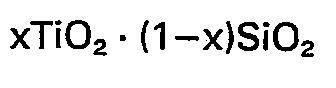
wherein x lies between 0.0001 and 0.04, optionally in the presence of one or more solvents.
wherein x lies between 0.0001 and 0.04, optionally in the presence of one or more solvents.
2. A process according to claim 1, wherein the oxidation reaction is carried out at
a temperature of between 50°C and 100°C.
3. A process according to claim 1, wherein the oxidation reaction is carried out under
the pressure spontaneously generated during progress of the reaction.
4. A process according to claim 1, wherein the hydrogen peroxide aqueous solution
is a diluted solution.
5. A process according to claim 1, wherein the concentration of H202 in the aqueous solution is from 10% to 70% on a weight-to-volume ratio.
6. A process according to claim 1, wherein the vinylbenzene compound is selected from
styrene, a-methylstyrene, 4-methoxystyrene and 4-methylstyrene.
7. A process according to claim 1, wherein the solvent is polar.
8. A process according to claim 7, wherein the polar solvent is selected from alcohols,
glycols, ketones, ethers and acids, having a number of carbon atoms less than, or
equal to 6.
9. A process according to claim 8, wherein the alcohol is methanol or tert.butanol.
10. A process according to claim 8, wherein the ketone is acetone.
1. Verfahren zur Oxidation von Vinylbenzolverbindungen zu β-Phenylaldehyden, dadurch
gekennzeichnet, daß diese Verbindungen mit einer wässerigen Lösung von Wasserstoffperoxid
bei einer Temperatur von 20°C bis 150°C in Gegenwart von Titanatome enthaltenden synthetischen
Zeolithen der nachfolgenden allgemeinen Formel:
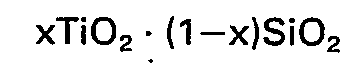
worin x einen Wert von 0,0001 bis 0,04 aufweist, gewünschtenfalls in Anwesenheit eines oder mehrerer Lösungsmittel umgesetzt werden.
worin x einen Wert von 0,0001 bis 0,04 aufweist, gewünschtenfalls in Anwesenheit eines oder mehrerer Lösungsmittel umgesetzt werden.
2. Verfahren nach Anspruch 1, worin die Oxidationsreaktion bei einer Temperatur von
50°C bis 100°C ausgeführt wird.
3. Verfahren nach Anspruch 1, worin die Oxidationsreaktion unter dem spontan im Verlauf
der Reaktion aufgebauten Druck ausgeführt wird.
4. Verfahren nach Anspruch 1, worin die wässerige Wasserstoffperoxidlösung eine verdünnte
Lösung ist.
5. Verfahren nach Anspruch 1, worin die Konzentration von Wasserstoffperoxid in der
wässerigen Lösung von 10 bis 70% auf Basis Gewicht/Volumen beträgt.
6. Verfahren nach Anspruch 1, worin die Vinylbenzolverbindung ausgewählt wird unter
Styrol, a-Methylstyrol, 4-Methoxystyrol und 4-Methylstyrol.
7. Verfahren nach Anspruch 1, worin das Lösungsmittel polar ist.
8. Verfahren nach Anspruch 7, worin das polare Lösungsmittel ausgewählt wird unter
Alkoholen, Glycolen, Ketonen, Ethern und Säuren mit einer Kohlenstoffatomanzahl kleiner
als oder gleich 6.
9. Verfahren nach Anspruch 8, worin der Alkohol Methanol oder tert.-Butanol ist.
10. Verfahren nach Anspruch 8, worin das Keton Aceton ist.
1. Procédé d'oxydation de composés de vinylbenzène en β-phényl-aldéhydes, caractérisé
en ce qu'on fait réagir lesdits composés avec une solution aqueuse d'eau oxygénée,
à une température de 20°C à 150°C, en présence de zéolites synthétiques contenant
des atomes de titane, de formule générale:
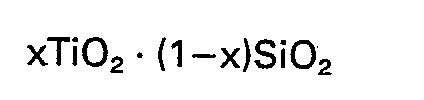
où x est compris entre 0,0001 et 0,04, éventuellement en présence d'un ou plusieurs solvants.
où x est compris entre 0,0001 et 0,04, éventuellement en présence d'un ou plusieurs solvants.
2. Procédé selon la revendication 1, dans lequel la réaction d'oxydation est mise
en oeuvre à une température comprise entre 50°C et 100°C.
3. Procédé selon la revendication 1, dans lequel la réaction d'oxydation est mise
en oeuvre sous une pression qui se développe spontanément pendant la progression de
la réaction.
4. Procédé selon la revendication 1, dans lequel la solution aqueuse d'éau oxygénée
est une solution diluée.
5. Procédé selon la revendication 1, dans lequel la concentration de H202 dans la solution aqueuse est de 10% à 70% exprimée en poids/volume.
6. Procédé selon la revendication 1, dans lequel le composé vinyl-benzène est choisi
parmi le styrène, l'a-méthylstyrène, le 4-méthoxy-styrène et le 4-méthylstyrène.
7. Procédé selon la revendication 1, dans lequel le solvant est polaire.
8. Procédé selon la revendication 7, dans lequel le solvant polaire est choisi parmi
les alcools, les glycols, les cétones, les éthers et les acides ayant un nombre d'atomes
de carbone inférieur ou égal à 6.
9. Procédé selon la revendication 8, dans lequel l'alcool est le méthanol ou le tert-butanol.
10. Procédé selon la revendication 8, dans lequel la cétone est l'acétone.