| (19) |
 |
|
(11) |
EP 0 102 922 B1 |
| (12) |
EUROPEAN PATENT SPECIFICATION |
| (45) |
Mention of the grant of the patent: |
|
20.05.1987 Bulletin 1987/21 |
| (22) |
Date of filing: 19.08.1983 |
|
| (51) |
International Patent Classification (IPC)4: B44D 3/18 |
|
| (54) |
Frame to give the correct adjustable tension, with automatic compensation of deformations,
to painting canvases
Rahmen zum Einstellen der richtigen Spannung mit automatischem Verformungsausgleich
von Malerleinwänden
Cadre pour donner à des canevas de peintre la tension correcte avec compensation automatique
des déformations
|
| (84) |
Designated Contracting States: |
|
AT BE DE FR GB IT LU NL SE |
| (30) |
Priority: |
02.09.1982 CH 5209/82
|
| (43) |
Date of publication of application: |
|
14.03.1984 Bulletin 1984/11 |
| (71) |
Applicant: Staro, Giorgio |
|
CH-6900 Lugano (CH) |
|
| (72) |
Inventor: |
|
- Staro, Giorgio
CH-6900 Lugano (CH)
|
| (74) |
Representative: Baggiolini, Raimondo
Patent Attorneys et al |
|
Fiammenghi-Fiammenghi
Via San Gottardo 15
CH-6900 Lugano
CH-6900 Lugano (CH) |
|
| |
|
|
|
Remarks: |
|
The file contains technical information submitted after the application was filed
and not included in this specification |
|
| Note: Within nine months from the publication of the mention of the grant of the European
patent, any person may give notice to the European Patent Office of opposition to
the European patent
granted. Notice of opposition shall be filed in a written reasoned statement. It shall
not be deemed to
have been filed until the opposition fee has been paid. (Art. 99(1) European Patent
Convention).
|
[0001] This invention has as its object a frame to give the correct adjustable tension,
with automatic compensation for dimensional deformations in use, to artists' canvasses
and the like, comprising a plurality of hollow sections and a plurality of connecting
inserts, each insert having a pair of arms which fit loosely into the end of adjacent
hollow sections so as to connect said sections together while allowing relative movement
thereof, and spring and screw means arranged to bias the arms of the inserts into
engagement with the hollow sections.
[0002] Frames for these purposes are already known, for example, Italian patent No. 935.183,
but the means used make the frame bulky, impractical, slow in putting to use and not
very attractive.
[0003] The FR patent: A―2 439 683 (Vidal) describes a frame comprising sections of rectangular
full shape and connecting means with two outside sliding channels in which each adjacent
full section can freely slide; each connecting means is provided with screws and springs
to cause a relative outward expansion movement of the frame.
[0004] The US―A―3 625 274 patent describes sections of hollow shape.
[0005] The frame according to the present invention eliminates the drawbacks mentioned above.
[0006] It is characterized in that adjacent each end of each hollow section there is provided
a block having first and second ends, said first end receiving one first end portion
of a square spring forming said spring means and said second end of the block receiving
a screw forming said screw means and each end of the arms is provided with a notch
which is loosely engageable by the second end portion of the torsion spring following
insertion of said second end portion through an opening in a wall of the hollow section,
said screw bearing on said wall to bias the respective arms of said inserts into engagement
with the hollow section to displace it in a direction causing said adjustable tension
to the canvas.
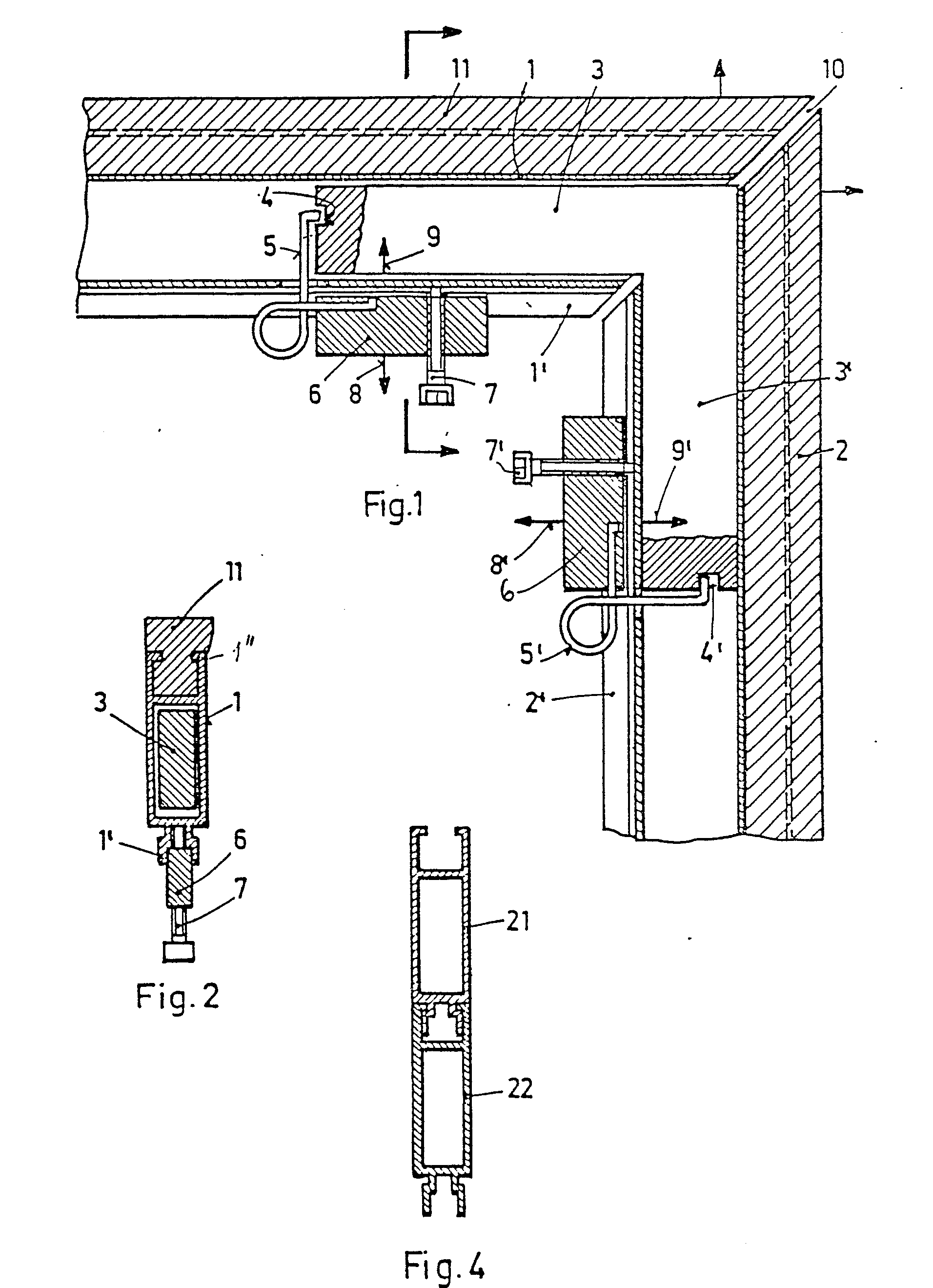
[0007] The accompanying drawings represent a preferred embodiment of the frame according
to the present invention. -
Fig. 1 represents in lengthwise section the frame only at its corner.
Fig. represents a cross section made along the plane passing through II―II in Fig.
1.
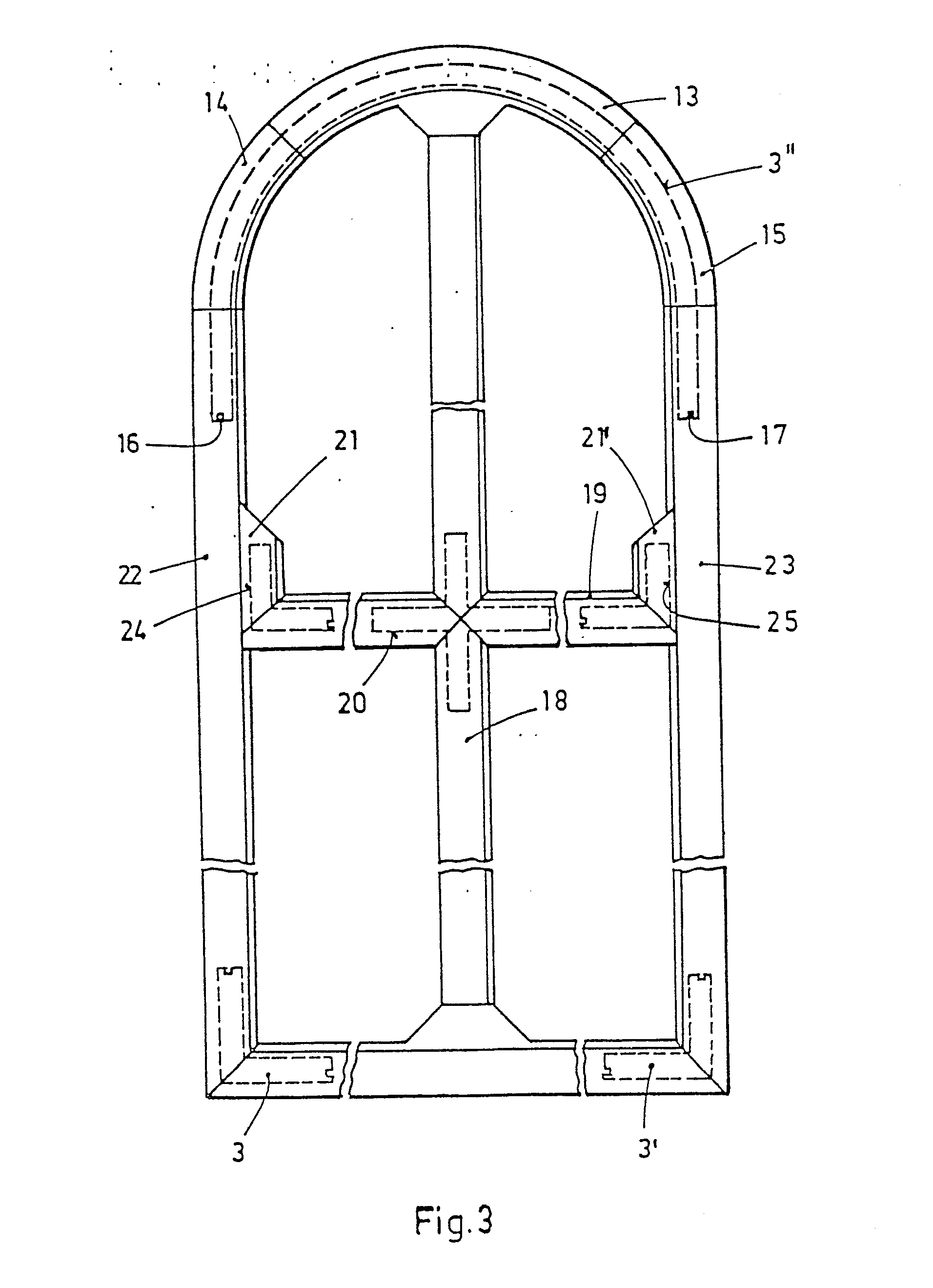
Fig. 3 represents the complete frame that can be used for a canvas with a semicircular
upper part that is reinforced by central shapes in the form of a cross.
Fig. 4 represents a detail of Fig. 3.
[0008] With reference to Fig. 1, the frame comprises, at a corner, two sections of shape
1, 2 joined by a square insert 3, 3' which goes into a central recess of the shape
(see also the crosswise section of Fig. 2).
[0009] Said insert exhibits, at each end, a notch 4 (4'), able to receive the square-bent
end of spring 5, (5'), while the other end is solid with block 6 (6').
[0010] Block 6 (or 6') can slide in the lower recess 1' (or 2') of shape 1 (2) to make the
bent end of corresponding spring 5 (5') go into notch 4 (4') of square insert 3 (3')..
[0011] By screw 7 -(7') being tightened, spring 5 (5') tends to drag insert 3 (3') in the
direction of arrow 8 (8'), while in reaction the section of shape 1 (2) moves in the
direction of arrow 9 (9') causing a space 10 to be formed at the formed at the ends
of the two sections 1 and 2, which has the effect of stretching the canvas placed
on peripheral cornice 11 (Fig. 2) made of wood or other material, thus giving the
correct tension to the canvas itself. The turned edges 1" of the sections 1 retain
the peripheral cornice 11.
[0012] During use, which can be several years or even centuries (since paintings are involved),
the dimensional deformations of the canvas are automatically compensated by spring
5 and 5' so that the canvas is always perfectly stretched to the correct value.
[0013] Fig. 3 shows the frame according to the invention complete with all its parts and
suitable for a canvas that has a semicircular upper part.
[0014] For this purpose, upper insert 3", indicated by the broken line, has a semicircular
shape, and segmented sections 13, 14, 15 are fitted on it and perform the same function
as the straight sections 1 and 2 shown in Fig. 1.
[0015] Notches 16, 17 receive the square-bent end of the springs 5 and 5' of Fig. 1, solid
with the corresponding blocks like 6 and 6' of Fig. 1 in which screws 7, 7' (means
not shown in Fig. 3 for simplicity) are tightened.
[0016] Similarly, square inserts 3, 3' at the lower corners of the frame are like those
shown in Fig. 1.
[0017] If the frame is large, shapes 18, 19 in form of a cross, with the corresponding insert
20 also cross-shaped, give the unit greater strength.
[0018] Two additional sections of shape 21, 21' should be noted which are fitted in and
slide in peripheral shapes 22, 23 as is clearly shown in section in Fig. 4.
[0019] In this case, square inserts 24 and 25 provide for connecting with the central part
of the frame.
[0020] Shapes 1, 2, etc., shown in Fig. 1, are preferably of aluminum or aluminum alloy
as are also inserts 3, 3' of the blocks and the other parts shown in Fig. 3.
[0021] But they can also be made of plastic or other material.
1. A frame to give the correct adjustable tension, with automatic compensation for
dimensional deformations in use, to artists' canvasses (11) and the like, comprising
a plurality of hollow sections (1, 2) and a plurality of connecting inserts, each
insert having a pair of arms (3, 3') which fit loosely into the end of adjacent hollow
sections (1, 2) so as to connect said sections together while allowing relative movement
thereof, and spring and screw means (5, 5'; 7, 7') arranged to bias the arms (3, 3')
of the inserts into engagement with the hollow sections (1, 2),
characterised in that adjacent each end of each hollow section (1, 2) there is provided
a block (6, 6') having first and second ends, said first end receiving one first end
portion of a square spring (5, 5') forming said spring means and said second end of
the block receiving a screw (7, 7') forming said screw means and each end of the arms
(3, 3') is provided with a notch (4, 4') which is loosely engageable by the second
end portion of the torsion spring (5, 5') following insertion of said second end portion
through an opening in a wall of the hollow section (1, 2), said screw (7, 7') bearing
on said wall to bias the respective arms (3, 3') of said inserts into engagement with
the hollow section to displace it in a direction causing said adjustable tension to
the canvas.
2. Frame as in claim 1 wherein for curved canvases, the inserts and or the corresponding
sections, either whole or divided into segments, have a shape that reproduces the
curve of the canvas.
3. Frame as in claims 1, 2 wherein for large- sized canvases at least a central reinforcement
(18, 19, Fig. 3) is provided with at least a cross-shaped insert (20) that is connected
to the peripheral sections (22, 23) by additional sections (21, 21') in a sliding
manner.
4. Frame as in claims 1 to 3 wherein said sections, the inserts and blocks (6, 6')
are of aluminum or aluminum alloy shapes, or synthetic resins, while the periphery
of the sections, in contact with the canvas (11) is of wood or synthetic resin.
1. Rahmen zum Einstellen der richtigen Spannung mit automatischen Ausgleich von Maßabweichungen
bei Verwendung mit Malerleinwänden (11) od.dgl., der eine Mehrzahl von Hohlprofilen
(1, 2) sowie eine Mehrzahl von verbindenden Einsatzstücken, von denen jedes ein Paar
von lose in das Ende von aneinandergrenzenden Hohlprofilen (1, 2) eingesetzten Schenkeln
(3,3') aufweist, um die Hohlprofile unter Ermöglichung einer Relativbewegung dieser
zueinander miteinander zu verbinden, und Feder- sowie Schraubeinrichtungen (5, 5';
7, 7'), die die Schenkel (3, 3') der Einsatzstücke in Anlage mit den Hohlprofilen
(1, 2) drücken, umfaßt, dadurch gekennzeichnet, daß benachbart zu jedem der Enden
eines jeden Hohlprofils (1, 2) ein Klotz (6, 6') mit einem ersten sowie zweiten Ende
angeordnet ist, von denen das erste Ende einen Endabschnitt einer die Federeinrichtung
bildenden rechtwinkligen Feder (5, 5') sowie das zweite Ende des Klotzes eine die
Schraubeinrichtung bildende Schraube (7, 7') aufnimmt, daß jedes Ende der Schenkel
(3, 3') mit einer Einkerbung (4, 4') versehen ist, in die der zweite Endabschnitt
der Torsionsfeder (5, 5') im Anschluß an dessen Einführen durch eine Öffnung in einer
Wand des Hohlprofils (1, 2) lose einsetzbar ist, und daß die Schraube (7, 7') gegen
diese Wand einen Druck ausübt, um die jeweiligen Schenkel (3, 3') der Einsatzstücke
in Anlage mit dem Hohlprofil zu dessen Verlagerung in einer die Einstellung der Spannung
der Leinwand bewirkenden Richtung zu drücken.
2. Rahmen nach Anspruch 1, dadurch gekennzeichnet, daß für einen bogenförmigen Verlauf
aufweisende Leinwände die Einsatzstücke oder die entsprechenden Hohlprofile entweder
insgesamt oder mit einer Unterteilung in Segmente eine den bogenförmigen Verlauf der
Leinwand nachbildende Gestaltung aufweisen.
3. Rahmen nach den Ansprüchen 1 und 2, dadurch gekennzeichnet, daß für Leinwände mit
großen Abmessungen wenigstens eine mittige Versteifung (18, 19, Fig. 3) mit wenigstens
einem kreuzförmigen Einsatzstück (20) vorgesehen ist, die mit den Rand-Hohlprofilen
(22, 23) durch zusätzliche Hohlprofile (21, 21') gleitend verbunden ist.
4. Rahmen nach den Ansprüchen 1 bis 3, dadurch gekennzeichnet, daß die Hohlprofile,
die Einsatzstücke und die Klötze (6, 6') aus Aluminium oder Aluminiumlegierungen oder
Kunstharzen gebildet sind, während der mit der Leinwand (11) in Berührung befindliche
Rand aus Holz oder Kunstharz besteht.
1. Cadre pour donner à des canevas de peintre (11) et à des objets analogues la tension
correcte avec compensation automatique des déformations de dimensions en utilisation,
comprenant une pluralité de parties creuses (1, 2) et une pluralité d'éléments de
raccordement insérés, chaque élément inséré ayant deux branches (3, 3') qui s'engagent
librement dans une extrémité de parties creuses adjacentes (1, 2) de façon à relier
ensemble lesdites parties creuses tout en permettant leur déplacement relatif et des
moyens à ressort et à vis (5, 5'; 7, 7') disposés pour déplacer les branches (3, 3')
des éléments insérés engagés dans les parties creuses (1, 2), caractérisé en ce qu'adjacent
à chaque extrémité de chaque partie creuse (1,2) est prévu un bloc (6, 6') ayant une
première extrémité et une seconde, ladite première extrémité recevant une première
partie terminale d'un ressort à angle droit (5, 5') formant ledit moyen à ressort
tandis que ladite seconde extrémité du bloc reçoit une vis (7, 7') formant ledit moyen
à vis et que chaque extrémité des branches (3,3') présente une encoche (4, 4') dans
laquelle peut s'engager librement la seconde partie terminale du ressort à torsion
(5, 5') après insertion de ladite seconde partie terminale à travers une ouverture
ménagée dans une paroi de la partie creuse (1, 2), ladite vis (7, 7') s'appuyant sur
ladite paroi pour pousser les branches respectives (3, 3') desdits éléments insérés
en prise avec la partie creuse afin de la déplacer dans une direction déterminant
ladite tension réglable pour le canevas.
2. Cadre selon la revendication 1 dans lequel pour des canevas incurvés les éléments
insérés et/ou les parties correspondantes, soit entières, soit divisées en segments,
ont une forme qui reproduit la courbe du canevas.
3. Cadre selon les revendications 1, 2 dans lequel, pour des canevas de grande dimension,
au moins un renforcement central (18, 19, fig. 3) est muni d'au moins un élément inséré
en forme de croix (20) qui est relié aux parties périphériques (22, 23) par des parties
additionnelles (21, 21') d'une manière coulissante.
4. Cadre selon les revendications 1 à 3, dans lequel lesdites parties, les éléments
insérés et les blocs (6, 6') sont en aluminium ou en alliages d'aluminium ou encore
en résines synthétiques tandis que la périphérie des parties, en contact avec le canevas
(11), est en bois ou en résine synthétique.