|
(11) | EP 0 103 874 B1 |

| (12) | EUROPEAN PATENT SPECIFICATION |
|
|
| (54) |
Flexible, nonstaining topcoat for an x-ray intensifying screen Biegsame, nichtfleckende Überschicht für einen Röntgenstrahlenverstärkungsschirm Couche de recouvrement flexible, ne tachant pas, pour écran renforçateur de rayons X |
|
|
|||||||||||||||||||||||||||||||
| Note: Within nine months from the publication of the mention of the grant of the European patent, any person may give notice to the European Patent Office of opposition to the European patent granted. Notice of opposition shall be filed in a written reasoned statement. It shall not be deemed to have been filed until the opposition fee has been paid. (Art. 99(1) European Patent Convention). |
Background of the invention
[0001] This invention relates to X-ray intensifying screens having a protective topcoat or abrasion layer coated thereon. More particularly, this invention relates to a combination of X-ray screens with photographic film having improved performance in automatic changer systems.
Description of the prior art
[0002] Traditionally, X-ray intensifying screens comprise, in order, a) a support, b) an active layer comprising a fluorescent phosphor dispersed in a suitable binder and, c) a protective topcoat or abrasion layer coated over the active layer to protect said active layer during use. In addition, the screen may also contain a reflective layer to enhance the utility thereof when used to expose silver halide photographic films. This reflective layer (e.g., Ti02 dispersed in a suitable binder) is'coated between the active layer and the support. Alternatively, the reflective layer may be coated on the opposite side of the support, or the reflective material incorporated directly into the support during manufacture thereof.
[0003] FR-A-2 308 128 is concerned with a topcoat containing particulate material dispersed in a binder. The particulate materials preferably are fluorinated polymers and are cast as small particles in the binder. It is stated that the fluorinated polymers may be in the form of copolymers with methylmethacrylate, but always as particles in a binder, not as the topcoat itself.
[0004] The above described screens are eminently useful in conjunction with photographic silver halide X-ray film. Such films consist essentially of a gelatino-silver halide emulsion coated on both sides of a support (so-called "double-side coated"). In this case, two X-ray screens are usually employed, one positioned on each side of the double-side coated film, and encased in a suitable casette. The cassette is then placed in proximity to the patient in the area desired, and the patient exposed to X-rays. The film is then removed and processed in conventional manner. Most of this handling must be done in the dark to protect the film from exposure.
[0005] Modern hospitals, however, where a large number of X-ray exposures are made on a daily basis, now use automatic changer and processing devices. These changer devices contain successive light sensitive films and one or more X-ray screens. Each unexposed film is successively fed into position between a pair of X-ray screens, exposed, and automatically unloaded. The feed path of the film changes direction abruptly near the entrance to the space between the screens. Conventional X-ray screens have protective topcoats comprising, for example, cellulose acetate or other polymeric materials that form a coherent layer on coating. These topcoats are inadequate to shield the active layer from abrasion caused by the rapid exchange of the film in and out of the automatic changer systems. In addition, the prior art topcoats tend to stain when accidentally contacted by processing fluids (e.g., developer and fixer) associated with the film development. The failure of the topcoat shortens the useful life of the X-ray screen, and the staining may cause unwanted image areas to appear on the film during exposure. Neither of these two defects can be tolerated in the medical X-ray area where a patient's life may depend on the results.
Brief summary of the invention
[0006] The present invention is directed to an X-ray image intensifying screen comprising, in order, a) a support, b) an active layer on said support comprising fluorescent phosphor particles dispersed in a film-forming binder, and, c) a protective topcoat coated on said active layer, and is characterized in that said topcoat is a flexible film of a copolymer composed of (1) a fluoroester of the formula:
wherein n is an integer from 2 to 9, and (2) methylmethacrylate.
[0007] X-ray intensifying screens made with the protective topcoat described above can be handled, with extended life, in automatic, rapid changer systems, show excellent resistance to staining, and resist failure between said topcoat and the active layer. When used in conjunction with X-ray photographic films, these screens produce sharper images than those produced using conventional X-ray screens made with conventional topcoats.
Detailed description of the invention
[0008] The fluoroesters useful in the preparation of the copolymers employed in the protective topcoat of this invention, and the process for their preparation are disclosed in U.S. Patents No. 3,542,461 and 3,282,905. The latter patent describes the reaction of a fluorinated alcohol (e.g., 1H,1H,2H,2H-heptafluoropentanol-1) with a copolymerizable vinyl compound (e.g., an alkyl acrylate) to form the fluoroester. According to the invention one uses a fluoroester of the formula
where n is an integer from 2-9 and more preferably 3-5. Mixtures of fluoroesters of varying chain length are common in the preparation of these compounds and their concentration (e.g., where n is 3-5) can only be obtained by fractional distillation of the broader range of mixtures. The fluoroesters are not, of themselves, useful as protective topcoats since they are normally fluid and are thus readily absorbed into the active layer. Hence, these compounds must be copolymerized with methylmethacrylate, in varying proportions of 3% to 98% by weight of fluoroester. A mixture of 80% by weight of the fluoroester and 20% by weight of methylmethacrylate is preferred. These copolymers are coated from a solvent or solvent mixture to form an adherent, film-forming, flexible topcoat that will perform as described above.
[0009] In X-ray screen applications, the support can be heavy paper or cardboard, metal foil (e.g. aluminum), but preferably is composed of a macromolecular, hydrophobic organic polymer. Suitable examples are polymers of such monomers as cellulose derivatives (e.g., cellulose acetate, cellulose propionate, etc), vinyl chloride, chloride/vinyl acetate, vinylidene chloride, vinyl acetate, acrylonitrile, and styrene. Polyesters, e.g., polyethylene terephthalate films, are particularly useful because of their dimensional stability. It is preferred to use biaxially oriented polyethylene terephthalate coated with a subbing layer as taught in Alles, et al., U.S. Patent No. 2,729,684. The thickness of this support may be anywhere from about 0.0064 cm (0.0025 in) to 0.0762 cm (0.03 in) with 0.0254 cm (0.01 in) being preferred.
[0010] The support or film base, moreover, may be coated with, or have dispersed therein, dyes or finely divided pigments, e.g., Ti02 to provide opacity or reflectivity or to absorb unwanted or scattered light caused by the exposure process to be described later. A reflective layer may be coated on the support either as a backing layer or interposed between the support and the active (phosphor) layer (described below). Preferably such a reflective layer is dispersed in a suitable binder such as that described by Brixner, Example 1 of U.S. Patent No. 3,895,157. The reflective layer may be coated at a thickness of about 0.0007 cm (0.0003 in) to about 0.00254 cm (0.001 in) or more.
[0011] The phosphor in the active layer can be selected from a legion of well-known X-ray luminescent phosphors or phosphor particles taught by the prior art, and can be dispersed in any one of a host of suitable polymeric binder systems. The phosphors include, for example, calcium tungstate, zinc sulfide, zinc oxide and calcium silicate, zinc phosphate, alkali halides, cadmium sulfide, cadmium selenide, cadmium tungstate, magnesium fluoride, zinc fluoride, strontium sulfide, zinc sulfate, barium lead sulfate, gadolinium oxysulfate, lanthanum oxyhalides, barium fluorohalides, and mixtures of two or more of the above. Some of these phosphors may be enhanced by activation, for example, using small amounts of rare earth elements such as terbium, samarium, thulium, etc., as well-known to those skilled in the art. The phosphors are traditionally dispersed by milling with a binder (e.g., polyvinyl butyral) in suitable solvents and are coated on the support by well-known methods to thicknesses of 0.010 cm (0.004 in) to 0.036 cm (0.014 in). The term "phosphor" or "active layer", as used herein, will denote any suitable phosphor that luminesces on exposure to X-rays and is coated in a binder on a support. This luminescence may occur in the ultra violet, the blue, green, or even the red portion of the spectrum from 300 to 700 nm, for example, depending on which phosphor is used.
[0012] The protective topcoat of this invention is made by copolymerizing a fluoroester (e.g., polyfluoro- alkylethylmethacrylate) with methylmethacrylate to form a hard, solid mass of copolymer. This mass is then crushed and dissolved in a suitable solvent for coating as a protective topcoat on one of the above described active layers. As stated above, the fluoroesters useful in this invention are prepared as described in U.S. 3,282,905, supra, and the fluoroester mixture is copolymerized with methylmethacrylate using a suitable initiator, e.g., 2,2'-azobis(isobutyronitrile), as fully described in U.S. 3,950,315, supra. Generally, the copolymer is prepared employing a mixture of about 10-75% by weight of methylmethacrylate and about 90-25% by weight of the fluoroester, in parts by weight of the mixture, preferably 80% fluoroester and 20% methylmethacrylate.
[0013] In preparing solutions of the aforesaid copolymers, fluorocarbon solvents (e.g., Freon@-TF, sold by E. I. du Pont de Nemours and Company, Wilmington, Delaware) are preferred since they are nonflammable and have excellent dispersing properties for these topcoats. For copolymers prepared employing higher concentrations of the methylmethacrylate monomer, mixed solvents (e.g., Freon@ type solvents and acetone) can be used.
[0014] The protective topcoat of this invention can be successfully coated over any of the above described phosphor-containing active layers. The preferred phosphor is a compound of the formula
wherein X is a halogen (e.g., chlorine, bromine or fluorine), Y is either trivalent thulium or terbium or some other appropriate well-known activator, and n is 0.006 to 0.0001.
[0015] X-ray screens having the novel protective topcoat of this invention are suitable for all X-ray radiographic processes. They can be used without showing signs of cracking and crazing. These screens are eminently suitable for use with modern rapid changer systems such as the Cut Film Changer Type AOT-R, or PUCK, sold by Elema-Schonander, Sweden, and the Buckymat Automatic Film Changer sold by Buckymat, Seimens Corp., Rep. of Germany. In these rapid changer systems or simulators the protective topcoat of this invention coated over a phosphor layer has been found to survive well beyond the life of conventional x-ray screens without topcoat failure, indicating excellent adhesion to the active layer and excellent surface durability.
[0016] Screens having this topcoat are relatively static-free although small amounts of conventional antistats may be added to the topcoat or to the active layer to insure that static is fully controlled in the rapid changer systems, where it has been a problem in the past. Static is usually built up during the exchange of film into and out of the area or cassette containing the x-ray screens. This has been known to cause static marks by exposure of the sensitive photographic film. This cannot be tolerated.
[0017] The topcoats of this invention are highly resistant to stain. Stain is caused when some of the processing fluids, or other items commonly associated with darkroom handling (e.g. hand cream, soaps, coffee and the like) are spilled on the x-ray screen itself. Since x-ray screens are unusually expensive and are used over and over again, it is important to keep the topcoat clean and free of stain. Defects such as stains, dirt, etc. may show up later on the exposed film. Prior art elements tend to be easily stained by contact with the above mentioned fluids and materials. The topcoats of this invention are highly resistant to this staining.
[0018] This invention will now be illustrated by the following examples of which Example 1 is considered to represent the best mode of carrying out the invention.
Example 1
[0019] A reflective suspension was prepared by sand milling the following ingredients:
The milled suspension was filtered, coated on a 0.0254 (0.010 in) thick biaxially oriented polyethylene terephthalate film sheet to a wet thickness of 0.0254 (0.010 in) and dried. Two samples were prepared.
[0020] A phosphor suspension was prepared by milling the following ingredients in a ball mill for about 16 hours:
[0022]
The phosphor suspension was then coated over the reflective layer on the above support. These elements were also dried.
A. Prior art topcoat:
B. Topcoat of this invention:
[0025]
Topcoat A was coated on one sample of the phosphor layer prepared above and Topcoat B was coated on the other sample. Both were dried to form an X-ray fluorescent screen having a) a support, b) a reflective layer, c) an active phosphor layer, and d) a protective topcoat layer, so as to compare the topcoat of this invention (Screen B) with the prior art (Screen A).
[0026] Each of these screens were then placed in a Buckymat Simulator designed to simulate passage through a Buckymat Automatic Film Changer. After 25,000 cycles, which simulated the passage of 6250 sheets of film in interface with the screen, Screen A failed cohesively and the topcoat began to peel away from the active layer. Screen B, however, lasted more than 160,000 cycles with no failure of the topcoat. In addition, Screen A showed cracking when a sample thereof was bent back and forth to simulate handling. The procedure for testing the resistance of an X-ray screen to development of cracks and crazes is described in Bauer, U.S. 3,164,719. Screen B showed no signs of cracking or crazing. In addition, samples of Cronex®-4 medical x-ray film (E. I. du Pont de Nemours and Company), i.e., a high speed gelatino-AglBr emulsion coated double side on a 7 mil biaxially oriented polyethylene terephthalate film support, were exposed to each screen in a conventional manner and developed, fixed, washed and dried. The film exposed to Screen B had greater image sharpness than that exposed to Screen A. Sensitometric characteristics (speed, gradient, fog, top density, etc.) were equivalent.
[0027] Finally, Screen B was found to be superior to Screen A in resisting staining. To test a screen for propensity to stain, the fluid to be tested (e.g., developer, fixer, coffee, hand lotion, etc.) is placed on a small area of the screen (e.g. on the topcoat) and the screen placed in a dark area for ca. 24 hours, or until the fluid has dried. The surface of the screen is then cleaned with soap and warm water and dried. A radiograph is made with the screen at 80 KVP and 2 ma with the time exposure adjusted to give a photographic density of 1.0±0.1 in the processed film. The film is then examined closed to see if the treated area of the screen has any effect on said film. This effect is usually noted as an area of light density if a significant amount of stain is left on the screen surface. The screen of this invention (Screen B) had no stains in this test whereas the prior art screen (A) showed significant stain.
Example 2
[0028] Topcoat formulations representing the topcoat of this invention were made as described in Example 1 except that the methylmethacrylate was varied in each case.
[0029] Solutions of these formulations were made up as follows:
All screens made with these topcoats were satisfactory for adhesion and image quality in all the tests outlined above but screens A and B were not stain-resistant. Sample A also failed to survive the automatic changer test. This Example demonstrates that it is necessary to copolymerize methylmethacrylate with a fluoroester in order to prepare a polymer which is useful as an x-ray screen topcoat.
Example 3
[0030] A topcoat solution identical to that described in Example 1 was prepared. Samples from this solution were used to prepare protective topcoats for a variety of phosphor-containing active layers including CaW04, Gd202S; mixtures of Gd202S and LaOBr, and BaFCI:Eu. The topcoat served to protect all of these active layers in a like manner; i.e., these screens passed all tests described in Example 1.
Example 4
[0031] Two topcoat solutions identical to those described in Example 1 were prepared. 13 g of Atlas G-3634 antistat and 13 g of Syloid-620 (Si02 from E. I. du Pont de Nemours and Company) was added to each solution and coated over an active layer identical to that of Example 1. These screens were tested in both the Cut Film Changer Type AOT-R and Type PUCK sold by Elema-Schonander, Sweden. The screen having the topcoat of this invention showed superior performance in both units and had better air-bleed times, i.e., photographic films could be released from these screens more rapidly than from controls, without any loss of image quality.
1. An x-ray image intensifying screen comprising, in order, a support, an active layer
on said support comprising fluorescent phosphor particles dispersed in a film-forming
binder, and a protective topcoat on said active layer, characterized in that said
topcoat is a flexible film of a copolymer composed of (1) a fluoroester of the formula:
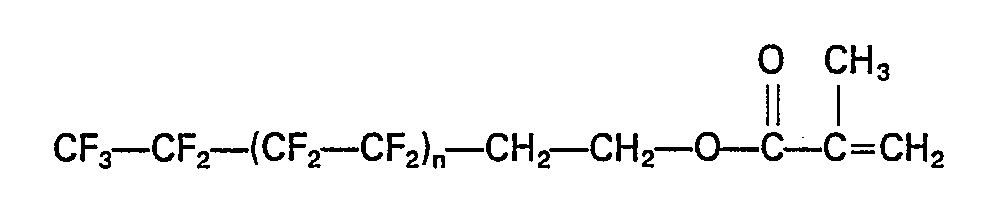
wherein n is an integer from 2 to 9, and (2) methylmethacrylate.
wherein n is an integer from 2 to 9, and (2) methylmethacrylate.
2. The intensifying screen of Claim 1 where n is an integer from 3-5.
3. The intensifying screen of Claim 1 wherein the copolymer is prepared from a mixture
of 80% fluoroester and 20% methylmethacrylate.
4. The intensifying screen of Claim 1 wherein the support is a biaxially oriented
polyethylene terephthalate film.
5. The intensifying screen of Claim 1 wherein the film-forming binder is polyvinyl
butyral.
6. The intensifying screen of Claim 1 wherein the phosphor particles are composed
of lanthanum oxybromide activated with thulium.
7. The intensifying screen of Claim 1 wherein the protective topcoat is coated from
an acetone/ fluorocarbon solvent solution.
8. The intensifying screen of Claim 1 wherein a light-reflecting layer is present
between the active layer and its support.
9. The. intensifying screen of Claim 1 in combination with a photosensitive x-ray
film.
1. Röntgenbild-Verstärkungsschirm, umfassend, in dieser Reihenfolge, einen Träger,
eine aktive Schicht, die fluoreszierende Teilchen eines Phosphors dispergiert in einem
filmbildenden Bindemittel umfaßt, auf diesem Träger und eine schützende Deckschicht
auf der aktiven Schicht, dadurch gekennzeichnet, daß diese Deckschicht ein flexibler
Film eines Copolymers bestehend aus
(1) einem Fluoroester der Formel
in der n eine ganze Zahl von 2 bis 9 ist, und
(2) Methylmethacrylat ist.
2. Verstärkungsschirm nach Anspruch 1, dadurch gekennzeichnet, daß n eine ganze Zahl
von 3 bis 5 ist.
3. Verstärkungsschirm nach Anspruch 1, dadurch gekennzeichnet, daß das Copolymer aus
einem Gemisch aus 80% Fluoroester und 20% Methylmethacrylat hergestellt ist.
4. Verstärkungsschirm nach Anspruch 1, dadurch gekennzeichnet, daß der Träger eine
biaxial orientierte Polyethylenterephthalat-Folie ist.
5. Verstärkungsschirm nach Anspruch 1, dadurch gekennzeichnet, daß das filmbildende
Bindemittel Polyvinylbutyral ist.
6. Verstärkungsschirm nach Anspruch 1, dadurch gekennzeichnet, daß die Phosphor-Teilchen
aus mit Thulium aktiviertem Lanthanoxybromid bestehen.
7. Verstärkungsschirm nach Anspruch 1, dadurch gekennzeichnet, daß die schützende
Deckschicht aus einer Lösung in einem Aceton/Fluorokohlenwasserstoff-Lösungsmittel
aufgetragen wird.
8. Verstärkungsschirm nach Anspruch 1, dadurch gekennzeichnet, daß eine Licht reflektierende
Schicht zwischen der aktiven Schicht und ihrem Träger vorliegt.
9. Verstärkungsschirm nach Anspruch 1 in Kombination mit einem lichtempfindlichen
Röntgenfilm.
1. Un écran renforçateur d'images radiographiques comprenant, dans l'ordre, un support,
une couche active appliqué sur ledit support comprenant des particules de substance
luminescente dispersées dans un liant filmogène, et une couche superficielle de protection
appliquée sur ladite couche active, caractérisé en ce que ladite couche superficielle
est une pellicule flexible d'un copolymère composé (1) d'un fluoroester de la formule:

dans laquelle n est un nombre entier de 2 à 9, et (2) de méthacrylate de méthyle.
dans laquelle n est un nombre entier de 2 à 9, et (2) de méthacrylate de méthyle.
2. L'écran renforçateur de la revendication 1, dans lequel n est un nombre entier
de 3 à 5.
3. L'écran renforçateur de la revendication 1, dans lequel le copolymère est préparé
à partir d'un mélange de 80% de fluoroester et de 20% de méthacrylate de méthyle.
4. L'écran renforçateur de la revendication 1, dans lequel le support est une pellicule
de polytéréphtalate d'éthylène orienté biaxialement.
5. L'écran renforçateur de la revendication 1, dans lequel le liant filmogène est
du butyral polyvinylique.
6. L'écran renforçateur de la revendication 1, dans lequel les particules de substance
luminescente sont composées d'oxybromure de lanthane activé par du thulium.
7. L'écran renforçateur de la revendication 1, dans lequel la couche superficielle
de protection est appliquée à partir d'une solution dans un mélange cétone/solvant
fluorocarboné.
8. L'écran renforçateur de la revendication 1, dans lequel une couche réfléchissant
la lumière est présente entre la couche active et son support.
9. L'écran renforçateur de la revendication 1, en combinaison avec une pellicule photosensible
pour radiographie.