|
(11) | EP 0 104 053 A1 |

| (12) | EUROPEAN PATENT APPLICATION |
|
|
|
|
|||||||||||||||||||||||||||
| (54) | Benzodiazepines for treating panic disorders |
| (57) Therapeutic process for treating panic disorders in humans comprising the systemic
administration of a compound of the formula
in which X is selected from the group consisting of-H, -CH3, and wherein R is hydrogen, alkyl of from 1 to 3 carbon atoms, wherein n is 0 to 16, and m is 1 to 16; including the N-oxides, esters, and pharmacologically acceptable acid addition salts thereof. |
[0001] This invention is a prophylactic ortherapeutic process for treating panic disorders in humans comprising the systemic administration of a benzodiazepine of the Formula 1:
in which X is : selected from the group consisting of -H, -CH3, -CH2-N=(CH3)2 and -CH2-O-R wherein R is hydrogen, alkyl of from 1 to 3 carbon atoms,
or
wherein n is 0 to 16, inclusive, and m is 1 to 16, inclusive; and including the N-oxides and pharmacologically acceptable acid addition salts thereof.
[0002] Panic attacks, a spontaneous attack, thought to be a biochemical disorder of genetic origin, begins in the majority of subjects at ages 15 to 30 years. The attacks occur with no apparent reason to the subject and are accompanied by symptoms of hyperventilation, heart-pounding, pain in head, numbness or tingling of the limbs, hot and cold flushes, lump in throat, and the like. The attacks continue to occur and can lead the subject to become house-bound.
[0003] Various treatments have been prescribed, including hypnosis and behavior therapies and chemotherapy, particulary the administration of imipramine hydrochloride or phenalzine sulfate. The latter although somewhat effective have undesirable side-effects, chlordiazepoxide and diazepam have been tried but found not effective to block the panic attack.
DETAILED DESCRIPTION
[0005] The compounds of the Formula I can be prepared by methods disclosed in U.S. Patent 3,987,052, issued October 19, 1976; U.S. Patent 4,116,956, issued September 26, 1978; U.S. Patent 4,250,094, issued February 10, 1981; U.S. Patent 3,987,052, issued October 19, 1976, and Belgium Patent 782,680 or French Patent 7215118 and as disclosed hereafter.
[0006] The oxidation of a compound of the Formula I normally follows a 2-step process with the formation of an oxazirino structure.
[0007] The (5) N-oxides of a compound of the Formula I can also be made by reacting a 2-methoxy-5-phenyl-7-chloro-3H-1,4-benzodiazepine 4- oxide with acethydrazide. This reaction can be carried out in a solvent inert to the reaction such as a lower alkanol of boiling range of about 100° C or above, especially 1-butanol or 1-pentanol. It is convenient to reflux the reaction mixture, and a convenient reaction temperature is in the range of 100-140° C. Under these conditions, the reaction time will be from 12 to 48 hours.
[0008] The peracid oxidation method described above for producing the (5) N-oxides of a compound of the Formula I produces an intermediate oxazirino compound as described above, and this latter compound can be further rearranged to the desired (5) N-oxide by heating in an appropriate solvent inert to the reaction and capable of being sustained in liquid form at normal pressures at temperatures of 150-200° C. Suitable reaction solvents are the liquid paraffinic hydrocarbons of 10-18 carbon atoms or other solvent hydrocarbons boiling above about 150° C such as mesitylene. The reaction is conveniently carried out under reflux for 10 minutes to 1 hour.
[0009] Acid addition salts of compounds of the Formula I can be prepared by neutralization of the free base with the appropriate amount of an inorganic or organic acid, examples of which are hydrochloric, hydrobromic, sulfuric, nitric, phosphoric, acetic, lactic, benzoic, salicyclic, glycolic, succinic, tartaric, maleic, malic, pamoic, cyclohex- anesulfamic, citric and methanesulfonic acids, and like acids. The neutralization can be carried out by a variety of procedures known to the art to be generally useful for the preparation of amine acid addition salts. The choice of the most suitable procedure will depend on a variety of factors including convenience of operation, economic consideration, and particularly the solubility characteristics of the particular free base, the acid, and the acid addition salt. If the acid is soluble in water, the free base can be dissolved in water containing an equivalent amount of the acid, and thereafter, the water can be removed by evaporation; in some instances, the salt precipitates from the aqueous solution, particularly when cooled, and evaporation is not necessary. If the acid is soluble in a relatively nonpolar solvent, for example, diethyl ether or diisopropyl ether, separate solutions of acid and free base in such a solvent can be mixed in equivalent amounts, whereupon the acid addition salt will usually precipitate because of its relatively low solubility in the nonpolar solvent. Alternatively, the free base can be mixed with an equivalent amount of the acid in the presence of a solvent of moderate polarity, for example, a lower alkanol, a lower alkanone, or a loweralkyl ester of a lower alkanoic acid. Examples of these solvents are ethanol, acetone, and ethyl acetate, respectively. Subsequent admixture of the resulting solution of acid adddition salt with a solvent of relatively low polarity, for example, diethyl ether or hexane, will usually cause precipitation of the acid addition salt. These acid addition salts are useful for upgrading the free bases.
[0010] The compositions of the present invention are presented for administration to humans in unit dosage forms, such as tablets, capsules, pills, powders, granules, sterile parenteral solutions or suspensions, and oral solutions or suspensions, and oil in water and water in oil emulsions containing suitable quantities of the compound of Formula I.
[0011] For oral administration either solid or fluid unit dosage forms can be prepared. For preparing solid compositions such as tablets, the compound of Formula I is mixed with conventional ingredients such as talc, magnesium stearate, dicalcium phosphate, magnesium aluminum silicate, calcium sulfate, starch, lactose, acacia, methylcellulose, and functionally similar materials as pharmaceutical diluents or carriers. Wafers are prepared in the same manner as tablets, differing only in shape and the inclusion of sucrose or other sweetener and flavor. In their simplest embodiment, capsules, like tablets, are prepared by mixing the compound with an inert pharmaceutical diluent and filling the mixture into a hard gelatin capsule of appropriate size. Soft gelatin capsules are prepared by machine encapsulation of a slurry of the compound with an acceptable vegetable oil, light liquid petrolatum or other inert oil.
[0012] Fluid unit dosage forms for oral administration such as syrups, elixirs, and suspensions can be prepared. The water-soluble forms can be dissolved in an aqueous vehicle together with sugar, aromatic flavoring agents and preservatives to form a syrup. An elixir is prepared by using a hydro-alcoholic (ethanol) vehicle with suitable sweeteners such as sugar and saccharin, together with an aromatic flavoring agent.
[0013] Suspensions can be prepared with a syrup vehicle with the aid of a suspending agent such as acacia, tragacanth, methylcellulose and the like.
[0014] For parenteral administration, fluid unit dosage forms are prepared utilizing the compound and a sterile vehicle, water being preferred. The compound, depending on the vehicle and concentration used, can be either suspended or dissolved in the vehicle. In preparing solutions the compound can be dissolved in water for injection and filter sterilized before filling into a suitable vial or ampul and sealing. Advantageously, adjuvants such as a local anesthetic, preservative and buffering agents can be dissolved in the vehicle. To enhance the stability, the composition can be frozen after filling into the vial and the water removed under vacuum. The dry lyophilized powder is then sealed in the vial and an accompanying vial of water for injection is supplied to reconstitute the liquid prior to use. Parenteral suspensions are prepared in substantially the same manner except that the compound is suspended in the vehicle instead of being dissolved and sterilization cannot be accomplished by filtration. The compound can be sterilized by exposure to ethylene oxide before suspending in the sterile vehicle. Advantageously, a surfactant or wetting agent is included in the composition to facilitate uniform distribution of the compound.
[0015] The term unit dosage form as used in the specification and claims refers to physically discrete units suitable as unitary dosages for human subjects and animals, each unit containing a predetermined quantity of a active material calculated to prevent panic atacks or treat panic disorders in association with the required pharmaceutical diluent, carrier or vehicle. The specifications for the novel unit dosage forms of this invention are dictated by and directly dependent on (a) the unique characteristics of the active material and the particular effect to be achieved, and (b) the limitations inherent in the art of compounding such an active material for use in humans and animals, as disclosed in detail in this specification, these being features of the present invention. Examples of suitable unit dosage forms in accord with this invention are tablets, capsules, pills, suppositories, powder packets, granules, wafers, cachets, teaspoonfuls, tablespoonfuls, dropperfuls, ampuls, vials, segregated multiples of any of the foregoing, and other forms as herein described.
[0016] The dosage of the compound for treatment depends on route of administration; the age, weight, and condition of the patient and the particular compound.
[0017] When X is -H or -CH3 a dosage dosage schedule of from about 1 to 10 mg/day in a single or divided dose, embraces the effective range for treating panic disorders for which the compositions are effective. The dosage to be administered is calculated on the basis of from about 0.01 to about 0.4 mg/kg by weight of subject per day.
[0018] When X is -CH2-N=(CH3)2 a dosage schedule of from about 5 to 50 mg/day in a single or divided dose, embraces the effective range for treating panic disorders for which the compositions are effective. The dosage to be administered is calculated on the basis of from about 0.05 to about 2 mg/kg by weight of subject per day.
[0019] When X is -CH2-0-R a dosage schedule of from about 2 to 20 mg in a single dose, embraces the effective range for treating panic disorders for which the compositions are effective. The dosage to be administered is calculated on the basis of from about 0.02 to about 0.8 mg/kg by weight of subject.
[0020] The compound is compounded with a suitable pharmaceutical carrier in unit dosage form for convenient and effective administration. In the preferred embodiments of this invention, the dosage units contain the compound in: 0.1, 0.5, 1, 5, 10, 20 and 50 mg amounts for systemic treatment; and 0.1% to 1% w/v for parenteral treatment.
[0021] The compositions are useful in preventing and treating panic attacks in adults (age fifteen years or more). Adults susceptible to panic attacks, agaraphobia, and phobic anxiety can be treated.
[0022] The following examples are illustrative of the best mode contemplated by the inventor for carrying out his invention and are not to be construed as limiting.
Example 1
[0023] A lot of 10,000 tablets, each containing 0.5 mg of 8-chloro-6-phenyl-4H-s-triazolo[4,3-a][1,4]benzodiazepine is prepared from the following types and amounts of ingredients:
[0024] The compound and dicalcium phosphate are mixed well, granulated with 7.5 percent solution of methylcellulose in water, passed through a No. 8 screen and dried carefully. The dried granules are passed through a No. 12 screen, mixed thoroughly with the talc, starch and stearate, and compressed into tablets.
Example 2
[0026] One thousand two-piece hard gelatin capsules, each containing 0.5 mg of 8-chloro-6-phenyl-4H-s-triazolo[4,3-ai[1,4]benzodiazepine are prepared from the following types and amounts of ingredients:
[0028] Capsules so prepared are useful to prevent panic attacks at a dose of one capsule four times a day.
Example 3
[0031] These tablets placed under the tongue are useful in treating panic attacks at a dose of 1 tablet.
Example 4
[0032] Soft gelatin capsules for oral use, each containing 10 mg of 6-phenyl-4H-s-triazolo[4,3-a][1,4]benzodiazepine are prepared by first dispersing the micronized compound in corn oil to render the material capsulatable and then encapsulating in the usual manner.
Example 5
[0034] One thousand tablets, each containing 5 mg. of 8-chloro-6-phenyl-4H-s-triazolo[4,3-a][1,4]benzodiazepine are made from the following types and amounts of ingredients:
Example 6
[0037] A sterile preparation suitable for intramuscular injection and containing 1 mg of 8-chloro-6-phenyl-4H-s-triazolo[4,3-a][1,4]benzodiazepine in each milliliter is prepared from the following ingredients:
Example 7
[0039] A lot of 10,000 tablets, each containing 5 mg of 8-chloro-l-r(di- methylamino)-methyl]-6-phenyl-4H-s-triazolo[4,3-a][1,4]benzodiazepine methanesulfonate is prepared from the following types and amounts of ingredients:
[0040] The compound and dicalcium phosphate are mixed well, granulated with 7.5 percent solution of methylcellulose in water, passed through a No. 8 screen and dried carefully. The dried granules are passed through a No. 12 screen, mixed thoroughly with the talc, starch and stearate, and compressed into tablets.
Example 8
[0042] One thousand two-piece hard gelatin capsules, each containing 10 mg of 8-chloro-1-[(dimethylamino)-methyl]-6-phenyl-4H-s-triazolo[4,3-a][1,4]benzodiazepine methanesulfonate are prepared from the following types and amounts of ingredients:
[0044] Capsules so prepared are useful to prevent panic attacks at a dose of one capsule four times a day.
Example 9
[0047] These tablets placed under the tongue are useful in treating panic attacks at a dose of 1 tablet.
Example 10
[0048] Soft gelatin capsules for oral use, each containing 20 mg of 8-chloro-1-[(dimethylamino)-methyl]-6-phenyl-4H-s-triazolo[4,3-a][1,41-benzodiazepine methanesulfonate are prepared by first dispersing the micronized compound in corn oil to render the material capsulatable and then encapsulating in the usual manner.
Example 11
[0050] One thousand tablets, each containing 50 mg. of 8-chloro-l-r(di- methylamino)-methyl]-6-phenyl-4H-s-triazolo[4,3-a][1,4]benzodiazepine methanesulfonate are made from the following types and amounts of ingredients:
Example 12
[0053] A sterile preparation suitable for intramuscular injection and containing 10 mg of 8-chloro-1-[(dimethylamino)-methyl]-6-phenyl-4H-s-triazolo[4,3-a][1,4]benzodiazepine methanesulfonate in each milliliter is prepared from the following ingredients:
Example 13
[0055] A lot of 10,000 tablets, each containing 0.5 mg of 8-chloro-1-methyl-6-phenyl-4H-s-triazolo[4,3-a][1,4]benzodiazepine is prepared from the following types and amounts of ingredients:
[0056] The compound and dicalcium phosphate are mixed well, granulated with 7.5 percent solution of methylcellulose in water, passed through a No. 8 screen and dried carefully. The dried granules are passed through a No. 12 screen, mixed thoroughly with the talc, starch and stearate, and compressed into tablets.
Example 14
[0058] One thousand two-piece hard gelatin capsules, each containing 0.5 mg of 8-chloro-l-methyl-6-phenyl-4H-s-triazolo[4,3-al[1,4]benzodiazepine are prepared from the following types and amounts of ingredients:
[0060] Capsules so prepared are useful to prevent panic attacks at a dose of one capsule four times a day.
Example 15
[0063] These tablets placed under the tongue are useful in treating panic attacks at a dose of 1 tablet.
Example 16
[0064] Soft gelatin capsules for oral use, each containing 10 mg of 1-methyl-6-phenyl-4H-s-triazolo[4,3-a][1,4]benzodiazepine are prepared by first dispersing the micronized compound in corn oil to render the material capsulatable and then encapsulating in the usual manner.
Example 17
[0066] One thousand tablets, each containing 5 mg. of 8-chloro-l-methyl-6-phenyl-4H-s-triazolo[4,3-a][1,4]benzodiazepine are made from the following types and amounts of ingredients:
Example 18
[0069] A sterile preparation suitable for intramuscular injection and containing 1 mg of 8-chloro-l-methyl-6-phenyl-4H-s-triazolo[4,3-aJ-[1,4]benzodiazepine in each milliliter is prepared from the following ingredients:
Example 19
[0071] A lot of 10,000 tablets, each containing 0.5 mg of 8-chloro-1-hydroxymethyl-6-phenyl-4H-s-triazolo[4,3-a][1,4]benzodiazepine is prepared from the following types and amounts of ingredients:
8-Chloro-l-hydroxymethyl-6-phenyl-4H-s-
[0072] The compound and dicalcium phosphate are mixed well, granulated with 7.5 percent solution of methylcellulose in water, passed through a No. 8 screen and dried carefully. The dried granules are passed through a No. 12 screen, mixed thoroughly with the talc, starch and stearate, and compressed into tablets.
Example 20
[0074] One thousand two-piece hard gelatin capsules, each containing 2 mg of 8-chloro-1-hydroxymethyl-6-phenyl-4H-s-triazolo[4,3-a][1,4]benzodiazepine are prepared from the following types and amounts of ingredients:
[0076] Capsules so prepared are useful to prevent panic attacks at a dose of one capsule four times a day.
Example 21
[0079] These tablets placed under the tongue are useful in treating panic attacks at a dose of one tablet.
Example 22
[0080] Soft gelatin capsules for oral use, each containing 10 mg of 8-chloro-1-hydroxymethyl-6-phenyl-4H-s-triazolo[4,3-a][1,4]benzodiazepine are prepared by first dispersing the micronized compound in corn oil to render the material capsulatable and then encapsulating in the usual manner.
Example 23
[0082] One thousand tablets, each containing 10 mg of 8-chloro-1-hydroxymethyl-6-phenyl-4H-s-triazolo[4,3-a][1,4]benzodiazepine are made from the following types and amounts of ingredients:
Example 24
[0085] A sterile preparation suitable for intramuscular injection and containing 2 mg of 8-chloro-l-hydroxymethyl-6-phenyl-4H-s-triazolo-[4,3-a][1,4]benzodiazepine in each milliliter is prepared from the following ingredients:
Example 25
[0087] Following the procedure of the preceding Examples 19 through 24, inclusive, compositions are similarly prepared and administered substituting an equal amount of the 1-methyl, ethyl or propyl ether, the 1-acetate, propionate or hemisuccinate ester of the anti-compound of the examples.
Example 26
A compound of the formula:
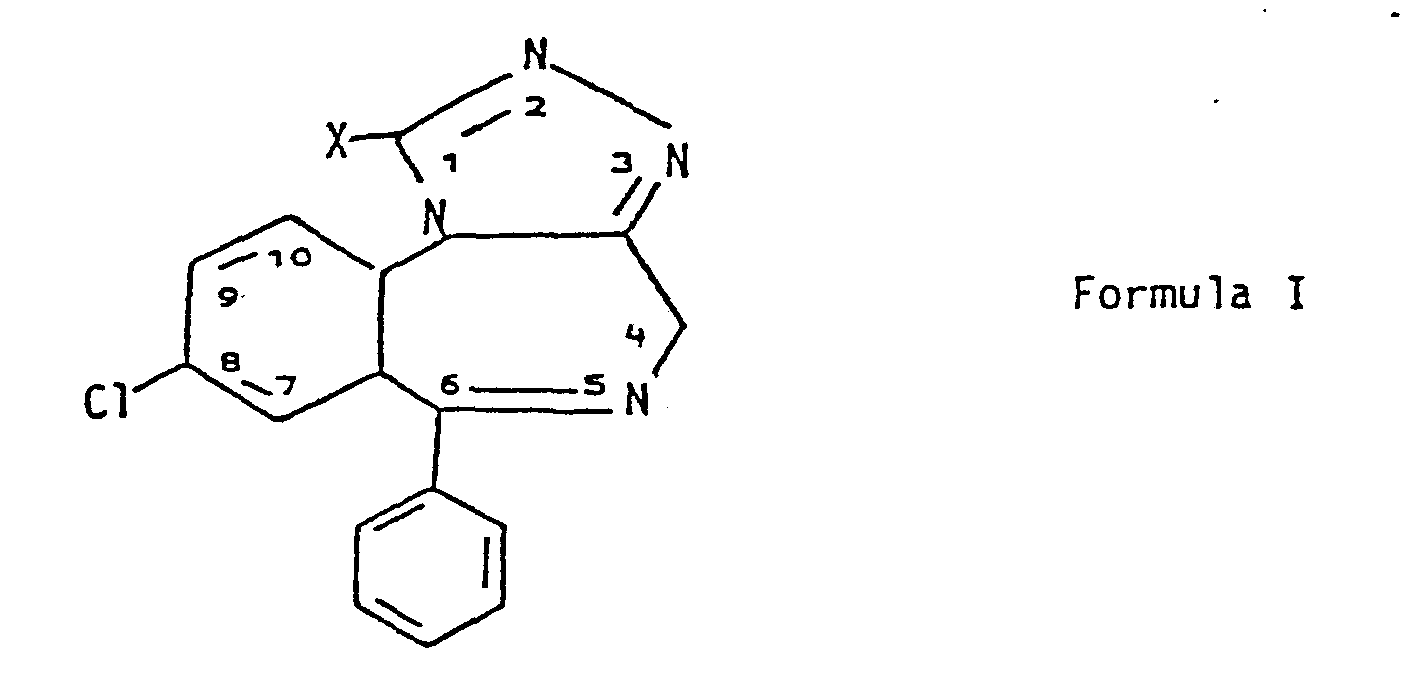
X is a member selected from the group consisting of -H, -CH3, -CH2-N=(CH3)2 and -CH2-O-R;
herein R is hydrogen, alkyl of from 1 to 3 carbon atoms, inclusive
or
wherein n is 0 to 16, inclusive, and m is 1 to 16, inclusive; or the pharmacologically
acceptable acid addition salt or a (5) N-oxide thereof,for preventing or treating
panic attacks.
-2-A compound of Claim 1 wherein the compound is 8-chloro-l-hydroxymethyl-6-phenyl-4H-s-tria
zolo[4,3-a][1,4]ben zodia zepine.
-3-A compound of Claim 1 wherein the compound is 8-chloro-6-phenyl-4H-s-triazolo[4,3-a][1,4]benzodiazepine.
-4-A compound of Claim 1 wherein the compound is 8-chloro-l-[(di- methylamino)-methyl]-6-phenyl-4H-s-[4,3-a][1,4]benzodiazepine.
-5-A compound of Claim 1 wherein the compound is 8-chloro-l-methyl-6-phenyl-4H-s-triazolo[4,3-a][1,4]benzodiazepine.