|
(11) | EP 0 104 562 B1 |

| (12) | EUROPEAN PATENT SPECIFICATION |
|
|
| (54) |
Polymer stabilization Stabilisierung von Polymeren Stabilisation de polymères |
|
|
|||||||||||||||||||||||||||||||
| Note: Within nine months from the publication of the mention of the grant of the European patent, any person may give notice to the European Patent Office of opposition to the European patent granted. Notice of opposition shall be filed in a written reasoned statement. It shall not be deemed to have been filed until the opposition fee has been paid. (Art. 99(1) European Patent Convention). |
Field of invention
[0001] This invention relates to improving the characteristics of arylene sulfide polymer compositions. In one aspect, this invention relates to the use of cure promoters in poly(arylene sulfide) polymer compositions. In another aspect, this invention relates to the use of cure promoters in poly(arylene sulfide) polymer compositions to enhance cross-linking or substantial alteration of physical properties during heating. In accordance with a further aspect, this invention relates to the use of metal salts of dihydrocarbyldithiophosphinic acid as curing agents for arylene sulfide polymers, e.g., poly(phenylene sulfide), the resulting polymer products, and to a process for enhancing the cure of such polymers.
Background of the invention
[0002] In the production of arylene sulfide polymers, it is sometimes desirable that the melt flow and molecular weight of the polymer be changed during processing of the polymer. Various procedures have been utilized to cause arylene sulfide polymers to change in physical properties during processing. It is well known that arylene sulfide polymers can be treated in a manner such that the polymer properties substantially change during heating of the polymer by incorporating into the polymer a curing promoter. A new group of curing agents has now been discovered.
[0003] Accordingly, an object of this invention is to provide a process for promoting the curing of arylene sulfide polymers.
[0005] Another object of this invention is to provide effective curing agents for poly(phenylene sulfide).
[0006] Other objects, aspects, and the several advantages of the invention will be apparent to those skilled in the art upon a study of the specification and the appended claims.
Summary of the invention
[0007] According to the invention, the curing of arylene sulfide polymers, exhibited as increased melt viscosity, is accelerated by the addition of a finite, but small effective amount of at least one metal salt of dihydrocarbyldithiophosphinic acid which promotes cross-linking of the polymer during heating.
[0008] In a specific embodiment of the invention, an arylene sulfide polymer, e.g., poly(phenylene sulfide) is heated in the presence of a finite, but small effective amount, sufficient to enhance curing (based on the storage modulus results obtained with a Rheometric Dynamic Spectrometer) of the polymer of at least one metal dihydrocarbyldithiophosphinate, particularly cobalt and zinc dicyclohexyldithiophosphinates.
Description of the preferred embodiments
[0009] The invention is applicable for use with any normally solid, heat curable, high molecular weight arylene sulfide polymer. Arylene sulfide polymers which can be employed in the process of this invention include arylene sulfide polymers which have a melt flow of at least about 10 and generally within the range of 20 to 400 and higher (determined by the method of ASTM D 1238-70, modified to a temperature of 316°C and using a 5-kg weight, the value being expressed as g/10 min.). Thus, the arylene sulfide polymers can be linear, branched or lightly cross-linked. The preferred arylene sulfide polymer is a linear poly(p-phenylene sulfide) (PPS) having a melting or softening point of at least 150°C, preferably 230°C to 330°C. Although the method by which the polymers of this description are produced is not critical, preferably the polymer employed' in the process is prepared by use of polyhaloaromatic compounds, alkali metal sulfides, and organic amides. For example, the arylene sulfide polymers for use in this invention can be produced by the method of U.S. Patent 3,354,129. Alternatively, and presently preferred the polymer employed can be prepared by use of a p-dihalobenzene, an alkali metal sulfide, an organic amide, and an alkali metal carboxylate as in U.S. Patent 3,919,177, optionally, together with an alkali metal hydroxide such as sodium hydroxide.
[0010] The metal salts of dihydrocarbyldithiophosphinic acid used as curing promoters according to the invention have the general formula
where M is a metal selected from among copper, zinc, chromium, manganese, cobalt and nickel, n is the valence of M and is generally 2, and R, R' are the same or different hydrocarbon (hydrocarbyl) radicals containing from 1 to 20 carbon atoms, preferably from 4 to 12 carbon atoms, selected from among alkyl, cycloalkyl, aryl and combinations thereof such as alkaryl. Cycloalkyl radicals are presently preferred.
Exemplary compounds include:
[0011]
copper(II) dimethyldithiophosphinate
copper(II) n-butyl-isobutyldithiophosphinate
zinc dicyclohexyldithiophosphinate
zinc dicycloheptyldithiophosphinate
zinc di-n-dodecyldithiophosphinate
chromium(II) diphenyldithiophosphinate
manganese(II) di-n-eicosyldithiophosphinate
cobalt dicyclohexyldithiophosphinate
cobalt dicyclooctyldithiophosphinate .
nickel(II) dibenzyldithiophosphinate and mixtures.
[0013] The amount of curing promoter incorporated into the arylene sulfide polymer will be a finite, effective amount sufficient to accelerate curing of the polymer. In general, the curing agent additives of this invention are employed in an amount within the range of 0.2 to 5, preferably 0.5 to 2 weight percent based on the weight of the arylene sulfide polymer.
[0014] In addition to the curing agent additives of this invention, the compositions can contain other ingredients conventionally employed in arylene sulfide polymer compositions. For instance, fillers such as titanium dioxide, calcium carbonate, aluminum oxide, aluminum silicate, ferric oxide, silicon dioxide, asbestos fibers, glass fibers, and poly(tetrafluoroethylene), pigments, resins, and/or plasticizers can be present.
[0015] The cure promoter can be incorporated into the arylene sulfide polymer at any stage of processing, preferably prior to being subjected to elevated temperature. In one practical application of the invention, the cure promoters are incorporated into the arylene sulfide polymer, such as a poly(phenylene sulfide) polymer, prior to forming articles by injection molding.
[0016] The processes of this invention of incorporating the cure promoters into the polymer can be conducted batch-wise or continuously.
[0017] The following examples are intended to illustrate the compositions and process of the invention.
Example
Sample preparation and test method
[0018] A series of samples was prepared by mixing individual portions of a linear poly(p-phenylene sulfide), abbreviated PPS, with a specified metal dihydrocarbyldithiophosphinate, when employed. The PPS was produced in the manner described in U.S. Patent 3,919,177. The recovered polymer was in the form of a powder (fluff) having a melt flow of 250 g/10 minutes as determined in accordance with ASTM D 1238-70, modified to a temperature of 316°C and using a 5 kg weight.
[0019] Generally, 15 g of the PPS powder was admixed with about 50 ml of an acetone solution containing 0.15 g of the metal dihydrocarbyldithiophosphinate. The solvent was removed by evaporation over a suitable period of time at ambient conditions, e.g. overnight or longer, if needed, in a laboratory fume hood. The dried powders were stirred and additionally dried in a vacuum oven at room temperature (about 23°C) for approximately 2 hours.
[0020] Discs measuring 1 xO.25 inches (2.54XO.64 cm) were compression molded from about 2.5 g of each mixture at room temperature by employing a mold and a laboratory press using a platen pressure of about 10,000 psig (69 MPa). Each cold molded disc was subsequently compression molded into test buttons measuring about 1x0.1875 inches (2.54x0.48 cm) at 325°C. The molding cycle typically comprised 2) minutes at a platen pressure of about 5,000-10,000 psig (34-69 MPa) and 2% minutes at a platen pressure of about 30,000 psig (207 MPa). While maintaining the latter pressure, heating was discontinued and cooling started by circulating tap water through the platens. When the mold temperature reached about 121°C, the pressure was released and the test button was removed from the mold.
[0021] Each test button was evaluated for changes in degree of crosslinking or melt viscosity in a test employing a Rheometric Dynamic Spectrometer. The test, which is useful in measuring the thermal stability of a sample, determines storage modulus of a sample as a function of time at a constant shear of 10 radians per second at 300°C.
[0022] The metal dihydrocarbyldithiophosphinates employed as additives in PPS and the test results obtained are given in the following Table.
[0023] The above results indicate that both CDP and ZDP initially decrease the melt viscosity of PPS based on the melt flow test at 316°C as shown by the greater values for invention runs 2 and 3. Little or no mixing occurs in the melt flow test because of its nature. However, under dynamic conditions such as those imposed in the RDS test, it is apparent that much different results are obtained with cobalt and zinc dicyclohexyldithiophosphinates since after 2 minutes into the test their storage modulus values are about 1.5 times and about 1.3 times greater, respectively, than that of the control. As the test progresses to 20 minutes the disparity between the control and invention runs becomes even greater, e.g. the cobalt salt-containing sample has a storage modulus value about 2.8 times greater than the control and the zinc salt-containing sample has a storage modulus value about 2.4 times greater than, the control. Since melt viscosity (degree of crosslinking) is directly proportional to storage modulus it is clear that the cobalt and zinc salts are acting as cure promoters for PPS as compared to the control in view of their substantially greater storage modulus values which accelerate throughout the length of the test.
1. A polymer composition comprising a poly(arylene sulfide) and at least one metal
salt of dihydrocarbyl dithiophosphinic acid.
2. The composition of claim 1 characterized in that said metal salt has the formula

wherein M is a metal selected from copper, zinc, chromium, manganese, cobalt and nickel, n is the valence of M, and R, R' are the same or different hydrocarbyl radicals containing from 1 to 20 carbon atoms.
wherein M is a metal selected from copper, zinc, chromium, manganese, cobalt and nickel, n is the valence of M, and R, R' are the same or different hydrocarbyl radicals containing from 1 to 20 carbon atoms.
3. The composition of claim 2 characterized in that R, R' are the same or different
hydrocarbyl radicals containing from 4 to 12 carbon atoms selected from alkyl, cycloalkyl,
aryl and alkaryl.
4. The composition of claim 3 characterized in that said salt is cobalt or zinc dicyclohexyldithiophosphinate.
5. The composition of any of claims 1 to 4 characterized in that the amount of metal
salt present ranges from 0.2 to 5 weight percent based on the weight of said polymer.
6. The composition of any of claims 1 to 5 characterized in that said poly(arylene
sulfide) is poly(p-phenylene sulfide).
7. The composition of claim 6 characterized in that said poly(p-phenylene sulfide)
has a melt flow from 20 to 400 g/10 min.
8. A method for increasing the melt viscosity of arylene sulfide polymers characterized
by incorporating therein at least one metal salt of dihydrocarbyldithiophosphinic
acid.
9. The method of claim 8 characterized in that said metal salt of dihydrocarbyldithiophosphinic
acid and/or said arylene sulfide polymer are as defined in any of claims 2 to 7.
10. The use of the composition of one of claims 1 to 7 for making molded articles.
1. Polymer-Masse, enthaltend ein Poly(arylensulfid) und mindestens ein Metallsalz
von Dihydrocarbyldithiophosphinsäure.
2. Masse nach Anspruch 1, dadurch gekennzeichnet, daß das Metallsalz die Formel

besitzt, wobei M ein Metall, ausgewählt aus Kupfer, Zinc, Chrom, Mangan, Kobalt und Nickel ist, n die Wertigkeit von M bedeutet, und R, R' die gleichen oder verschiedene Hydrocarbyl-Reste bedeuten, die 1 bis 20 Kohlenstoffatome enthalten.
besitzt, wobei M ein Metall, ausgewählt aus Kupfer, Zinc, Chrom, Mangan, Kobalt und Nickel ist, n die Wertigkeit von M bedeutet, und R, R' die gleichen oder verschiedene Hydrocarbyl-Reste bedeuten, die 1 bis 20 Kohlenstoffatome enthalten.
3. Masse nach Anspruch 2, dadurch gekennzeichnet, daß R, R' die gleichen oder unterschiedliche
Hydrocarbyl-Reste bedeuten, die 4 bis 12 Kohlenstoffatome enthalten, ausgewählt aus
Alkyl, Cycloalkyl, Aryl und Alkaryl.
4. Masse nach Anspruch 3, dadurch gekennzeichnet, daß das Salz Kobalt- oder Zink-dicyclohexyldithiophosphinat
ist.
5. Masse nach einem der Ansprüche 1 bis 4, dadurch gekennzeichnet, daß die Menge des
anwesenden Metallsalzes 0,2 bis 5 Gewichtsprozent, bezogen auf das Gewicht des Polymeren,
beträgt.
6. Masse nach einem der Ansprüche 1 bis 5, dadurch gekennzeichnet, daß das Poly(arylensulfid)
Poly(p-phenylensulfid) ist.
7. Masse nach Anspruch 6, dadurch gekennzeichnet, daß das Poly(phenylensulfid) einen
Schmelzfluß von 20 bis 400 g/min besitzt.
8. Verfahren zur Erhöhung der Schmelz-Viskosität von Arylensulfid-Polymeren, gekennzeichnet
durch die Einverleibung mindestens eines Metallsalzes von Dihydrocarbyldithiophosphinsäure.
9. Verfahren nach Anspruch 8, dadurch gekennzeichnet, daß das Metallsalz von Dihydrocarbyldithiophosphinsäure
und/oder das Arylensulfid-Polymere gemäß der Definition in einem der Ansprüche 2 bis
7 sind.
10. Verwendung der Masse nach einem der Ansprüche 1 bis 7 zur Herstellung geformte
Teile.
1. Composition de polymère comprenant un poly(sulfure d'arylène) et au moins un sel
métallique d'un acide dihydrocarbyle dithiophosphinique.
2. Composition selon la revendication 1, caractérisée en ce que ce sel métallique
répond à la formule:
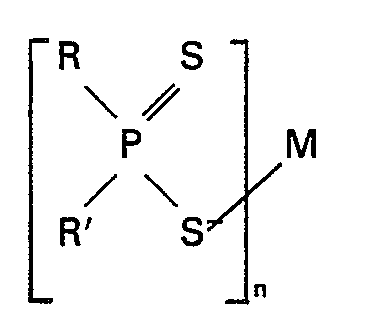
dans laquelle M est un métal choisi parmi le cuivre, le zinc, le chrome, le manganèse, le cobalt et le nickel, n est la valence de M et R, R' sont des radicaux hydrocarbyle identiques ou différents en Cl à C20.
dans laquelle M est un métal choisi parmi le cuivre, le zinc, le chrome, le manganèse, le cobalt et le nickel, n est la valence de M et R, R' sont des radicaux hydrocarbyle identiques ou différents en Cl à C20.
3. Composition selon la revendication 2, caractérisée en ce que R, R' sont des radicaux
hydrocarbyle identiques ou différents contenant de 4 à 12 atomes de carbone, choisis
parmi les radicaux alkyle, cycloalkyle, aryle et alcaryle.
4. Composition selon la revendication 3, caractérisée en ce que ce sel est le dicyclohexyldithiophosphinate
de cobalt ou de zinc.
5. Composition selon l'une quelconque des revendications 1 à 4, caractérisée en ce
que la quantité de sel métallique présente va de 0,2 à 5% en poids par rapport au
poids de ce polymère.
6. Composition selon l'une quelconque des revendications 1 à 5, caractérisée en ce
que ce poly(sulfure d'arylène) est un poly(sulfure de p-phénylène).
7. Composition selon la revendication 6, caractérisée en ce que ce poly(sulfure de
p-phénylène) a un indice de fusion de 20 à 400 g/10 min.
8. Procédé pour augmenter la viscosité à l'état fondu des polymères du sulfure d'arylène,
caractérisé en ce qu'on leur incorpore au moins un sel métallique d'un acide dihydrocarbyldithiophosphinique.
9. Procédé selon la revendication 8, caractérisé en ce que ce sel métallique d'acide
dihydrocarbyldithiophosphinique et/ou ce polymère du sulfure d'arylène sont tels que
définis dans l'une quelconque des revendications 2 à 7.
10. Utilisation de la composition selon l'une quelconque des revendications 1 à 7,
pour fabriquer des articles moulés.