|
(11) | EP 0 104 666 B2 |

| (12) | NEW EUROPEAN PATENT SPECIFICATION |
|
|
| (54) |
Production of formaldehyde Verfahren zur Herstellung von Formaldehyd Préparation du formaldéhyde |
|
|
|||||||||||||||||||||||||||||||
|
||||||||||||||||||||||||||||||||
Background of the invention
Field of the invention
[0001] This invention is concerned with an improvement in the production of formaldehyde from methanol. In particular, it relates to such a process where use of small amounts of phosphorus containing compounds improve selectivity to formaldehyde.
Prior art
[0002] The catalytic conversion of methanol to produce formaldehyde has been known since 1878. The use of silver catalysts for such a process has been known since at least 1908 and is disclosed in German Patent No. 228,687. Other metals or metal alloys as well as metal oxides have also been suggested and used for this process.
[0003] Commercially there are two processes that are in widespread use. The first utilizes silver as the catalyst. This process is carried out in a methanol rich atmosphere. The second uses a metal oxide catalyst and operates in an oxygen rich atmosphere. Basically the first process is operated at approximately one to three atmospheres absolute, although other pressure ranges can be employed if desired. Methanol and air are passed over a stationary bed of the catalyst. The overall reaction is exothermic in nature and can operate anywhere between 450-750°C depending upon process and product requirements. The mixture which is passed through the catalyst bed is not restricted to methanol and air only since various diluents have been disclosed in the literature. Diluents may consist of steam, carbon oxides, and recycled off gases, including formaldehyde.
[0004] The mechanism of formaldehyde production is believed to be a combination of two reactions, namely the dehydrogenation and oxidative dehydrogenation of methanol.
[0005] Depending upon the conversion required, the silver catalyzed process can be operated in stages. Single stage operation allows only moderate amounts of methanol to be converted in a single pass limited by reaction temperature unless a heat sink such as inerts or water is employed. This necessitates distillation of unreacted methanol from the product formaldehyde and entails substantial investment in distillation facilities.
[0006] Another way to operate the process which eliminates distillation or other concentration facilities is to use two or more catalytic stages with interstage cooling. A basic two stage process is disclosed in U.S. Patent No. 2,462,413 to Meath. An improvement over the Meath process where even lower amounts of methanol in the product can be obtained is disclosed in U.S. Patent No. 3,959,383 issued to Northheimer. A modification of the process for the preparation of formaldehyde in the presence of a silver catalyst is disclosed in U.S. Patent No. 4,098,826. A gas containing a halogen or halogen compound is fed into the reaction mixture in order to increase the yield of formaldehyde.
[0007] The use of substantial amounts of trisubstituted organic phosphates and small, but an undetermined amount of phosphine in the production of ethylene oxide from ethylene and air at operating temperatures of -310°C using a supported silver catalyst is disclosed in U.S. Patent No. 2,587,468 issued to R. L. Heider.
Summary of the invention
[0008] It has been discovered that in the conversion of methanol to formaldehyde, the selectivity of the process to produce formaldehyde is increased when very small amounts of phosphorus containing compounds with the exception of phosphorus triiodide are co-fed to the reactor. This is observed when the reactor is operated in a single stage with or without added water vapor or in the dual stage where two reactors operate in series. Such selectivity improvement has been demonstrated with silver, silver-gold and copper-gold catalysts.
Detailed description of the invention
[0009] The present invention pertains to the discovery that use of a very small amount of phosphorus or a phosphorus containing compound in the reactor feed increases selectivity to formaldehyde. The terms "conversion" and "selectivity" used in the specification, examples and claims are defined as follows:
[0010] For the sake of convenience, the phosphorus or phosphorus containing compound may hereafter be sometimes referred to as "moderator" or "catalyst moderator". Moderator or catalyst moderator means in addition to elemental phosphorus, a phosphorus containing compound where the phosphorus is in a formal oxidation state of +3 or +5. The valences for the oxidation states can be satisfied by hydrogen, oxygen, sulfur, hydroxy, thiol, or carbon containing species. The carbon containing species may be aliphatic or aromatic as well as ester functions containing an oxycarbon bond. Obviously, the substituted phosphorus containing compound does not have to be symmetrical since unlike groups can be attached to satisfy the valence requirements.
[0011] The preferred method of adding a catalyst moderator to a reactor is to mix it with the methanol vapor inlet stream by direct injection through a jet nozzle or other suitable dispersing device. Alternatively, one can mix it with the methanol prior to vaporization provided decomposition reactions in the vaporizer can be minimized, a phosphorus compound which is soluble in methanol is being used and the boiling point of the moderator is such that known amounts can be vaporized. The former method is preferable when employing a moderator whose boiling point is greater than 100°C. Other methods of moderator introduction will be obvious to those skilled in the art, the only requirement being that the moderator be part of the reaction mixture entering the reactor.
[0012] The quantity of the catalyst moderator used is very small. Depending on the particular moderator used the amount of phosphorus it provides will not be greater than 15 ppm, but can be as low as 0.001 ppm (parts per million) both by weight based on the weight of methanol in the reaction mixture. It is not to be construed that the actual catalyst moderator is phosphorus itself since it is not known what happens to phosphorus or a phosphorus containing compound in the immediate vicinity of the catalyst or on the catalyst surface itself. What is known is that these do not permanently stay on the catalyst since the performance of the catalyst reverts back to its original unmoderated state some finite time after moderator addition is stopped. The examples provided refer to parts per million of the moderator used by weight based on the weight of methanol since the effect of molecular structure, association, hydrogen bonding, etc., by themselves or in combination thereof are not precisely known. Therefore, the amount of moderator needed will vary with the type of moderator used but when calculated on a phosphorus basis, the amount of phosphorus they provide will be from 0.001 to 15 ppm by weight, based on the weight of methanol in the reaction mixture. If too much moderator is used, loss of reaction occurs although the effect is not permanent.
[0013] The preferred phosphorus compounds are the organophosphites and organophosphates of the formulas
where -R, -R1, -R2, -R3, -R4 and -R5 are the same or different, and selected from the class consisting of alkyl groups containing from 1 to 12 carbon atoms, aryl groups containing from 6 to 12 carbon atoms, alkaryl groups containing from 7 to 12 carbon atoms and OH.
[0014] Such preferred phosphorus containing compounds include trimethyl, triethyl, triisopropyl, tributyl phosphites, and phosphates. As representatives of aryl substituents triphenyl and tricresyl phosphites and phosphates are preferred. Di- and mono-alkyl and aryl phosphites as well as the completely hydrolyzed acids are also preferred since hydrolysis of organophosphorus compounds is known to result in total hydrolysis or to a mixture of hydrolyzed species depending on the severity of reaction conditions.
[0015] In a preferred aspect of the invention from 0.1 to 1.0 mole of water vapor per mole of methanol is present in the feed to the catalyst bed to facilitate hydrolysis of the phosphorus compound.
[0016] It is to be understood that the phosphorus can be fed in any form which will convert to an organo phosphorus compound under the reaction conditions, i.e., in the presence of methanol, oxygen (and optionally watervapor) at 450° to 750°C. Thus elemental phosphorus, phosphoric acid, phosphorous acid, PCI3, etc. when added to the reaction system will form the requisite organo phosphorus compounds.
[0017] In a typical formaldehyde process, using silver, silver-gold or copper-gold catalyzed reactors, methanol is fed to a vaporizer then to a superheater where the temperature is raised to from about 140 to about 180°C. The superheated methanol is mixed with air and fed to the reactor which is operated at from 450° to 750°C. Optionally the product gases from the reactor can be mixed with additional air and sent to a second reactor to increase conversion of methanol to formaldehyde. The gases finally are sent to an absorber where they are cooled to from 25 to 45°C. Product formaldehyde in water, as 40 to 60% formaldehyde, is removed from the absorber.
[0018] The catalysts useful herein are silver, silver-gold alloys containing from 25 to 75 atomic percent silver and the remainder gold, and copper-gold alloys containing from 25 to 75 atomic percent copper and the remainder gold.
[0019] The moderators of this invention should find general use in heterogeneously catalyzed oxidation reactions as well, such as the conversion of propylene to acrolein and butadiene to furan.
Example 1
[0020] A 10 mm (I.D.) quartz tube is filled to a depth of one inch (25.4 mm) with silver crystals which pass a 10 mesh screen and are retained on a 60 mesh screen (Tyler Sieve Series). Methanol, 1.3 g/min., is vaporized and mixed with preheated air to furnish the desired oxygen to methanol ratio reported in Table 1 and passed through the catalyst bed. The catalyst section is heated externally to initiate reaction and once initiated the external heat is adjusted to maintain at the value reported in Table 1. When water vapor is used in the feed in addition to methanol and air, liquid water is vaporized to give the water to methanol ratios reported in Table 1. Triethylphosphite moderator is premixed with the methanol to give moderator levels reported in Table 1 when studying the effect of moderator. The product from the reactor is analyzed by gas chromatography to determine conversion and selectivity. The amount of triethylphosphite (or other moderators) reported in Tables 1 to 8 is based on the amount of methanol fed to the catalyst bed. Runs 1 and 4 are control Runs without moderator. The results are reported in Table 1.
Example 2
[0021] Example 1 is repeated except trimethylphosphite is used as the moderator in Runs 9, 10, 11 and 12 and trimethylphosphate is used as the moderator in Runs 14 and 15. Runs 8 and 13 are control runs without moderator. The results are reported in Table 2.
Example 3
[0022] Two 10 mm (ID.) quartz tubes are filled to a depth of one inch (25.4 mm) with silver crystals as described in Example 1. The two tubes are connected in series with provision to add air to the effluent from the first tube prior to entering the second tube. The reaction in the first tube is initiated with methanol (1.3 g/min.) and air as described in Example 1. The reaction in the second tube is initiated with product from the first reactor and additional air. Both tubes have external heaters around the catalyst section. After reaction is initiated these heaters are adjusted to maintain the values reported for two-stage operation. The product from the second stage is analyzed by gas chromatography to determine conversion and selectivity. The amount of moderator is based on the amount of methanol fed to the first catalyst bed. Runs 16, 17, 23 and 26 are control runs without moderator. In runs 18, 19 and 27 the moderator is trimethylphosphite. In runs 20, 21 and 22 the moderator is triethylphosphite. In runs 24 and 25 the moderator is tri-n-butylphosphite. The results are reported in Table 3.
Example 4
[0023] Example 3 is repeated except crystals of a copper and gold alloy in a one to one atomic ratio are used as the catalyst and trimethylphosphite is used as the moderator in Runs 29, 30, 32 and 33. Runs 28 and 31 are a control run without moderator. The results are reported in Table 4.
Example 5
[0024] Example 3 is repeated except the catalyst bed in the second quartz tube is crystals of a silver-gold alloy 170/30 atomic ratio). The moderator in Runs 35 and 36 is triethylphosphite. Run 34 is the control run without moderator. The results are reported in Table 5.
Example 6
[0025] Example 1 is repeated except dimethylphosphite is injected into the methanol vapors in Runs 38 and 39 rather than being premixed with the methanol. Water is not used. Run 37 is the control run without moderator. The results are reported in Table 6.
Example 7
[0026] The use of a moderator is tested in a two-stage process where both reactors are one inch 125.4 mm) in diameter. The operation is similar to Example 3 except that the amount of methanol fed is 7.0 g/min. and trimethylphosphite moderator is directly injected into the gaseous product stream from the first-stage reactor before entering the second stage. Run 40 is a control without moderator and run 41 is with moderator, the amount of moderator being based on the amount of methanol fed to the first reactor. The results are reported in Table 7.
Example 8
[0027] Example 1 is repeated except triphenylphosphite is used as the moderator in Runs 43 and 44, phosphorus acid dissolved in methanol in Run 46 and dimethyl methyl phosphonate in Run 47. All these moderators are directly injected into the methanol vapor stream. In Run 49 phosphorus acid dissolved in water is directly injected into the methanol stream. Runs 42, 45 and 48 are controls without moderator. The results are reported in
1. An oxidation process comprising contacting methanol in the presence of oxygen with
a catalyst comprising silver, silver-gold alloys or copper-gold alloys, at from 450°
to 750°C wherein a catalyst moderator is added to the reaction mixture, characterized
by from 0.001 to 15 parts per million, based on methanol, of phosphorus from a phosphorus
source, with the exception of phosphorus triiodide, being present, and recovering
the formaldehyde.
2. The process of claim 1 wherein the phosphorus source is injected into the methanol
vapor prior to contacting the catalyst.
3. The process of claim 2 wherein the phosphorus source is in the form of
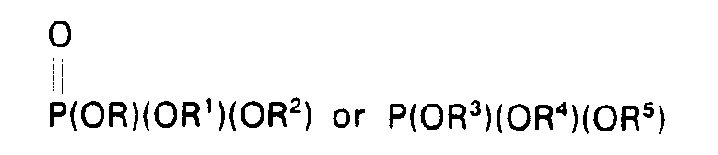
wherein -R, -R1, -R2, -R3, -R4 and -R5 are the same or different and are selected from the class consisting of alkyl groups containing from 1 to 12 carbon atoms, aryl groups containing from 6 to 12 carbon atoms, alkaryl groups containing from 7 to 12 carbon atoms and OH.
wherein -R, -R1, -R2, -R3, -R4 and -R5 are the same or different and are selected from the class consisting of alkyl groups containing from 1 to 12 carbon atoms, aryl groups containing from 6 to 12 carbon atoms, alkaryl groups containing from 7 to 12 carbon atoms and OH.
4. The process of claim 3 wherein from 0. 1 to 1.0 mole of water vapor is present
per mole of methanol in the feed to the catalyst.
5. The process of claim 4 wherein from 0.01 to 5 parts per million, calculated as
phosphorus, based on methanol, from the phosphorus source is present.
6. The process of claim 5 wherein the catalyst is silver.
7. The process of claim 5 wherein the catalyst is a gold-silver alloy containing from
25 to 75 mole % gold and the remainder silver.
8. The process of claim 5 wherein the catalyst is a copper-gold alloy containing from
25 to 75 mole % copper and the remainder gold.
1. Oxidationsverfahren, umfassend das Inkontaktbringen von Methanol mit einem Silber,
Silber-Gold-Legierungen oder Kupfer-Gold-Legierungen enthaltenden Katalysator in Geger-wart
von Sauerstoff bei 450° bis 750°C, wobei ein Moderator für den Katalysatorzum Reaktionsgemisch
gegeben wird, gekennzeichnet durch die Gegenwart von 0,001 bis 15 ppm, bezogen auf
Methanol, Phosphor aus einer Phosphorquelle, mit Ausnahme von Phosphortrijodid, und
die Gewinnung des Formaldehyds.
2. Verfahren nach Anspruch 1, worin die Phosphorquelle in den Methanoldampf vor dem
Inkontaktbringen mit dem Katalysator injiziert wird.
3. Verfahren nach Anspruch 2, worin die Phosphorquelle in Form von

worin -R, -R1, -2, -R3, -R4 und -R5 gleich oder verschieden sind und ausgewählt werden aus der Klasse, bestehend aus Alkylgruppen mit 1 bis 12 Kohlenstoffatomen, Arylgruppen mit 6 bis 12 Kohlenstoffatomen, Alkarylgruppen mit 7 bis 12 Kohlenstoffatomen und -OH, vorliegt.
worin -R, -R1, -2, -R3, -R4 und -R5 gleich oder verschieden sind und ausgewählt werden aus der Klasse, bestehend aus Alkylgruppen mit 1 bis 12 Kohlenstoffatomen, Arylgruppen mit 6 bis 12 Kohlenstoffatomen, Alkarylgruppen mit 7 bis 12 Kohlenstoffatomen und -OH, vorliegt.
4. Verfahren nach Anspruch 3, worin 0,1 bis 1,0 Mol Wasserdampf pro Mol Methanol in
der Speisung für den Katalysator vorhanden sind.
5. Verfahren nach Anspruch 4, worin 0,01 bis 5 ppm, berechnet als Phosphor, bezogen
auf Methanol, der Phosphorquelle vorhanden sind.
6. Verfahren nach Anspruch 5, worin der Katalysator Silber ist.
7. Verfahren nach Anspruch 5, worin der Katalysator eine 25 bis 75 Mol-% Gold und
Rest Silber enthaltende Gold-Silber-Legierung ist.
8. Verfahren nach Anspruch 5, worin der Katalysator eine 25 bis 75 Mol-% Kupfer und
Rest Gold enthaltende Kupfer-Gold-Legierung ist.
1. Un procédé d'oxydation comprenant la mise en contact de méthanol en présence d'oxygène
avec un catalyseur comprenant de l'argent, des alliages argent-or ou des alliages
cuivre-or, à 450 à 750°C, dans lequel un modérateur de catalyseur est ajouté au mélange
réactionnel, caractérisé par la présence de 0,01 à 15 parties par million, par rapport
au méthanol, de phosphore provenant d'une source de phosphore, à l'exception du triio-
dure de phosphore, et par la récupération du formaldéhyde.
2. Le procédé de la revendication 1, dans lequel la source de phosphore est injectée
dans la vapeur de méthanol avant mise en contact avec le catalyseur.
3. Le procédé de la revendication 2, dans lequel la source de phosphore est de la
forme

où -R, -R1, -R2, -R3, -R4 et -R5 sont identiques ou différents et sont choisis dans la classe formée par les groupes alkyles contenant de 1 à 12 atomes de carbone, les groupes aryles contenant de 6 à 12 atomes de carbone, les groupes alkaryles contenant de 7 à 12 atomes de carbone et -OH.
où -R, -R1, -R2, -R3, -R4 et -R5 sont identiques ou différents et sont choisis dans la classe formée par les groupes alkyles contenant de 1 à 12 atomes de carbone, les groupes aryles contenant de 6 à 12 atomes de carbone, les groupes alkaryles contenant de 7 à 12 atomes de carbone et -OH.
4. Le procédé de la revendication 3, dans lequel est présente une proportion de 0,1
à 1,0 mole de vapeur d'eau par mole de méthanol dans l'alimentation envoyée au catalyseur.
5. Le procédé de la revendication 4, dans lequel est présente une proportion de 0,01
à 5 parties par million, calculée en phosphore et rapportée au méthanol, de la source
de phosphore.
6. Le procédé de la revendication 5, dans lequel le catalyseur est de l'argent.
7. Le procédé de la revendication 5, dans lequel le catalyseur est un alliage or-argent
contenant de 25 à 75 moles % d'or et le reste d'argent.
8. Le procédé de la revendication 5, dans lequel le catalyseur est un alliage cuivre-or
contenant de 25 à 75 moles % de cuivre et le reste d'or.