| (19) |
 |
|
(11) |
EP 0 105 653 B1 |
| (12) |
EUROPEAN PATENT SPECIFICATION |
| (45) |
Mention of the grant of the patent: |
|
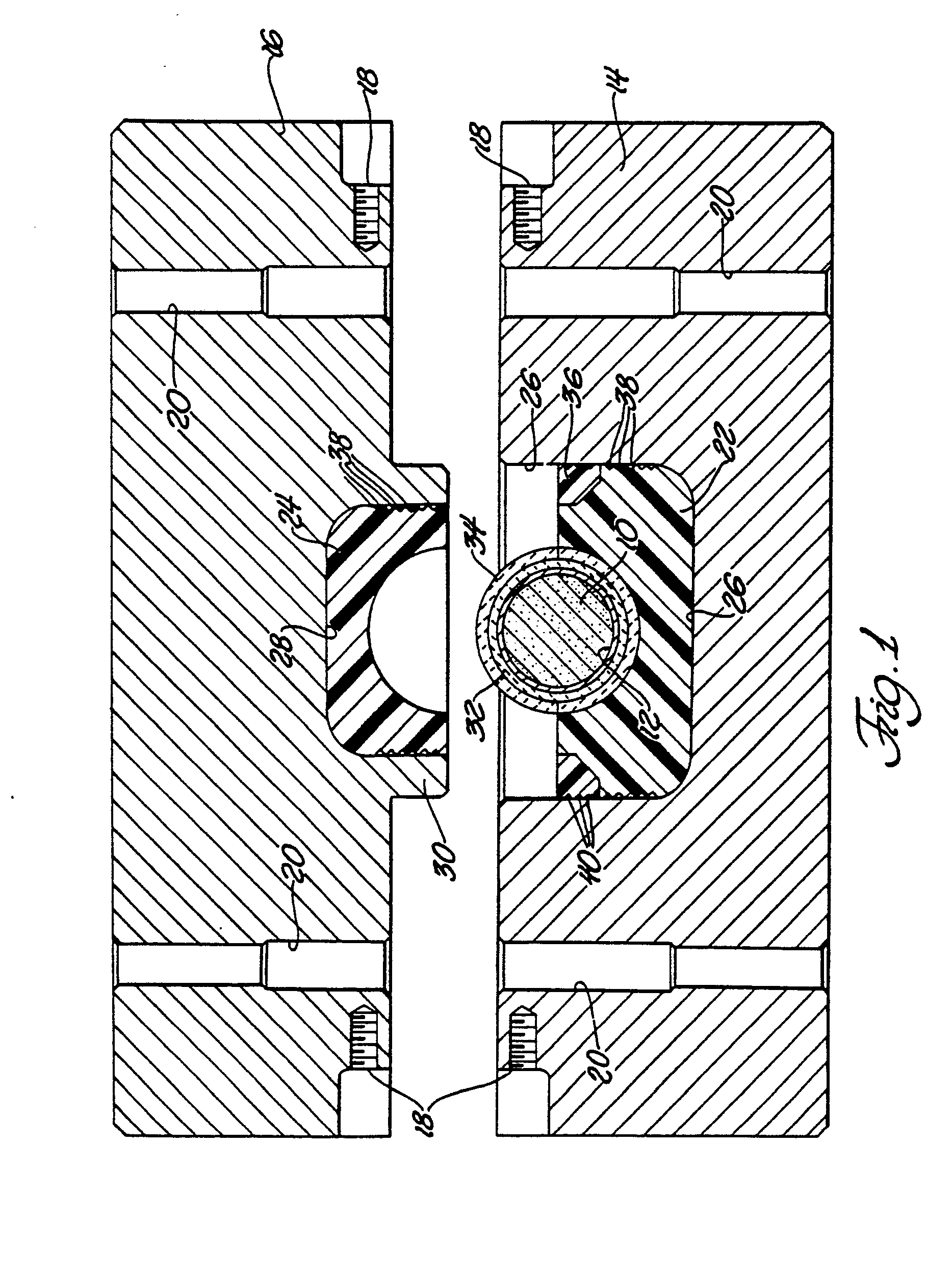
13.01.1988 Bulletin 1988/02 |
| (22) |
Date of filing: 16.09.1983 |
|
| (51) |
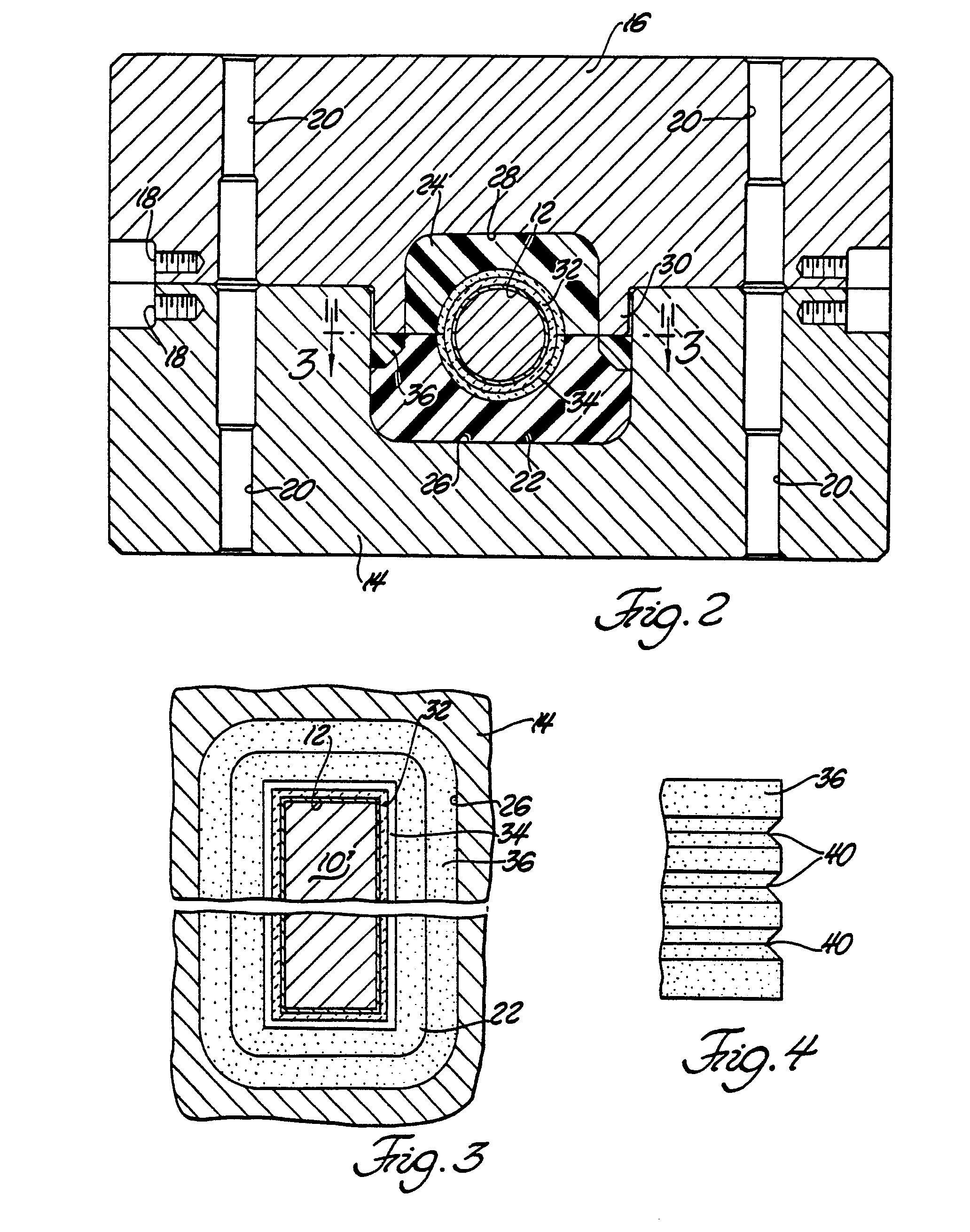
International Patent Classification (IPC)4: B22F 3/14 |
|
| (54) |
Method and assembly for hot consolidating materials
Verfahren und Vorrichtung zum Heissverdichten von Material
Procédé et dispositif pour la consolidation à chaud d'un matériau
|
| (84) |
Designated Contracting States: |
|
AT BE CH DE FR GB IT LI LU NL SE |
| (30) |
Priority: |
20.09.1982 US 419435
|
| (43) |
Date of publication of application: |
|
18.04.1984 Bulletin 1984/16 |
| (73) |
Proprietor: THE DOW CHEMICAL COMPANY |
|
Midland
Michigan 48640-1967 (US) |
|
| (72) |
Inventor: |
|
- Rozmus, Walter J.
Traverse City
Michigan 49684 (US)
|
| (74) |
Representative: Wharton, Peter Robert et al |
|
Urquhart-Dykes & Lord
Inventions House
Valley Court, Canal Road
Bradford BD1 4SP
Bradford BD1 4SP (GB) |
| (56) |
References cited: :
EP-A- 0 014 975
FR-A- 1 338 493
FR-A- 2 002 433
|
EP-A- 0 039 014
FR-A- 1 420 799
FR-A- 2 453 701
|
|
| |
|
|
|
|
| |
|
| Note: Within nine months from the publication of the mention of the grant of the European
patent, any person may give notice to the European Patent Office of opposition to
the European patent
granted. Notice of opposition shall be filed in a written reasoned statement. It shall
not be deemed to
have been filed until the opposition fee has been paid. (Art. 99(1) European Patent
Convention).
|
Technical Field
[0001] The subject invention is used for consolidating material of metallic and nonmetallic
powder compositions and combinations thereof to form a predetermined densified compact.
Consolidation is usually accomplished by evacuating a container and filling the container
with a powder to be consolidated and thereafter hermetically sealing the container.
Pressure is then applied to the filled and sealed container to subject the powder
to pressure. Typically, heat is also applied to heat the powder to a compaction temperature.
The combination of heat and pressure facilitates consolidation of the powder.
Background Art
[0002] It is well-known to place a hermetically sealed container with the powder therein
in an autoclave or hot isostatic press where it is subjected to heat and gas pressure.
[0003] Because of the expense and limitations of an autoclave or hot isostatic press, there
have been significant developments made wherein the powder to be compacted is encapsulated
in a substantially fully dense and incompressible container providing a pressure-transmitting
medium which maintains its configurational integrity while being handled both at ambient
temperatures and at the elevated compaction temperatures, yet becomes fluidic and
capable of plastic flow when pressure is applied to the entire exterior surface thereof
to hydrostatically compact the powder. Typically,the powder is hermetically encapsulated
within the pressure-transmitting medium which is thereafter heated to a temperature
sufficient for compaction and densification of the powder. After being sufficiently
heated, the pressure-transmitting medium with the powder therein may be placed between
two dies of a press which are rapidly closed to apply pressure to the entire exterior
of the pressure-transmitting medium. The pressure-transmitting medium, at least immediately
prior to a selected predetermined densification, must be fully dense and imcompressible
and capable of flow so that the pressure transmitted to the powder is hydrostatic
and, therefore, from all directions, i.e., omnidirectional. After the material is
densified to the desired degree, the pressure-transmitting medium defining the container
must be removed from the compacted material and in so doing the integrity of the pressure-transmitting
medium is lost whereby either the pressure-transmitting medium is no longer usable
or must be completely recycled to fabricate a new container.
[0004] In French patent no. 2002433 there is disclosed a device using a pressure-transmitting
medium of elastomeric nature.
Summary of the Invention and Advantages
[0005] The subject invention is for consolidating material of metallic and nonmetallic compositions
and combinations thereof to form a densified compact of predetermined density wherein
a quantity of such material which is less dense than the predetermined density is
heated and disposed in a cavity in a pressure-transmitting medium to which external
pressure is applied to the entire exterior of the medium to cause a predetermined
densification of the material by hydrostatic pressure applied by the medium in response
to the medium being substantially fully dense and incompressible and capable of elastic
flow at least just prior to the predetermined densification, the pressure-transmitting
medium being an elastomeric medium. The invention is characterised by encapsulating
the material in a thermal insulating barrier means disposed within the cavity of the
elastomeric medium to establish a thermal barrier between the material to be compacted
and the elastomeric medium prior to applying pressure to the medium to limit heat
transfer between the material and the elastomeric medium.
[0006] In order to effect compaction hydrostatically through a substantially fully dense
and incompressible medium in a press, the press must provide sufficient force to cause
plastic flow of the medium. Typically, the material to be compacted is placed within
a pressure-transmitting medium which is, in turn, placed in a press where it is subjected
to forces rendering it fluid and capable of transmitting forces hydrostatically to
the material to be compacted and in so doing the pressure-transmitting medium changes
shape. Additionally, the pressure-transmitting medium totally encapsulates the material
being compacted and loses its integrity upon being moved from the compacted material.
Because the pressure-transmitting medium changes shape during the compaction and has
its integrity destroyed by being removed from the compacted material, it either cannot
be reused or must undergo significant processing for reuse. An advantage of the subject
invention is that the pressure-transmitting medium comprises an elastomeric medium
which becomes fully dense and incompressible and capable of elastic flow just prior
to the predetermined densification of the compact, yet is sufficiently elastic to
return to its initial configuration for continued and repetitive reuse and compaction.
This may be accomplished in accordance with the instant invention by utilizing a thermal
insulating barrier means between the elastomeric medium and the heated material to
be compacted so that the integrity of the elastomeric medium is not degraded by the
heat and may be used repetitively.
Brief Description of the Drawings
[0007] Other advantages of the present invention will be readily appreciated as the same
becomes better understood by reference to the following description when considered
in connection with the accompanying drawings wherein:
FIGURE 1 is a cross-sectional view of an assembly utilized in accordance with the
subject invention disposed in the open position;
FIGURE 2 is a cross-sectional view similar to FIGURE 1 showing the assembly in a closed
position;
FIGURE 3 is a fragmentary cross-sectional view taken along line 3-3 of FIGURE 2; and
FIGURE 4 is a fragmentary view of a portion of the exterior surface of a seal utilized
in the assembly of the subject invention.
Description of the Invention
[0008] The subject invention may be utilized for consolidating various metallic powders
and non- metallic powders, as well as combinations thereof, to form a densified compact.
In accordance with the invention, the degree of density of the powder is increased
to a predetermined or desired density which may be full density or densification or
less than full density or densification.
[0009] The invention relates to a method for consolidating material of metallic and nonmetallic
compositions and combinations thereof to form a densified compact of a predetermined
density wherein a quantity of such material which is less dense than the predetermined
final density is encapsulated in a pressure-transmitting medium to which external
pressure is applied to the entire exterior of the medium to cause a predetermined
densification of the encapsulated material by hydrostatic pressure applied by the
medium in response to the medium being substantially fully dense and incompressible
and capable of elastic flow, i.e., fluidic, at least just prior to the predetermined
densification. In other words, the medium transmits pressure hydrostatically like
a liquid omnidirectionally about the material for compaction thereof.
[0010] As the invention is illustrated, a quantity of less than fully dense powder 10 fills
and is encapsulated within a container 12. The container 12 is evacuated as by a vacuum
through a tube (not shown) and then is filled with the powder 10 under vacuum through
the tube. After filling, the tube is sealed to hermetically seal the container 12
with the powder 10 under a vacuum therein. The container 10 is a thin-walled and preferably
of a sheet metal material. The container 12 may be filled and sealed in accordance
with the teachings of United States Patent 4,229,872 granted October 28, 1980 and
assigned to the assignee of the subject invention.
[0011] The container 12 is circular in cross section to define a cylinder and has a fill
tube (not shown) extending from one end thereof. It will be understood, however, that
the configuration of the container 12 will depend upon the desired configuration of
the end part or compact.
[0012] As illustrated, an assembly for implementing the subject invention includes a pot
die 14 and a ram 16 which include attachment points 18 for attaching alignment keys
for aligning the pot die 14 and ram 16. The pot die 14 and the ram 16 also include
bores 20 for receiving attaching bolts or pins to attach the pot die 14 and ram 16
to a press which may be one of any of a number of well-known types. The ram 16 and
pit die 14 are aligned during the opening and closing of the press between the open
position shown in Figure 1 and the closed position shown in FIGURE 2.
[0013] A pressure-transmitting medium, comprising first and second elastomeric components
22 and 24, defines a cavity for encapsulating the material to be consolidated. The
pot die 14 is made of an incompressible material such as steel and includes a pot
die cavity 26. In a similar fashion, the ram 16 is made of an incompressible material
such as steel and includes a ram-cavity 28 therein. The ram 16 includes a raised flange
or ridge 30 surrounding the ram-cavity 28. The pot-die cavity 26 has peripheral surfaces
for receiving and sliding engagement with the exterior surfaces of the raised flange
30 of the ram 16. In other words, the interior surfaces of the cavity 26 in the pot
die 14 are aligned with the exterior surfaces of the flange 30 of the ram 16 so that
they are in close sliding engagement with one another as the pot die 14 and ram 16
are closed. The first component 22 of the elastomeric medium is retained in the pot-die
cavity 26 as by being wedged therein or having small amounts of adhesive securing
the elastomeric component to the cavity 26. In a similar fashion, the second elastomeric
component 24 is retained in the ram-cavity 28. The first and second elastomeric components
22 and 24 define a cylindrical cavity for surrounding the material 10 for compaction
thereof. The elastomeric components 22 and 24 may, in addition to natural rubber,
consist of elastomers such as neoprene, polysiloxane elastomers, polyurethane, polysulfide
rubber, polybutadiene, buna-S, etc. The elastomeric medium making up the components
22 and 24 is elastic in that it may be compressed and. yet returns to its original
configuration. However, after the elastomeric medium defining the components 22 and
24 is compressed to a certain degree, it becomes substantially incompressible, yet
fluidic, i.e., capable of elastic flow, so that at the point of compaction and the
desired densification of the powder 10, it hydrostatically applies pressure omnidirectionally
about the container 12 to compact the powder 10 therein. The container 12 is of a
material which is thin-walled and reduces in volume to compact the powder 10.
[0014] The powder 10 is heated to an elevated temperature for facilitating densification
and compaction of the powder 10. In order to protect the elastomeric medium defining
the components 22 and 24, a thermal insulating barrier means establishes a thermal
barrier between the powder material 10 and the elastomeric medium 22 and 24 prior
to applying pressure to the medium 22 and 24 by the closure of the pot die 14 and
ram 16 to limit the heat transfer between the material 10 and the elastomeric medium
22 and 24. The thermal insulating barrier means includes a first thermal insulating
jacket 32 completely surrounding the container 12 for limiting the heat loss from
the material 10 and a second thermal insulating jacket 34 surrounding the first jacket
32 for protecting the elastomeric components 24 and 22 from heat emanating from the
first jacket 32.
[0015] In accordance with the subject invention, the jackets 32 and 34 are made of a ceramic
material having a very low thermal conductivity. In addition, the material of which
the jackets 32 and 34 are made is fluidic or capable of flow at least just prior to
the desired compaction of the powder 10 as pressure is applied thereabout hydrostatically
through the elastomeric components 22 and 24. By analogy, the material of the jackets
32 and 34 may flow in the manner of quicksand just prior to compaction. In the preferred
mode, the container 12 has the first jacket 32 cast thereabout in a mold so that the
jacket 32 completely encapsulates the container 12 and is a homogeneous material.
The first jacket 32 with the container 12 and the material therein is heated to an
elevated temperature sufficient for compaction. During this heating, the jacket 32
becomes heated. Thereafter, the jacket 32, with the container 12 and the material
10 therein, is placed within the second jacket 34 within the cavity defined by the
elastomeric components 22 and 24. The second jacket 34 is made of two complementary
sections which mate together to completely encapsulate and surround the first jacket
32. The second jacket 34 is also fluidic or capable of flow just prior to the desired
densification of the powder 10. Once the heated material 10 within the container 12
which is, in turn, encapsulated in the first jacket 32 is placed within the second
jacket 34 as illustrated in FIGURE 1, the press closes to close the pot die 14 and
ram 16 whereby the flange 30 of the ram 16 enters the cavity 26 of the pot die 14.
It is important to note that the flange 30 enters the cavity 26 of the pot die 14
before the elastomeric components 22 and 24 contact one another and are compressed
to create hydrostatic pressure as they become incompressible and fluidic for transmitting
hydrostatic pressure omnidirectionally against the second jacket 34 which, in turn,
transmits the hydrostatic pressure through the jacket 32 and the container 12 to compact
and densify the powdered metal 10. To compensate for differences in coefficients of
thermal expansion, either or both of the jackets 32 and 34 may be made of a ceramic
having reinforcing fibres therein which allow some contraction or expansion of the
basic materials making up the jackets 32 or 34. In other words, either one of the
jackets 32 and 34 may have fibers dispersed therein for reinforcement. Further, the
jackets 32 and 34 may be made of a crumbling material which may be crushed to become
incompressible, but yet fluidic enough to transmit the pressure hydrostatically from
the elastomeric components 22 and 24 to the container 12 and, thus, to the powdered
metal 10.
[0016] It is important that the flange 30 of the ram 16 enter the cavity 26 of the pot die
14 prior to the elastomeric components 22 and 24 engaging one another to control the
movement of the elastomeric components 22 and 24. Further to this end, a seal 36 of
a harder material than the elastomeric medium defining the components 22 and 24 is
disposed within and below the upper extremity of the cavity 26 of the pot die 14 so
that after the flange 30 of the ram 16 enters the pot die 14 and applies pressure
to the elastomeric components 22 and 24, the seal 36 is forced into sealing engagement
with the interior surfaces of the cavity 26 in the pot die 14 at the juncture thereof
with the exterior surface of the flange 30 of the ram 16 to prevent leakage of the
elastomeric components 22 and 24 between the ram 16 and the pot die 14. The seal 36
is of a higher durometer than the elastomeric components 22 and 24 and, therefore,
is less capable of plastic flow albeit the seal material 36 is capable of plastic
flow.
[0017] Once the flange 30 of the ram 16 enters the cavity 26 of the pot die 14, the elastomeric
components 22 and 24 engage one another and begin to compress to a point at which
they become incompressible and convey pressure hydrostatically in an omnidirectional
fashion to compact the powdered metal 10. During the initial compression of the elastomeric
components 22 and 24, they move or slide relative to the surfaces of the cavities
in which they are disposed in the pot die 14 and ram 16, respectively. Accordingly,
the components 22 and 24, as well as the seal 36, include a plurality of lubrication
grooves 38 and 40, respectively, in the exterior surfaces thereof to facilitate movement
relative to the adjacent supporting surface of the cavities in which they are disposed.
Preferably, a lubricant is disposed within the grooves 38 and 40 to allow the material
to compress and slide relative to the adjacent surfaces. As illustrated in FIGURE
2, upon full compression of the components, the grooves are diminished in size so
as to be imperceivable, yet the grooves exist to trap incompressible lubricant therein
during full compression.
[0018] In accordance with the invention, the powdered metal 10 fills a thin-walled container
12 which is, in turn, encapsulated within a first thermal insulating jacket 32 as
by having the jacket 32 cast thereabout, after which they are heated to an elevated
temperature sufficient for compaction of the powder 10. Thereafter, a lower section
of the second jacket 34 may be disposed within a cavity in the elastomeric component
22 of the pot die 14 and the first jacket 32 with the powder therein disposed within
the lower section 34 of the outer jacket. The upper half or section of the second
jacket 34 is then disposed over the heated inner or first jacket 32 and the ram and
pot die are moved together to the position shown in FIGURE 2 to densify and compact
the powder into a densified compact 10'. The elastomeric medium defining the components
22 and 24 may initially be compressible, but upon reaching a certain point of applied
pressure becomes incompressible so as to hydrostatically transmit pressure in an omnidirectional
fashion entirely about the jackets 32 and 34 to the powder 10 to compact and densify
the powder into the compact 10' of the desired densification. The pot die 14 and ram
16 may be opened to allow the elastomeric components 22 and 24 to return to their
precompressed shape and to remove the comapct 10' so that thereafter the container
10 and the jackets 32 and 34 may be removed to expose the compact 10'. Normally, the
jackets 32 and 34 will be disposable and new jackets would be utilized on successive
opening and closing of the pot die 14 and ram 16 for successively forming compacts
10'.
[0019] It will be appreciated that in many circumstances only one thermal insulating jacket
may be utilized between the heated powdered material 10 and the elastomeric components
22 and 24. Additionally, the thicknesses of the thermal insulating barrier means may
vary depending on the sizes, configurations, masses, etc. of the powder 10 to be compacted
and densified.
[0020] The invention has been described in an illustrative manner, and it is to be understood
that the terminology which has been used is intended to be in the nature of words
of description rather than of limitation.
[0021] Obviously, many modifications and variations of the present invention are possible
in light of the above teachings. It is, therefore, to be understood that within the
scope of the appended claims wherein reference numerals are merely for convenience
and are not to be in any way limiting, the invention may be practiced otherwise than
as specifically described.
1. A method for hot consolidating material (10) of metallic and non-metallic compositions
and combinations thereof to form a densified compact (10') of a predetermined density
wherein a quantity of such material (10) which is less dense than the predetermined
density is heated and disposed in a cavity in a pressure-transmitting medium (22,
24) to which external pressure is applied to the entire exterior of the medium (22,
24) to cause a predetermined densification of the material by hydrostatic pressure
applied by the medium (22, 24) in response to the medium being substantially fully
dense and incompressible and capable of elastic flow at least just prior to the predetermined
densification, said pressure-transmitting medium (22, 24) being an elastomeric medium,
characterised by the material (10) being encapsulated in a thermal insulating barrier
means (32, 34) within the cavity to establish a thermal barrier between the material
(10) and the elastomeric medium (22, 24) prior to applying pressure to the medium
(22, 24) to limit heat transfer between the material (10) and the elastomeric medium
(22, 24).
2. A method as set forth in claim 1 further characterized by encapsulating the material
(10) in a thermal insulating barrier means including a first thermal insulating jacket
(32) for limiting heat loss from the material (10) and a second thermal insulating
jacket (34) surrounding the first jacket (32) for protecting the elastomeric medium
(22, 24) from heat from the first jacket (32).
3. A method as set forth in claim 2 further characterized by heating and encapsulating
the material (10) in the first jacket (32) prior to disposing the first jacket (32)
and material (10) within the second jacket (34) within the medium (22,24).
4. A method as set forth in claim 3 further characterized by encapsulating the material
(10) in a sealed container (12) and thereafter disposing the container (12) with the
material (10) therein within the first jacket (32).
5. A method as set forth in claim 4 further characterized by casting the first jacket
(32) about the container (12) so that the first jacket (32) is a monolithic material.
6. A method as set forth in claim 5 further characterized by disposing the first jacket
(32) in the second jacket (34) of a plurality of sections mated together to surround
the first jacket (32).
7. A method as set forth in any one of claims 1 through 6 further characterized by
utilizing a thermal barrier means (32, 34) which is at least in part fluidic and capable
of flow just prior to the predetermined densification.
8. A method as set forth in any one of claims 1 through 6 further characterized by
utilizing a thermal barrier means (32, 34) which is at least in part reinforced with
fibers dispersed therein.
9. A method as set forth in any one of claims 1 through 6 further characterized by
applying pressure to the elastomeric medium (22, 24) by disposing the elastomeric
medium (22, 24) between a ram (16) and pot die (14) of a press.
10. A method as set forth in any one of claims 1 through 6 further characterized by
applying pressure to the elastomeric medium (22, 24) by attaching a first component
(22) of the elastomeric medium within a pot die cavity (26) and attaching a second
component (24) of the elastomeric medium to a ram (16) movable into and out of the
pot die cavity (26) in close sliding engagement therewith and positioning the first
(22) and second (24) elastomeric components so that the ram (16) enters the cavity
(26) of the pot die (14) prior to the first (22) and second (24) elastomeric components
engaging one another to surround the thermal barrier means (32, 34) within the cavity
defined by the first (22) and second (24) components of elastomeric medium so that
the first and second components of elastomeric medium may be successively opened and
closed with the opening and closing of the ram (16) and pot die (14) in a press to
successively form a plurality of densified compacts (10').
11. A method as set forth in any one of claims 1 through 6 further characterized by
applying pressure to the elastomeric medium (22, 24) by attaching a first component
(22) of the elastomeric medium within a pot die cavity (26) and attaching a second
component (24) of the elastomeric medium to a ram (16) movable into and out of the
pot die cavity (26) in close sliding engagement therewith and positioning the first
(22) and second (24) elastomeric components so that the ram (16) enters the cavity
(26) of the pot die (14) prior to the first (22) and second (24) elastomeric components
engaging one another to surround the thermal barrier means (32, 34) within the cavity
defined by the first (22) and second (24) components of elastomeric medium so that
the first (22) and second (24) components of elastomeric medium may be successively
opened and closed with the opening and closing of the ram (16) and pot die (14) in
a press to successively form a plurality of densified compacts (10'), and providing
a plurality of lubrication grooves (38) in the surface of at least one of the components
(22, 24) of elastomeric medium to facilitate movement thereof relative to the adjacent
supporting surface of the ram (16) or pot die (14).
12. A method as set forth in any one of claims 1 through 6 further characterized by
applying pressure to the elastomeric medium by attaching a first component (22) of
the elastomeric medium within a pot die cavity (26) and attaching a second component
(24) of the elastomeric medium to a ram (16) movable into and out of the pot die cavity
(26) in close sliding engagement therewith and positioning the first (22) and second
(24) elastomeric components so that the ram (16) enters the cavity (26) of the pot
die (14) prior to the first (22) and second (24) elastomeric components engaging one
another to surround the thermal barrier means (32, 34) within the cavity defined by
the first (22) and second (24) components of elastomeric medium so that the first
and second components of elastomeric medium may be successively opened and closed
with the opening and closing of the ram (16) and pot die (14) in a press to successively
form a plurality of densified compacts (10'), and disposing a seal (36) of a harder
material than the elastomeric medium (22) within and below the extremity of the cavity
(26) of the pot die (14) so that after the ram (16) enters the pot die (14) and applies
pressure to the elastomeric medium the seal (36) is forced into sealing engagement
with the cavity (26) of the pot die (14) at the juncture thereof with the ram (16)
to prevent leakage of the elastomeric medium (22) between the ram (16) and pot die
(14).
13. An assembly for hot consolidating material (10) of metallic and non-metallic compositions
and combinations thereof to form a densified compact (10') of a predetermined density
wherein a quantity of such material (10) which is less dense than the predetermined
density is heated and disposed in a cavity in a pressure-transmitting medium (22,
24) to which external pressure is applied to the entire exterior of the medium (22,
24) to cause a predetermined densification of the material (10) by hydrostatic pressure
applied by the medium (22, 24) in response to the medium being substantially fully
dense and incompressible and capable of elastic flow at least just prior to the predetermined
densification, the pressure-transmitting medium being elastomeric, characterised by
a thermal insulating barrier means (32, 34) being used to surround the material (10)
and disposition within the cavity of the elastomeric medium (22, 24) to establish
a thermal barrier between the material (10) and the elastomeric medium (22, 24) prior
to applying pressure to the medium (22, 24) to limit heat transfer between the material
(10) and the elastomeric medium (22, 24).
14. An assembly as set forth in claim 13 further characterised by said thermal insulating
barrier means (32, 34) including a first thermal insulating jacket (32) for limiting
heat loss from the material (10) and a second thermal insulating jacket (34) surrounding
the first jacket (32) for protecting the elastomeric medium (22, 24) from heat from
the first jacket (32).
15. An assembly as set forth in claim 14 further characterised by including a sealed
container (12) encapsulating the material (10), said first jacket (32) having an interior
cavity corresponding to the exterior configuration of said container (12) for surrounding
said container (12).
16. An assembly as set forth in claim 15 further characterized by said first jacket
(32) being a monolithic material surrounding said container (12).
17. An assembly as set forth in claim 16 further characterized by said second jacket
(34) including a plurality of sections for mating engagement with one another to surround
said first jacket (32).
18. An assembly as set forth in any one of claims 13 through 17 further characterized
by said thermal barrier means (32, 32) being at least in part fluidic and capable
of flow just prior to the predetermined densification.
19. An assembly as set forth in any one of claims 13 through 17 further characterized
by said thermal barrier means (32, 34) including, at least in part, reinforcing fibers
dispersed therein.
20. An assembly as set forth in any one of claims 13 through 17 further characterized
by including a ram (16) and pot die (14) for applying pressure to said medium (22,
24).
21. An assembly as set forth in any one of claims 13 through 17 further characterized
by said elastomeric medium (22, 24) being defined by first (22) and second (24) components,
said first component (22) of said elastomeric medium being attached within a cavity
(26) in said pot die (14), said second component (24) of said elastomeric medium being
attached to said ram (16), said ram (16) being movable into and out of said cavity
(26) in said pot die (14) in close sliding engagement therewith, said first and second
elastomeric components (22, 24) and said ram (16) and pot die (14) being configured
so that said ram (16) enters said cavity (26) of said pot die (14) prior to said elastomeric
components (22, 24) engaging one another to surround said thermal barrier means (32,
34) within said cavity defined by said first and second elastomeric components (22,
24) so that said first and second elastomeric components (22, 24) may be successively
opened and closed with the opening and closing of said ram (16) and pot die (14) in
a press to successively form a plurality of densified compacts (10').
22. An assembly as set forth in any one of claims 13 through 17 further characterized
by said elastomeric medium being defined by first (22) and second (24) components,
said first component (22) of said elastomeric medium being attached within a cavity
(26) in said pot die (14), said second component (24) of said elastomeric medium being
attached to said ram (16), said ram (16) being movable into and out of said cavity
(26) in said pot die (14) in close sliding engagement therewith, said first and second
elastomeric components (22, 24) and said ram (16) and pot die (14) being configured
so that said ram (16) enters said cavity (26) of said pot die (14) prior to said elastomeric
components (22, 24) engaging one another to surround said thermal barrier means (32,34)
within said cavity defined by said first and second elastomeric components (22, 24)
so that said first and second elastomeric components (22, 24) may be successively
opened and closed with the opening and closing of said ram (16) and pot die (14) in
a press to successively form a plurality of densified compacts (10'), [at least one
of said elastomeric components (22, 24) having a plurality of lubrication grooves
(38) in the surface thereof abutting said ram (16) or pot die (14) for facilitating
movement of said elastomeric component relative to the adjacent supporting surface
of said ram or pot die.]
23. An assembly as set forth in any one of claims 13 through 17 further characterized
by said elastomeric medium being defined by first (22) and second (24) components,
said first component (22) of said elastomeric medium being attached within a cavity
(26) in said pot die (14), said second component (24) of said elastomeric medium being
attached to said ram (16), said ram (16) being movable into and out of said cavity
(26) in said pot die (14) in close sliding engagement therewith, said first and second
elastomeric components (22, 24) and said ram (16) and pot die (14) being configured
so that said ram (16) enters said cavity (26) of said pot die (14) prior to said elastomeric
components (22, 24) engaging one another to surround said thermal barrier means (32,
34) within said cavity defined by said first and second elastomeric components (22,
24) so that said first and second elastomeric components (22, 24) may be successively
opened and closed with the opening and closing of said ram (16) and pot die (14) in
a press to successively form a plurality of densified compacts (10'), a seal (36)
of harder material than the elastomeric medium (22) disposed within and below the
extremity of the cavity (26) of said pot die (14) so that after the ram (16) enters
said pot die (14) and applies pressure to said elastomeric medium (22, 24) said seal
(36) is forced into sealing engagement with said cavity (26) in said pot die (14)
at the juncture thereof with said ram (16) to prevent leakage of the elastomeric medium
(22) between said ram (16) and pot die (14).
24. An assembly as set forth in any one of claims 13 through 17 further characterized
by said elastomeric medium being defined by first (22) and second (24) components,
said first component (22) of said elastomeric medium being attached within a cavity
(26) in said pot die (14), said second component (24) of said elastomeric medium being
attached to said ram (16), said ram (16) being movable into and out of said cavity
(26) in said pot die (14) in close sliding engagement therewith, said first and second
elastomeric components (22, 24) and said ram (16) and pot die (14) being configured
so that said ram (16) enters said cavity (26) of said pot die (14) prior to said elastomeric
components (22, 24) engaging one another to surround said thermal barrier means (32,
34) within said cavity defined by said first and second elastomeric components (22,
24) so that said first and second elastomeric components (22, 24) may be successively
opened and closed with the opening and closing of said ram (16) and pot die (14) in
a press to successively form a plurality of densified compacts (10'), a seal (36)
of harder material than the elastomeric medium (22) disposed within and below the
extremity of the cavity (26) of said pot die (14) so that after the ram (16) enters
said pot die (14) and applies pressure to said elastomeric medium (22, 24) said seal
(36) is forced into sealing engagement with said cavity (26) in said pot die (14)
at the juncture thereof with said ram (16) to prevent leakage of the elastomeric medium
(22, 24) between said ram (16) and pot die (14), said seal having a beveled surface
disposed at an acute angle relative to the direction of movement of said ram (16)
into said pot die (14) and facing into said cavity (26) of said pot die (14), said
seal (36) having grooves (40) in the exterior surface thereof.
1. Verfahren zum Heißverdichten von Material (10) aus metallischen und nichtmetallischen
Zusammensetzungen und deren Kombinationen unter Ausbildung eines verdichteten Preßlings
(10') von einer vorbestimmten Dichte, wobei eine Menge von einem solchen Material
(10), das weniger dicht ist als die vorbestimmte Dichte, erhitzt und in einen Holraum
eines Druck übertragenden Mediums (22,24) eingebracht wird, auf welches ein äußerer
Druck auf das gesamte Äußere des Mediums (22, 24) ausgeübt wird, um eine vorbestimmte
Verdichtung des Materials durch den hydrostatischen Druck, der durch das Medium (22,
24) als Reaktion darauf ausgeübt wird, zu erreichen, da das Medium zumindest kurz
vor der vorbestimmten Verdichtung im wesentlichen vollständig dicht und nicht komprimierbar
und fähig zum elastischen Fließen ist, wobei das Druck übertragende Medium (22, 24)
ein elastomeres Medium ist, dadurch gekennzeichnet, daß das Material (10) vor dem
Ausüben von Druck auf das Medium (22, 24) in eine wärmeisolierende Sperrschicht-Vorrichtung
(32, 34) innerhalb des Hohlraumes verkapselt wird, um eine Wärmesperrschicht zwischen
dem Material (10) und dem elastomeren Medium (22, 24) aufzubauen, um den Wärmetransfer
zwischen dem Material (10) und dem elastomeren Medium (22,24) zu begrenzen.
2. Verfahren nach Anspruch 1, dadurch gekennzeichnet, daß das Material (10) in einer
wärmeisolierenden Sperrschicht-Vorrichtung verkapselt wird, die eine erste wärmeisolierende
Ummantelung (32) zur Begrenzung des Wärmeverlustes des Materials (10) und eine zweite
wärmeisolierende Ummantelung (34) umfaßt, die die erste Ummantelung (32) zum Schutz
des elastomeren Mediums (22, 24) vor Wärme der ersten Ummantelung (32) umgibt.
3. Verfahren nach Anspruch 2, dadurch gekennzeichnet, daß das Material (10) in der
ersten Ummantelung (32) vor dem Einbringen der ersten Ummantelung (32) und dem Material
(10) in die zweite Ummantelung (34) in dem Medium (22,24) erwärmt und verkapselt wird.
4. Verfahren nach Anspruch 3, dadurch gekennzeichnet, daß das Material (10) in einem
verschlossenen Behälter (12) verkapselt wird und danach der Container (12) mit dem
darin enthaltenen Material (10) in die erste Ummantelung (32) eingebracht wird.
5. Verfahren nach Anspruch 4, dadurch gekennzeichnet, daß die erste Ummantelung (32)
um den Container (12) geformt wird, so daß die erste Ummantelung (32) ein monolytisches
Material ist.
6. Verfahren nach Anspruch 5, gekennzeichnet durch das Einbringen der ersten Ummantelung
(32) in die zweite Ummantelung (34) aus einer Mehrzahl von Abschnitten, die zusammengepaßt
die erste Ummantelung umgeben.
7. Verfahren einem der Ansprüche 1 bis 6, dadurch gekennzeichnet, daß eine Wärmesperrschicht-Vorrichtung
(32, 34) verwendet wird, die kurz vor der vorbestimmten Verdichtung zumindest teilweise
fluid und fließfähig ist.
8. Verfahren nach einem der Ansprüche 1 bis 6, dadurch gekennzeichnet, daß eine Wärmesperrschicht-Vorrichtung
(32, 34) verwendet wird, die zumindest teilweise durch darin dispergierte Fasern verstärkt
ist.
9. Verfahren nach einem der Ansprüche 1 bis 6, dadurch gekennzeichnet, daß dadurch
Druck auf das elastomere Medium (22, 24) ausgeübt wird, indem das elastomere Medium
(22, 24) zwischen einen Kolben (16) und eine Topfbacke (14) einer Presse eingebracht
wird.
10. Verfahren nach einem der Ansprüche 1 bis 6, gekennzeichnet durch das Ausüben von
Druck auf ein elastomeres Medium (22, 24) durch Befestigen einer ersten Komponente
(22) des elastomeren Mediums in einem Topfbackenhohlraum (26) und durch Befestigen
einer zweiten Komponente (24) des elastomeren Mediums an einem Kolben (16), der in
engem gleitendem Eingriff in den Topfbackenhohlraum 26 hinein- und herausbewegbar
ist und daß die ersten (22) und zweiten (24) elastomeren Komponenten so angeordnet
sind, daß der Kolben (16) in dem Hohlraum (26) der Topfbacke (14) eindringt, bevor
die ersten (22) und die zweiten (24) elastomeren Komponenten zueinander in Eingriff
kommen, um die Wärmesperrschicht-Vorrichtung (32, 34) in dem durch die ersten (22)
und die zweiten (24) Komponenten des elastomeren Mediums definierten Hohlraum zu umfassen,
so daß die ersten und zweiten Komponenten des elastomeren Mediums mit Öffnen und Schließen
des Kolbens (16) und der Topfbacke (14) in einer Presse aufeinanderfolgend geöffnet
und geschlossen werden können, um so aufeinanderfolgend eine Vielzahl von verdichteten
Preßlingen (10') zu bilden.
11. Verfahren nach einem der Ansprüche 1 bis 6, gekennzeichnet durch Ausüben eines
Druckes auf das elastomere Medium (22, 24) durch Befestigen einer ersten Komponente
(22) des elastomeren Mediums innerhalb eines Topfbackenhohlraumes (26) und Befestigen
einer zweiten Komponente (24) des elastomeren Mediums an einem Kolben (16), der in
engem gleitenden Eingriff in den Topfbackenhohlraum (26) hinein- und herausbewegbar
ist und Ausrichten der ersten (22) und zweiten (24) elastomeren Komponenten, so daß
der Kolben (16) in den Hohlraum (26) der Topfbacke (14) eindringt, bevor die ersten
(22) und zweiten (24) elastomeren Komponenten miteinander in Eingriff kommen, um die
Wärmesperrschicht-Vorrichtung (32, 34) innerhalb des Hohlraumes zu umfassen, der durch
die ersten (22) und zweiten (24) Komponenten des elastomeren Mediums definiert wird,
so daß die ersten (22) und zweiten (24) Komponenten des elastomeren Mediums mit dem
Öffnen und Schließen des Kolbens (16) und der Topfbacke (14) in einer Presse aufeinanderfolgend
geöffnet und geschlossen werden können, um in aufeinanderfolgender Weise eine Vielzahl
von verdichteten Preßlingen (10') zu bilden und durch Bereitstellen einer Mehrzahl
von Schmierrillen (38) in der Oberfläche von zumindest einer der Komponenten (22,
24) des elastomeren Mediums, um dessen Beweglichkeit relativ zu den banachbarten Trägeroberflächen
des Kolbens (16) oder der Topfbacke (14) zu erleichtern.
12. Verfahren nach einem der Ansprüche 1 bis 6, gekennzeichnet durch das Anwenden
von Druck auf ein elastomeres Medium durch Befestigen einer ersten Komponente (22)
des elastomeren Mediums in einem Topfbackenhohlraum (26) und Befestigen einer zweiten
Komponente (24) des elastomeren Mediums an einem Kolben (16), der in engem gleitendem
Eingriff in den Topfbackenhohlraum (26) hinein- und herausbewegbar ist und dem Anordnen
der ersten (22) und zweiten (24) elastomeren Komponenten, so daß der Kolben (16) in
den Hohlraum (26) der Topfbacke (14) eindringt, bevor die ersten (22) und zweiten
(24) elastomeren Komponenten miteinander in Eingriff kommen, um die Wärmesperrschicht-Vorrichtung
(32, 34) innerhalb des Hohlraums zu umgeben, der durch die ersten (22) und zweiten
(24) Komponenten des elastomeren Mediums definiert wird, so daß die ersten und zweiten
Komponenten des elastomeren Mediums mit dem Öffnen und Schließen des Kolbens (16)
und der Topfbacke (14) in einer Presse aufeinanderfolgend geöffnet und geschlossen
werden können, um aufeinanderfolgend eine Vielzahl von verdichteten Preßlingen (103)
zu bilden und dem Einbringen einer Dichtung (36) aus einem Material, das härter ist
als das elastomere Medium (22) innerhalb und unterhalb des äußeren Endes des Hohlraumes
(26) der Topfbacke (14), so daß, nachdem der Kolben (16) in die Topfbacke (14) eindringt
und Druck auf das elastomere Medium ausübt, die Dichtung (36) in dichtendem Eingriff
mit dem Hohlraum (26) der Topfbacke (14) bei ihrere Berührung mit dem Kolben (16)
gebracht wird, um ein Austreten des elastomeren Mediums (22) zwischen dem Kolben (16)
und der Topfbacke (14) zu vermeiden.
13. Anordnung zum Heißverdichten von Material (10) aus metallischen und nichtmetallischen
Zusammensetzungen und deren Kombinationen, um einen verdichteten Preßling (10') von
einer vorbestimmten Dichte auszubilden, wobei eine Menge eines solchen Materials (10),
das weniger dicht ist als die vorher bestimmte Dichte, erhitzt und in einen Hohlraum
eines Druck übertragenden Mediums (22, 24) eingebracht wird, auf das äußerer Druck
auf das gesamte Äußere des Mediums (22, 24) ausgeübt wird, um eine vorbestimmte Verdichtung
des Materials (10) durch den hydrostatischen Druck, der durch das Medium (22, 24)
als Reaktion darauf ausgeübt wird, zu erreichen, da das Medium zumindest vor der vorbestimmten
Verdichtung vollständig dicht und nicht komprimierbar und fähig ist, elastisch zu
fließen, wobei das Druck übertragende Medium elastomer ist, gekennzeichnet durch eine
wärmeisolierende Sperrschicht-Vorrichtung (32, 24), die verwendet wird, um das Material
(10) zu umgeben und durch deren Einbringen innerhalb des Hohlraumes des elastomeren
Mediums (22, 24) um eine Wärmesperrschicht zwischen dem Material (10) und dem elastomeren
Medium (22, 24) zu bilden, bevor Druck auf das Medium (22, 24) ausgeübt wird, um den
Wärmetransfer zwischen dem Material (10) und dem elastomeren Medium (22, 24)zu begrenzen.
14. Anordnung nach Anspruch 13, dadurch gekennzeichnet, daß die wärmeisolierende Sperrschicht-Vorrichtung
(32, 34) eine erste wärmeisolierende Ummantelung (32) zum Begrenzen des Wärmeverlustes
des Materials (10) und eine zweite wärmeisolierende Ummantelung (34) umfaßt, die die
erste Ummantelung (32) zum Schutz des elastomeren Mediums (22, 24) vor der Wärme der
ersten Ummantelung (32) umgibt.
15. Anordnung nach Anspruch 14, dadurch gekennzeichnet, daß sie einen verschlossenen
Container (12) umfaßt, in dem das Material (10) verkapselt ist, wobei die erste Ummantelung
(32) einen inneren Hohlraum aufweist, der der äußeren Konfiguration des Containers
(12) entspricht, um den Container (12) zu umgeben.
16. Anordnung nach Anspruch 15, dadurch gekennzeichnet, daß die erste Ummantelung
(32) aus einem monolitischen Material besteht, das den Container (12) umgibt.
17. Anordnung nach Anspruch 16, dadurch gekennzeichnet, daß die zweite Ummantelung
(34) eine Mehrzahl von Abschnitten umfaßt, die zueinander passen, um die erste Ummantelung
(32) zu umgeben.
18. Anordnung nach einem der Ansprüche 13 bis 17, dadurch gekennzeichnet, daß die
Wärmesperrschicht-Vorrichtung (32) kurz vor der vorbestimmten Verdichtung zumindest
teilweise fluid und fließfähig ist.
19. Anordnung nach einem der Ansprüche 13 bis 17, dadurch gekennzeichnet, daß die
Wärmesperrschicht (32, 34) zumindest teilweise darin dispergierte Verstärkungsfasern
enthält.
20. Anordnung nach einem der Ansprüche 13 bis 17, dadurch gekennzeichnet, daß sie
einen Kolben (16) und eine Topfbacke (14) zum Ausüben von Druck auf das Medium (22,
24) umfaßt.
21. Anordnung nach einem der Ansprüche 13 bis 17, dadurch gekennzeichnet, daß das
elastomere Medium (22, 24) durch erste (22) und zweite (24) Komponenten definiert
wird, wobei die erste Komponente (22) des elastomeren Mediums innerhalb eines Hohlraumes
(26) in der Topfbacke (14) befestigt ist, die zweite Komponente (24) des elastomeren
Mediums an dem Kolben (16) befestigt ist, wobei der Kolben (16) in engem gleitendem
Eingriff in den Hohlraum (26) in der Topfbacke (14) hinein- und herausbewegbar ist,
die ersten und zweiten elastomeren Komponenten (22, 24) und der Kolben (16) und die
Topfbacke (14) so ausgebildet sind, daß der Kolben (16) in den Hohlraum (26) der Topfbacke
(14) eindringt, bevor die elastomeren Komponenten (22,24) miteinander in Eingriff
kommen, um die Wärmesperrschicht-Vorrichtung (32, 34) in dem Hohlraum zu umgeben,
der durch die ersten und zweiten elastomeren Komponenten (22, 24) gebildet wird, so
daß die ersten und zweiten elastomeren Komponenten (22, 24) beim Öffnen und Schließen
des Kolbens (16) und der Topfbacke (14) in einer Presse aufeinanderfolgend geöffnet
und geschlossen werden können, um in aufeinanderfolgender Weise eine Vielzahl von verdichteten Preßlingen (10') zu bilden.
22. Anordnung nach einem der Ansprüche 13 bis 17, dadurch gekennzeichnet, daß das
elastomere Medium durch erste (22) und zweite (24) Komponenten definiert wird, die
erste Komponente (22) des elastomeren Mediums in einem Hohlraum (26) in der Topfbacke
(14) befestigt wird, die zweite Komponente (24) des elastomeren Mediums an dem Kolben
(16) befestigt wird, der Kolben (16) in engem gleitendem Eingriff in den Hohlraum
(26) der Topfbacke (14) hinein- und herausbewegbar ie die erste und zweite elastomere
Komponente (22, 24) und der Kolben (16) und die Topfbacke (14) so ausgebildet sind,
daß der Kolben (16) in den Hohlraum (26) der Topfbacke (14) eindringt, ehe die elastomeren
Komponenten (22, 24) miteinander in Eingriff kommen, um die Wärmesperrschicht-Vorrichtung
(32, 34) innerhalb des Hohlraumes zu umgeben, der durch die erste und zweite elastomere
Komponente (22, 24) definiert wird, so daß die erste und zweite elastomere Komponente
(22, 24) mit dem Öffnen und Schließen des Kolbens (16) und der Topfbacke (14) in einer
Presse aufeinanderfolgend geöffnet und geschlossen werden können, um aufeinanderfolgend
eine Vielzahl von verdichteten Preßlingen (10') zu bilden, [wobei zumindest eine der
elastomeren Komponenten (22, 24) eine Mehrzahl von Schmierrillen (38) an der Oberfläche
aufweist, die an den Kolben (16) oder die Topfbacke (14) grenzt, um die Bewegung der
elastomeren Komponente relativ zu der benachbarten Trägeroberfläche des Kolbens oder
der Topfbacke zu erleichtern.]
23. Anordnung nach einem der Ansprüche 13 bis 17, dadurch gekennzeichnet, daß das
elastomere Medium durch erste (22) und zweite (24) Komponenten definiert wird, die
erste Komponente (22) des elastomeren Mediums innerhalb eines Hohlraumes (26) der
Topfbacke (14) befestigt ist, die zweite Komponente (24) des elastomeren Mediums an
dem Kolben (16) befestigt ist, der Kolben (16) in engem gleitendem Eingriff in den
Hohlraum (26) der Topfbacke (14) hinein- und herausbewegbar ist, die erste und zweite
elastomere Komponente (22, 24) und der Kolben (16) und die Topfbacke (14) so ausgestaltet
sind, daß der Kolben (16) in den Hohlraum (26) der Topfbacke (14) eindringt, bevor
die elastomeren Komponenten (22, 24) miteinander in Eingriff kommen, um die Wärmesperrschicht-Vorrichtung
(32, 34) innerhalb des Hohlraumes zu umgeben, der durch die ersten und zweiten elastomeren
Komponenten (22, 24) definiert wird, so daß die ersten und zweiten elastomeren Komponenten
(22, 24) mit dem Öffnen und Schließen des Kolbens (16) und der Topfbacke (14) in einer
Presse aufeinanderfolgend geöffnet und geschlossen werden können, um aufeinanderfolgend
eine Vielzahl von verdichteten Preßlingen (10') zu bilden, eine Dichtung (36) eines
Materials, das härter ist als das elastomere Medium (22), innerhalb und unterhalb
der äußeren Randes des Hohlraumes (26) der Topfbacke (14) angeordnet ist, so daß,
nachdem der Kolben (16) in die Topfbacke (14) eingedrungen ist und Druck auf das elastomere
Medium (22, 24) ausübt, die Dichtung in dichtenden Eingriff mit dem Hohlraum (26)
in der Topfbacke (14) bei ihrer Berührung mit dem Kolben (16) gedrückt wird, um ein
Austreten des elastomeren Mediums (22) zwischen dem Kolben (16) und der Topfbacke
(14) zu verhindern.
24. Anordnung nach einem der Ansprüche 13 bis 17, dadurch gekennzeichnet, daß das
elastomere Medium durch erste (22) und zweite (24) Komponenten definiert wird, die
erste Komponente (22) des, -elastomeren Mediums innerhalb eines Hohlraumes (26) in
der Topfbacke (14) befestigt ist, die zweite Komponente (24) des elastomeren Mediums
an dem Kolben (16) befestigt ist, der Kolben (16) in engem gleitenden Eingriff in
dem Hohlraum (26) der Topfbacke (14) hinein- und herausbewegbar ist, die erste und
zweite elastomere Komponente (22, 24) und der Kolben (16) und die Topfbacke (14) so
ausgebildet sind, daß der Kolben (16) in den Hohlraum (26) der Topfbacke (14) eindringt,
bevor die elastomeren Komponenten (22, 24) miteinander in Eingriff kommen, um die
Wärmesperrschnitt-Vorrichtung (32, 34) innerhalb des Hohlraums zu umgeben, der durch
die erste und zweite elastomere Komponente (22, 24) definiert wird, so daß die erste
und zweite elastomere Komponente (22, 24) mit dem Öffnen und Schließen des Kolbens
(16) und der Topfbacke (14) aufeinanderfolgend in einer Presse geöffnet und geschlossen
werden können, um nacheinander eine Vielzahl von verdichteten Preßlingen zu bilden,
eine Dichtung (36) aus einem Material, das härter ist als das elastomere Medium (22),
innerhalb und unterhalb des äußeren Randes des Hohlraumes (26) der Topfbacke (14)
angeordnet ist, so daß die Dichtung, nachdem der Kolben (16) in die Topfbacke (14)
eingedrungen ist und Druck auf das elastomere Medium (22,24) ausübt, in dichtenden
Eingriff mit dem Hohlraum (26) in der Topfbacke (14) bei der Berührung mit dem Kolben
(16) gepreßt wird, um ein Austreten des elastomeren Mediums (22, 24) zwischen dem
Kolben (16) und der Topfbacke (14) zu verhindern, wobei die Dichtung eine abgeschrägte
Oberfläche hat, die in einem spitzen Winkel relativ zu der Bewegungsrichtung des Kolbens
(16) in die Topfbacke (14) angeordnet ist und die dem Hohlraum (26) der Topfbacke
(14) zugekehrt ist, wobei die Dichtung (36) Rillen (40) an ihrer äußeren Oberfläche
hat.
1. Procédé pour le compactage à chaud d'une matière (10) faite de compositions métalliques
et non-métalliques et de combinaisons de celles-ci pour former une pièce compacte
densifiée (10') de densité prédéterminée, dans lequel une quantité de cette matière
(10) qui est moins dense que la densité prédéterminée est chauffée et est disposée
dans une cavité d'un agent transmettant la pression (22, 24) auquel est appliquée
une pression extérieure sur tout l'extérieur de l'agent (22, 24) pour provoquer une
densification prédéterminée de la matière par la pression hydrostatique appliquée
par l'agent (22, 24) en réponse au fait que l'agent est sensiblement complètement
dense et incompressible et susceptible de présenter un écoulement élastique au moins
juste avant la densification prédéterminée, ledit agent (22, 24) transmettant la pression
étant un agent élastomère, caractérisé en ce que la matière (10) est encapsulée dans
un moyen (32, 34) formant écran d'isolation thermique à l'intérieur de la cavité pour
établir un écran thermique entre la matière (10) et l'agent élastomère (22, 24) avant
l'application d'une pression à l'agent (22, 24) pour limiter le transfert de chaleur
entre la matière (10) et l'agent élastomère (22, 24).
2. Procède selon la revendication 1, caractérisé en outre par l'encapsulage de la
matière (10) dans un moyen formant écran d'isolation thermique comprenant une première
enveloppe (32) d'isolation thermique pour limiter la déperdition de chaleur de la
matière (10) et une seconde enveloppe (34) d'isolation thermique entourant la première
enveloppe (32) protéger l'agent élastomère (22, 24) contre la chaleur émanant de la
première enveloppe (32).
3. Procédé selon la revendication 2, caractérisé en outre par le chauffage et l'encapsulage
de la matière (10) dans la première enveloppe (32) avant de disposer la première enveloppe
(32) et la matière (10) dans la seconde enveloppe (34) dans l'agent (22, 24).
4. Procédé selon la revendication 3, caractérisé en outre par l'encapsulage de la
matière (10) dans un récipient hermétique (12), puis par la disposition du récipient
(12) contenant la matière (10) à l'intérieur de la première enveloppe (32).
5. Procédé selon la revendication 4, caractérisé en outre par le moulage de la première
enveloppe (32) autour du récipient (12) de façon que la première enveloppe (32) soit
une matière monolithique.
6. Procédé selon la revendication 5, caractérisé en outre par la disposition de la
première enveloppe (32) dans la seconde enveloppe (34) faite d'une pluralité de parties
unies les unes aux autres pour entourer la première enveloppe (32).
7. Procédé selon l'une quelconque des revendications 1 à 6, caractérisé en outre par
l'utilisation d'un moyen formant écran thermique (32, 34) qui devient au moins en
partie fluide et est capable de couler juste avant la densification prédéterminée.
8. Procédé selon l'une quelconque des revendications 1 à 6, caractérisé en outre par
l'utilisation d'un moyen formant écran thermique (32, 34) qui est au moins en partie
renforcé par des fibres dispersées dans celui-ci.
9. Procédé selon l'une quelconque des revendications 1 à 6, caractérisé en outre par
l'application d'une pression sur l'agent élastomère (22, 24) en disposant l'agent
élastomère (22, 24) entre un poinçon (16) et la matrice creuse (14) d'une presse.
10. Procédé selon l'une quelconque des revendications 1 à 6, caractérisé en outre
par l'application d'une pression sur l'agent élastomère (22, 24) en fixant un premier
élément constitutif (22) de l'agent élastomère à l'intérieur d'une cavité (26) de
la matrice creuse et en fixant un second élément constitutif (24) de l'agent élastomère
à un poinçon (16) pouvant entrer dans la cavité (26) de la matrice creuse et en sortir
en contact glissant étroit avec celle-ci et en plaçant les premier (22) et second
(24) éléments élastomères de façon que le poinçon (16) entre dans la cavité (26) de
la matrice creuse (14) avant que les premier (22) et second (24) éléments élastomères
ne viennent au contact l'un de l'autre pour entourer le moyen formant écran thermique
(32, 34) à l'intérieur de la cavité définie par les premier (22) et second (24) éléments
de l'agent élastomère de façon que les premier et second éléments de l'agent élastomère
puissent être successivement ouverts et fermés avec l'ouverture et la fermeture du
poinçon (16) et de la matrice creuse (14) d'une presse pour former successivement
une pluralité de pièces compactes densifiées (10').
11. Procédé selon l'une quelconque des revendications 1 à 6, caractérisé en outre
par l'application d'une pression sur l'agent élastomère (22, 24) en fixant un premier
élément constitutif (22) de l'agent élastomère à l'intérieur d'une cavité (26) de
la matrice creuse et en fixant un second élément constitutif (24) de l'agent élastomère
à un poinçon (16) pouvant entrer dans la cavité (26) de la matrice creuse et en sortir
en contact glissant étroit avec celle-ci et en plaçant les premier (22) et second
(24) éléments élastomères de façon que le poinçon (16) entre dans la cavité (26) de
la matrice creuse (14) avant que les premier (22) et second (24) éléments élastomères
ne viennent au contact l'un de l'autre pour entourer le moyen formant écran thermique
(32, 34) à l'intérieur de la cavité définie par les premier (22) et second (24) éléments
de l'agent élastomère de façon que les premier et second éléments de l'agent élastomère
puissent être successivement ouverts et fermés avec l'ouverture et la fermeture du
poinçon (16) et de la matrice creuse (14) d'une presse pour former successivement
une pluralité de pièces compactes densifiées (10'), et par la réalisation d'une pluralité
de rainures de graissage (38) dans la surface d'au moins un des éléments (22, 24)
de l'agent élastomère pour faciliter le mouvement de ceux-ci par rapport à la surface
portante contigüe du poinçon (16) ou de la matrice creuse (14).
12. Procédé selon l'une quelconque des revendications 1 à 6, caractérisé en outre
par l'application d'une pression sur l'agent élastomère en fixant un premier élément
constitutif (22) de l'agent élastomère à l'intérieur d'une cavité (26) de la matrice
creuse et en fixant un second élément (24) de l'agent élastomère à un poinçon (16)
pouvant entrer dans la cavité (26) de la matrice creuse et en sortir en contact glissant
étroit avec celle-ci et en plaçant les premier (22) et second (24) éléments élastomères
de façon que le poinçon (16) entre dans la cavité (26) de la matrice creuse (14) avant
que les premier (22) et second (24) éléments élastomères ne viennent au contact l'un
de l'autre pour entourer le moyen formant écran thermique (32, 34) à l'intérieur de
la cavité définie par les premier (22) et second (24) éléments de l'agent élastomère
de façon que les premier et second éléments de l'agent élastomère puissent être successivement
ouverts et fermés avec l'ouverture et la fermeture du poinçon (16) et de la matrice
creuse (14) d'une presse pour former successivement une pluralité de pièces compactes
densifiées (10'), et par la disposition d'un joint d'étanchéité (36) en matière plus
dure que l'agent élastomère (22) dans et sous l'extrémité de la cavité (16) de la
matrice creuse (14) de façon qu'après que le poinçon (16) est entré dans la matrice
creuse (14) et a appliqué une pression sur l'agent élastomère, le joint (36) soit
poussé en contact étanche avec la cavité (26) de la matrice creuse (14) à la jonction
de celle-ci avec le poinçon (16) pour empêcher les fuites de l'agent élastomère (22)
entre le poinçon (16) et la matrice creuse (14).
13. Dispositif pour le compactage à chaud d'une matière (10) faite de compositions
métalliques et non-métalliques et de combinaisons de celles-ci pour former une pièce
compacte densifiée (10') de densité prédéterminée, dans lequel une quantité de cette
matière (10) qui est moins dense que la densité prédéterminée est chauffée et est
disposée dans une cavité d'un agent transmettant la pression (22, 24) auquel est appliquée
une pression extérieure sur tout l'extérieur de l'agent (22, 24) pour provoquer une
densification prédéterminée de la matière par la pression hydrostatique appliquée
par l'agent (22, 24) en réponse au fait que l'agent est sensiblement complètement
dense et incompressible et susceptible de présenter un écoulement élastique au moins
juste avant la densification prédéterminée, l'agent transmettant la pression étant
élastomère, caractérise par un moyen formant écran d'isolation thermique (32, 34)
servant à entourer la matière (10) et disposé à l'intérieur de la cavité de l'agent
élastomère (22, 24) pour établir un écran thermique entre la matière (10) et l'agent
élastomère (22, 24) avant l'application d'une pression sur l'agent (22, 24) pour limiter
le transfert de chaleur entre la matière (10) et l'agent élastomère (22,24) .
14. Dispositif selon la revendication 13, caractérisé en outre en ce que ledit moyen
formant écran d'isolation thermique (32, 34) comprend une première enveloppe d'isolation
thermique (32) pour limiter les déperditions de chaleur de la matière (10) et une
seconde enveloppe d'isolation thermique (34) entourant la première enveloppe (32)
pour protéger l'agent élastomère (22, 24) contre la chaleur émanant de la première
enveloppe (32).
15. Dispositif selon la revendication 14, caractérisé en outre en ce qu'il comprend
un récipient étanche (12) encapsulant la matière (10), ladite première enveloppe (32)
ayant une cavité intérieure qui correspond à la configuration extérieure du récipient
(12) pour entourer ledit récipient (12).
16. Dispositif selon la revendication 15, caractérisé en outre en ce que ladite première
enveloppe (32) est une matière monolithique entourant le récipient (12).
17. Dispositif selon la revendicaiton 16, caractérisé en outre en ce que la seconde
enveloppe (34) comprend une pluralité de parties destinées à s'unir les unes avec
les autres pour entourer la première enveloppe (32).
18. Dispositif selon l'une quelconque des revendications 13 à 17, caractérisé en outre
en ce que le moyen formant écran thermique (32, 34) peut devenir au moins en partie
fluide et peut couler juste avant la densification prédéterminée.
19. Dispositif selon l'une quelconque des revendications 13 à 17, caractérisé en outre
en ce que le moyen formant écran thermique (32, 34) comprend, au moins en partie,
des fibres de renforcement dispersées dans celui-ci.
20. Dispositif selon l'une quelconque des revendications 13 à 17, caractérisé en outre
en ce qu'il comprend un poinçon (16) et une matrice creuse (14) pour appliquer une
pression sur ledit agent (22, 24).
21. Dispositif selon l'une quelconque des revendications 13 à 17, caractérisé en outre
en ce que l'agent élastomère (22, 24) est défini par un premier (22) et un second
(24) éléments constitutifs, ledit premier élément (22) de l'agent élastomère étant
fixé à l'intérieur d'une cavité (26) de la matrice creuse (14), ledit second élément
(24) de l'agent élastomère étant fixé au poinçon (16), le poinçon (16) pouvant entrer
dans la cavité (26) de la matrice creuse (14) et en sortir en contact glissant étroit
avec celle-ci, les premier et second éléments élastomères (22, 24) et le poinçon (16)
et la matrice creuse (14) ayant une configuration telle que le poinçon (16) entre
dans la cavité de la matrice creuse (14) avant que les premier et second éléments
élastomères (22, 24) ne viennent au contact l'un de l'autre pour entourer le moyen
formant écran thermique (32, 34) à l'intérieur de la cavité définie par les premier
et second éléments élastomères (22, 24) de façon que les premier et second éléments
élastomères (22, 24) puissent être successivement ouverts et fermés avec l'ouverture
et la fermeture du poinçon (16) et de la matrice creuse (14) d'une presse pour former
successivement une pluralité de pièces compactes densifiées (10')..
22. Dispositif selon l'une quelconque des revendications 13 à 17, caractérisé en outre
en ce que l'agent élastomère est défini par des premier (22) et second (24) éléments
constitutifs, le premier élément (22) de l'agent élastomère étant fixé à l'intérieur
d'une cavité (26) de la matrice creuse (14), le second élément (24) de l'agent élastomère
étant fixé au poinçon (16), le poinçon (16) pouvant entrer dans la cavité (26) de
la matrice creuse (14) et en sortir en contact glissant étroit avec celle-ci, les
premier et second éléments élastomères (22, 24) et le poinçon (16) et la matrice creuse
(14) ayant une configuration telle que le poinçon (16) entre dans la cavité (26) de
la matrice creuse (14) avant que les premier et second éléments élastomères (22, 24)
ne viennent au contact l'un de l'autre pour entourer le moyen formant écran thermique
(32, 34) à l'intérieur de la cavité définie par les premier et second éléments élastomères
(22, 24) de façon que les premier et second éléments élastomères (22, 24) puissent
être successivement ouverts et fermés avec l'ouverture et la fermeture du poinçon
(16) et de la matrice creuse (14) d'une presse pour former successivement une pluralité
de pièces compactes densifiées (10'), au moins un des éléments élastomères (22, 24)
ayant une pluralité de rainures de graissage (38) dans la surface de ceux-ci qui bute
contre le poinçon (16) ou la matrice creuse (14) pour faciliter le mouvement de l'élément
élastomère par rapport à la surface d'appui contigüe du poinçon ou de la matrice creuse.
23. Dispositif selon l'une quelconque des revendications 13 à 17, caractérisé en outre
en ce que l'agent élastomère est défini par des premier (22) et second (24) éléments
constitutifs, le premier élément (22) de l'agent élastomère étant fixé à l'intérieur
d'une cavité (26) de la matrice creuse (14), le second élément (24) de l'agent élastomère
étant fixé au poinçon (16), le poinçon (16) pouvant entrer dans la cavité (26) de
la matrice creuse (14) et en sortir en contact glissant étroit avec celle-ci, les
premier et second éléments élastomères (22, 24) et le poinçon (16) et la matrice creuse
(14) ayant une configuration telle que le poinçon (16) entre dans la cavité (26) de
la matrice creuse (14) avant que les premier et second éléments élastomères (22, 24)
ne viennent au contact l'un de l'autre pour entourer le moyen formant écran thermique
(32, 34) à l'intérieur de la cavité définie par les premier et second éléments élastomères
(22, 24) de façon que les premier et second éléments élastomères (22, 24) puissent
être successivement ouverts et fermés avec l'ouverture et la fermeture du poinçon
(16) et de la matrice creuse (14) d'une presse pour former successivement une pluralité
de pièces compactes densifiées (10'), en ce qu'un joint d'étanchéité (36) en matière
plus dure que l'agent élastomère (22) est disposé dans et sous l'extrémité de la cavité
(16) de la matrice creuse (14) de façon qu'après que le poinçon (16) est entré dans
la matrice creuse (14) et a appliqué une pression sur l'agent élastomère, le joint
(36) soit pousse en contact étanche avec la cavité (26) de la matrice creuse (14)
à la jonction de celle-ci avec le poinçon (16) pour empecher les fuites de l'agent
élastomère (22) entre le poinçon (16) et la matrice creuse (14).
24. Dispositif selon l'une quelconque des revendications 13 à 17, caractérisé en outre
en ce que l'agent élastomère est défini par des premier (22) et second (24) éléments
constitutifs, le premier élément (22) de l'agent élastomère étant fixé à l'intérieur
d'une cavité (26) de la matrice creuse (14), le second élément (24) de l'agent élastomère
étant fixé au poinçon (16), le poinçon (16) pouvant entrer dans la cavité (26) de
la matrice creuse (14) et en sortir en contact glissant étroit avec celle-ci, les
premier et second éléments élastomères (22, 24) et le poinçon (16) et la matrice creuse
(14) ayant une configuration telle que le poinçon (16) entre dans la cavité (26) de
la matrice creuse (14) avant que les premier et second éléments élastomères (22, 24)
ne viennent au contact l'un de l'autre pour entourer le moyen formant écran thermique
(32, 34) à l'intérieur de la cavité définie par les premier et second éléments élastomères
(22, 24) de façon que les premier et second éléments élastomères (22, 24) puissent
être successivement ouverts et fermés avec l'ouverture et la fermeture du poinçon
(16) et de la matrice creuse (14) d'une presse pour former successivement une pluralité
de pièces compactes densifiées (10'), en ce qu'un joint d'étanchéité (36) en matière
plus dure que l'agent élastomère (22) est disposé dans et sous l'extrémité de la cavité
(26) de la matrice creuse (14) de façon qu'après que le poinçon (16) est entré dans
la matrice creuse (14) et a appliqué une pression sur l'agent élastique, le joint
(36) soit poussé en contact étanche avec la cavité (26) de la matrice creuse (14)
à la jonction de celle-ci avec le poinçon (16) pour empêcher les fuites de l'agent
élastomère (22) entre le poinçon (16) et la matrice creuse (14), ledit joint d'étanchéité
ayant une surface biseautée disposée suivant un angle aigu par rapport au sens du
mouvement du poinçon (16) jusque dans la matrice creuse (14) et faisant face à l'intérieur
de la cavité (26) de la matrice creuse (14), le joint (36) ayant des rainures (40)
dans la surface extérieure de celui-ci.