| (19) |
 |
|
(11) |
EP 0 109 991 B1 |
| (12) |
EUROPEAN PATENT SPECIFICATION |
| (45) |
Mention of the grant of the patent: |
|
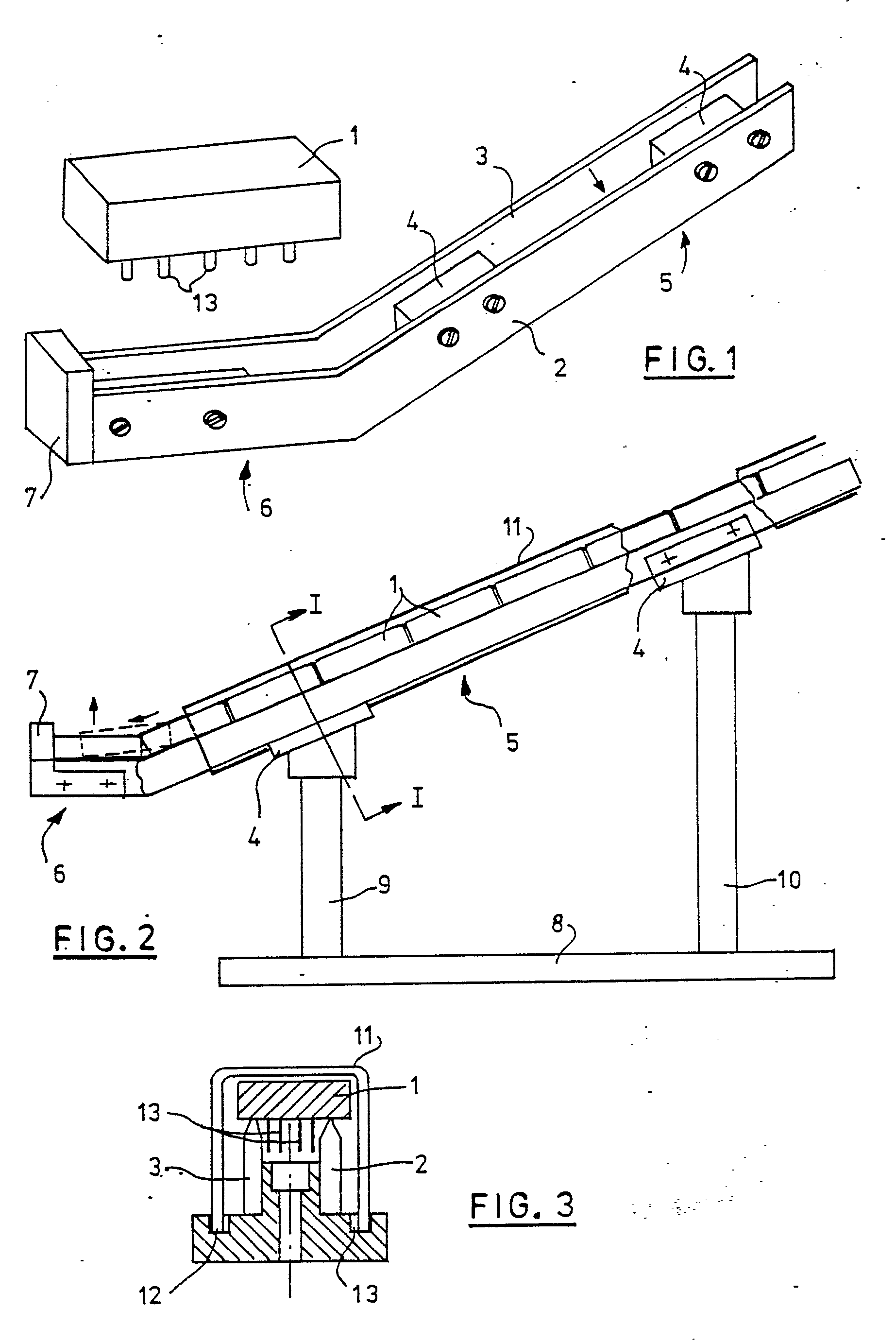
29.04.1987 Bulletin 1987/18 |
| (22) |
Date of filing: 30.11.1982 |
|
|
| (54) |
Gravity feed chute
Schwerkraftzufuhrrinne
Chute d'alimentation à gravité
|
| (84) |
Designated Contracting States: |
|
DE FR GB IT |
| (43) |
Date of publication of application: |
|
13.06.1984 Bulletin 1984/24 |
| (71) |
Applicant: International Business Machines
Corporation |
|
Armonk, N.Y. 10504 (US) |
|
| (72) |
Inventors: |
|
- Rigbey, Leonard John
Winchester
Hampshire, SO22 4JL (GB)
- MacWilliams, David
Portsmouth
Hampshire (GB)
|
| (74) |
Representative: Bailey, Geoffrey Alan |
|
IBM United Kingdom Limited
Intellectual Property Department
Hursley Park
Winchester
Hampshire SO21 2JN
Winchester
Hampshire SO21 2JN (GB) |
|
| |
|
| Note: Within nine months from the publication of the mention of the grant of the European
patent, any person may give notice to the European Patent Office of opposition to
the European patent
granted. Notice of opposition shall be filed in a written reasoned statement. It shall
not be deemed to
have been filed until the opposition fee has been paid. (Art. 99(1) European Patent
Convention).
|
[0001] The invention relates to a chute for gravity feeding a plurality of like components
to a pick-up station of a robotic or machine controlled arm for subsequent access
and pick-up by a suitable mechanism carried by the arm during automatic assembly operations.
[0002] The success of automatic assembly depends on the constant supply of various components
to their respective pick-up stations from where they are accessible to the pick-up
mechanism for transportation to the assembly site. Each pick-up operation involves
a sequence of precise movements of the arm pick-up mechanism, namely, gross movement
of the arm and pick-up mechanism to the pick-up station; precise and often delicate
manipulation -of the pick-up mechanism at the station as it goes through the motions
required to pick-up a component; and gross movement of the arm, pick-up mechanism
and, assuming that the pick-up operation was successful, a component from the pick-up
station to the assembly site. Clearly, the success of the pick-up operation relies
heavily on the component feeder supplying a component at the required time and with
it being accurately positioned at the pick-up station.
[0003] It is an object of the present invention therefore to provide a component feeder
operable, in use, to supply components on demand to a pick-up station with each component
aligned and accurately located at the station for subsequent access by the pick-up
mechanism.
[0004] Although not essential; it is also a desirable feature for the feeder to present
components for access by the pick-up mechanism in a plane coincident with, or parallel
to, the plane of assembly, so that initial pick-up direction and final placement direction
of a component are parallel to each other, thereby avoiding the problems of lack of
repeatability and motion time loss involved in the inclining of the pick-up mechanism,
which would otherwise be required. Generally, this means in practice that the pick-up
station should lie in the horizontal plane. r
[0005] A variety of feeders of components are available which utilise straight or curved
chutes, often with positive displacement actuators to propel a component to its final
position at the pick-up station. These mechanisms are invariably complex and consequently
expensive. Furthermore, possibly due to their complexity, they often malfunction.
An important factor influencing the choice of robotic assembly as opposed to manual
assembly is its cost effectiveness. Since robotic devices themselves are generally
very expensive, it is important for the cost of all ancilliary equipment, including
component feeders to be kept to a minimum.
[0006] Examples of some prior art feeders include the following:
US-A-4,314,628 (Calbert) discloses a gravity feed chute adapted to receive electronic
components having any one of 3 different widths. The components slide down rails provided
as the upper surfaces of the inclined straight chute. A gate mechanism releases the
components one at a time into a receiving unit..
US-A-3,068,626 (lanuzzi) discloses the use of an inclined feeder leading into a horizontal
final section capable of holding approximately 6 components and having no end stop.
The components are removed horizontally from the open end by means of a shuttle with
notches adapted to receive the components.
[0007] EP 42,977 (IBM) discloses a gravity feed chute for supplying several components in
parallel to a pick-up station. The chute consists of a downwardly inclined straight
section which gradually levels off at its lower end.
[0008] It is a further object of the present invention to provide a component feeder that
is not only reliable in operation, but also of simple construction and therefore of
low cost.
[0009] The invention provides a chute for gravity feeding a plurality of like components
to a pick-up station of a robotic controlled arm for subsequent access and pick-up
during automatic assembly operations, said chute comprising a downwardly inclined
first straight section adapted to receive said plurality of like components at the
upper end thereof, the lower end of said downwardly inclined section leading with
a change in direction into a second straight section having an end stop, characterised
in that the second straight section is substantially horizontal and in that the change
in direction is abrupt and located at a distance from ' the end stop equal to the
length of one component, said second straight section constituting said pick-up station
from which the components are removed by said arm.
[0010] In order that the invention may be fully understood, a preferred embodiment thereof
will now be described by way of example with reference to the accompanying drawings,
in which:
Figure 1 is a schematic drawing of a chute with top and side restraint removed illustrating
the principle employed;
Figure 2 shows in side elevation a practical chute constructed for feeding electrical
components; and
Figure 3 shows a part-section of the chute in Figure 2 taken along the line I-I.
[0011] A number of components that are to be assembled to a printed circuit card are generic,
of substantially cuboid shape with pins projecting from one surface. In searching
for a simple, effective, low cost solution, a feeder for this type of component has
been developed which is also useful for feeding other components of the same body
shape with or without pins.
[0012] Referring to the figures, the feeder chute for feeding components 1 is seen to consist
of two guide rails 2 and 3 fabricated from sheet metal and held apart by spacers 4.
Each rail is shaped as shown to provide a relatively long downwardly extending straight
section (shown generally as section 5 of the chute), inclined at a shallow angle to
the hroizontal, which terminates at its lower end with a further straight section
(shown generally as section 6 of the chute) which is itself horizontal. The upper
edges of the rails are chamfered as shown in Figure 3 with all burrs and sharp edges
removed to provide low friction surfaces over which components 1 can slide freely.
The abrupt change in direction from the inclined section 5 to the horizontal section
6 of the chute guide rails is via a small radius curve so as not to impede the free
sliding movement of the components past this surface discontinuity.
[0013] An end-stop 7, itself incorporating a guide rail spacer, is provided at the end of
the horizontal sections 6 of the guide rails. This horizontal section has a length
just sufficient to accommodate one component, and in practice is approximately 0.1
mm longer than the component length. A component is regarded as being at the pick-up
station when it is in the horizontal section 6 with one end abutting the end stop
7. The relative inclination of the two section of the chute is. selected to suit the
mass and friction characteristics of the component to be fed. In the example shown
in Figure 2 the angle of inclination between the two is 30 degrees, and in general
can be expected to lie between 20 and 35 degrees.
[0014] The spacers 4 for the guide rails 2 and 3 of the feeder chute shown in Figures 2
and 3 are in the form of rectangular blocks to which the rails are screwed. The chute
itself is supported from a rigid base plate 8 on two supporting legs 9 and 10 to which
the spacer blocks are attached. A clear acrylic cover 11 sprung into slots 12 and
13 provided on either side of each spacer block, as shown in Figure 3, extends over
the major portion of the inclined section 5 of the chute and provides an upper restraint
for the components 1 as they slide down towards the pick-up station 6.
[0015] In use, the componets 1 are loaded at the upper end of the chute from a suitable
hopper (not shown) with their pins 13 extending downward between the two guide rails
2 and 3. By this means, lateral registration of the component is affected during their
passage down the chute. Clearly, a chute for feeding components without pins; such
as for example keybuttons, will require the addition of retaining side members over
its entire length to provide lateral restraint for the components as they slide down
the chute, and lateral registration of the components in the pick-up station. The
side members may conveniently be provided by the cover 11 itself along the inclined
section of the chute, but only side members must be provided on each side of the chute
in the region of the pick-up station to permit access to the components.
[0016] As each component in turn is removed from the pick-up station, so the remaining components
slide down the inclined section 5 of the chute on the low friction guide rails 2 and
3 and the next component slides into the pick-up station. During the entire movement
into the pick-up station-a component 1 experiences a horizontal force driving it towards
the end stop 7. At the _point where the friction angle and the angle the component
makes with the horizontal are equal (approximately 4 degrees) there is sufficient
momentum to complete the motion to the end stop 7 even when the component is the last
to be fed. Furthermore it will be observed that the act of removing a component from
the pick-up station has the effect of lifting the leading edge of the next component
so aiding its free movement into the pick-up station.
1. A chute for gravity feeding a plurality of like components to a pick-up station
of a robotic controlled arm for subsequent access and pick-up during automatic assembly
operations, said chute comprising a downwardly inclined first straight section (5)
adapted to receive said plurality of like components (1) at the upper end thereof,
the lower end of said downwardly inclined section leading with a change in direction
into a second straight section (6) having an end stop (7), characterised in that the
second straight section is substantially horizontal and in that the change in direction
is abrupt and located at a distance from the end stop (7) equal to the length of one
component, said second straight section constituting said pick-up station from which
the components (1) are removed by said arm.
2. A chute as claimed in claim 1, in which said like components are each of generally
cuboidal shape and the angle of inclination of said first section with respect to
said second section is such that the trailing edge of a component in the second section
is overlapped by the leading edge of the next following component in the first section
so that a component removed from the second section will tend to momentarily lift
the leading edge of the next component so as to reduce the tendency of said next component
to baulk at said abrupt change in direction of the guide rails during its subsequent
movement into the second section.
3. A chute as claimed in claim 1, in which the angle of inclination of said first
section with respect to said second section lies between 20° and 35°.
4. A chute as claimed in any of the preceeding claims, in which two spaced-apart parallel
guide rails (2, 3) each formed from sheet material constitute low friction surfaces
of said first and second sections down and along which components loaded into said
chute can slide.
5. A chute as claimed in claim 4, including side walls spaced one on each side of
the guide rails to provide lateral restraint for components sliding down said chute
and lateral registration for a component located in said pick-up station.
6. A chute as claimed in claim 4 or claim 5, in which said components (1) are electrical
components of general cuboidal shape and having electrical connection pins (13) extending
from one surface thereof, the construction and arrangement of said parallel guides
being such that they are sufficiently spaced to receive therebetween the pins (13)
of components supplied thereto but sufficiently close to each other to support the
edges ofthe surface of the component from which the pins extend, whereby the pins
and guide rails provide lateral restraint and registration for the components as they
slide in succession down the chute and into the pick-up station.
7. A chute as claimed in any preceeding claim, including a cover (11) extending over
the major portion of the downwardly inclined first portion (5) of the chute to provide
an upper restraint for components (1) as they slide towards the pick-up station (6).
1. Rinne zum Zuführen einer Vielzahl gleicher Bauelememte mittels Schwerkraft zu einer
Entnahmestation eines robotergesteuerten Armes, der während automatischer Montagevorgänge
nacheinander aufdie Bauelemente zugreift und sie entnimmt, mit einem nach unten geneigten
ersten geraden Abschnitt (5), welcher die Vielzahl gleicher Bauelemente (1) an seinem
oberen Ende aufnimmt, wobei das untere Ende des nach unten geneigten Abschnittes seine
Richtung ändert und in einen zweiten geraden Abschnitt (6) mit einem Endstück (7)
führt, dadurch gekennzeichnet, daß der zweite gerade Abschnitt im wesentlichen horizontal
verläuft und daß die Richtungsänderung abrupt erfolgt und vom Endstück (7) so weit
entfernt istwie ein Bauelement lang ist, wobei der zweite gerade Abschnitt die Entnahmestation
ist, von der die Bauelemente (1) mittels des Armes entnommen werden.
2. Rinne nach Anspruch 1, dadurch gekennzeichnet, daß jedes der gleichen Bauelemente
Würfelform aufweist und daß der Neigungswinkel des ersten Abschnittes bzgl. des zweiten
Abschnittes derart ist, daß die hintere Kante eines im zweiten Abschnitt befindlichen
Bauelements von der vorderen Kante des nachfolgenden, im ersten Abschnitt befindlichen
Bauelements überlappt wird, so daß ein vom zweiten Abschnitt entommenes Bauelement
die vordere Kante des nachfolgenden Bauelements kurz anheben kann und dadurch die
Möglichkeit verringert, daß das nachfolgende Bauelement bei der abrupten Richtungsänderung
der Führungsschienen während seiner Weiterbewegung in den zweiten Abschnitt eingeklemmt
wird.
3. Rinne nach Anspruch 1, dadurch gekennzeichnet, daß der Neigungswinkel des ersten
Abschnittes bzgl. des zweiten Abschnittes zwischen 20 und 35° liegt.
4. Rinne nach einem der vorhergehenden Ansprüche, dadurch gekennzeichnet, daß zwei
im Abstand voneinander angeordnete, parallele Führungsschienen (2,3) aus Blech dem
ersten und zweiten Abschnitt jeweils eine Oberfläche mit geringer Reibung geben, über
welche die in die Rinne geladenen Bauelemente hinunterrutschen.
5. Rinne nach Anspruch 4, dadurch gekennzeichnet, daß jede Seite der Führungsschienen
mit einer Seitenwand versehen ist, welche den durch die Rinne abwärtsrutschenden Bauelement
seitlichen Halt gibt und ein in der Entnahmestation befindliches Bauelement seitlich
ausrichtet.
6. Rinne nach Anspruch 4 oder 5, dadurch gekennzeichnet, daß die Bauelemente (1) elektrische
Bauelemente in Würfelform sind und elektrische Anschlußstifte (13) Aufweisen, die
von einer Seite des Elements wegragen, wobei die parallelen Führungsschienen derart
konstruiert und angeordnet sind, daß die ausreichenden Abstand voneinander haben und
die Stifte (13) der zugeführten Bauelemente aufnehmen können, jedoch auch ausreichend
eng zusammenliegen, um die Oberflächenkanten des Bauelements, von dem die Stifte wegragen,
tragen zu können, wodurch die Stifte und die Führungsschienen die Bauteile seitlich
halten und ausrichten, während sie nacheinander die Rinne hinunterrutschen und in
die Entnahmestation gelangen.
7. Rinne nach einem der vorhergehenden Ansprüche, dadurch gekennzeichnet, daß sich
eine Abdeckung (11) über den Haupteil des nach unten geneigten ersten Abschnittes
(5) der Rinne erstreckt und so den in Richtung Entnahmestation (6) rutschenden Bauelementen
(1) oberen Halt gibt.
1. Goulotte pour acheminer par gravité une pluralité de pièces identiques jusqu'à
un poste de ramassage d'un bras à commande robotisée pour permettre un accès et un
ramassage ultérieurs pendant des opérations d'assemblage automatique, ladite goulotte
comportant un premier tronçon rectiligne (5) incliné vers le bras et conçu pour recevoir
ladite pluralité de pièces identiques (1) à l'extrémité supérieure de celui-ci, l'extrémité
inférieure dudit tronçon incliné vers le bas conduisant avec un changement de direction
jusque dans un deuxième tronçon rectiligne (6) possédant une butée terminale (7),
caractérisée en ce que le deuxième tronçon rectiligne est sensiblement horizontal
et en ce que le changement de direction est brusque et situé à une distance de la
butée terminale (7) égale à la longueur d'une pièce, ledit deuxième tronçon rectiligne
constituant le poste de ramassage depuis lequel les pièces (1) sont retirées par ledit
bras.
2. Goulotte selon la revendication 1, dans laquelle lesdites pièces identiques sont
chacune de forme globalement cubique et l'angle d'inclination dudit premier tronçon
par rapport audit deuxième tronçon est le que le bord postérieur d'une pièce dans
deuxième tronçon est chevauché par le bord antérieur de la.pièce immédiatement suivante
dans le premier tronçon de telle façon qu'une pièce retirée du deuxième tronçon tend
à soulever momentanément le bord antérieur de la pièce suivante afin de réduire la
tendance de ladite pièce suivante à se mettre de travers à l'endroit du brusque changement
de direction des rails de guidage pendant son mouvement ultérieur d'entrée dans le
deuxième tronçon.
3. Goulotte selon la revendication 1, dans laquelle l'angle d'inclination du premier
tronçon par rapport au deuxième tronçon est compris entre 20° et 35°.
4. Goulotte selon l'une quelconque de revendications précédentes, dans laquelle deux
rails (2, 3) de guidage parallèle espacés entre eux, réalisés chacun en matière en
feuille, constituent des surfaces à faible frottement desdits premier et deuxième
tronçons vers le bas et le long desquels peuvent glisser des pièces chargées dans
la goulotte.
5. Goulotte selon la revendication 4, comportant des parois latérales espacées, une
sur chaque côte des rails de giudage, afin d'assurer une retenue latérale des pièces
glissant vers le bas de la goulotte et un alignement latéral pour une pièce située
dans une poste de ramassage.
6. Goulotte selon la revendication 4 ou la revendication 5, dans laquelle lesdites
pièces (1) sont des composants électriques à forme globalement cubique et possédant
des broches (13) pour branchements électriques s'étendant depuis une surface de ceux-ci,
la construction et l'agencement des rails de guidage parallèles étant tels que ces
rails sont suffisamment espacés pour recevoir entre eux les broches (13) de composants
envoyés sur eux, mais suffisamment proches l'un de l'autre pour supporter les bords
de la surface du composant depuis laquelle s'étendent les broches, grâce à quoi les
broches et les rails de guidage assurent une retenue et un alignement latéraux des
composants à mesure qu'ils glissent les uns après les autres vers le bas de la goulotte
et qu'ils entrent dans le poste de ramassage.
7. Goulotte selon l'une quelconque des revendications précédentes, comportant un couvercle
(11) s'étendant sur la plus grande partie du premier tronçon (5) de la goulotte incliné
vers le bas afin de réaliser un guidage forcé supérieur des composants (1) à mesure
qu'ils glissent vers le poste de ramassage (6).