| (19) |
 |
|
(11) |
EP 0 111 604 B2 |
| (12) |
NEW EUROPEAN PATENT SPECIFICATION |
| (45) |
Date of publication and mentionof the opposition decision: |
|
27.12.1991 Bulletin 1991/52 |
| (45) |
Mention of the grant of the patent: |
|
16.06.1987 Bulletin 1987/25 |
| (22) |
Date of filing: 17.12.1982 |
|
| (51) |
International Patent Classification (IPC)5: H04B 3/54 |
|
| (54) |
Transmitter/receiver circuit pair for signal transmission over power wiring
Sende-/Empfangskreis-Paar zur Signalübertragung über Netzleitungen
Paire de circuits émetteur/récepteur pour la transmission de signaux par lignes de
transport d'énergie
|
| (84) |
Designated Contracting States: |
|
DE FR GB IT |
| (43) |
Date of publication of application: |
|
27.06.1984 Bulletin 1984/26 |
| (73) |
Proprietor: SHARP KABUSHIKI KAISHA |
|
Osaka 545 (JP) |
|
| (72) |
Inventors: |
|
- Ise, Masahiro
Kashihara-shi
Nara-ken (JP)
- Machino, Katsuyuki
Nara-shi
Nara-ken (JP)
- Tanaka, Hidehiko
Tenri-shi
Nara-ken (JP)
- Matsubara, Toshiyuki
Tenri-shi
Nara-ken (JP)
|
| (74) |
Representative: Wright, Peter David John et al |
|
Willowbrook
Winkfield Row
GB-Bracknell, Berkshire RG42 6LS
GB-Bracknell, Berkshire RG42 6LS (GB) |
| (56) |
References cited: :
DE-A- 1 922 439
FR-A- 1 418 591
US-A- 3 909 821
|
DE-A- 2 358 003
US-A- 2 282 968
|
|
| |
|
|
- U.Tietze, Ch. Schenk, "Halbleiterschaltungstechnik, 5.Auflage, Springer Verl. 1980,S.188,
346 ff."
- A.I. Zvereo "Handbook of Filter Synthesis", J.Wileyand sous inc,1967
|
|
| |
|
[0001] The present invention relates to a transmitter receiver circuit pair for signal transmission
over power wiring.
[0002] In the transmitting section of power wiring transmission, the lower the output impedance
the better for effective superimposing of signals on the distribution line. However,
low impedance loads must be prevented from remaining on the distribution line and
carrier leakages due to the effects of high level noise (thyristor noise etc.) on
the input side must also be prevented during transmission breaks. The higher the input
impedance the better from the standpoint of the receiving section to prevent drops
in signal level at the receiving point and also to prevent loading when a number of
receiving units are connected.
[0003] US 3,909,821 discloses a system for communicating over power lines the transmitter
comprising a circuit in which the output of a sine wave oscillator is fed to an electronic
switch and this output is then fed to a distribution line through a series resonant
circuit after passing through a step-down transformer.
[0004] However, typical electronic switches in such a transmitter/circuit are susceptible
to noise superimposed on the distribution line which is stepped up by the transformer.
According to the present invention there is provided a transmitter preciser circuit
pair as claimed in claim 1.
[0005] The transmitter/receiver circuit pair of the present invention alleviates the above
problem of noise on the distribution line because the photocoupler isolates the base
of the emitter follower.
[0006] The transmitter/receiver circuit pair of the present invention has the further advantage
that the filter characteristics of the resonant circuits of the receiving section
are improved by the series and parallel impedance-matching resistors.
[0007] Embodiments of the invention will now be described by way of example only with reference
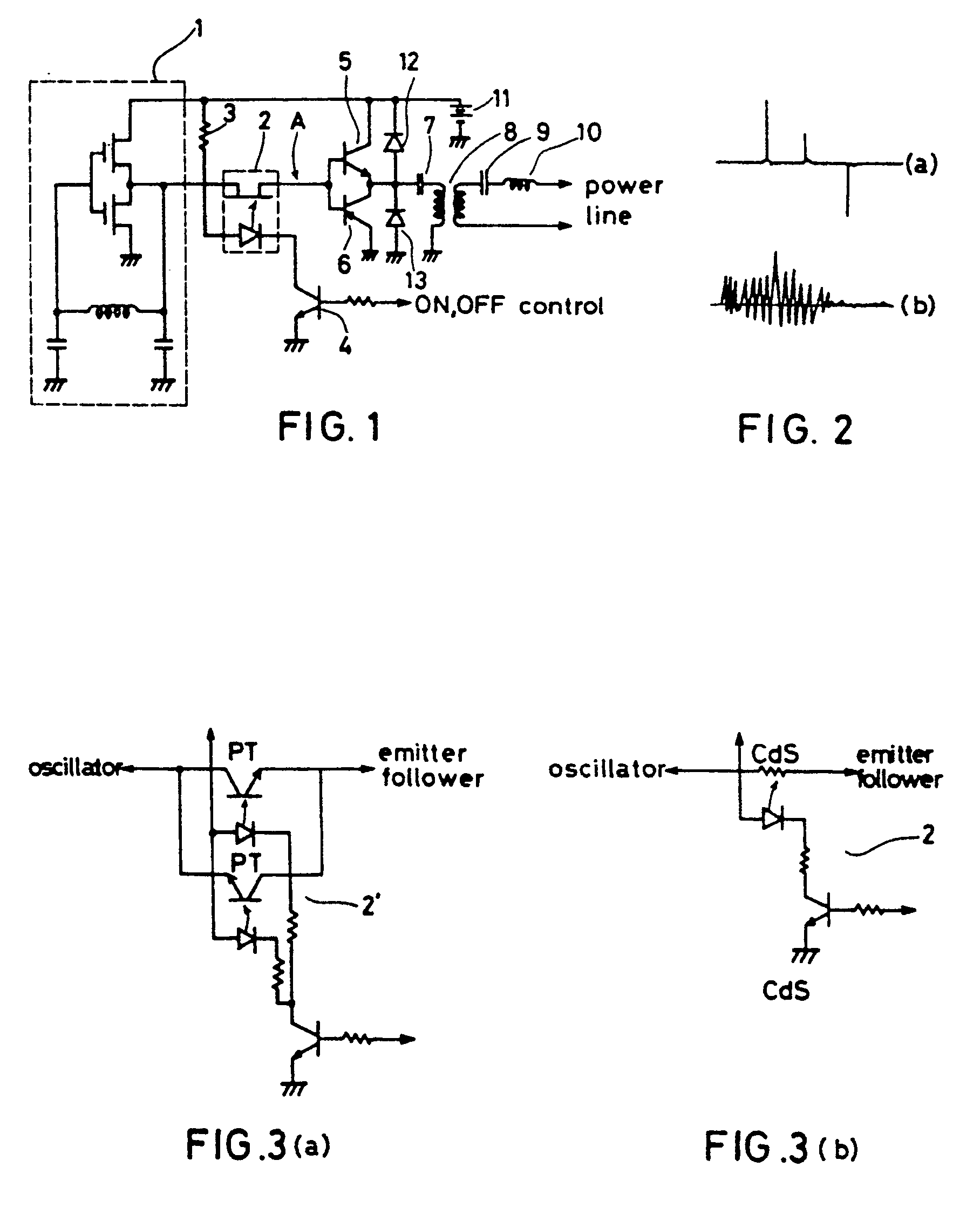
to Figures 1 to 6 of the accompanying drawings, of which:
Figure 1 is a circuit diagram of a transmitter circuit in a transmitter/receiver circuit
pair in accordance with the invention;
Figures 2(a) and (b) are time charts showing examples of various types of noise;
Figures 3(a) and (b) are diagrams showing alternatives to photocoupler 2 in Figure
1;
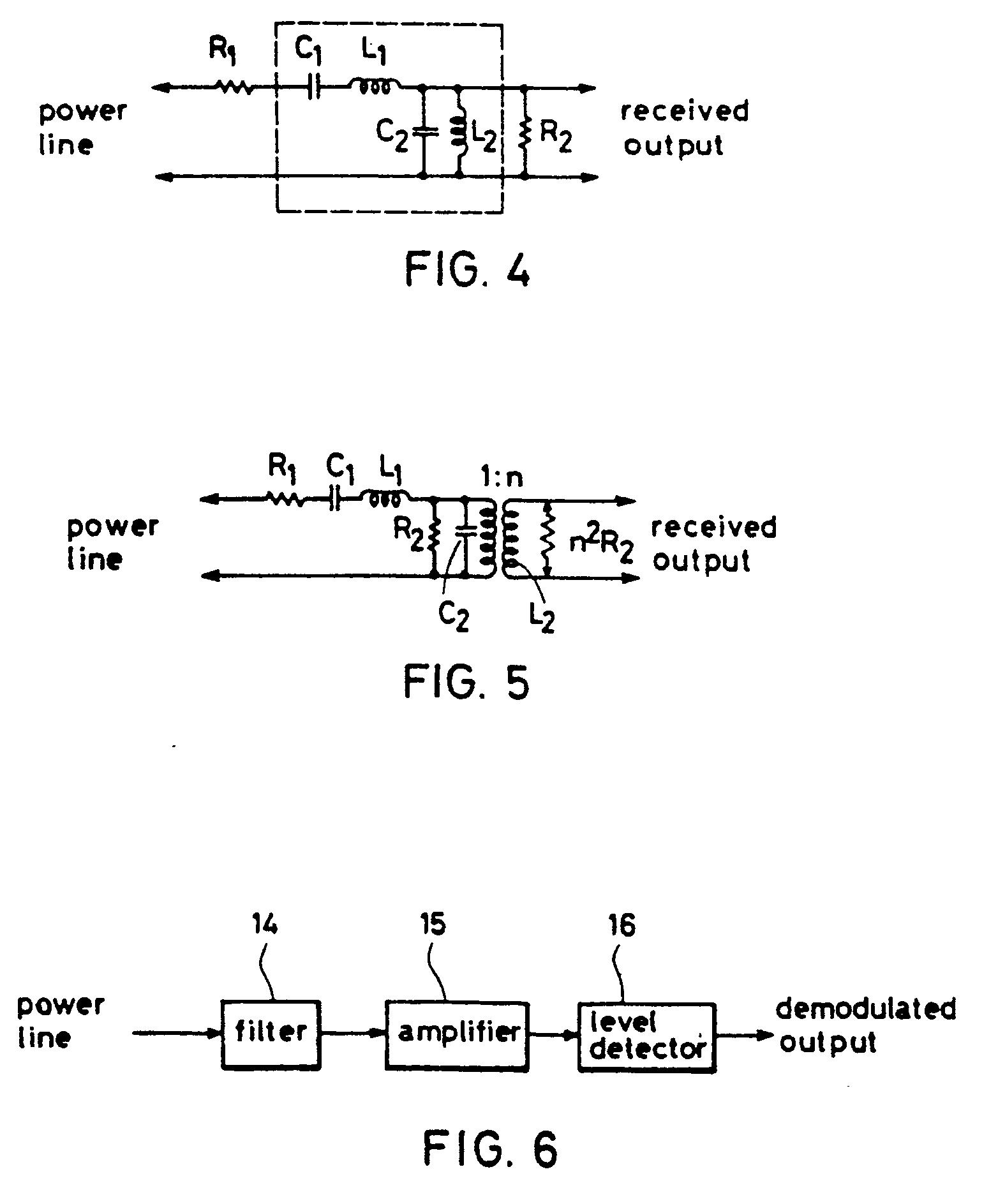
Figure 4 is a diagram showing an example of the filter circuit in the receiver unit
of a transmitter/receiver circuit pair in accordance with the invention;
Figure 5 is a diagram showing an example of the filter of Figure 4, inductance-coupled
to increase the level, and
Figure 6 is a block diagram showing in outline the receiving system of a transmitter/receiver
circuit pair accordance with the invention.
[0008] We shall first start by describing the transmitter. Figure 1 is the electrical circuit
of the transmitter. The circuit includes sine wave oscillator circuit 1, photocoupler
(2-directional FET type) 2, current limiting resistor 3 for the photocoupler LED,
transistor 4 that controls the LED by an ON-OFF signal from the control section (microcomputer
etc.), emitter-follower transistors 5 and 6 for lowering the impedance, decoupling
capacitor 7, step-down transformer (n:1) to further lower impedance, series resonance
circuits 9 and 10 to isolate the distribution line voltage and feed the carrier to
the distribution line at a low impedance, power supply 11, and high leverdistribution
line noise suppression diodes 12 and 13.
[0009] Although the output impedance of normal transistor emitter-followers (5 and 6 in
the diagram) is about 15 ohm, this is not satisfactory, as the distribution line impedance
is only about 2 to 5 ohm. Step-down transformer 8 is therefore inserted between the
emitter-follower and the distribution line and the desired impedance obtained by setting
the output impedance to 1/n
2 (n is the turns ratio). However, it will be necessary to generate a signal of n times
the final level with the sine wave oscillator circuit for the output voltage to also
be 1/n. However, it will serve no purpose even if the impedance is lowered up to stepdown
transformer 8 if the impedance at the connection to the distribution line is high.
For this reason capacitor 9 and coil 10 are inserted in the form of a series resonance
circuit at the connection where only a capacitor is used normally. Although operation
during transmission is as explained above, consideration will also be necessary for
transmission breaks. As various devices are generally connected to the distribution
line, various type of noise will be mixed on the line. The principal types will be
thyristor noise (Fig. 2(a)) and motor brush noise (vacuum cleaners etc., Fig. 2(b)).
These noise levels reach a maximum of 30Vpp for thyristor and 2Vpp for vacuum cleaners.
These noise frequencies pass through the series resonance circuit 9, 10 and are added
to the base of emitter-follower 5, 6 after being stepped up through transformer 8.
[0010] However, as photocoupler 2 acts as an isolating analog switch, the emitter-follower
will be in a completely isolated OFF state and will therefore not load the distribution
line as its output impedance is high. Although the secondary impedance of step-down
transformer 8 will be the direct load during the OFF state, there will therefore be
practically no problem if a sufficiently high impedance (over 1 mH) is selected. Also,
as the control of the analog switch is completely isolated from the switch, there
will be no adverse effects even if there is line noise present on the base.
[0011] As the switch and control parts are not completely isolated in normal analog switches
(transistors FET's CMOS's etc.), in essence, carrier leakage to the distribution line
will occur for OFF commands issued by the control section when the level at point
A (base of emitter-follower 5, 6) becomes momentarily high or low. If point A is grounded
through a resistor or capacitor in an attempt to prevent this, a low impedance load
will be presented to the distribution line as emitter-follower 5, 6 will not be completely
isolated. As each power wiring transmission section is normally made u p of a transmitter/receiver
pair, the load applied even during OFF periods of the transmitter when a large number
of units are connected for an answer back service on the assumption of improved reliability
is highly undesirable. This invention completely resolves these problems.
[0012] Instead of the 2-way FET shown in Figure 1, photo transistors (2 sets used to obtain
2-way characteristics) connected as shown in Figure 3(a) and (b) and CDS can also
be used for photocoupler 2. Photo- thyristors are not suitable as they are turned
ON easily but require additional circuitry to turn OFF and switching speed is slow.
[0013] We shall now explain the receiving section. In power wiring transmission using an
AM system, data transmission is carried out by turning a special carrier frequency
ON and OFF. To block the distribution line voltage and effectively remove the noise
elements, the narrower the band width of the filter used the better the results. The
higher the input impedance the better at the receiving point to prevent attenuation
of the signal and to prevent loading when a number of receiving circuits are connected.
Although a signal tuning circuit is normally used in this section, this will not be
suitable here considering the foregoing problems. As shown in Figure 4, this example
uses a series resonance circuit composed of capacitor C1 and coil L1 as a filter at
the connection to the distribution line and a parallel resonance circuit composed
of capacitor C2 and coil L2 on the load side. If the circuit within the dotted lines
in Figure 4 satisfies the following conditions, it can be treated a a constant-K filter
and this simplifies design.

The various parameters of the filter may be obtained as follows. Characteristic impedance:

Centre frequency:

Bandwidth:

[0014] The characteristic impedance determines the impedance at the input and output sections
of the filter and can be arbitrarily selected by means of C
I, C
2, L
i and L
2. However, if we select 1 k ohm for example to disregard the load effect, the anticipated
filter characteristics will not be obtained as it will be extremely mismatched with
a line impedance of only about 2 to 5 ohm. In this invention, resistors R
1 and R
2 have been inserted to match the input/out sections with the characteristic impedance.
When Z
o.. distribution line impedance and also Z
o.. input impedance of the next stage (inputs to emitter-follower, MOS etc.), the following
can be selected.

The receiving level in this condition will be 1/2 the level on the distribution line.
[0015] If a coil with ratio 1:n is added as shown in Figure 5 to isolate the portion following
the output of the filter from the distribution line and also give additional voltage
gain, a receiving line of n/2 will be realized. Although R
2 may be repositioned in the secondary at this time, its equivalent value must be n
2R
2. Demodulation is carried out by means of an amplifier and level detector connected
after the filter. In Figure 6, 14 is the filter, 15 the amplifer and 16 the level
detector.
1. A transmitter/receiver circuit pair for power wiring transmission, the transmitting
section comprising a circuit in which the output of a sine wave oscillator (1) is
fed to a distribution line through a series resonant circuit (9, 10) after passing
through a step-down transformer (8), wherein a photocoupler-controlled switch (2)
is connected to receive and control the feeding of said output, switch control means
(3, 4, ON, OFF control) being provided for supplying a switch control signal to said
switch (2), wherein after having passed the photocoupler-controlled switch (2) and
before being fed to the step-down transformer (8) the output of the sine wave oscillator
is fed to an emitter follower (5) which is electrically isolated by the photocoupler
controlled switch from the switch control means and wherein the receiving section
comprises a level detector (16), an amplifier (15) and a filter circuit (14), in which
the signal from the distribution line is fed to a parallel resonant circuit (L2, C2) to which a first resistor (R2) is connected in parallel, after passing through a series resonant circuit (LI, C1) to which a second resistor (R1) is connected in series, the resistors matching the filter (14) to the power wiring
output impedance and to the amplifier (15) input impedance and the respective centre
frequencies of the resonant circuits of the receiving section being substantially
identical.
2. A transmitter/receiver circuit pair as claimed in claim 1, wherein the series and
parallel resonant circuits of said receiving section obey the relationship:

L
1, and L
2 being the inductances of the series and parallel resonant circuits respectively and
C
1 and C
2 being the capacitances of the series and parallel resonant circuits respectively.
3. A transmitter/receiver circuit pair as claimed in claim 1 or claim 2, wherein said
photocoupler (2) comprises an FET connected in series between the base of said emitter
follower (5, 6) and said oscillator (1), further switching means (4) being coupled
to a photodiode of said photocoupler and thereby arranged to modulate the output of
said oscillator.
4. A transmitter/receiver circuit pair as claimed in claim 1 or claim 2, wherein said
photocoupler (2) comprises a pair of reverse parallel connected bipolar phototransistors
(PT) connected in series between said oscillator (1) and the base of said emitter
follower (5, 6), respective photodiodes associated with said phototransistors being
coupled to further switching means (4) which is arranged to modulate the output of
said oscillator.
5. A transmitter/receiver circuit pair as claimed in claim 1 or claim 2, wherein said
photocoupler (2) comprises a photosensitive resistance connected in series between
said oscillator and the base of said emitter follower (5, 6), a photodiode being associated
with said photosensitive resistance and connected to further switching means (4) which
is arranged to modulate the output of said oscillator.
6. A transmitter/receiver circuit pair as claimed in any preceding claim, wherein
said parallel resonant circuit (7, 8) comprises a stepdown transformer (8), the secondary
of which is connected in series with the series resonant circuit (C1, L1) of said receiving section.
1. Sender/ Empfänger-Schaltkreispaar zur Übertragung über eine Stromversorgungsleitung,
bei dem der Sendeteil einen Schaltkreis enthält, bei dem der Ausgang eines Sinus-Oszillators
(1) nach Durchlaufen eines Abwärtstransformators (8) über einen Serien-Resonanzkreis
(9, 10) eine Verteilerleitung speist, bei dem ein Photokoppler-gesteuerter Schalter
(2) das Ausgangssignal übernimmt und steuert, bei dem Schaltersteuermittel (3, 4,
ON/OFF-control) vorgesehen sind, die den Schalter mit einem Schaltersteuersignal beaufschlagen,
bei dem der Ausgang des Sinus-Oszillators nach Durchlaufen des Photokoppler-gesteuerten
Schalters (2) und vor Einspeisung in den Abwärtstransformator (8) auf einen Emitterfolger
(5) gelangt, der von den Schaltersteuermitteln durch den Photokoppler-gesteuerten
Schalter elektrisch getrennt ist und bei dem der Empfangsteil einen Pegeldetektor
(16), einen Verstärker (15) und einen Filterschaltkreis (14) enthält, bei dem das
Signal von der Verteilerleitung einen Parallel-Resonanzkreis (L2, Cv speist, zu dem ein erster Widerstand (R2) parallel geschaltet ist, danach einen
Serien-Resonanzkreis (LI, C1) durchläuft, zu dem ein zweiter Widerstand (R1) in Reihe liegt, wobei die Widerstände das Filter (14) auf die Ausgangsimpedanz der
Stromversorgungsleitung und auf die Eingangsimpedanz des Verstärkers (15) anpassen,
und wobei die jeweiligen Mittenfrequenzen der Resonanzkreise des Empfangsteils im
wesentlichen identisch sind.
2. SenderlEmpfänger-Schaltkreispaar nach Anspruch 1, dadurch gekennzeichnet, daß die
Serien- und Parallel-Resonanzkreise des Empfangsteils folgende Gleichung erfüllen:

wobei L
1 und L
2 die Induktivitäten der Serien- bzw. Parallel-Resonanzkreise und C
1 und C
2 die Kapazitäten der Serien- bzw. Parallel-Resonanzkreise darstellen.
3. Sender/ Empfänger-Schaltkreispaar nach Anspruch 1 oder 2, dadurch gekennzeichnet,
daß der Photokoppler (2) einen in Serie zwischen die Basis des Emitterfolgers (5,
6) und den Oszillator (1) geschalteten FET enthält, sowie weiterhin eine Schaltvorrichtung
(4), die mit einer Photodiode des Photokopplers verbunden ist und dadurch den Ausgang
des Oszillators moduliert.
4. Sender/Empfänger-Schaltkreispaar nach Anspruch 1 oder 2, dadurch gekennzeichnet,
daß der Photokoppler (2) ein in Serie zwischen den Oszillator (1) und die Basis des
Emitterfolgers (5, 6) geschaltetes Paar von antiparallel verbundenen bipolaren Phototransistoren
(PT) enthält, wobei entsprechende, dem Phototransistor zugeordnete Photodioden weiterhin
mit einer Schaltvorrichtung (4) verbunden und so angeordnet sind, daß der Ausgang
des Oszillators moduliert wird.
5. Sender/ Empfänger-Schaltkreispaar nach Anspruch 1 oder 2, dadurch gekennzeichnet,
daß der Photokoppler (2) einen in Serie zwischen dem Oszillator und der Basis des
Emitterfolgers (5, 6) geschalteten Photowiderstand enthält, wobei dem Photowiderstand
eine Photodiode zugeordnet und weiterhin so mit einer Schaltvorrichtung (4) verbunden
ist, daß der Ausgang des Oszillators moduliert wird.
6. Sender/Empfänger-Schaltkreispaar nach einem der vorhergehenden Ansprüche, dadurch
gekennzeichnet, daß der Parallel-Resonanzkreis (7, 8) einen Abwärtstransformator (8)
enthält, dessen Sekundärseite in Serie mit dem Serien-Resonanzkreis (C1, L1) des Empfangsteils geschaltet ist.
1. Paire de circuits émetteur/récepteur pour la transmission par lignes de transport
d'énergie, la section d'émission comprenant un circuit dans lequel le signal de sortie
d'un oscillateur à ondes sinusoïdales (1) est envoyé à une ligne de distribution à
travers un circuit résonnant série (9,10), après avoir traversé un transformateur
abaisseur (8), dans lequel un interrupteur (2) commandé par un optocoupleur est connecté
de manière à recevoir et à commander l'application dudit signal de sortie, un moyen
de commande d'interrupteur (3,4, commande MARCHE-ARRET) étant prévu pour fournir un
signal de commande d'interrupteur audit interrupteur (2), et dans lequel, après avoir
traversé l'interrupteur (2) commandé par l'optocoupleur et avant d'être envoyé au
transformateur abaisseur (8), le siganl de sortie de l'oscillateur à ondes sinusoïdales
est envoyé à un émetteur suiveur (5) qui est électriquement isolé, par l'interrupteur
commandé par optocoupleur, du moyen de commande d'interrupteur tandis que la section
de réception comprend un détecteur de niveau (16), un amplificateur (15) et un circuit
de filtrage (14), dans lequel le signal délivré par la ligne de distribution est envoyé
à un circuit résonnant parallèle (L2,C2) sur lequel une première résistance (R2) est branchée en parallèle, après avoir traversé un circuit résonnant série (L1' C1) auquel une seconde résistance (R1) est connectée en série, les résistances réalisant une adaptation du filtre (14)
à l'impédance de sortie de la ligne de transport d'énergie et à l'impédance d'entrée
de l'amplificateur (15), et les fréquences centrales respectives des circuits résonnants
de la section de réception étant sensiblement identiques.
2. Paire de circuits émetteur/récepteur selon la revendication 1, dans lequel le circuit
résonnant série et le circuit résonnant parallèle de ladite section de réception obéissent
à la relation :

L, et L2 étant les inductances respectives du circuit résonnant série et du circuit
résonnant parallèle, et C
1 et C
2 étant les capacités respectives du circuit résonnant série et du circuit résonnant
parallèle.
3. Paire de circuits émetteur/récepteur selon la revendication 1 ou la revendication
2, dans lequel ledit optocoupleur (2) comprend un transistor FET branché en série
entre la base dudit émetteur suiveur (5,6) et ledit oscillateur (1), des moyens supplémentaires
de commutation (4) étant accouplés à une photodiode dudit optocoupleur et étant alors
conçus pour moduler le signal de sortie dudit oscillateur.
4. Paire de circuits émetteur/récepteur selon la revendication 1 ou la revendication
2, dans lequel ledit optocoupleur (2) comprend un couple de phototransistors bipolaires
(PT) en montage anti-parallèle, connecté en série entre ledit oscillateur (1) et la
base dudit émetteur suiveur (5,6), des photodiodes respectives associées auxdits phototransistors
étant accouplées à des moyens supplémentaires de commutation (4) qui sont conçus pour
moduler le signal de sortie dudit oscillateur.
5. Paire de circuits émetteur/récepteur selon la revendication 1 ou la revendication
2, dans lequel ledit optocoupleur (2) comprend une résistance photosensible branchée
en série entre ledit oscillateur et la base dudit émetteur suiveur (5,6), une photodiode
étant associée à ladite résistance photosensible et connectée à des moyens supplémentaires
de commutation (4) qui sont conçus pour moduler le signal de sortie dudit oscillateur.
6. Paire de circuits émetteur/récepteur selon l'une quelconque des revendications
précédentes, dans lequel ledit circuit résonnant parallèle (7,8) comprend un transformateur
abaisseur (3), dont le secondaire est branché en série avec le circuit résonnant série
(C1,L1) de ladite section de réception.