|
(11) | EP 0 113 190 A1 |

| (12) | EUROPEAN PATENT APPLICATION |
|
|
|
|
|||||||||||||||||||||||||||
| (54) | Alpha-hydroxy-beta-haloethylphosphinic acids and their salts, and their production and use |
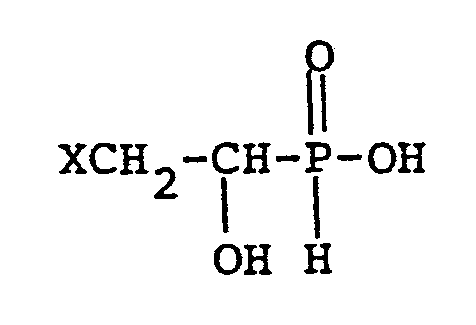
| (57) A compound of the formula:
wherein X is a chlorine atom or a bromine atom, or its salt, which is useful as a fungicide. |
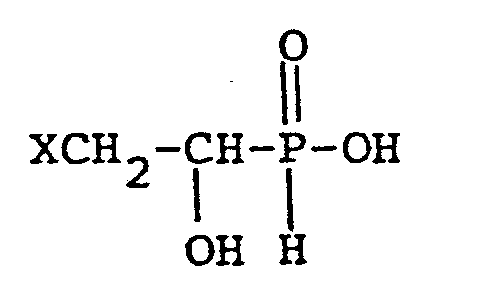
[0001] The present invention relates to a-hydroxy-S-haloethylphosphinic acids and their salts, and their production and use.
[0002] The said a-hydroxy-6-haloethylphosphinic acids are compounds of the formula:
wherein X is a chlorine atom or a bromine atom.
[0003] Various fungicides having only a preventive effect have been used for the control of plant diseases such as late blight and downy mildew which are caused by an infection of Phycomycetes. However, their practical use has been limited, because an insufficient controlling effect was produced after the invasion of pathogenic fungi into plant bodies.
[0004] It has now been found that the α-hydroxy-β-haloethylphosphinic acids (I) and their salts such as metal salts and quaternary ammonium salts exhibit not only a preventive effect but also a curative effect against plant diseases,such as late blight and downy mildew,caused by an infection of Phycomycetes. Thus, they are useful as fungicides for plants.
[0005] Examples of phytopathogenic fungi belonging to Phycomycetes, against which the α-hydroxy-β-haloethylphosphinic acids (I) and their salts can exert their fungicidal activity, are as follows: Peronospora brassicae on vegetables and radish, Peronospora spinaciae on spinach, Peronospora tabacina on tobacco, Pseudoperonospora cubensis on cucumber, Plasmopara viticola on grape, Plasmopara nivea on Umbelliferae plants, Phytophthora cactorum on apple, strawberry and carrot, Phytophthora capsici on tomato and cucumber, Phytophthora cinnamomi on pineapple, Phytophthora infestans on potato, tomato and eggplant, Phytophthora nicotianae var. nicotianae on tobacco, kidney bean and onion, Pythium aphanidermatum on cucumber, Pythium sp. on spinach, Pythium sp. on wheat, Pythium debaryanum on tobacco, Pythium rot (i.e. P. aphanidermatum, P. debaryanum, P. irregulare, P. myriotylum, P. ultimum) on soybean and so forth.
[0006] Accordingly, the a-hydroxy-B-haloethylphosphinic acids (I) and their salts may be used as fungicides for application to ploughed fields, orchards, tea-gardens, mulberry gardens, meadows and lawns.
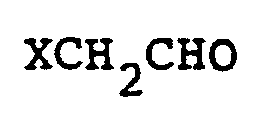
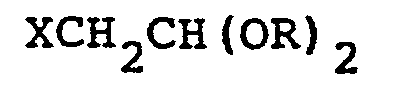
[0007] The a-hydroxy-6-haloethylphosphinic acid (I) is an acidic substance and can be produced by reacting a haloacetaldehyde of the formula:
wherein X is as defined above or the dialkylacetal thereof of the formula:
wherein R is a lower alkyl group and X is as defined above with aqueous phosphinic acid in the presence of an acid catalyst (e.g. hydrochloric acid or sulfuric acid), usually at a tenperature in the range of from 10 to 100°C for a period of from 1 to 24 hours. The amount of the phosphinic acid may be from 1.0 to 10 equivalents based an the haloacetaldehyde (II) or its dialkylacetal (III).
[0008] When the α-hydroxy-β-haloethylphosphinic acid (I) is reacted with an organic or inorganic base or a metal salt in an inert solvent such as water, an alcohol (e.g. methanol, ethanol), an ether (e.g. tetrahydrofuran, dioxane) or a halogenated hydrocarbon (e.g. chloroform, dichloromethane), a salt thereof is produced. This salt may be further subjected to salt-exchange with any metal salt in an inert solvent such as water or an alcohol (e.g. methanol, ethanol) to give any other salt. Alternatively, the a-hydroxy-β-haloethylphosphinic acid (I) may be treated with a. cation exchange resin previously exchanged with an organic amine residue or a metal ion to give the corresponding salt.
[0009] Examples of the organic base are alkylamines (e.g. methylamine, ethylamine, n-propylamine, isopropylamine, n-butylamine, isobutylamine, sec-butylamine, tert-butylamine, n-amylamine, isoamylamine, n-hexylamine, cyclohexylamine, 2-methylpentylamine), alkenylamines (e.g. allylamine), aralkylamines (e.g. benzylamine, a-phenethylamine, B-phenethylamine, a-naphthylethylamine, a,a-dimethylbenzylamine, p-tolylphenylethylamine), heterocyclic ring- substituted alkylamines (e.g. 2-(2-thienyl)ethylamine, 2-(2-furyl)ethylamine, furfurylamine, 2-thienylmethylamine), dialkylamines (e.g. dimethylamine, diethylamine, methyl- ethylamine, di-n-propylamine, diisopropylamine, di-n-butylamine, diisobutylamine), dialkenylamines (e.g. diallylamine), alkyl-aralkylamine (e.g. methyl-benzylamine, methyl- phenethylamine), trialkylamines (e.g. triethylamine, trimethylamine, tri-n-propylamine, tri-n-butylamine, dimethyl- cyclohexylamine), cyclic amines (e.g. pyrrolidine, piperidine, morpholine, 2-methylpiperidine, 2,6-dimethyl- morpholine, piperazine, 4-methylpiperazine, triethylenediamine), alcohol amines (e.g. ethanolamine, N-methylethanolamine, N-isopropylethanolamine, N,N-dimethylethanolamine, diethanolamine, triethanolamine, tris(hydroxymethyl)aminomethane, diglycolamine), alkylenediamines (e.g. ethylenediamine, trimethylenediamine, N,N-dimethylethylenediamine, N,N'-dimethylethylenediamine, N,N,N',N'-tetramethylethylenediamine, N,N-dimethyltrimethylenediamine, N,N,N',N'- tetramethyltrimethylenediamine, 1,2-diaminocyclohexane, N,N-dimethyl-1,2-diaminocyclohexane), hydrazines (e.g. N-methylhydrazine, N,N-dimethylhydrazine, N-phenylhydrazine, N-3-acetylphenylhydrazine), anilines (e.g. aniline, N-methylaniline, diphenylamine, 4-fluoroaniline, 4-chloroaniline, 4-bromoaniline, 4-iodoaniline, 2,4-dichloroaniline, 2,5-dichloroaniline, 3,5-dichloroaniline, 2,4,6-trichloroaniline, 3-trifluoromethylaniline, 4-nitroaniline, 2-methyl-4-methoxyaniline, 3-fluoroaniline, 3-chloroaniline, 3-bromoaniline, 3-iodoaniline, 2,6-dimethylaniline, 2,6-diethylaniline, 4-methylaniline, 4-tert-butylaniline) or nitrogen-containing heterocyclic bases (e.g. pyridine, a-picoline, S-picoline, Y-picoline, 2,6-lutidine, collidine, 2-amino-3-methylpyridine, 2,2'-bipyridyl, 4,4'-bipyridyl, 2,4'-bipyridyl, pyrazole, triazole, imidazole, triazine, pirazine, pyrimidine, thiazole, oxazole, isoxazole, quinoline, isoquinoline, pyrrole). Examples of the inorganic base are alkali metal hydroxides (e.g. lithium hydroxide, sodium hydroxide, potassium hydroxide), ammonia or hydrazine.
[0010] Examples of the metal salt are carbonates (e.g. calcium(II) carbonate, barium(II) carbonate, thallium(I) carbonate), acetates (e.g. zinc(II) acetate, calcium(II) acetate, barium(II) acetate, magnesium(II) acetate, manganese(II) acetate, nickel(II) acetate, cobalt(II) acetate, copper(II) acetate), nitrates (e.g. calcium(II) nitrate, barium(II) nitrate, magnesium(II) nitrate, aluminum(III) nitrate, manganese(II) nitrate, iron(III) nitrate, zinc(II) nitrate, nickel(II) nitrate, copper(II) nitrate, cobalt(II) nitrate), chlorides (e.g. calcium(II) chloride, barium(II) chloride, magnesium(II) chloride, iron(II) chloride, iron(III) chloride, zinc(II) chloride, tin(II) chloride, tin(IV) chloride, nickel(II) chloride, copper(II) chloride, cobalt(II) chloride, titanium(IV) chloride)orlactates (e.g. aluminum(III) lactate).
[0011] Some typical examples of the production of the a-hydroxy-s-haloethylphosphinic acids (I) and their salts are shown in the following examples.
Example 1
[0012] A solution of chloroacetaldehyde dimethylacetal (124.5 g) in phosphinic acid (50 %, 132 g) was heated at 50 to 60°C for 26 hours in the presence of conc. hydrochloric acid (10 ml). The resultant mixture was concentrated in vacuo to give 140 g (96.7 %) of a-hydroxy-S-chloroethylphosphinic acid (Compound No. 1). nD22.0 1.4970.
Example 2
[0013] A solution of bromoacetaldehyde diethylacetal (197 g) in phosphinic acid (50 %, 132.0 g) was heated at 60 to 70°C for 48 hours in the presence of sulfuric acid (0.5 g). The resultant mixture was concentrated in vacuo to give 187.0 g (98.9 %) of α-hydroxy-β-bromoethylphosphinic acid (Compound No. 2). nD23 1.5105.
Example 3
[0014] To a solution of a-hydroxy-B-chloroethylphosphinic acid (1.45 g) in water (12 ml), a solution of sodium .hydroxide (0.4 g) in water (5 ml) was added, followed by stirring for 1 hour. The reaction mixture was concentrated in vacuo to give 1.67 g (99.8 %) of sodium a-hydroxy-B-chloroethylphosphinate (Compound No. 4) as a hygroscopic solid.
Example 4
[0015] To a solution of aluminum lactate (50 g) in distilled water (1800 ml), weakly acidic cation exchange resin (Dowex CCR-2 H+ type; 250 g) was added, and the resulting mixture was stirred for 1 hour. The resultant mixture was allowed to stand, and the supernatant was eliminated. To the residue, distilled water (500 ml) was added, and the resulting mixture was stirred for 30 minutes and then filtered. The resin was washed with distilled water and added to a solution of α-hydroxy-β-bromoethylphos- phinic acid (9.5 g) in water (150 ml), followed by stirring for 1 hour. The resulting mixture was filtered, and the collected resin was washed with distilled water. The filtrate was concentrated to give 9.8 g (90.7 %) of aluminum α-hydroxy-β-bromoethylphosphinate (Compound No. 11) as a white powder.
Example 5
[0016] To a solution of α-hydroxy-β-chloroethylphosphinic acid (1.45 g) in methanol (10 ml), a solution of morpholine (0.87 g) in methanol (10 ml) was added, and the resultant mixture was stirred for 2 hours. After removal of methanol by distillation, there was obtained 2.30 g (98 %) of morpholinium a-hydroxy-B-chloroethylphosphinate (Compound No. 12) as a creamy solid.
[0017] Some examples of the α-hydroxy-β-haloethylphosphinic acids (I) and their salts are shown in Table 1.
[0018] In actual application as fungicides, the a-hydroxy-B-haloethylphosphinic acids (I) and their salts may be used alone without incorporation of other ingredients. For easier application, however, they are normally employed in admixture with solid or liquid carriers or diluents. The fungicidal compositions can be formulated into any of ordinarily adopted forms such as, for example, dusts, granules, wettable powders, emulsifiable concentrates, fine particles, aqueous solutions, oil sprays, aerosols and tablets. Such compositions generally contain 0.1 to 99.9 % by weight, preferably 2.0 to 80.0 % by weight of the active ingredient.
[0019] As the solid carriers or diluents usable for formulation of the fungicidal composition, there may be exemplified plant carriers (e.g. wheat flour, tobacco powder, soybean powder, walnut-shell powder, wooden powder, saw dust, wheat bran, bark dust, cellulose powder, extract residue), fibrous products (e.g. paper, card board, rag), crushed synthetic resins, clays (e.g. kaolin, bentonite, terra alba), talcs, other inorganic minerals (e.g. pyro- phyllite, celicite, pumice, sulfur powder, diatomaceous earth, white carbon, activated carbon)orchemical fertilizers (e.g. ammonium sulfate, ammonium phosphate, ammonium nitrate, urea, ammonium chloride). As the liquid carriers or diluents, there may be employed water, alcohols (e.g. methanol, ethanol), ketones (e.g. acetone, methylethylketone), ethers (e.g. diethyl ether, dioxane, cellosolve, tetrahydrofuran), aromatic hydrocarbons (e.g. benzene, toluene, xylene, methylnaphthalene), aliphatic hydrocarbons (e.g. gasoline, kerosene, lamp oil), esters, nitriles, acid amides (e.g. methylformamide, dimethylacetamide)orhalogenated hydrocarbons (e.g. dichloroethane, trichloroethylene, carbon tetrachloride).
[0020] In addition to the solid or liquid carriers or diluents as exemplified above, there may be used surfactants when desired. Examples of the surfactants are polyoxyethylene phenylphenol polymer, polyoxyethylene alkylaryl ether, sodium laurylsulfate, calcium alkylbenzenesulfonate, alkylsulfates, alkylsulfonates, alkylarylsulfonates, polyethyleneglycol ethers, polyvalent alcohol esters, etc. There may be also used adhesive agents, dispersing agents, stabilizers, etc. Their specific examples are casein, gelatin, starch, carboxymethyl cellulose, gum arabic, alginate, calcium ligninsulfonate, bentonite, molasse, polyvinyl alcohol, palm oil, agar, acid isopropyl phosphate, tricresyl phosphate, tall oil, epoxylated oil, surfactants or aliphatic acids and their esters.
[0021] Moreover, the fungicidal composition may comprise other fungicides, insecticides, nematocides, acaricides, insect repellents, plant growth regulators, herbicides, fertilizers or soil improvers.
[0022] Some typical examples of the fungicidal composition of this invention are shown below. In those examples, part(s) and % are by weight unless otherwise indicated.
Example A
[0023] Compound No. 13 (2 parts), clay (88 parts) and talc (10 parts) are thoroughly pulverized and mixed together to obtain a dust containing 2 % of the active ingredient.
Example B
[0024] Compound No. 6 (30 parts), diatomaceous earth (45 parts), white carbon (20 parts), a wetting agent (sodium laurylsulfate) (3 parts) and a dispersing agent (calcium ligninsulfonate) (2 parts) are thoroughly pulverized and mixed together to obtain a wettable powder containing 30 % of the active ingredient.
Example C
[0025] Compound No.7 (50 parts), diatomaceous earth (45 parts), a wetting agent (calcium alkylbenzenesulfonate) (2.5 parts) and a dispersing agent (calcium ligninsulfonate) (2.5 parts) are thoroughly pulverized and mixed together to obtain a wettable powder containing 50 % of the active ingredient.
Example D
[0026] Compound No. 13 (20 parts), xylene (60 parts) and an emulsifier (polyoxyethylene phenylphenol polymer type) (20 parts) are mixed together to obtain an emulsifiable concentrate containing 20 % of the active ingredient.
Example
[0027] Compound No. 10 (50 parts), water (45 parts) and a wetting agent (polyoxyethylene alkylaryl ether type) (5 parts) are mixed together to obtain an aqueous solution containing 50 % of the active ingredient.
[0028] A suitable amount of the fungicidal composition of the invention to be applied is generally from 10 to 200 grams in terms of the active ingredient per 10 are. In case of the composition form such as wettable powder, emulsifiable concentrate or aqueous solution, it is normally diluted with water and then applied. The concentration of the active ingredient on the application is preferably within the range of 0.001 to 0.2 % by weight. In case of the composition form such as dust or granule, it is ordinarily applied as such. Since, however, the amount and concentration largely depend upon composition forms, application times, application methods, application sites, diseases and crops, they may be increased or decreased appropriately.
[0029] The following examples show some typical test results supporting the excellent fungicidal activity of α-hydroxy-β-haloethylphosphinic acids (I) and their salts. In these examples, the compound numbers correspond to those in Table 1. The compounds used for comparison are as follows:
Example I
[0030] Seeds of cucumber (species: "Sagamihanjiro") were sowed in soil filled in plastic pots and cultivated in a greenhouse for 14 days to obtain seedlings of cucumber having cotyledons. An aqueous dilution of the test compound in the form of aqueous solution or wettable powder was applied onto the seedlings by foliar treatment. Then, the seedlings were grown in the greenhouse for 5 days. A spore suspension of Pseudoperonospora cubensis was sprayed onto the seedlings, which were placed at 20°C under a humid condition for 3 days and then grown at 20°C under the irradiation with a fluorescent lamp for 3 days. The state of infection of the test plants was observed, and the preventive value was calculated according to the following equation:
Example II
[0032] Seeds of cucumber (species: "Sagamihanjiro") were sowed in soil filled in plastic pots and cultivated in a greenhouse for 14 days to obtain seedlings of cucumber having cotyledons. The seedlings were-treated by soil- drench with an aqueous dilution of the test compound in the form of aqueous solution or wettable powder. After 4 days, a spore suspension of Pseudoperonospora cubensis was sprayed onto the seedlings, which were placed at 20°C under a humid condition for 3 day and then grown at 20°C under the irradiation with a fluorescent lamp for 4 days. The state of infection of the plants was observed, and the preventive value was calculated as in Example I.
Example III
[0034] Seeds of grape (species: "Delaware") were sowed in soil filled in plastic pots and cultivated in a greenhouse for 2 months to obtain seedlings of grape at the 2 to 3-leaved stage. A spore suspension of Plasmopara viticola was sprayed onto the seedlings, which were placed at 23°C under a humid condition for 2 days. Then, an aqueous dilution of the test compound in the form of aqueous solution or wettable powder was applied onto the seedlings ) by foliar treatment. Thereafter, the seedlings were grown at 23°C under the irradiation with a fluorescent lamp for 14 days. The state of infection of the plants was observed, and the preventive value was calculated as in Example I.
Example IV
[0036] Seeds of potato (species: "Danshaku") were sowed in soil filled in plastic pots and cultivated in a greenhouse for 2 months to obtain seedlings of potato. A spore suspension of Phytophthora infestans was sprayed onto the seedlings, which were placed at 20°C under a humid condition for 20 hours. Then, an aqueous dilution of the test compound in the form of aqueous solution or wettable powder was applied onto the seedlings by foliar treatment. Thereafter, the seedlings were grown at 15°C under a humid condition for 6 days. The state of infection of the plants was observed, and the preventive value was calculated as in Example I.
1. A compound of the formula:
wherein X is a chlorine atom or a bromine atom, or a salt thereof.
wherein X is a chlorine atom or a bromine atom, or a salt thereof.
2. A compound as claimed in claim 1 which is in the form of the calcium salt thereof.
3. A compouned as claimed in claim 1 which is in the form of an aluminium salt thereof.
4. A compound as claimed in claim 1 which is in the form of an ammonium salt thereof.
5. A process for producing a compound as claimed in claim 1 or a salt thereof, which
comprises reacting a haloacetaldehyde of the formula:
wherein X is as defined in claim 1 or a dialkylacetal thereof of the formula:
wherein R is a lower alkyl group and X is as defined above with aqueous phosphinic acid in the presence of an acid catalyst,and optionally reacting the resultant α-hydroxy-β-haloethylphosphinic acid with an organic or inorganic base or a metal salt to give the corresponding salt.
wherein X is as defined in claim 1 or a dialkylacetal thereof of the formula:
wherein R is a lower alkyl group and X is as defined above with aqueous phosphinic acid in the presence of an acid catalyst,and optionally reacting the resultant α-hydroxy-β-haloethylphosphinic acid with an organic or inorganic base or a metal salt to give the corresponding salt.
6. A fungicidal composition which comprises as an active ingredient a fungicidally
effective amount of a compound as claimed in claim 1 or a salt thereof, together with
an inert carrier or diluent.
7. A method for preventing plant disease which comprises applying a fungicidally effective
amount of the compound as claimed in claim 1, or a salt thereof to plants.
8. A method as claimed in claim 7 wherein the plant disease is one caused by fungi
belonging to Phycomycetes.
9. A method for curing plant disease which comprises applying a fungicidally effective
amount of a compound as claimed in claim 1 or a salt thereof to diseased plants.
10. A method as claimed in claim 9 wherein the plant disease is the one caused by
fungi belonging to Phycomycetes.
Claims for the following Contracting State(s) : AT
1. A process for the preparation of a compound of the formula:
wherein X is a chlorine atom or a bromine atom, or a salt thereof, which process comprises reacting a haloacetaldehyde of the formula:
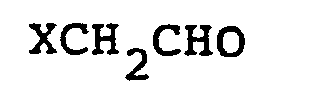
wherein X is as defined above, or a dialkylacetal thereof of the formula:
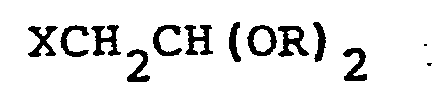
wherein R is a lower alkyl group and X is as defined above with aqueous phosphinic acid in the, presence of an acid catalyst, and optionally reacting the resultant α-hydroxy-β-haloethyl phosphinic acid with an organic or inorganic base or a metal salt to give the corresponding metal salt.
wherein X is a chlorine atom or a bromine atom, or a salt thereof, which process comprises reacting a haloacetaldehyde of the formula:
wherein X is as defined above, or a dialkylacetal thereof of the formula:
wherein R is a lower alkyl group and X is as defined above with aqueous phosphinic acid in the, presence of an acid catalyst, and optionally reacting the resultant α-hydroxy-β-haloethyl phosphinic acid with an organic or inorganic base or a metal salt to give the corresponding metal salt.
2. A process as claimed in claim 1 wherein the resultant α-hydroxy-β-haloethyl phosphinic
acid is reacted with a calcium compound to give the corresponding calcium salt.
3. A process as claimed in claim 1 wherein the resultant α-hydroxy-β-haloethyl phosphinic
acid is reacted with an aluminium compound to give the corresponding aluminium salt.
4. A process as claimed in claim 1 wherein the resultant α -hydroxy-β-haloethyl phosphinic
acid is reacted with an ammonium compound to give the corresponding ammonium salt.
5. A fungicidal composition which comprises as a active ingredient a fungicidally
effective amount of a compound as defined in claim 1, or a salt thereof together with
an inert carrier or diluent.
6. A method for preventing plant disease which comprises applying a fungicidally effective
amount of a compound as defined in claim 1, or a salt thereof, to plants.
7. A method as claimed in claim 6 wherein the plant disease is one caused by fungi
belonging to Phycomycetes.
8. A method for curing plant disease which comprises applying a fungicidally effective
amount of a compound as defined in claim 1, or a salt thereof, to plants.
9. A method as claimed in claim '8 wherein the plant disease is one caused by fungi
belonging to Phycomycetes.