| (19) |
 |
|
(11) |
EP 0 119 310 B1 |
| (12) |
EUROPEAN PATENT SPECIFICATION |
| (45) |
Mention of the grant of the patent: |
|
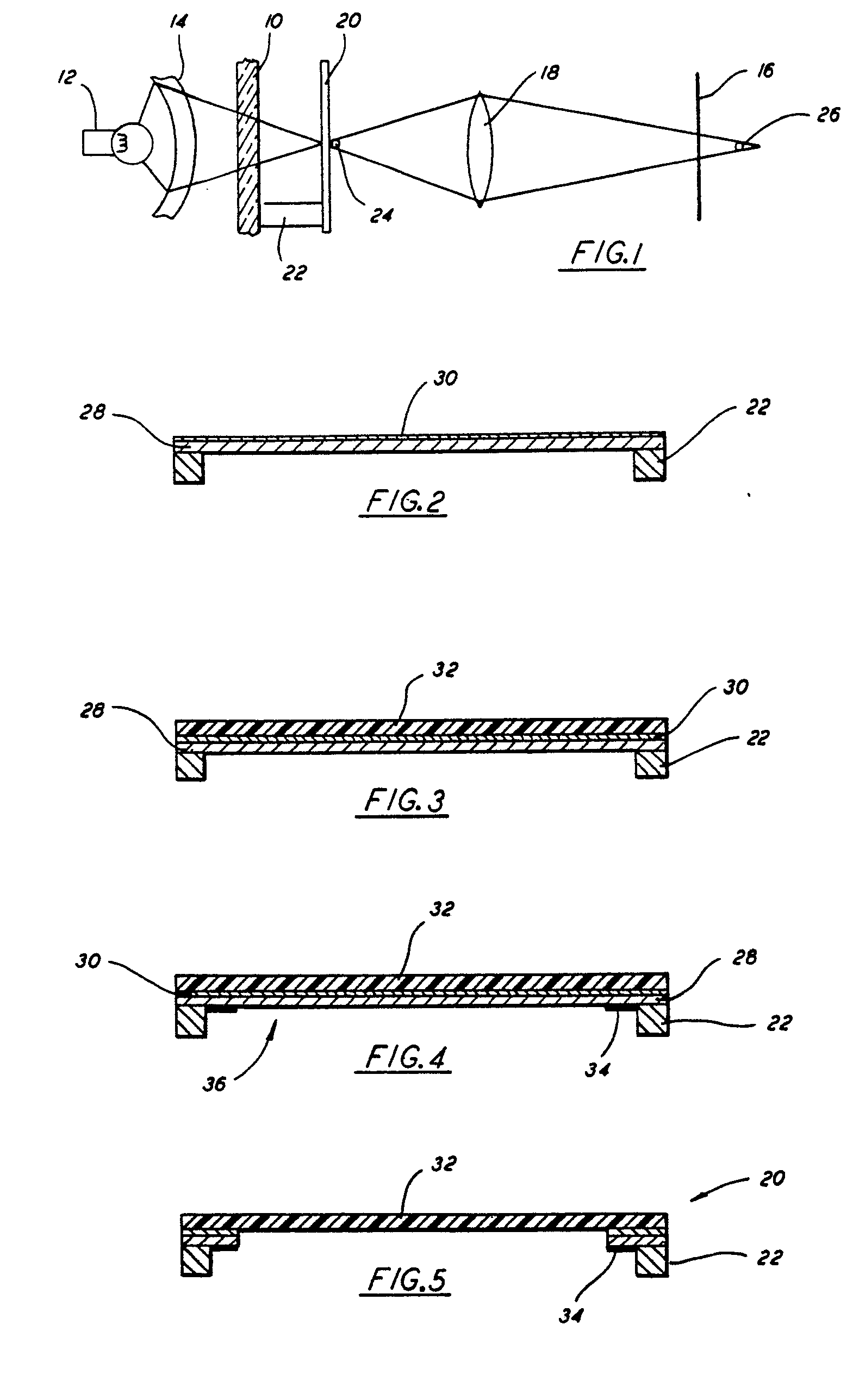
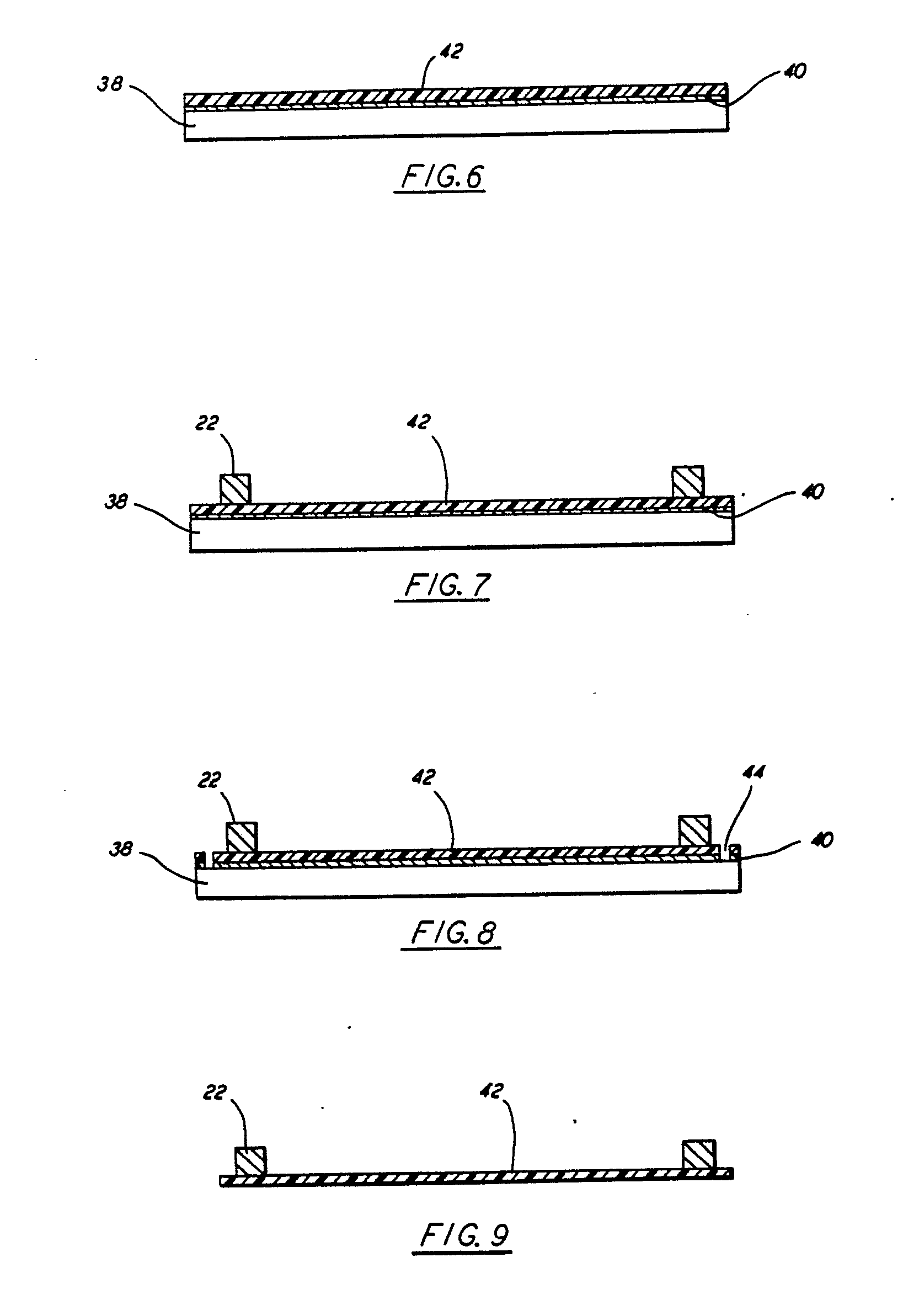
01.06.1988 Bulletin 1988/22 |
| (22) |
Date of filing: 09.12.1983 |
|
| (51) |
International Patent Classification (IPC)4: G03F 1/00 |
|
| (54) |
Method of fabricating a pellicle cover for projection printing system
Verfahren zur Herstellung einer Filmabdeckung für ein Projektionsbelichtungssystem
Procédé pour la fabrication d'un opercule pelliculaire pour un système d'exposition
par projection
|
| (84) |
Designated Contracting States: |
|
DE FR GB NL |
| (30) |
Priority: |
14.02.1983 US 466268
|
| (43) |
Date of publication of application: |
|
26.09.1984 Bulletin 1984/39 |
| (73) |
Proprietor: THE PERKIN-ELMER CORPORATION |
|
Norwalk
Connecticut 06856-0181 (US) |
|
| (72) |
Inventors: |
|
- Duly, Dawn L.
Huntington
Connecticut 06484 (US)
- Windischmann, Henry
Huntington
Connecticut 06484 (US)
- Buckley, W.D.
Easton
Connecticut 06615 (US)
|
| (74) |
Representative: Grünecker, Kinkeldey,
Stockmair & Schwanhäusser
Anwaltssozietät |
|
Maximilianstrasse 58
80538 München
80538 München (DE) |
| (56) |
References cited: :
US-A- 4 246 054
|
US-A- 4 254 174
|
|
| |
|
|
- IBM TECHNICAL DISCLOSURE BULLETIN, vol. 22, no. 10, March 1980, pages 4765-4766, New
York, US S. CHENG et al.: "Improved device for photographic mask and wafer protection"
|
|
| |
|
| Note: Within nine months from the publication of the mention of the grant of the European
patent, any person may give notice to the European Patent Office of opposition to
the European patent
granted. Notice of opposition shall be filed in a written reasoned statement. It shall
not be deemed to
have been filed until the opposition fee has been paid. (Art. 99(1) European Patent
Convention).
|
[0001] This invention relates to a method of fabricating a pellicle cover assembly for use
in a projection system for forming an image on a radiation sensitive wafer, said method
comprising the steps of forming a polymer film on a substrate, curing said polymer
film and using a support ring to hold the polymer film. As the case may be the substrate
may be etched away. Such a pellicle cover assembly may cover the mask and/or the wafer.
The systems according to the invention are adapted particularly among other possible
uses, for effecting the exposure of photoresist-coated semi-conducted wafers in the
manufacture of integrated circuits.
[0002] Projection printing systems for forming an image on a light sensitive substrate or
wafer normally include a mask having a transparent substrate with a pattern of opaque
and transparent areas formed on one surface thereof, an illumination system for directing
a beam of radiation energy such as light or UV rays through the mask to a radiation
sensitive substrate or wafer, optical means for forming a focused image of the mask
pattern on the radiation sensitive substrate and a pellicle cover for maintaining
the images of any dirt particles on the surface of the mask out of focus. The pellicle
cover is normally bonded to the substrate and completely covers the mask pattern.
Such systems, for example, are described in US-A-4 063 812 and US-A-4131 361 and in
an article by Ron Hersel entitled: Pellicle Protection of Integrated Circuits (IC)
Masks", appearing in SPIE, vol. 275 Semiconductor Microlithography VI, (1981) page
23.
[0003] In US-A-4 254 174 a process for fabricating a polyimide membrane x-ray lithography
masks has already been described. In this process a thin membrane of polyimide is
formed by spinning polyamic acid on a glass substrate and polymerizing the same in
situ. Then a gold absorber pattern is formed on top of the polyimide polymer film
wherein the glass substrate acts as a holder and efficient heat sink. A support ring
is then bonded to the polyimide film and the glass is then etched in dilute HF. In
this way a gold absorber pattern is formed on an optically smooth polyimide membrane
with a thickness from 0.5 to 5 11m.
[0004] With increasing miniaturization, the pattern elements have become smaller and smaller
to the extent that pattern resolution is limited by the wavelength of the light. This
has led to the use of shorter wavelengths of the UV spectrum.
[0005] One disadvantage of the mask covers used heretofore is that they are only suitable
for use in the wavelength range of from 4.10-71im (4000 angstroms) and above. Thus,
an object of this invention is to provide a new and improved method of making a pellicle
cover, which is suitable for use in the wavelength range of 2.10-7 to 3.10-7pm (2000
and 3000 angstroms).
[0006] In order to accomplish the desired results, the invention provides according to claim
1 a first solution consisting in a method of fabricating a pellicle cover assembly
for use in a projection system for forming an image on a radiation sensitive wafer,
said method comprising the steps of forming a polymer film on a substrate and curing
the same, using a support ring to hold the polymer film and etching the substrate
away, wherein the substrate is mounted on a metal ring, wherein the substrate is a
membrane, wherein the front surface of said substrate is coated with the uniform thin
polymer film, which in one form of the invention is polymethylmethacrylate, wherein
said polymer film is cured, the back surface of the substrate is coated with the photoresist,
an aperture of preselected dimension is defined in said photoresist by exposure and
development, and wherein said photoresist is baked and said thin substrate is etched
away leaving a free standing polymer film.
[0007] According to claim 8 another solution according to the invention consisting in a
method of fabricating a pellicle assembly cover for use in the projection system for
forming an image on a radiation sensitive wafer is provided that method comprising
the steps of forming a polymer film on a substrate, curing said polymer film and using
a support ring to hold the polymer film, and wherein a gold film is applied onto the
surface of the substrate which is formed by a wafer, said thin uniform polymer film
is applied onto the gold film surface of said wafer, said polymer film is cured, a
pellicle support ring is adhered to the polymer film, the polymer and gold films cutting
through the ring and wafer edges to expose the wafer surface, the ring is carefully
peeled off the wafer, resulting in a gold coated polymer membrane that is already
mounted on a pellicle support ring and wherein the gold is finally etched off.
[0008] According to claim 17 a third solution according to the invention provides a method
of fabricating a pellicle cover assembly for use in a projection system for forming
an image on a radiation sensitive wafer, said method comprising the steps of forming
a polymer film on a substrate, curing said polymer film and using a support ring to
hold the polymer film, wherein a thin gold film is applied onto a chromium coated
surface of the substrate, which is formed by a silicon wafer, a thin uniform polymer
film is applied onto the gold film surface of said wafer, said polymer film is cured,
a pellicle support ring is adhered to the polymer film and wherein the polymer film
is carefully peeled directly off the gold surface.
[0009] Furthermore, all embodiments are in accordance with the sub-claims and are included
in the specification by a special reference thereto.
[0010] Specific embodiments of the invention have been chosen for purposes of illustration
and description, and are shown in the accompanying drawings, forming a part of this
specification.
Fig. 1 is a schematic drawing of a projection printing system for forming an image
on a radiation sensitive coated wafer constructed in accordance with the concepts
of the present invention;
Figs. 2 to 5 are side elevations showing the method steps involved for forming a pellicle
cover assembly according to one embodiment of the invention; and
Figs. 6 to 9 are side elevations showing the series of steps involved and the method
of fabricating a pellicle cover assembly according to another embodiment of the invention.
[0011] Referring to Fig. 1, there is shown a projection printing system for forming an image
on a radiation sensitive wafer, which comprises a mask 10 having a transparent substrate
with a pattern of opaque and transparent areas formed on one surface thereof. An illuminating
system is provided which includes a radiation source 12 and a condenser lens system
14 for directing radiation through the mask 10 to a radiation sensitive coated wafer
member 16. An optical system 18 serves to form a focused image of the mask pattern
on the wafer. A pellicle cover 20 is mounted on the mask 10, as by means of a support
ring 22. As a result, scratching or particulate contaminates 24, which would otherwise
rest on the mask surface, now rest on the surface of the pellicle and hence are focused
out of the focal plane by thousands of times the depth of field, as indicated at 26,
Fig. 1. Their shadows are dissipated over the image field and have no effect on the
resist image.
[0012] The pellicle 20 is a thin polymer film. Polymethylmethacrylate (PMMA) has been found
to be a particularly desirable material. Among other possible desirable parameters,
PMMA has a high transmission in the range of. from about 2,6.10-
7m (2600 angstroms) to about 8·10
-7m (8000 angstroms), low light scattering, and thickness uniformity. It is also rugged
enough to be handled and cleaned without damage.
[0013] Further, according to the invention, there is provided a new and improved method
of fabricating the pellicle assembly. This method comprises the steps of taking a
thin membrane, having a one micrometer titanium layer 28, Fig. 2, and 0,3.10-'m (300
angstrom) gold layer 30, and tensioning it and mounting it on the ring 22 to form
a substrate. This membrane may be metallic or nonmetallic depending on the application.
However, a particularly desirable membrane comprises a titanium layer and a gold layer.
Referring to Fig. 3, a thin polymer film of polymethylmethacrylate, (PMMA), 32 is
then coated on the surface of the gold layer 30 in a uniform film using any suitable
conventional technique such as spinning, for example. Then the PMMA polymer film 32
is cured. The back surface of the substrate, i.e., the exposed surface of the titanium
28 is then coated with photoresist 34. An aperture of the desired dimension is then
defined in this photoresist by exposure and development, as indicated at 36 in Fig.
4. After hard baking the photoresist 34, the titanium layer 28 is etched away using
a solution of hydrogen fluoride and deionized water, 1 to 19, as shown in Fig. 5.
Immediately after rinsing in the deionized water, the gold layer 30 is etched away
by a suitable conventional gold etching technique, leaving a free standing PMMA polymer
membrane or cover as seen in Fig. 5. The film thickness can be varied as desired from
a few thousands angstroms (1 angstrom = 10
-10m to many pm).
[0014] Figs. 6 to 8 illustrate a second method of fabricating the pellicle assembly, according
to the invention. This method has certain advantages over the previously described
method, because it is simpler, less expensive and allows for the use of standard equipment
and some of the same techniques which are already in use in the semiconductor industry.
The starting substrate is an oxidized wafer 38, Fig. 6, the size thereof being dependent
on the required finished pellicle size. Onto the polished surface of this wafer, a
0,5·10
-7m (500 angstrom) gold layer 40 is vac- cuum evaporated. A thin uniform PMMA polymer
film 42 is coated onto the surface of the gold film, using suitable conventional spinning
techniques. Thence, the polymer is cured, preferably at about 170°C. As seen in Fig.
7, the next fabricating step comprises epoxying the pellicle support or mounting ring
22 onto the surface of the polymer layer 42. Then, with a razor blade or the like,
a circular cut is made around the mounting ring 22, i.e., between the ring and the
wafer edge, through the PMMA polymer layer 42 and gold film 40 so that the wafer surface
is exposed, as indicated at 44, Fig. 8.
[0015] The next step in the method is to carefully peel the ring off the wafer, resulting
in a gold coated polymer membrane that is already mounted on a suitable pellicle ring.
Then the gold is etched off by a suitable, conventional gold etching technique, such
as for example by using potassium iodide/iodine/water solution, to produce the desired
pellicle assembly as seen in Fig. 9.
[0016] In some instances it may be desired to use a silicon wafer coated with chromium and
the gold. In this case, after application and curing, the polymer membrane may be
peeled directly off the gold surface, eliminating the gold etching step.
[0017] It will thus be seen that the present invention does indeed provide a new and improved
pellicle assembly, which has a high transmission in the range of from about 2,6.10-'m
(2600 angstroms) to about 8.10-
7m (8000 angstroms), low light scattering, and thickness uniformity, and which is rugged
enough to be handled and cleaned without damage.
1. A method of fabricating a pellicle cover assembly for use in a projection system
for forming an image on a radiation sensitive wafer, said method comprising the steps
of forming a polymer film on a substrate and curing the same, using a support ring
to hold the polymer film for etching the substrate away, characterized in that the
substrate is formed by a membrane and is mounted on a metal ring, the front surface
of said membrane is coated with the uniform thin polymer film, said polymer film is
cured, the back surface of the membrane is coated with a photoresist, an aperture
of preselected dimension is defined in said photoresist by exposure and development,
said photoresist is baked and said thin membrane is etched away having a free standing
polymer film.
2. A method of fabricating a pellicle cover assembly according to claim 1 wherein
said step of coating the front surface of said membrane is effected by spinning.
3. A method of fabricating a pellicle cover assembly according to claim 1 wherein
said thin membrane includes a layer of titanium and a layer of gold.
4. A method of fabricating a pellicle cover assembly according to claim 3 wherein
said layer of titanium is about 1 um thick and said layer of gold is about 0.03 11m
thick.
5. A method of fabricating a pellicle cover assembly according to claims 3 or 4 wherein
said step of etching said thin membrane away includes the step of etching the titanium
layer away using a 1 to 19 solution of hydrogen fluoride and deionized water and etching
the gold layer away with a potassium iodide solution.
6. A method of fabricating a pellicle cover assembly according to claim 1 wherein
said step of curing the polymer film is effected in an oven at a temperature of about
170°C.
- 7. A method of fabricating a pellicle cover assembly according to claim 1 wherein
said polymer film is polymethylmethacrylate.
8. A method of fabricating a pellicle cover assembly for use in a projection system
for forming an image on a radiation sensitive wafer, said method comprising the steps
of forming a polymer film on a substrate, curing said polymer film and using a support
ring to hold the polymer film, characterized in that a gold film is applied onto the
surface of the substrate, which is formed by a wafer, said thin uniform polymer film
is applied onto the gold film surface of said wafer, said polymer film is cured, a
pellicle support ring is adhered to the polymer film, the polymer and gold films are
cut through between the ring and the wafer edges to expose the wafer surface, the
ring is carefully peeled off the wafer, resulting in a gold coated polymer membrane
which is already mounted on a pellicle support ring and the gold film is etched off.
9. A method of fabricating a pellicle cover assembly according to claim 8 wherein
said wafer is an oxidized silicon wafer.
10. A method of fabricating a pellicle cover assembly according to claim 8 wherein
the gold film has a thickness of about 50 nm.
11. A method of fabricating a pellicle cover assembly according to claim 8 wherein
said step of coating a thin polymer film onto the surface of the wafer uses a spinning
process.
12. A method of fabricating a pellicle cover assembly according to claim 8 wherein
said step of curing the polymer film is effected in an oven at a temperature of about
170°C.
13. A method of fabricating a pellicle cover assembly according to claim 8 wherein
said step of etching off the gold is effected with a solution of potassium iodide.
14. A method of fabricating a pellicle cover assembly according to claim 8 wherein
said step of applying a gold film is effected by vacuum evaporation.
15. A method of fabricating a pellicle cover assembly according to claim 8 wherein
said polymer film is polymethylmethacrylate.
16. A method of fabricating a pellicle cover assembly according to claim 8 wherein
said step of etching off the gold is effected with a solution of hydrogen iodide.
17. A method of fabricating a pellicle cover assembly for use in a projection system
for forming an image on a radiation sensitive wafer, said method comprising the steps
of forming a polymer film on a substrate, curing said polymer film and using a support
ring to hold the polymer film, characterized in that a thin gold film is applied onto
a chromium coated surface of the substrate, which is formed by a silicon wafer, said
thin uniform polymer film is applied onto the gold film surface of said wafer, said
polymer film is cured, a pellicle support ring is adhered to the polymer film, and
the polymer film is carefully peeled directly off the gold surface.
18. A method of fabricating a pellicle cover assembly according to claim 17 wherein
said polymer film is polymethylmethacrylate.
19. A method of fabricating a pellicle cover assembly according to claim 17 wherein
said gold film has a thickness of about 50 nm.
20. A method of fabricating a pellicle cover assembly according to claim 17 wherein
said step of applying a polymer film uses a spinning process.
21. A method of fabricating a pellicle cover assembly according to claim 17 wherein
said step of curing the polymer film is effected in an oven at a temperature of about
170°C.
22. A method of fabricating a pellicle cover assembly according to claim 17 wherein
said step of applying a gold film is effected by vacuum evaporation.
1. Verfahren zur Erzeugung einer Filmschichtabdeckung für ein Projektionsbelichtungssystem
zur Erzeugung eines Bildes auf einem strahlungsempfindlichen Plättchen, wobei das
Verfahren Schritte umfaßt, bei denen eine Polymerschicht auf einem Träger gebildet
wird, die dann getrocknet wird, wobei ein Trägerring verwendet wird, um den Polymerfilm
beim Wegätzen des Trägers zu halten, dadurch gekennzeichnet, daß der Träger von einer
Membran gebildet wird und auf einem Metallring befestigt ist, wobei die Vorderfläche
der Membran mit einer gleichförmig dünnen Polymerschicht überzogen ist, wobei die
Polymerschicht getrocknet wird, wobei die Rückfläche der Membran mit einem Fotoresist
überzogen wird, wobei eine Öffnung einer bestimmten Größe in dem Fotoresist durch
Belichtung und Entwicklung definiert wird, wobei der Fotoresist gebacken wird und
wobei die dünne Membran weggeätzt wird, so daß man eine freiliegende Polymerschicht
hat.
2. Verfahren nach Anspruch 1, wobei der Verfahrensschritt des Überziehens der Frontfläche
der Membran durch Verwirbeln erzeugt wird.
3. Verfahren nach Anspruch 1, wobei die dünne Membran eine Schicht aus Titan und eine
Schicht aus Gold umfaßt.
4. Verfahren nach Anspruch 3, wobei die Schicht aus Titan ca. 1 pm dick und die Schicht
aus Gold ca. 0,03 um dick ist.
5. Verfahren nach Anspruch 3 oder 4, wobei im Verfahrensschritt des Abätzens der dünnen
Membran ein Schritt enthalten ist, in dem die Titanschicht abgeätzt wird, wobei hierzu
eine 1 bis 19%ige Wasserstoffluoridlösung und deionisiertes Wasser verwendet wird
und wobei das Abätzen der Goldschicht mit einer Jodkalilösung erfolgt.
6. Verfahren nach Anspruch 1, wobei die Verfahrensschritt des Trocknens der Polymerschicht
in einem Ofen bei einer Temperatur von ca. 170°C durchgeführt wird.
7. Verfahren nach Anspruch 1, wobei die Polymerschicht Polymethylmethacrylat ist.
8. Verfahren zur Herstellung einer Filmabdekkung für ein Projektionsbelichtungssystem
zur Erzeugung eines Bildes auf einem strahlungsempfindlichen Plättchen, wobei das
Verfahren die Schritte umfaßt, daß auf einem Träger eine Polymerschicht erzeugt wird,
daß die Polymerschicht dann getrocknet wird und daß dann ein Stützring zum Halten
der Polymerschicht verwendet wird, dadurch gekennzeichnet, daß auf der Oberfläche
des Trägers eine Goldschicht erzeugt ist, die von einem Plättchen gebildet wird, wobei
die dünne gleichförmige Polymerschicht auf der Goldschichtfläche des Plättchens aufgetragen
wird, wobei die Polymerschicht getrocknet wird, wobei ein Filmträgerring an der Polymerschicht
zum Anhaften gebracht wird, wobei die Polymer-und Goldschichten zwischen den Ring-
und den Plättchenkanten durchgeschnitten werden, um die Plättchenfläche freizulegen,
wobei dann der Ring vorsichtig von dem Plättchen abgeschält wird, was zu einer goltbeschichteten
Polymermembran führt, die bereits auf einem Filmstützring angeordnet ist und wobei
dann die Goldschicht abgeätzt wird.
9. Verfahren nach Anspruch 8, wobei das Plättchen ein oxidiertes Siliziumplättchen
ist.
10. Verfahren nach Anspruch 8, wobei die Goldschicht eine Dicke von ca. 50 nm hat.
11. Verfahren nach Anspruch 8, wobei zum Beschichten der Oberfläche des Plättchens
mit der dünnen Polymerschicht eine Verwirbelungsverfahren eingesetzt wird.
12. Verfahren nach Anspruch 8 wobei der Verfahrensschritt des Trocknens der Polymerschicht
in einem Ofen bei einer Temperatur von ca. 70°C durchgeführt wird.
13. Verfahren nach Anspruch 8, wobei der Verfahrensschritt des Abätzens des Goldes
mit einer Jodkalilösung durchgeführt wird.
14. Verfahren nach Anspruch 8, wobei der Verfahrensschritt des Auftragens einer Goldschicht
durch Vakuumverdampfen durchgeführt wird.
15. Verfahren nach Anspruch 8, wobei die Polymerschicht eine Polymethylmethacrylatschicht
ist.
16. Verfahren nach Anspruch 8, wobei der Verfahrensschritt des Abätzens des Goldes
mit Hilfe einer Wasserstoffiodidlösung durchgeführt wird.
17. Verfahren zur Herstellung einer Filmabdekkung für ein Projektionsbelichtungssystem
zur Erzeugung eines Bildes auf einem strahlungsempfindlichen Plättchen, wobei bei
dem Verfahren eine Polymerschicht auf einem Träger erzeugt wird, wobei dann die Polymerschicht
gehärtet wird und wobei dann ein Tragring verwendet wird, um die Polymerschicht zu
halten, dadurch gekennzeichnet, daß eine dünne Goldschicht auf einer chromüberzogenen
Oberfläche des Trägers erzeugt wird, der von einem Silikonplättchen gebildet wird,
wobei dann die dünne gleichförmige Polymerschicht auf die goldbeschichtete Oberfläche
des Plättchens aufgetragen wird, wobei dann die Polymerschicht getrocknet wird, wobei
dann ein Filmträgerring mit der Polymerschicht verbunden wird, und wobei dann die
Polymerschicht sorgfältig direkt von der Goldoberfläche abgeschält wird.
18. Verfahren nach Anspruch 17, wobei die Polymerschicht eine Polymethylmethacrylatschicht
ist.
19. Verfahren nach Anspruch 17, wobei die Goldschicht eine Dicke von ca. 50 nm hat.
20. Verfahren nach Anspruch 17, wobei beim Auftragen der Polymerschicht ein Verwirbelungsverfahren
verwendet wird.
21. Verfahren nach Anspruch 17, wobei der Verfahrensschritt des Trocknens der Polymerschicht
in einem Ofen bei einer Temperatur von ca. 170°C. durchgeführt wird.
22. Verfahren nach Anspruch 17, wobei der Schritt des Auftragens der Goldschicht durch
Vakuumaufdampfen durchgeführt wird.
1. Procédé de fabrication d'un ensemble formant écran pelliculaire pour emploi dans
un système de projection pour former une image sur une pastille sensible au rayonnement,
ledit procédé comportant les étapes consistant à former un film polymère sur un substrat,
puis à faire durcir ce film, en utilisant un anneau support pour maintenir le film
polymère pour en enlever le substrat par attaque chimique, caractérisé en ce que le
substrat est formé par une membrane que l'on monte sur un anneau métallique; en ce
que l'on revêt la surface avant de ladite membrane avec le film polymère fin uniforme;
en ce que l'on fait durcir ledit film polymère; en ce que l'on revêt la surface arrière
de la membrane avec un enduit photorésistant; en ce que l'on définit une ouverture
de dimension présélectionnée dans ledit enduit photorésistant par exposition et développement;
en ce que l'on cuit ledit enduit photorésistant; et un ce que l'on enlève ladite membrane
fine par attaque chimique pour avoir un film polymère autonome.
2. Procédé de fabrication d'un ensemble formant écran pelliculaire selon la revendication
1, dans lequel l'étape consistant à revêtir la surface avant de ladite membrane s'effectue
par centrifugation.
3. Procédé de fabrication d'un ensemble formant écran pelliculaire selon la revendication
1, dans lequel ladite membrane fine comprend une couche de titane et une couche d'or.
4. Procédé de fabrication d'un ensemble formant écran pelliculaire selon la revendication
3, dans lequel ladite couche de titane a une épaisseur d'environ 1 um et ladite couche
d'or, une épaisseur d'environ 0,03 pm.
5. Procédé de fabrication d'un ensemble formant écran pelliculaire selon les revendications
3 ou 4, dans lequel ladite étape consistant à enlever ladite membrane fine par attaque
chimique comprend l'étape consistant à enlever la couche de titane en l'attaquant
au moyen d'une solution d'acide fluorhydrique et d'eau désionisée de rapport 1 à 19
et celle consistant à enlever la couche d'or en l'attaquant avec une solution d'iodure
de potassium.
6. Procédé de fabrication d'un ensemble formant écran pelliculaire selon la revendication
1, dans lequel ladite étape consistant à faire durcir le film polymère s'effectue
dans un four à une température d'environ 170°C.
7. Procédé de fabrication d'un ensemble formant écran pelliculaire selon la revendication
1, dans lequel ledit film polymère est en polyméthyl- métacrylate.
8. Procédé de fabrication d'un ensemble formant écran pelliculaire pour emploi dans
un système de projection pour former une image sur une pastille sensible au rayonnement,
ledit procédé comportant les étapes consistant à former un film polymère sur un substrat,
à faire durcir ledit film polymère et à utiliser un anneau support pour maintenir
le film polymère, charactérisé en ce que l'on applique un film d'or sur la surface
du substrat, qui est formé par une pastille; en ce que l'on applique ledit film polymère
fin uniforme sur la surface du film d'or de ladite pastille; en ce que l'on fait durcir
ledit film polymère; en ce que l'on fait adhérer un anneau support de l'écran pelliculaire
au film polymère; en ce que l'on découpe de part en part le film polymère et le film
d'or entre l'anneau et les bords de la pastille pour exposer la surface de la pastille;
en ce que l'on détache soigneusement l'anneau de la pastille en le pelant, d'où résulte
une membrane polymère revêtue d'or qui est déjà montée sur un aneau support de l'écran
pelliculaire; et en ce que l'on enléve le film d'or par attaque chimique.
9. Procédé de fabrication d'un ensemble formant écran pelliculaire selon la revendication
8, dans lequel ladite pastille est une pastille de silicium oxydé.
10. Procédé de fabrication d'un ensemble formant écran pelliculaire selon la revendication
8, dans lequel le film d'or a une épaisseur d'environ 50 nm.
11. Procédé de fabrication d'un ensemble formant écran pelliculaire selon la revendication
8, dans lequel ladite étape consistant à revêtir la surface de la pastille d'un film
polymère fin utilise un processus de centrifugation.
12. Procédé de fabrication d'un ensemble formant écran pelliculaire selon. la revendication
8, dans lequel ladite étape consistant à faire durcir le film polymère s'effectue
dans un four à une température d'environ 170°C.
13. Procédé de fabrication d'un ensemble formant écran pelliculaire selon la revendication
8, dans lequel ladite étape consistant à enlever l'or par attaque chimique s'effectue
au moyen d'une solution d'iodure de potassium.
14. Procédé de fabrication d'un ensemble for- .mant écran pelliculaire selon la revendication
8, dans lequel ladite étape consistant à appliquer un film d'or s'effectue par évaporation
sous vide.
15. Procédé de fabrication d'un ensemble formant écran pelliculaire selon la revendication
8, dans lequel ledit film polymère est de polyméthyl- méthacrylate.
16. Procédé de fabrication d'un ensemble formant écran pelliculaire selon la revendication
8, dans lequel ladite étape consistant à enlever l'or par attaque chimique s'effectue
au moyen d'une solution d'iodure d'hydrogène.
17. Procédé de fabrication d'un ensemble formant écran pelliculaire pour. emploi dans
un système de projection pour former une image sur une pastille sensible au rayonnement,
ledit procédé comportant les étapes consistant à former un film polymère sur un substrat,
à faire durcir ledit film polymère et à utiliser un anneau support pour maintenir
le film polymère, caractérisé en ce que l'on applique un fin film d'or sur une surface,
revêtue de chrome, du substrat qui est formé par une pastille de silicium; en ce que
l'on applique ledit film polymère fin et uniforme sur la surface du film d'or de ladite
pastille; en ce que l'on fait durcir ledit film polymère; en ce que l'on fait adhérer
un anneau support de l'écran pelliculaire au film polymère; et en ce que l'on détache
soigneusement le film polymère de la surface de l'or en le pelant.
18. Procédé de fabrication d'un ensemble formant écran pelliculaire selon la revendication
17, dans lequel ledit film polymère est du polymé- thylméthacrylate.
19. Procédé de fabrication d'un ensemble formant écran pelliculaire selon la revendication
17, dans lequel ledit film d'or a une épaisseur d'environ 50 nm.
20. Procédé de fabrication d'un ensemble formant écran pelliculaire selon la revendication
17, dans lequel ladite étape consistant à appliquer un film polymère utilise un processus
de centrifugation.
21. Procédé de fabrication d'un ensemble formant écran pelliculaire selon la revendication
17, dans lequel ladite étape consistant à faire durcir le film polymère s'effectue
dan un four à une température d'environ 170°C.
22. Procédé de fabrication d'un ensemble formant écran pelliculaire selon la revendication
17, dans lequel ladite étape consistant à appliquer un film d'or s'effectue par évaporation
sous vide.