|
(11) | EP 0 120 561 A1 |

| (12) | EUROPEAN PATENT APPLICATION |
|
|
|
|
|||||||||||||||||||||||||||
| (54) | Water-agglomeration method for depeptide sweetened products |
| (57) @ An improved process is provided by the present invention. The improvement embraces
a water-agglomeration process for efficiently preparing a comestible mix wherein the
sweetening agent is a dipeptide sweetener (APM). The method utilizes an agglomeration
vehicle, consisting essentially of water, thereby providing a low calorie comestible
mix that has enhanced solubility characteristics. |
Technical Field
[0001] The present invention relates generally to modes of producing agglomerated products, and more specifically to an improved method for agglomerating dipeptide-sweetened food products via agglomeration.
[0002] with the introduction of such novel sweetening agents as aspartyl-phenylalanine methylester (APM) glycyrrhizin, neo-hesperdine or many of the compounds now under investigation, novel methods for incorporating said ingredients are needed so that said ingredients may be included in various comestible product formulations. Being of novel structure and of a idiosyncratic nature, the above mentioned sweeteners present a multiplicity of processesing problems. For example, APM resists homogenous placement. When added to a comestible dry mix, APM tends to coalesce as the individual crystals are, due to attractive forces, induced to stick to one another. This phenomenon is so great that individual APM crystals will transmigrate through the mix and form ball-like clumps of said sweetening agent. Compounding the above stated problem, APM crystals imbued with said attractive forces will actually adhere to the processesing machinery itself, said adhesion preventing the introduction of all of the APM into the mix.
[0003] There are many techniques for placing APM crystals or other sweeteners within a comestible dry mix. For example, one may dissolve the total mix product including the sweetener and, via a spray drying unit, produce regularized particles of said finished mix product. Spray drying, wherein the total mix is dissolved, requires a great deal of energy to dry the comestible mix as well as endangering the APM by introducing said APM to what is usually an aqueous acid or other degrative liquid environment. On the other hand, dry mixing of a comestible mix with the inclusion of APM or other dipeptide sweeteners, while of an economical nature, is precluded by the fact that APM will clump and coaelesce and thereby greatly reduce the rate of solubility of the mix.
[0004] The method known as fluidized bed agglomeration, wherein a series of disparate ingredients is suspended by a stream of air above the bed of the agglomerating unit, so that an agglomerating vehicle may be used to induce the formation of regularly sized particles.
[0005] The prior art is aware of examples of various and sundry agglomeration procedures where sugar, saccharine and cyclamates are the major sweetening agents.. The previously published prior art, however, hast not dealt with the agglomeration of such idiosyncratic and disruptive agents as APM.
DISCLOSURE OF THE INVENTION
[0006] Accordingly, the present invention provides a process for effecting an APM-sweetened, comestible product via an improved water-agglomeration procedure. First, a series of dry particulate ingredients such as flavorings, fillers, and acids, together with APM is blended so that a homogeneous dry mix is achieved. This homogenous mixture which will continue to stay homogenous for only a very short period of time is introduced directly into a suitable fluidized agglomerating apparatus. The agglomeration apparatus fluidizes the mix and induces the suspension of said mixed particles within the unit. An aqueous fluid consisting essentially of water and a colorant, such as a solubilized FD&C dye, is then sprayed into the agglomeration unit, said unit being maintained within a critical temperature range, so that the disparate particles are made to coalesce into larger regularized particles thereby causing the adhesion of said APM sweetener into the edible comestible product. The newly formed agglomerated product or agglomerate is then dried and inspected. If resultant agglomerated particles are of a size which is smaller than optimally desired, said particles may be made to increase in size merely by contacting said particles with the aqueous fluid vehicle. These finished particles may then be directly assimilated into containers and sold, for each particle represents approximately the total reconstituted comestible product. The above outlined procedure, permits relatively small amounts of energy to be used, for the fluidized mix is exposed to water in only the agglomeration step thereby reducing the energy costs necessary to dry a disolved or essentially dissolved solution-suspension. Moreover, this instant aqueous procedure protects the dipeptide sweetener from degradation due to prolonged chemical reaction. Moreover, it has been found that the aqueously constructed agglomerates provide enhanced solubility characteristics, said characteristics being comparable to an agglomerated product wherein the agglomeration vehicle was an aqueous dextrin solution said mixture being noted as a solubility enhancer. Other advantages are decreased dustiness, enhanced flow characteristics, improved process flexibility, lower costs and fewer calories.
[0007] The improved method for agglomerating aspartame sweetened beverage mixes is outlined in a stepwise fashion hereinbelow. First, aspartame (APM) of a suitable particle size, said size being between 0.5-300 microns is obtained and is to be blended with appropriate amounts of flavor and appropriate amounts of food acid. Oversized particles would necessitate grinding the APM so that 95% of said APM by weight percent is within a preferred particle size range of from 5-125 microns. The ingredients including an organic acid, and one or more of a plurality of flavorings are combined for blending.
[0008] The blending operation, which may be effected via a ribbon-type blender, a V-blender or other suitable device, involves the addition of the total contents, that is all components with partial or complete exclusion of colorings, to be added to a holding container. Activation of the blender for a blending period which is proportional to the amount of "mix" results in a homogenous comestible mixture. The mixture is then ready to undergo further processing.
[0009] The thoroughly admixed components are then transferred to a fluidized bed agglomerating unit, said unit may be either a "batch"-type or a kind that employs an endless foraminous belt and is continuous in nature. The agglomeration procedure is initiated with the addition of the admixture to the agglomerator, wherein the particles are induced to rise above the base portion and are kept suspended therein. The inlet air temperature must be kept below a maximum of 204.4°C (400°F) with a preferred inlet temperature range of ambient to 100°C (212°F). Within the agglomerator environment, the finely divided particles of the mix are fluidizedly suspended within the machine, the APM component being dispersed evenly throughout.
[0010] As a preferred embodiment, an aqueous solution consisting of water and colorants is used as the agglomerating vehicle to bind the fluidized and finely dispersed particles. The particles which comprise the comestible mix are in essence momentarily cemented to the various components of the mix to form regular-sized particles thereby. Unlike using citric acid or other organic acids, as agglomerating vehicles, that water-agglomerates will not form a hard crystalline-shelled agglomerate particle. Moreover, the agglomerate is essentially non-hygroscopic, so that it will not attract water as an acid-shelled agglomerate would
[0011] According to this invention the agglomerating vehicle is a water solution containing only a colorant. The agglomerating vehicle is maintained at a temperature of up to but not exceeding 100°C (212°F) and is sprayed onto the fluidized bed. Spraying may be accomplished by one or more nozzles or similar spray assemblies, which spray the solution into the fluidized mix. The agglomerating vehicle is sprayed in at a rate so that it is dispensed within about one hour. Atomization of the fluid is effected by introducing compressed air at between .5 to 5.0 bar with a preferred range of operating pressures between 2.0-4.0 bar. The fluid is sprayed into the mix at a weight ratio of from about 1:5 to about 1:20, and typically from about 1:12 to 1:17.
[0012] The newly formed agglomerates display a vivid color and a uniform size. By including the coloring as a component of the agglomerating vehicle, the intense color may directly color the agglomerate. The moisture content is between .6% and 4% after drying of the agglomerate has been effected with a preferred moisture content of less than 1%.
[0013] In this fixed state, the sweetener, for example APM, will stay bound within the regularized particles of the comestible mix. At this point the agglomerated mix is ready to be packaged within appropriate containers and commercially marketed. The APM remains in a fixed and stable condition for pro- longed periods of time and the agglomerated mix retains its ability to quickly dissolve when introduced into cold water.
BEST MODE FOR CARRYING OUT THE INVENTION
EXAMPLE 1
[0014] The appropriately sized APM is added to a blending apparatus, for example, a Day Ribbon Blender with such components as citric acid, potassium citrate and flavor. In a lemon-lime flavored drink mix, the percentage by weight would be approximately 76% citric acid, 2% potassium citrate, 8% natural lemon flavor, 1% natural lime flavor, 5% APM and 0.5% Vitamin C. The above mentioned formulation is included in the ribbon blender with the mixture being mixed for approximately 15 minutes with samples extracted therefrom to ensure uniformity of the mixture. The mix is then placed into an agglomeration unit. The agglomerating equipment may be, for example, an Anhydro Model 38 continuous fluid bed agglomerator. The mixture is continuously fed using a screw conveyor to the agglomeration unit and air is introduced so as to fluidize the unit and the particles are held suspended above the air dispersion plate. The agglomeration vehicle is composed of water with a coloring agent added. Therefore, not only is the agglomeration vehicle used to, in essence, cement the fluidized particles together, but also it is used to color the particles. The agglomerated product thereby is of a vivid color, adding to the overall desirability of the product. The processing is facilitated by using a three-zone agglomeration unit. Metal weirs with adjustable heights are inserted into the unit, thus yielding three distinct processing zones. Each zone has the same bed surface area for fluidization and subsequent processing. In Zone 1, all of the agglomeration vehicle is sprayed on using a conventional two-fluid nozzle with an atomization air pressure of 2.0 bar. Hence, Zone 1 is the primary agglomeration zone and preliminary drying zone. The inlet air temperature is approximately 90°C. The agglomeration vehicle is continuously fed at a rate of 15 kg/hr. The inlet air temperature in Zone 2 is 90°C and, therefore, Zone 2 becomes the primary drying zone. The inlet air temperature to Zone 3 is 30°C. This zone functions as the cooling zone. Processed powder exits the unit as a dried agglomerate. The density of the agglomerate is 0.45-0.6 grams per cc with a moisture content of between 1.0 and 1.8% by weight. The product throughput rate is 100-115 kg/hr. Tricalcium phosphate or another flow agent is added to the agglomerate and dispersed using conventional methods. Finished product is now ready for packaging.
EXAMPLE 2
[0015] A comestible mix, and more specifically a flavored beverage mix is set out by example hereinbelow, utilizing the instant fixation via agglomeration process. The first step is to take the raw APM dipeptide sweetener, and to mill said material to a particle size of between 5 to 125 microns or more preferably to 10 and 30 microns. The milled APM is added to a blending apparatus for example, a Day Ribbon Blender with such components as citric acid, potassium citrate, natural fruit flavorings, juice solids, and a portion of vitamin C. For example, in a fruit-flavored drink mix, the percentage by weight would be approximately 50-80% citric acid, 5-13% potassium citrate, 7% natural lemon flavor, 4% ground APM, 2% leomon juice solids, .5% vitamin C. The above mentioned formulation is included in the Ribbon Blender with the mixture being mixed for approximately 15 minutes with samples extracted therefrom to insure uniformity of the mixture. The mix is then fed into a batch agglomeration unit, each batch being about 2000 lb (907.2 kg). The agglomerating means may be for example, a Glatt fluid bed agglomerator Model WSG-500 which is available from Glatt Air Techniques, Ramsey, New Jersey. The mixture is added to the agglomeration unit and air is introduced so as to fluidize the particles of the complete mix. The fluidization air is introduced at 4000 cubic meters per hour and the particles are held suspended above the agglomerating base. The agglomerating vehicle is composed of water with a coloring agent added. The rate at which the agglomeration vehicle is sprayed is 1000 ml/min which induces the formation of agglomerated particles. With an inlet air temperature of between 40 and 70°C and a resulting oulet air temperature of 30 to 50°C agglomeration takes place. The compressed air, which is at an atomization pressure of 4 Barrs, is used to power the agglomeration vehicle as it is sprayed over and through the fluidized particles. The spraying phase of the process takes approximately one hour or less. With the agglomeration procedure essentially completed and the formation of agglomerate particles achieved, the temperature is increased to 80°C to facilitate drying. Therefore, not only is the agglomeration vehicle used to in essence cement the fluidized particles together, but also it is used to color plate the partcles. The agglomerate produced thereby is of a vivid color, adding to the overall desireablity of the product. The product is then dried to 1% moisture with a drying temperature that is about 80°C. Tricalcium phosphate or another flow agent is added to the agglomerator and fluidized for 2 to 3 minutes to disperse the ingredients. After this procedure, the product is then discharged and may be immediately packaged. The density of the agglomerate is about .7 to .8 grams per cc with a moisture content of between .8 and 1.4% by weight.
EXAMPLE 3
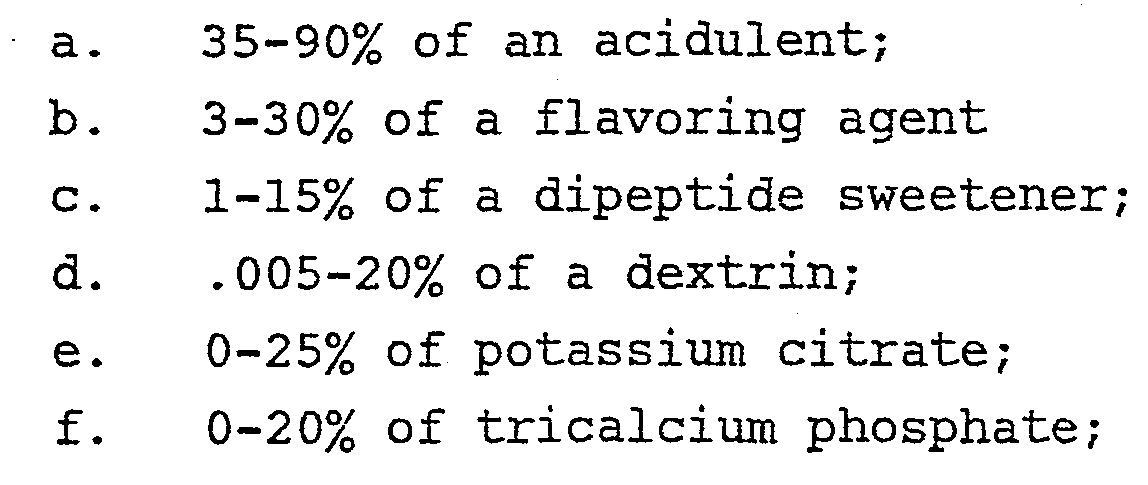
[0016] By employing the above described fixation via agglomeration methods a fruit flavored beverage may be made with a representative percentage by dry weight distribution of ingredients as follows:
EXAMPLE 4
[0017] The process according to the above enumerated methods may be used to produce a citrus (orange, lemon-lime) beverage, said beverage being composed of:
EXAMPLE 5
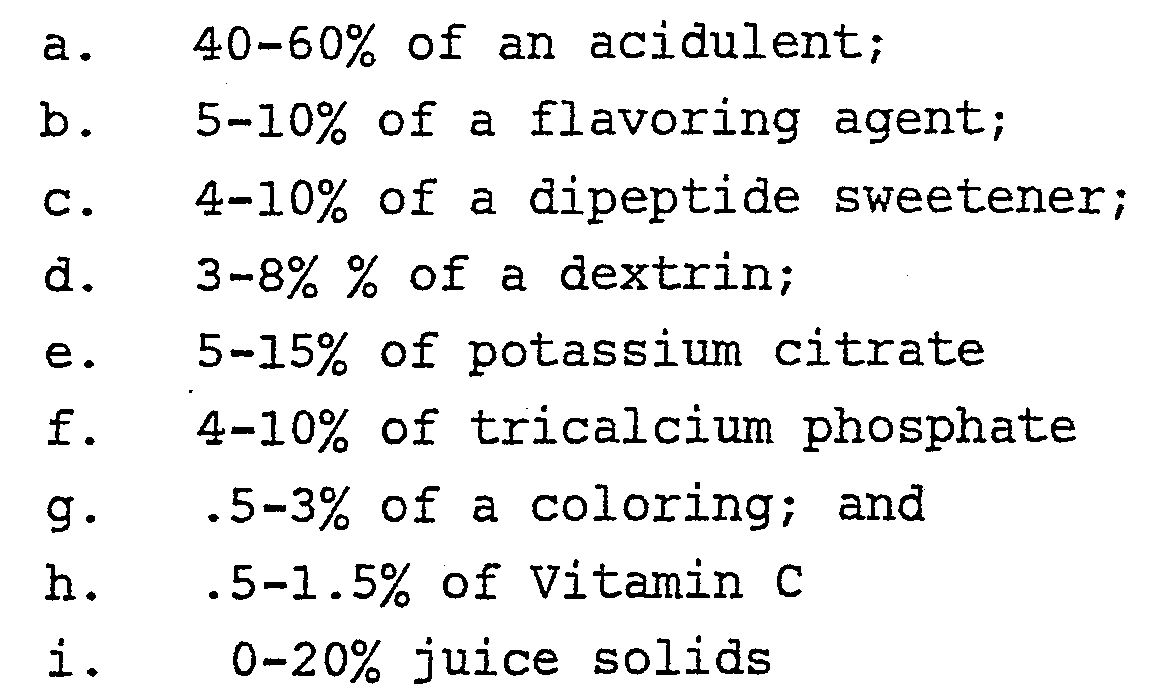
[0018] The process according to the above-enumerated methods may be used to produce a fruit punch flavored beverage, said beverage being composed of:
EXAMPLE 6
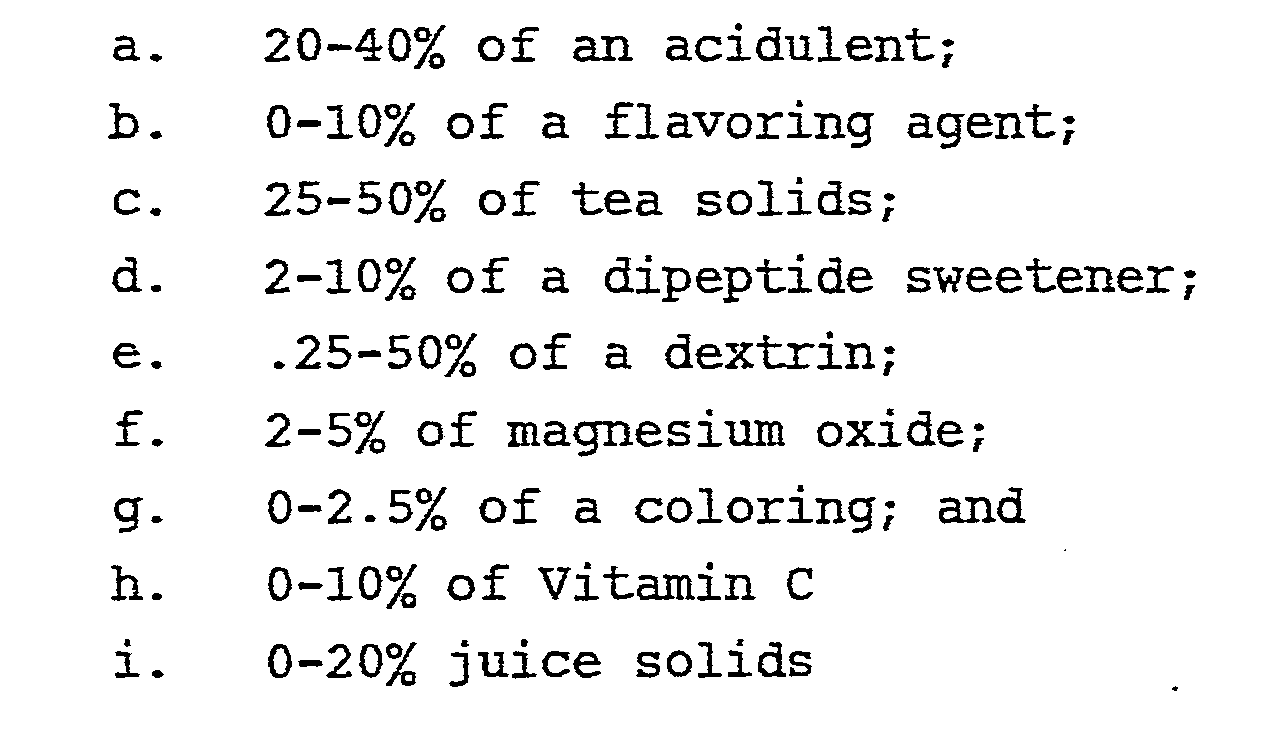
[0019] The process according to the above enumerated methods may be used to produce a tea-flavored beverage, said dry mix being composed of:
[0020] The advantages endemic to the above-presented invention follow. By agglomerating the total mix the need for further processing is thereby reduced. By fixing via agglomerating the dipeptide sweetener within the other components an agglomerate which presents the total product may be obtained. Agglomerates by their very nature are amenable to being handled by unmodified machinery. Most importantly, the improved fixation of the dipeptide sweetener APM via agglomeration outlined hereinabove prevents degradation of the dipeptide sweetener APM. By fixing the sweetener directly onto the mix components so that a particle composed of the whole mix base is obtained, the need for dissolving the APM is eliminated. With the relative absence of water the dipeptide which is sensitive to aqueous acid media may be interposed on an essentially-acid mix product without the risk of consequent breakdown. Moreover, the increased size and composition of the agglomerates aid in the rate of solubility of not only the APM but also such components as tea solids.
[0021] As set forth in the above table wherein equal weights of comparable dry beverage mixes were dissolved in two quarts of cold water, APM-containing agglomerates produced by the above described improved process display solubility characteristics equal to agglomerates wherein the binding agent is an aqueous dextrin solution and greatly superior to the solubility characteristics of dry mixed powders.
[0022] It has been found that surprisingly, water is preferred to an aqueous dextrin solution as an agglomerating fluid for APM-containing beverage mixes as the water-agglomerated particles are more resistant to cracking or attrition. Specifically, it has been found that in a standardized particle strength test, wherein 10 gram of an agglomerated particle fraction which is retained on a #40 U.S. Standard sieve is subjected to a 15 minute abuse cycle in a testing instrument known as a friabulator (available from Key Industries, Englishtown, New Jersey) more fine particles (less than #60 U.S. Standard Sieve) are generated from beverage agglomerates which utilized a 40% (by weight) aqueous solution of a 10 D.E. dextrin as the agglomerating vehicle than when water was used as the agglomerating vehicle. In the actual experiment, 5.26% by weight of the abused agglomerates passed through a 60 U.S. mesh screen in the case of the dextrin solution agglomerate; whereas, only 3.09% by weight of the abused agglomerates passed through a 60 U.S. mesh screen in the case of the water agglomerated material of this invention·.
1. A method for fixing a dipeptide sweetener on a comestible substrate via agglomeration
comprising the steps of:
a. mixing an organic acid, flavoring and a dipeptide sweetener;
b. fluidizing said mixture with heated air; and
c. agglomerating said fluidized mixture using water as the agglomerating vehicle.
2. A method according to claim 1 wherein the agglomerating vehicle consists of water
and a colorant.
3. A method according to claim 1 wherein said agglomerating step is conducted at an
inlet air temperature of less than 400°F.
4. A product according to the method of claim 1.
5. A method according to claim 1 wherein the dipeptide sweetener is aspartyl-phenylalanine
methyl ester, said dipeptide having a particle size between 0.5-300 microns.
6. A tea beverage product according to the method of Claim 1 comprising on a dry weight
basis:
7. A fruit punch beverage product according to the method of claim 1 comprising on
a dry weight basis:
8. A citrus flavored beverage product according to the method of claim 1 comprising
on a dry weight basis:
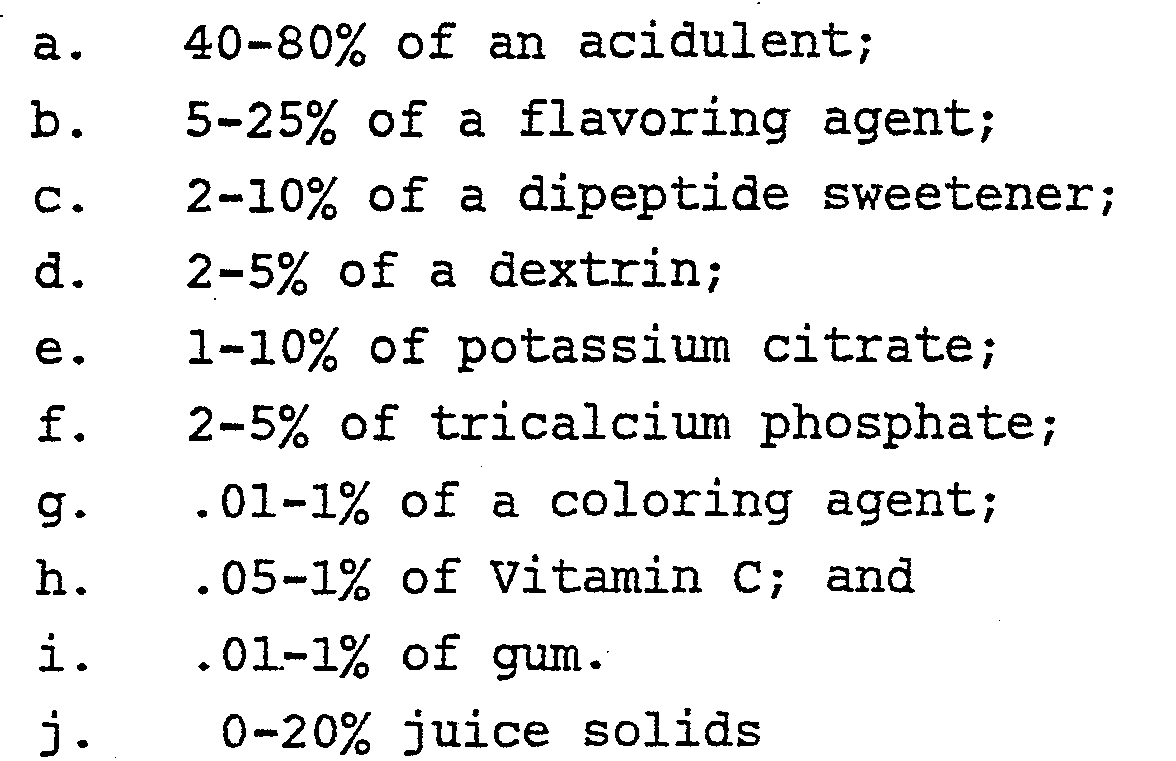
9. A fruit flavored beverage product according to the method of claim 1 comprising
on a dry weight basis: