|
(11) | EP 0 122 482 B1 |

| (12) | EUROPEAN PATENT SPECIFICATION |
|
|
| (54) |
Monoazo dyestuffs for polyester fibers Monoazofarbstoffe zum Färben von Polyestern Colorants monoazoiques pour la teinture de fibres en polyester |
|
|
|||||||||||||||||||||||||||||||
|
||||||||||||||||||||||||||||||||
| Note: Within nine months from the publication of the mention of the grant of the European patent, any person may give notice to the European Patent Office of opposition to the European patent granted. Notice of opposition shall be filed in a written reasoned statement. It shall not be deemed to have been filed until the opposition fee has been paid. (Art. 99(1) European Patent Convention). |
[0001] This invention relates to monoazo dyestuffs preferably for polyester fibers. More specifically, it relates to monoazo dyestuffs which dye polyester fibers in blue colors excellent in various fastness properties, in particular, light fastness, sublimation fastness, washing fastness, perspiration fastness and water fastness, and which are also excellent in heat resistance and alkali discharge printing properties.
[0002] Recently, an alkali discharge printing process has been increasingly frequently carried out as a new dyeing process for polyester fibers. The principle of the alkali discharge printing is to hydrolyze a dyestuff with alkali, thereby depriving it of its affinity to polyester fibers.
[0003] Therefore, the dyestuff intended for that purpose contain carboxylate ester groups, hydroxyl groups etc. which have great hydrophilic properties and are easily reactive with alkali in their backbone structure. For that reason, they had a disadvantage that their moisture fastness, such as washing fastness, perspiration fastness, water fastness etc. and also heat resistance were poor. The present inventors have been intensively studying in order to develop blue dyestuffs having good alkali discharge printing properties and also having good moisture fastness and heat resistance, and finally have solved this antithetical contradiction in principle, thereby having accomplished this invention.
[0004] Although dyestuffs having structures analogues to those of this invention are known from Japanese Patent Application Laid-open No. 133457/1980, it is evident, as demonstrated by the comparison data in Table 1, that the dyestuffs of this invention are far more excellent in both moisture fastness and heat resistance as well as maintain good alkali discharge printing properties.
[0005] Monoazo dyes for polyester fibers having a similar structure as the dyestuffs of the invention of formula I below, however containing different ester residues R1 are also known from US-A-4,271,071 and DE-A 3 313 797.
[0006] Accordingly, this invention provides monoazo dyestuffs for polyester fibers which are of the formula [I]:
wherein X represents hydrogen, chlorine, methyl, alkoxy or alkoxyalkoxy, Y represents hydrogen, methyl, methoxy, chlorine or acylamino, and R1 represents C8―C10 alkyl. The alkoxy residue (including in the alkoxy-alkoxy residue) contains up to 4 carbon atoms.
[0007] The dyestuffs of the formula [I] above may be produced by diazotizing 2-amino-5-nitrothiazole and coupling it with an aniline of the formula [II]:
wherein X, Y, and R1 are as defined above.
[0008] The C8―C10 alkyl residue represented by R1 may be either straight-chain or branched-chain. Examples of the alkoxy represented by X include methoxy, ethoxy, propoxy, butoxy etc.; examples of the alkoxyalkoxy include methoxyethoxy, ethoxyethoxy, butoxyethoxy etc.; and examples of the acylamino represented by Y include acetylamino, C6-C13 alkylcarbonylamino, chloroacetylamino, benzoylamino, ethoxycarbonylamino, ethylcarbonylamino, methylsulfonylamino, chloropropionylamino etc.
[0009] Examples of fibers which can be dyed with the monoazo dyestuffs of this invention include polyester fibers composed of e.g. polyethylene terephthalate, a polycondensate of terephthalic acid and 1,4-bis-(hydroxymethyl)cyclohexane, etc., and also mixed yarns and mixed woven fabrics of natural fibers such as cotton, silk, wool, etc. with the above-described polyester fibers.
[0010] Dyeing of a polyester fiber with the dyestuff of this invention may be achieved in the conventional manner, for example, by dispersing the dyestuff of the formula [I] above in an aqueous medium using a dispersing agent such as a condensate of naphthalenesulfonic acid and formaldehyde, a higher alcohol sulfuric acid ester, a higher alkylbenzenesulfonic acid salt etc. to prepare a dyeing path or printing paste, and conducting dip dyeing or print dyeing. For example, where dip dyeing is conducted, by applying a conventional dyeing process, e.g. high temperature process, carrier process, thermosol process etc., polyester fibers or their mixed spun or mixed woven products can be dyed in colors excellent in fastness properties. In addition, even better results may sometimes be obtained by adding an acidic substance such as formic acid, acetic acid, phosphoric acid, ammonium sulfate etc. to the dyeing bath.
[0011] The monoazo dyestuffs of this invention may also be used in combination with dyestuffs of the same type or those of other type, in particular, a combination of the dyestuffs of the formula (I) above with each other sometimes gives improved results, such as enhancement of dyeing properties, etc.
Example 1
[0013] 0.5 g of a monoazo dyestuff of the formula:
was dispersed in 31 of water containing 1.0 g of naphthalenesulfonic acid-formaldehyde condensate and 2 g of a higher alcohol sulfuric acid ester to prepare a dyeing bath. 100 g of a polyester cloth was dipped in the dyeing bath, and dyed at 130°C for 60 minutes followed by soaping, washing with water and drying to obtain a yellow dyed polyester cloth having good light fastness, sublimation fastness and moisture fastness.
[0014] The dyestuff used in this example was prepared by dissolving 7.56 g of 3-N-2-ethylhexyloxycarbonyl- ethylamino-4-ethoxyacetanilide in 100 ml of methanol, adding dropwise thereto a diazo solution obtained by diazotizing 2.9 g of 5-nitro-2-aminonitrothiazole in sulfuric acid using nitrosol sulfuric acid, filtering out the separated precipitates, washing with water and drying (60% of the theoretical yield).
Example 2
[0016] 0.5 g of a dyestuff of the formula:
was mixed with 0.5 g of a naphthalenesulfonic acid-formaldehyde condensate, and pulverized on a paint shaker to obtain a finely particulated dyestuff. This was then adequately mixed with a basal paste having the following composition:
to obtain 100 g of a printing color paste.
[0017] A polyester fiber was print dyed with this printing color paste, provisionally dried at 100°C, then maintained in superheated steam at 170°C for 7 minutes to develop a color, soaped, washed with water and dried to obtain a reddish blue dyed polyester cloth having good light fastness, sublimation fastness and moisture fastness.
Example 3
1. A monoazo dyestuff of the general formula I
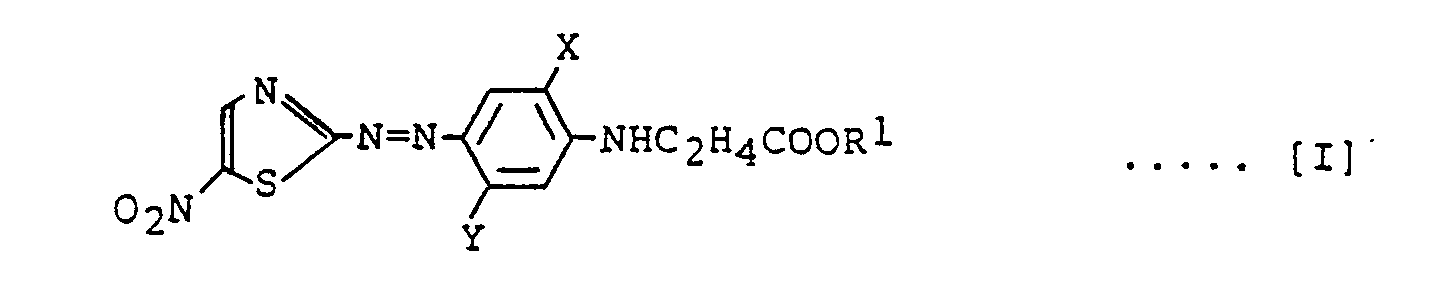
wherein X represents hydrogen, chlorine, methyl, alkoxy or alkoxyalkoxy, Y represents hydrogen, methyl, methoxy, chlorine or acylamino, and R1 represents C8―C10 alkyl.
wherein X represents hydrogen, chlorine, methyl, alkoxy or alkoxyalkoxy, Y represents hydrogen, methyl, methoxy, chlorine or acylamino, and R1 represents C8―C10 alkyl.
2. The monoazo dyestuff for polyester fibers according to Claim 1 wherein X is hydrogen,
chlorine, methyl or alkoxy, Y is hydrogen, methyl, chlorine or acylamino, and R1 is C8―C10 alkyl.
3. The monoazo dyestuff for polyester fibers according to Claim 1 wherein X is hydrogen,
chlorine, methoxy or ethoxy, Y is hydrogen, methyl or acylamino, and R1 is C8―C10 alkyl.
4. The monoazo dyestuff for polyester fibers according to Claim 1 wherein X is chlorine,
methoxy or ethoxy, Y is hydrogen, acetylamino or propionylamino, and R1 is C8―C10 alkyl.
5. The use of the monoazo dyestuffs according to claims 1 to 4 for dyeing polyester
fibers and mixed yarns and mixed woven fabrics of natural fibers and polyester fibers.
1. Monoazo-Farbstoff der allgemeinen Formel I
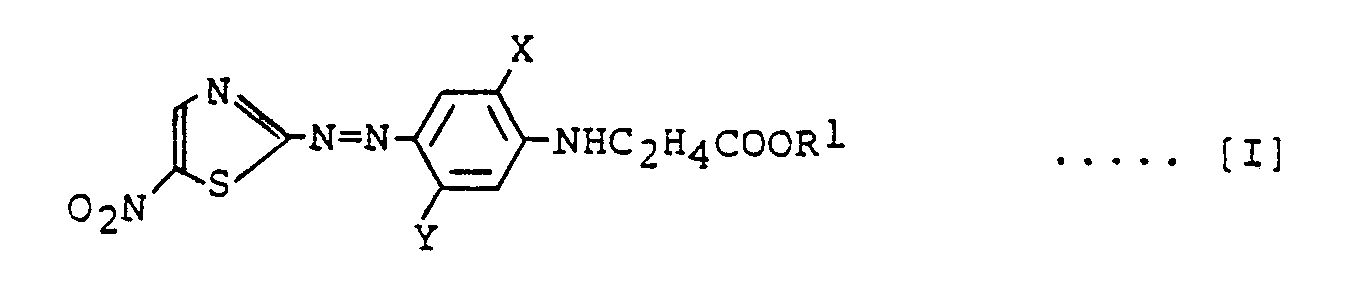
in der X ein Wasserstoff- oder Chloratom, eine Methyl-, Alkoxy- oder Alkoxyalkoxygruppe darstellt, Y ein Wasserstoffatom, eine Methyl- oder Methoxygruppe, ein Chloratom oder eine Acylaminogruppe darstellt und R' einem C8―C10-Alkylrest bedeutet.
in der X ein Wasserstoff- oder Chloratom, eine Methyl-, Alkoxy- oder Alkoxyalkoxygruppe darstellt, Y ein Wasserstoffatom, eine Methyl- oder Methoxygruppe, ein Chloratom oder eine Acylaminogruppe darstellt und R' einem C8―C10-Alkylrest bedeutet.
2. Monoazo-Farbstoff für Polyesterfasern nach Anspruch 1, wobei X ein Wasserstoff-
oder Chloratom, eine Methyl- oder Alkoxygruppe bedeutet, Y ein Waserstoffatom, eine
Methylgruppe, ein Chloratom oder einen Acylaminorest darstellt und R1 einen C8―C10-Alkylrest bedeutet.
3. Monoazo-Farbstoff für Polyesterfasern nach Anspruch 1, wobei X ein Wasserstoff-
oder Chloratom, eine Methoxy-oder Äthoxygruppe bedeutet, Y ein Wasserstoffatom, eine
Methyl- oder Acylaminogruppe darstellt und R1 einen C8―C10-Alkylrest bedeutet.
4. Monoazo-Farbstofffür Polyesterfasern nach Anspruch 1, wobei X ein Chloratom, eine
Methoxy- oder Äthoxygruppe bedeutet, Y ein Wasserstoffatom, eine Acetylamino- oder
Propionylaminogruppe darstellt und R1 ein C8―C10-Alkylrest bedeutet.
5. Verwendung der Monoazo-Farbstoffe nach den Ansprüchen 1 bis 4 Färben von Polyesterfasern
und Mischgarnen und Mischgeweben aus natürlichen Fasern und Polyesterfasern.
1. Un colorant monoazoïque de formule générale (I):

dans laquelle X représente l'hydrogène ou le chlore ou un groupe méthyle, alcoxy ou alcoxyalcoxy, Y représente l'hydrogène ou le chlore ou un groupe méthyle, méthoxy ou acylamino et R1 représente un groupe alkyle en C8―C10.
dans laquelle X représente l'hydrogène ou le chlore ou un groupe méthyle, alcoxy ou alcoxyalcoxy, Y représente l'hydrogène ou le chlore ou un groupe méthyle, méthoxy ou acylamino et R1 représente un groupe alkyle en C8―C10.
2. Le colorant monoazoïque pour fibres de polyesters selon la revendication 1, dans
lequel X est l'hydrogène ou le chlore ou un groupe méthyle ou alcoxy, Y est l'hydrogène
ou le chlore ou un groupe méthyle ou acylamino et R1 est un groupe alkyle en C8―C10.
3. Le colorant monoazoïque pour fibres de polyesters selon la revendication 1, dans
lequel X est l'hydrogène ou le chlore ou un groupe méthoxy ou éthoxy, Y est l'hydrogène
ou un groupe méthyle ou acylamino et R1 est un groupe alkyle en C8―C10.
4. Le colorant monoazoïque pour fibres de polyesters selon la revendication 1, dans
lequel X est le chlore ou un groupe méthoxy ou éthoxy, Y est l'hydrogène ou un groupe
acétylamino ou oropionylamino et R1 est un groupe alkyle en C8―C10.
5. L'utilisation des colorants monoazoïques selon les revendications 1 à 4 pour teindre
les fibres de polyesters et les filaments mélangés et étoffes tissées mélangées de
fibres naturalles et de fibres de polyesters.