|
(11) | EP 0 123 750 B1 |

| (12) | EUROPEAN PATENT SPECIFICATION |
|
|
| (54) |
Condensed amino pyrimidinones and their use in the treatment and prophylaxis of viral infections Anniellierte Aminopyrimidinone und deren Verwendung für die Behandlung und Prophylaxe von viralen Infektionen Aminopyrimidinones condensées et leur utilisation dans le traitement et la prophylaxie d'infections virales |
|
|
|||||||||||||||||||||||||||||||
| Note: Within nine months from the publication of the mention of the grant of the European patent, any person may give notice to the European Patent Office of opposition to the European patent granted. Notice of opposition shall be filed in a written reasoned statement. It shall not be deemed to have been filed until the opposition fee has been paid. (Art. 99(1) European Patent Convention). |
[0001] This invention relates to novel compounds and to their use in the treatment and prophylaxis of viral infections.
[0002] Wagner, US Pat No US-A-3,275,400 describes compounds having the formula
in which R is H, a hydroxyl, or an alkoxy radical and Z is H or an alkyl, hydroxyalkyl, alkenyl, or alkynyl radical. An example of a compound falling within this formula is 2-amino-5,6-dihydro-8-methoxybenzo[h]-quinazolin-4(3H)-one, which is described in cols. 5-6.
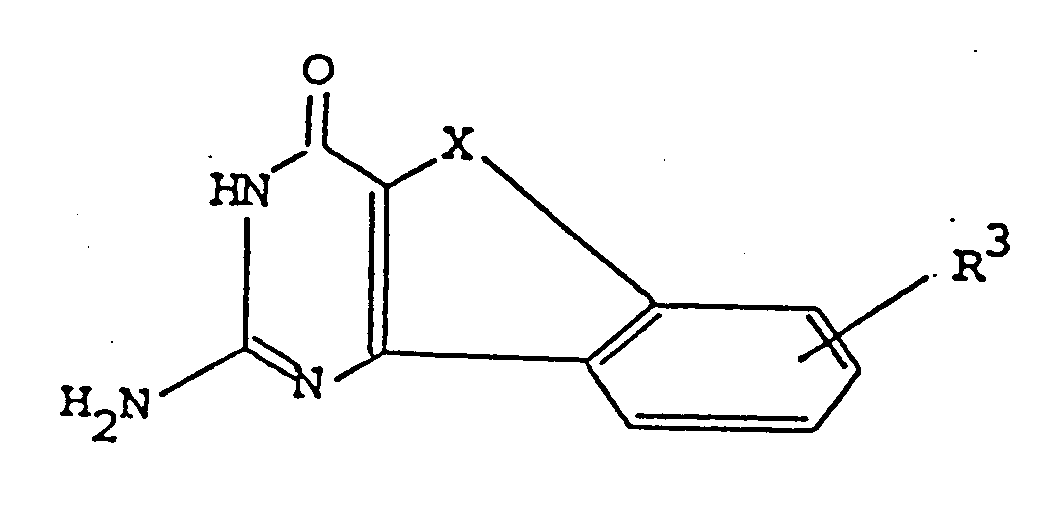
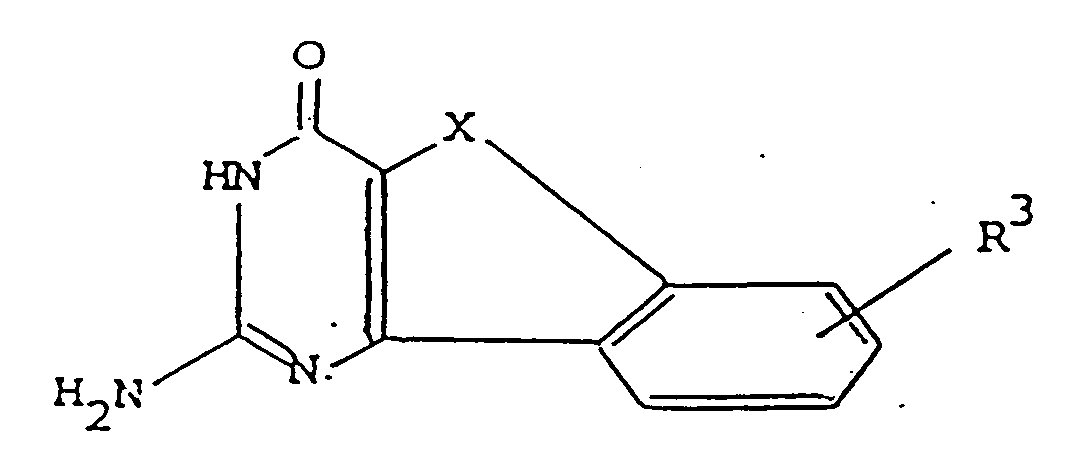
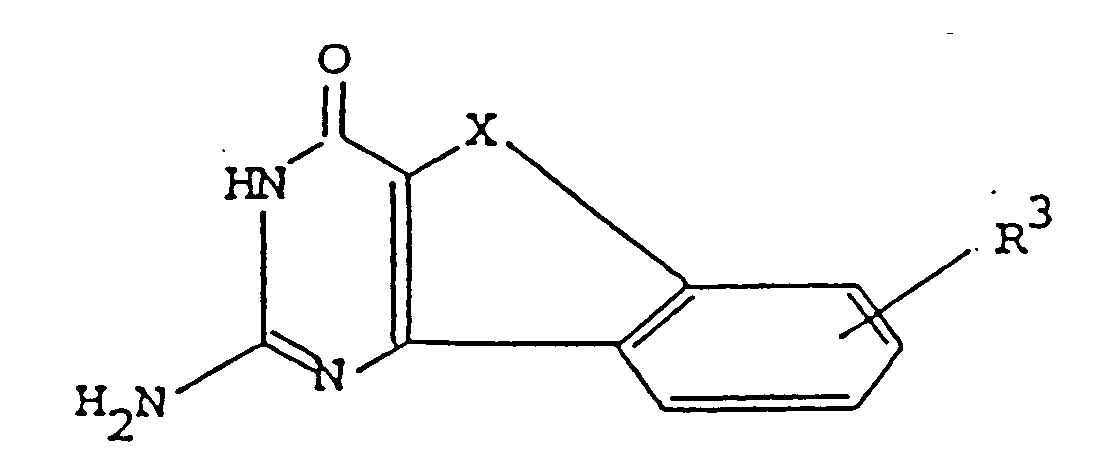
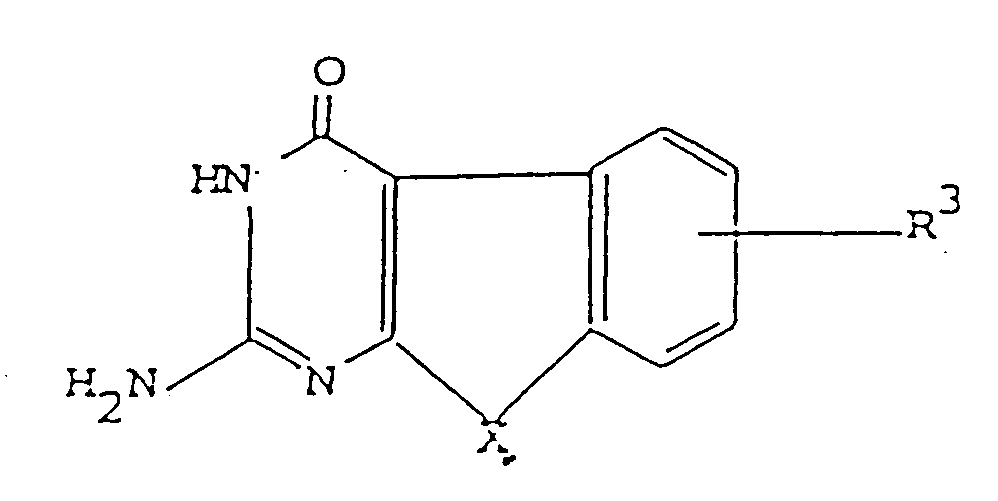
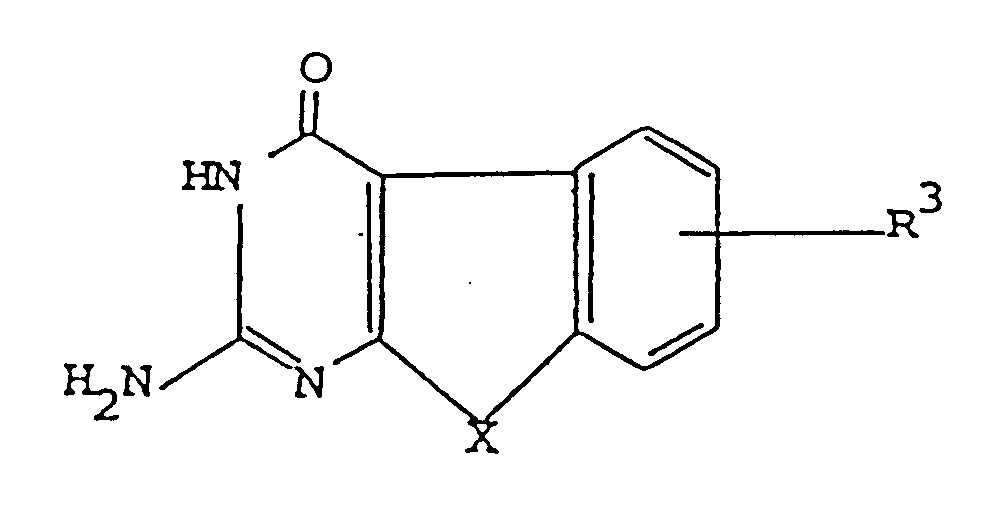
[0003] According to a first aspect of the present invention, we provide a compound having the formula
wherein
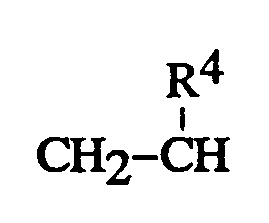
X is (CH₂)n where 1≦n≦3;
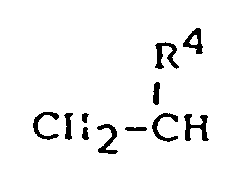
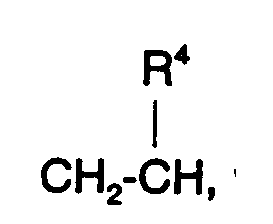
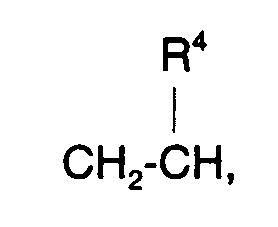
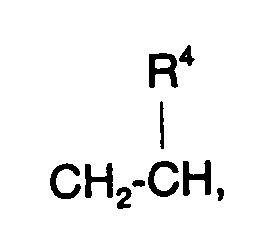
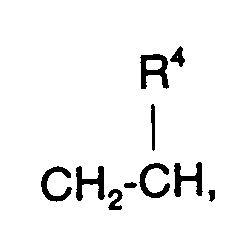
where R⁴ is an alkyl group having fewer than 6 carbon atoms; CH₂S; or CH₂O; and
R³ is H, an alkyl group having fewer than 6 carbon atoms, an alkoxy group having fewer than 6 carbon atoms, a halogen, C≡N, nitro, amino, alkylamino, dialkylamino, arylamino, carboxy, or alkoxy (with fewer than 6 carbon atoms) carbonyl; provided that, when n=2, R³ cannot be H or an alkoxy group with fewer than 6 carbon atoms at position 8;
or a pharmaceutically acceptable salt thereof.
[0004] In a preferred embodiment the compound is 2-amino-4-oxo-5, 6, 7-trihydrobenzo-cyclohepta (5, 6-d)-pyrimidine.
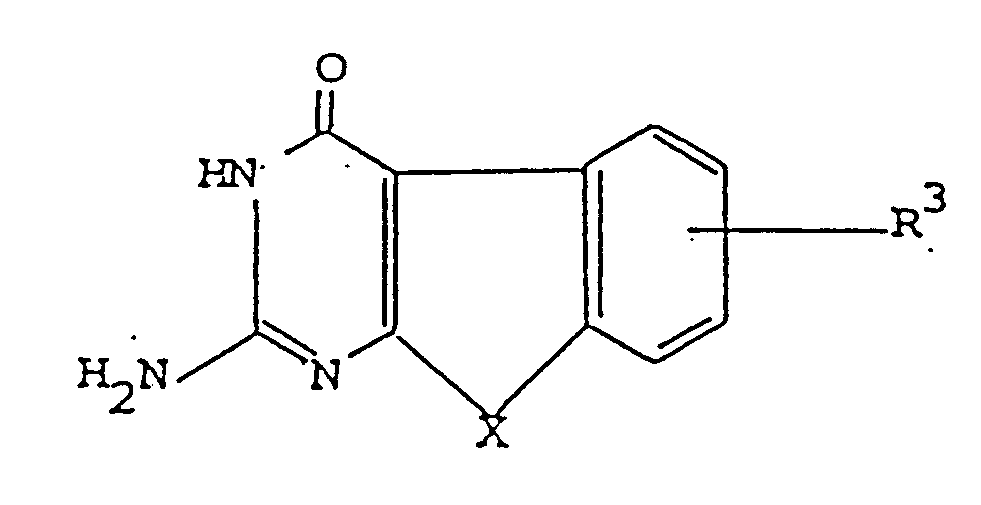
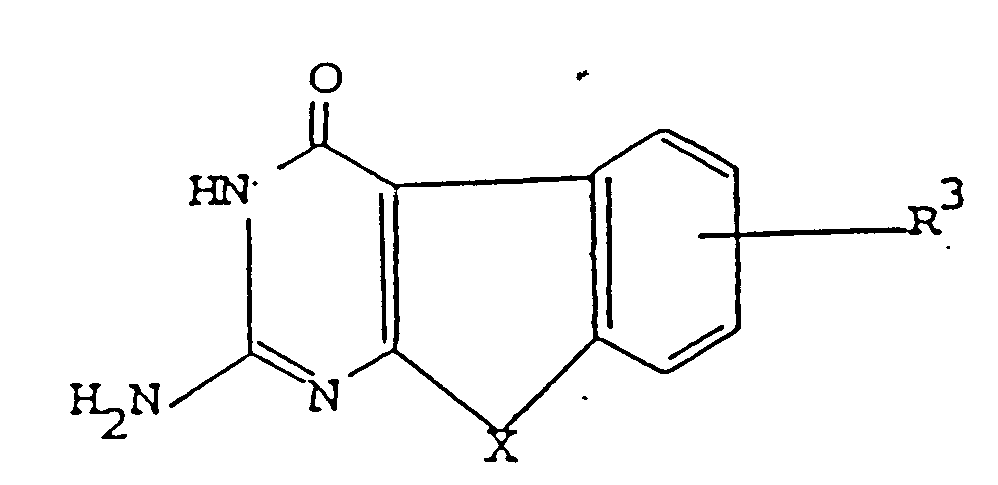
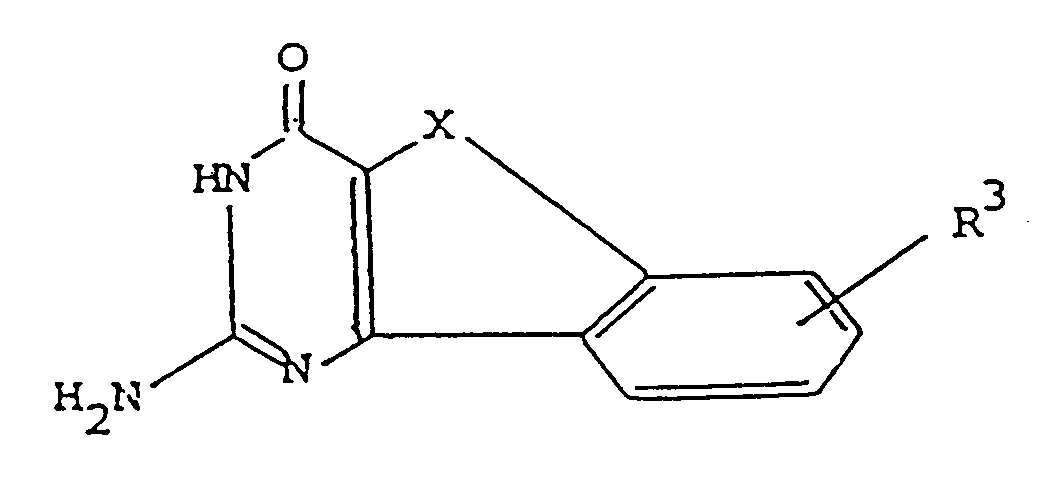
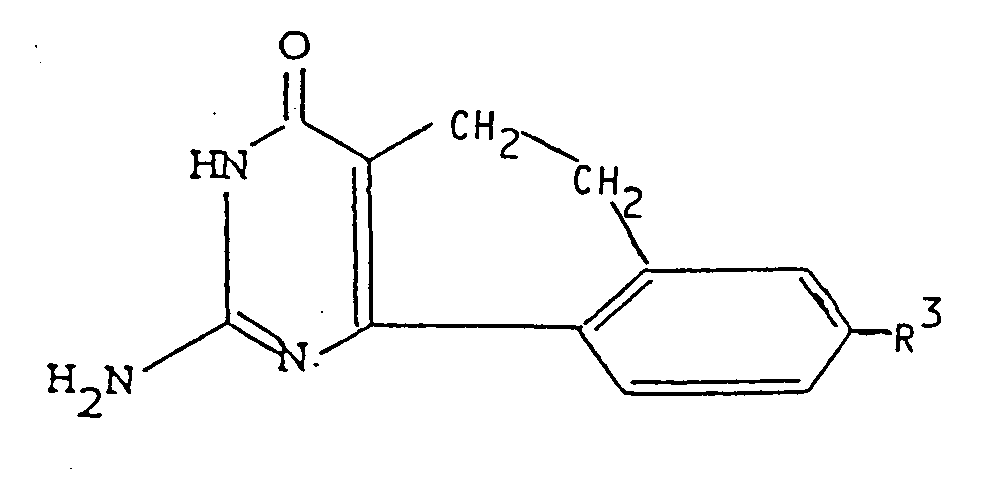
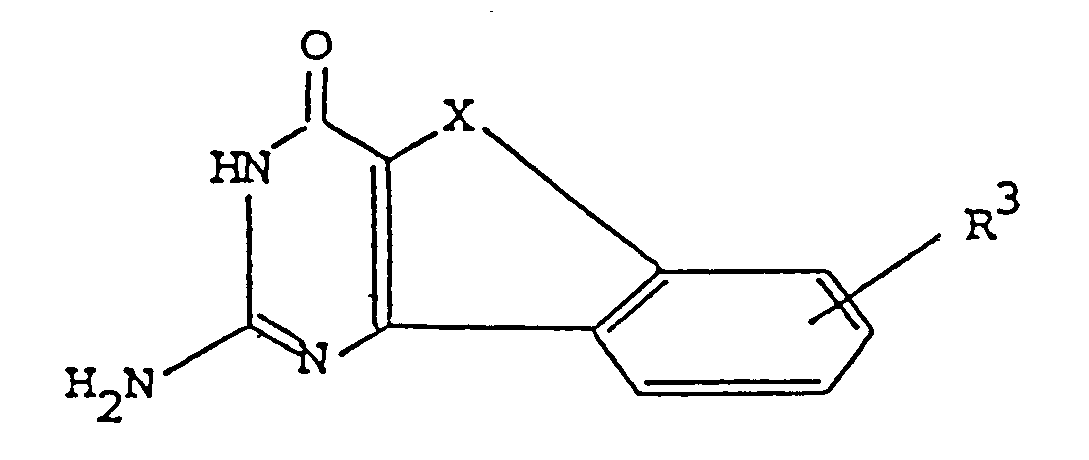
[0005] In a second and alternative aspect thereof, the invention provides a compound having the formula:
wherein
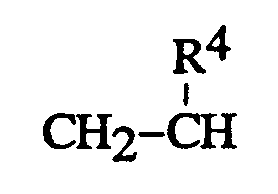
X is (CH₂)n where 1≦n≦3;
where R⁴ is an alkyl group having fewer than 6 carbon atoms; CH₂S; or CH₂O; and R³ is H, an alkyl group having fewer than 6 carbon atoms, an alkoxy group having fewer than 6 carbon atoms, halogen, C≡N, nitro, amino, alkylamino, dialkylamino, arylamino, carboxy, alkoxy (with fewer than 6 carbon atoms) carbonyl;
or a pharmaceutically acceptable salt thereof.
[0006] In a preferred embodiment the compound is 2-amino-4-oxo-3,4,5,6-tetrahydrobenzo (h) quinazoline.
[0007] The compounds of Formulae (1) or (2) as defined above may be used in the treatment or prophylaxis of viral infections, particularly of herpes simplex type II viral infections or of the common cold.
[0008] We have found compounds of formulae (1) and (2) to exhibit potent antiviral activity, to be chemically stable, not to be toxic to humans or other mammals, and not to decompose in the stomach. The compounds can be particularly valuable in the treatment of immuno-compromised patients, e. g. cancer patients, who are at risk of contracting viral infections, particularly herpes simplex virus type II infections.
[0009] The invention is hereinafter more particularly described by way of example only with reference to a number of Examples of preparation of specific compounds in accordance with the invention and with reference to the single figure of the accompanying drawing, which shows a plan view, partially broken away, of a packet containing a towlette impregnated with an antiviral compound in accordance with the invention.
[0010] The Compounds in accordance with the present invention have the general formulae (1)or(2) recited above. The compounds all contain an aminopyrimidone ring fused to a non-aromatic ring.
[0011] The compounds, or pharmaceutically acceptable salts thereof, can be administered alone or in combination with a pharmaceutically acceptable carrier.
[0012] Acceptable salts include those made with, e.g., hydrochloric, hydrobromic, hydroiodic, sulphuric, maleic, or fumaric acid; or with potassium, sodium hydroxide, or dicyclohexylamine.
[0013] For oral administration the pharmaceutical composition can most conveniently be in the form of pills, capsules or tablets. The composition can also take the form of an ingestible liquid, e.g., syrup. The compounds can also be provided in the form of topical preparations, e.g., ointments, lotions, creams, powders, gels and sprays.
[0014] Referring now to the Figure, flexible sheet 10 of fibrous, absorbant paper can be impregnated with an antiviral compound of the invention, diluted, if desired, with a carrier, e.g. distilled water.
[0015] The impregnated towelette 10 is folded and enclosed in rectangular, sealed, gas tight envelope 12, having fused periphery 14, in a manner such as is described in Clancy U.S. Pat. No. 3,398,826 or Williams U.S. Pat. No. 3,057,467. The towlett is impregnated using conventional techniques, e.g. that disclosed in Bauer U.S. Pat. No. 3,786,615.
Synthesis
[0016] To synthesize a compound of Formula 1 or 2,
a mixture of the appropriate beta-ketoester and guanidine carbonate in xylene is refluxed overnight, and the final product is then collected by filtration and purified.
[0017] The beta-ketoester, if not commercially available, can be prepared by any of several methods, e.g., the reaction of a cyclic ketone with diethyloxalate followed by pyrolysis; or esterification of the commercially available beta-keto acid, e.g. camphor carboxylic acid; or the reaction of a cyclic ketone with diethylcarbonate at elevated temperature in the presence of guanidine salts in an appropriate solvent, e.g., alcohols, xylene, toluene.
[0018] General references describing the synthesis of beta-ketoesters can be found in The Pyrimidines, A. Weissberger, Ed., Interscience, New York, 1962; J. Org. Chem., 30, 1837 (1965); J. Org. Chem. 33, 4288 (1968); J. Het. Chem. 7, 197 (1970); J. Het Chem., 13, 675 (1976); Org. Syn. 47, 20 (1967).
[0019] Another method of synthesizing a compound of Formula 1 or 2 involves the formation of a 2, 4-diaminopyrimidine derivative by the reaction of a cyclic ketone with dicyandiamide, either in the absence of or in an appropriate solvent, e.g., dimethylformamide, ethoxyethoxyethanol, followed by selective hydrolysis of one amino group.
2-amino-4-oxo-5, 6, 7-trihydrobenzocycohepta (5, 6-d)-pyrimidine
[0021] First 2-ethoxycarbonyl-1-benzosuberone was prepared by placing 3.4 g of 50% NaH mineral oil dispersion in a 250 ml three-necked flask, fitted with an additional funnel and a water condenser, under a nitrogen atmosphere. The mineral oil was removed by washing with dry benzene several times, and the residue was then resuspended in dry benzene (34 ml). Diethylcarbonate (5.9 g) was then added all at once. After reflux the mixture was treated with dropwise addition of a solution of 1-benzosuberone (4.0 g) in dry benzene (10 ml) over a 3 hour period, and refluxing was continued for another 1/2 hour. The mixture was cooled to room temperature, treated with acetic acid (5 ml) and ice-water (17 ml) to dissolve the solid, and the organic layer was then washed with water several times and then dried (MgSO₄). After evaporation of solvent the residue was subjected to fractional distillation to give a colourless oil product (3.12 g) at 135-140 °C/0.3 mm Hg (40 N m⁻²).
[0022] A mixture of 2-ethoxycarbonyl-1-benzosuberone (2.82 g), guanidine carbonate (2.62 g) in xylene (50 ml) was refluxed overnight. After cooling to room temperature, the resulting solid was collected by filtration, washed with water and then ether and then dried. The solid was redissolved in 2N-HCl with heating, then cooled in an ice bath. The white precipitate was collected by filtration, washed with ether, then dried to yield a white powder (900 mg).
2-amino-4-oxo-3, 4, 5, 6-tetrahydrobenzo (h) quinazoline
[0024] First, 2-ethoxycarbonyl-1-tetralone was made by placing 4.65 g of 50% NaH mineral oil dispersion in a 250 ml three-necked flask, fitted with an additional funnel and a water condenser, under a nitrogen atmosphere. The mineral oil was removed by washing with dry benzene several times and NaH was then resuspended in dry benzene (48 ml), and diethylcarbonate (8.1 g) was added all at once. After refluxing, the mixture was treated with a dropwise addition of a solution of alpha-tetralone (5 g) in dry benzene (1 ml) over a 3 hour period, and refluxing was continued for another 1/2 hour. The mixture was cooled to room temperature, treated with acetic acid (7 ml) and ice-water (23 ml) to dissolve solid and organic layers, washed with water several times, dried (using anhydrous MgSO₄). After evaporation of solvent, the residue was subjected to fractional distillation to yield product (2.3 g) at 151-157°C 0.2 mm Hg (26.66 N m⁻²).
[0025] A mixture of 2-ethoxycarbonyl-1-tetralone (0.65 g) and guanidine carbonate (0.65 g) in xylene (15 ml) was refluxed overnight and, after cooling to room temperature, the tan solid was collected by filtration, washed with water and alcohol, and then dried to yield 0.24 g of tan solid, m.p.>300°C. The solid was dissolved in Con.-HCl, concentrated in vacuo to dryness, and recrystallized from ethanol to yield a colourless solid product, (0.28 g).
Use
[0026] When administered to mammals (e.g., orally, nasally, topically, parenterally, intravenously, or by suppository), the compounds have an antiviral effect, and are particularly, effective against herpes simplex viruses occurring in the eye, cutaneously, orally, genitally, or in upper respiratory areas.
[0027] Good in vivo test results, compared to in vitro results, suggest that the compounds, rather than acting directly on the virus, act via some other mechanism, e.g. immunomodulation or inducement of interferon production.
[0028] The compounds can, be administered to a mammal, e.g. a human, in a dosage of 25 to 300 mg/kg/day, preferably 100 to 200 mg/kg/day.
[0029] Referring again to the Figure, when it is desired to apply an antiviral compound topically, sealed envelope 12 containing the impregnated towlette 10 is torn open and the towlette is removed and used, and the packet and used towlette are then discarded.
[0030] The impregnated towlette can be used in the treatment and or prevention of herpes simplex type II infections. In the case of the treatment of a skin lesion associated with herpes, the impregnated towlette can be used to apply the antiviral compound to the affected area and then discarded. For prevention of herpes infections, the impregnated towlette can be used to apply the antiviral compound to an area which the user suspects has been recently exposed to herpes virus, e.g., to the genitals following sexual relations.
[0031] Other arrangements are also possible. For example, the impregnated sheet can be, in addition to absorbant paper, another suitable material such as unwoven fabric. Instead of sealing wet towlettes in individual packets, multiple impregnated sheets can be provided in one container, e.g. a jar or a metal or plastic can. Impregnated towlettes can be used to treat or prevent other viral infections, e.g. the common cold; for treatment of colds, for example, facial tissues could be impregnated with an antiviral compound, application of the tissue to the nose providing the antiviral compound to that area.
Claims for the following Contracting State(s): BE, CH, LI, DE, FR, GB, IT, LU, NL,
SE
1. A compound having the formula:
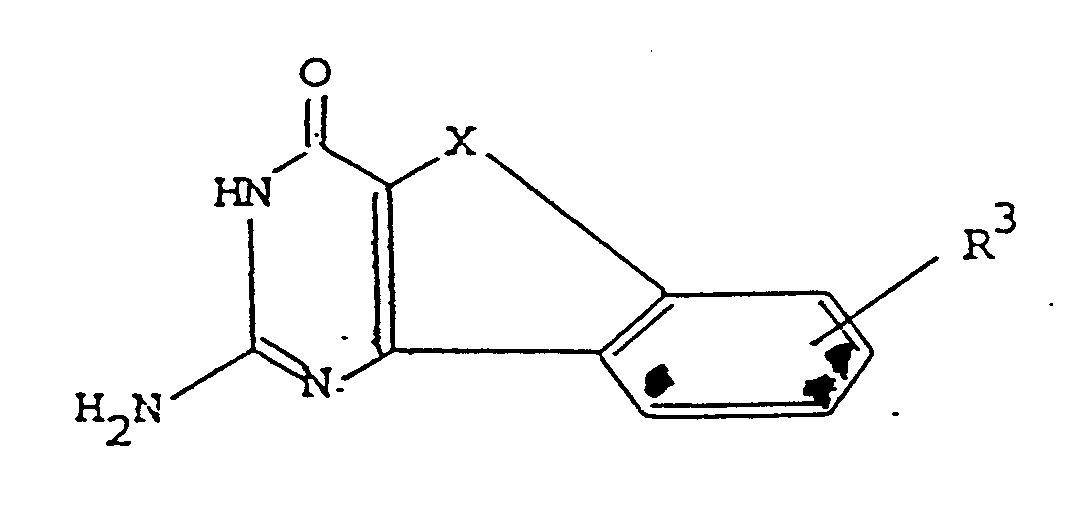
wherein
X is (CH₂)n where 1 ≦ n ≦ 3;
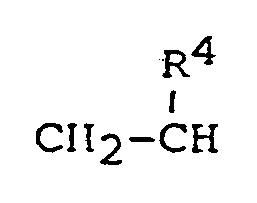
where R⁴ is an alkyl group having fewer than 6 carbon atoms; CH₂S; or CH₂O; and
R³ is H, an alkyl group having fewer than 6 carbon atoms; an alkoxy group having fewer than 6 carbon atoms; a halogen, C≡N, nitro, amino, alkylamino, dialkylamino, arylamino, carboxy, or alkoxy(with fewer than 6 carbon atoms)carbonyl; provided that, when n = 2, R³ cannot be H
or an alkoxy group with fewer than 6 carbon atoms at position 8;
or a pharmaceutically acceptable salt thereof.
wherein
X is (CH₂)n where 1 ≦ n ≦ 3;
where R⁴ is an alkyl group having fewer than 6 carbon atoms; CH₂S; or CH₂O; and
R³ is H, an alkyl group having fewer than 6 carbon atoms; an alkoxy group having fewer than 6 carbon atoms; a halogen, C≡N, nitro, amino, alkylamino, dialkylamino, arylamino, carboxy, or alkoxy(with fewer than 6 carbon atoms)carbonyl; provided that, when n = 2, R³ cannot be H
or an alkoxy group with fewer than 6 carbon atoms at position 8;
or a pharmaceutically acceptable salt thereof.
2. A compound according to Claim 1, wherein X is (CH₂)3 and R³ is H;
said compound having the formula 2-amino-4-oxo-5, 6, 7-trihydrobenzocyclohepta (5, 6-d)-pyrimidine.
said compound having the formula 2-amino-4-oxo-5, 6, 7-trihydrobenzocyclohepta (5, 6-d)-pyrimidine.
3. A compound having the formula:
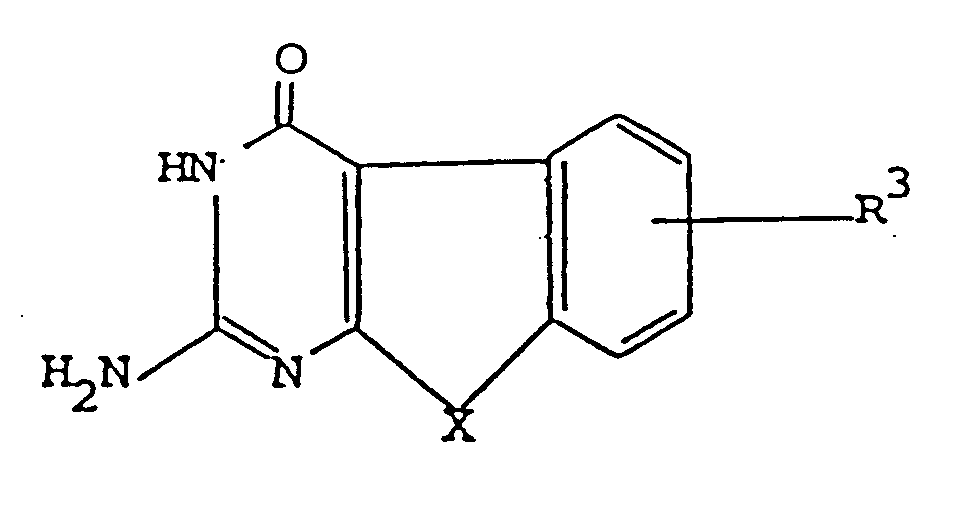
wherein
X is (CH₂)n where 1 ≦ n ≦ 3;
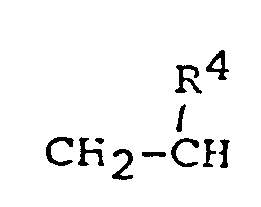
where R⁴ is an alkyl group having fewer than 6 carbon atoms; CH₂S; or CH₂O; and
R³ is H; an alkyl group having fewer than 6 carbon atoms; an alkoxy group having fewer than 6 carbon atoms; a halogen, C≡N, nitro, amino, alkylamino, dialkylamino, arylamino, carboxy, or alkoxy(with fewer than 6 carbon atoms)carbonyl;
or a pharmaceutically acceptable salt thereof.
wherein
X is (CH₂)n where 1 ≦ n ≦ 3;
where R⁴ is an alkyl group having fewer than 6 carbon atoms; CH₂S; or CH₂O; and
R³ is H; an alkyl group having fewer than 6 carbon atoms; an alkoxy group having fewer than 6 carbon atoms; a halogen, C≡N, nitro, amino, alkylamino, dialkylamino, arylamino, carboxy, or alkoxy(with fewer than 6 carbon atoms)carbonyl;
or a pharmaceutically acceptable salt thereof.
4. 2-amino-4-oxo-3,4,5,6-tetrahydrobenzo (h) quinazoline, or a pharmaceutically acceptable
salt thereof.
5. A therapeutic composition comprising a therapeutically effective amount of a compound
according to any preceding claim, together with a pharmaceutically acceptable carrier.
6. A composition according to Claim 5, wherein said composition is in the form of a pill,
capsule, or tablet for oral administration to a human or other mammalian patient;
or in the form of an ointment, lotion, cream, powder, gel, or spray for application
to the skin of a human or other mammalian patient; or in the form of a pharmaceutically
acceptable ingestible liquid containing a therapeutically effective concentration
of a compound according to any of Claims 1 to 4.
7. A therapeutic towlette, said towlette being impregnated with a compound according
to any of Claims 1 to 4.
8. A therapeutic towlette, said towlette being impregnated with a compound according
to any of Claims 1 to 4 in combination with a pharmaceutically acceptable carrier.
9. A compound according to any of Claims 1 to 4, for the treatment or prophylaxis of
viral infections.
10. A compound according to any of Claims 1 to 4, for the treatment or prophylaxis of
herpes simplex tyre II viral infections or of the common cold.
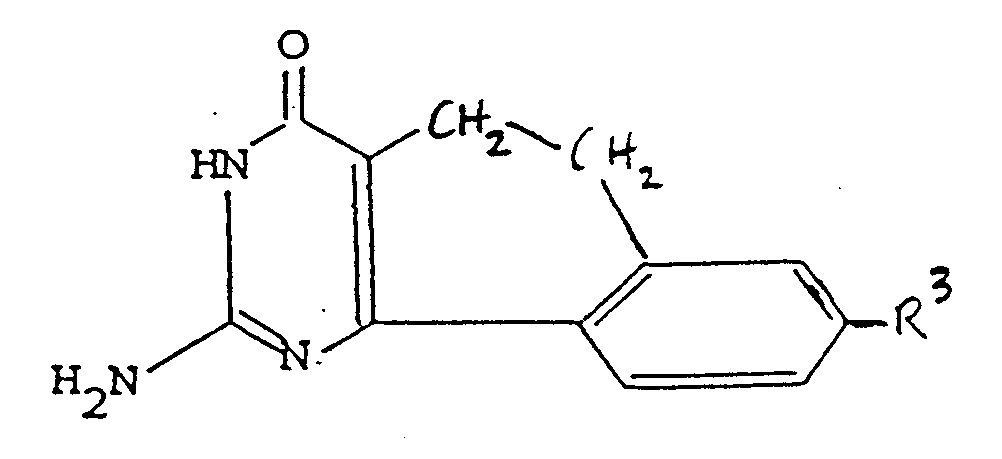
11. Use of a compound having the formula
wherein
R³ is an alkoxy group with fewer than 6 carbon atoms for the manufacture of a medicament for the treatment or prophylaxis of viral infections.
wherein
R³ is an alkoxy group with fewer than 6 carbon atoms for the manufacture of a medicament for the treatment or prophylaxis of viral infections.
Claims for the following Contracting State(s): AT
1. A method for the production of a compound having the formula:
wherein
X is (CH₂)n where 1 ≦ n ≦ 3;
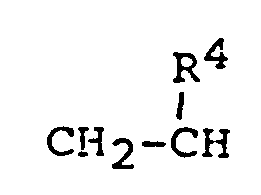
where R⁴ is an alkyl with fewer than 6 carbon atoms; CH₂S; or CH₂O; and
R³ is H; an alkyl with fewer than 6 carbon atoms; an alkoxy with fewer than 6 carbon atoms; a halogen, C≡N, nitro, amino, alkylamino, dialkylamino, arylamino, carboxy, or alkoxy(with fewer than 6 carbon atoms)carbonyl; provided that, when n = 2, R³ cannot be H or an alkoxy group with fewer than 6 carbon atoms at position 8;
or a pharmaceutically acceptable salt thereof;
or a compound having the formula:
wherein
X is (CH₂)n where 1 ≦ n ≦ 3;
where R⁴ is an alkyl with fewer than 6 carbon atoms: CH₂S; or CH₂O; and
R³ is H, an alkyl with fewer than 6 carbon atoms; an alkoxy with fewer than 6 carbon atoms; halogen, C≡N, nitro, amino, alkylamino, dialkylamino, arylamino carboxy, or alkoxy(with fewer than 6 carbon atoms)carbonyl;
or a pharmaceutically acceptable salt thereof
the method comprising the steps of reacting the corresponding beta-ketoester with guanidine carbonate in an inert solvent, and retrieving the product.
wherein
X is (CH₂)n where 1 ≦ n ≦ 3;
where R⁴ is an alkyl with fewer than 6 carbon atoms; CH₂S; or CH₂O; and
R³ is H; an alkyl with fewer than 6 carbon atoms; an alkoxy with fewer than 6 carbon atoms; a halogen, C≡N, nitro, amino, alkylamino, dialkylamino, arylamino, carboxy, or alkoxy(with fewer than 6 carbon atoms)carbonyl; provided that, when n = 2, R³ cannot be H or an alkoxy group with fewer than 6 carbon atoms at position 8;
or a pharmaceutically acceptable salt thereof;
or a compound having the formula:
wherein
X is (CH₂)n where 1 ≦ n ≦ 3;
where R⁴ is an alkyl with fewer than 6 carbon atoms: CH₂S; or CH₂O; and
R³ is H, an alkyl with fewer than 6 carbon atoms; an alkoxy with fewer than 6 carbon atoms; halogen, C≡N, nitro, amino, alkylamino, dialkylamino, arylamino carboxy, or alkoxy(with fewer than 6 carbon atoms)carbonyl;
or a pharmaceutically acceptable salt thereof
the method comprising the steps of reacting the corresponding beta-ketoester with guanidine carbonate in an inert solvent, and retrieving the product.
2. A method according to Claim 1, wherein
the said beta-ketoester is formed by the reaction of a cyclic ketone with diethyloxalate followed by pyrolysis.
the said beta-ketoester is formed by the reaction of a cyclic ketone with diethyloxalate followed by pyrolysis.
3. A method according to Claim 1 where
the beta-ketoester is formed by the reaction of a cyclic ketone with diethylcarbonate at elevated temperature in the presence of guanidine salts in a solvent selected from alcohols, xylene and toluene.
the beta-ketoester is formed by the reaction of a cyclic ketone with diethylcarbonate at elevated temperature in the presence of guanidine salts in a solvent selected from alcohols, xylene and toluene.
4. A method of preparing a compound having either of the formulae defined in Claim 1,
or pharmaceutically acceptable salts thereof;
the method comprising the steps of formation of the corresponding 2,4-diaminopyrimidine derivative by the reaction of a cyclic ketone with dicyandiamide followed by selective hydrolysis of one amino group, and recovery of the said compound.
the method comprising the steps of formation of the corresponding 2,4-diaminopyrimidine derivative by the reaction of a cyclic ketone with dicyandiamide followed by selective hydrolysis of one amino group, and recovery of the said compound.
5. A method of manufacturing a therapeutic composition comprising performing a method
in accordance with any of Claims 1 to 4 to produce a said compound or a pharmaceutically
acceptable salt thereof; and mixing the said compound or salt with a pharmaceutically
acceptable carrier.
6. A method for the production of a therapeutic towlette comprising the steps of performing
a method according to any of Claims 1 to 4 to produce a said compound or a pharmaceutically
acceptable salt thereof; providing a towlette; and impregnating the said towlette
with the said compound or its salt.
7. A method of producing a therapeutic towlette, comprising the steps of performing a
method according to any of Claims 1 to 4 to produce a said compound or a pharmaceutically
acceptable salt thereof; providing a towlette; and impregnating the said towlette
with the said compound or its salt in combination with a pharmaceutically acceptable
carrier.
8. Use of a compound having either the formulae defined in Claim 1, or pharmaceutically
acceptable salts thereof; for the manufacture of a medicament for the treatment or
prophylaxis of viral infections.
9. Use of a compound having either of the formulae defined in Claim 1, or pharmaceutically
acceptable salts thereof; for the manufacture of a medicament for the treatment or
prophylaxis of herpes simplex type II viral infections or of the common cold.
10. A method of manufacturing a therapeutic composition comprising mixing a compound as
defined by either of the formulae set out in Claim 1 or a pharmaceutically acceptable
salt thereof, with a pharmaceutically acceptable carrier.
11. A method for the production of a therapeutic towlette comprising the steps of: providing
a towlette; and impregnating the said towlette with a compound as defined in either
of the formulae set out in Claim 1 or a pharmaceutically acceptable salt thereof.
12. A method of producing a therapeutic towlette, comprising the steps of: providing a
towlette; and impregnating the said towlette with a compound as defined in either
of the formulae set out in Claim 1 or a pharmaceutically acceptable salt thereof in
combination with a pharmaceutically acceptable carrier.
Patentansprüche für folgende(n) Vertragsstaat(en): BE, CH, LI, DE, FR, GB, IT, LU,
NL, SE
1. Verbindung der Formel:
in der
X für (CH₂)n, wobei 1 ≦ n ≦ 3 ist;
wobei R⁴ eine Alklgruppe mit weniger als 6 Kohlenstoffatomen ist; CH₂S oder CH₂O und
R³ für H; eine Alkylgruppe mit weniger als 6 Kohlenstoffatomen; eine Alkoxygruppe mit weniger als 6 Kohlenstoffatomen, ein Halogen, C≡N, Nitro, Amino, Alkylamino, Dialkylamino, Arylamino, Carboxy oder Alkoxy(mit weniger als 6 Kohlenstoffatomen)carbonyl steht; unter der Voraussetzung, daß, wenn n = 2 ist, R³ nicht H oder eine Alkoxygruppe mit weniger als 6 Kohlenstoffatomen in 8-Stellung sein kann; oder ein pharmazeutisch vertretbares Salz davon.
in der
X für (CH₂)n, wobei 1 ≦ n ≦ 3 ist;
wobei R⁴ eine Alklgruppe mit weniger als 6 Kohlenstoffatomen ist; CH₂S oder CH₂O und
R³ für H; eine Alkylgruppe mit weniger als 6 Kohlenstoffatomen; eine Alkoxygruppe mit weniger als 6 Kohlenstoffatomen, ein Halogen, C≡N, Nitro, Amino, Alkylamino, Dialkylamino, Arylamino, Carboxy oder Alkoxy(mit weniger als 6 Kohlenstoffatomen)carbonyl steht; unter der Voraussetzung, daß, wenn n = 2 ist, R³ nicht H oder eine Alkoxygruppe mit weniger als 6 Kohlenstoffatomen in 8-Stellung sein kann; oder ein pharmazeutisch vertretbares Salz davon.
2. Verbindung nach Anspruch 1, bei der X für (CH₂)3 und R³ für H steht, wobei die Verbindung
die Formel 2-Amino-4-oxo-5, 6, 7-trihydrobenzocyclohepta(5, 6-d)pyrimidin aufweist.
3. Verbindung der Formel:
in der X für (CH₂)n, wobei 1 ≦ n ≦ 3 ist;
wobei R⁴ eine Alkylgruppe mit weniger als 6 Kohlenstoffatomen ist; CH₂S oder CH₂O und
R³ für H, eine Alkylgruppe mit weniger als 6 Kohlenstoffatomen; eine Alkoxygruppe mit weniger als 6 Kohlenstoffatomen, ein Halogen, C≡N, Nitro, Amino, Alkylamino, Dialkylamino, Arylamino, Carboxy oder Alkoxy(mit weniger als 6 Kohlenstoffatomen)carbonyl steht;
oder ein pharmazeutisch vertretbares Salz davon.
in der X für (CH₂)n, wobei 1 ≦ n ≦ 3 ist;
wobei R⁴ eine Alkylgruppe mit weniger als 6 Kohlenstoffatomen ist; CH₂S oder CH₂O und
R³ für H, eine Alkylgruppe mit weniger als 6 Kohlenstoffatomen; eine Alkoxygruppe mit weniger als 6 Kohlenstoffatomen, ein Halogen, C≡N, Nitro, Amino, Alkylamino, Dialkylamino, Arylamino, Carboxy oder Alkoxy(mit weniger als 6 Kohlenstoffatomen)carbonyl steht;
oder ein pharmazeutisch vertretbares Salz davon.
4. 2-Amino-4-oxo-3,4,5,6-tetrahydrobenzo (h) chinazolin oder ein pharmazeutisch vertretbares
Salz davon.
5. Therapeutische Zusammensetzung, die eine therapeutisch wirksame Menge einer Verbindung
nach einem der vorstehenden Ansprüche zusammen mit einem pharmazeutisch vertretbaren
Arzneiträger umfaßt.
6. Zusammensetzung nach Anspruch 5, die in Form einer Pille, Kapsel oder Tablette für
die orale Verabreichung an Menschen oder Säugetiere oder in Form von Salbe, Lotion,
Creme, Puder, Gel oder Spray zum Auftragen auf die Haut eines Menschen oder Säugetiers
oder in Form einer pharmazeutisch vertretbaren Flüssigkeit zum Einnehmen vorliegt,
die eine therapeutisch wirksame Konzentration einer Verbindung nach einem der Ansprüche
1 bis 4 enthält.
7. Tuch für therapeutische Zwecke, das mit einer Verbindung nach einem der Ansprüche
1 bis 4 getränkt ist.
8. Tuch für therapeutische Zwecke, das mit einer Verbindung nach einem der Ansprüche
1 bis 4 in Kombination mit einem pharmazeutisch vertretbaren Arzneiträger getränkt
ist.
9. Verbindung nach einem der Ansprüche 1 bis 4 zur Behandlung bzw. Prophylaxe von Virusinfektionen.
10. Verbindung nach einem der Ansprüche 1 bis 4 zur Behandlung bzw. Prophylaxe von Infektionen
mit dem Herpes-simplex-Virus Typ 2 oder von Erkältung.
11. Verwendung einer Verbindung der Formel
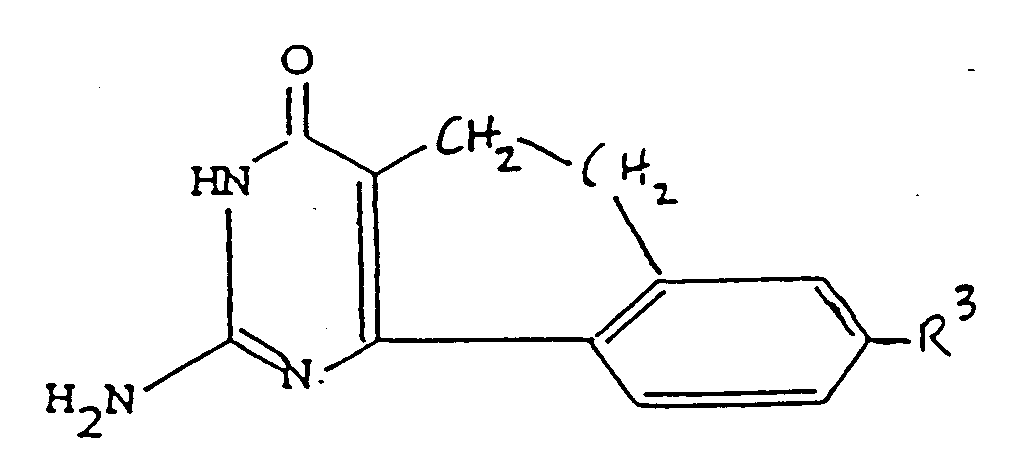
in der R³ für eine Alkoxygruppe mit weniger als 6 Kohlenstoffatomen steht, für die Herstellung eines Arzneimittels zur Behandlung bzw. Prophylaxe von Virusinfektionen.
in der R³ für eine Alkoxygruppe mit weniger als 6 Kohlenstoffatomen steht, für die Herstellung eines Arzneimittels zur Behandlung bzw. Prophylaxe von Virusinfektionen.
Patentansprüche für folgende(n) Vertragsstaat(en): AT
1. Verfahren zur Herstellung einer Verbindung der Formel:
in der X für (CH₂)n, wobei 1 ≦ n ≦ 3 ist;
wobei R⁴ ein Alkyl mit weniger als 6 Kohlenstoffatomen ist; CH₂S oder CH₂O und
R³ für H; ein Alkyl mit weniger als 6 Kohlenstoffatomen; ein Alkoxy mit weniger als 6 Kohlenstoffatomen; ein Halogen, C≡N, Nitro, Amino, Alkylamino, Dialkylamino, Arylamino, Carboxy oder Alkoxy(mit weniger als 6 Kohlenstoffatomen)carbonyl steht; unter der Voraussetzung, daß, wenn n = 2 ist, R³ nicht H oder eine Alkoxygruppe mit weniger als 6 Kohlenstoffatomen in 8-Stellung sein kann;
oder eines pharmazeutisch vertretbaren Salzes davon;
oder einer Verbindung der Formel:
in der
X für (CH₂)n, wobei 1 ≦ n ≦ 3 ist;
wobei R⁴ ein Alkyl mit weniger als 6 Kohlenstoffatomen ist; CH₂S oder CH₂O und
R³ für H, ein Alkyl mit weniger als 6 Kohlenstoffatomen; ein Alkoxy mit weniger als 6 Kohlenstoffatomen; Halogen, C≡N, Nitro, Amino, Alkylamino, Dialkylamino, Arylamino, Carboxy oder Alkoxy(mit weniger als 6 Kohlenstoffatomen)carbonyl steht;
oder eines pharmazeutisch vertretbaren Salzes davon,
wobei das Verfahren als Schritte das Umsetzen des entsprechenden Beta-Ketoesters mit Guanidincarbonat in einem inerten Lösungsmittel und das Wiedergewinnen des Produkts umfaßt.
in der X für (CH₂)n, wobei 1 ≦ n ≦ 3 ist;
wobei R⁴ ein Alkyl mit weniger als 6 Kohlenstoffatomen ist; CH₂S oder CH₂O und
R³ für H; ein Alkyl mit weniger als 6 Kohlenstoffatomen; ein Alkoxy mit weniger als 6 Kohlenstoffatomen; ein Halogen, C≡N, Nitro, Amino, Alkylamino, Dialkylamino, Arylamino, Carboxy oder Alkoxy(mit weniger als 6 Kohlenstoffatomen)carbonyl steht; unter der Voraussetzung, daß, wenn n = 2 ist, R³ nicht H oder eine Alkoxygruppe mit weniger als 6 Kohlenstoffatomen in 8-Stellung sein kann;
oder eines pharmazeutisch vertretbaren Salzes davon;
oder einer Verbindung der Formel:
in der
X für (CH₂)n, wobei 1 ≦ n ≦ 3 ist;
wobei R⁴ ein Alkyl mit weniger als 6 Kohlenstoffatomen ist; CH₂S oder CH₂O und
R³ für H, ein Alkyl mit weniger als 6 Kohlenstoffatomen; ein Alkoxy mit weniger als 6 Kohlenstoffatomen; Halogen, C≡N, Nitro, Amino, Alkylamino, Dialkylamino, Arylamino, Carboxy oder Alkoxy(mit weniger als 6 Kohlenstoffatomen)carbonyl steht;
oder eines pharmazeutisch vertretbaren Salzes davon,
wobei das Verfahren als Schritte das Umsetzen des entsprechenden Beta-Ketoesters mit Guanidincarbonat in einem inerten Lösungsmittel und das Wiedergewinnen des Produkts umfaßt.
2. Verfahren nach Anspruch 1, wobei der Beta-Ketoester durch Umsetzung eines Ringketons
mit Diethyloxalat und anschließende Pyrolyse gebildet wird.
3. Verfahren nach Anspruch 1, wobei der Beta-Ketoester durch Umsetzung eines Ringketons
mit Diethylcarbonat bei erhöhter Temperatur in Gegenwart von Guanidinsalzen in einem
unter Alkohol, Xylen und Toluen ausgewählten Lösungsmittel gebildet wird.
4. Verfahren zur Herstellung einer Verbindung mit einer der in Anspruch 1 definierten
Formeln oder eines pharmazeutisch vertretbaren Salzes davon, wobei das Verfahren als
Schritte die Bildung des entsprechenden 2,4-Diaminopyrimidinderivats durch Umsetzung
eines Ringketons mit Dicyandiamid, an die sich die selektive Hydrolyse einer Aminogruppe
anschließt, und die Wiedergewinnung der besagten Verbindung umfaßt.
5. Verfahren zur Herstellung einer therapeutischen Zusammensetzung, das als Schritte
die Ausführung eines Verfahrens entsprechend einem der Ansprüche 1 bis 4 zur Gewinnung
einer der besagten Verbindungen oder eines pharmazeutisch vertretbaren Salzes davon
und Mischen der Verbindung oder des Salzes mit einem pharmazeutisch vertretbaren Arzneiträger
umfaßt.
6. Verfahren zur Herstellung eines Tuchs für therapeutische Zwecke, das als Schritte
die Ausführung eines Verfahrens nach einem der Ansprüche 1 bis 4 zur Gewinnung einer
der besagten Verbindungen oder eines pharmazeutisch vertretbaren Salzes davon, die
Bereitstellung eines Tuchs und das Tränken des Tuchs mit der Verbindung oder ihrem
Salz umfaßt.
7. Verfahren zur Herstellung eines Tuchs für therapeutische Zwecke, das als Schritte
die Ausführung eines Verfahrens nach einem der Ansprüche 1 bis 4 zur Gewinnung einer
der besagten Verbindungen oder eines pharmazeutisch vertretbaren Salzes davon, die
Bereitstellung eines Tuchs und das Tränken des Tuchs mit der Verbindung oder ihrem
Salz in Kombination mit einem pharmazeutisch vertretbaren Arzneiträger umfaßt.
8. Verwendung einer Verbindung mit einer der in Anspruch 1 definierten Formeln oder pharmazeutisch
vertretbarer Salze davon für die Herstellung eines Arzneimittels zur Behandlung oder
Prophylaxe von Virusinfektionen.
9. Verwendung einer Verbindung mit einer der in Anspruch 1 definierten Formeln oder pharmazeutisch
vertretbarer Salze davon für die Herstellung eines Arzneimittels zur Behandlung oder
Prophylaxe von Infektionen mit dem Herpes-simplex-Virus Typ 2 oder von Erkältung.
10. Verfahren zur Herstellung einer therapeutischen Zusammensetzung, die das Mischen einer
Verbindung entsprechend einer der in Anspruch 1 angegebenen Formeln oder eines pharmazeutisch
vertretbaren Salzes davon mit einem pharmazeutisch vertretbaren Arzneiträger umfaßt.
11. Verfahren zur Herstellung eines Tuchs für therapeutische Zwecke, das die folgenden
Schritte umfaßt: Bereitstellen eines Tuchs und Tränken des Tuchs mit einer Verbindung
entsprechend einer der in Anspruch 1 angegebenen Formeln oder eines pharmazeutisch
vertretbaren Salzes davon.
12. Verfahren zur Herstellung eines Tuchs für therapeutische Zwecke, das die folgenden
Schritte umfaßt: Bereitstellen eines Tuchs und Tränken des Tuchs mit einer Verbindung
entsprechend einer der in Anspruch 1 angegebenen Formeln oder eines pharmazeutisch
vertretbaren Salzes davon in Kombination mit einem pharmazeutisch vertretbaren Arzneiträger.
Revendications pour l'(les) Etat(s) contractant(s) suivant(s): BE, CH, LI, DE, FR,
GB, IT, LU, NL, SE
1. Composé ayant la formule
dans laquelle
X est (CH₂)n dans laquelle 1 ≦ n ≦ 3;
dans lequel R⁴ est un groupe alkyle ayant moins de 6 atomes de carbone; CH₂S ; ou CH₂O ; et
R³ est H, un groupe alkyle ayant moins de 6 atomes de carbone ; un groupe alcoxy ayant moins de 6 atomes de carbone, un halogène, C≡N, nitro, amino, alkylamino, dialkylamino, arylamino, carboxy, ou alcoxy (avec moins de 6 atomes de carbone)carbonyle; à la condition que, quand n = 2, R³ ne peut pas être H ou un groupe alcoxy avec moins de 6 atomes de carbone en position 8;
ou un de ses sels pharmaceutiquement acceptables.
dans laquelle
X est (CH₂)n dans laquelle 1 ≦ n ≦ 3;
dans lequel R⁴ est un groupe alkyle ayant moins de 6 atomes de carbone; CH₂S ; ou CH₂O ; et
R³ est H, un groupe alkyle ayant moins de 6 atomes de carbone ; un groupe alcoxy ayant moins de 6 atomes de carbone, un halogène, C≡N, nitro, amino, alkylamino, dialkylamino, arylamino, carboxy, ou alcoxy (avec moins de 6 atomes de carbone)carbonyle; à la condition que, quand n = 2, R³ ne peut pas être H ou un groupe alcoxy avec moins de 6 atomes de carbone en position 8;
ou un de ses sels pharmaceutiquement acceptables.
2. Composé selon la revendication 1, dans lequel X est (CH₂)₃ et R³ est H ;
ledit composé ayant la formule
2-amino-4-oxo-5,6,7-trihydrobenzocyclohepta-(5,6-d)-pyrimidine.
ledit composé ayant la formule
2-amino-4-oxo-5,6,7-trihydrobenzocyclohepta-(5,6-d)-pyrimidine.
3. Composé ayant la formule :
dans laquelle
X est (CH₂)n dans laquelle 1 ≦ n ≦ 3 ;
dans lequel R⁴ est un groupe alkyle ayant moins de 6 atomes de carbone; CH₂S ; ou CH₂O ; et
R³ est H, un groupe alkyle ayant moins de 6 atomes de carbone ; un groupe alcoxy ayant moins de 6 atomes de carbone, un halogène, C≡N, nitro, amino, alkylamino, dialkylamino, arylamino, carboxy, ou alcoxy (avec moins de 6 atomes de carbone)carbonyle ;
ou un de ses sels pharmaceutiquement acceptables.
dans laquelle
X est (CH₂)n dans laquelle 1 ≦ n ≦ 3 ;
dans lequel R⁴ est un groupe alkyle ayant moins de 6 atomes de carbone; CH₂S ; ou CH₂O ; et
R³ est H, un groupe alkyle ayant moins de 6 atomes de carbone ; un groupe alcoxy ayant moins de 6 atomes de carbone, un halogène, C≡N, nitro, amino, alkylamino, dialkylamino, arylamino, carboxy, ou alcoxy (avec moins de 6 atomes de carbone)carbonyle ;
ou un de ses sels pharmaceutiquement acceptables.
4. 2-amino-4-oxo-3,4,5,6-tétrahydrobenzo(h)quinazoline ou un de ses sels pharmaceutiquement
acceptables.
5. Composition thérapeutique comprenant une quantité thérapeutiquement efficace d'un
composé selon l'une quelconque des revendications précédentes, en présence d'un véhicule
pharmaceutiquement acceptable.
6. Composition selon la revendication 5, dans laquelle ladite composition est sous la
forme d'une pilule, d'une capsule ou d'un comprimé pour l'administration orale à un
patient humain ou à un autre mammifère, ou sous la forme d'ne pommade, d'une lotion,
d'une crème, d'une poudre, d'un gel ou d'une pulvérisation pour l'application à la
peau d'un être humain ou d'un autre mammifère; ou sous la forme d'un liquide ingérable
pharmaceutiquement acceptable contenant une concentration thérapeutiquement efficaced'un
composé selon l'une quelconque des revendications 1 à 4.
7. Serviette thérapeutique, ladite serviette étant imprégnée d'un composé selon l'une
quelconque des revendications 1 à 4.
8. Serviette thérapeutique, ladite serviette étant imprégnée d'un composé selon l'une
quelconque des revendications 1 à 4 en combinaison avec un véhicule pharmaceutiquement
acceptable.
9. Composé selon l'une quelconque des revendications 1 à 4, pour le traitement ou la
prophylaxie des infections virales.
10. Composé selon l'une quelconque des revendications 1 à 4, pour le traitement ou la
prophylaxie des infections virales d'herpès simplex de type II ou du rhume commun.
11. Utilisation d'un composé qui a la formule :
dans laquelle
R³ est un groupe alcoxy avec moins de 6 atomes de carbone pour préparer un médicament pour le traitement ou la prophylaxie des infections virales.
dans laquelle
R³ est un groupe alcoxy avec moins de 6 atomes de carbone pour préparer un médicament pour le traitement ou la prophylaxie des infections virales.
Revendications pour l'(les) Etat(s) contractant(s) suivant(s): AT
1. Procédé de production d'un composé ayant la formule :
dans laquelle
X est (CH₂)n dans laquelle 1 ≦ n ≦ 3;
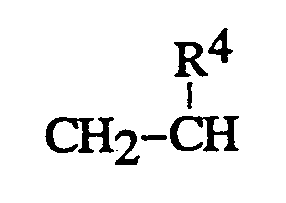
dans lequel R⁴ est un groupe alkyle ayant moins de 6 atomes de carbone; CH₂S ; ou CH₂O ; et
R³ est H, un groupe alkyle ayant moins de 6 atomes de carbone ; un groupe alcoxy ayant moins de 6 atomes de carbone, un halogène, C≡N, nitro, amino, alkylamino, dialkylamino, arylamino, carboxy, ou alcoxy (avec moins de 6 atomes de carbone)carbonyle; à la condition que, quand n = 2, R³ ne peut pas être H ou un groupe alcoxy avec moins de 6 atomes de carbone en position 8 ;
ou un de ses sels pharmaceutiquement acceptables ;
ou un composé ayant la formule :
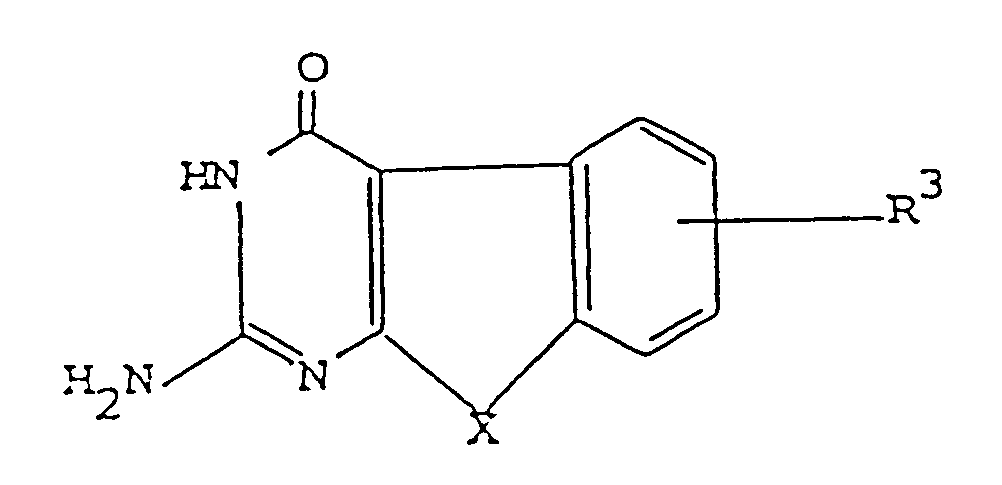
dans laquelle
X est (CH₂)n dans laquelle 1 ≦ n ≦ 3 ;
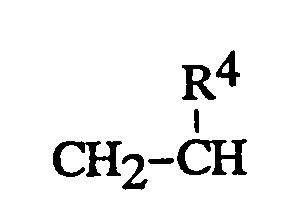
dans lequel R⁴ est un groupe alkyle ayant moins de 6 atomes de carbone; CH₂S ; ou CH₂O ; et
R³ est H, un groupe alkyle ayant moins de 6 atomes de carbone ; un groupe alcoxy ayant moins de 6 atomes de carbone, un halogène, C≡N, nitro, amino, alkylamino, dialkylamino, arylamino, carboxy, ou alcoxy (avec moins de 6 atomes de carbone)carbonyle ;
ou un de ses sels pharmaceutiquement acceptables.
Le procédé comprenant les étapes de faire réagir le β-cétoester correspondant avec du carbonate de guanidine dans un solvant inerte, et de recueillir le produit.
dans laquelle
X est (CH₂)n dans laquelle 1 ≦ n ≦ 3;
dans lequel R⁴ est un groupe alkyle ayant moins de 6 atomes de carbone; CH₂S ; ou CH₂O ; et
R³ est H, un groupe alkyle ayant moins de 6 atomes de carbone ; un groupe alcoxy ayant moins de 6 atomes de carbone, un halogène, C≡N, nitro, amino, alkylamino, dialkylamino, arylamino, carboxy, ou alcoxy (avec moins de 6 atomes de carbone)carbonyle; à la condition que, quand n = 2, R³ ne peut pas être H ou un groupe alcoxy avec moins de 6 atomes de carbone en position 8 ;
ou un de ses sels pharmaceutiquement acceptables ;
ou un composé ayant la formule :
dans laquelle
X est (CH₂)n dans laquelle 1 ≦ n ≦ 3 ;
dans lequel R⁴ est un groupe alkyle ayant moins de 6 atomes de carbone; CH₂S ; ou CH₂O ; et
R³ est H, un groupe alkyle ayant moins de 6 atomes de carbone ; un groupe alcoxy ayant moins de 6 atomes de carbone, un halogène, C≡N, nitro, amino, alkylamino, dialkylamino, arylamino, carboxy, ou alcoxy (avec moins de 6 atomes de carbone)carbonyle ;
ou un de ses sels pharmaceutiquement acceptables.
Le procédé comprenant les étapes de faire réagir le β-cétoester correspondant avec du carbonate de guanidine dans un solvant inerte, et de recueillir le produit.
2. Procédé selon la revendication 1, dans lequel on forme ledit β-cétoester par réaction
d'une cétone cyclique avec l'oxalate de diéthyle puis on pyrolyse.
3. Procédé selon la revendication 1, dans lequel on forme le β-cétoester par réaction
d'une cétone cyclique avec du carbonate de diéthyle à haute température en présence
de sels de guanidine dans un solvant choisi parmi les alcools, le xylène et le toluène.
4. Procédé de préparation d'un composé qui a soit la formule définie à la revendication
1, soit ses sels pharmaceutiquement acceptables;
le procédé comprenant les étapes de formation des dérivés correspondants de 2,4-diaminopyrimidine en faisant réagir une cétone cyclique avec du dicyandiamide puis on réalise l'hydrolyse sélective d'un groupe amino, et on recueille lesdits composés.
le procédé comprenant les étapes de formation des dérivés correspondants de 2,4-diaminopyrimidine en faisant réagir une cétone cyclique avec du dicyandiamide puis on réalise l'hydrolyse sélective d'un groupe amino, et on recueille lesdits composés.
5. Procédé de préparation d'une composition thérapeutique comprenant de réaliser un procédé
selon l'une quelconque des revendications 1 à 4 pour produire ledit composé ou un
de ses sels pharmaceutiquement acceptables, et de mélanger ledit composé ou sel avec
un véhicule pharmaceutiquement acceptable.
6. Procédé de production d'une serviette thérapeutique qui comprend les étapes de réaliser
un procédé selon l'une quelconque des revendications 1 à 4 pour produire ledit composé
ou un de ses sels pharmaceutiquement acceptables ; de fournir une serviette ; d'imprégner
ladite serviette avec ledit composé ou son sel.
7. Procédé de production d'une serviette thérapeutique comprenant les étapes de réaliser
un procédé selon l'une quelconque des revendications 1 à 4 pour produire ledit composé
ou un de ses sels pharmaceutiquement acceptables ; de fournir une serviette ; d'imprégner
ladite serviette avec ledit composé ou son sel en combinaison avec un véhicule pharmaceutiquement
acceptable.
8. Utilisation d'un composé ayant soit les formules définies à la revendication 1, soit
ses sels pharmaceutiquement acceptables; pour préparer un médicament pour le traitement
ou la prophylaxie des infections virales.
9. Utilisation d'un composé ayant l'une quelconque des formules définies à la revendication
1, ou un de ses sels pharmaceutiquement acceptables ; pour préparer un médicament
pour le traitement ou la prophylaxie des infections virales d'herpès simplex de type
II ou du rhume commun.
10. Procédé de préparation d'une composition thérapeutique qui comprend de mélanger un
composé tel qu'il est défini par l'une quelconque des formules indiquées à la revendication
1 ou un de sels sels pharmaceutiquement acceptables, avec un véhicule pharmaceutiquement
acceptable.
11. Procédé de préparation d'une serviette thérapeutique comprenant les étapes de : fournir
une serviette ; et imprégner ladite serviette d'un composé tel que défini dans l'une
quelconque des formules indiquées à la revendication 1 ou un de ses sels pharmaceutiquement
acceptables.
12. Procédé de préparation d'une serviette thérapeutique, qui comprend les étapes de :
fournir une serviette ; et imprégner ladite serviette d'un composé tel que défini
dans l'une quelconque des formules indiquées à la revendication 1 ou un de ses sels
pharmaceutiquement acceptable en combinaison avec un véhicule pharmaceutiquement acceptable.