(57) Halogen is produced by electrolyzing an aqueous halide in a specially designed cell.
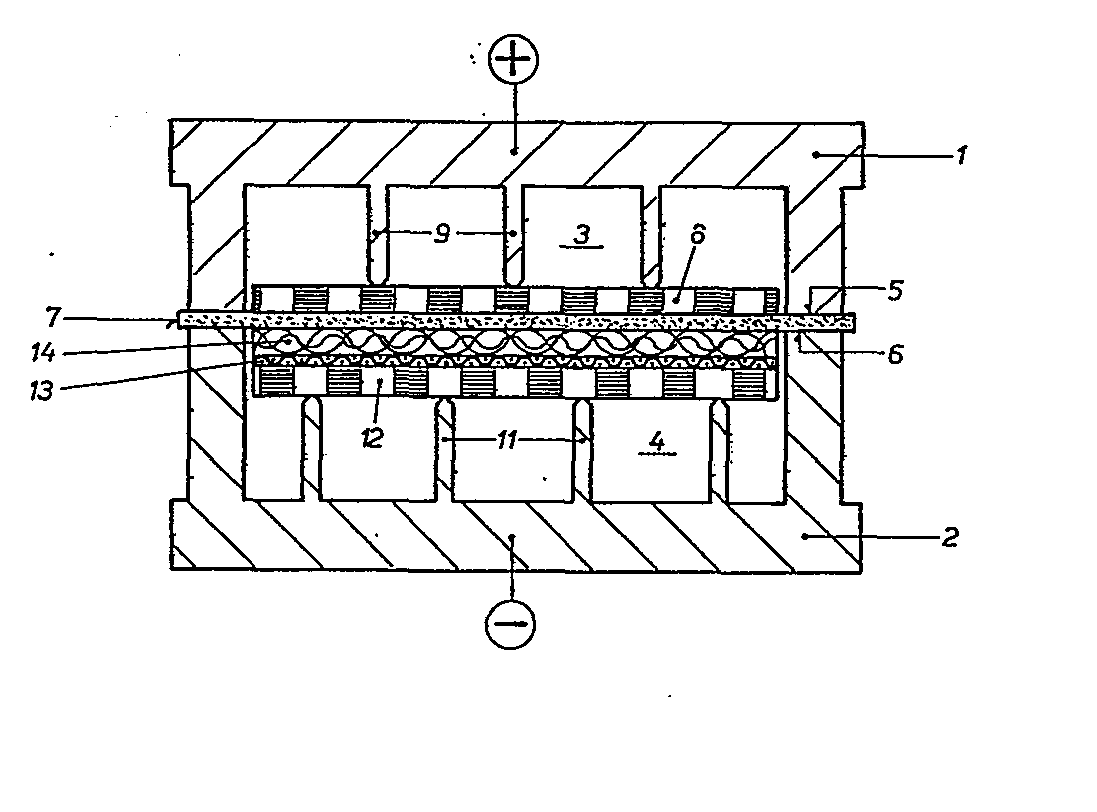
The cell comprises an analyte chamber and a catholyte chamber separated by a permeable
membrane or diaphragm, notably an ion exchange (generally cation exchange) polymer.
At least one electrode comprises at least two sections. One section comprises a gas
and electrolyte permeable layer, sheet or mat having a catalytic surface, i.e. one
having a low overvoltage, (low hydrogen overvoltage if the cathode and low halogen
overvoltage if the anode). This layer is spaced from the membrane by a second portion
comprising an electroconductive resiliently compressible layer or mat, which is in
contact with the membrane on one side thereof, the other side thereof being in contact
with the main cathode.
This second or spacer section advantageously has an electrode surface having a higher
overvoltage than the first electrode surface. Preferably the cathode has the above
construction.
Upon electrolysis of alkali metal chloride or other halide in such a cell and with
a cathode of the type described above, a low voltage is obtained even at high current
densities and the cathode efficiency is high.
|
|
