|
(11) | EP 0 124 378 A1 |

| (12) | EUROPEAN PATENT APPLICATION |
|
|
|
|
|||||||||||||||||||
| (54) | Fluorinated alkyl ether-containing ethylenes, precursors thereto, and copolymers thereof with tetrafluoroethylene |
| (57) Copolymers of TFE with fluorinated alkyl ethylenes which contain ether linkages are
provided. The copolymers are thermally stable and useful as electrical insulation.
Some of the copolymers contain functional groups and are hydrolyzable to fluorinated
copolymers which contain acid functional groups. Novel monomers and precursors thereof
are also provided. |
FIELD OF THE. INVENTION
[0001] This invention relates to copolymers of tetrafluoroethylene, and more specifically to copolymers of tetrafluoroethylene and fluorinated alkyl ethylenes which contain ether linkages.
BACKGROUND OF THE INVENTION
[0002] Many copolymers of tetrafluoroethylene are known, but new copolymers of tetrafluoroethylene are always of interest due to a desire to obtain polymers having improved properties over polymers known heretofore.
[0003] U.S. 3,465,045 to Pittman et al. discloses the preparation, homopolymerization and copolymerization of (CF3)2CFOCH=CH2, but copolymerization with tetrafluoroethylene (TFE) is not disclosed.
[0004] U.S. 3,577,465 to Anello et al. discloses the preparation of (CF3)2CFOCF2CF2CH=CH2, but copolymerization with TFE is not disclosed.
[0005] Belgian 690,605 (Hoechst) discloses various compounds of the formula RfOR where Rf is perfluoroalkyl of at least 2 carbon atoms and R is various groups including beta-bromoethyl. Preparation of (CF3)2CFOCH=CH2 is described. It is also disclosed that vinyl ethers such as the latter can be polymerized to oil- and water-repellant polymers, but copolymers with TFE are not disclosed.
[0006] It is an object of this invention to provide novel copolymers of TFE, novel monomers, and precursors thereto.
[0007] It is a more specific object of this invention to provide novel copolymers of TFE with fluorinated alkyl ethylenes which contain ether linkages, and novel such comonomers.
SUMMARY OF THE INVENTION
[0008] Briefly, the present invention provides copolymers of TFE and fluorinated alkyl ethylenes which contain ether linkages.
[0009] More specifically, there is provided according to the invention a copolymer comprising 90-99.8 mol % tetrafluoroethylene units and 0.2-10 mol % of substituted ethylene units of the formula
where n is 0 or 1: X is F-, FS02-, NC-, or CF3O(CF2O)m- wherein m is 0, 1, 2 or 3; and Rf is a divalent moiety CpF2p wherein p is 2, 3, 4 or 5; said substituted ethylene units being randomly positioned throughout the copolymer chain.
[0010] Additionally, the present invention provides a substituted ethylene having the structural formula YCF2CF2OCF2CF2CH=CH2' where Y is FSO2-, NC-, or CF3O(CF2O)m- wherein m is 0,
DETAILED DESCRIPTION OF THE INVENTION
[0013] The copolymers can be made by copolymerizing TFE and a fluorinated alkyl ethylene containing one or more ether linkages under the influence of a free radical initiator. Ordinarily a solvent is used during the copolymerization. Both batch and continuous processes are suitable.
[0014] As solvents in the polymerization, fluoro- or chlorofluoro-hydrocarbons, preferably having 1 to 4, and especially 1 to 2, carbon atoms, are useful. Suitable solvents include: dichlorodifluoromethane, trichloromonofluoromethane, dichloromonofluoromethane, monochlorodifluoromethane, chlorotrifluoromethane, tetrafluoroethane, trichlorotrifluoroethane, dichlorotetrafluoroethane, fluorochloropropane, perfluoropropane, perfluorocyclobutane, etc. or mixtures thereof. It is best to use a saturated fluoro- or chlorofluoro-hydrocarbon which does not have a hydrogen atom in the molecule, such as dichlorodifluoromethane, trichloromonofluoromethane, trichlorotrifluoroethane, dichlorotetrafluoroethane, perfluorocyclobutane, etc., since such solvents have a tendency of increasing the molecular weight of the resulting copolymer. When such a solvent is used, good results are attainable when used in amounts of 0.5-20 mol and especially about 1-10 mol of the solvent per mol of monomer mixture of tetrafluoroethylene and ether-containing perfluoroalkyl ethylene monomer.
[0015] The copolymerization reaction can be carried out by using less than 0.5 mol of the solvent per mol of monomer mixture. However, it is advantageous to use more than 1 mol of solvent in order to enhance the rate of the copolymerization. It is possible to use more than 20 mols of solvent, but it is advantageous to use less than 10 mols per mol of monomer mixture for economic reasons, such as solvent recovery.
[0016] A mixture of a solvent as described above and other organic solvents may be used. It is also possible to use a mixed reaction medium of solvents as described above.
[0017] The advantage of using such a mixed solvent consists in easy stirring of the reaction system and easy removal of the heat of reaction. In accordance with the process of the invention, the conditions of the copolymerization can be varied depending upon the type of polymerization initiator or the reaction medium.
[0018] A wide variety of polymerization initiators can be used depending upon the polymerization system. However, when a solvent as described above is used, it is preferable to use a soluble free-radical polymerization initiator, such as an organic peroxy compound. It is possible to use high energy ionizing radiation of 10-105 rad/hour dose rate. Suitable peroxy compounds may be the organic peroxides, e.g., benzoylperoxide or lauroylperoxide; peresters, e.g., t-butyl peroxyisobutyrate: or peroxy dicarbonates, e.g., 4-tert-butylcyclohexyl peroxydicarbonate, diisopropylperoxy dicarbonate, etc. It is especially preferred to use as the initiator in non-aqueous systems, a peroxide having the formula
wherein Rf each represent perfluoroalkyl groups containing from 3-13 carbon atoms, in a solvent as described above. Suitable such peroxides include bis(perfluoropropionyl) peroxide, bis(perfluorohexanoyl) peroxide, etc.
[0019] The polymerization can be carried out at a temperature of between 30 and 110°C, and preferably at a temperature of between 40 and 80°C. Pressures employed in the polymerization are ordinarily those pressures between 0.1 x 10⁶ and 7 x 10⁶ pascals (1 and 70 kg/cm ) and preferably are those between 0.3 x 10⁶ and 3.5 x 10⁶ pascals (3 and 35 kg/cm2).
[0020] It is often preferable to include a small amount of a telogenic material in the reaction medium in order to control the molecular weight of the resulting copolymer. Alcohols such as methanol or ethanol, and alkanes such as ethane, butane, cyclohexane, etc., are suitable telogens.
[0022] The reaction may be carried out until solids content of the reaction mixture reaches about 12%.
[0023] If a large concentration, i.e., over about 3 mol %, of perfluoroalkyl ethylene is employed in batch runs, the polymerization reaction is inhibited, except for (CF3)2CFOCH=CH2, which did not result in inhibition in any concentration employed.
[0024] It is possible, if desired, to carry out the polymerization in a continuous manner which maintains the concentration of the fluorinated alkyl ether-containing ethylene in the reaction mixture at a relatively constant and low concentration compared to the concentration of tetrafluoroethylene. More specifically, such a process can comprise (a) combining and agitating tetrafluoroethylene and the fluorinated alkyl ethylene in the presence of a nonaqueous solvent in a reaction vessel at a temperature of between 30°C and 110°C and a pressure of between 0.1 x 10⁶ and 7 x 10 pascals (1 kg/cm2 and 70 kg/cm2) and preferably between 0.3 x 10 and 3.5 x 10 pascals (3 kg/cm and 35 kg/cm2), in the presence of a free-radical polymerization initiator, said combining of the tetrafluoroethylene and fluprinated alkyl ether-containing ethylene being carried out by continuously and uniformly adding fluorinated alkyl ether-containing ethylene to the reaction vessel in a manner which maintains a concentration of fluorinated alkyl ether-containing ethylene in the vessel during agitation below 2.5 mol %, and preferably below 1 mol %, relative to tetrafluoroethylene, said agitation being continued until copolymer formation has occurred, and (b) separating the copolymer from the other ingredients present in step (a).
[0025] The copolymers of the invention are non-brittle, non-elastomeric plastics, and are melt-processible. They can be hot-pressed into tough, clear films, and converted to melt extrudates that are strong and non-brittle. In these respects they differ from polytetrafluoroethylene (PTFE) and are more tractable than PTFE, even though the amount of comonomer incorporated is small. They also have good thermal and chemical stability.
[0026] By "nonelastomeric" is meant that the molded copolymer is not a material which at room temperature can be stretched repeatedly to at least twice its original length and, upon immediate release of the stress, will return with force to its approximate original length.
[0027] Novel fluorinated alkyl ethylenes containing one or more ether linkages provided by the invention have the structural formula YCF2CF2OCF2CF2CH=CH2, where Y is FS02-. NC-, or CF3O(CF2O)m- wherein m is 0, 1, 2 or 3.
[0028] Such monomers can be made by dehydroiodination of a precursor which is a compound having the structural formula YCF2CF2OCF2CF2CH2CH2I, where Y is FSO2-, NC-, or CF3O(CF2O)m- wherein m is 0, 1, 2 or 3.
[0029] The dehydroiodination step can be carried out by treatment of said precursor with a tertiary amine, optionally in a suitable solvent, at elevated temperature, e.g., 100-150°C., or with aqueous caustic solution in those cases where the compound is not otherwise affected by caustic, at room temperature or above.
[0030] Said precursors are in turn made by insertion of ethylene into fluorinated iodo compounds, which can be represented by the formula YCF2CF2OCF2CF2I, where Y is FS02-, NC-, or CF3O(CF2O)m- wherein m is 0, 1, 2 or 3. Such compound where Y is FSO2- is available by the method described in U.S. 4,254,030. The ethylene insertion reaction to make said precursors can be carried out by reaction of said fluorinated iodo compounds with ethylene at elevated temperature, typically 150-200°C., under pressure, typically 1 x 10⁷ to 1.5 x 10⁷ pascals (1500-2200 psig).
[0031] Some of said fluorinated iodo compounds, i.e., YCF2CF20CF2CF2I, where Y is NC- or CF3O(CF2O)m- wherein m is 0, 1, 2 or 3 are also novel compounds and are provided by the present invention. Such compound where Y is CF3O(CF2O)m- is made by reacting the appropriate acyl fluoride, such as CF3OCF2OCF2COF, with TFE, iodine and KF in a suitable solvent. Such compound where Y is NC- is made by reacting NCCF2COF with TFE, IC1 and KF in a suitable solvent.
EXAMPLES
[0032] In the following examples, apparent melt viscosity was determined by calculations based on the melt flow rate. The melt flow rate was determined with the procedure of ASTM D1238 at a load of 5000g except that the melt flow rate was determined in grams/minute rather than grams/10 minutes, and the equation used to calculate the apparent melt viscosity (MV) was:
[0033] This equation provides MV values in poises. MV5 as reported herein in Table I is the MV so determined after holding the sample in melt form for 5 minutes just before determination of the melt flow rate. Melt viscosity is related to the molecular weight of the polymer.
[0034] Melting point was determined by Differential Scanning Calorimetry (DSC) at a rate of 15°C per minute.
[0035] The comonomer content of the copolymers of the invention was estimated by a method based on melting point data. The method as used herein employs the melting point data obtained as indicated above and the method described by Paul J. Flory (see "Principles of Polymer Chemistry", Cornell University Press, Ithica, N.Y., 1953, p. 568), using the following equation:
where TM = melting point of the copolymer in °K TTFE = melting point of homopolymer PTFE (559.5°K) NTFE = mole fraction TFE in the copolymer The numerical constants in the equation vary somewhat for different comonomers, and can be determined as described in the Flory reference cited above. The comonomer content of the copolymers disclosed herein was estimated from the equation with numerical constants derived for copolymers of TFE and nonafluorobutyl ethylene.
Example 1
[0036] In a 110-ml stainless steel shaker tube were placed 0.052g of 4-tert-butylcyclohexyl peroxydicarbonate and a solution of 1.3g of vinyl heptafluoroisopropyl ether in 50ml of 1,1,2-trichloro-1,2,2-trifluoroethane. The sample of vinyl heptafluoroisopropyl ether used had been shown by gas chromatography (GC) analysis to be 85% pure (the remaining 15% was believed to be vinyl bromide). The shaker tube was sealed, cooled with a solid CO2/acetone bath, and briefly evacuated; then lOg of tetrafluoroethylene was introduced. The tube and contents were shaken at 55-65°C and autogenous pressure for 4 hours (the first hour at 55-58°C, the second at 59°C, the third at 58-65°C, the fourth at 62-65°C). The product was a slurry, from which a white powder was collected by filtration. It weighed 10.3g after drying overnight in a vacuum oven at 100°C. A sample was analyzed by Differential Scanning Calorimetry (DSC) to give m.p. 322.3°C, f.p. 303.0°C, re-melt m.p. 321.9°C. A sample of tetrafluoroethylene homopolymer prepared and isolated in the same way had m.p. 326.5°C, f.p. 307.6°C, re-melt m.p. 326.5°C by DSC analysis. Another sample was used for determination of melt viscosity at 372°C, which was found to be 49.8 x 10⁴ poises.
[0037] The extrudate made during determination of the melt flow rate was flexible without breaking. The infrared spectrum of a hot-pressed film showed absorption from CH bonds at 3.4, 7.0, 7.2 um and ether oxygen at 10.1-10.2 um. The amount of the ether-containing comonomer incorporated in the copolymer was estimated to be 0.4%.
Example 2
[0038] In a 110-ml stainless steel shaker tube were placed 0.050g of 4-tert-butylcyclohexyl peroxydicarbonate and a solution of 0.542g (0.0025 mole) of vinyl heptafluoroisopropyl ether (purity 99% by GC analysis) in 50ml of 1,1,2-trichloro-1,2,2-trifluoroethane. The shaker tube was sealed, cooled to -24°C with a solid CO2/acetone bath, and briefly evacuated; then 10g of tetrafluoroethylene was introduced. The tube and contents were shaken at 50-57°C for one hour and then at 65-70°C for 3 hours at autogenous pressure. There was some mechanical loss during the run. The product was a gel-like slurry from which the solvent was evaporated to leave a white powder, wt. 6.1g after drying overnight in a vacuum oven at 100°C. Analysis by DSC gave m.p. 325.6°C, f.p. 305.3°C, re-melt m.p. 325.1°C. Melt viscosity was 12 x 104 poises at 372°C. The extrudate made during.determination of the melt flow rate was flexible without breaking. The infrared spectrum of a hot-pressed film closely resembled that of the polymer of Example 1. The amount of the ether-containing comonomer incorporated in the copolymer was estimated to be 0.2%. Example 3 Preparation of 2,2,3,3,5,5,6,6-octafluoro-4-oxa-7-octenenitrile (CH2=CHCF2CF2OCF2CF2CN).
A. Preparation of 6-Iodoperfluoro-4-oxahexanenitrile (first intermediate)
[0039] In a 500-ml three-necked flask fitted with a solid C02 condenser, a serum cap, and a magnetic stirrer bar was placed 29.0g of anhydrous potassium fluoride that had been dried in a vacuum oven at 100°C. The flask was evacuated, flamed, and brought to atmospheric pressure with dry nitrogen. This cycle was repeated twice. Then 200ml of anhydrous 2-methoxyethyl ether was added through the serum cap with a hypodermic syringe. The flask was cooled with a bath of solid C02 and acetone. Into a trap cooled with a mixture of solid C02 and acetone was condensed 73g of cyanodifluoroacetyl fluoride which was then allowed to come to ambient temperature slowly while evaporated through a hypodermic needle through the serum cap into the stirred mixture of KF and 2-methoxyethyl ether over a period of 65 minutes. The stirring was continued for another 5 hours during which most of the KF dissolved. The mixture was allowed to come to ambient temperature and stand for several hours. It was then placed in a 400ml stainless steel shaker tube with 100g of iodine monochloride (ICl). After the tube was sealed and cooled to 12°C, 50g of tetrafluoroethylene was added. The tube and contents were shaken at 44-47°C for 10 hours. The product, combined with rinsings with 1,1,2-trichloro-1,2,2-trifluoroethane, was poured into cold water and filtered to remove some iodine. The lower layer was washed with 5% aqueous Na2SO3 solution and water, dried over MgSO4, filtered, and fractionally distilled. The fractions boiling at 93-95°C (atmospheric pressure) and 41-42°C (100mm pressure) were primarily (by GC analysis) 6-iodoperfluoro-4-oxahexanenitrile (ICF2CF2OCF2CF2CN). Its yield as calculated from GC analysis data of all the distillation fractions was 18.2g. It was identified by 19F-NMR analysis which showed lines at -66.3ppm for CF2 adjacent to I, -87.0 and -88.7ppm for the two CF2 groups adjacent to 0, and -110.6ppm for CF2 group adjacent to CN. The infrared spectrum showed a strong absorption band for -CN at 4.4um.
B. Conversion to the ethylene insertion compound (second intermediate)
[0040] In a 70-ml stainless steel shaker tube were placed 13.9g of 6-iodoperfluoro-4-oxahexanenitrile and 17ml of 1,1,2-trichloro-1,2,2-trifluoroethane. The tube was sealed and ethylene was introduced. The tube and contents were shaken at 150°C and 1 x 10⁷ pascals (1500psig) for 2 hours and then at 200°C and up to 1.5 x 10⁷ pascals (2200psig) for 16 hours.
[0041] The product was fractionally distilled to give 8-iodo-2,2,3,3,5,5,6,6-octafluoro-4- oxaoctanenitrile, b.p. of main fraction 69-70° (24mm), wt. 11.3g (by GC analyses of all fractions). The 1H and 19F-NMR spectra were consistent with the structure (1H: two complex systems of lines in the 2.3-3.3ppm region; 19F: single lines at -88.0, -110.1, -120.2ppm).
C. Conversion to the olefin by dehydroiodination
[0042] In a flask fitted with a thermometer, a magnetic stirring bar, and a still head were placed 4.5g of tri-n-propylamine, 9.1g of 8-iodo-2,2,3,3,-5,5,6,6-octafluoro-4-oxaoctanenitrile, and 6ml of 2-methoxyethyl ether. The flask and contents were heated rapidly to 145°C and then stirred at 130-145°C for 3-1/2 hours during which a colorless distillate was collected. Further distillate was obtained by reducing the pressure to 24mm. The distillate was fractionally distilled to give 2,2,3,3,5,5,6,6-octafluoro-4-oxa-7-octenenitrile (4.14g, 67.1% yield), b.p. 84°C. The 1H-NMR spectrum showed a multiple line pattern between 5.2 and 5.6ppm; the 19F-NMR spectrum contained three lines: at -89.1ppm for CF2 groups surrounding 0, -l13.0ppm for CF2 adjacent to CN, and -120.4ppm for CF2 adjacent to CH=CH2 group (integral ratios 2:1:1).
Example 4 Preparation of 7-fluorosulfonyl-1,1,2-tri- hydroperfluoro-5-oxa-1-heptene (CH2=CHCF2CF2OCF2CF2SO2F)
A. Ethylene insertion step
[0043] In a 70-ml stainless steel shaker tube were placed 18.06g of 1-iodo-5-fluorosulfonylperfluoro-3- oxapentane (prepared under conditions similar to those described in U.S. Patent 4,254,030) dissolved in 40ml of 1,1,2-trichloro-1,2,2-trifluoroethane. The tube was sealed and ethylene was introduced to a pressure of 1.4 x 10⁶ pascals (200psig). The tube and contents were shaken and rapidly heated to 200°C. Ethylene pressure was increased to and maintained at 1.4 x 10⁷ pascals (2000psig) by constant repressuring for 17 hours. The product was fractionally distilled to give 1-iodo-7-fluorosulfonyl-3,3,4,4,6,6,7,7-octafluoro-5-oxaheptane, 11.0g, b.p. 70-71°C at 13mm, nD 1.3790. The 1H and 19 F-NMR spectra of the product were consistent with the structure.
B. Dehydroiodination step
[0044] In a flask fitted with a thermometer, a magnetic stirring bar, an addition funnel, and a still head were placed 4.0g of tri-n-propylamine and 5ml of 2-methoxyethyl ether. The solution was stirred at 120-130°C while ll.Og of 1-iodo-7-fluorosulfonyl-3,3,4,4,6,6,7,7-octafluoro-5-oxaheptane in 5ml of 2-methoxyethyl ether was added over a 12-minute period. The mixture was stirred at 135°C for 3 hours. Then the temperature was lowered to 70°C and the pressure gradually lowered to about -10mm. A distillate was collected in a receiver cooled with an acetone-solid C02 bath, diluted with 1,1,2-trichloro-1,2,2-trifluoroethane solvent, washed with water, dried over anhydrous MgSO4, filtered, and fractionally distilled to give 7-fluorosulfonyl-1,1,2-trihydroperfluoro-5-oxa-1-heptene, b.p. 45° at 60mm, 3.5g, n 1.3131. The 1H-NMR spectrum shows a group of lines in the 5.3-5.7ppm range; the 19 F-NMR spectrum contained 5 lines: 42.9, -83.1, -89.5, -114.9, -120.3ppm (integral ratio 1:2:2:2:2). Example 5 Preparation of 1,1,2-trihydroperfluoro-5,8,-10-trioxa-l-undecene (CH2=CHCF2CF2OCF2CF2OCF2OCF3)
A. Preparation of 9-Iodo-2,4,7-trioxa- perfluorononane (first intermediate)
[0045] In a 400-ml shaker tube were placed 80.Og of iodine, 13.0g of anhydrous KF, 200ml of anhydrous 2-methoxyethyl ether, and 103.8g of a distillation fraction containing (by GC analysis) 51.lg of perfluoro-3,5-dioxahexanoyl fluoride and 52.3g of 1,1,2-trichloro-1,2,2-trifluoroethane. The tube was sealed, cooled in an acetone-solid C02 bath, evacuated briefly, and charged with 50g of tetrafluoroethylene. The tube and contents were shaken at 80°C and autogenous pressure for 5 hours. The product was poured into water; the bottom layer was washed with 5% aqueous Na2SO3 solution, dried over anhydrous MgSO4, and fractionally distilled. The fraction with b.p. 108°C, nD 1.3083, 3.2g, was identified by NMR as 9-iodo-2,4,7-trioxaperfluorononane. The 19F spectrum contained six lines at -54.5, -58.0, -64.9, -86.6, -89.5, -91.0ppm in integral ratios 2:3:2:2:2:2.
B. Ethylene insertion step
[0046] In a 75-ml stainless steel shaker tube were placed 9.2g of 9-iodo-2,4,7-trioxaperfluorononane and 40ml of 1,1,2-trichloro-1,2,2-trifluoroethane. The tube was sealed, cooled, and briefly evacuated. Ethylene was introduced at an initial pressure of 1.4 x 10⁶ pascals (200psig). The tube and contents were shaken at 150°C and 7 x 10⁶ pascals (1000psig) for one hour, 175°C and 1 x 10⁷ pascals (1500psig) for one hour, and 200°C and 1.4 x 10⁷ pascals (2050psig) for 8-1/2 hours. The product was fractionally distilled. The fraction boiling at 53-55° at 9mm, 1.2g was identified by NMR as 11-iodo-10,10,11,11-tetrahydro- perfluoro-2,4,7-trioxaundecane.
C. Dehydroiodination step
[0047] In a 50-ml bottle were placed 9.24g of 11-iodo-10,10,11,11-tetrahydroperfluoro-2,4,7-trioxaun- decane, 1.214g of TLF-2370-C surfactant, 2.756g of 50% aqueous NaOH solution, and 3ml of dichloromethane. The bottle was shaken on a wrist-action shaking apparatus for six hours. The nonaqueous layer was dried and fractionally distilled. The fractions boiling at 101-112°C, 2.5g, were shown by GC and NMR analyses to be mostly 1,1,2-trihydroperfluoro-5,8,10-trioxa-1-undecene. Example 6-16 Preparation of Copolymers with Tetrafluoroethylene.
[0048] The amounts of tetrafluoroethylene, comonomer, initiator (4-tert-butylcyclohexyl peroxydicarbonate), and solvent (1,1,2-trichloro-1,2,2-trifluoroethane) are listed in Table I. The time of reaction (4 hours) and size of stainless steel shaker tube (110m1) were the same in each run. Temperature of polymerization was mostly in the 55-65°C range and is also listed in Table I. Most of the copolymers gave non-brittle extrudates after fusion, and tough flexible hot-pressed films.
[0049] The infrared spectra of all the copolymers show absorption bands corresponding to C-H bonds, and those of the copolymers containing NC- or FSO2- groups show absorption bands corresponding to those groups as well.
INDUSTRIAL APPLICABILITY
1. A copolymer comprising 90-99.8 mol % tetrafluoroethylene units and 0.2-10 mol %
of substituted ethylene units of the formula

where n is 0 or 1; X is F-, FSO2-, NC-, or CF3O(CF2O)m- wherein m is 0 or 1, 2 or 3; and Rf is a divalent moiety CpF2p wherein p is 2, 3, 4 or 5; said substituted ethylene units being randomly positioned throughout the copolymer chain.
where n is 0 or 1; X is F-, FSO2-, NC-, or CF3O(CF2O)m- wherein m is 0 or 1, 2 or 3; and Rf is a divalent moiety CpF2p wherein p is 2, 3, 4 or 5; said substituted ethylene units being randomly positioned throughout the copolymer chain.
2. A copolymer according to claim 1 wherein n is 0, Rf is
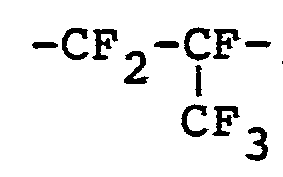
3. A copolymer according to claim 1 wherein n is 1, Rf is CF2-CF-, and X is F-. CF3
4. A copolymer according to claim 1 wherein n is 1, Rf is -CF2-CF2-, and X is FS02-.
5. A copolymer according to claim 1 wherein n is 1, Rf is -CF2-CF2-, and X is NC-.
6. A copolymer according to claim 1 wherein n is 1, Rf is -CF2-CF2-, and X is CF3O(CF2O)m- wherein m is 1.
7. A substituted ethylene having the structural formula YCF2CF2OCF2CF2CH=CH2, where Y is NC-, or CF30(CF20)m- wherein m is 0, 1, 2 or 3.
8. A compound having the structural formula YCF2CF2OCF2CF2CH2CH2I, where Y is NC-, or CF3O(CF2O)m- wherein m is 0, 1, 2 or 3.
9. A compound having the structural formula YCF2CF20CF2CF2I, where Y is NC- or CF3O(CF2O)m- wherein m is 0, 1, 2 or 3.
10. A compound according to claim 7, 8 or 9 wherein Y is CF3O(CF2O)m- and m is 1.
11. Coatings or linings of a copolymer as claimed in any one of claims 1 to 6.