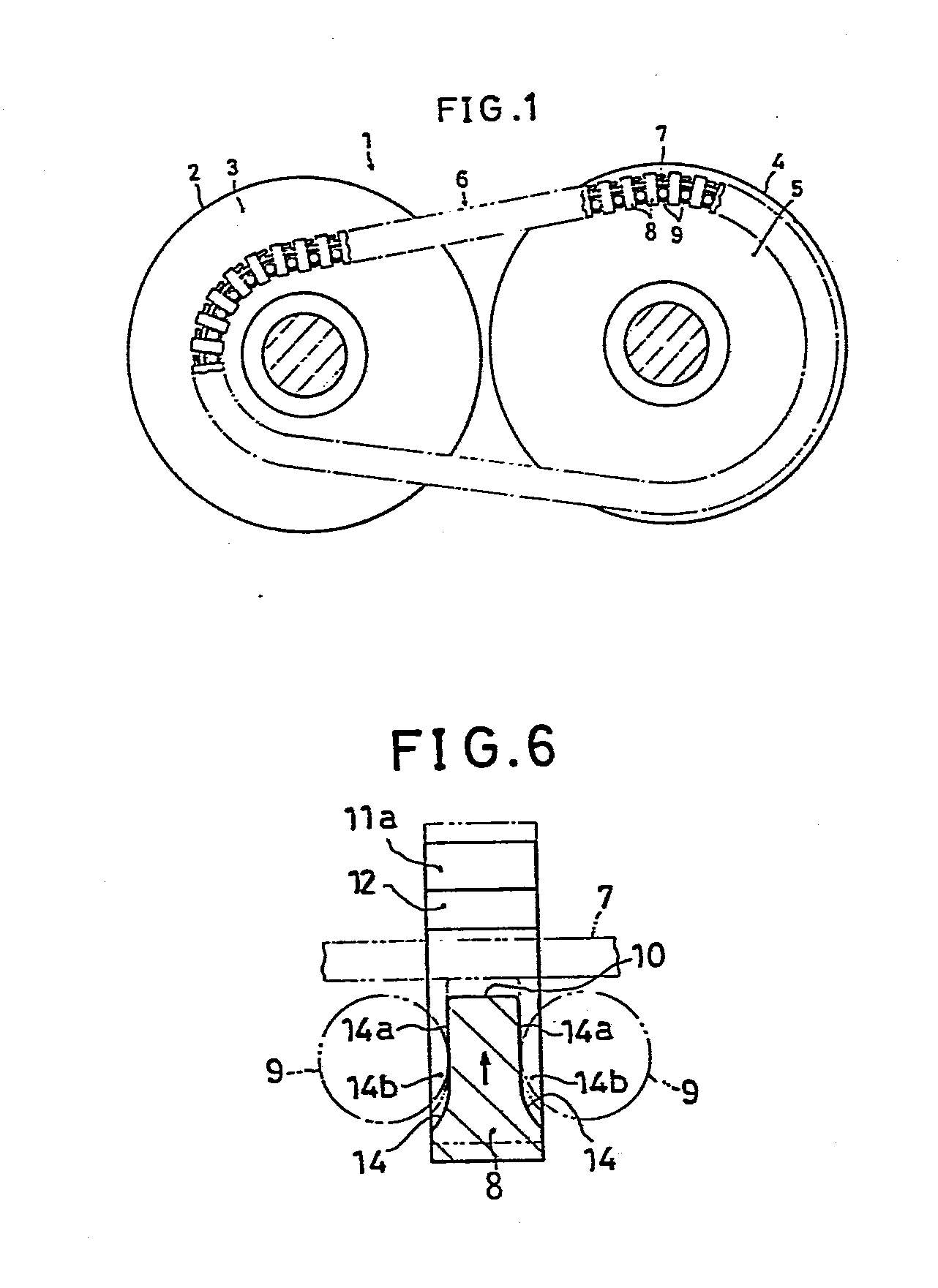
(57) A V-belt transmission is disclosed in which an endless metallic belt (7) is provided
with a large number of V-shaped metallic members (8,8,....), each having an engaging
surface (10) facing the metallic belt. The metallic members are disposed in an array
along the lengthwise direction of the endless metallic belt so as to make, as a whole,
a V-belt assembly. This V-belt assembly is applied between a driving V-pulley (2)
and a driven V-pulley (4) so as to effect power transmission therebetween. A large
number of intermediate members (9,9,....) are so interposed between respective adjacent
metallic members (8,8,....) and positioned inside the metallic belt (7) as to be fastened
together from the outer periphery thereof with the metallic belt. The transmission
is characterised in that each of the V-shaped metallic members (8,8,....) is so held
between a corresponding two of the intermediate members (9, 9,....) which are located
on mutually opposite sides of the metallic member (8) in the lengthwise direction
of the metallic belt (7) as to be moveable inwards and outwards so that when the respective
V-shaped metallic members (8, 8,....) are brought into engagement with either of the
V-pulleys (2, 4), the metallic members (8, 8,....) are pushed by the V-pulley (2 or
4) to be moved outwards to be brought into pressure contact connection, at their engaging
surfaces (10), with the metallic belt (7). By arranging in the present V-belt assembly
that when respective V-shaped metallic members are brought into engagement with respective
V-pulleys, the metallic members are forced to move outwards to be brought into pressure
contact connection with the inner circumferential surface of the metallic belt, the
connection of the metallic members with thee metallic belt can be increased in comparison
with a V-belt assembly in which the V-shaped metallic members are connected only through
the intermediate members to the metallic belt.
|
|
